Russian Realism in 19th Century Art
The story of 19th century Russia unfolds through brushstrokes and bold artistic declarations that challenged empire and academy alike. When fourteen art students walked away from their final examinations in 1863, they sparked a movement that would forever transform how Russian society saw itself reflected in paint and canvas.
Quick Answer
Russian Realism in 19th century art was a revolutionary artistic movement led by the Peredvizhniki (Wanderers), who rejected academic classicism to create socially conscious art depicting authentic Russian life. These artists brought exhibitions directly to the people, painting everything from peasant struggles to haunting portraits of national figures, establishing a uniquely Russian visual language that influenced art for generations.
What is Russian Realism?
Russian Realism emerged as a group of Russian painters who in the second half of the 19th century rejected the restrictive and foreign-inspired classicism of the Russian Academy to form a new realist and nationalist art that would serve the common man. This movement represented far more than a simple artistic technique – it embodied a complete philosophical shift toward depicting truth over idealization.
Russian Realism emerged in the mid-19th century as a reaction against the prevailing Romanticism and Neoclassicism of the Imperial Academy of Arts. The movement gained momentum when fourteen students protested academic restrictions by leaving the Academy in 1863, forming the “Peredvizhniki” (The Wanderers or Itinerants).
The movement distinguished itself from Western European realism through its moral urgency and spiritual depth. Whereas French realism was centered on forming objective and impartial representations of contemporary life, Russian realist artists cultivated their tendentiousness, representing reality while still valuing subjectivity and empathic judgment.
Historical Context and the Revolt of Fourteen
The seeds of Russian Realism sprouted in the politically charged atmosphere of mid-19th century Russia. This development from the “critical realism” of the 1860s, whose expression had been limited by tsarist censorship, occurred relatively late compared with the main trends in European realism. It also carried hopes for social progress, influenced by Tolstoy’s ideas and the gradual political evolution of the country, marked by the abolition of serfdom in 1861.
In 1863, fourteen candidates refused to take part in the St. Petersburg Academy’s final competitive examination on set subjects. They opposed the classical teaching that limited pictorial subjects to mythological and heroic Classical themes or religious history, and demanded contemporary Russian subjects instead.
This rebellion, known as the “Revolt of the fourteen” was one of the catalysts for the formation of a new realism, freed of picturesque sentimentality. The rejected students formed an artistic commune called the Petersburg Cooperative of Artists (Artel), which would evolve into something far more significant.
💰 Did You Know?
The “Revolt of the Fourteen” occurred just two years after the emancipation of Russian serfs in 1861, reflecting the broader social upheaval transforming Russian society. These art students weren’t just rejecting academic subjects – they were demanding the right to paint the newly freed Russian people.
The Birth of the Peredvizhniki Movement
In 1870, this organization was largely succeeded by the Association of Travelling Art Exhibits (Peredvizhniki) to give people from the provinces a chance to follow the achievements of Russian Art, and to teach people to appreciate art. The name “Peredvizhniki” literally means “wanderers” or “itinerants,” referring to their groundbreaking practice of taking art exhibitions on the road.
The first Peredvizhniki exhibition opened in St. Petersburg in November 1871 and then traveled to Moscow in early 1872. It was met with immediate acclaim by powerful critics such as Vladimir Vasilevich Stasov, who proclaimed it the dawn of a new day for Russian art. The early Peredvizhnki’s exhibitions were a curiosity—the first exhibition traveled to only four cities, but had a total of 30,527 visitors—but by 1877, the exhibitions were genuinely popular, attracting over 40,000 visitors a year and traveling to eight or more cities.
Defining Characteristics of Russian Realist Art
Authentic Russian Subjects
As opposed to the “Academy” painters, who favored (classical) historical and religious scenes, “the Wanderers” painted primarily Russian subjects in a more or less realistic mode, emphasizing scenes that could be interpreted to have “progressive” or “democratic” content.
The artists deliberately chose subjects that reflected contemporary Russian reality. Peredvizhniki portrayed the many-sided aspects of social life, often critical of inequities and injustices. But their art showed not only poverty but also the beauty of the folk way of life; not only suffering but also fortitude and strength of characters.
Social Commentary Through Art
They considered that only through realism could they directly influence social conditions. This wasn’t art for art’s sake, but art with a mission. Russian realist painters often embedded subtle but powerful social criticism within their works, navigating censorship while still conveying their messages.
Technical Innovation
During their blossoming (1870–1890), the Peredvizhniki society developed an increasingly wider scope, with more natural and free images. In contrast to the traditional dark palette of the time, they chose a lighter palette, with a freer manner in their technique.
Major Figures in Russian Realism
Ivan Kramskoi (1837-1887)
Antokolskiy, Repin, Savistskiy, Yaroshenko and the leader of the group, Kramskoi, painted the social and political reality of contemporary Russia. Kramskoi emerged as the philosophical leader of the movement, articulating its principles and organizing its activities.
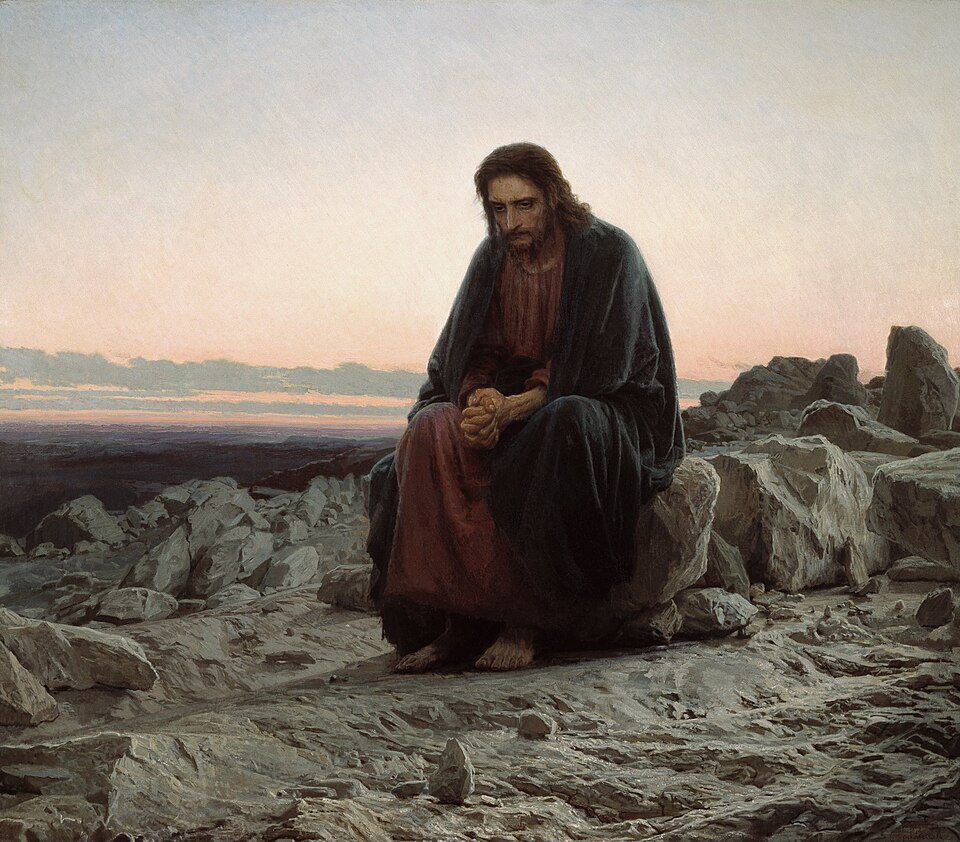
His masterpiece “Christ in the Desert” (1872) exemplified the movement’s approach to religious subjects. Ivan Kramskoi (1837-1887) is noted for his piece Christ in the Desert (1872). The painting portrays Christ after his forty days and nights spent wandering and fasting in the desert looking as haggard and exhausted as one would expect for a man who has just been through such an ordeal.
Ilya Repin (1844-1930)
The most prominent Russian artists of the 1870s and 1880s, including Ivan Kramskoy, Ilya Repin, Vasily Surikov, Vasily Perov, and Vasily Vereshchagin, belonged to this group. Repin became perhaps the most internationally recognized Russian realist painter.
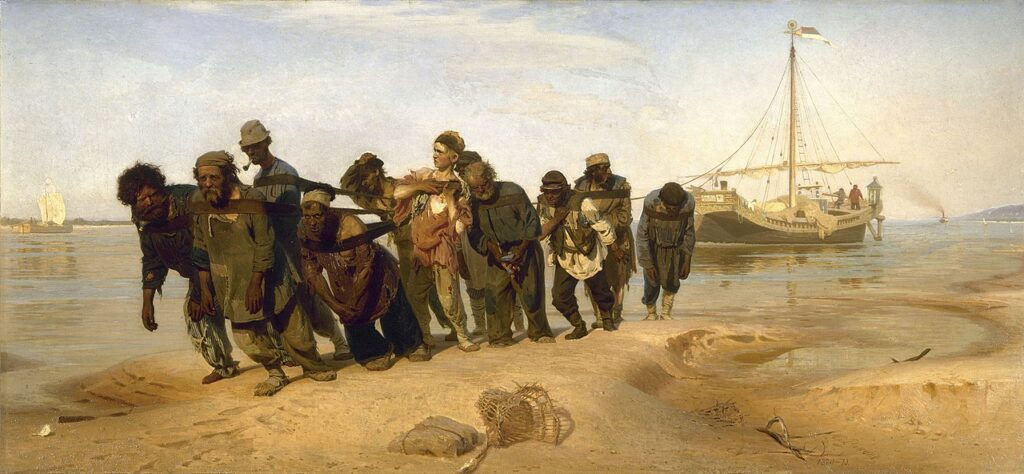
Repin’s breakthrough came in 1873 with “Barge Haulers on the Volga,” a powerful depiction of laborers that brought him immediate recognition. The painting’s unflinching realism and social commentary established him as a leading voice in Russian art.
Vasily Perov (1834-1882)
Vasily Perov (1834-1882), for instance, openly depicted themes of social and religious realism in his painting Easter Procession (1861). The painting shows drunken clergymen exiting the local tavern amidst a crowd of both religiously devout and apathetic peasants. His composition shows the church leaders as fraudulent and the peasants as more devoted and holding greater integrity than their religious leaders.
Notable Works and Their Impact
Landscape Painting
Landscape painting flourished in the 1870s and 1880s. Peredvizhniki painted mainly landscapes; some, like Polenov, used plein air technique. Russian landscape painting took on special significance as an expression of national identity.
Peredvizhniki painted landscapes to explore the beauty of their own country and encourage ordinary people to love and preserve it. Peredvizhniki gave a national character to landscapes, so people of other nations could recognize Russian landscape. The landscapes of Peredvizhniki are the symbolic embodiments of Russian nationality.
Genre Painting and Social Themes
The Itinerants expressed their ideological realism through different genres: landscape painting, historical painting, portrait painting and genre painting. Genre paintings – scenes of everyday life – became vehicles for social commentary.
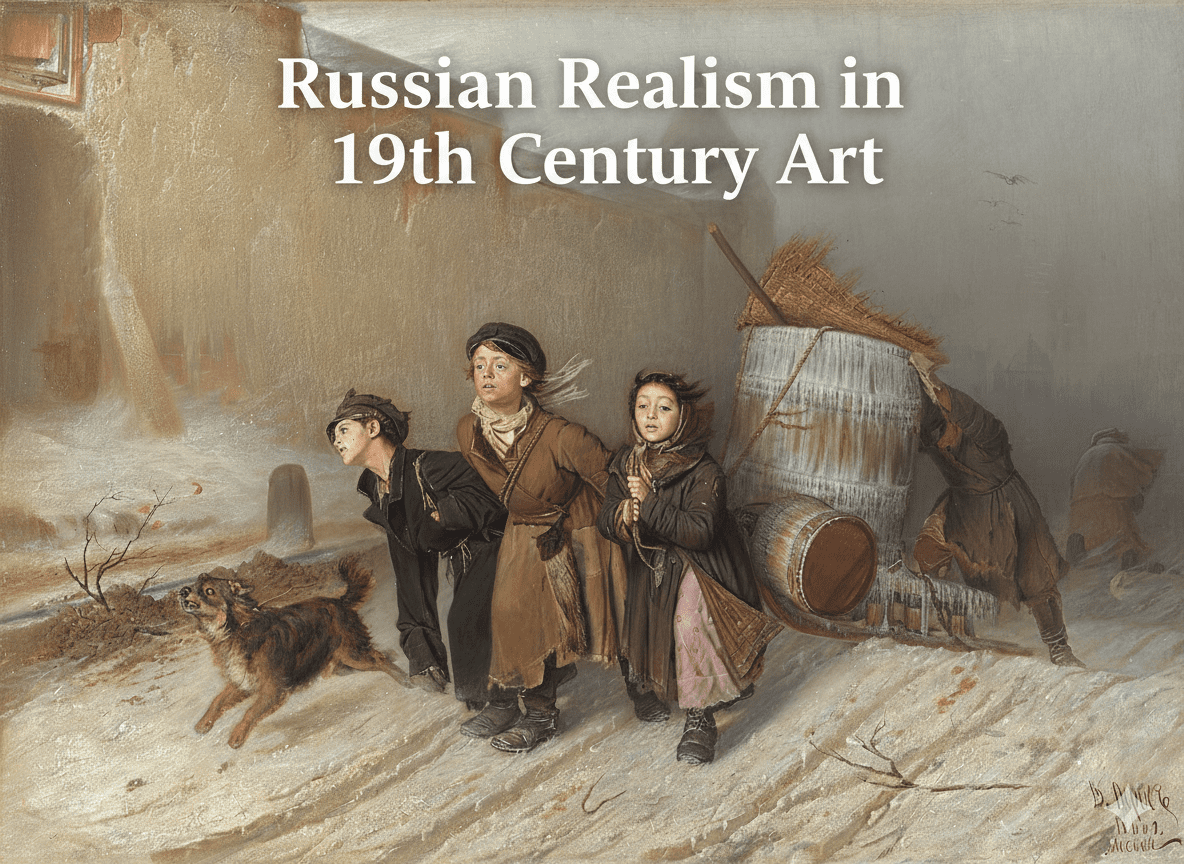
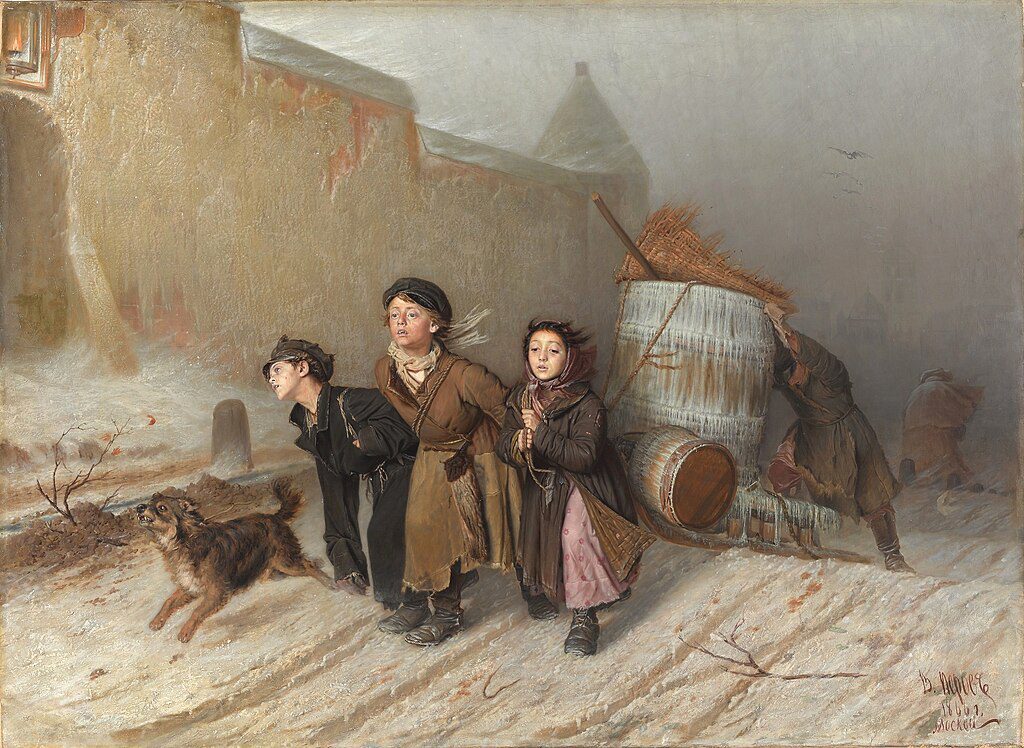
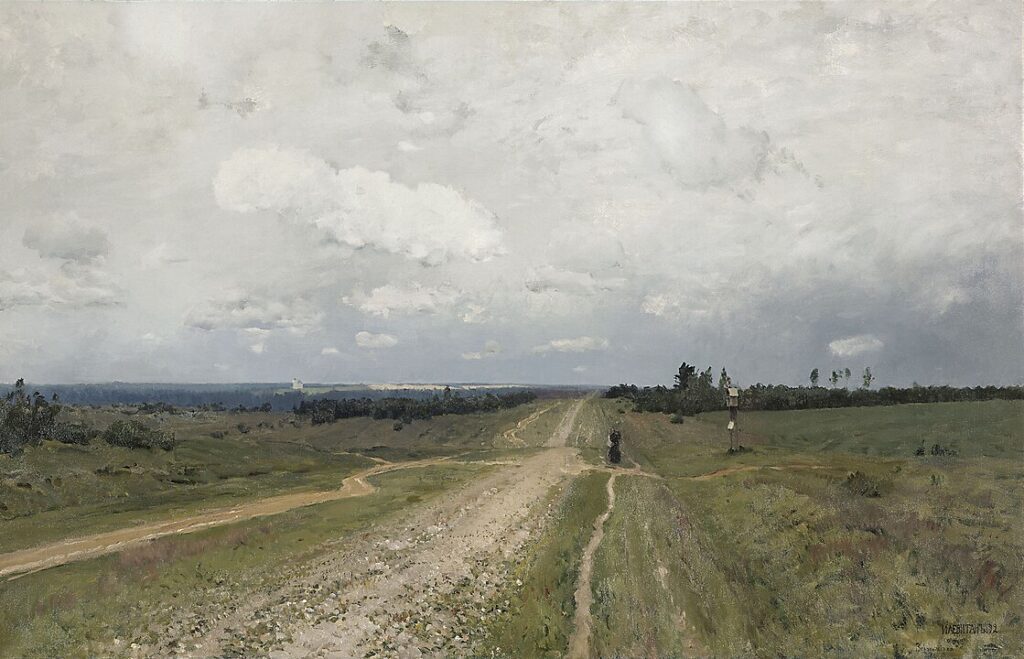
Repin’s Barge Haulers on the Volga, Levitan’s Vladimirka Road, Perov’s Troika and The Tea-party in Mytishchi, Ivanov’s On the Road, the Death of a Migrant, and The Shooting stand out as rather subversive works. Very often, these artists dealt with inhumane working conditions, child labor, widespread poverty, life in the Russian countryside and criticism of the church.
The Movement’s Relationship with Literature
Their interest in specifically Russian national themes links them with such musicians as Musorgsky, Borodin, and Rimsky-Korsakov, while their painterly realism–which was based, in theory, on a commitment to painting from life–links their work to that of the great Russian 19th- century writers like Dostoevsky, Turgenev, Tolstoy, and Chekhov.
In 1852, famed author Ivan Turgenev (1818-83) released the highly influential anthology Sketches from a Hunter’s Album. Humanizing the lower classes while exposing the unjust behaviors of many members of the upper echelon, Turgenev’s work was an early example of the wave of Realist literature and art that would characterize the remainder of the 19th century.
Patronage and Public Reception
Pavel Tretyakov’s Support
Pavel Mikhailovich Tretyakov showed the work of these artists in his gallery and gave them important material and moral support. The merchant-philanthropist Pavel Tretyakov became the movement’s most important patron, purchasing works and eventually donating his collection to create what is now the State Tretyakov Gallery.
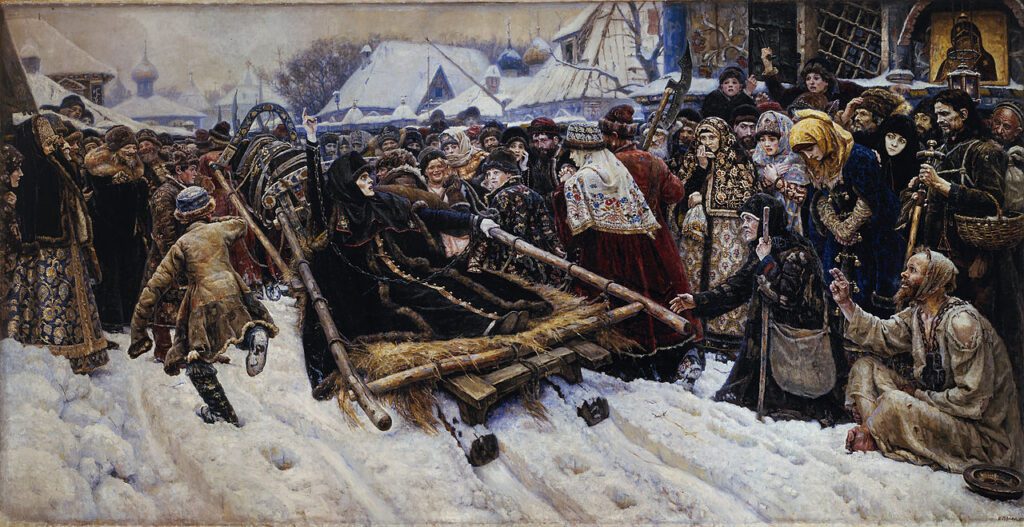
Collector and philanthropist Pavel Tretyakov supported the society, not just by buying pictures for his gallery at itinerant exhibitions, but also by commissioning original work from artists. At the Peredvizhniki’s exhibitions, landmark works of Russian art, such as The Rooks Have Come Back by Alexei Savrasov, Moscow Courtyard by Vasily Polenov, The Morning of the Streltsy Execution and Boyarina Morozova by Vasily Surikov, The Birch Grove by Arkhip Kuindzhi, The Stoker by Nikolai Yaroshenko and A Rye Field by Ivan Shishkin, were shown for the first time.
Popular Impact
Local photographers created the first reproductions of Peredvizhniki’s paintings, which helped popularize the works and could be bought at exhibitions. Niva magazine also published illustrated articles about the exhibitions.
Historical Impact and Influence
Academic Recognition
By the 1890s, the Academy of Arts structure was including Peredvizhniki art in its classes and history, and the influence of the artists showed in national art schools. The movement had successfully transformed Russian artistic education.
International Recognition
By the late 19th century, Russian Realism had become recognized internationally, with exhibitions in Paris, Vienna, and other European capitals showcasing Russian artistic achievements and changing foreign perceptions of Russian culture.
Legacy and Modern Relevance
Connection to Socialist Realism
The movement dominated Russian art for nearly 30 years and was the model for the Socialist Realism of the Soviet Union. However, the relationship between 19th century Russian Realism and Soviet Socialist Realism is complex, as the earlier movement maintained artistic freedom while the later was state-mandated.
Early examples of realism in Russian art include the work of the Peredvizhnikis and Ilya Yefimovich Repin. While these works do not have the same political connotation, they exhibit the techniques exercised by their successors.
Contemporary Influence
Russian Realism established lasting paradigms in Russian and Soviet art. The movement’s technical achievements and emotional depth continue to influence contemporary Russian artists, many of whom study and reference realist masterworks while addressing current themes.
Common Misconceptions
Many people outside Russia confuse 19th century Russian Realism with Soviet Socialist Realism. While there are technical connections, the earlier movement was characterized by artistic freedom and social criticism, while Socialist Realism served specific state ideology.
Another misconception is that Russian Realism was merely imitative of Western European realism. In fact, Russian realist artists cultivated their tendentiousness, representing reality while still valuing subjectivity and empathic judgment, creating a distinctly Russian approach to realistic art.
Related Movements and Connections
The Peredvizhniki movement connected to broader cultural currents in 19th century Russia. Their interest in specifically Russian national themes links them with such musicians as Musorgsky, Borodin, and Rimsky-Korsakov, creating a coordinated cultural renaissance.
The movement also influenced the development of Russian photography and popular culture. Russian photographers, like other artists, were also keen to show their commitment to Russian traditions. Photography became a crucial tool in the numerous ethnographic studies which were then developing in Russia.
Essential Points About Russian Realism in 19th Century Art
• Revolutionary Origins: Born from the 1863 “Revolt of the Fourteen” students who rejected academic restrictions at the Imperial Academy of Arts
• Social Mission: Artists believed art should serve society and depict authentic Russian life rather than mythological or classical subjects
• Traveling Exhibitions: The Peredvizhniki pioneered bringing art directly to people across the Russian Empire through mobile exhibitions
• National Identity: Created the first distinctly Russian visual language that celebrated Russian landscapes, people, and cultural values
• Technical Innovation: Developed lighter palettes and freer painting techniques while maintaining commitment to realistic representation
• Cross-Cultural Impact: Connected with contemporary Russian literature and music to create a unified cultural movement
• International Recognition: Gained acclaim in European capitals and influenced global perceptions of Russian culture
• Lasting Legacy: Established foundations for both Soviet Socialist Realism and contemporary Russian artistic traditions
Frequently Asked Questions
What was the main goal of Russian Realist artists?
Russian Realist artists, particularly the Peredvizhniki, aimed to create a national art that depicted authentic Russian life and served the common people. The goal of the Society for Traveling Art Exhibitions was two-fold: to make art accessible while promoting a greater understanding of the media, and to depict the diversity and daily realities of the Russian population, regardless of social and economic class. Rather than focusing their artistic attention on the aristocracy and inaccessible images of Greek mythology, the Society depicted a profoundly humanistic view of the true Russian life, in all its beauty and hardship.
How did Russian Realism differ from European movements?
Whereas French realism was centered on forming objective and impartial representations of contemporary life, Russian realist artists cultivated their tendentiousness, representing reality while still valuing subjectivity and empathic judgment. Russian Realism was more explicitly moralistic and socially conscious, often carrying hopes for social reform and national awakening.
What role did landscape painting play in the movement?
Landscape painting became a crucial expression of Russian national identity. Peredvizhniki painted landscapes to explore the beauty of their own country and encourage ordinary people to love and preserve it. Peredvizhniki gave a national character to landscapes, so people of other nations could recognize Russian landscape. Artists like Ivan Shishkin and Isaac Levitan specialized in Russian landscapes that became iconic symbols of the nation.
Who was the most famous Russian Realist artist?
The most prominent Russian artists of the 1870s and 1880s, including Ivan Kramskoy, Ilya Repin, Vasily Surikov, Vasily Perov, and Vasily Vereshchagin, belonged to this group, but Ilya Repin became the most internationally recognized. His works like “Barge Haulers on the Volga” and “They Did Not Expect Him” are considered masterpieces of social realism.
How does Russian Realism relate to modern art?
Even as avant-garde movements like Suprematism and Constructivism briefly dominated after the 1917 Revolution, realist approaches eventually returned as Socialist Realism—an ideologically modified descendant of 19th-century realism. The movement’s technical achievements and emotional depth continue to influence contemporary Russian artists, many of whom study and reference realist masterworks while addressing current themes.