Quick Answer
Nicholas Roerich (1874 to 1947) was a Russian painter who spent his last twenty years in India’s Kullu valley, painting Himalayan peaks in glowing tempera. He also proposed the Roerich Pact, an inter-American treaty signed in Washington in 1935, which holds that protecting cultural monuments outranks military necessity. The idea grew from his career in Mir iskusstva, stage design for the Ballets Russes, and expeditions across Central Asia. Together his art and his treaty argue that culture belongs to everyone and deserves protection even in war.
A Painter Who Wrote International Law
Few painters have a treaty to their name, but Nicholas Roerich does. His canvases and the Pact are bound by a single conviction, formed in Petersburg’s museums and among the burial mounds of northern Russia: a people’s buried and built past is a shared inheritance, not the spoils of whoever holds the field. This article follows that idea from his early paintings of ancient Rus to Himalayan peaks and a signing ceremony at the White House.
A Petersburg Childhood Between Law Books and Burial Mounds
Roerich was born on 9 October 1874 in Saint Petersburg, to a Baltic German father and a Russian mother. The household was comfortable and well connected, and the boy drifted easily between drawing, botany and archaeology. As a young man he joined excavations of burial mounds near the family’s country estate, handling the pottery and weapons he would later paint.
He trained as both a lawyer and an artist. The pairing is easy to overlook, yet a mind schooled in statutes and in stratigraphy is just the mind to draft a treaty.
Learning Light from Arkhip Kuindzhi
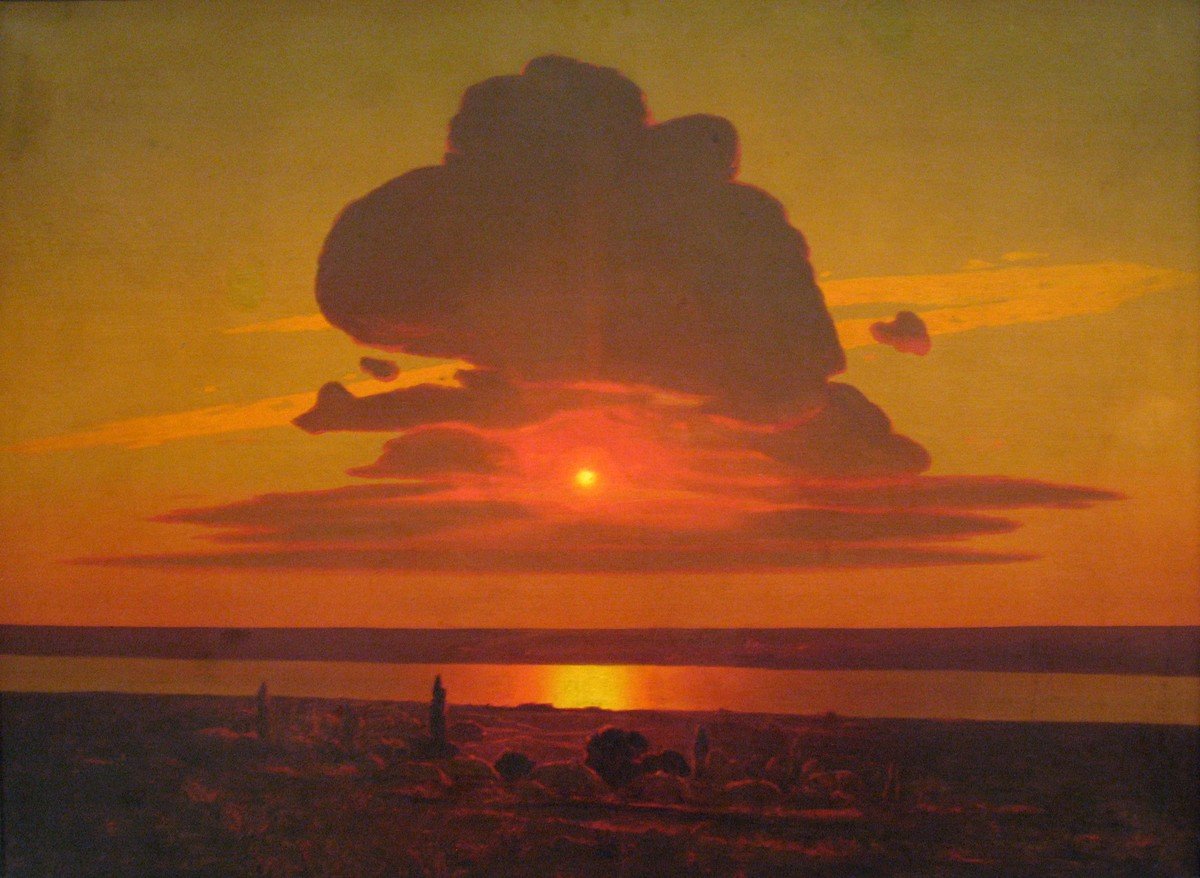
In the 1890s Roerich studied under Arkhip Kuindzhi, the landscape painter known for moonlit rivers and fiery skies that seemed to glow from behind the canvas. Kuindzhi taught that color could carry emotion without any anecdote to support it. His sunset studies, such as the late Red Sunset on the Dnieper, flatten the scene into a few saturated bands of orange, crimson and violet.
The lesson stuck. Decades later, Roerich’s mountain ridges would turn from rose to blue to ash within a single panel: the same idea, carried to far greater altitude.
Painting the Slavic Past Before 1917
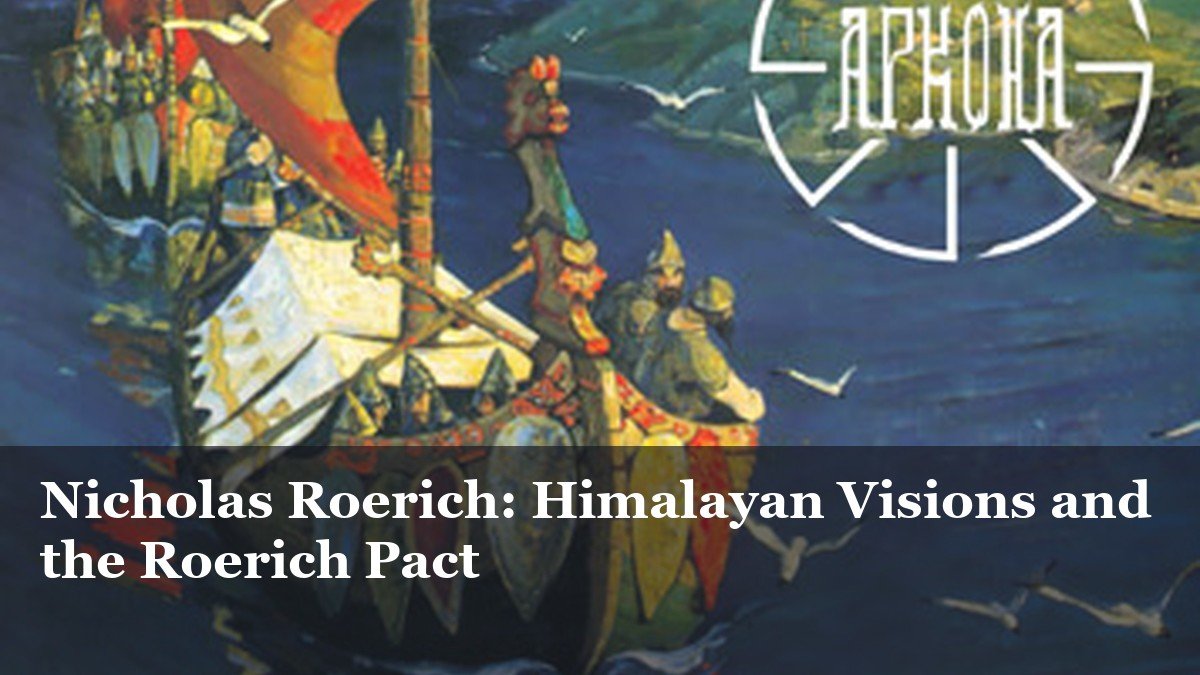
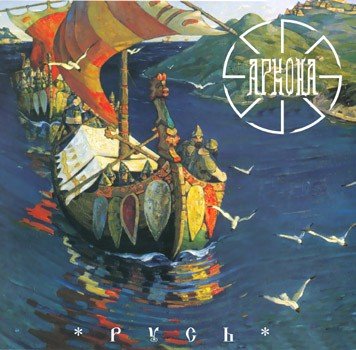
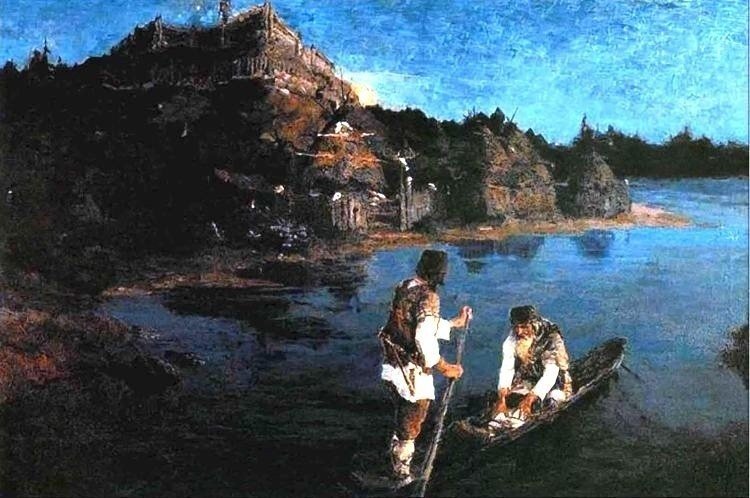
Roerich’s first fame came from imagined prehistory. Guests from Overseas (1901) shows dragon-prowed Varangian ships nosing toward a Slavic shore, and the work is now at the State Tretyakov Gallery. The Messenger (1897), subtitled “Tribe Has Risen Against Tribe,” stages the moment before a clan war.
Why did Roerich paint ancient Rus?
He wanted the early Slavs seen as a documented people, not a fairy tale. His excavation experience let him set real helmets, boat shapes and ornaments into the picture. That insistence on evidence, joined to a taste for simplified, poster-like shapes, set him apart from the narrative realists of the previous generation.
Mir iskusstva and the Stage
Roerich belonged to the circle around Mir iskusstva, the magazine and movement led by Alexandre Benois and Sergei Diaghilev, which argued that decorative beauty, book design and theater deserved to be taken as serious art. From 1906 until 1917 he also directed the school of the Imperial Society for the Encouragement of the Arts.
The circle’s theatrical wing became the Ballets Russes, which brought Russian design to Paris. Roerich fit naturally. He could research a pagan ritual in the morning and paint its costumes by evening.
Designing The Rite of Spring
For the 1913 premiere of Igor Stravinsky’s The Rite of Spring, Roerich devised the libretto with the composer and created the sets and costumes. The Paris premiere on 29 May 1913, with Vaslav Nijinsky’s choreography, provoked an uproar. Historians disagree about how much of the noise was aimed at the music, the dance or the staging.
What survives clearly is the visual idea: a bare hillside and layered, earthy costumes that treated an imagined pagan Russia as a real place.
Leaving Russia for London and New York
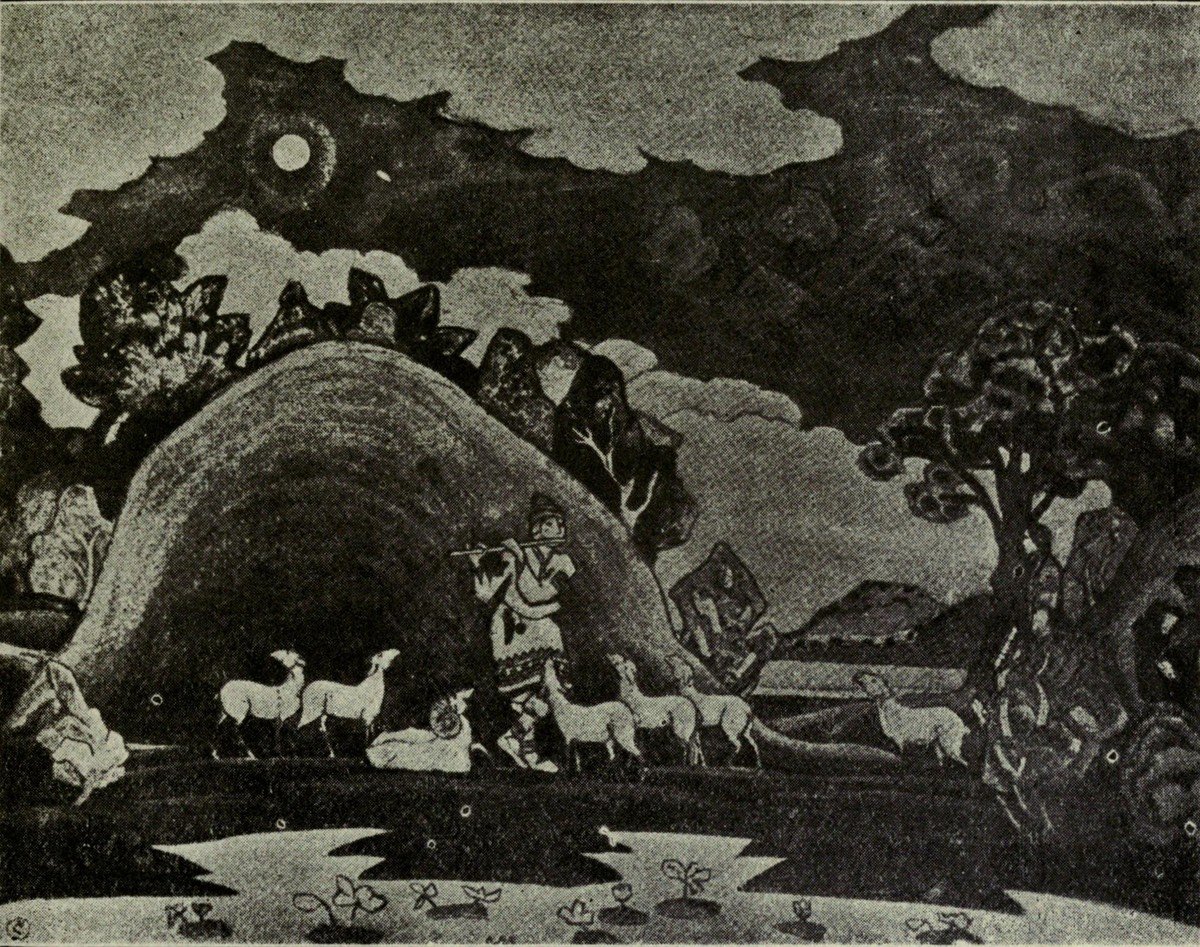
After the Russian Revolution Roerich left the country, passing through Finland and London before reaching the United States in 1920. An exhibition tour followed, and in 1921 he founded the Master Institute of United Arts in New York. Works from this period, such as The Song of Lee (1921), already turn away from Slavic legend toward mythic, mountain-haunted scenes.
In 1929 the Master Apartments at 103rd Street and Riverside Drive were built for Nicholas and Helena Roerich. They housed the museum that bears his name before it moved to its current brownstone on West 107th Street.
Agni Yoga: The Teaching Behind the Paintings
From 1920 Helena Roerich and Nicholas Roerich transmitted Agni Yoga, also called Living Ethics, a neo-Theosophical doctrine. Followers hold that the teacher Master Morya gave it to the family. The name is usually translated as “Mergence with Divine Fire,” and the teaching stresses daily practice and directed thought.
Skeptical readers treat the books as Helena’s spiritual writing rather than dictation, and scholars of esotericism study them as a late chapter of Theosophy. Either way, the doctrine shaped how Roerich framed his later pictures and his campaigns.
Myth vs. Fact: Did the Roerich Pact protect art in World War II?
Myth: The Roerich Pact was a worldwide treaty that shielded museums during the Second World War. Fact: It bound only the American states that signed and ratified it, so it could not govern the European and Asian fronts. Its lasting value was as a legal and moral precedent, not as a wartime shield.
The Central Asian Expedition, 1925 to 1928
With sketchbooks and tempera in their baggage, the Roerichs traveled from Kashmir through Ladakh and the Karakoram to Khotan, Kashgar, the Altai, Mongolia and Tibet. In the winter of 1927 to 1928 the party was held up for months on the high Tibetan plateau in bitter cold, and several caravan members died.
The journey supplied his visual vocabulary: prayer flags, monasteries, pack animals, and above all rock faces seen at dawn and dusk. He also gathered archaeological observations, continuing the amateur fieldwork he had begun as a teenager.
Kullu Valley: The Last Twenty Years
Roerich spent the final two decades of his life in the Kullu valley in the western Himalayas, settling at Naggar. Helena was honorary president-founder of the Urusvati Himalayan Research Institute, established there to study the region. He died in Naggar on 13 December 1947.
By any measure, his output across seven decades was vast: hundreds of canvases from the Asian expeditions alone, alongside the earlier Slavic series, stage designs, and works made in the Kullu valley.
How Do You Read a Roerich Himalaya?
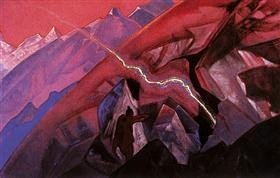
Look at the structure first. Ridges are built from stacked, faceted planes rather than modeled slopes. A single peak may shift from rose at its crest to cobalt at its base, the way Kuindzhi staged his sunsets. Tiny pilgrims, caves or monastery walls give scale, and the matte surface of tempera leaves the colors chalky and cool rather than glossy.
Arjuna (1929) shows how he could bring a mythic figure into this setting without leaving the mountain’s logic. Scholars disagree on whether the symbolism is meant to be decoded or simply felt, and Roerich himself invited both readings.
From Brush to Treaty: Drafting the Pact
By the late 1920s Roerich had concluded that paintings, manuscripts and temples were vulnerable in modern war. In 1929 he drafted a text with the Paris jurist Georges Chklaver, and international conferences in Bruges in the early 1930s debated it.
What is the Roerich Pact in plain terms?
The Roerich Pact is the Treaty on the Protection of Artistic and Scientific Institutions and Historic Monuments, an inter-American agreement. Its central idea is that defending cultural objects matters more than using or destroying them for military purposes. Museums, universities and monuments are treated as neutral, and protection takes precedence over military necessity.
The Banner of Peace
A law is hard to apply if nobody can see what it covers, so Roerich proposed a flag. His Banner of Peace shows three red spheres inside a red circle on a white field. Interpretations vary: some read the spheres as past, present and future within eternity, others as religion, art and science.
The emblem was meant to be hoisted over protected sites, much as a red cross marks a field hospital. It gave the Pact a recognizable face, a trick he learned on stage, where one strong image can organize an entire production.
Signing at the White House, 1935
The treaty was signed in Washington on 15 April 1935 by the United States and Latin American republics, under the framework of the Pan American Union. Among the American officials who supported it was Henry A. Wallace, then Secretary of Agriculture, who knew Roerich personally.
That friendship later became a liability. Roerich’s reputation still divides readers: admirers see a determined pacifist, critics an eccentric with political entanglements. Scholars disagree about how far his spiritual leadership shaped the diplomacy.
From Red Spheres to the Blue Shield
The idea he championed returned in the Hague Convention for the Protection of Cultural Property of 1954, adopted after the devastation of the Second World War. Its emblem is a blue and white shield instead of red spheres, and its legal machinery is far more detailed.
Yet the logic is familiar: mark what must be spared, and make the marking part of the law. Today, when museums in conflict zones are in the news, Roerich’s insistence that culture is humanity’s shared property feels less like mysticism and more like groundwork.
Essential Points
- Roerich’s early canvases of ancient Rus and his later treaty share one premise: a people’s past is held in trust, not owned by whoever wins.
- His legal training and his archaeology gave the Pact a structure that most artists’ manifestos lack: definitions, neutrality, a visible emblem.
- Stage design for The Rite of Spring taught him to turn research into a single memorable image, a skill he reused for the Banner of Peace.
- The Himalayan paintings carry Kuindzhi’s color-plane teaching to its furthest reach: stacked ridges shifting from rose to cobalt echo his saturated sunset bands, now applied to peaks encountered after months of expedition travel.
- Roerich’s spiritual teaching and his public campaigns were intertwined, and scholars still argue over how much one drove the other.
- The red spheres of his banner were replaced in later law by the blue shield of 1954, yet the shared logic of marking what must be spared persisted.
- Reading Roerich well means holding three things together: a trained painter, a convinced mystic, and a persistent lobbyist for peace.
Frequently Asked Questions
- Do I need to believe in Agni Yoga to enjoy Roerich’s paintings?
- No. You can appreciate the color, composition and mountain scale without accepting the doctrine. Many viewers read the pictures simply as luminous tempera landscapes, while others use the spiritual writing as a key. Knowing the teaching adds context, not a requirement, much like knowing the Bible helps with an icon.
- Why was the Roerich Pact signed in Washington and not in Europe?
- It was framed as an inter-American treaty, so the Pan American Union system, with the United States as host, was the natural venue. European governments had attended the Bruges conferences but did not sign. The 1935 ceremony therefore bound American republics only, which also explains its limited reach during the Second World War.
- What is tempera, and why did Roerich favor it?
- Tempera binds powdered pigment with a medium such as egg yolk, producing a matte, quick-drying surface. It echoes icon painting, which Roerich knew from Russian churches. The chalky finish suits thin mountain air, and fast drying helped him work on expedition, where oil paint was impractical to carry and cure.
- Did Roerich’s sons become artists too?
- Svetoslav Roerich (1904 to 1993), born in Saint Petersburg, became a painter based in India. His brother George, known for Tibetan studies, took the scholarly path instead. Both traveled with their parents, which made the family expeditions a shared artistic and research enterprise rather than one man’s adventure.
- Where can I see Nicholas Roerich’s art today?
- The Nicholas Roerich Museum, in a brownstone at 319 West 107th Street on Manhattan’s Upper West Side, holds about 150 works and archival materials. Early pieces such as Guests from Overseas hang at the State Tretyakov Gallery in Moscow. The Kullu valley around Naggar in India preserves the setting he painted.
This guide was written and reviewed by the rus-art.com editorial team, specializing in Russian art history. We cross-check dates, attributions, and museum holdings against museum and academic sources.