Quick Answer
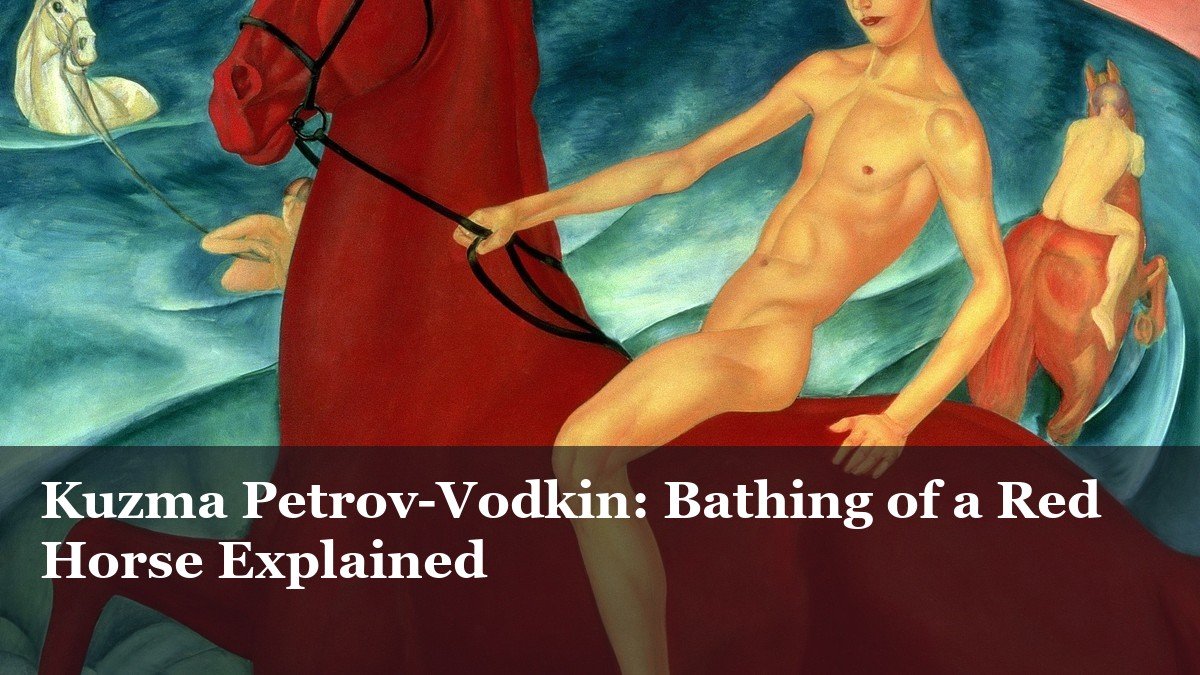
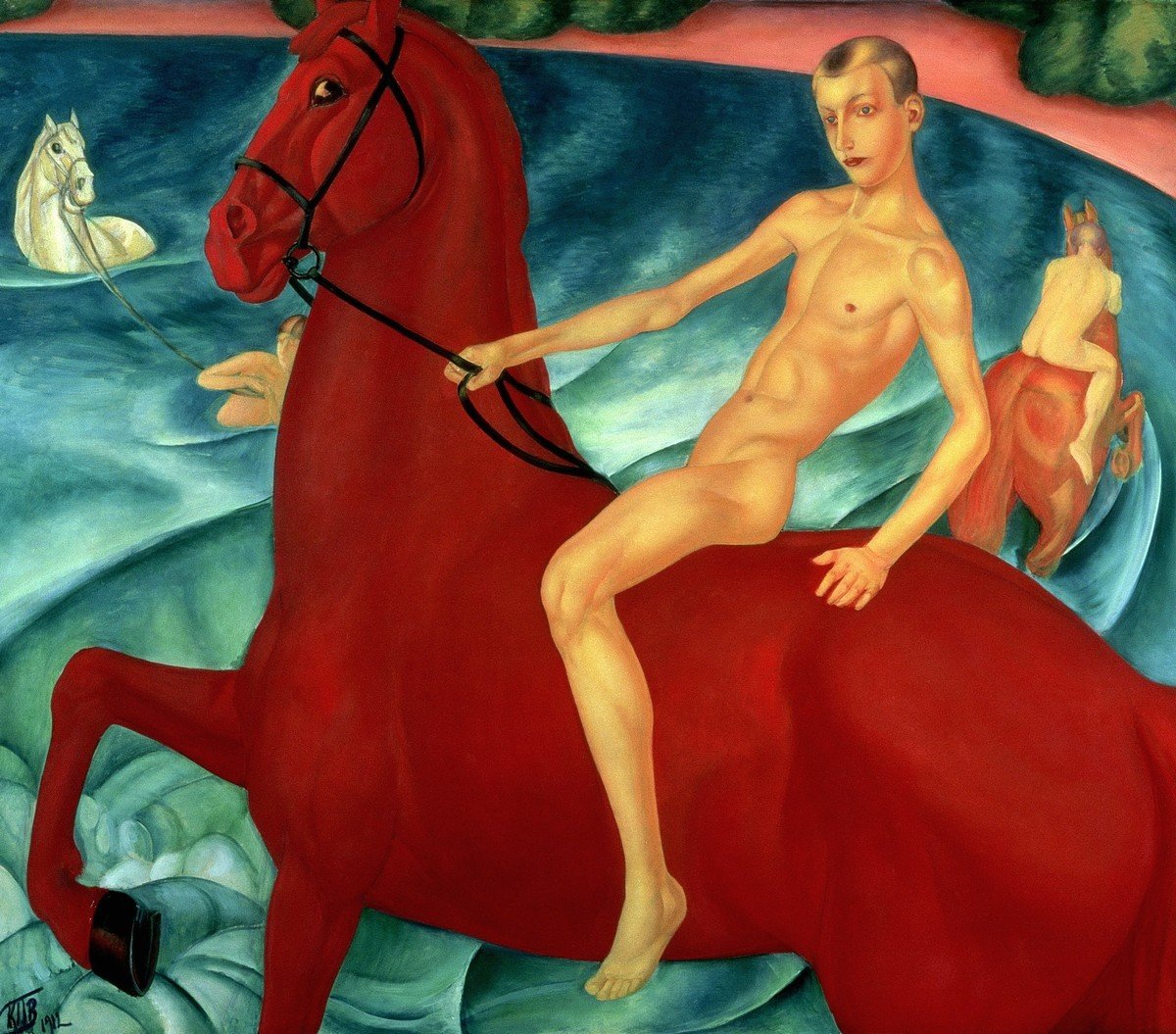
Bathing of a Red Horse (1912) is Kuzma Petrov-Vodkin‘s best-known painting, and a showcase for his spherical perspective. A nude boy rides a blazing red horse into a lake, painted in saturated primary colors with a horizon that curves like the surface of a globe. The red echoes Russian icon painting rather than nature, and the curved space makes the viewer feel the whole planet beneath the scene. Many viewers later read it as a premonition of war and revolution, though scholars disagree.
What Is Bathing of a Red Horse?
Bathing of a Red Horse (1912) is an oil painting by Kuzma Petrov-Vodkin, and it hangs in the State Tretyakov Gallery in Moscow. A naked boy sits on an enormous crimson horse at the edge of a lake. Behind them, two smaller horses, each with a boy, stand in the water. The canvas measures about 1.6 by 1.9 meters, and the horse seems to press against the frame. First shown in 1912, it has remained the artist’s signature image.
It also demonstrates his spherical perspective, a way of building space as if the scene were drawn on a curved surface rather than a flat plane. Petrov-Vodkin (1878 to 1939) was a Russian and Soviet painter who worked between icon painting and modernism. In this canvas the two meet most visibly.
From a Volga Town to Munich and Paris
Petrov-Vodkin was born in 1878 in Khvalynsk, a town on the Volga. He grew up among village church painting, long before he saw a museum. He trained in Samara and St Petersburg, then at the Moscow School of Painting, Sculpture and Architecture, where Valentin Serov and Konstantin Korovin were among his teachers.
In the early 1900s he continued his studies in Munich and Paris and travelled in Italy and North Africa. By his own later account, Italian fresco and the open horizons of the Mediterranean gave him the sense of the earth as a globe, and his mature work depends on it. His early icon-based pictures already used effects built on the curve of the globe. The Orthodox Church judged some of them blasphemous.
A Boy, a Hill and a Lake: Reading the Composition
Start with the geometry. The horse is one huge shape, almost in profile. Petrov-Vodkin gives it a smooth outline and little interior shading, so it reads as a flat plane of red lifted against blue and green. The boy’s pale body sits low on its back, as if the animal might slide out from under him.
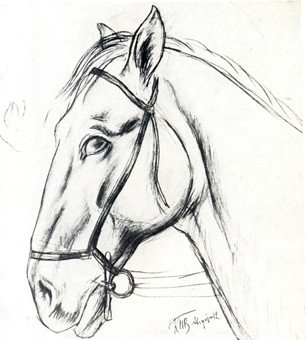
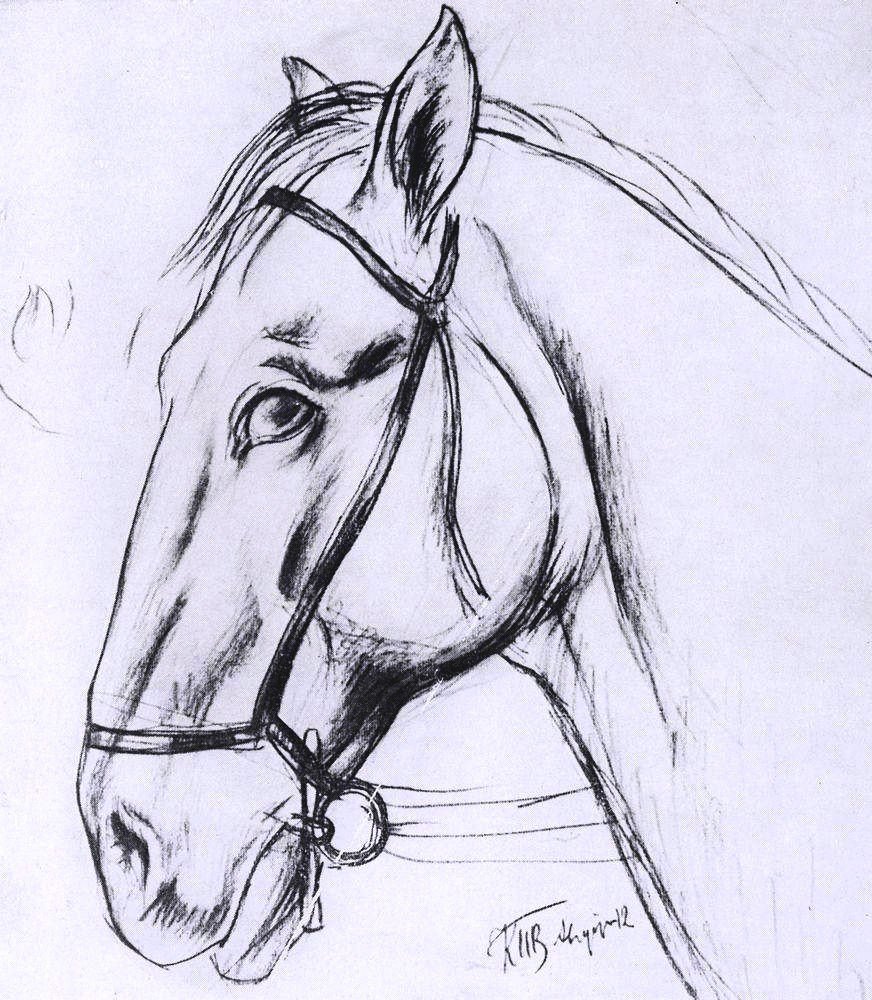
Behind the pair, the shore swells into a rounded hill. The two smaller horses at the water repeat the diagonal of the first. The subject is ordinary: the watering of horses, which Volga villages knew well. Scale and stillness turn that chore into a ritual. Preparatory studies for the canvas survive, and set beside the finished work they show how much he simplified.
What Is Spherical Perspective?
Spherical perspective is Petrov-Vodkin’s name for picturing space as if the painter stood on a curved surface and looked around. Horizons bow, the ground tilts toward the viewer, and the scene is seen from more than one height at once. He used the phrase for his own practice, not for an established school. Scholars disagree on whether it is a consistent system or a personal habit of seeing that he later wrote up as theory.
How is it different from linear perspective?
Renaissance linear perspective fixes one eye at one height and sends parallel lines to a single vanishing point on a straight horizon. Petrov-Vodkin keeps the foreground close and large, but he lets the horizon curve and the ground rise. The viewer stands on the same round surface as the figures, not outside a window.
Is it the same as reverse perspective?
No. Reverse perspective, also called Byzantine perspective, draws distant objects larger and lets parallel lines diverge, as in many icons. Petrov-Vodkin borrowed the icon painter’s freedom from a single viewpoint but did not enlarge the far side of the picture. He bent space instead of inverting it.
Look Closer: Follow the far shoreline
Trace the far shore across the canvas with your eye, or lay a ruler along it on a reproduction. It does not stay level. The water seems to climb toward the top of the picture, so the lake reads less like a floor and more like a bowl tipped toward you.
Icon Roots and the Red Horse
Russian icons reached Kievan Rus’ from Byzantium after the adoption of Orthodoxy in 988. They taught Petrov-Vodkin to treat color as structure. Icon painters set saturated areas of pigment inside firm outlines and let figures stand outside any single viewpoint. He took the lesson without copying the look. His boy is a village child, not a saint.
Why is the horse red?
The painting has no single source, so the answer is a set of overlapping associations. Many scholars point to Novgorod icons of mounted saints, where horses appear in colors no stable would produce. Some writers add that the old Russian word krasny meant ‘beautiful’ before it meant ‘red’. Others look to the red horse of the Book of Revelation, taken up in the next section but one. No source settles the question.
Three Colors Doing the Work of Lines
Petrov-Vodkin worked from red, blue and yellow, a triad he later built into his teaching. In this canvas he splits the roles by plane. Red goes to the nearest and largest body, blue and green to the water rising behind it, and pale yellow to the boy and the shore.
Warm colors advance and cool ones recede, so the palette does part of the job that linear perspective usually leaves to converging lines. The color field itself pushes the horse forward. The water retreats, and no receding edge is needed to guide the eye.
Did the Painting Predict the Revolution?
Many later viewers said yes. The canvas dates to 1912, two years before the First World War, and shows a boy on a horse that looks barely held in check. The second horseman of Revelation rides a red horse and takes peace from the earth. That gave critics a ready vocabulary once war and the revolutions of 1917 arrived, and Soviet and post-Soviet commentators often framed the picture that way.
Scholars disagree. The reading depends on hindsight. The picture’s own details (a bathing ritual, bare skin, calm water) point as easily toward renewal and youth as toward catastrophe. A cautious reading treats the prophecy as something viewers added afterwards.
Madonna and Battlefield, 1915 and 1916
In 1915 Petrov-Vodkin painted Mother of God of Tenderness Toward Evil Hearts, now in the State Russian Museum in St Petersburg. It recasts a familiar icon type in his own curved space, and church authorities objected to this kind of work.
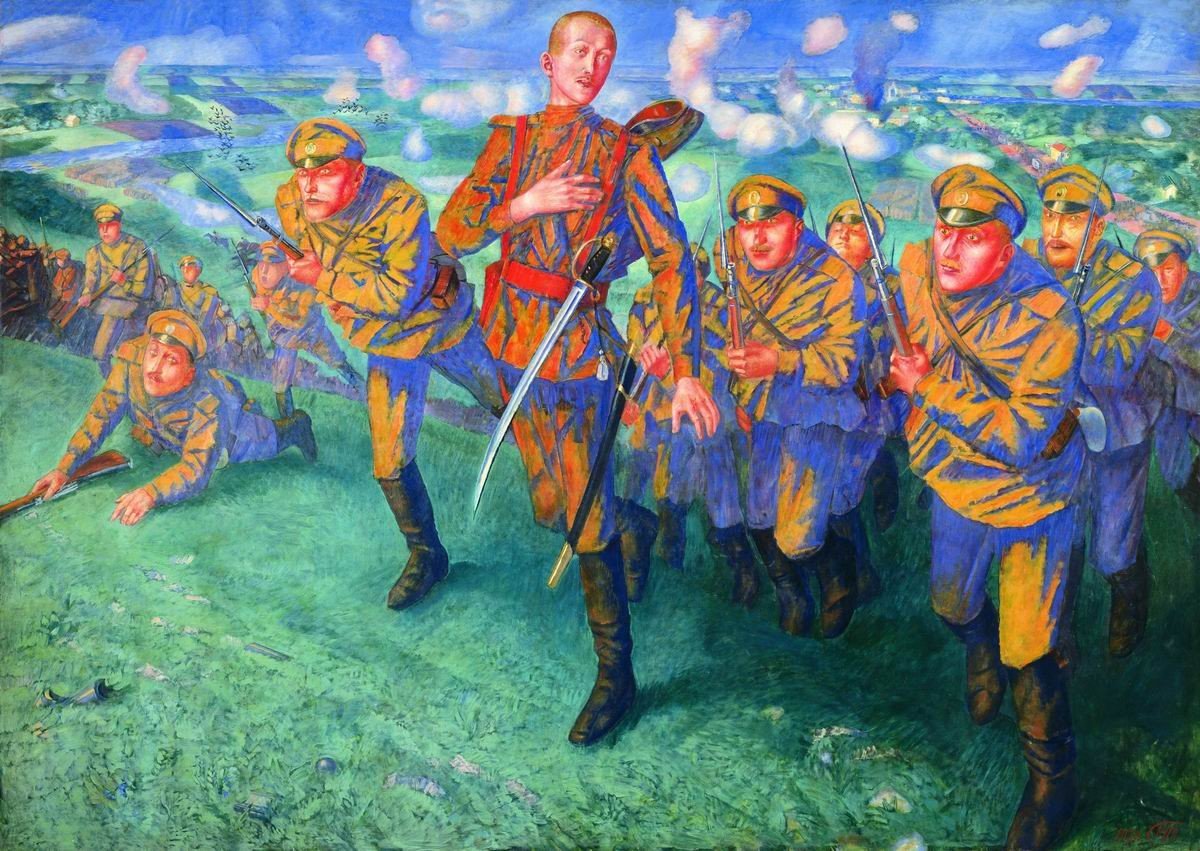
The next year he turned the same method on war in In the Line of Fire (1916), in the same collection. The ground bends away beneath the soldiers instead of lying flat behind them. Side by side, the two pictures show one spatial system moving from prayer to violence without changing its rules.
The Painter Who Wrote Euclid’s Space
His autobiographical writings drew wide praise and have enjoyed a later revival. They matter to art history because they carry his own account of how he saw.
Where did he explain his method?
Mainly in prose from the early 1930s, including Khlynovsk, a memoir of his Volga childhood, and Euclid’s Space. As commonly read, the second contrasts the flat geometry behind Renaissance perspective with a planetary way of seeing. The title points at Euclid as the emblem of the flat plane. The explanation comes from the artist, so historians treat it as testimony about intention, not as proof that every canvas follows one rule.
His Self-Portrait (1926 to 1927), also in the Russian Museum, applies the same compact, firmly outlined handling to a face.
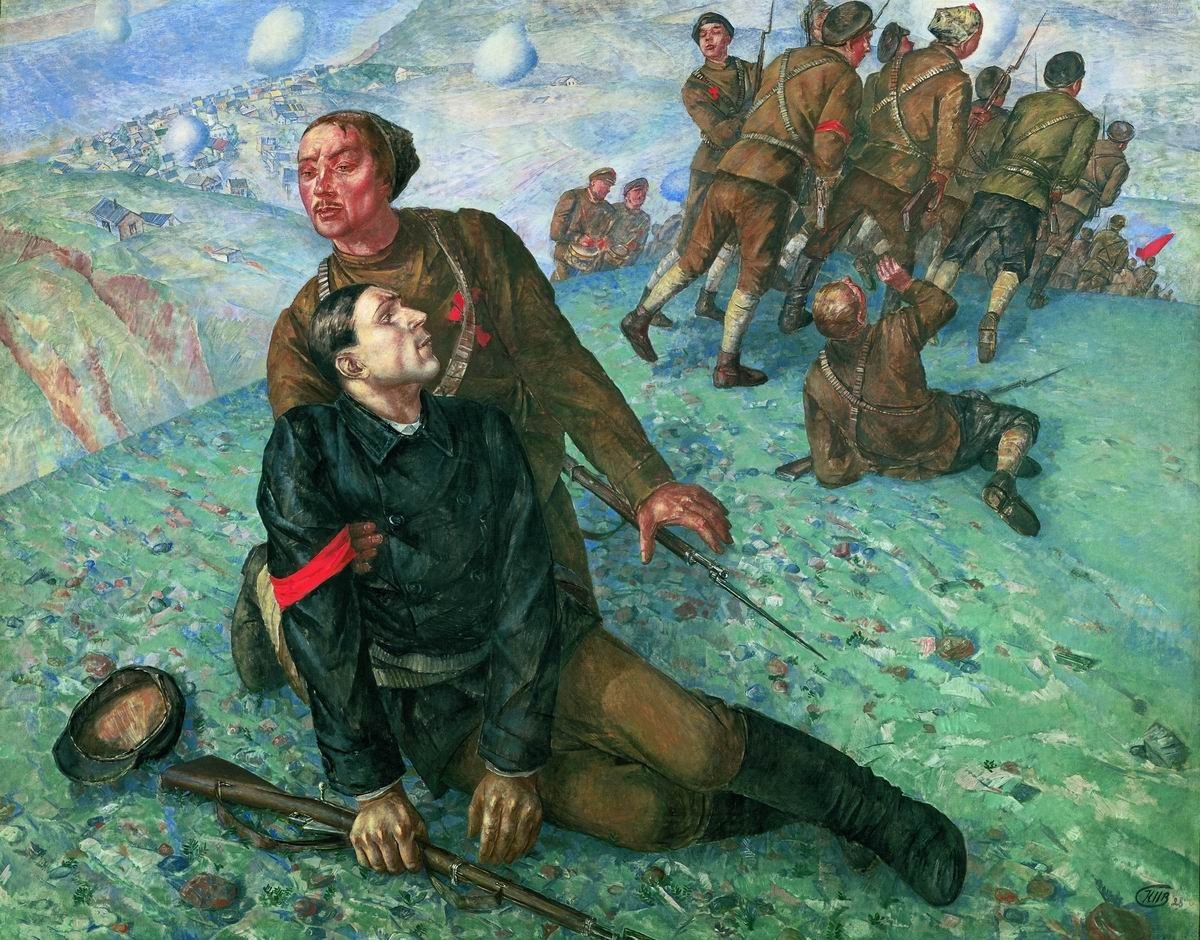
The Commissar Falls in Curved Space
Death of the Commissar (1928), set in the Civil War, puts the curved ground to work on a Soviet subject. The dying commissar is the pivot, and his comrades group around him in a descending line. Many commentators note that the pose and grouping echo Lamentation icons and Renaissance Pietàs. A political martyrdom thus takes a form viewers already knew.
A drawing from 1927 and a sketch from 1928 survive, so the composition can be followed through several versions before the finished oil. The result is a revolutionary event told in the visual language of an altar piece.
Neighbors in Russian Symbolism
Petrov-Vodkin’s contemporaries show how different Symbolist surfaces could be. Mikhail Vrubel built pictures like Bogatyr (1898) from faceted, mosaic-like strokes. Mikhail Nesterov, one of the first exponents of Symbolism in Russia, painted hushed religious scenes in muted northern light. Victor Borisov-Musatov, who with Vrubel is often called a creator of Russian Symbolism, drifted women in long dresses through overgrown gardens in soft blue-greens, as in The Emerald Necklace (1903).
Against them, Petrov-Vodkin chose monumental simplicity: big shapes, few colors, hard contours. Later he joined The Four Arts, an association active in Moscow and Leningrad from the mid-1920s.
Why a Curved Horizon Still Matters
Bathing of a Red Horse became a shorthand image for early twentieth century Russian art well beyond Russia. It turns up often on book covers and exhibition posters.
Curved perspective feels familiar now. Phone panoramas and fisheye lenses bend horizons in a similar way, though they do it by optics and he did it by hand and conviction. For teachers, the painting is a clean case for showing that Renaissance perspective is a convention, not a law of vision. For Soviet-era painters under pressure to paint plain realism, his curved spaces showed one way to be monumental without being literal.
Essential Points
- Petrov-Vodkin worked between two traditions, the icon and modern Symbolist painting, and never settled fully into either.
- Spherical perspective is a personal method, not a movement. Its payoff is the feeling of standing on a planet rather than in a room.
- One curved space serves three unlike subjects: a bathing ritual, a battlefield and a political martyrdom.
- The red horse has no single decoded meaning. Treat its symbols as overlapping associations, not entries in a dictionary.
- Check the date before accepting any prophecy story. Ask what was actually knowable in 1912.
- His prose is part of his work. Later accounts of his method lean heavily on what he wrote himself.
- To compare Symbolist painters, ask how each treats the surface: Vrubel fractured it, Musatov softened it, Petrov-Vodkin simplified it.
Frequently Asked Questions
- What should I look at first in Bathing of a Red Horse?
- Start where the red horse meets the water, then follow the far shoreline. Those two edges show his main choices: flat, saturated color and a bending horizon. Then step back. From a distance the three colors read as large shapes before any detail appears, which is how the composition is meant to work.
- What was happening in Russian art around 1912?
- The Jack of Diamonds group had formed around 1910 and Moscow painters were absorbing Cézanne and Cubism, while the Union of Youth organized in St Petersburg. Petrov-Vodkin stayed apart from both camps, shaping a figurative art from icons and Symbolism instead of breaking forms into geometric fragments.
- How can I spot spherical perspective in a painting?
- Look for a bowed horizon and ground that seems to climb toward the top of the canvas. Check also for mixed viewpoints, such as a figure seen from the side beside a field seen from above. Linear perspective, by contrast, keeps a straight horizon and a single eye height.
- What official role did Petrov-Vodkin hold in Soviet art?
- He became the first president of the Leningrad Union of Soviet Artists, a body created when Soviet authorities replaced independent art groups with unified unions. The post made him a public face of Soviet painting in the 1930s despite his icon-inflected style. He died in Leningrad in early 1939.
- Where can I see Petrov-Vodkin’s paintings today?
- The Tretyakov Gallery in Moscow and the Russian Museum in St Petersburg hold the core of his work. Check current displays on their sites before travelling, since major canvases are lent out and rooms are rehung. Public domain reproductions on Wikimedia Commons let you prepare in advance.
This guide was written and reviewed by the rus-art.com editorial team, specializing in Russian art history. We cross-check dates, attributions, and museum holdings against museum and academic sources.