Quick Answer
Black Square is Kazimir Malevich‘s 1915 oil painting that abandoned recognizable subject matter entirely, showing only a black square on a white ground. First hung high in a corner at the 0,10 exhibition in Petrograd in December 1915, a spot traditionally reserved for Russian Orthodox icons, it announced Suprematism, an art movement built on pure geometric form rather than depiction. Malevich painted three later versions between 1923 and the early 1930s. Now held at the State Tretyakov Gallery in Moscow, it remains one of the most debated paintings in modern art history.
What Is the Black Square?
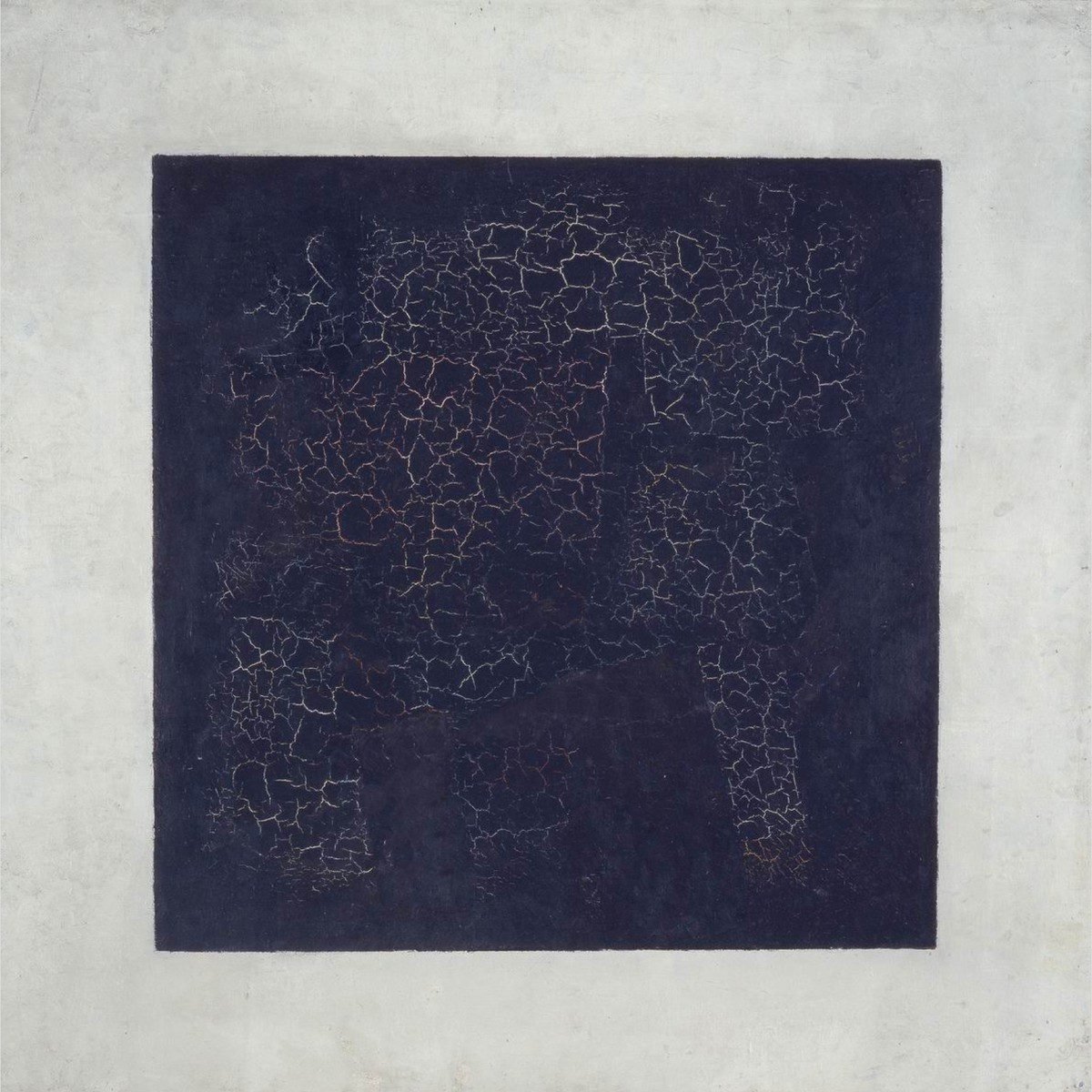
Black Square is a 1915 oil on linen by Kazimir Malevich, a Russian avant-garde artist who worked mainly in Kiev and Petrograd. The canvas shows nothing but a black square set slightly off-center on a white ground. No horizon, no figure, no object anyone could name. Malevich called it the founding work of Suprematism, a movement built on what he termed the supremacy of pure artistic feeling over the depiction of real-life subjects. He first hung the painting in a corner near the ceiling at a Petrograd exhibition in December 1915, the spot Russian homes traditionally reserved for an icon. That single decision told viewers exactly how seriously he wanted the picture taken. More than a century later, Black Square still splits opinion between those who see a hoax and those who see the boldest gesture in modern painting.
From Icon Corners to the Kiev Drawing School
Kazimir Severinovich Malevich was born on 23 February 1879 (11 February by the old Russian calendar) near Kiev, in modern day Ukraine, to an ethnic Polish family that worked in the sugar beet industry. The household moved often between small Ukrainian towns, and the young Malevich grew up surrounded by embroidered folk textiles and Orthodox icon painting rather than academic art. He had no formal training until his family settled closer to Kiev, where he enrolled in a drawing school.
Where was Malevich born?
Malevich was born near Kiev in 1879. He later described his rural Ukrainian childhood, its peasant crafts and icon corners, as the first source of the flat, non-naturalistic shapes he would return to decades later in Suprematism.
Cubism, Futurism, and the Road to Suprematism
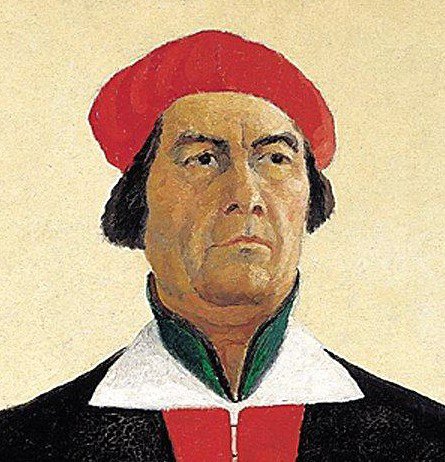
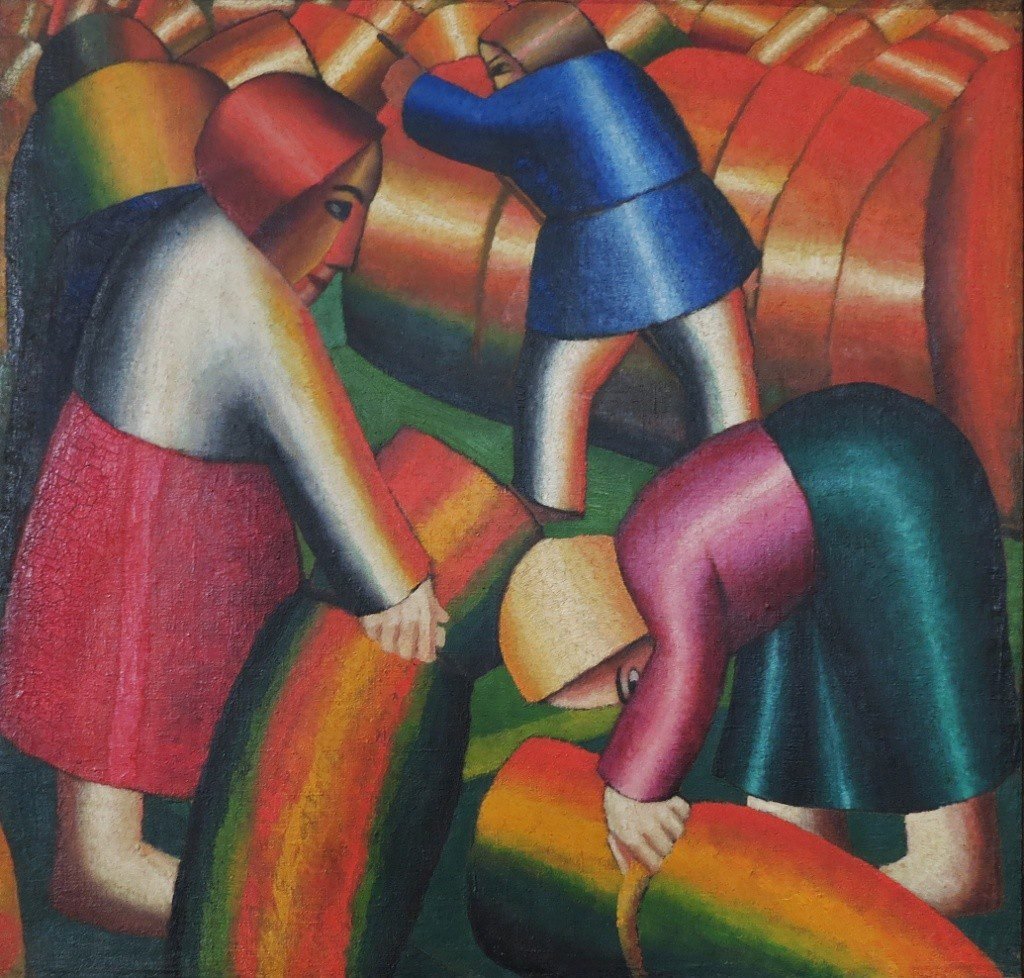
By the early 1910s Malevich had moved to Moscow, where he moved quickly through Impressionism, Symbolism, Fauvism, and Cubism, absorbing each mostly from reproductions and the French paintings held in Moscow private collections. He exhibited alongside fellow Russian avant-garde painters Mikhail Larionov and Natalia Goncharova, and by 1912 he was painting monumental peasant subjects, such as Taking in the Rye, in a faceted, cylindrical style scholars now call Cubo-Futurism. These paintings kept recognizable bodies and objects but broke them into planes and tubes borrowed from Cubism and the speed lines of Italian Futurism. Malevich admired Cubism for its ability to take painting apart, and he began asking a harder question: once a picture stops describing an object, what is actually left on the canvas. That question pushed him past Cubo-Futurism entirely within about three years.
The Birth of Suprematism in 1915
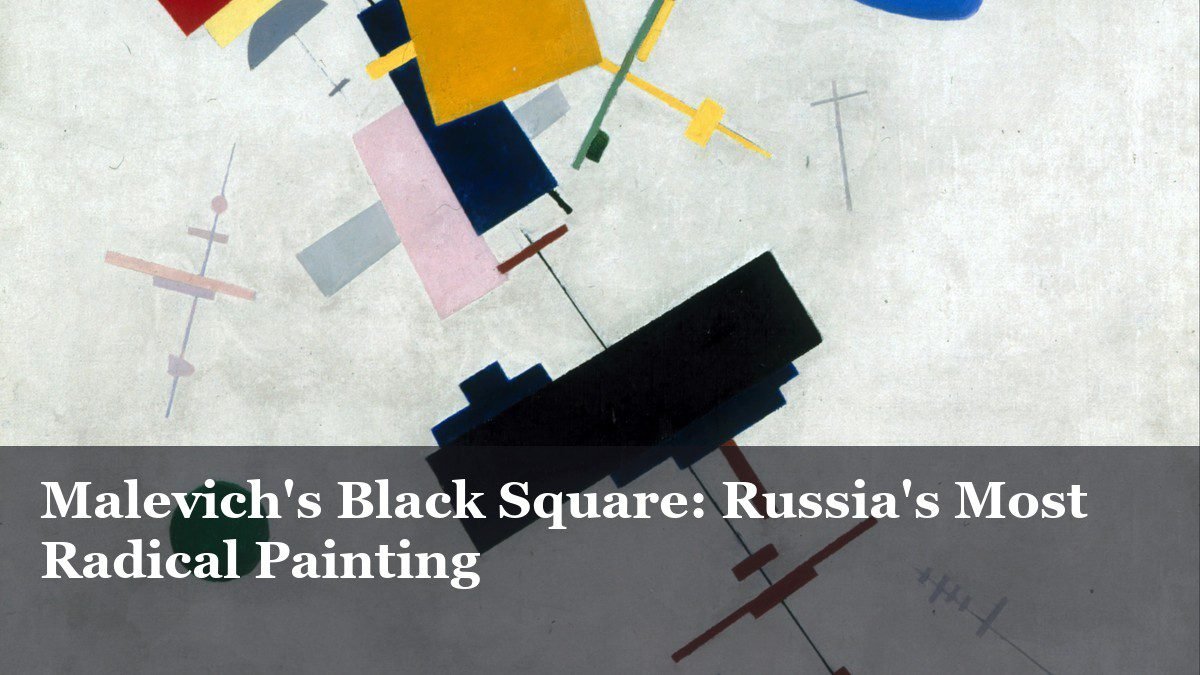
Malevich introduced Suprematism formally in 1915, though he had used the related name Supremus for a group he organized as early as 1913. The system reduced painting to circles, squares, crosses, and rectangles, arranged in a narrow palette and detached from any object in the visible world. He led a circle of painters, among them Aleksandra Ekster, Ivan Puni, Ksenia Boguslavskaya, and Nina Genke-Meller, in what art historians describe as the first Russian avant-garde movement to break deliberately from the entire trajectory of prior Russian art rather than adapt a Western European style.
What does Suprematism mean?
The word comes from Malevich’s own claim that his geometric forms expressed the supremacy of pure artistic feeling over the depiction of real objects. Suprematism was not decoration; he intended it as a total rejection of representational painting.
Inside the 0,10 Exhibition
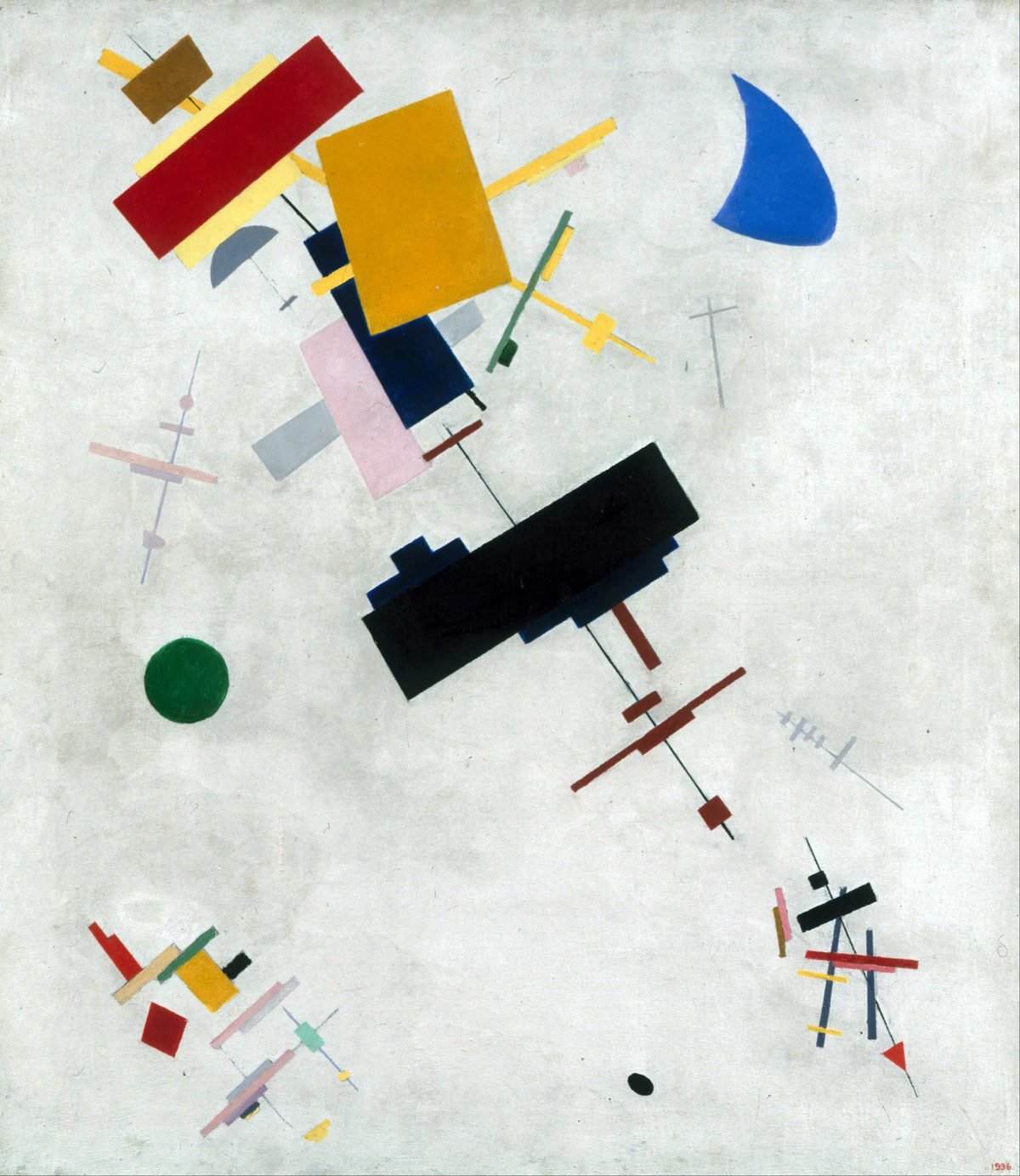
0,10 exhibition opened at the Dobychina Art Bureau on Marsovo Pole in Petrograd on 19 December 1915 and ran through 17 January 1916. Ten artists were originally announced, though fourteen ultimately took part, and the show doubled as a farewell to Cubo-Futurism, hence its full title, The Last Futurist Exhibition of Paintings. Malevich hung dozens of his new Suprematist works, with Black Square placed high in the corner where an Orthodox household would keep its icon. Other exhibitors, including Nadezhda Udaltsova and Olga Rozanova, were still showing work rooted in Cubism and Futurism, so visitors could walk through the same room and watch one movement end while another began in front of them.
Defining Features of Suprematist Painting
Suprematist paintings share a short list of traits: flat geometric shapes (squares, circles, crosses, bars), a plain background, usually white, and a limited color range that Malevich expanded over time from black and white to red, yellow, green, and blue. Forms often appear to float or tilt, suggesting motion without any horizon line to anchor them. Malevich ranked the black, red, and white squares as the three foundational Suprematist forms, and other painters in his circle, Olga Rozanova among them, developed the same vocabulary with their own color logic.
What makes the Black Square different from earlier abstract art?
Earlier abstraction, including Wassily Kandinsky’s, still grew out of landscape scenery or musical association. Malevich’s square keeps no trace of an outside source. It is not a simplified view of anything, which is exactly the distinction he wanted.
Malevich’s Circle: Kliun, Rozanova, Popova, and Udaltsova
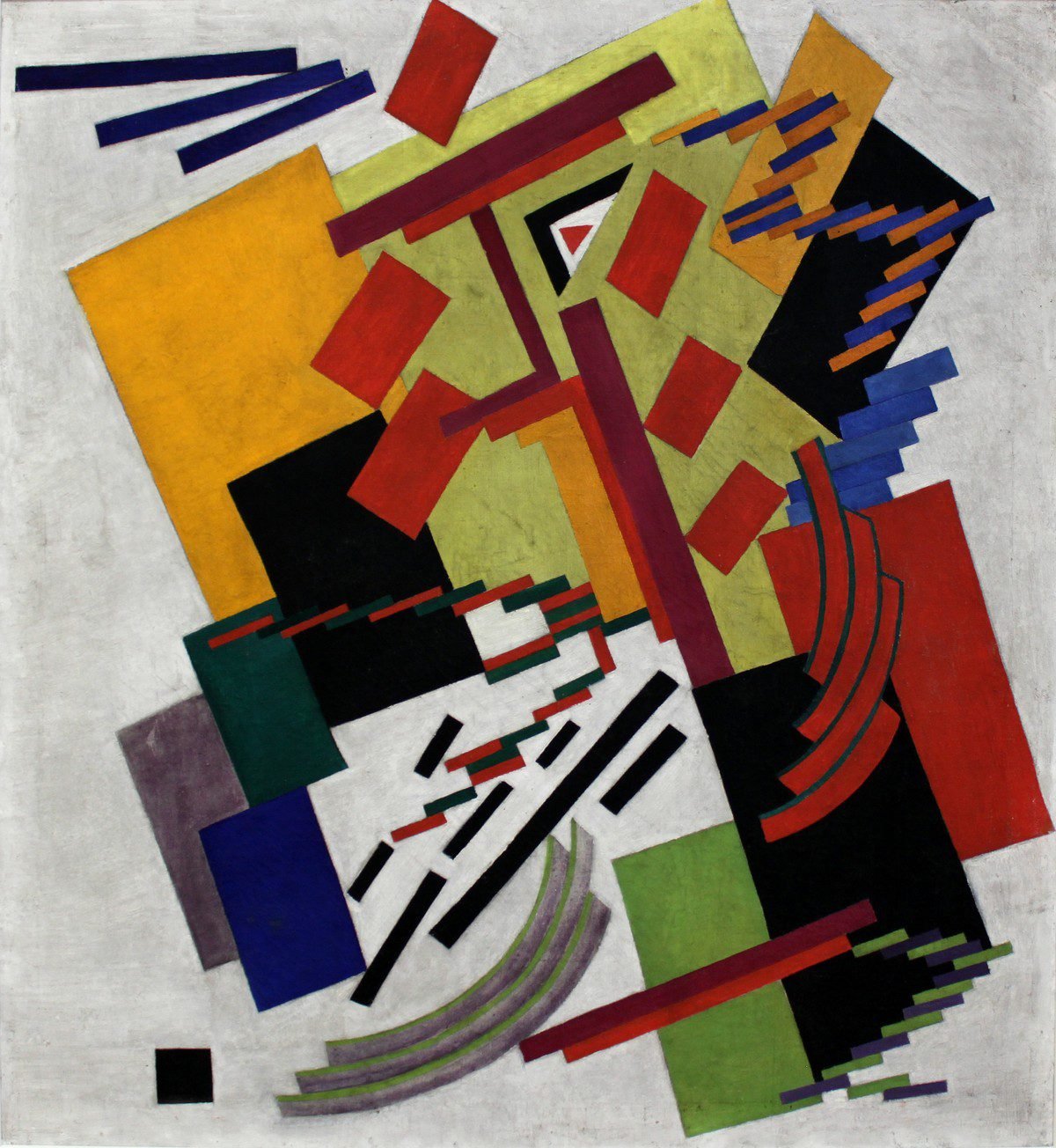
Suprematism was never a one-man project. Ivan Kliun, a close friend of Malevich since 1907, worked through his own Suprematist compositions built from stacked color bands. Olga Rozanova brought a painter’s eye for saturated color contrast that Malevich’s harder-edged work often lacked. She died suddenly in 1918 at only thirty-two, cutting short one of the movement’s sharpest talents. Lyubov Popova and Nadezhda Udaltsova, both trained partly in Cubism in Paris, folded Suprematist flatness into what they called Painterly Architectonics, compositions of overlapping colored planes that pushed toward the Constructivism that followed. None of these artists simply copied Malevich; each treated his geometry as a starting position to argue with.
UNOVIS and the Vitebsk Years
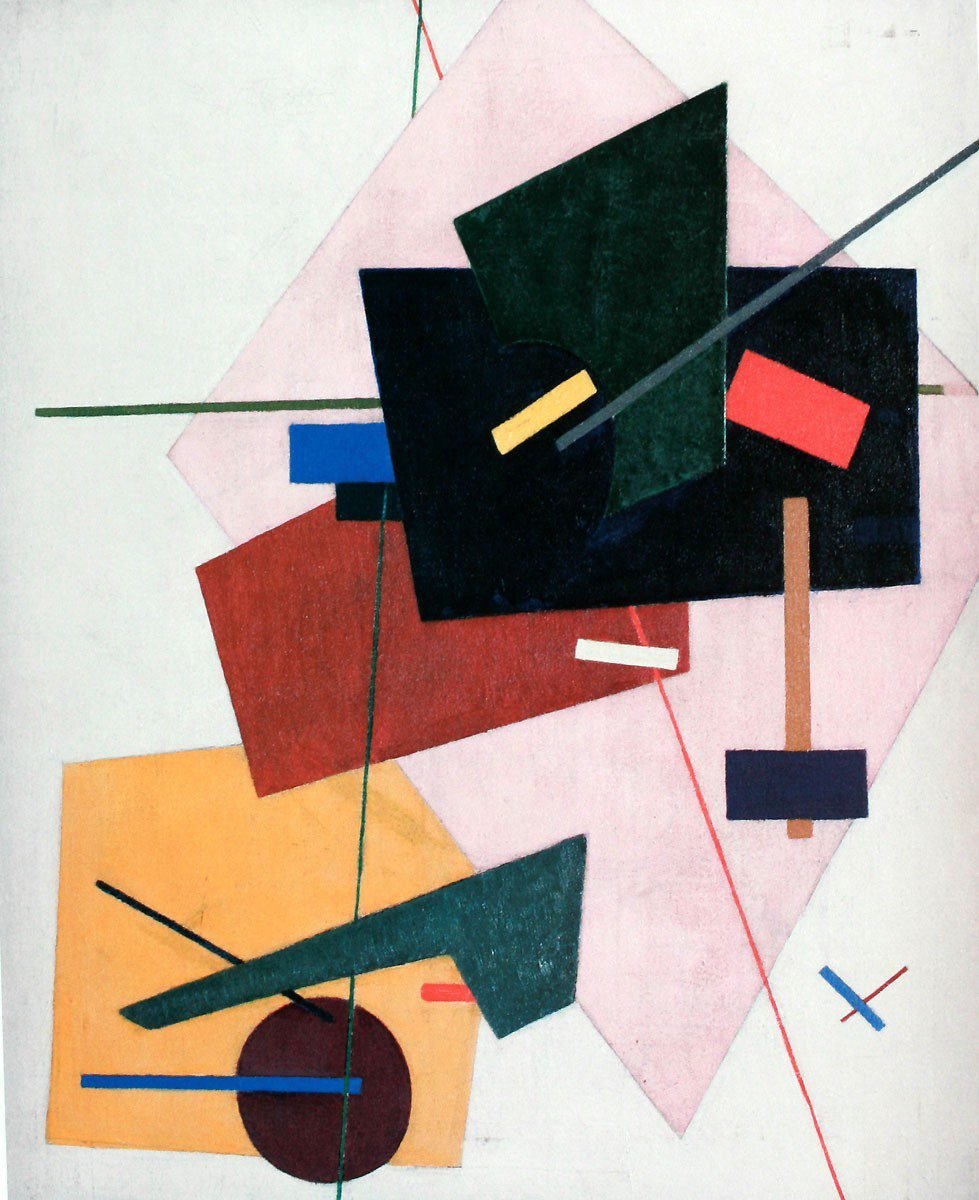
In 1919 Malevich took a teaching post at the Vitebsk Art School (in present day Belarus) at the invitation of Marc Chagall, and within months he had effectively taken over the school’s direction. Students first organized as MOLPOSNOVIS before renaming themselves UNOVIS under Malevich’s leadership.
What was UNOVIS?
UNOVIS stood for Champions of the New Art. The group, which included El Lissitzky and the younger painter Ilya Chashnik, produced posters, banners, and even painted trams in Suprematist designs, carrying Malevich’s geometry into the everyday urban life of a young Soviet state. UNOVIS disbanded in 1922, but its workshop-collective model shaped Soviet art education for years afterward.
Myth vs. Fact: A Painting With Something to Hide
Myth: Malevich painted Black Square as a fast, throwaway provocation. Fact: when conservators examined the 1915 original with infrared and X-ray imaging, they found an earlier, more complex composition underneath the black paint, along with a handwritten inscription. The square sat on top of real revision, not a single quick gesture.
El Lissitzky and the Proun Bridge to Design
El Lissitzky, born Lazar Markovich Lissitzky, joined Malevich at Vitebsk and became Suprematism’s most effective translator into architecture and graphic design. Where Malevich kept his forms flat, Lissitzky pushed them into implied three dimensional space with a series he called Proun, an acronym roughly meaning project for the affirmation of the new. Proun works read as diagrams for buildings that were never built, floating geometric volumes rendered with an engineer’s precision. Lissitzky carried this vocabulary to Weimar Germany after 1921, where his exhibition designs and typography influenced the Bauhaus and international Constructivism far beyond what Malevich’s paintings alone reached.
The Four Versions of the Black Square
Malevich returned to the composition three more times after 1915, producing versions in 1923, 1929, and once more in the late 1920s or early 1930s. Each canvas differs slightly in size, in the exact placement of the square, and in surface texture, since the first version was already cracking within Malevich’s own lifetime because of how he mixed his paint. The original 1915 canvas is held at the State Tretyakov Gallery in Moscow; the other three are split between Moscow’s Tretyakov, the State Russian Museum in St. Petersburg, and a private Russian collection.
Why did Malevich paint the square four times?
Scholars generally read the repeats as Malevich reasserting Suprematism’s founding image at moments when his own position, first amid Bolshevik era exhibitions, later under mounting state pressure, needed restating.
Historical Impact on the International Avant-Garde
Suprematism reached well beyond Russia’s borders in the 1920s. Malevich traveled to Warsaw and Berlin in 1927, leaving behind a large body of paintings and manuscripts that stayed in Western Europe when Soviet cultural policy turned against him, works that later anchored major Malevich holdings in Amsterdam. Lyubov Popova’s Painterly Architectonics and the flat, unbounded color planes of Suprematism fed directly into Constructivism, and from there into Bauhaus design teaching once artists like Lissitzky began working in Germany. Later movements as different as Minimalism and hard-edge geometric abstraction in the United States trace a direct line back to the same basic move Malevich made in 1915: painting that refers to nothing beyond its own shape and color.
Soviet Suppression and Malevich’s Return to the Figure
By the early 1930s Socialist Realism had become official Soviet doctrine, and abstraction of any kind fell under suspicion as bourgeois formalism. Malevich, briefly arrested in 1930, responded by painting peasant and worker figures again, canvases such as Carpenter I from the late 1920s, but he built these figures from the same flattened, geometric logic he had developed for Suprematism, giving his workers blank ovoid faces and rigid cylindrical limbs rather than realistic features. It reads less as a retreat from abstraction than as Suprematism carried back into subjects the state found acceptable. Malevich died in Leningrad on 15 May 1935. Friends carried his coffin in a Suprematist-designed vehicle, and a black square marked his grave.
Legacy in Minimalism, Conceptual Art, and Design
Black Square anticipated arguments that would not fully surface in Western art until decades later. Ad Reinhardt’s black paintings of the 1950s and 60s, Frank Stella’s early shaped canvases, and the Minimalist insistence on the artwork as a plain physical object rather than a window onto something else all restate, knowingly or not, the position Malevich staked out in 1915. Conceptual artists have returned to the square repeatedly as a test case for what counts as an artwork at all. Outside fine art, the flat geometric vocabulary Suprematism and Constructivism developed together fed into twentieth century graphic design and typography, a far wider reach than a single small canvas would suggest.
Common Misconceptions About the Black Square
A few myths attach to this painting more than almost any other in Russian art. One is that Malevich threw it together in an afternoon as a joke or provocation. Conservators examining the 1915 original found an earlier composition and a handwritten phrase underneath the black paint, evidence of real revision rather than a single quick gesture. Another misconception treats Suprematism as identical to later Western geometric abstraction. Malevich saw his work as spiritual and near-religious in ambition, not simply a formal design exercise.
Is the Black Square really just a black square?
Look closely at any version and the surface is uneven, cracked, and worked over, not a flat printed color field. Malevich treated the square as a painted object with its own history, not a diagram.
Essential Points
- Black Square is a 1915 oil on linen painting by Kazimir Malevich, first shown at the 0,10 exhibition in Petrograd (December 1915 to January 1916).
- Malevich hung it high in a room corner, the traditional spot for an Orthodox icon, to signal how seriously he wanted it taken.
- The painting introduced Suprematism, an abstract style built only on flat geometric shapes and a narrow color range.
- Malevich painted four versions between 1915 and the early 1930s; the original is at the State Tretyakov Gallery in Moscow.
- Suprematism grew out of a circle that included Ivan Kliun, Olga Rozanova, Lyubov Popova, and Nadezhda Udaltsova, not Malevich alone.
- UNOVIS, the Vitebsk teaching group Malevich led from 1919 to 1922, spread Suprematist design into posters, textiles, and architecture through students such as El Lissitzky.
- Soviet cultural policy turned against abstraction by the early 1930s, and Malevich spent his last years painting peasant figures built from Suprematist geometry.
- The painting’s influence runs through Minimalism and Conceptual art and into modern graphic design.
Frequently Asked Questions
- What is Black Square by Malevich?
- Black Square is a 1915 painting by Russian artist Kazimir Malevich showing only a black square on a white canvas. It introduced Suprematism, an art movement based on pure geometric form instead of recognizable subjects. Malevich considered it his most important work and the starting point of abstract painting in Russia.
- Why was Black Square first shown in a corner?
- Malevich hung the painting high in the corner of a room at the 1915 0,10 exhibition in Petrograd, the exact spot where Russian Orthodox households traditionally displayed an icon. The placement told visitors he intended the painting to carry the same weight as a sacred image, not simply decorate a wall.
- Does Black Square have hidden meaning or hidden images?
- Conservators found an earlier composition and a handwritten phrase beneath the surface of the original 1915 canvas, showing Malevich revised the work before settling on the final square. Beyond that, he intended the painting to carry no fixed symbolic meaning, only pure feeling detached from recognizable objects.
- Who else painted in the Suprematist style besides Malevich?
- Malevich led a circle that included Ivan Kliun, Olga Rozanova, Lyubov Popova, Nadezhda Udaltsova, and later El Lissitzky and Ilya Chashnik through the Vitebsk teaching group UNOVIS. Each developed a personal variation on Suprematist geometry rather than simply repeating Malevich’s own compositions.
- Where can you see Malevich’s Black Square today?
- The original 1915 version is on permanent display at the State Tretyakov Gallery in Moscow. Later versions Malevich painted in the 1920s and early 1930s are held at the Tretyakov, the State Russian Museum in St. Petersburg, and a private Russian collection, rarely shown publicly.
This guide was written and reviewed by the rus-art.com editorial team, specializing in Russian art history. We cross-check dates, attributions, and museum holdings against museum and academic sources.