Quick Answer
Ilya Repin (1844-1930) was the leading painter of Russian Realism and a core member of the Peredvizhniki, the group of artists who broke from the Imperial Academy of Arts to depict everyday Russian life. Born in Chuguev, he trained first as an icon painter before studying in Saint Petersburg. His best known works, Barge Haulers on the Volga, Ivan the Terrible and His Son Ivan, and Reply of the Zaporozhian Cossacks, combine exacting realism with intense psychological drama. He also painted definitive portraits of Leo Tolstoy, Modest Mussorgsky, and other major cultural figures of his era.
Who Was Ilya Repin?
Ilya Repin (1844 to 1930) is the painter most people picture when they think of Russian Realism, the artist whose portraits and history scenes still shape how the world imagines nineteenth century Russia. Born in the Ukrainian town of Chuguev on 5 August 1844, Ilya Repin trained first as an icon painter, then entered the Imperial Academy of Arts in Saint Petersburg. Across roughly six decades he produced some of Russian art’s most recognizable images: Barge Haulers on the Volga, Ivan the Terrible and His Son Ivan, Reply of the Zaporozhian Cossacks, and searching portraits of Leo Tolstoy, Modest Mussorgsky, and Pavel Tretyakov. He worked alongside the Peredvizhniki, the realists who broke from the Academy’s rules to root their art in everyday Russian life. Repin paired exact observation with psychological depth. That combination is why students, scholars, and museum visitors keep returning to his canvases well over a century after he painted them.
From Icon Painting in Chuguev to the Imperial Academy
Repin’s father served in an Uhlan cavalry regiment before turning to horse trading, and the family got by on modest means. At sixteen, Repin started painting icons for local churches, learning the discipline of fine detail and religious composition long before he set foot in a formal art school. His first attempt to enter the Imperial Academy of Arts failed. He went to Saint Petersburg anyway in 1863, audited classes without official enrollment, and worked his way in slowly, winning his first academy prizes in 1869 and 1871.
How did Repin learn to paint before his formal training?
Icon painting taught Repin patience with small, precise brushwork and an eye for the human face under stylized conditions, skills he later turned toward unflinching realism. In 1872, after a research trip along the Volga River, he brought drawings from the journey back to the academy. Grand Duke Vladimir Alexandrovich saw promise in the sketches and commissioned a large scale painting, the work that became Barge Haulers on the Volga.
Barge Haulers on the Volga: The Debut That Announced a Master
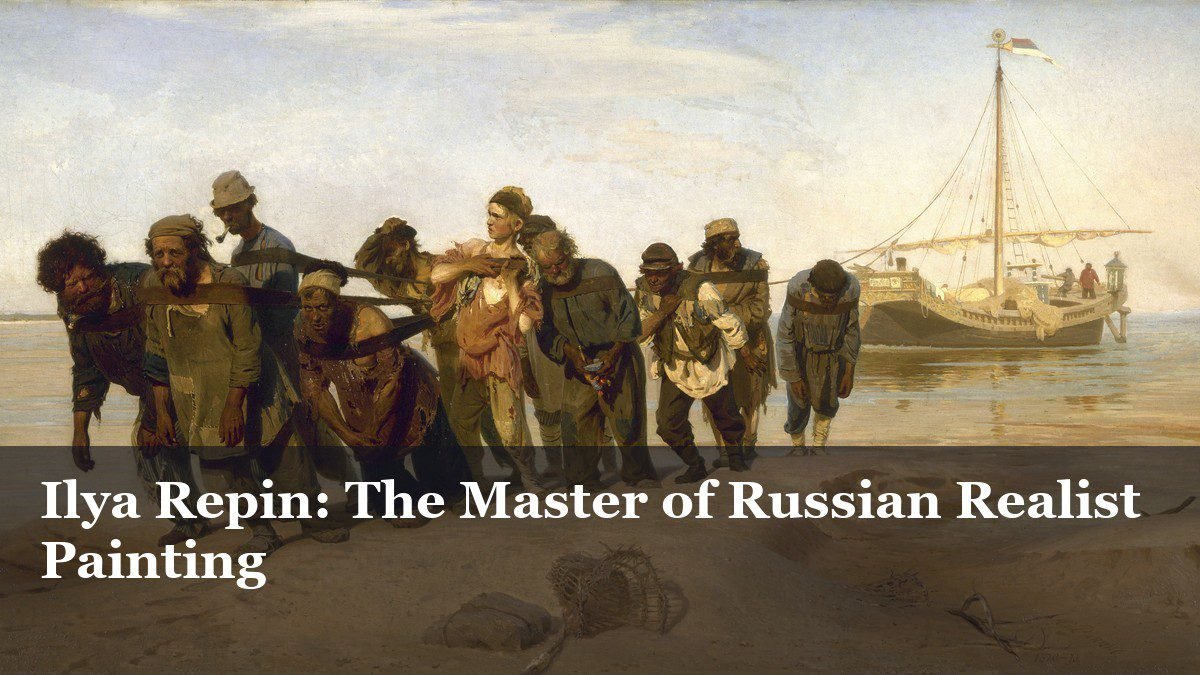
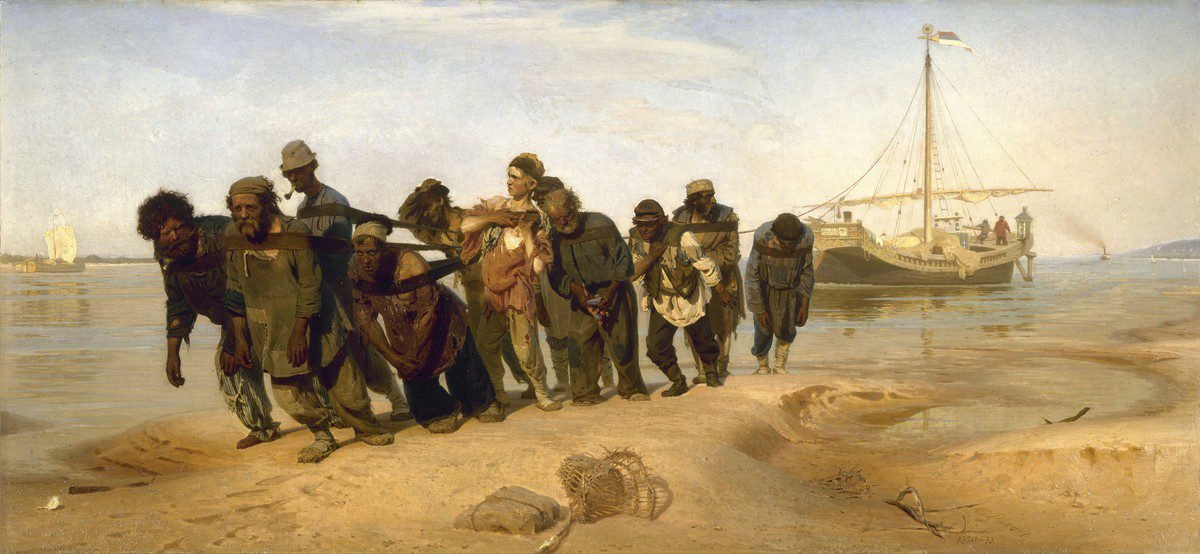
Painted between 1870 and 1873, Barge Haulers on the Volga shows eleven burlaki, laborers who hauled river barges by rope harness, trudging along the riverbank under a punishing sun. Repin met many of these men during his Volga travels and painted their real faces and postures rather than idealized models. Most of the group looks resigned, almost stoical, ground down by the weight of the rope. One figure breaks that pattern: a bright shirted youth at the center of the canvas strains against his harness, his face turned away in what reads as quiet defiance. Grand Duke Vladimir Alexandrovich bought the finished canvas, and it was soon shown across Europe as a landmark of Russian realist painting. Many call it the single most famous painting to come out of the Peredvizhniki movement, prized for its unflinching honesty about backbreaking labor rather than any decorative softening of the subject.
The Peredvizhniki: Painting for the Public, Not the Academy
The Peredvizhniki, often translated as the Wanderers or the Itinerants, began as a protest. A group of young painters rejected the Imperial Academy’s insistence on mythological and biblical subjects handed down from above, and organized their own cooperative instead. By 1870 that cooperative had become the Society for Traveling Art Exhibitions, which carried paintings to provincial cities across the Russian Empire rather than keeping them locked in the capital. Founding members included Ivan Kramskoi, who acted as the group’s chief theorist, along with Grigoriy Myasoyedov, Vasily Perov, Nikolai Ge, and Ivan Shishkin. Later figures such as Vasily Surikov and Arkhip Kuindzhi joined as the movement grew. Repin exhibited with the group for decades. His paintings of laborers, clergy, and literary figures did exactly what the Wanderers argued art should do: show Russian life as it actually looked, to audiences who rarely saw themselves reflected in academic painting.
What Defines Repin’s Realism?
Repin’s realism goes beyond accurate rendering of surfaces. He built each composition around a psychological moment, choosing the instant that reveals character rather than the instant that flatters it. His figures carry weight, fatigue, doubt, or grief in ways academic painting rarely allowed. He also worked at large scale on subjects earlier Russian painters had considered unworthy of major canvases: barge haulers, provincial religious processions, rural laborers.
What makes Repin’s brushwork distinctive?
Repin varied his handling by subject. Portrait faces got tight, controlled modeling, while backgrounds, clothing, and crowd scenes could turn loose, almost impressionistic. That contrast keeps the eye anchored on character and expression even in his busiest multi figure compositions, an approach that shaped how later Russian portraitists treated the human face.
Portraits of a Nation: Repin and Russia’s Literary Giants
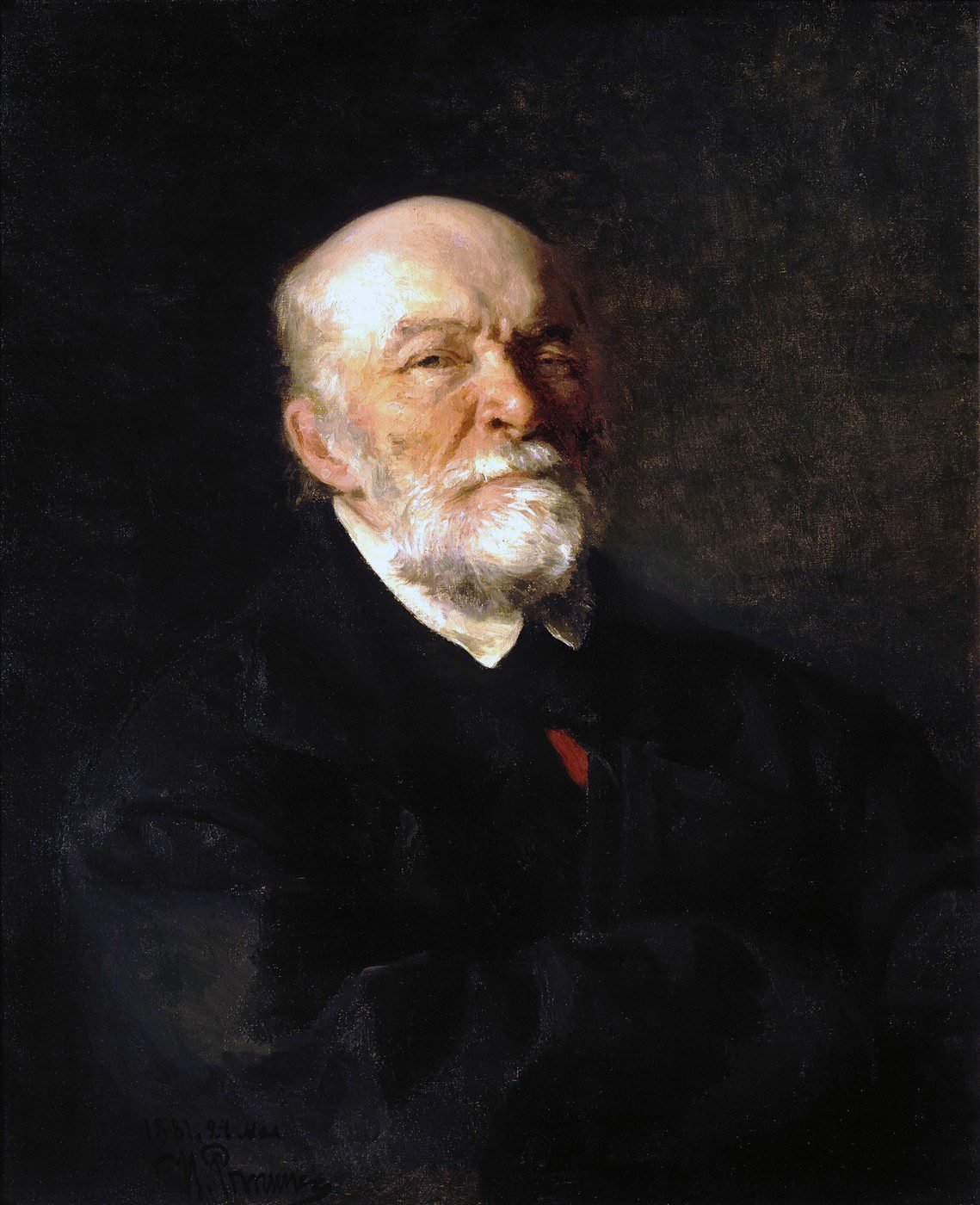
Alongside his large narrative canvases, Repin built a parallel career as Russia’s foremost portraitist of its cultural elite. He painted the composer Modest Mussorgsky in 1881, only days before Mussorgsky’s death, catching him disheveled and unwell in a portrait now ranked among the most honest artist portraits of the era. He painted the surgeon Nikolay Pirogov in 1881, rendering the scientist’s sharp, appraising gaze with the same care he gave his laborers. He painted the critic Vladimir Stasov, an early champion of the Peredvizhniki, and the collector Pavel Tretyakov, whose gallery would eventually house many of Repin’s own major works. These portraits share a common trait. Repin refused to smooth over age, illness, or eccentricity, choosing instead to record his sitters as he actually saw them.
Repin and Leo Tolstoy: Portraits of a Friendship
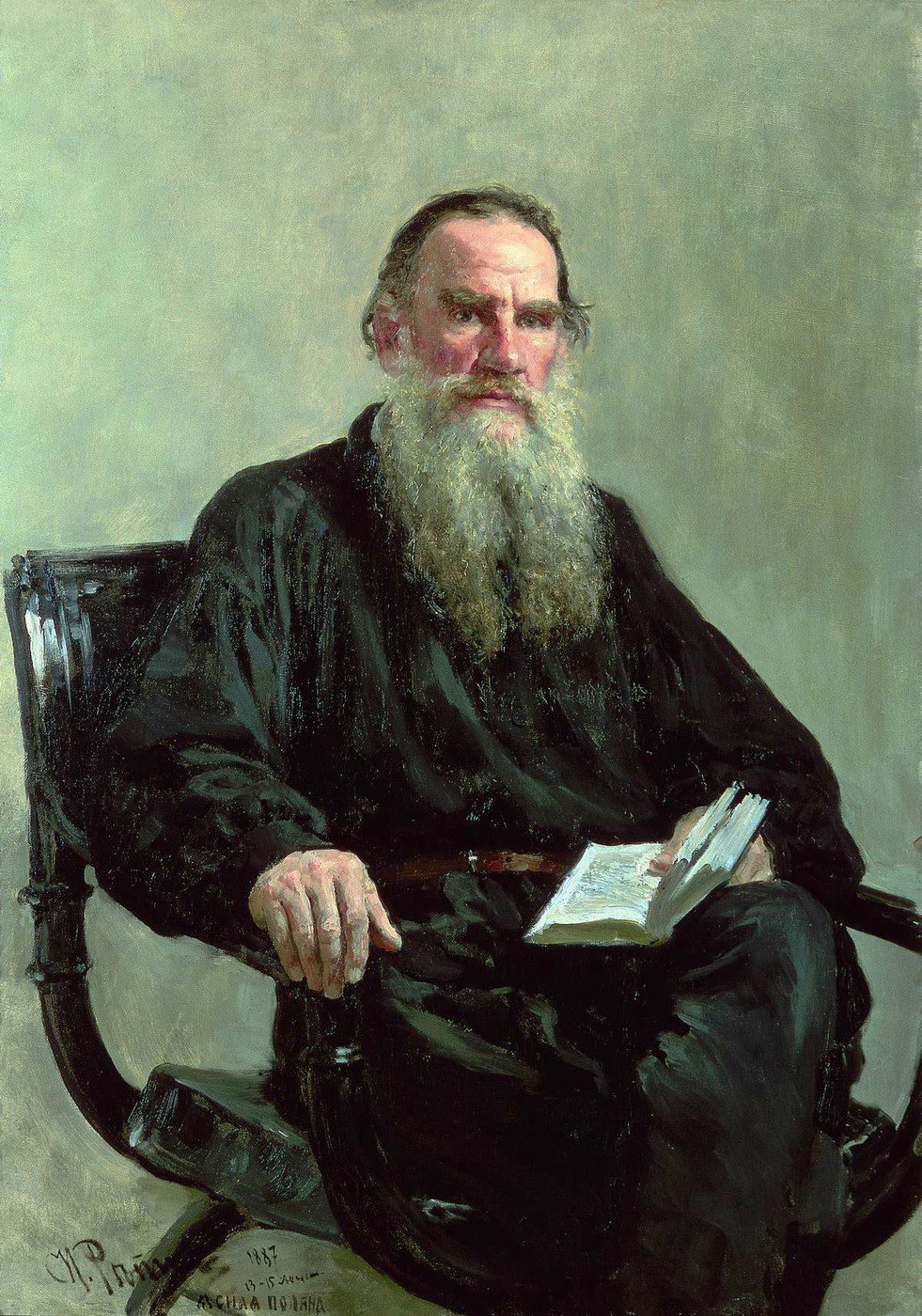
Of all Repin’s sitters, none mattered to him more than Leo Tolstoy. The two men kept up a friendship that lasted decades, and Repin visited Tolstoy’s estate at Yasnaya Polyana again and again to sketch and paint him, sometimes barefoot in the fields, sometimes seated in quiet concentration. The 1887 portrait shows Tolstoy in a plain peasant style shirt, arms crossed, gazing straight at the viewer with an expression that reads as both stern and searching. Repin painted Tolstoy so many times, across so many settings, that the portraits together form a kind of visual biography, tracking the writer’s turn from celebrated novelist to the ascetic moral philosopher of his later years. Their correspondence and mutual sittings remain one of the best documented artist and subject relationships in Russian cultural history.
Ivan the Terrible and His Son Ivan: Anatomy of a Controversial Masterpiece
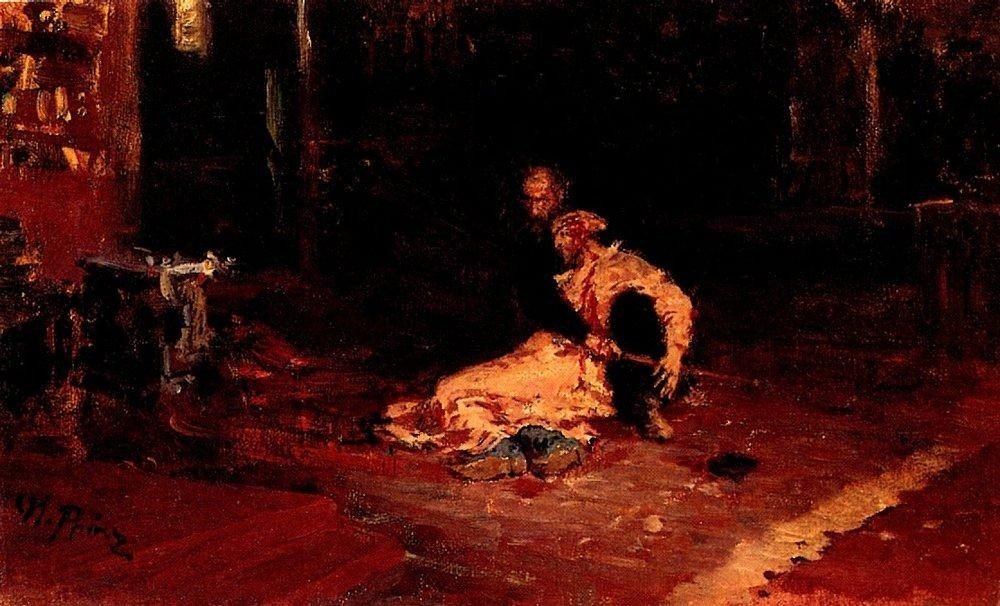
Completed in 1885 after two years of work, Ivan the Terrible and His Son Ivan shows the aftermath of a real, documented tragedy: Tsar Ivan IV striking his own son in a fit of rage, a blow that proved fatal. Repin painted the moment just after the blow, the horrified tsar cradling his dying heir. He used his friend and fellow painter Grigoriy Myasoyedov as the model for Ivan the Terrible’s face, and the writer Vsevolod Garshin as the model for the dying Tsarevich. Pavel Tretyakov bought the finished canvas in 1885 for his gallery in Moscow, where it remains one of the most visited and most argued over paintings in the collection. Its raw depiction of violence and grief has provoked strong reactions since it was first shown, and the canvas has been physically attacked by vandals more than once, most notably in 1913, a measure of how much emotional force the image still carries.
Reply of the Zaporozhian Cossacks: Two Decades on One Canvas
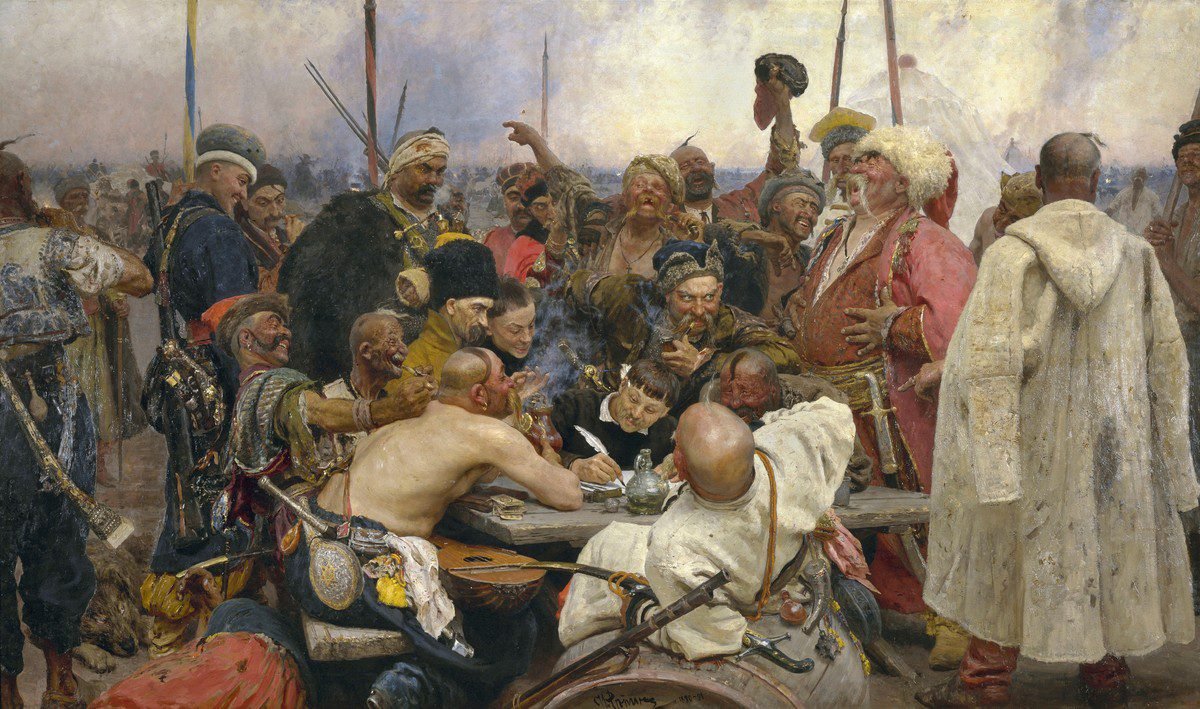
Reply of the Zaporozhian Cossacks, also known by the longer title Cossacks of Saporog Are Drafting a Manifesto, occupied Repin on and off from 1880 to 1891. He traveled to gather material for it, sketching in the Cossack settlement of Pashkovskaya, in Yekaterinoslav (today Dnipro), and at Kachanivka, and he noted the years of labor along the canvas’s lower edge. The painting shows a raucous band of Zaporozhian Cossacks composing a mocking letter to the Ottoman sultan, roaring with laughter as they write. Tsar Alexander III bought the finished work for 35,000 rubles, an enormous sum at the time, and it has hung in the State Russian Museum in Saint Petersburg ever since. Repin painted a second version, now in the Kharkiv Art Museum in Ukraine, and the composition later turned up in the BBC’s 1980 television series 100 Great Paintings.
Look Closer: Look closer at the youth in the pale shirt
In Barge Haulers on the Volga, find the young man in the pale rose shirt near the center of the group. Unlike the other burlaki, who trudge forward with their eyes down, he strains upward against his harness, his face turned away from the line. Many historians read him as a note of resistance inside an otherwise resigned crowd, though Repin left the meaning open rather than spelling it out.
Religious Procession in Kursk Province: Russia in Miniature
Painted between 1880 and 1883, Religious Procession in Kursk Province shows a crowd of pilgrims, clergy, police, and onlookers escorting a venerated icon along a dusty rural road. Repin used the procession as a device for surveying Russian society from top to bottom in a single frame: mounted officials keep order at the front, wealthy landowners walk near the icon itself, and the poor and disabled are pushed toward the margins and the ditch at the roadside. The composition lets viewers read social hierarchy directly from where each figure stands in the crowd, without a single line of explanatory text. It remains one of the clearest examples of Repin using a seemingly ordinary public event to comment on inequality in late nineteenth century Russian society.
Teaching the Next Generation at the Academy of Arts
Repin’s influence did not stop at his own canvases. He taught at the Imperial Academy of Arts in Saint Petersburg for years, and his studio became a proving ground for younger painters who would go on to shape twentieth century Russian art. He gave early instruction to Valentin Serov, who as a boy studied informally under Repin’s guidance before developing his own looser, more modern style of portraiture. Repin’s teaching emphasized close observation from life over academic formula, the same principle that guided his own paintings, and that emphasis carried forward into the work of the students who passed through his classroom.
Repin Among the Wanderers: Kramskoi, Surikov, and Shared Ideals
Repin worked within a wider circle of realist painters who shared his commitment to depicting Russian life honestly. Ivan Kramskoi, the group’s leading theorist, painted searching portraits and religious subjects like Christ in the Wilderness that pushed moral questions into everyday visual language. Vasily Surikov approached similar territory from a different angle, building large history paintings such as Boyarina Morozova around specific, documented events from Russia’s past.
How did Repin’s work differ from Vasily Surikov’s history paintings?
Surikov concentrated almost entirely on historical drama drawn from centuries earlier, reconstructing crowds and costumes with painstaking care. Repin moved more freely between contemporary genre scenes, portraiture, and the occasional historical subject like Ivan the Terrible, giving his body of work a broader range of subject matter than most of his Peredvizhniki colleagues.
Common Misconceptions About Ilya Repin
A common misconception treats Repin as a painter of grim social realism alone, fixed only on suffering laborers and stern portraits. In fact he also painted folkloric and fantastical subjects, including Sadko, an 1876 canvas depicting the legendary merchant of Novgorod tales wandering an underwater kingdom filled with princesses. Another misconception collapses Repin’s Ukrainian birth and his Russian artistic career into a single simple label. Repin was born in Chuguev, in what is now Ukraine, trained and worked mainly in Saint Petersburg and Moscow, and painted Ukrainian Cossack subjects such as Reply of the Zaporozhian Cossacks alongside distinctly Russian ones, a biography that resists a tidy single nationality. A third misconception assumes Ivan the Terrible and His Son Ivan was pure invention. Repin researched the historical episode carefully before he composed the scene.
Repin’s Final Years in Finland
After the 1917 revolution, the border between Soviet Russia and newly independent Finland shifted, and Repin’s country estate at Kuokkala, which he called Penaty, ended up on the Finnish side. Repin stayed there for the rest of his life, effectively cut off from Soviet Russia by a border he had never crossed himself. Soviet officials made repeated attempts to persuade him to return, but he declined, continuing to paint and receive visitors at Penaty until his death on 29 September 1930. His long final period outside Russia meant that many of his late works and his personal archive stayed in Finland, later forming the basis of the Penaty museum that preserves his home today.
Legacy: Why Repin Still Matters
Repin’s insistence on painting real people, in real settings, with unvarnished honesty gave later Russian and Soviet painters a template for combining technical mastery with social observation. Soviet Socialist Realism, which emerged decades after his major works, borrowed some of his visual vocabulary even though Repin himself worked in a very different political and artistic context. According to profiles such as Encyclopaedia Britannica, Repin’s technical range, from monumental history painting to intimate portraiture, remains a benchmark for Russian art education. His canvases anchor the collections of the country’s most important museums, and reproductions of Barge Haulers on the Volga and Ivan the Terrible and His Son Ivan still circulate as shorthand for Russian art itself, well beyond specialist circles.
Related Movements and Where Repin Fits in Art History
Russian realism did not develop in isolation. Painters like Repin knew French Realism, particularly the work of Gustave Courbet, which had already challenged academic hierarchies of subject matter in Western Europe a generation earlier. The Peredvizhniki adapted that broader European turn toward everyday subject matter to specifically Russian concerns: serfdom’s legacy, religious life, and the literary culture centered on figures like Tolstoy and Dostoevsky. After Repin’s generation, the Mir Iskusstva (World of Art) movement reacted against Peredvizhniki style realism, favoring decorative and symbolist approaches instead. It shows how quickly Repin’s dominant realist mode became, in turn, something the next generation defined itself against.
Where to See Ilya Repin’s Paintings Today
Most of Repin’s major works remain in Russia’s two great national collections. The State Tretyakov Gallery in Moscow holds Ivan the Terrible and His Son Ivan and Religious Procession in Kursk Province, while the State Russian Museum in Saint Petersburg holds Barge Haulers on the Volga and the primary version of Reply of the Zaporozhian Cossacks.
Can you visit Repin’s actual studio and home?
Yes. Penaty, Repin’s estate in what is now the town of Repino near Saint Petersburg, operates as a house museum, preserving his studio, personal effects, and several late works much as he left them. A second version of Reply of the Zaporozhian Cossacks hangs in the Kharkiv Art Museum in Ukraine, giving visitors outside Russia a chance to see Repin’s Cossack subject firsthand.
Essential Points
- Ilya Repin (1844-1930) was born in Chuguev and trained first as an icon painter before entering the Imperial Academy of Arts in Saint Petersburg.
- Barge Haulers on the Volga (1870-1873) launched his career and became one of the most famous paintings of the Peredvizhniki movement.
- Repin exhibited for decades with the Peredvizhniki, the Wanderers, who broke from the Academy in favor of realist art shown in traveling exhibitions.
- He painted some of the era’s most revealing portraits, including Leo Tolstoy, Modest Mussorgsky, and the surgeon Nikolay Pirogov.
- Ivan the Terrible and His Son Ivan (1885) remains one of Russia’s most famous and most contested paintings, and it has been physically attacked more than once.
- Reply of the Zaporozhian Cossacks took Repin roughly a decade to complete, from 1880 to 1891.
- After the 1917 revolution redrew the border, Repin spent his final years at his estate in Finland rather than in Soviet Russia.
- His major works are held today primarily in the State Tretyakov Gallery in Moscow and the State Russian Museum in Saint Petersburg.
Frequently Asked Questions
- What is Ilya Repin best known for?
- Repin is best known as Russia’s leading Realist painter, celebrated for Barge Haulers on the Volga, Ivan the Terrible and His Son Ivan, and Reply of the Zaporozhian Cossacks, along with searching portraits of figures like Leo Tolstoy. His work combines precise observation with strong psychological intensity.
- Why did Repin and other painters form the Peredvizhniki?
- The Peredvizhniki, or Wanderers, rejected the Imperial Academy of Arts’ control over subject matter and formed their own cooperative in 1863, which became the Society for Traveling Art Exhibitions in 1870. They wanted to bring realist art depicting everyday Russian life to audiences across the empire, not just the capital.
- What does the bright shirted man in Barge Haulers on the Volga mean?
- The young man in the pale shirt at the center of the canvas is the only figure straining against his harness rather than accepting it. Many art historians read him as a spark of resistance within an otherwise resigned group, though Repin never explained the detail directly.
- Was Ilya Repin Russian or Ukrainian?
- Repin was born in Chuguev, in what is now Ukraine, in 1844, and he painted Ukrainian Cossack subjects throughout his career. He trained and worked mainly in Saint Petersburg and Moscow and is generally classified as a Russian realist painter, reflecting the shared imperial context he worked within.
- Where can you see Ilya Repin’s paintings today?
- Most major works are in Russia: the State Tretyakov Gallery in Moscow holds Ivan the Terrible and His Son Ivan, and the State Russian Museum in Saint Petersburg holds Barge Haulers on the Volga. His former home, Penaty near Saint Petersburg, is also open as a museum.
This guide was written and reviewed by the rus-art.com editorial team, specializing in Russian art history. We cross-check dates, attributions, and museum holdings against museum and academic sources.