Quick Answer
Russian frescoes are murals painted onto wet lime plaster inside Orthodox churches, binding pigment permanently into the wall. The tradition arrived from Byzantium in 988 and was transformed by masters including Theophanes the Greek and Andrei Rublev. Surviving cycles at Novgorod (1378), Vladimir (1408), and the Ferapontov Monastery (1502) show a visual language that rejected Western spatial illusion in favor of symbolic color, hierarchical composition, and a deliberate sense of timeless, sacred presence.
What Are Russian Frescoes?
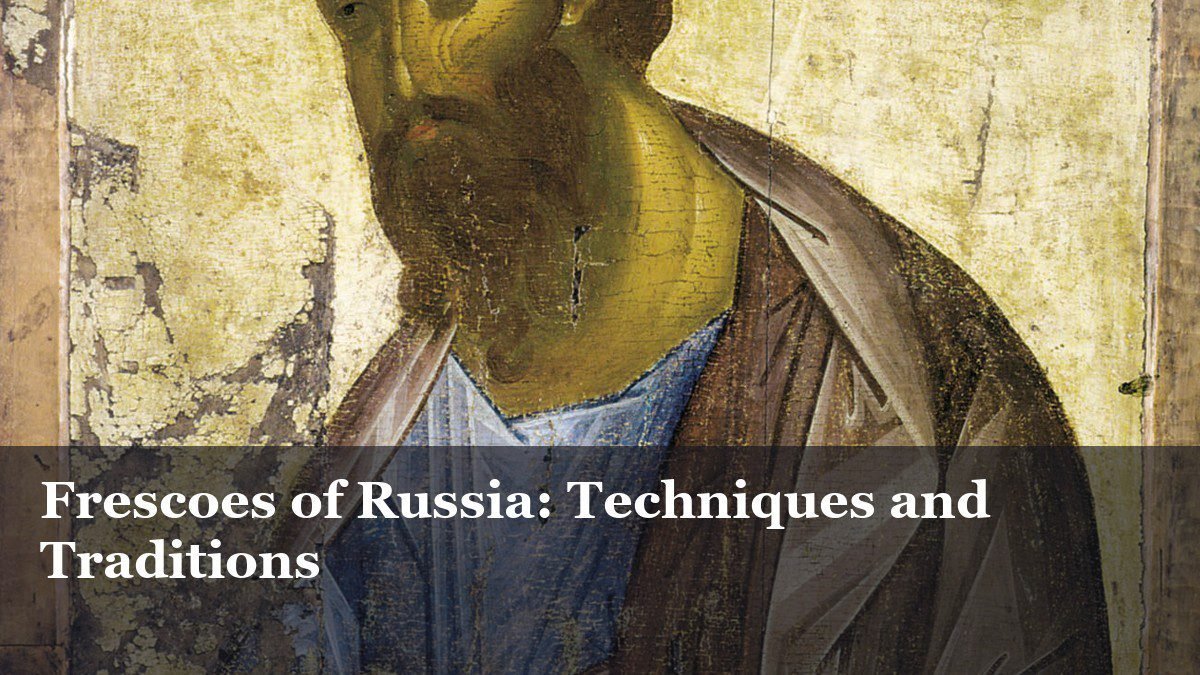
Russian frescoes are murals applied directly to fresh lime plaster on the interior walls, vaults, and domes of Orthodox churches. As the plaster dries, calcium hydroxide converts to calcium carbonate, locking pigment into the wall surface so that image and architecture become chemically one.
The technique arrived from Byzantium after the Christianization of Kievan Rus in 988, and over six centuries it grew into something distinct from its Byzantine source, and from fresco traditions in Italy or the Balkans. A panel icon can be carried from church to home and back again. A fresco cannot. To see it, you must enter the building it inhabits. That constraint shaped how Russian painters conceived the work: the figures were designed to surround the standing worshipper, transforming the entire church interior into a picture of the heavenly order.
Painting into Wet Plaster: The Buon Fresco Process
Buon fresco demands that the painter apply water-ground pigment to freshly laid lime plaster, the intonaco, before it sets. The window is a few hours at most: once the plaster carbonates it stops absorbing, and the pigment no longer bonds. No other painting medium enforces its timetable so harshly.
Russian masters typically began a composition with a sinopia, a red-ochre underdrawing worked on the coarse base coat. When the final intonaco was spread, the master re-drew the main contours and proceeded section by section, completing one giornata (a day’s patch) before the plaster closed. Faces and hands, which required the most precise control, were left for the last pass on each section.
What Is the Difference Between Buon Fresco and Secco Fresco?
Buon fresco bonds pigment into the plaster chemically. Secco fresco applies pigment mixed with a binder, such as egg or lime water, to plaster that has already dried. Secco is far less durable: moisture eventually separates it from the wall. In Russian churches, many cycles combine both methods, buon fresco for the main color fields and secco for fine detail or later additions. This is partly why some passages in a single cycle survive far better than others.
From Byzantium to the Rus: The Origins of a Sacred Art
When Prince Vladimir of Kiev accepted Orthodox Christianity in 988, he brought Greek craftsmen to build and decorate churches in the Byzantine manner. The oldest surviving frescoes on what is now Russian territory date to around 1037, in the Cathedral of St Sophia in Kiev. Whether painted by Byzantine artists or by local painters trained under them, these works set the visual grammar that Russian fresco would follow and test for the next five centuries: Christ Pantocrator in the central dome, the Theotokos in the apse conch, apostles and saints along the nave walls, the Last Judgment on the west wall.
Two forces pulled that inherited grammar in directions neither Greece nor the Balkans followed. Severe freeze-thaw cycles put constant stress on plastered walls. Then the Mongol invasions of 1237-1240 leveled city after city across the Vladimir-Suzdal region, breaking the chain of transmission: later painters had to reconstruct the tradition partly from memory, partly from whatever provincial examples the violence had spared.
Novgorod and the First Flowering of Russian Fresco
Novgorod escaped the worst of the Mongol destruction and through the 12th and 14th centuries became Russia’s most active center for fresco painting. Its merchants and monasteries kept commissioning church after church: the interiors range from the severe, almost stripped-down program of the Church of the Savior on Nereditsa (1199, largely destroyed in World War II) to the charged drama of Theophanes the Greek’s 1378 cycle in the Church of the Transfiguration on Elijah Street.
Novgorodian painters developed a flat, frontal style with bold contour lines and warm ochre and reddish-brown grounds. They did not simply transcribe Byzantine models. Compositions were simplified, figures enlarged relative to the available space, and the gaze of the painted saint directed straight at the worshipper below. The result is an art of confrontation, not contemplation: you look up, and the figure looks back.
Theophanes the Greek: Expressive Lines in Russian Chapels
Theophanes the Greek (c. 1330/1340-c. 1410) came to Russia after working in Constantinople, Chalcedon, and the Crimea. His 1378 cycle in the Church of the Transfiguration on Elijah Street in Novgorod is the only fully authenticated work of his surviving on Russian soil.
What sets him apart is a controlled violence of mark-making. His saints and hermit figures stand in a storm of white highlights, broken strokes of chalky paint that suggest divine radiance rather than describe it. There is no smooth modeling from dark to light. The prophets in the upper chamber look almost etched into the wall, their garments rendered as pure graphic energy. Some scholars have reached for Expressionism as a comparison, though that flattens his theological aims: the agitated surface embodies hesychast theology, which held that uncreated divine light was directly visible to the purified soul.
Why Did Theophanes the Greek Work in Russia Rather Than Constantinople?
By the late 14th century, Byzantium was in political and economic decline, and Constantinople could no longer sustain major artistic commissions at the scale it once had. Russia, recovering from the Mongol period, offered working patronage: Novgorodian merchants were building church after church. Theophanes followed the work, as Greek artists had done before him, and in doing so carried Constantinople’s most advanced visual thinking into northern Russia.
Andrei Rublev and the Soul of the Moscow School
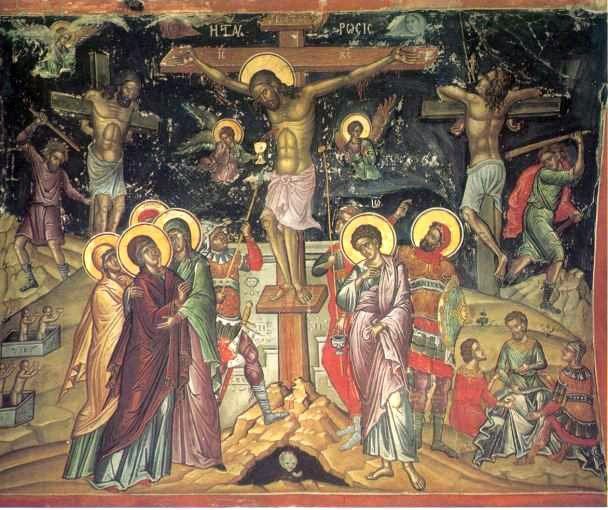
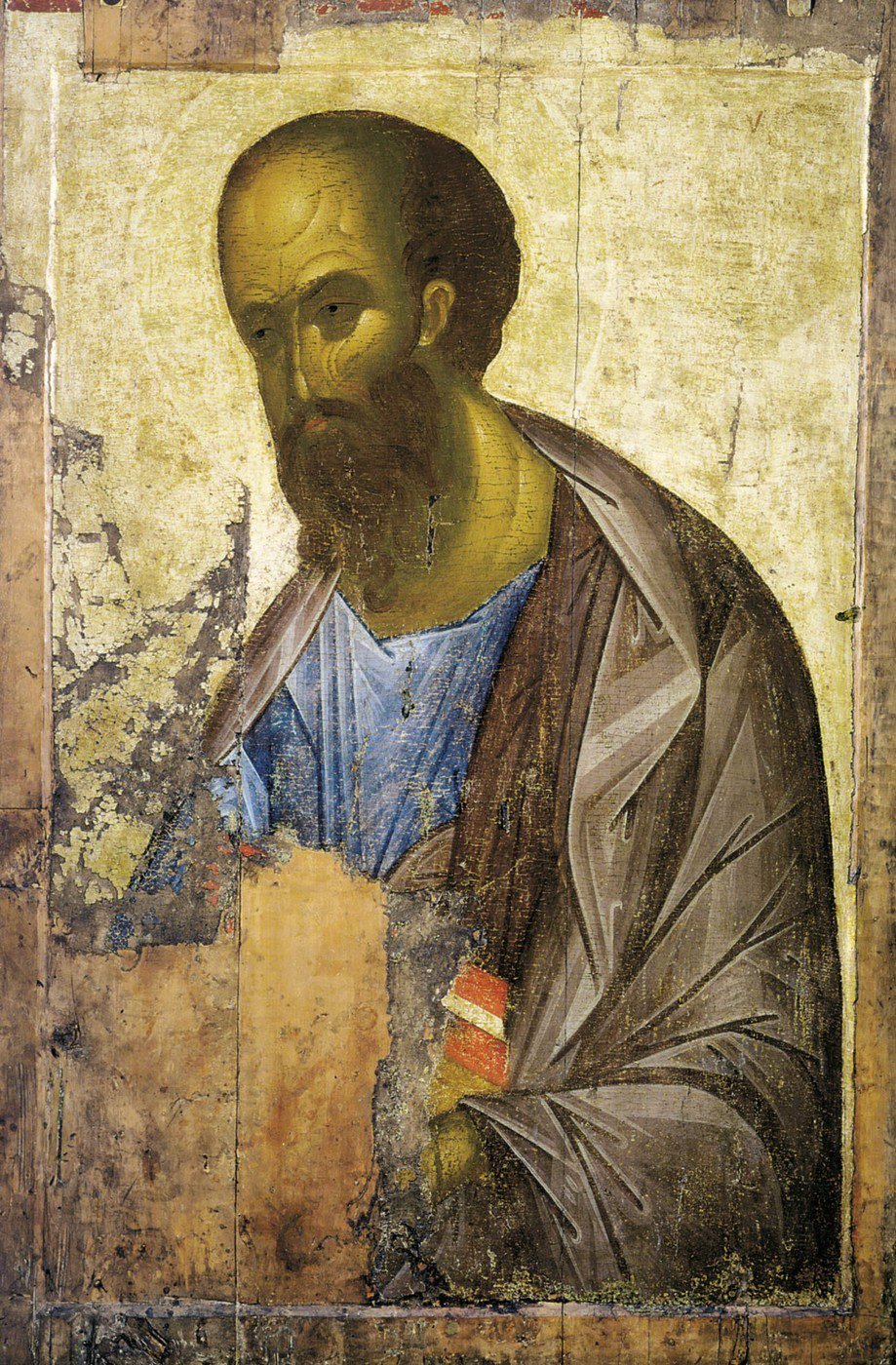
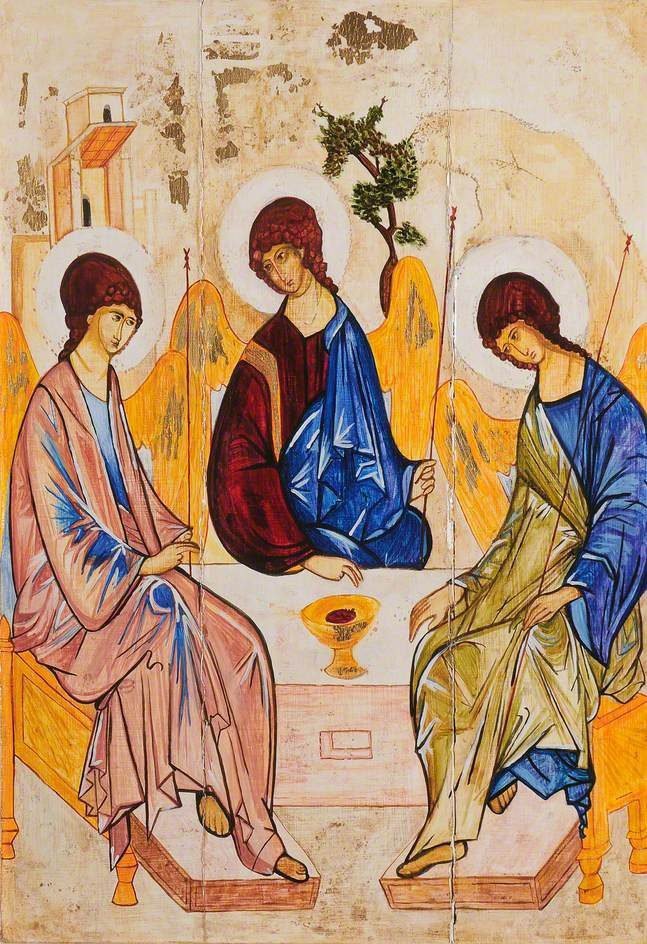
Andrei Rublev (c. 1360-c. 1430) is the most celebrated Russian painter of the medieval period and the first Russian painter the Russian Orthodox Church canonized as a saint, his feast day falling on 29 January. Andrei Rublev He trained under Theophanes the Greek and later worked alongside the painter Daniil Chorny on major fresco campaigns.
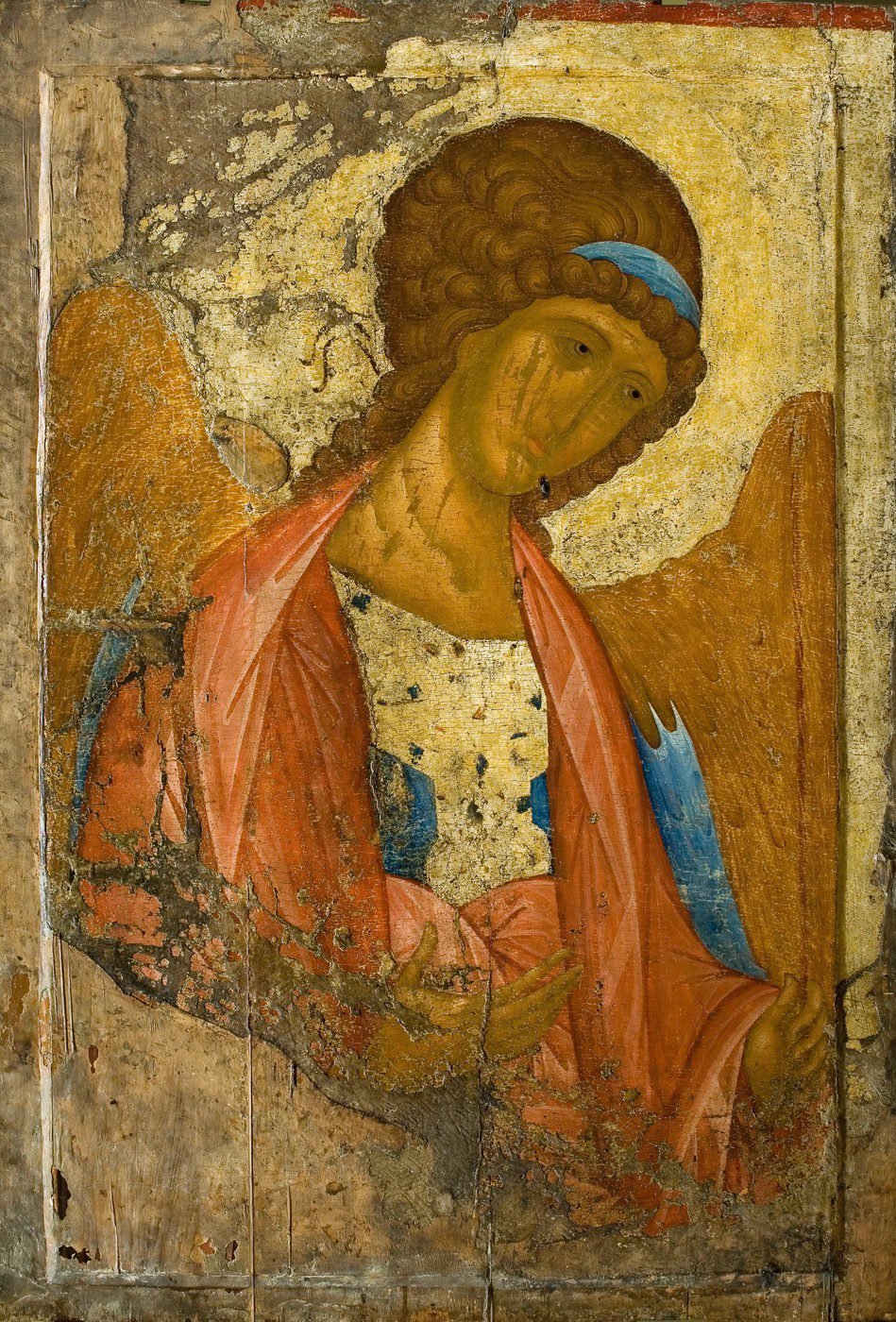
Where Theophanes built toward confrontation and spiritual voltage, Rublev moved toward stillness. His figures are softer in outline, his palette lighter and more consonant, his compositions organized around circular or rhythmic movement rather than frontal symmetry. Russian writers have used the word umilenie, tender compassion, to name the emotional register his work occupies. Scholars continue to debate how much of this shift traces to Rublev’s own sensibility and how much to changes in Moscow’s theological climate, which placed greater weight on the mercy and accessibility of Christ than on the fearful majesty that earlier Byzantine tradition had foregrounded.
The Cathedral of the Dormition at Vladimir
In 1408, Rublev and Daniil Chorny painted the Cathedral of the Dormition in Vladimir, among the most prestigious commissions in Russia at the time. Much of that cycle was overpainted in later centuries, but the Last Judgment on the west wall and arches survives in substantial part. The Apostles seated in judgment show what is perhaps Rublev’s most characteristic quality: faces turned not toward condemnation but toward something more like gentle inquiry, as though the viewer standing below might still choose differently.
The Vladimir campaign established what later historians came to call the Moscow school of fresco, a tradition holding Byzantine solemnity in balance with a more lyrical, human register. Rublev’s color choices became a touchstone imitated across the 15th century: rose-mauve tones for flesh, clear blue-green for backgrounds, saturated gold for divine presences.
Dionysius at Ferapontov Monastery: Elegance in Blue and White
Dionysius (c. 1440/1450-c. 1508) painted the Cathedral of the Nativity of the Virgin at the Ferapontov Monastery between 1502 and 1503. The cycle covers nearly 600 square meters of wall surface and is the most complete single medieval Russian fresco program to survive anywhere. Dionysius the Painter UNESCO inscribed the monastery in 2000, citing in part the exceptional condition of Dionysius’s work.
His palette is dominated by white, pale blue, and cool pink, which together give the frescoes a translucency quite unlike the warm ochres of Theophanes or the mid-register harmonics of Rublev. The figures are unusually elongated, almost without weight, and the compositional rhythms move like a procession through ordered space. There are no dead passages on these walls, no abrupt breaks between scenes.
Myth vs. Fact: Fresco vs. Wall Painting
Myth: Any mural inside a Russian church is a fresco. Fact: True buon fresco requires pigment applied to wet lime plaster, which then chemically bonds as the plaster dries. Many Russian church murals were painted onto dry walls in tempera, oil, or distemper, which are far more vulnerable to humidity and frost. Because dry surface layers such as secco sit on top of the wall, they are less durable and often flake first, but only a conservation report can confirm whether visible damage is later overpaint or the original buon fresco itself.
Color, Symbol, and Spiritual Space
Russian fresco painters inherited from Byzantium a color system that stayed largely stable across five centuries. Gold and radiant white carried divine light and spiritual purity. Deep blue, ground from lapis lazuli or azurite, designated the Virgin’s outer mantle. Red marked martyrdom, royal dignity, or seraphic fire. Earthy greens and ochres kept human figures rooted against the eternal.
The spatial layout of each church was equally fixed. Christ Pantocrator held the highest point of the central dome, looking down over the congregation. The Theotokos appeared in the curved apse, arms raised in the orant posture. The Deesis row, Christ flanked by the Virgin and John the Baptist with apostles extending on either side, ran along the upper nave walls. Narrative scenes came lower, descending toward eye level. The Last Judgment covered the western wall, arranged to meet the congregation as it filed out. Walking into a Russian church and walking out was a passage through sacred time.
Pigments, Plaster, and the Workshop Craft
Every pigment had to come from mineral sources: iron ochres for yellows and reds, malachite for green, azurite and smalt (ground cobalt glass) for blues, pure lime white for highlights. Not all of them tolerated the alkaline plaster. Vermilion, mercury sulfide, was the most troublesome, reacting with lime, so painters typically applied it a secco over dried areas rather than risk the chemistry of buon fresco.
Workshop practice organized around the master, who handled faces, hands, and the most theologically weighted figures. Trained assistants took the backgrounds, architectural framing, and secondary saints. Apprentices ground pigments, prepared plaster, and transferred outline drawings. A major church cycle might draw fifteen or twenty people working across several months. Only the master’s name appeared in the church chronicles, if any name appeared at all.
The Yaroslavl School: Narrative Abundance in the 17th Century
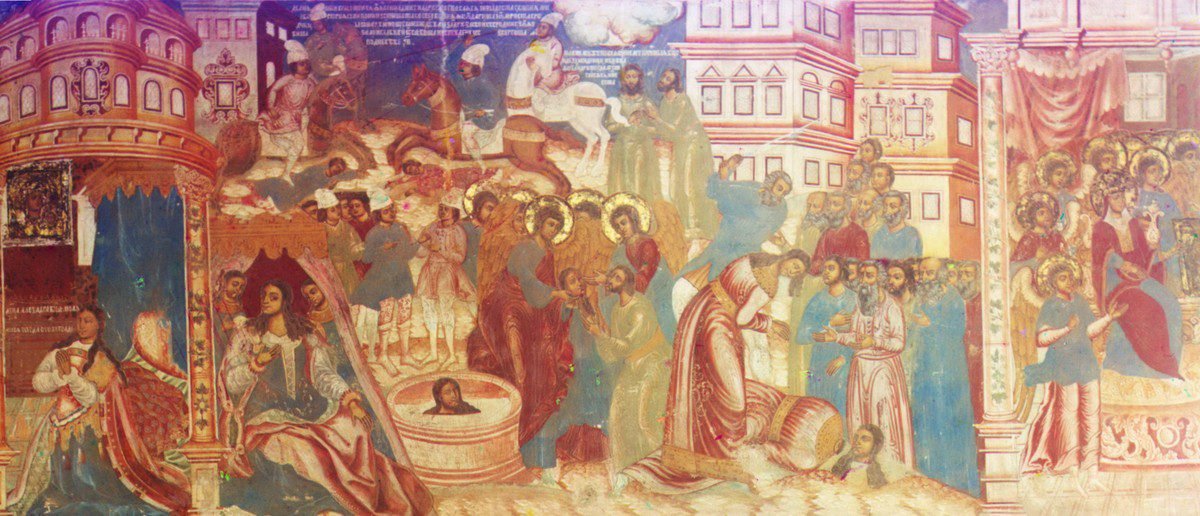
Merchant wealth accumulated in 17th-century Yaroslavl and spent itself, in part, on fresco programs unlike anything Russia had seen before. The Church of Elijah the Prophet (frescoes completed 1681) and the Church of John the Baptist at Tolchkovo (1694-1695) pack walls, vaults, and pillars with thousands of narrative scenes drawn from scripture, saints’ lives, and popular religious literature.
Earlier Russian fresco had worked with monumental single figures and theological economy. The Yaroslavl painters turned instead toward narrative density and undisguised pleasure in the visible world. Architectural settings grew more elaborate. Figures gained individualized faces and expressions. Scenes from daily life pressed in alongside sacred subjects. The figures themselves grew shorter and more grounded, arranged in processional rows that betray familiarity with Flemish and Dutch prints then circulating through Russia.
Russian Frescoes and Italian Renaissance Painting: Key Differences
How Did Russian Frescoes Differ from Italian Renaissance Frescoes?
Both traditions used buon fresco technique, but their visual programs diverged at nearly every other point. Italian Renaissance fresco pursued spatial illusion: orthogonal perspective, volumetric figures, cast shadows, and a convincing simulation of three-dimensional space. Russian Orthodox fresco refused all of this, deliberately. Inverted perspective, in which objects appear larger as they recede from the picture plane, pulls the viewer into the sacred image rather than opening a window onto an objective world. Frontal poses and suppressed individual psychology communicated universal archetype, not biographical person.
The two traditions also stood in different relationships to civic life. Italian Renaissance fresco programs frequently served dynastic or civic prestige. Russian fresco was a liturgical instrument: it taught, sanctified, and surrounded the worshipper with the entire cosmos of Orthodox belief, from the dome of heaven to the Last Judgment at the door.
What Gets Called a Fresco but Often Is Not
In Russian usage, “fresco” describes almost any wall painting in a church, whatever technique actually produced it. Many 18th and 19th-century murals were executed in oil paint on plastered walls, in distemper (water-based paint bound with glue), or in a layered approach mixing true fresco passages with extensive secco overpaint.
That terminological looseness matters for conservation. True buon fresco fuses pigment into the crystalline calcium carbonate matrix of the wall and, when competently executed, can survive for millennia. Secco layers applied over dry plaster are far more fragile: humidity, frost, and salts migrating through the masonry all work to lift them. When a visitor finds a Russian church with ‘frescoes’ that are flaking or blackened, the damage almost always originates in secco or oil-paint passages, not in the original plaster-bonded layers beneath.
Survival, Loss, and Restoration
The history of Russian frescoes is also a history of attrition. The Mongol invasions of 1237-1240 destroyed dozens of major church buildings across the Vladimir-Suzdal region. Later centuries brought whitewashing (many medieval cycles were sealed under limewash when tastes changed, which paradoxically preserved them), Soviet-era demolitions, wartime bombardment, and decades of inadequate heating that allowed freeze-thaw cycles to split plaster season after season. World War II destroyed the Church of the Savior on Nereditsa (c. 1199), one of the most significant 12th-century fresco cycles in Russia.
Major restoration campaigns have stabilized the Ferapontov frescoes and the surviving Rublev passages in Vladimir. A national documentation program recorded hundreds of provincial church paintings before they deteriorated beyond legibility. Scholars estimate that less than five percent of the medieval fresco surfaces that once existed in Russia survive in any form, and a significant share of those have been compromised by earlier restoration work using synthetic consolidants that proved incompatible with lime plaster over time.
Where Russian Frescoes Survive Today
Four sites are essential for anyone who wants to see Russian frescoes in person. The Church of the Transfiguration on Elijah Street in Veliky Novgorod (1378) holds the chamber frescoes of Theophanes the Greek, the most intact body of his work on Russian soil. The Cathedral of the Dormition in Vladimir preserves the 1408 Rublev-Chorny Last Judgment across the west wall and arches. The Ferapontov Monastery in the Vologda region contains the complete Dionysius cycle of 1502-1503, the most intact medieval fresco program in Russia. The Yaroslavl churches, particularly the Church of Elijah the Prophet and the Church of John the Baptist at Tolchkovo, show the 17th century’s shift toward narrative density and visual exuberance.
For closer study of brushwork and pigment, the State Tretyakov Gallery in Moscow and the State Russian Museum in St. Petersburg hold detached fresco fragments and panel paintings by the same masters.
Essential Points
- Russian fresco painting arrived from Byzantium after the Christianization of Kievan Rus in 988 and developed distinct regional traditions over six centuries.
- True buon fresco locks pigment into wet lime plaster chemically; many Russian church murals use secco, oil, or mixed techniques, which affects their long-term survival.
- Theophanes the Greek (c. 1330-c. 1410) brought an intense, expressively marked style to Novgorod; Andrei Rublev (c. 1360-c. 1430) shifted the tradition toward quieter, more compassionate imagery.
- The Ferapontov Monastery (Dionysius, 1502-1503) preserves the most complete medieval Russian fresco cycle in existence and is a UNESCO World Heritage site.
- Russian Orthodox fresco used inverted perspective and suppressed bodily weight, deliberately rejecting the spatial illusionism of Italian Renaissance painting.
- Color carried fixed theological meaning: deep blue for the Virgin, gold and white for divine light, red for martyrdom.
- The Yaroslavl school (17th century) replaced single monumental figures with dense narrative cycles covering entire church interiors.
- Scholars estimate that less than five percent of medieval Russian fresco surfaces survive intact today.
Frequently Asked Questions
- What is the difference between a fresco and an icon in Russian Orthodox art?
- A fresco is a mural painted directly onto plaster walls and permanently fixed to the church building. An icon is a portable panel painting on wood. Both served Orthodox worship, but frescoes surrounded the congregation with a comprehensive visual program of the entire heavenly hierarchy while icons were carried in processions, kept in homes, or placed on the iconostasis.
- How did the Mongol invasions affect Russian fresco painting?
- The invasions of 1237-1240 destroyed major cities and their churches across the Vladimir-Suzdal region, wiping out most early fresco work and causing a cultural rupture. Later painters had to reconstruct the tradition from provincial survivals and Byzantine sources, which partly explains the distinctive regional schools, particularly in Novgorod, that developed from the 14th century onward.
- What pigments did medieval Russian fresco painters use?
- Russian fresco painters used mineral pigments: iron ochres for reds and yellows, malachite for green, azurite and smalt for blues, and lime white for highlights. Vermilion (mercury sulfide) reacted poorly with alkaline plaster and was usually applied a secco. Lapis lazuli, used for the Virgin’s blue mantle, was reserved for major commissions due to its high cost.
- What makes Andrei Rublev’s fresco style distinctive?
- Rublev favored harmonious color relationships, gentle circular compositions, and figures with calm, inward-turning expressions. Compared to his teacher Theophanes the Greek, whose work emphasizes raw spiritual intensity through fractured white highlights, Rublev’s frescoes communicate tender compassion. His surviving Vladimir Cathedral work shows rose-mauve flesh tones, clear blue-green backgrounds, and saturated gold for divine presences.
- Where can visitors see medieval Russian frescoes today?
- The finest in-situ collections are at the Church of the Transfiguration on Elijah Street in Veliky Novgorod (Theophanes the Greek, 1378), the Cathedral of the Dormition in Vladimir (Rublev and Daniil Chorny, 1408), and the Ferapontov Monastery, Vologda region (Dionysius, 1502-1503, UNESCO World Heritage). The State Tretyakov Gallery and the State Russian Museum also hold detached fresco fragments.
This guide was written and reviewed by the rus-art.com editorial team, specializing in Russian art history. We cross-check dates, attributions, and museum holdings against museum and academic sources.