Quick Answer
Natalia Goncharova (1881 to 1962) was a Russian avant-garde painter who fused peasant folk art, Orthodox icon painting, and the lubok print with Cubist fragmentation and Futurist motion. She co-founded Jack of Diamonds and Donkey’s Tail, invented Rayonism with Mikhail Larionov, and staged what is widely regarded as Russia’s first solo retrospective of a living artist in 1913 to 1914. She later designed for Diaghilev’s Ballets Russes and settled in Paris.
What Is Natalia Goncharova’s Legacy in Russian Art?
Natalia Goncharova (3 July 1881 to 17 October 1962) stood among the leading figures of the Russian avant-garde. She painted, designed costumes, and made prints, fusing the flat color and heavy black outline of Russian peasant crafts, Orthodox icon painting, and the lubok woodcut with the fractured motion of European Futurism. In 1909 she co-founded the exhibiting group Jack of Diamonds, and in 1912 she helped launch its more radical splinter, Donkey’s Tail. Between 1912 and 1914 she invented Rayonism with her lifelong partner Mikhail Larionov. Her solo exhibitions in Moscow and St. Petersburg in 1913 and 1914 are widely cited as the first in Russia devoted to promoting a living artist through an independent gallery, a distinction that marks her as a pivotal figure rather than a follower of Western trends. She carried that influence to Paris, where she designed for Diaghilev’s Ballets Russes and lived until her death in 1962.
From a Noble Estate to the Moscow Art School
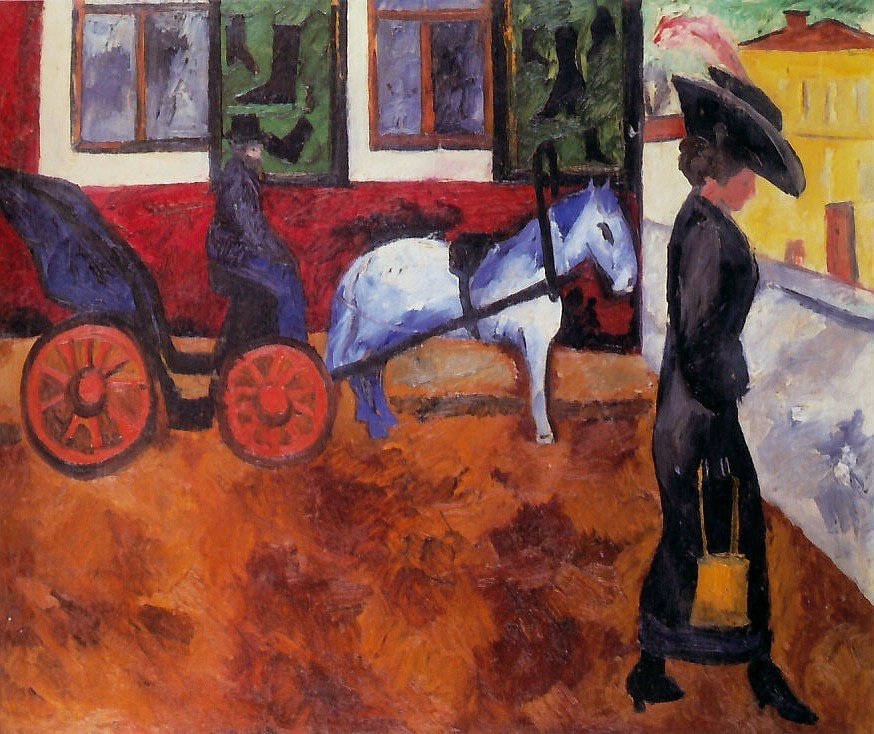
Goncharova enrolled at the Moscow School of Painting, Sculpture and Architecture around 1900, training first as a sculptor before she turned to painting. There she met Mikhail Larionov, a fellow student who became her lifelong partner and closest artistic collaborator. The two stayed inseparable in life and work for more than five decades. Her earliest surviving canvases, loose, high-keyed studies of streets, orchards, and still lifes, show her absorbing Impressionist and Fauvist color while still working within academic conventions. Street in Moscow (1909) captures this transitional moment: recognizable urban space rendered in flattened, unmodulated blocks of color that already strain against naturalistic depth. Within a few years she dropped Impressionist light altogether for the blunt, unshaded planes of Russian folk art, a shift that set the course for the rest of her career.
Why Did Goncharova Turn to Peasant and Icon Imagery?
She treated the lubok print, embroidered textiles, painted trays, and village icon boards as a living, undervalued national tradition, one she believed had more to teach Russian painters than the Paris salons her contemporaries admired.
Peasant Icons and Primitive Power: Her Defining Style
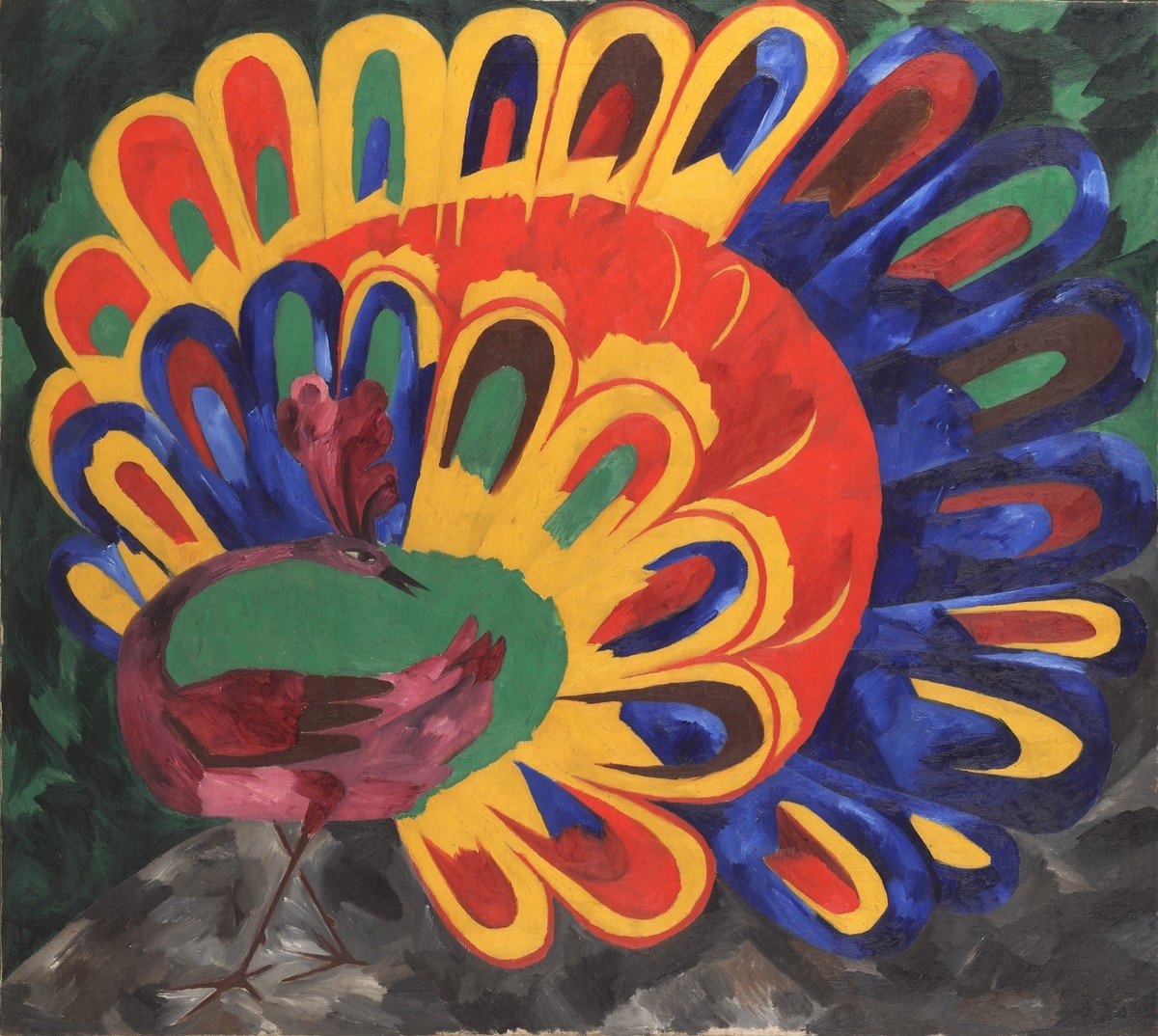
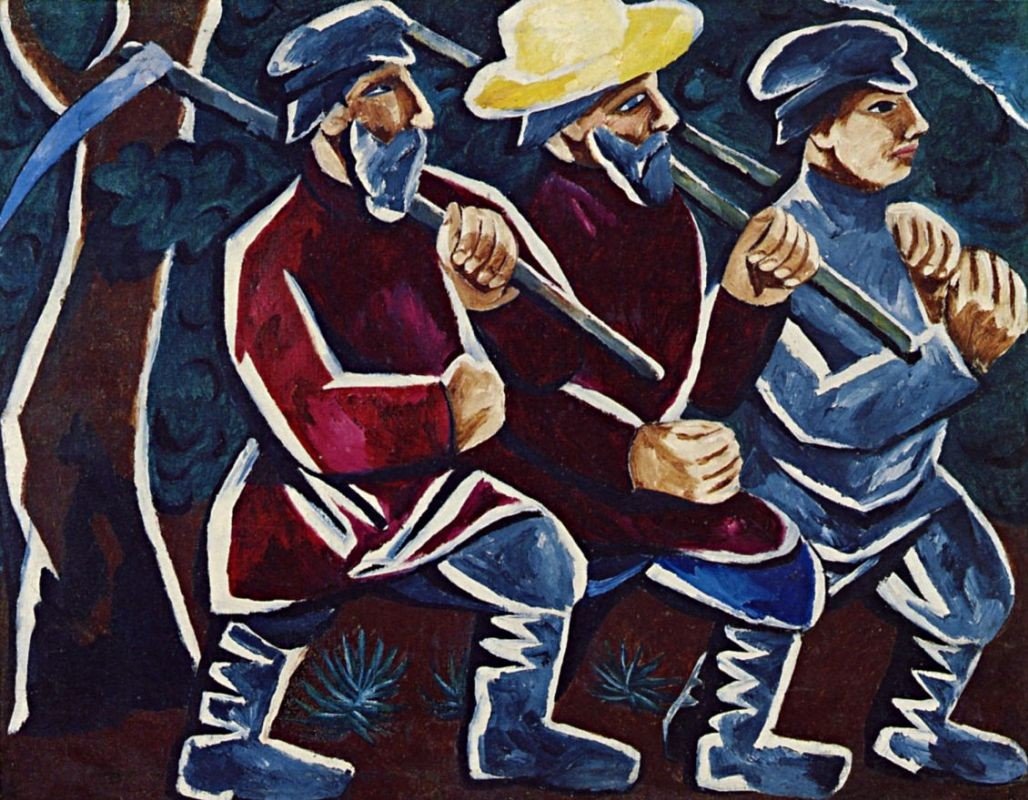
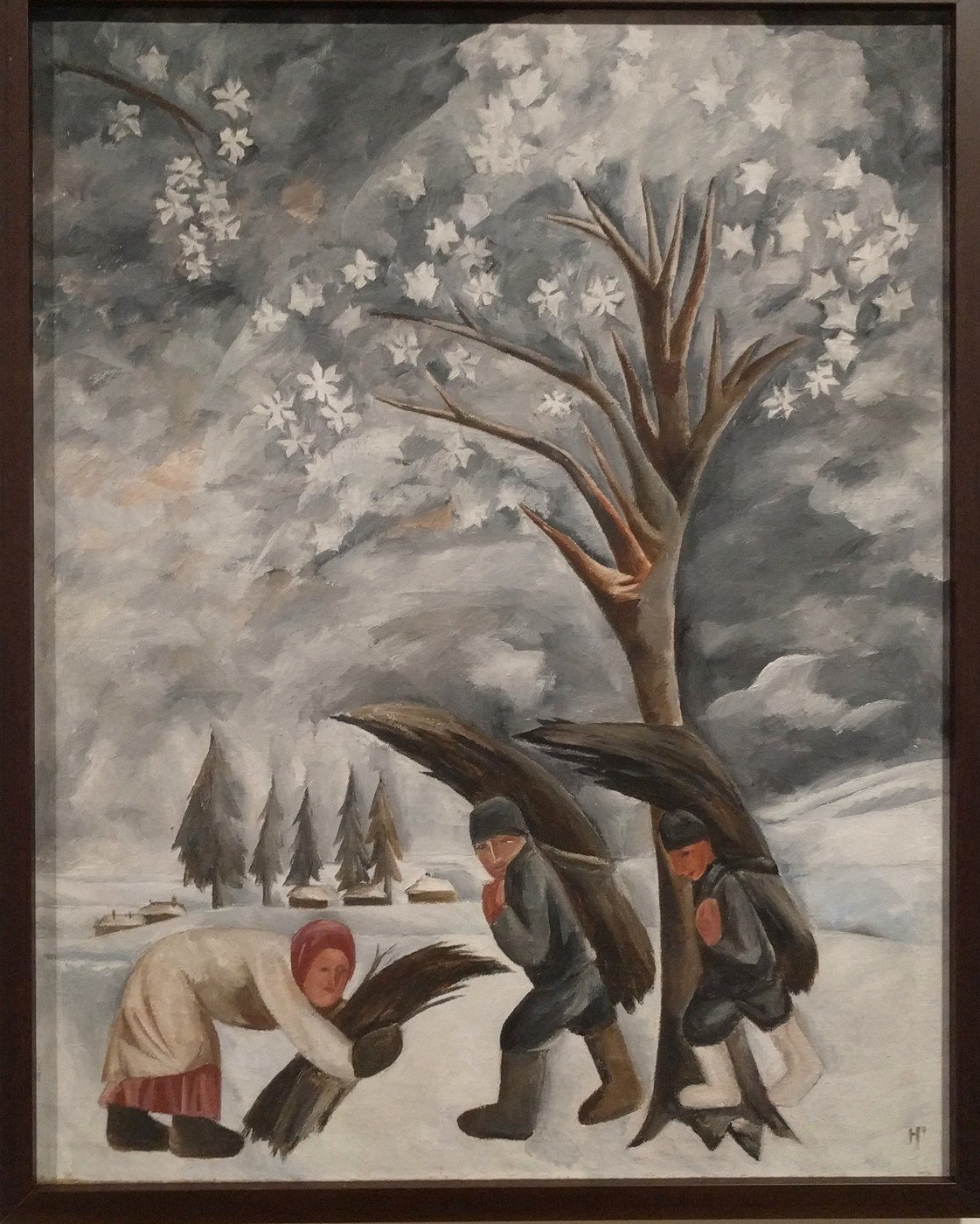
Goncharova’s mature style, often labeled Neo-primitivism, rejected illusionistic space for the bold black contours, frontal poses, and saturated flat color of icon painting and peasant crafts. Reapers (1911) shows the approach at its clearest: field workers compress into stacked, sculptural blocks, their bodies simplified almost to geometric shorthand, echoing the rhythm of manual labor rather than describing individual faces. Gathering Firewood and her many peasant-labor scenes from 1910 and 1911 follow the same logic, treating rural life as a subject worthy of the same formal seriousness as religious icons rather than picturesque genre painting. This was a deliberate provocation. Decorative painting and icon work were a respected, separate craft tradition at the time, and applying their visual language to modern fine art blurred a boundary many critics considered sacred. Goncharova’s peasants are neither sentimentalized nor exoticized. They are built from the same flattened, weighty forms she found in centuries-old panel painting.
Jack of Diamonds and the Birth of a Rebellious Circle
In 1909, Goncharova became a founding member of Jack of Diamonds, Moscow’s first radical independent exhibiting group, formed in direct opposition to the conservative academies and to the more decorative Symbolism of the older World of Art circle. The group, which also drew in artists such as David Burliuk, gave young Moscow painters a venue free of jury restrictions, letting raw, unfinished-looking, deliberately crude work onto gallery walls for the first time. Goncharova showed her peasant and still-life canvases alongside Larionov and other emerging Cubo-Futurists, and the exhibitions drew large, often hostile crowds along with press coverage that treated the paintings as an affront to taste. That controversy became part of the group’s identity and Goncharova’s own public profile. Being denounced in the Moscow papers did more for her visibility than a favorable academic review ever could have.
Donkey’s Tail: Breaking With the West
By 1912, Goncharova and Larionov judged Jack of Diamonds too dependent on French models and split off to found Donkey’s Tail, a name that mocked a Paris hoax in which a donkey’s tail dipped in paint had been exhibited as a modern artwork. Where Jack of Diamonds still looked to Cezanne and the Cubists, Donkey’s Tail turned deliberately inward, championing Russian icon painting, the lubok, children’s drawing, and shop-sign lettering as legitimate, self-sufficient sources for modern art. Goncharova became its most visible painter, showing large religious and peasant compositions that argued Russian visual tradition needed no European validation. The group dissolved by 1913, but its central argument, that Russia’s own folk and sacred art could generate an avant-garde as advanced as anything in Paris, shaped how Goncharova was understood for the rest of her career.
Rayonism: Painting Light Itself
Around 1912, Goncharova and Larionov developed Rayonism, a style built from crossing, ray-like lines meant to depict not objects but the light reflecting off them, one of the first genuinely abstract movements to emerge in Russia. Larionov’s Red and Blue Rayonism (Beach) (1911) shows the method at its most extreme, dissolving shoreline figures into intersecting shafts of colored light. Goncharova applied the same idea more selectively, often keeping a recognizable subject, a cyclist, a street, a still life, visible beneath the radiating lines, so the ray-forms read as energy layered over the world rather than a full replacement of it. The pair published a Rayonist manifesto in 1913, positioning the style as a distinctly Russian answer to Italian Futurism’s fixation on speed and machinery.
The 1912 Icon Scandal and the Fight Over Blasphemy
Goncharova’s religious paintings, canvases depicting evangelists and saints in the same blunt, icon-derived style she used for peasant subjects, provoked open conflict with civil and religious authorities. Icon painting was a licensed, closely regulated craft in the pre-revolutionary period, and applying its visual language to gallery paintings of her own invention struck censors as a transgression rather than a homage. Several works were pulled from exhibition as blasphemous before crowds could see them. The episode turned Goncharova into a public flashpoint. Newspapers debated whether a woman painter had any right to appropriate sacred imagery, while her supporters argued she was reviving, not desecrating, a national tradition. The controversy did not end her interest in religious subjects, but it marked her, alongside the earlier obscenity charges brought over her nude studies, as an artist whose work authorities were prepared to physically suppress rather than merely criticize.
Major Works: Reapers, The Cyclist, and the Rhythms of Peasant Life
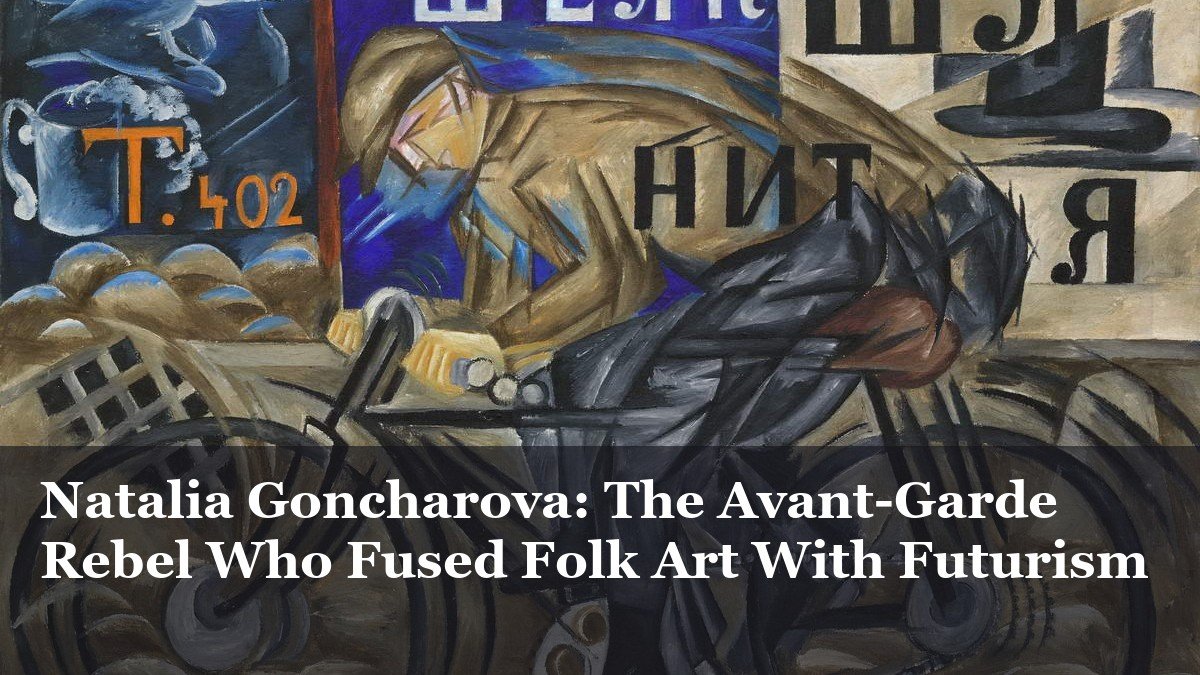
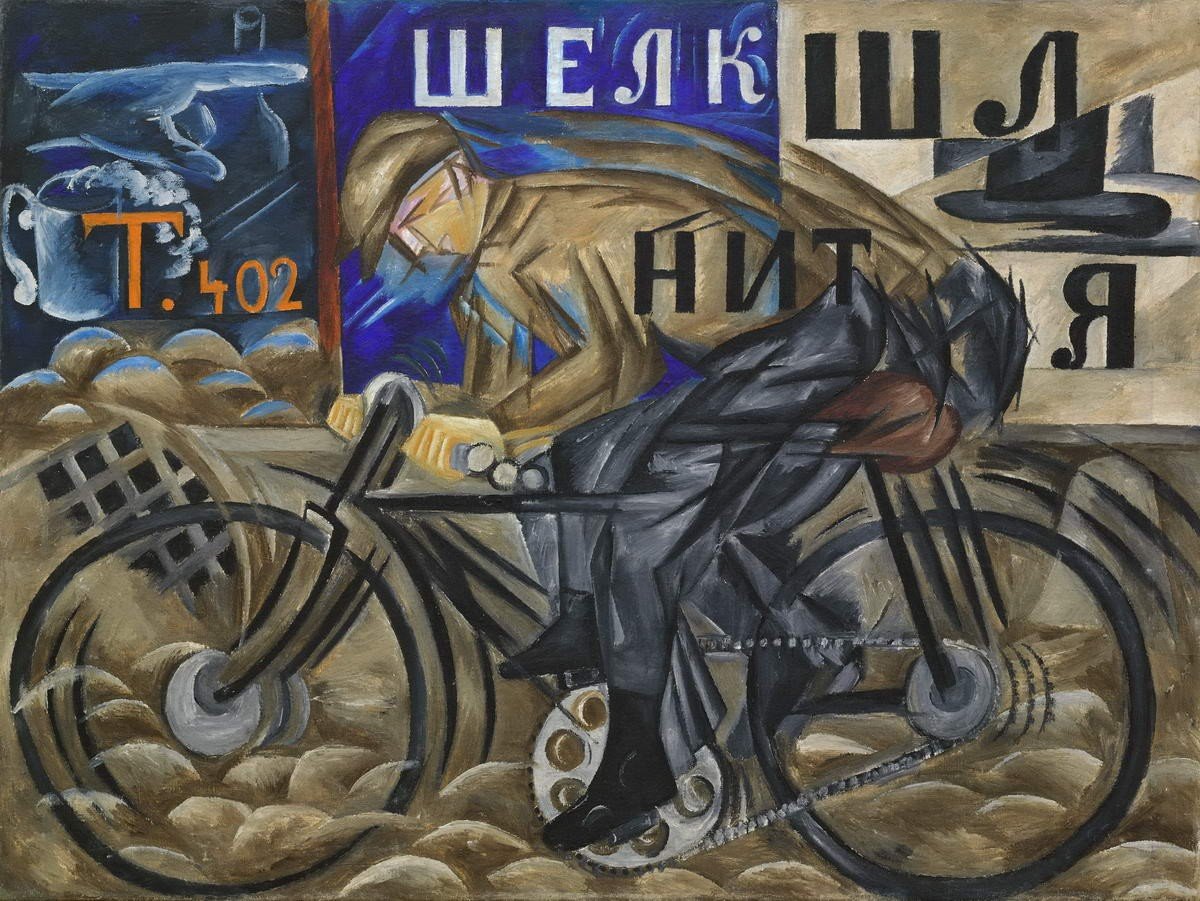
The Cyclist (1913, State Russian Museum) is Goncharova’s clearest fusion of her two central concerns. A modern subject, a rider bent over handlebars, is rendered through the multiplied, overlapping outlines of Cubo-Futurism, with fragments of shop-sign lettering scattered across the canvas like the painted signboards she studied in Moscow’s streets. Where the Italian Futurists idolized speed for its own sake, Goncharova grounds the same fractured technique in an everyday, distinctly urban Russian scene. Linen (1913), by contrast, applies her flattened, icon-derived figuration to a domestic subject, women washing and hanging cloth, proof that her formal vocabulary worked as well for quiet labor as for peasant fieldwork or motion studies. Seen alongside Reapers, these works show an artist moving fluidly between Neo-primitivism and Cubo-Futurism within a single year, never settling into one imported label.
Myth vs. Fact: She Did Not Copy Paris
Myth: Goncharova’s fractured, geometric canvases were a Russian echo of French Cubism. Fact: she and Larionov built Rayonism out of homegrown sources, the woodcut-flat color of the lubok print, the gold-ground stillness of Orthodox icons, and Russian shop signboards, arriving at abstraction on a track that ran parallel to Paris rather than trailing behind it.
Goncharova and Larionov: A Lifelong Creative Partnership
Mikhail Larionov was Goncharova’s partner for more than fifty years and her closest collaborator, from their student days at the Moscow School of Painting through Jack of Diamonds, Donkey’s Tail, Rayonism, and eventually the Ballets Russes in France and Switzerland. Larionov’s 1915 portrait of Goncharova captures her at the height of this partnership, painted the year before their work with Diaghilev pulled them permanently toward theater design. The two developed Rayonism jointly and signed its manifesto together, and throughout their careers they organized exhibitions, wrote polemics, and staged public provocations as a unit rather than as rivals chasing the same audience. Their relationship offers a working model rare among avant-garde couples of the period: two independent, equally radical painters who sharpened each other’s ideas for decades without either fully overshadowing the other’s individual body of work.
Diaghilev’s Ballets Russes and the Move to Paris
In 1914, Sergei Diaghilev invited Goncharova to design sets and costumes for the Ballets Russes, a commission that pulled her decisively toward Western Europe and toward theater as a primary medium. Working alongside Larionov, she carried the same saturated color and folk-derived pattern from her paintings onto the stage, translating peasant embroidery and icon gold into costume design for Parisian audiences who had never seen Russian avant-garde painting firsthand. In 1921 she settled permanently in Paris, where she kept designing for ballet and opera while also exhibiting paintings, and she remained based there for the rest of her life. Major museums including the Tate hold examples of her theater designs and paintings today, evidence of how thoroughly her later career was absorbed into the European gallery and performance circuit rather than remaining a purely Russian phenomenon.
Der Blaue Reiter and Goncharova’s Reach Beyond Russia
Before her move to Paris, Goncharova was already tied to Western European modernism as a member of Der Blaue Reiter, the Munich-based circle organized around Wassily Kandinsky and Franz Marc that championed spiritual and folk-inspired abstraction across national lines. Her inclusion in Der Blaue Reiter’s exhibitions and almanac placed her Neo-primitivist and Rayonist work alongside German Expressionists pursuing parallel, though independently developed, interests in non-naturalistic color and stylized form. This connection matters because it shows her reputation was international well before her emigration. Munich audiences and critics encountered her work years ahead of most of Paris. It also situates her within a wider European pattern in which artists across Russia, Germany, and France were independently mining folk art, non-Western sources, and religious imagery for a new visual language, each arriving at broadly similar conclusions from different starting points.
Legacy: Why Goncharova Matters to Modern Art
Natalia Goncharova is remembered less for one signature painting than for proving that a home-grown visual tradition, icons, lubok prints, embroidery, could generate an avant-garde as advanced as anything produced in Paris or Munich. Her insistence on treating peasant and religious imagery as serious formal material, not folkloric decoration, opened space for later Russian and Soviet artists to draw on vernacular sources without apology. As a woman leading exhibiting groups, co-authoring a manifesto, and staging what scholars describe as Russia’s first living-artist retrospective, she also expanded what institutional recognition could look like for female avant-garde painters in a field dominated by men. Her theater work with Diaghilev further ensured that Russian avant-garde design vocabulary reached mainstream European audiences decades before Soviet-era painting became widely accessible in the West, making her one of the main channels through which this material first became visible abroad.
Common Misconceptions About Goncharova
One persistent misconception treats Rayonism as a purely abstract, subjectless style comparable to later non-objective painting. In practice, most Rayonist works by both Goncharova and Larionov keep a recognizable figure or object visible beneath the crossing rays. Total abstraction was the exception within the style, not its rule. A second misconception assumes Larionov invented the couple’s shared innovations while Goncharova merely followed, an assumption that ignores her independent authorship of the Jack of Diamonds and Donkey’s Tail exhibitions and the fact that her solo retrospective, not a joint one, was the landmark exhibition of 1913 to 1914. Reading the two as co-authors of Rayonism, rather than as inventor and assistant, better reflects how their contemporaries and later art historians have credited the movement.
Related Movements: Cubo-Futurism, Neo-Primitivism, and Rayonism’s Heirs
Goncharova’s career crosses several overlapping strands of the Russian avant-garde. Cubo-Futurism blended Italian Futurist fragmentation with French Analytical Cubism and became the dominant painting style among Russian Futurist artists after 1913, supplying the framework Goncharova used in works like The Cyclist. Neo-primitivism, her earlier peasant and icon-derived style, fed directly into this later Cubo-Futurist phase rather than being replaced by it. Contemporaries working in related directions included Kazimir Malevich and Vladimir Tatlin, both of whom passed through their own primitivist and Cubo-Futurist phases before developing Suprematism and Constructivism respectively, and Aristarkh Lentulov, whose faceted, brightly colored cityscapes shared exhibition space with Goncharova’s work in Moscow’s independent gallery scene. Rayonism itself had no direct successor movement, but its core idea, that painting could depict light and energy rather than solid form, anticipated concerns that later abstract painters across Europe would return to independently.
Essential Points
- Natalia Goncharova (1881 to 1962) fused Russian folk art, icon painting, and the lubok print with European Futurist fragmentation.
- She co-founded Jack of Diamonds in 1909 and the more radical Donkey’s Tail in 1912.
- With Mikhail Larionov she invented Rayonism between 1912 and 1914, one of Russia’s first abstract art movements.
- Her 1913 to 1914 Moscow and St. Petersburg exhibitions are widely regarded as Russia’s first solo retrospectives of a living artist staged by an independent gallery.
- She belonged to the German-based Der Blaue Reiter circle, linking the Russian and Western European avant-gardes.
- She designed sets and costumes for Sergei Diaghilev’s Ballets Russes.
- She emigrated to Paris in 1921 and remained there until her death in 1962.
- Authorities pulled several of her religious-themed paintings from exhibition as blasphemous, a rare instance of state censorship targeting pre-revolutionary avant-garde art.
Frequently Asked Questions
- Who was Natalia Goncharova?
- Natalia Goncharova (1881 to 1962) was a Russian avant-garde painter and stage designer who combined Russian folk art, icon painting, and the lubok print with Cubist and Futurist fragmentation. She co-founded Jack of Diamonds and Donkey’s Tail and later designed for the Ballets Russes in Paris.
- Why was Goncharova’s art considered scandalous in pre-revolutionary Russia?
- Authorities and critics objected to her applying icon painting’s sacred visual language to independent gallery paintings, and to her nude studies, leading to censorship and public obscenity charges. Both controversies stemmed from her refusal to keep folk and religious imagery confined to their traditional, licensed craft contexts.
- How did icon painting shape Goncharova’s technique specifically?
- She borrowed icon painting’s flattened space, thick black contours, and reverse perspective, where distant elements appear as large as near ones, rather than illusionistic depth. This gave even secular subjects like reapers or cyclists the frontal, weighty presence typical of a devotional panel.
- Was Goncharova as prominent as Mikhail Larionov during her lifetime?
- Arguably more so early on: her 1913 to 1914 Moscow and St. Petersburg shows are widely regarded as Russia’s first solo retrospectives of a living artist by an independent gallery, a milestone Larionov did not individually match, even though the two developed Rayonism and exhibited together for decades.
- Where can I see Natalia Goncharova’s work today?
- Major holdings are in Moscow’s State Tretyakov Gallery and the State Russian Museum in St. Petersburg, with additional paintings and Ballets Russes designs at institutions such as the Tate in London and other European museums that collect Russian avant-garde and theater design material.
This guide was written and reviewed by the rus-art.com editorial team, specializing in Russian art history. We cross-check dates, attributions, and museum holdings against museum and academic sources.