Quick Answer
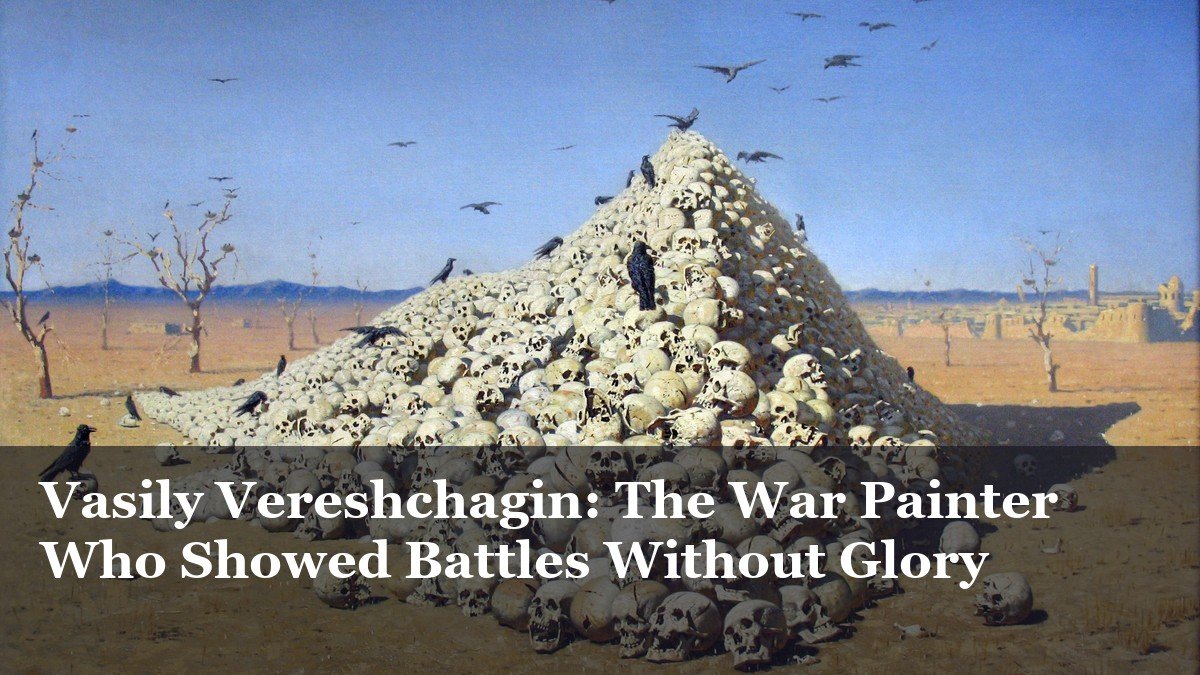
Vasily Vereshchagin (1842 to 1904) was a Russian painter who made war look like what it was: dead soldiers, ruined cities and survivors left in the cold. After serving in Central Asia and the Balkans, he refused the parade-ground heroism of conventional battle painting. His best-known work, The Apotheosis of War (1871), shows a pyramid of skulls dedicated ‘to all great conquerors’. His eyewitness approach angered Russian officials, yet it reshaped how war could be painted.
Who Was Vasily Vereshchagin?
Vasily Vereshchagin was a Russian painter, war artist and traveller, born on 26 October 1842 and killed on 13 April 1904. He built his career on a simple idea that few wanted to hear: a battle painting should show what war costs, not who won it.
Born in Cherepovets, in the Novgorod province, to a landowning family, he spent four decades moving between Central Asia, India, the Balkans, Palestine and the Philippines. Each journey was a commission from his own conscience. Many of his realist scenes were so graphic that they were never printed or shown to the public in his lifetime.
What he left sits awkwardly between genres. It is part history painting, part reportage, part travel diary. Nothing in Russian art before him looked quite like it.
From Naval Cadet to Student of Gérôme
Vereshchagin did not begin as an artist. His family sent him to the Naval Cadet Corps in St Petersburg, and he completed his studies there. He then turned away from a naval path and enrolled at the Imperial Academy of Arts, which he found stiff and dull.
Paris came next, and the academic painter Jean-Léon Gérôme. Gérôme gave him polished finish and a taste for Oriental subjects. Vereshchagin kept the tools and threw out the fantasy. Where Gérôme staged harems and gladiators, he wanted places he had actually stood in.
His naval training survives in his habits. He sketched on the spot, kept detailed notes, and went back to the studio to assemble canvases that read like annotated reports.
Samarkand, 1868: A Painter Under Siege
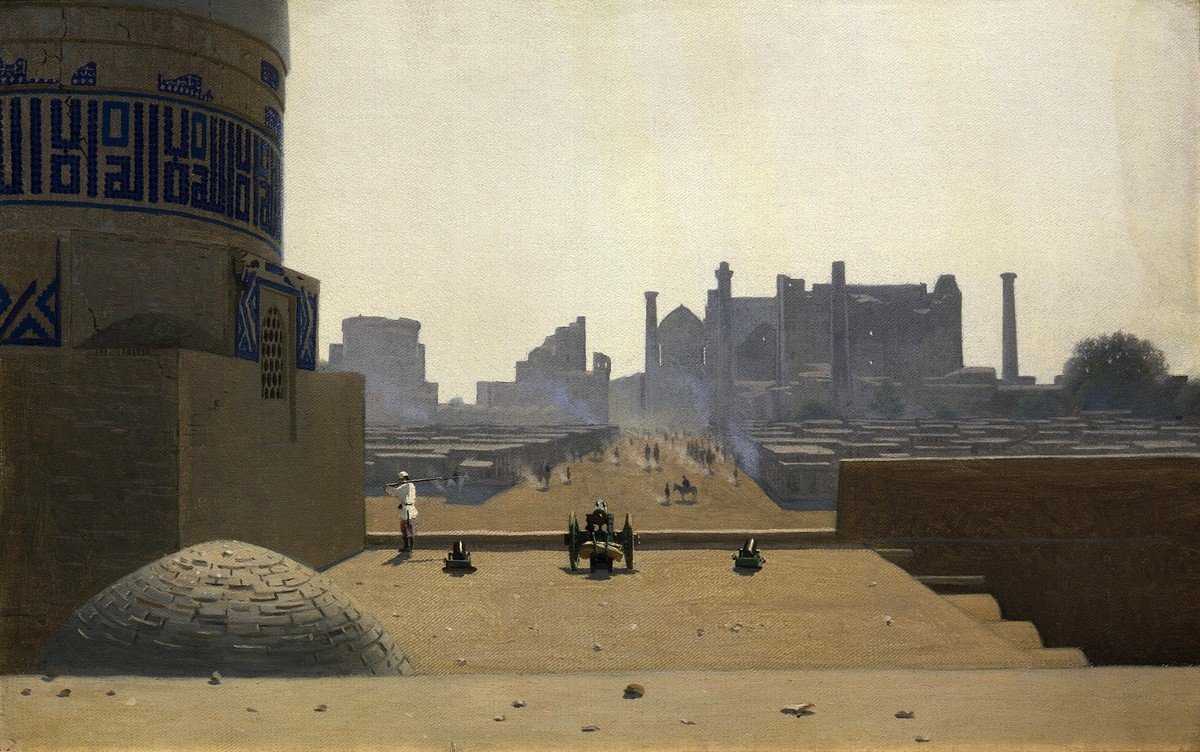
In 1867 Vereshchagin travelled to Russian Turkestan, newly conquered territory that the empire was organising under Governor-General Konstantin von Kaufman. In 1868 he was in Samarkand when the garrison in the citadel came under siege, and he fought in its defence. He received the Order of St George for it. He also never forgot what the fighting looked like from inside.
The same journey produced the quieter pictures of the Turkestan series. In his view of the main street of Samarkand from the citadel at early morning, and in his study of the Shir-Dor madrasa on the Registan, he records architecture with a surveyor’s patience.
Behind it all lay the Russian conquest of Central Asia, which pushed out the empire’s frontier and set off the Great Game with Britain. Vereshchagin saw that expansion at ground level, not on a map.
The Apotheosis of War: A Pyramid of Skulls
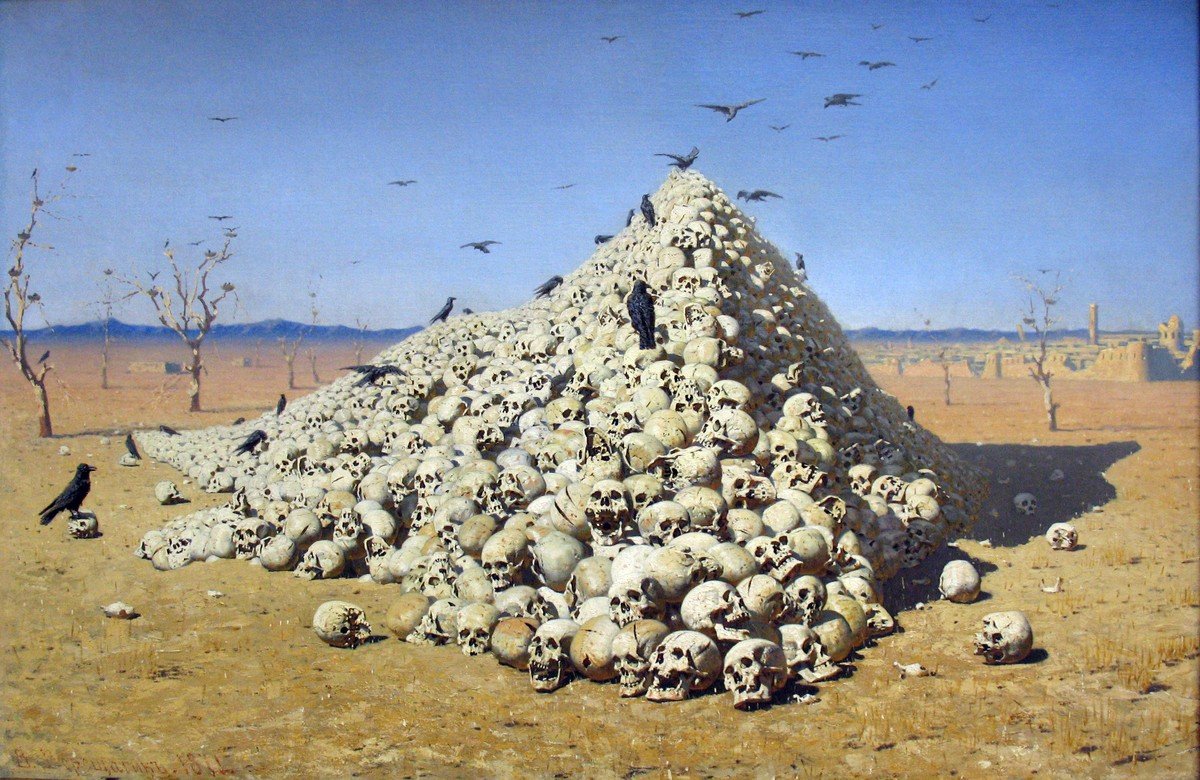
The Apotheosis of War (1871) is oil on canvas and belongs to the Turkestan series. A heap of skulls rises outside the walls of a Central Asian city, under a bare sky. Vereshchagin dedicated it ‘to all great conquerors, past, present and to come’, and that line turns a landscape into an accusation.
The skull pyramid draws on Central Asian history, in which rulers were reputed to stack the heads of their enemies. Yet the painter named no single conqueror, so the picture implicates Tamerlane and Tsars alike. Scholars still debate how directly he meant the Russian campaigns to fall under that dedication.
Today it hangs in the Tretyakov Gallery in Moscow, where it remains one of the most reproduced images of anti-war art in Russian culture.
Look Closer: The Apotheosis of War
Study the sky and the ground around the skull pyramid in The Apotheosis of War. No living person appears anywhere in the picture, and the only creatures present are crows. The empty scene turns the viewer into the sole witness, with nobody to cheer for and nobody to blame.
Why Did the Russian Establishment Turn on Him?
Who objected to Vereshchagin’s paintings, and why?
Mostly senior officers and court circles. His Turkestan exhibition in St Petersburg in 1874 drew crowds, but military critics accused him of slandering the Russian soldier and of fabricating details. Some argued that a veteran should not paint a conquest as a cemetery.
He answered by working in the same register. He had seen what he painted, he said, and a country comfortable with parade-ground pictures should not be shielded from pictures of the aftermath.
That quarrel shows what the art was for. Vereshchagin was not decorating a campaign. He was testing whether official culture could tolerate a witness.
Painting Like a Reporter: What Defines His Style
Vereshchagin’s canvases tend to be large, yet they avoid the swirling cavalry charge. He composes around stillness: a corpse on a frozen road, a sentry at his post, a line of captives. The viewer stands at ground level, often close enough to see faces and boots.
His colour is sober and local. Skies in the Turkestan work are pale and dry, while his Balkan snow scenes run to cold greys and blue shadows. A commander rarely occupies the centre of the action, which strips away the usual hierarchy of battle painting.
He also worked in series. Turkestan, the Balkan war, India, Palestine and the 1812 cycle were each exhibited as linked sets, closer to a photo essay than to a single masterpiece. Photography shaped him too. He knew the camera could record the dead, and he wanted painting to do the same with more weight.
Plevna and Shipka: The Balkan War Up Close
When the Russo-Turkish War broke out in 1877, Vereshchagin joined the army again, this time attached to the staff. A Russian-led coalition fought the Ottoman Empire, aiming in part to free Balkan nations from Ottoman rule, and the war eventually produced independent states in Romania, Serbia and Montenegro.
He witnessed the siege of Plevna, where two failed assaults cost the Russians heavily before Romanian King Carol I shifted to a siege. Vereshchagin was wounded in the fighting, and his brother Sergei was killed in the war.
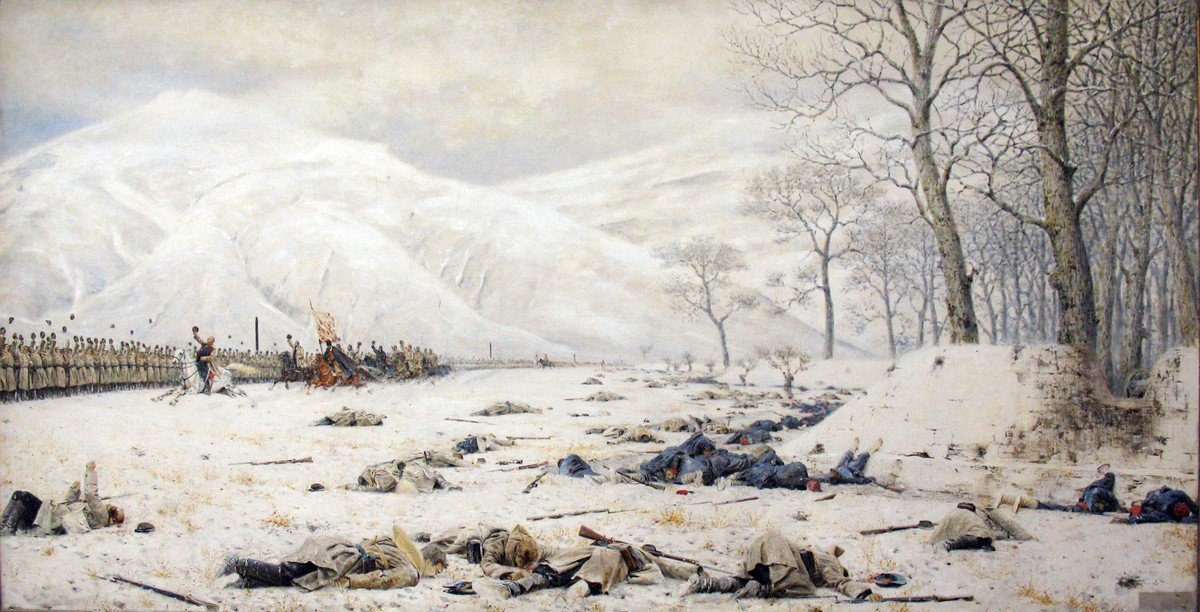
From this came his Balkan series, including the Shipka-Sheinovo canvas. General Skobelev rides before ranks of soldiers across a snowy field strewn with the fallen. The victory is real, but the bodies lie in the foreground, and that is the point.
India: The Pearl Mosque and the Traveller’s Eye
Between campaigns Vereshchagin travelled to India in the mid 1870s and painted Delhi and the Himalayas. His view of the Pearl Mosque in Delhi (1876) shows a white marble interior almost empty of people, rendered in clean, cool light.
These pictures show that violence was never his only interest. He painted places with the same exactness whether they held a battle or a prayer, and the India work supports his reputation as a field observer in the tradition of Russian explorers.
It also gave him a commercial footing. Exhibitions of his Indian studies in Europe built the international audience that later turned its attention to his war pictures.
The Holy Land and the Crucifixion by the Romans
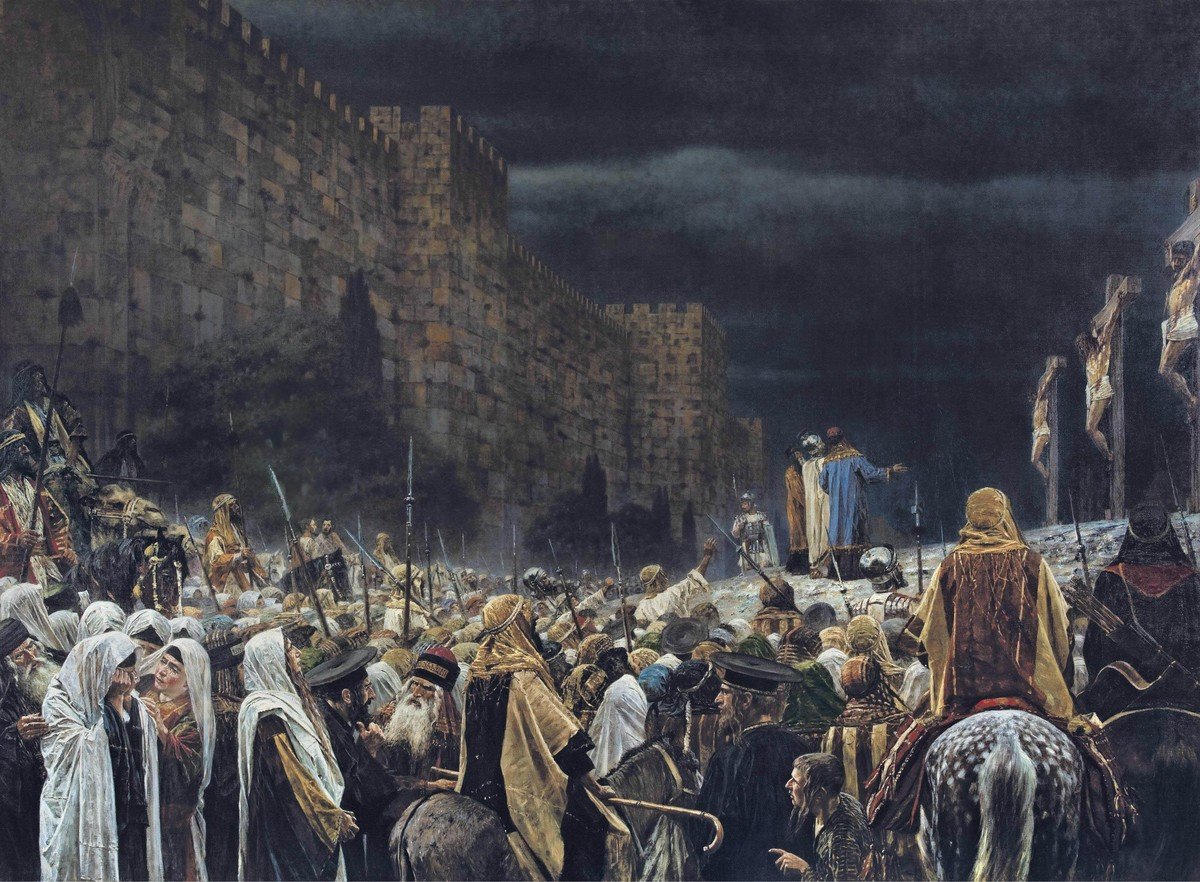
In the 1880s Vereshchagin turned to Palestine and religious subjects. His Crucifixion by the Romans (1887) presents execution as a state procedure: crosses on a hillside, bodies left in view, soldiers going about their duty.
He treated the subject as Roman imperial punishment, not as a devotional image, an approach that echoed his view of conquerors in Turkestan. Church authorities and some critics found it irreverent, and the series drew controversy in several countries.
Here the canvas makes clear that his central theme was never tied to one army. He was after the machinery by which states deal death and expect the public to look away.
The Other Tradition: Roubaud and Surikov
To see what Vereshchagin rejected, set him beside Franz Roubaud. Roubaud, a Russian painter of French origin, built vast panoramas such as the Siege of Sevastopol and Borodino, viewed from inside a cylinder, and his images were often believed to reproduce the original scene with high fidelity. His Storming of the Aul of Gunib (1886) celebrates the capture of Imam Shamil with cavalry and bright uniforms.
Vasily Surikov offers a third approach. His Suvorov Crossing the Alps in 1799 (1899) is dramatic, but it is a historical tableau about courage under hardship, not an indictment.
Together they form a spectrum: Roubaud gave war spectacle, Surikov gave it myth, Vereshchagin gave it evidence. Only he left viewers uneasy about enjoying the sight.
The Wanderers and the Man Who Stood Apart
The Peredvizhniki, or Itinerants, formed an artists’ cooperative in protest of academic restrictions and became the Society for Travelling Art Exhibitions in 1870. They shared Vereshchagin’s commitment to realism and social observation, and their exhibitions toured the provinces.
He stayed an independent, though. He worked abroad for long stretches, funded his own tours, and ran his exhibitions like international events. Where the Wanderers painted Russian peasants and priests, he painted the empire’s frontiers and its wars.
The comparison still helps. Both movements tested whether Russian painting could carry moral argument, and Vereshchagin pushed that argument into the area most governments guard most closely.
1812 and the Napoleon Pictures
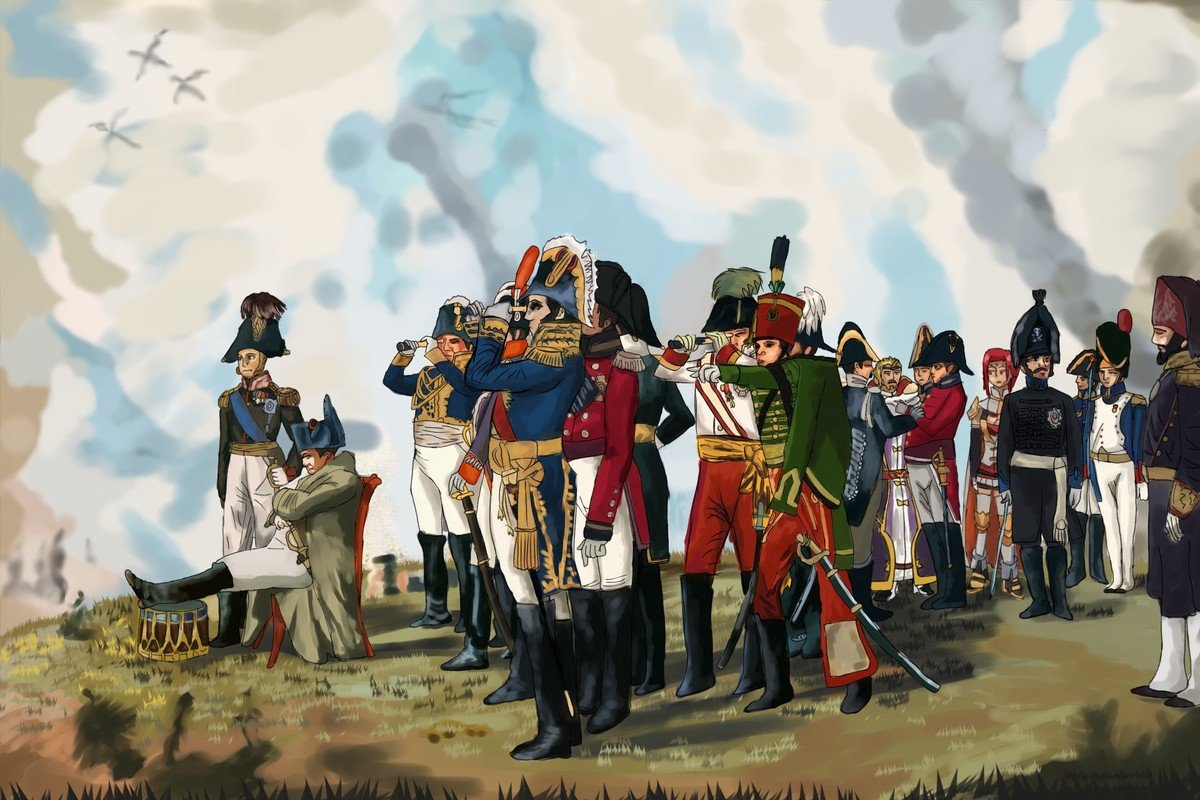
In the 1890s Vereshchagin took up Napoleon’s invasion of Russia. Napoleon near Borodino (1897) puts the emperor in the shadow of a battle he cannot control, a figure who has become a spectator of his own catastrophe.
The 1812 cycle brought him back to home ground, but his method held steady. He researched uniforms, routes and accounts, then painted fatigue, cold and indecision, not triumph.
Memoirs and essays occupied him in these years too, and the texts act as a verbal counterpart to the canvases. Read together, they show a man who treated the studio as a place to test an argument.
Port Arthur, 1904: Death on the Petropavlovsk
Vereshchagin died on 13 April 1904, when the battleship Petropavlovsk struck a mine at Port Arthur during the Russo-Japanese War. He was aboard as an artist, still travelling toward the front at sixty-one.
There is a hard irony in it. The painter who spent his career warning against the glorification of war was lost in one, and the loss was widely treated as a national tragedy, with the nation embracing him in death more readily than in life.
His end also settled an old question about his sincerity. He had not been a salon moralist. He kept going where the danger was.
Legacy: How He Changed War Art
Military art began as a celebration of victory, since rulers have always been keen to celebrate their victories and intimidate potential opponents. Casualties and civilians entered the picture far more slowly, and Vereshchagin stands among the figures who accelerated that shift.
The practice he helped establish, treating aftermath rather than triumph as the painter’s subject, found its most visible continuation in the First World War generation: Paul Nash’s shell-cratered landscapes in Britain and Otto Dix’s depictions of trench warfare in Germany brought the same insistence on honest witness to the next century’s conflicts.
In Russia, the Soviet period celebrated his anti-imperial and anti-militarist side while minimising the awkward fact that he had served the Tsar’s armies. A fair reading keeps both: he was a soldier-artist who judged what he served.
Where Can You See Vereshchagin’s Work?
Start at the State Tretyakov Gallery in Moscow, which holds The Apotheosis of War and much of the Turkestan material. Pavel Tretyakov’s early purchases created that concentration, and they explain why visitors see the series in Moscow instead of scattered abroad.
Other Russian museums also hold his Balkan and Indian studies, and reproductions of his canvases circulate widely through digital archives, including public-domain scans of the Shipka paintings.
If you can visit only one room, choose the one with the skull pyramid. Then walk to the Balkan canvases and notice how little the figures of command matter.
Was He a Pacifist?
Not in the strict sense. Vereshchagin volunteered for combat in 1868, joined the army in 1877, and went to the Far East in 1904. What he opposed was glorification and the silence around casualties, not the presence of artists at war.
That distinction is why admirers and critics can both cite him. He believed war was terrible, and he believed an honest painter had to go and look. Reading him as a simple peace campaigner flattens a more uncomfortable position.
Essential Points
- Vereshchagin trained as a naval cadet before turning to art, which gave him a disciplined, observational habit rather than an academic one.
- His credibility came from presence: he was under fire in Samarkand in 1868 and again in the Balkans in 1877.
- The Turkestan series did double duty as ethnography and anti-war statement, a combination rare in nineteenth-century Russian painting.
- Official hostility came from the army and court, not from the public, and his exhibitions drew large crowds.
- His war pictures rely on aftermath and waiting, not on the clash itself.
- Painters such as Franz Roubaud and Vasily Surikov show the alternative tradition he was reacting against.
- Pavel Tretyakov’s purchases explain why so much of his Central Asian work sits in a Moscow museum today.
- He died the way he painted, within sight of a battle, aboard a flagship at Port Arthur.
Frequently Asked Questions
- Who was Vasily Vereshchagin in simple terms?
- Vasily Vereshchagin was a nineteenth-century Russian painter who travelled with armies and painted what he saw. Instead of cheering generals and charges, he painted corpses, ruins and exhausted soldiers. His work is best known for its blunt honesty and for angering many officials at home.
- Why was Vereshchagin controversial in imperial Russia?
- His paintings contradicted the heroic image of conquest that the army and court preferred. When his Turkestan series appeared in St Petersburg in 1874, officers questioned its accuracy and patriotism. Crowds still came, which showed that public curiosity ran ahead of official comfort with realistic war imagery.
- What do the skulls in The Apotheosis of War symbolise?
- The skull pyramid stands for the human cost of conquest, and the dedication to all conquerors widens the target beyond one ruler. Vereshchagin painted it in 1871 as part of his Turkestan series. Scholars debate how directly it was aimed at Russian campaigns specifically.
- Was Vereshchagin part of the Peredvizhniki, the Wanderers?
- Not as a member. He shared the Wanderers’ realism and moral seriousness, and their cooperative formed around the same period, but he worked independently and often abroad. His subjects were frontiers and battlefields, while the Wanderers mostly painted Russian social life.
- Where can I see Vereshchagin’s paintings today?
- The State Tretyakov Gallery in Moscow holds The Apotheosis of War and much of his Turkestan series, thanks to Pavel Tretyakov’s collecting. Other Russian museums hold Balkan and Indian works, and many canvases are available as high-resolution public-domain images through Wikimedia Commons.
This guide was written and reviewed by the rus-art.com editorial team, specializing in Russian art history. We cross-check dates, attributions, and museum holdings against museum and academic sources.