
Quick Answer
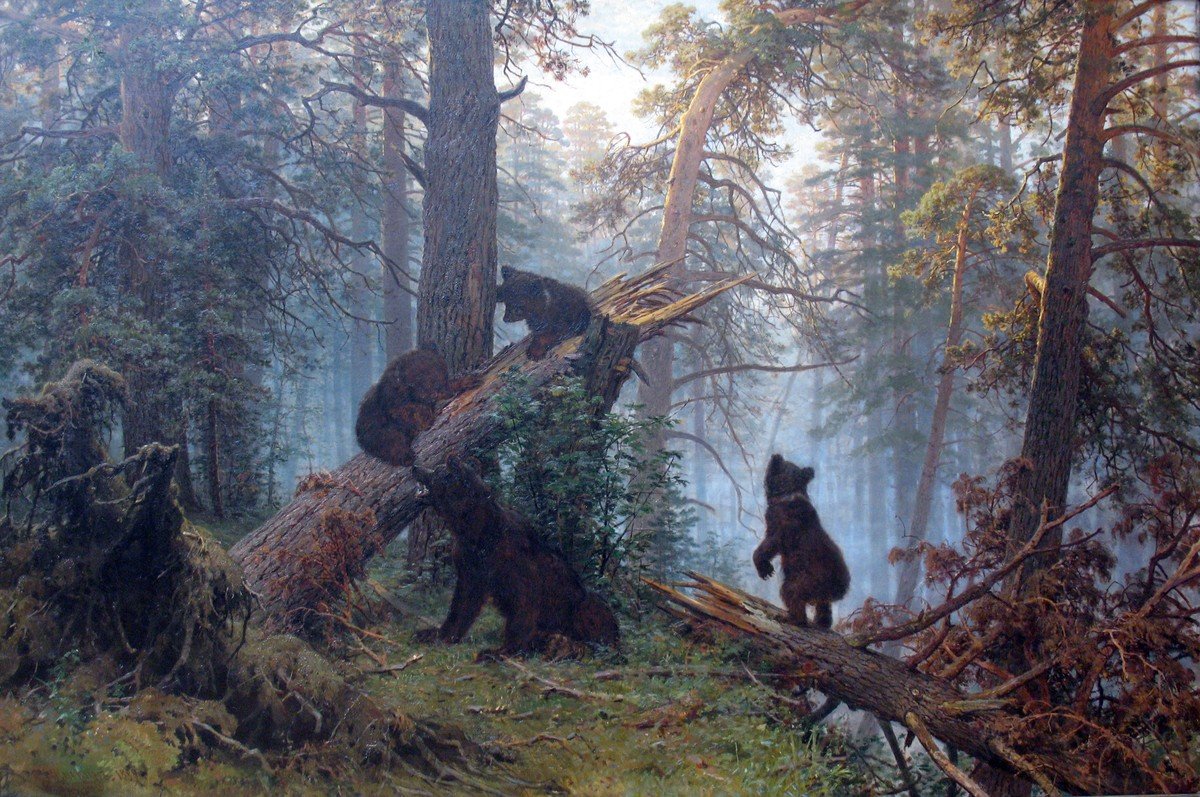
Ivan Shishkin (1832 to 1898) was a Russian Realist painter who turned the northern pine forest into a national subject. His most famous canvas, Morning in a Pine Forest (1889), is a joint work: Shishkin painted the forest and fellow Wanderer Konstantin Savitsky added the bears. Shishkin’s authority came from years of botanical drawing, outdoor study, and a founding role in the Peredvizhniki, the artists’ society that took exhibitions out of the capital. The result is a painting Russians recognize at a glance, even when they cannot name its maker.
What Is Morning in a Pine Forest?
Morning in a Pine Forest (Russian: Утро в сосновом лесу) is an 1889 oil painting of a she-bear and three cubs clambering over a snapped pine in dawn mist. It hangs in the State Tretyakov Gallery in Moscow. Two painters share the credit. Ivan Shishkin designed the forest and painted nearly all of it, while Konstantin Savitsky added the bears.
The canvas measures roughly 139 by 213 centimeters, big enough that the nearest trunks loom over anyone standing close. It was first known as The Bear Family in the Forest, a title that shows what the artists first thought the subject was.
The Man Who Knew Every Tree
Ivan Ivanovich Shishkin was born on 25 January 1832 (13 January, Old Style) in Yelabuga, a town on the Kama River. He died in St Petersburg on 20 March 1898 (8 March, Old Style). A Realist painter and draughtsman best known for landscapes, he came up during the reign of Tsar Alexander II and was among the founders of the Peredvizhniki.
His subject was narrow, and he never apologized for it: pine, spruce, oak, birch, rye. Colleagues and critics of his day treated him as the specialist other landscape painters consulted when a tree had to look like that tree and no other.
From Yelabuga to the Academy
Shishkin came from a merchant family in a provincial river town, far from the art schools of the capitals. He trained first at the Moscow School of Painting, Sculpture and Architecture, then moved to the Imperial Academy of Arts in St Petersburg in the later 1850s.
Composed, studio-built views, often Italianate, were the Academy’s taste in those years. Shishkin did the required work and won recognition for it, including a stipend to study abroad. Yet his sketchbooks from Russian woods already pointed somewhere the curriculum did not.
Düsseldorf, Zurich and a Lesson in Looking
Between 1862 and 1865 Shishkin worked abroad, spending time in Zurich and Düsseldorf, both centers of precise landscape study. He drew mountains and woods outdoors and picked up a German habit of building a picture from measured detail.
Did foreign training shape his forests?
Yes, mainly in method. The subjects stayed Russian, but the discipline of drawing outdoors came home with him. A Düsseldorf view he showed in 1865 earned him the title of academician, a credential that later let him argue with the Academy from inside it.
Why the Wanderers Needed a Forest Painter
The Peredvizhniki formed as an artists’ cooperative in protest of academic restrictions, then became the Society for Travelling Art Exhibitions in 1870. Its public frontman was Ivan Kramskoi, a Realist painter and critic who argued that Russian art should speak about Russian life.
Genre painters had obvious subjects: peasants, clerics, exiles. Shishkin supplied the other half of the program, a countryside with no Italian ruins in it. When the society’s exhibitions traveled to provincial cities, his forests were the part of the show many viewers could check against their own walks.
Drawing First: How Shishkin Built a Forest
Shishkin’s method started with pencil, ink and charcoal studies of single trunks, roots and branches. On these sheets a pine and a spruce are visibly different animals. The pine’s bark breaks into plates, the spruce lets its lower boughs droop, the oak twists its limbs.
An early canvas such as Lumbering (1867) already shows the habit. Felled timber and standing trees get the same close attention, and the eye stays low, among the trunks rather than above them. Later paintings simply scale up that discipline.
Rye and the Open Field
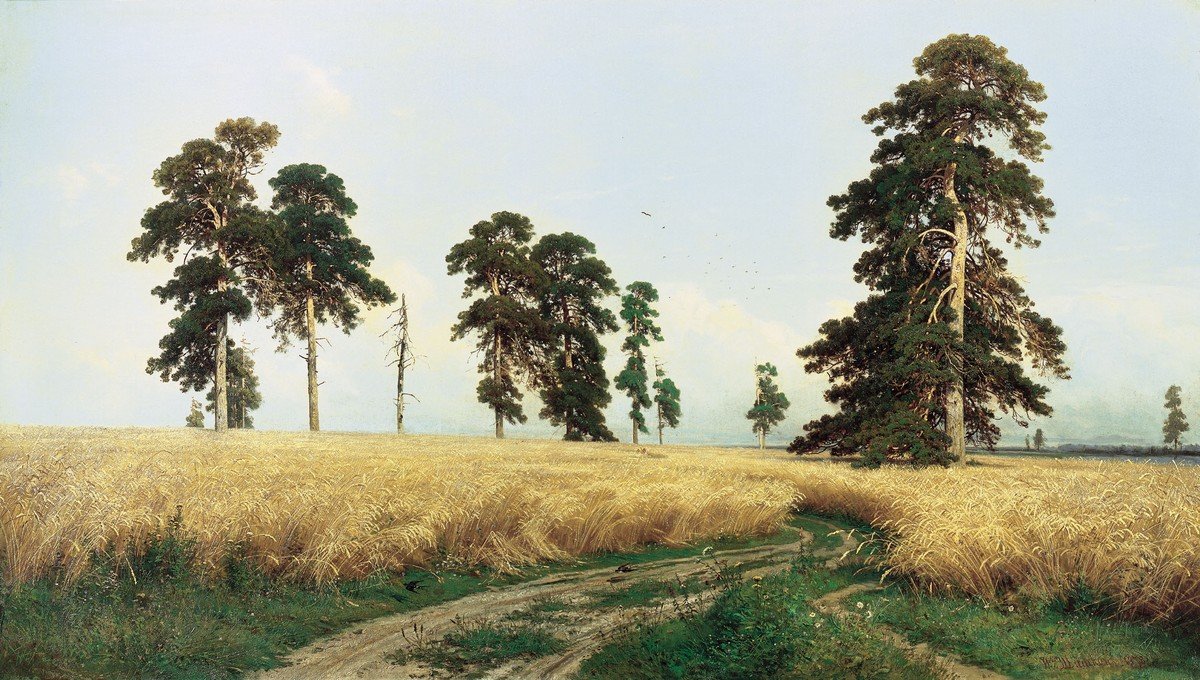
Anyone who files Shishkin as a pure forest specialist should stand in front of Rye (1878). A road cuts through tall ripening grain toward a cluster of pines under a high sky, and the horizon is given real room.
The picture belongs to the same decade as the Wanderers’ growing confidence. It also shows that his precision was not tied to trees. The grain heads get the same care as bark, and the sky is left to carry the weather.
Who Painted the Bears?
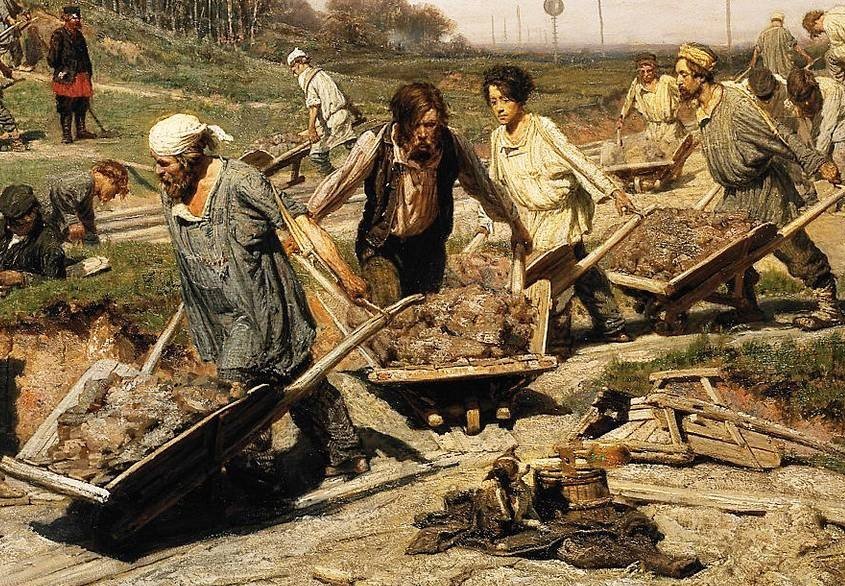
Konstantin Apollonovich Savitsky (1844 to 1905) was a Realist known mainly for genre pictures such as Repair Work on the Railway (1874), which follows laborers with documentary frankness. Animals were not his usual business, yet the bears in Morning in a Pine Forest are his.
Collector Pavel Tretyakov bought the painting and, according to the widely repeated account, had Savitsky’s signature removed, reportedly judging that the concept, composition and mood belonged to Shishkin. Savitsky’s contribution was thus physically erased from the canvas while remaining in the record. Accounts of Tretyakov’s exact words vary, so read the story as tradition rather than a documented transcript.
Look Closer: Follow the Trunks Into the Haze
Look at the pines at the back of Morning in a Pine Forest. They lose color and edge as they recede, until the farthest ones are barely darker than the mist itself. Then return to the splintered bark of the broken tree in the foreground. The gap between that crisp surface and the dissolving distance is what makes a clearing of a few meters feel like deep woods.
A Bear Family Becomes a Morning
Changing the title from The Bear Family in the Forest to Morning in a Pine Forest moves the subject. The first name points at the animals. The second points at the hour, the place and the air.
That shift suits how the picture is built. The bears are small against the trees, and viewers remember them first only because they are the one thing that moves. The title asks you to notice that the forest, not the family, is doing the talking.
Reading the Canvas: How the Composition Works
The broken pine in the foreground works as a hinge. Its diagonal brings the eye in from the lower edge, carries it across the cubs, and hands it to the vertical rhythm of standing trunks. Because the trunks are cropped at the top, the forest has no visible ceiling.
The cubs break the symmetry of an otherwise orderly row of tall stems. Without them, the scene would read as a study of a clearing. With them, it reads as an event already underway.
Polesie, Forest Distances and the Late Style
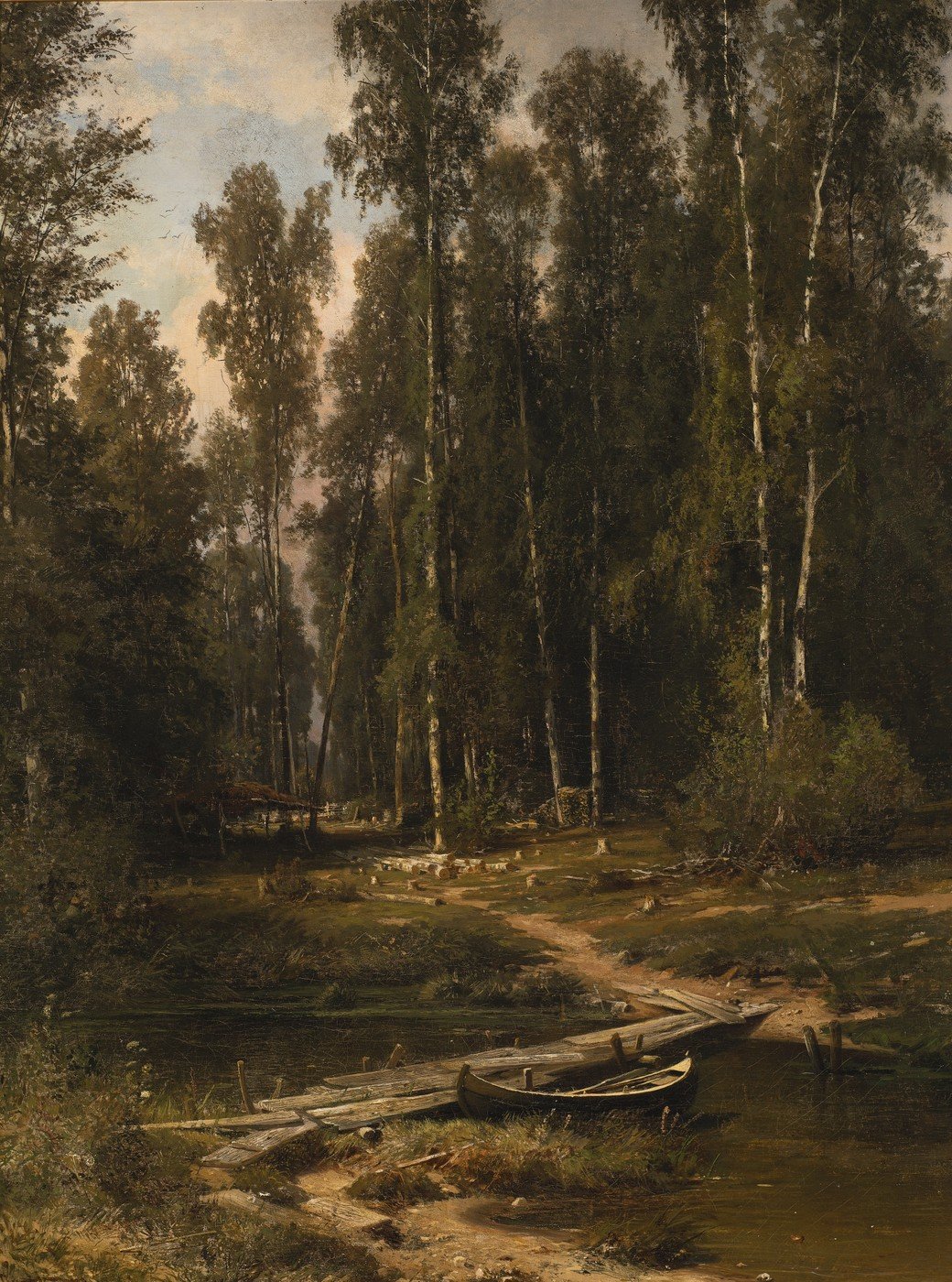
In the 1880s Shishkin’s views widened. Polesie (1883) and Forest Distances (1884) stretch woodland toward a faint horizon, with the density of foliage built up in layers rather than line.
The manner is calmer and more panoramic than the clearings of his early career. Scholars sometimes read it as settled confidence, though no single document fixes when the shift began.
Savrasov, Vasilyev and Kuindzhi: Neighbors, Not Copies
Russian landscape in the 1870s was crowded with strong voices. Alexei Savrasov’s The Rooks Have Returned (1871) asked viewers to feel early spring in a thawing village. Fyodor Vasilyev, who died at 23, painted The Thaw (1871) with a loose, melancholy touch. Arkhip Kuindzhi staged glowing light, as in Moonlit Night on the Dnieper (1880).
Shishkin stood apart because he described rather than evoked. Those painters moved the viewer through atmosphere. He did it through verifiable structure: this tree, this bark, this light.
Teaching and the Last Years
In the mid-1890s Shishkin headed the landscape studio at the Academy of Arts, passing his approach directly to a younger generation. He kept exhibiting with the Wanderers and drawing from nature well into his sixties.
He died suddenly in St Petersburg in 1898, reportedly while at work. A man who spent a career insisting that painters should look before they compose left behind a body of drawings that is still used as a teaching reference.
From Gallery Wall to Candy Wrapper
Morning in a Pine Forest ranks among the most recognized paintings in Russia, often mentioned alongside Viktor Vasnetsov’s Bogatyrs (1898) as a shared national image. Its reach extends well beyond the museum: Russian chocolates named Mishka Kosolapy (Clumsy Bear) have long carried a version of the scene.
That ubiquity creates a quiet problem. A picture seen on a wrapper in childhood is rarely looked at again as a painting, which is part of why close-looking at the original still rewards the visitor.
Where Shishkin Sits in Russian Art
Shishkin links the academic landscape tradition to the Realist program of the Wanderers, and his insistence on structure shaped what the next painters could rebel against. Younger artists such as Isaac Levitan would favor mood over inventory, while Kuindzhi pushed color and light toward theater.
Seen against that line of descendants, Shishkin is the fixed point: the artist who made the Russian forest specific enough to be argued about.
Essential Points
- Shishkin’s reputation rests on drawing: his forests persuade because each tree is built from studied structure, not from mood.
- Morning in a Pine Forest is best read as a collaboration between a landscape specialist and a genre painter, not a solo work.
- The Peredvizhniki gave Shishkin a public: exhibitions that traveled meant Russian forests were seen by people who lived near them.
- His open-field pictures, such as Rye, show a range that the famous bears tend to hide.
- Among his landscape contemporaries, he is the one who describes, while others tend to evoke.
- Mass reproduction turned a museum picture into shared cultural furniture, which is both its fame and its risk of being overlooked.
- To understand Shishkin, look at his sheets of studies as much as his finished canvases.
Frequently Asked Questions
- Where should a beginner start with Ivan Shishkin?
- Start with Morning in a Pine Forest, then look at Rye to see his open-air range, and finish with a few of his pencil studies. That sequence moves from the famous image to the evidence behind it. Museum websites usually offer high-resolution zooms of all three.
- Why did Russian painters of the 1870s turn to local landscape?
- Alexander II’s reforms encouraged public debate about national identity, and the Wanderers wanted art that spoke about Russia itself. Italianate studio landscapes felt distant to them. Painting birch groves, rye fields and pine woods offered a subject that viewers across the empire could recognize.
- What materials did Shishkin work in besides oil paint?
- Shishkin drew extensively in pencil, charcoal and ink, and he also made etchings, a medium that rewarded his love of line and texture. Many of his most admired studies are black-and-white sheets of single trees, which show his understanding of structure before color was added.
- What was the link between Shishkin and Ivan Kramskoi?
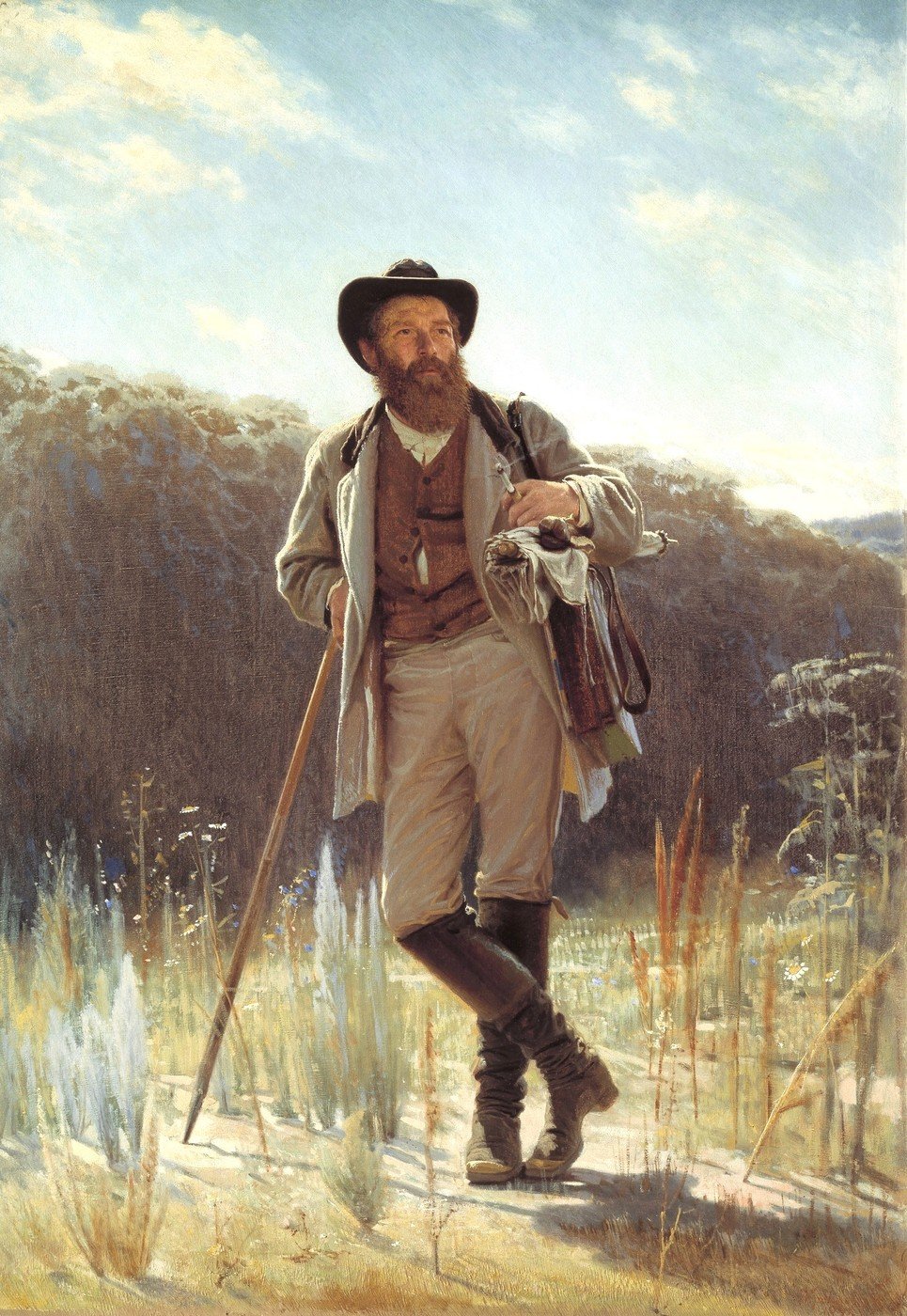
- Both were founders of the Peredvizhniki. Kramskoi was its organizer and public voice, and he painted a portrait of Shishkin in 1880. Their link shows that the society’s landscape and portrait wings worked closely together, even though their daily practice differed.
- Where can I see Shishkin’s paintings today?
- The State Tretyakov Gallery in Moscow holds Morning in a Pine Forest and other major canvases, and the State Russian Museum in St Petersburg also has strong holdings. Both publish collection pages online, and many Shishkin images are in the public domain on Wikimedia Commons.

This guide was written and reviewed by the rus-art.com editorial team, specializing in Russian art history. We cross-check dates, attributions, and museum holdings against museum and academic sources.