Quick Answer
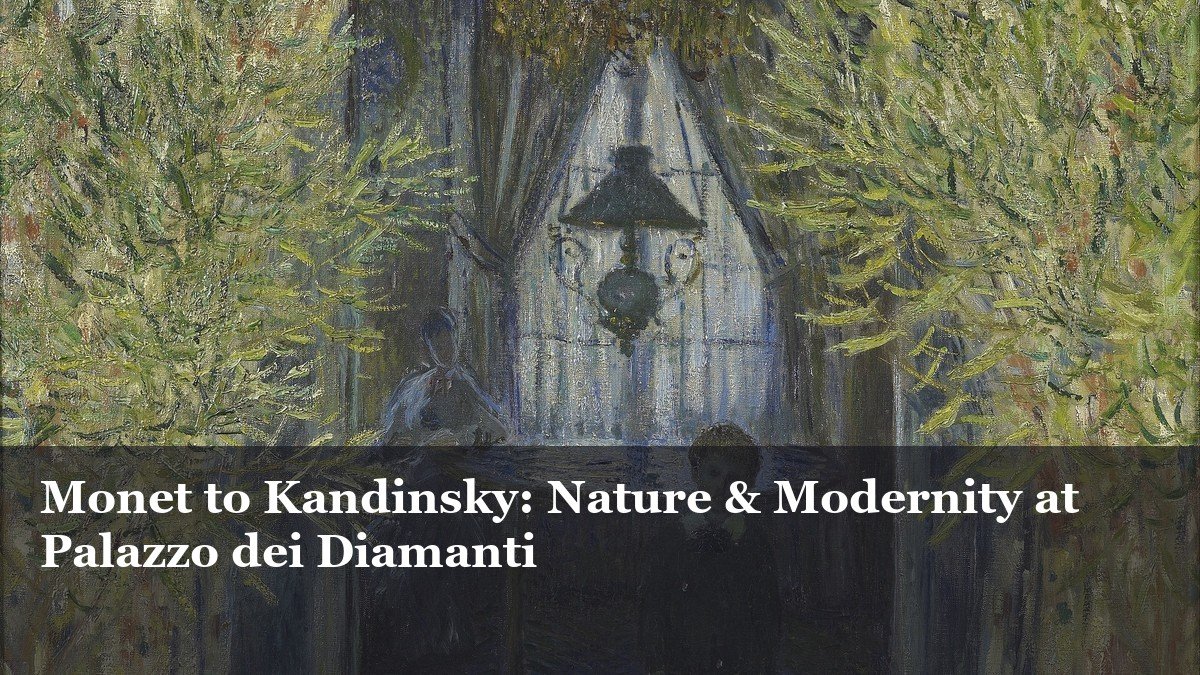
An exhibition at Palazzo dei Diamanti, Ferrara, running 19 September 2026 to 10 January 2027. Works come from the Museum Boijmans Van Beuningen and other European collections, arranged into nine sections. The four headline names are Monet, Van Gogh, Kandinsky and Mondrian; the through line is how European painting moved from observed nature toward pure abstraction. For current hours and ticket prices, check the official listing before visiting.
Nature as subject, then nature as pretext, then nature left behind. The exhibition From Monet to Van Gogh to Kandinsky. New Perspectives on Nature and Modernity builds its whole argument around that shift, pulling paintings from the Museum Boijmans Van Beuningen and other European collections into nine sections that read like chapters of one long sentence.
It starts with the Barbizon School’s plain-spoken fields and ends with grids and color planes that owe nothing to a landscape at all. In between, Impressionism does the hinge work: light and weather painted on the spot, perception trusted over description.
Palazzo dei Diamanti, Ferrara, Italy
Dates: 19 September 2026 to 10 January 2027
The Artists
Claude Monet gave the exhibition’s organizing idea its name, in a sense. His insistence on painting what the eye actually meets, outdoors, in shifting light, set Impressionism’s terms and makes him the show’s natural starting pulse.
Vincent van Gogh pushed that same commitment to perception toward something rawer. His landscapes and still lifes, built from bold color and urgent brushwork, carry the emotional charge that later Expressionist and abstract painters would claim as ancestry. The Ferrara show positions him in the middle sections, between the Impressionist works and the turn toward Kandinsky’s abstraction, which is the position where his role in that transition reads most clearly.
Wassily Kandinsky, born in Moscow, is usually credited as a founding figure of Western abstraction. Where Monet and Van Gogh still painted a field or a chair, Kandinsky worked toward forms untethered from any object, a logical endpoint for a show tracking nature’s slow exit from the canvas.
Piet Mondrian completes that arc. He moved from figurative Dutch landscape painting toward Neoplasticism, reducing his vocabulary to line, plane and primary color, art built on universal structure rather than observed nature. His trajectory within this exhibition, from the observed landscape he started with to the grids he arrived at, is one of the show’s most instructive sequences for visitors tracing how figurative painting gave way to abstraction.
Style and Movement
What the Ferrara exhibition does differently from a textbook treatment is compress the argument into nine consecutive sections under one roof. Most permanent collections hold Barbizon, Impressionist and early abstract works in separate rooms or buildings, rarely framing them as stages of a single claim. The sequence is the exhibition’s argument, not its container. The Boijmans Van Beuningen holds a range across this period that few collections can match, and bringing those loans to Ferrara allows the nine-section arc to make its case with primary evidence rather than reconstruction.
Those nine sections move through deliberate stages: the Barbizon painters working on location, the Impressionist shift from subject to perception, the Expressionist intensification of color and mark, and finally the non-objective work Kandinsky and Mondrian produced in the 1920s. What no survey book can replicate is walking that arc in sequence, each room reframing the one before it, so that Mondrian’s grids read less as a stylistic leap and more as an earned conclusion.
Why It Matters
Kandinsky’s presence gives this otherwise French-and-Dutch story a Russian hinge point: his late-career turn to abstraction, shaped by Bauhaus teaching from 1922 onward, sits at the exact pivot this exhibition is built around. For readers tracking Russian art’s reach into European modernism, seeing his work staged against Monet and Van Gogh, rather than in isolation, shows exactly where that reach lands.
Essential Points
- Palazzo dei Diamanti, Ferrara: 19 September 2026 to 10 January 2027
- Nine sections trace painting from the Barbizon School through Impressionism to abstraction
- Works drawn from the Museum Boijmans Van Beuningen and other European collections
- Monet, Van Gogh, Kandinsky and Mondrian mark four stages of the same arc
- Kandinsky, born in Moscow, anchors the show’s Russian connection to European abstraction
For current hours, tickets, and any changes to these dates, always check the official exhibition listing before visiting.
This listing is compiled from official museum/gallery sources and reputable arts publications, linked above. Details change — always confirm dates on the official listing before visiting.