Quick Answer
The State Russian Museum, housed in the Mikhailovsky Palace on Arts Square, brings together Russian fine art spanning eight centuries in a single institution. Opened to the public in 1898 as a museum named for Alexander III, it holds medieval icons, eighteenth-century portraits, Bryullov’s The Last Day of Pompeii, Repin’s Barge Haulers on the Volga, Vrubel’s Flying Demon and a major avant-garde collection. It draws millions of visitors each year, yet many tourists to St Petersburg choose the Hermitage and never see it.
What Is the Russian Museum?
The Russian Museum holds a major collection of Russian fine art. It stands on Arts Square in the center of Saint Petersburg. It was once the Russian Museum of His Imperial Majesty Alexander III, and today its official name is the State Russian Museum.
The focus is narrow on purpose. The museum does not chase the Louvre’s range or the Hermitage’s European masters. It collects Russian art, from medieval icons and folk art through the eighteenth and nineteenth centuries to the twentieth-century avant-garde. Walking its rooms, you follow one national story told in paint, wood, stone and paper.
A Palace Built for a Younger Son
The main building began as a family home, not a gallery. The Mikhailovsky Palace was planned as the residence of Grand Duke Michael Pavlovich, youngest son of Emperor Paul I. Work had not started when Paul was overthrown and killed in a palace coup that put Michael’s elder brother on the throne as Alexander I.
Once Michael turned 22, the new emperor revived the plan. Carlo Rossi drew up designs for a fresh site, and the palace became the centerpiece of an ensemble of new streets and squares. In 1825 Alexander gave it to Michael and his wife, Grand Duchess Elena Pavlovna. Contemporary accounts record that the interiors cost more than the main construction, a fair measure of how much the family prized display.
A Museum Named for an Emperor
At the end of the nineteenth century the imperial family turned the palace into a public museum. It opened in 1898 as the Russian Museum of His Imperial Majesty Alexander III, a memorial to the emperor who loved collecting Russian painting. His own purchases, including major canvases by Ilya Repin, formed part of the founding stock.
That royal start explains a quirk in the museum’s character. The state was a buyer, not merely a custodian. Court taste, the Academy of Arts and the emperor’s purchase list all shaped what entered the collection. The result is a museum that shows Russian art as it was recognized officially in its own day.
How Is It Different From the Tretyakov Gallery?
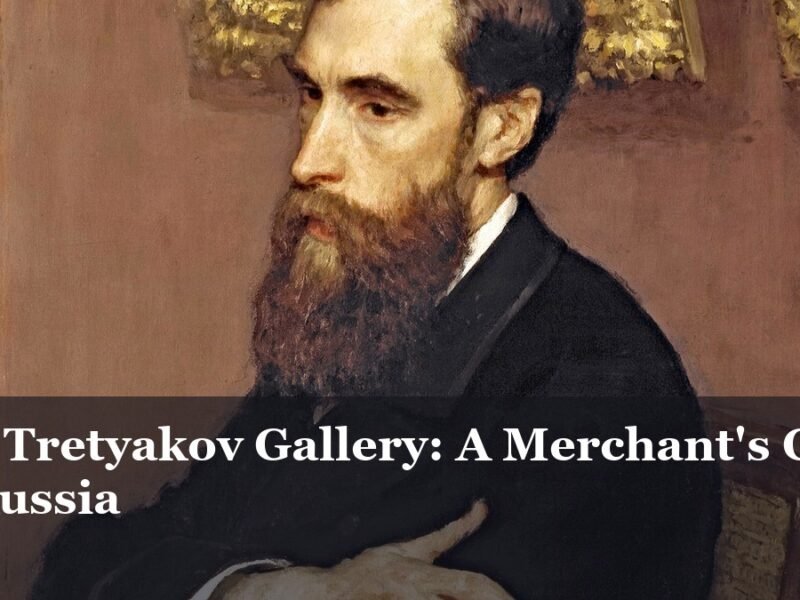
The two great Russian collections grew from opposite impulses. The State Tretyakov Gallery in Moscow began in 1856, when the merchant Pavel Mikhailovich Tretyakov started buying works by artists of his own time. In 1892 he presented his collection to the Russian nation. Many writers still call the gallery the foremost depository of Russian fine art in the world.
Which one should you visit first?
The Tretyakov Gallery reflects one man’s eye. The Russian Museum reflects a state’s institutional memory. Compare the two cities and you will meet the same artists in both, but weighted differently. For a first-time student of the field, seeing both on a single trip is the cleanest way to separate personal taste from national narrative.
Why Do Tourists Skip It?
Most visitors to Saint Petersburg arrive with a short list: the Hermitage, the Church of the Savior on Spilled Blood, perhaps a canal cruise. The Russian Museum sits a few minutes’ walk from the church, yet it often falls off the plan because it carries no famous name from outside Russia. Anyone hoping for Rembrandt or Matisse will not find them here.
The neglect is only relative. The museum draws millions of visitors each year, making it one of the most-visited cultural institutions in Russia. It is not obscure. It is simply second on the itinerary in a city whose first stop is enormous.
Before the Academy: Icons and Early Portraits
The earliest rooms hold medieval icons, many from Novgorod and other northern workshops. This is a primary place to see how Russian painting looked before Peter the Great pulled it toward Europe. One celebrated example is the twelfth-century icon known as the Angel with Golden Hair, which many visitors single out as the museum’s oldest star.
The next rooms show the shift. In the later eighteenth century, portraitists such as Dmitry Levitsky painted the pupils of the Smolny Institute in the poised, silk-heavy manner of the European court. A few steps carry you from flat, gold-grounded saints to girls with powdered hair, and the distance shows how quickly the rules of Russian painting were rewritten.
Bryullov and the Painting That Made Russia Famous
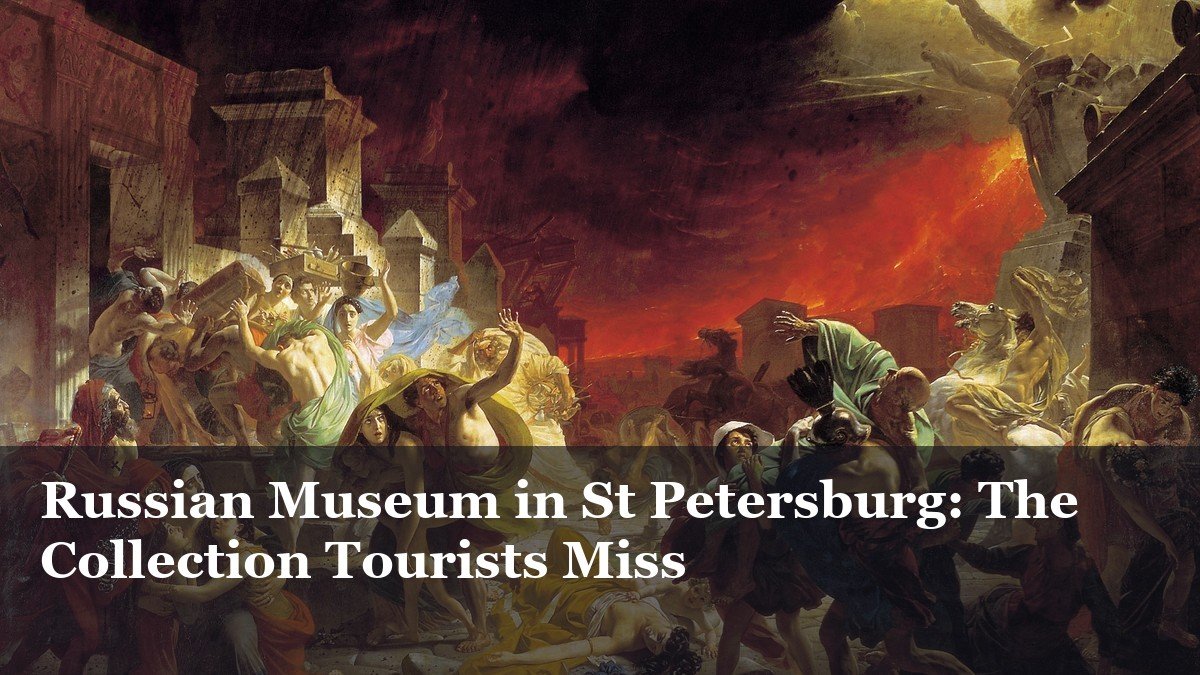
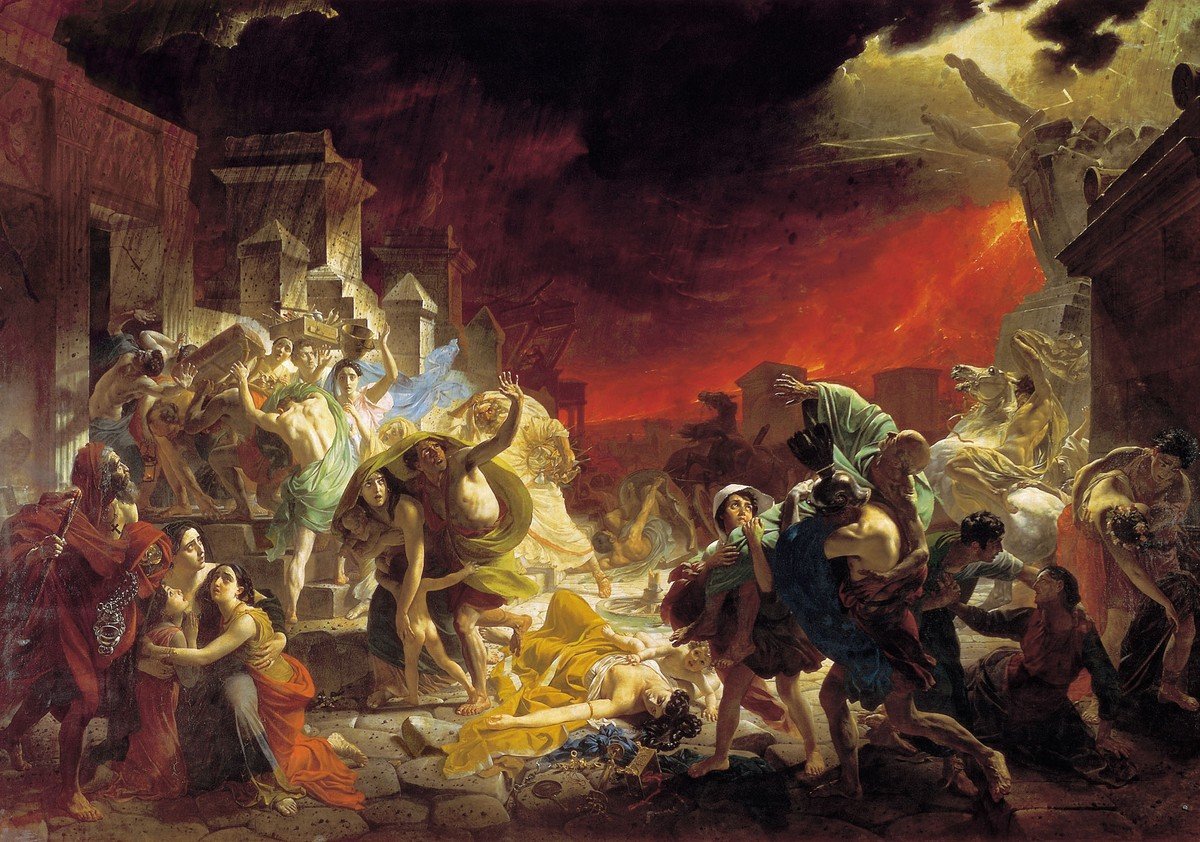
Karl Bryullov painted The Last Day of Pompeii between 1830 and 1833, a vast history painting of the eruption of Mount Vesuvius in AD 79. It sits between Neoclassicism, which dominated Russian painting at the time, and Romanticism as practiced in France.
Acclaim was nearly universal, and the canvas won Bryullov an international reputation that reached well beyond Russia. At home it served as proof that Russian art equaled art elsewhere in Europe. Bulwer-Lytton’s novel The Last Days of Pompeii appeared the following year, and many accounts link the two works. Critics in France and Russia did point to one odd tension: the perfectly modeled bodies seem calmer than their desperate situation, as if the Academy’s sculptural training had survived the earthquake.
Aivazovsky and the Wave That Will Not Break
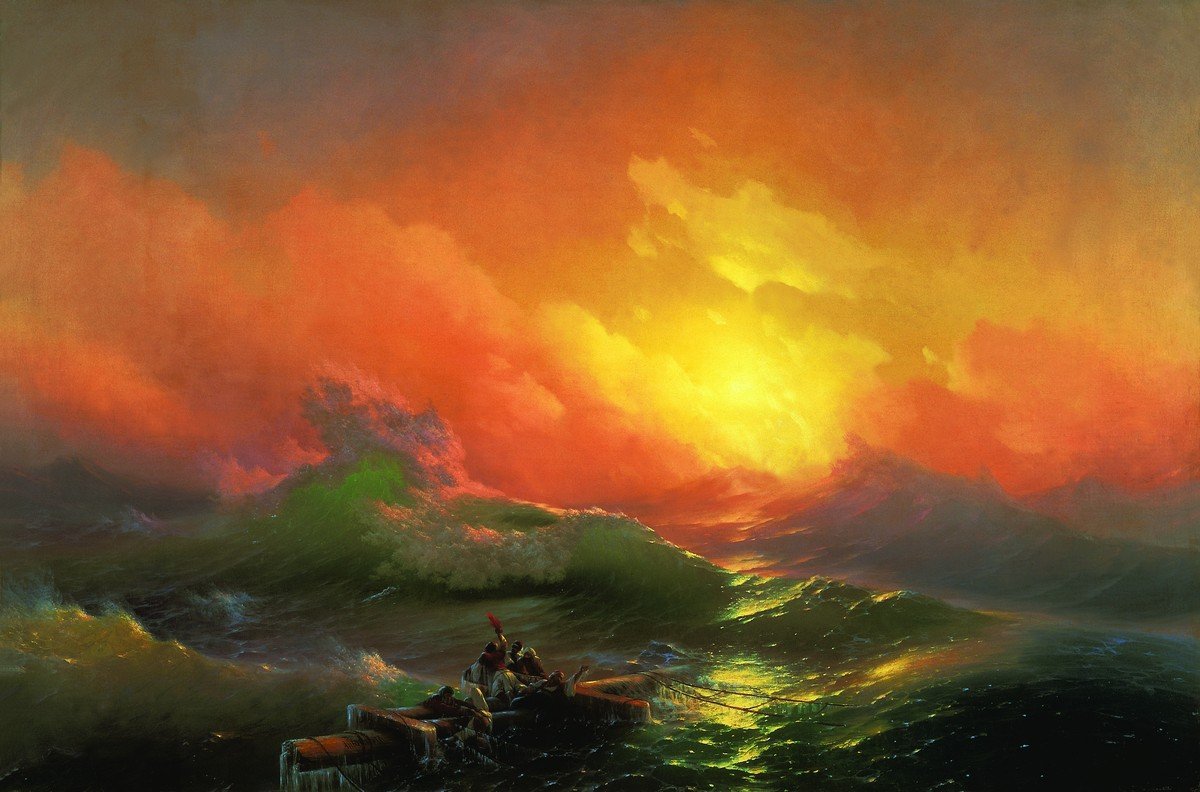
Ivan Aivazovsky painted The Ninth Wave in 1850, and it remains the best-known work of his career. The title borrows an old sailing expression for a wave of enormous size that follows a series of ever-larger swells.
The canvas shows the sea after a night storm, with survivors clinging to the debris of a wrecked ship. The wreckage forms a cross, which viewers often read as a Christian image of salvation. Warm tones soften the sea’s menace, so a chance of survival feels plausible. Violence and beauty share one sky here. Stand in front of it for a few minutes and you will watch the light shift across the surface in a way no reproduction conveys.
Repin and the Faces of Realism
Ilya Repin was born in Chuguev, began painting icons at sixteen, and failed his first attempt to enter the Imperial Academy of Arts. He went to Saint Petersburg anyway in 1863, audited courses and won his first prizes in 1869 and 1871. After a tour along the Volga, he presented drawings at the Academy in 1872.
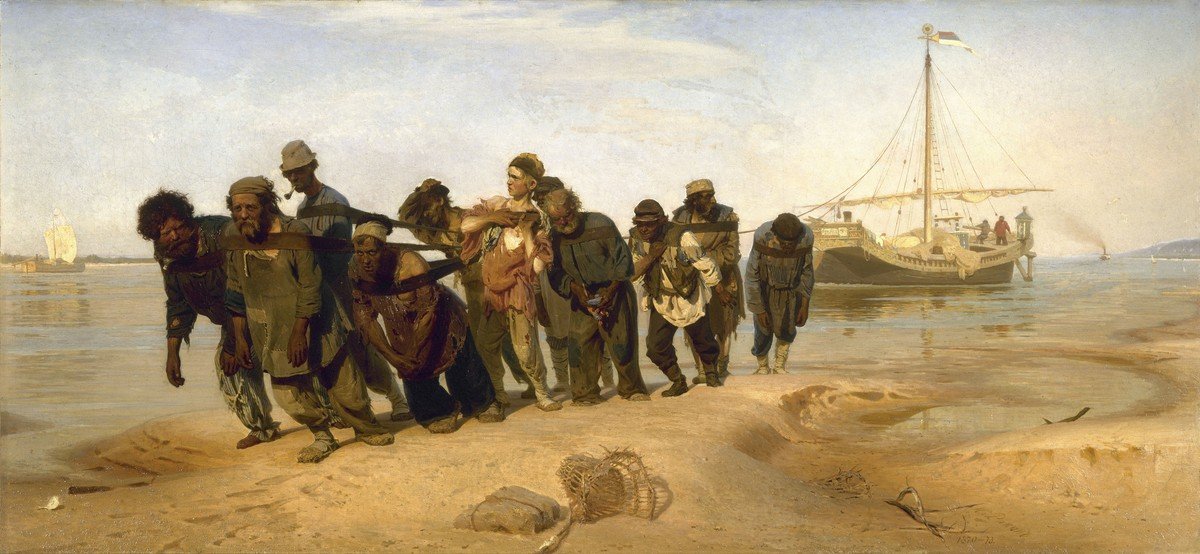
The result was Barge Haulers on the Volga, painted between 1870 and 1873. It shows 11 men hauling a barge along the Volga, close to collapse in the heavy heat. Repin built the figures from real people he met on his travels, and the realism of these working men won international praise. Grand Duke Vladimir Alexandrovich bought it soon after completion, and it toured Europe as a landmark of Russian Realism.
Look Closer: Find the youth in the middle of the line
In Repin’s Barge Haulers on the Volga, count the eleven men and look at the center of the row. One brightly dressed youth pulls against his leather harness while his older companions simply sag under it. Repin places him at the exact center of the canvas, so your eye lands on resistance before it notices exhaustion.
The Cossacks’ Letter, Written by Everyone
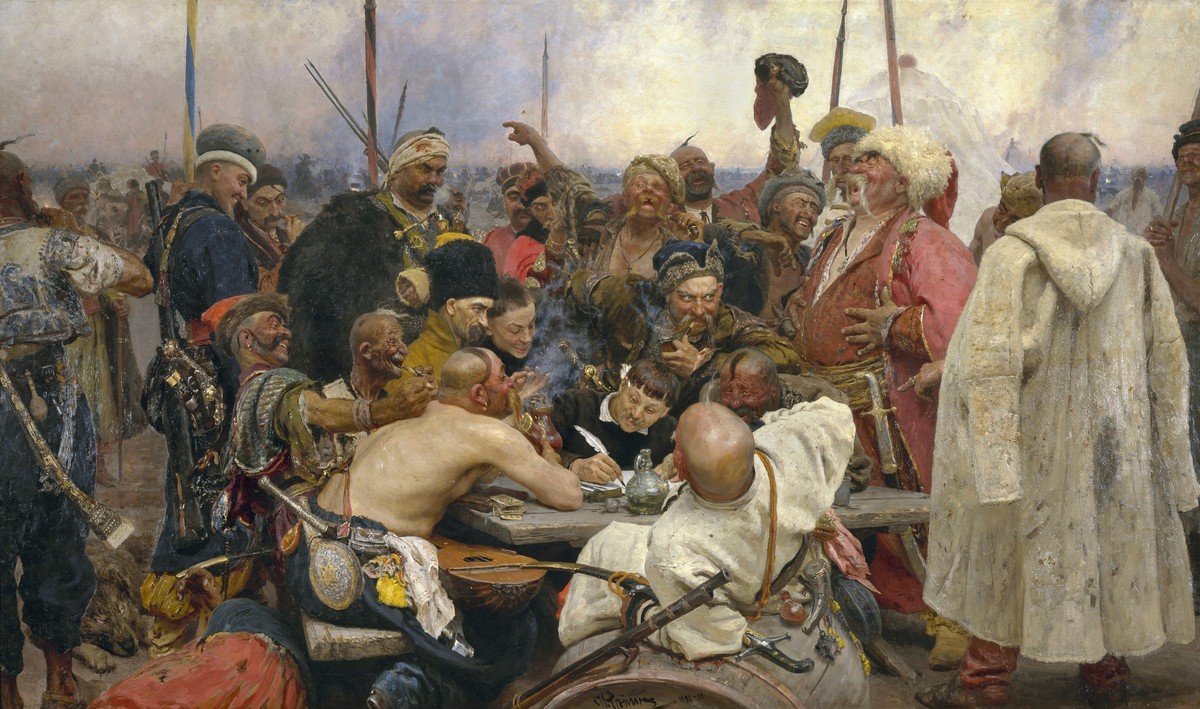
Repin worked on Reply of the Zaporozhian Cossacks from 1880 to 1891, more than a decade. A crowd of Cossacks roars with laughter as they compose a rude answer to the Ottoman sultan’s demand for surrender.
Barge Haulers is a study in silence. This canvas is built on noise. Each face carries its own reaction, from the belly laugh to the squint of the scribe. Viewers often linger at the edges longer than at the center, and that is deliberate: the picture is a crowd study, and no single figure dominates. Alexander III purchased the painting, which ties it to the founding story of the museum.
Sadko and the Fairy-Tale Turn
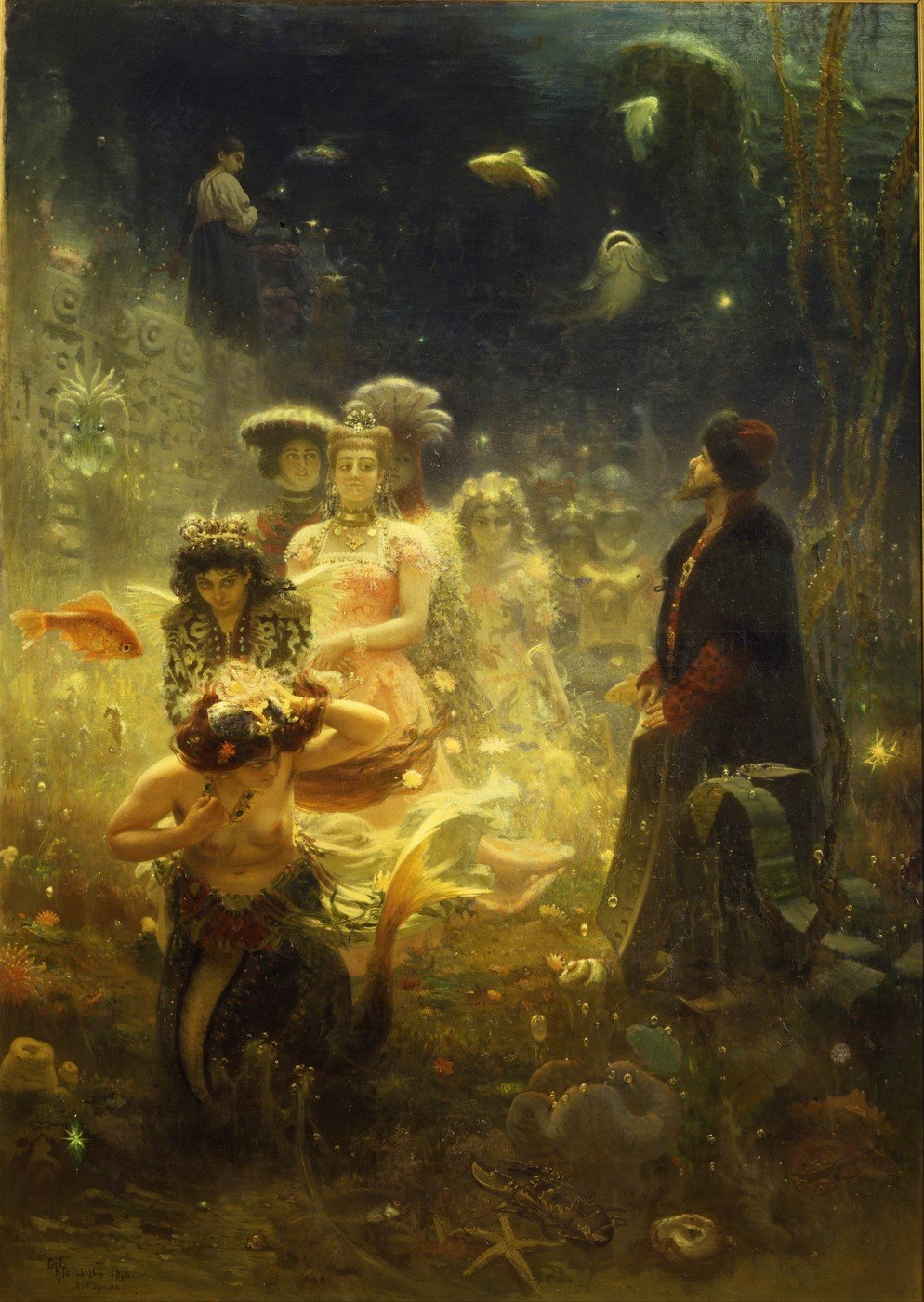
Repin’s 1876 canvas Sadko shows a different side of the Realist master. It illustrates a medieval Novgorod epic in which a minstrel descends under the sea and is offered a bride from a line of maidens.
It earns a stop because it separates Repin from the stereotype of the pure social reporter. The sea king’s court glows green and gold, and the women filing past the hero move with the rhythm of a procession. A student curious about how Russian painters moved from gritty documentary to national myth will find the bridge here, a generation before Vrubel carried the fairy tale to a more radical extreme.
Vrubel’s Flying Demon and the Symbolist Break
Mikhail Vrubel’s 1899 canvas Flying Demon belongs to his long cycle on Lermontov’s poem. His brushwork builds the surface from small mosaic-like facets, and the figure’s body seems to dissolve into the sky around it. It reads less as a portrait than as a glimpse of a mood.
The contrast with Repin helps. Repin works from observation, each face bound to a documented person. Vrubel makes the surface itself the subject, which is what linked him to the Symbolists and the Art Nouveau generation. Seeing the two artists within a few rooms of each other shows how fast Russian painting changed between the 1870s and the turn of the century.
Serov: Society Portraits and Antique Myth
Valentin Serov appears here at two extremes. His 1910 portrait of Ida Rubinstein reduces a dancer’s body to a long, angular nude, built from a few strokes of charcoal-like color. The same year he painted The Rape of Europa with an almost poster-like economy.
Serov taught and mentored younger painters, and he moved between society commissions and mythology. Vrubel faceted the world into crystals. Serov polished it down to a few decisive edges. Set side by side, they show that fin-de-siècle Russian painting offered a choice between invented worlds and sharpened observation, not a single manner.
Malevich and the Avant-Garde Rooms
The twentieth-century galleries carry the story into the avant-garde. Kazimir Malevich’s Head of a Peasant Girl, dated 1913, turns a village face into cylinders and planes in a Cubo-Futurist idiom. His Carpenter I from 1928 and 1929 marks the later return to the figure, the body stripped to a few colored shapes.
Together they make a point the usual story of Malevich skips. His career did not end with abstraction. He circled back to peasants and workers in the late 1920s, and the Russian Museum is one of the places where you can follow that return in person.
The Benois Wing and the Palace Annexes
The Mikhailovsky Palace now houses the museum’s main building and displays its collections of early, folk, eighteenth and nineteenth century art. Twentieth-century works hang in a separate building added to the palace complex, named for the architect Leonty Benois.
Is the Russian Museum only one building?
No. The museum also runs other historic buildings in the center of Saint Petersburg, including the Marble Palace, the Stroganov Palace and the Mikhailovsky Castle. A first visit can stay with the main palace and its neighboring wing. If the museum has caught your interest, a second trip can chase the annexes.
How Do You Plan a Visit?
Give the main palace a half-day. Start with the icons and eighteenth-century rooms, move on to Bryullov, Aivazovsky and the Realists, and save the twentieth-century building for the end, when you want a contrast with the nineteenth-century pace.
Check the State Russian Museum website for opening hours, ticket rules and temporary exhibitions before you go, because schedules and policies change. Pair the museum with the nearby Church of the Savior on Spilled Blood and the Arts Square gardens, and you have a walkable day in the old center.
Why the Collection Matters Now
For researchers, the Russian Museum offers a rare chance to study one national school across eight centuries under a single roof. For students, it shows how Russian art kept reinventing itself: from icon workshops to the Academy, from the Academy to Realism, from Realism to Symbolism and the avant-garde.
For general travelers, it solves a practical problem. A trip to Saint Petersburg usually gives you Europe in Russia. A morning at the Russian Museum gives you Russia in Russia, and that makes the rest of the city easier to read.
Essential Points
- The museum opens with Russian art itself as its subject, so each room reads as a continuous national story rather than a sample of European masters.
- Its palace is part of the exhibit: Rossi’s design shaped the surrounding streets and squares, not just one building.
- A single morning can cover eight centuries, from a twelfth-century icon to a Malevich of the late 1920s.
- Bryullov’s Pompeii and Aivazovsky’s Ninth Wave show how Russian painters competed on the European stage before Realism turned inward.
- Repin’s range runs from reportage (Barge Haulers) to epic comedy (the Cossacks) to folk epic (Sadko).
- Vrubel and Serov were close contemporaries who answered the same fin-de-siècle mood in opposite ways, one with faceted fantasy, the other with polished observation.
- Visiting both the Russian Museum and the Tretyakov Gallery gives two different editorial views of one national school.
- The museum draws millions of visitors each year, so its obscurity among tourists is a matter of itinerary, not quality.
Frequently Asked Questions
- What is the Russian Museum in St Petersburg known for?
- Dedicated entirely to Russian art, the State Russian Museum spans eight centuries from medieval icons to the twentieth-century avant-garde. It covers folk art, eighteenth and nineteenth century painting, and major works by Repin, Aivazovsky and Malevich. Its main building is the Mikhailovsky Palace on Arts Square, and it is a different experience from the Hermitage, which focuses on European art.
- When and why was the Russian Museum founded?
- The museum opened in 1898 as the Russian Museum of His Imperial Majesty Alexander III, honoring the emperor who collected Russian painting. It occupies the former home of Grand Duke Michael Pavlovich, designed by Carlo Rossi and given to Michael and his wife Elena Pavlovna in 1825.
- What should I look for in Aivazovsky’s The Ninth Wave?
- Look at the light. Warm tones soften the storm’s menace, and the survivors cling to wreckage shaped like a cross, which viewers often read as a Christian image of salvation. The sea after the night storm seems both violent and beautiful, which gives the painting its tension and makes survival feel possible.
- Which Ilya Repin paintings can I see at the Russian Museum?
- The museum shows Barge Haulers on the Volga, painted between 1870 and 1873, and Reply of the Zaporozhian Cossacks, which Repin worked on from 1880 to 1891. It also holds his 1876 Sadko, a fairy-tale subject that shows a different side of a painter best known for Realism.
- Is the Russian Museum worth visiting if I have already seen the Hermitage?
- Yes, because the two collections do different jobs. The Hermitage is a European encyclopedia, while the Russian Museum shows the national school across eight centuries. It draws millions of visitors each year, so you will not be alone in finding it worthwhile.
Writers and editors specializing in Russian art history.