Quick Answer
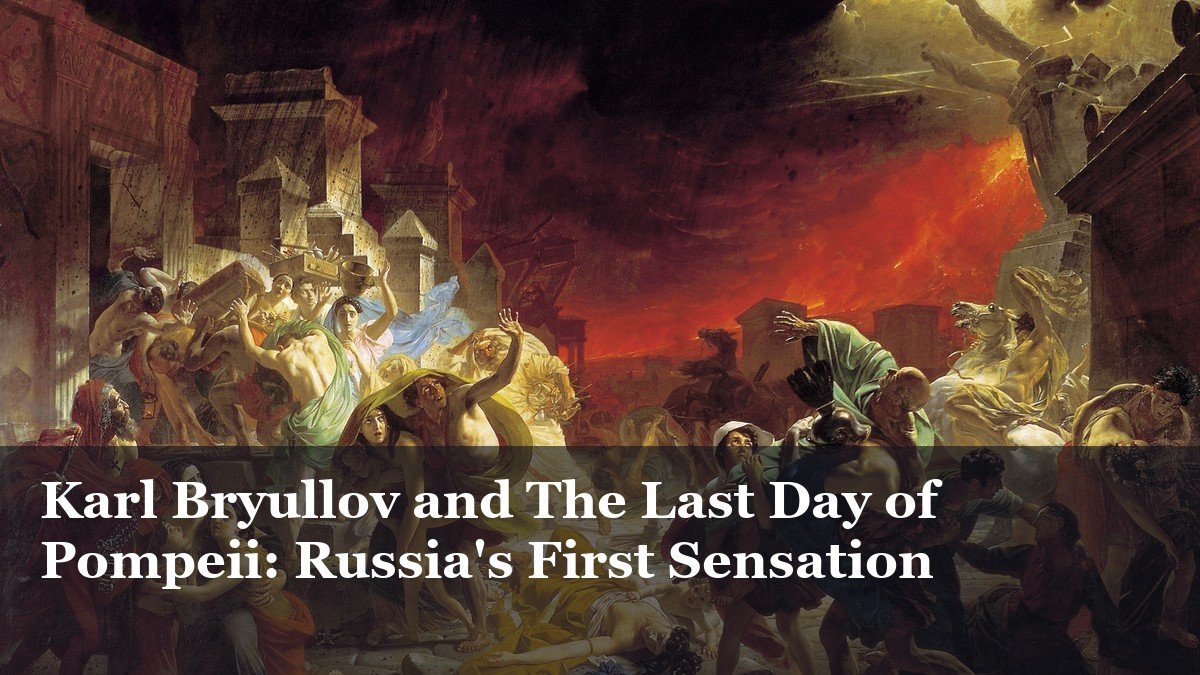
The Last Day of Pompeii is a monumental oil painting finished in 1833 by Karl Bryullov, a Russian trained at the Imperial Academy of Arts and working in Rome. It shows the eruption of Vesuvius in 79 AD as a crowd of individual human dramas. Shown in Rome, Milan and Paris, it reportedly earned Bryullov a gold medal at the 1834 Paris Salon and arguably made him the first Russian painter to command the attention of the European art world. It now hangs in the State Russian Museum in St Petersburg.
What Is The Last Day of Pompeii?
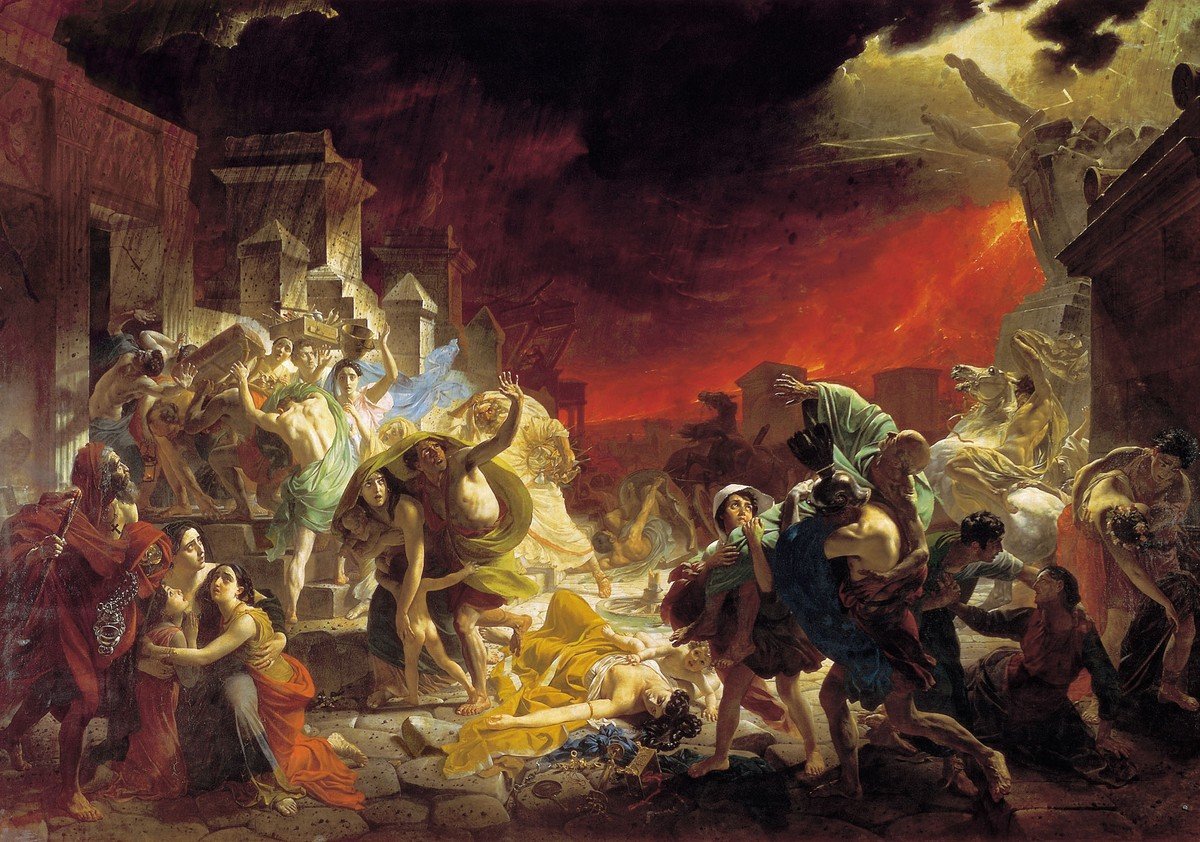
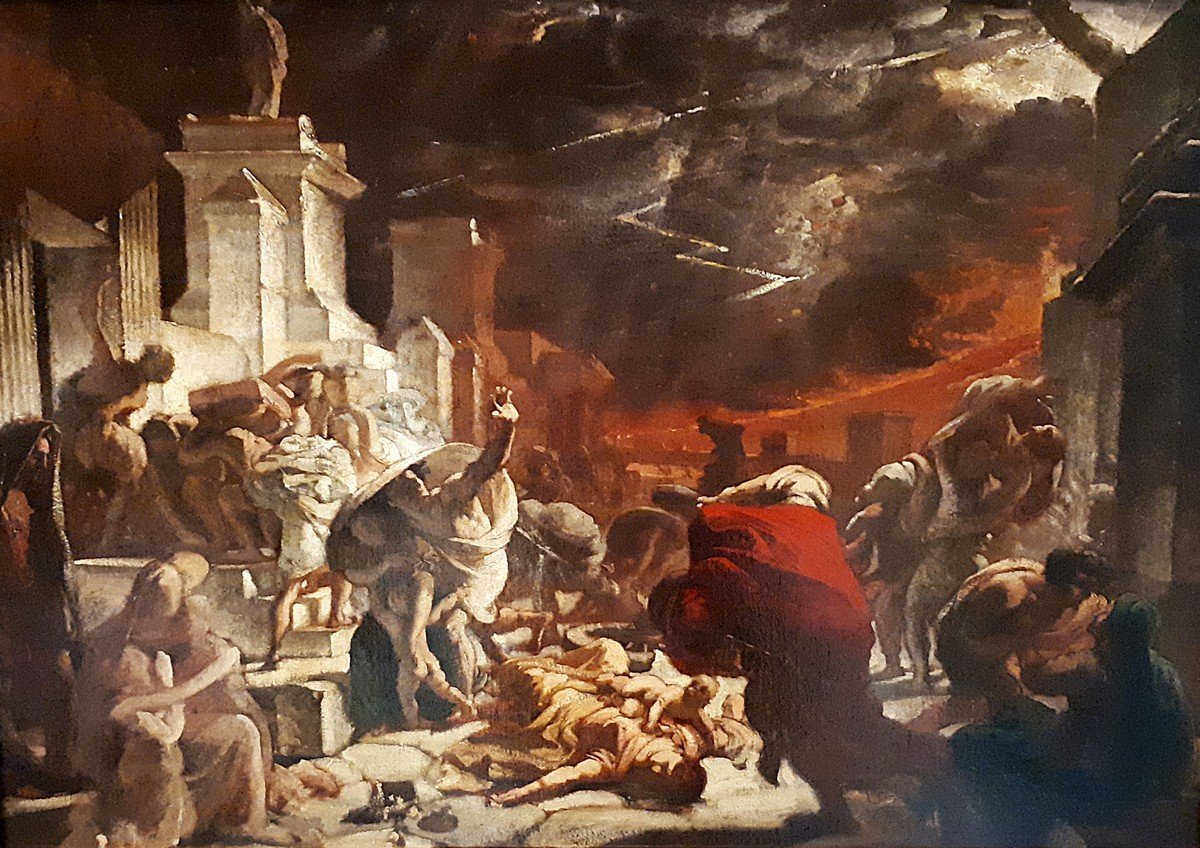
The Last Day of Pompeii is a vast oil painting by Karl Bryullov, finished in Rome in 1833 after roughly six years of work. It shows Vesuvius destroying Pompeii in 79 AD, yet no single hero anchors the scene. The canvas breaks into clusters of terrified people: sons carrying an old father, a mother with her daughters, a bride thrown from her chariot.
Bryullov (1799 to 1852) was a Russian painter, trained in St Petersburg and living in Italy when he made it. Paris, Milan and Rome treated the picture as an event, not a curiosity, and no Russian painting had managed that before. It belongs to the State Russian Museum in St Petersburg today.
From Brüllo to Bryullov: A Painter’s Apprenticeship
Karl Pavlovich Bryullov was born in St Petersburg in 1799 into a family of decorative artists whose surname was originally Brüllo. His father taught at the Imperial Academy of Arts, and the boy entered the Academy as a child. He drew from plaster casts for years before anyone let him near a live model.
In 1821 he finished his training with a gold medal. The prize carried a scholarship, and in 1822 he left Russia as a pensioner of the Society for the Encouragement of Artists, which paid for years of study abroad. Italy was the destination. The Academy expected him to come home a polished history painter.
Why did Russian painters go to Rome?
At home there was nothing like the Vatican collections, the antique sculpture or the working studios. Rome offered Raphael’s frescoes, a community of foreign artists and a steady market of wealthy travellers.
The Rome Bryullov Found
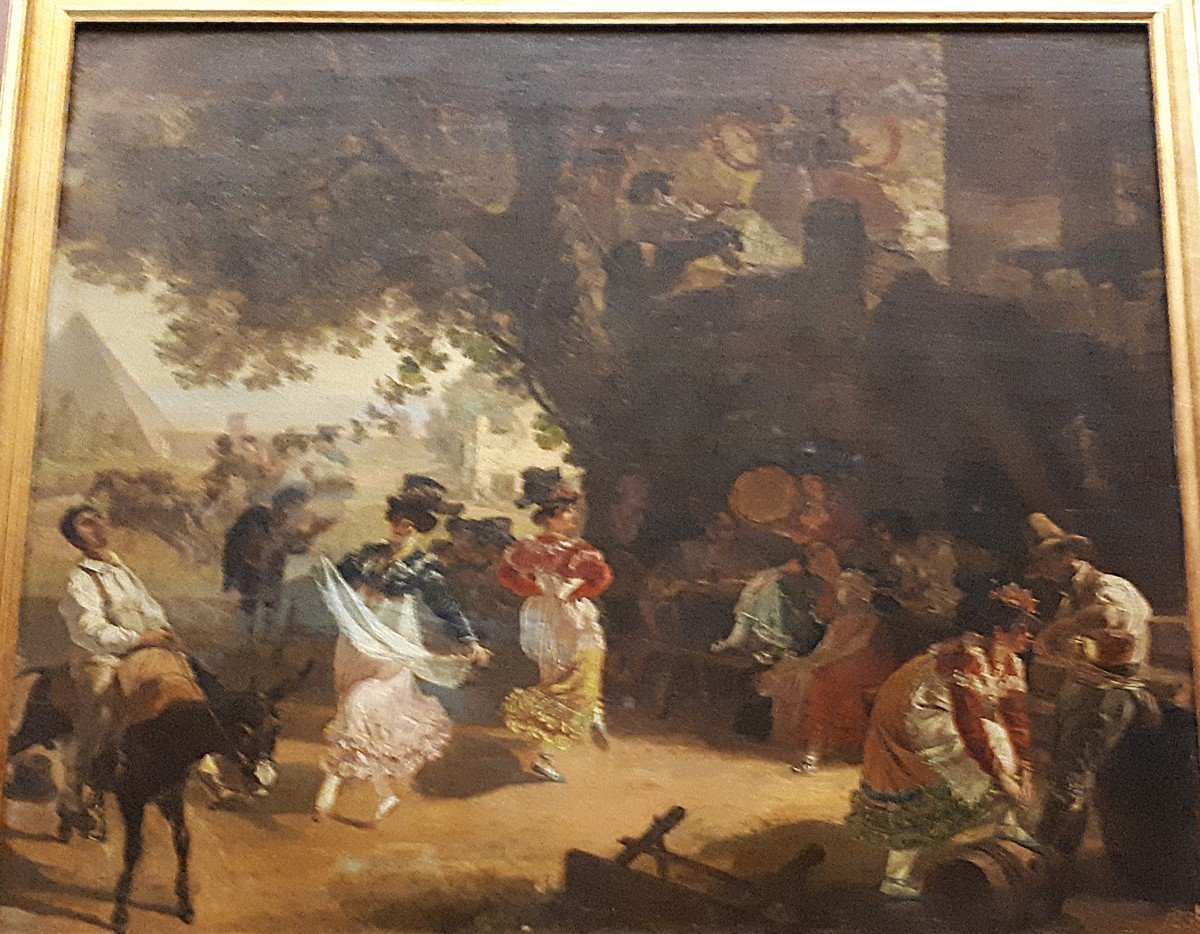
Bryullov reached Rome in 1823 and landed in a small but lively Russian colony. Alexander Ivanov, born in 1806, spent decades there on a single religious masterpiece. Orest Kiprensky, the leading Russian portraitist of the Romantic period, passed long stretches in Italy, and his 1827 portrait of Pushkin shows the polished, emotional style Russian patrons were learning to admire. Sylvester Shchedrin, the landscape painter, had settled near Naples and died in 1830, just as Bryullov’s ambitions were growing.
Rome became a testing ground because of this colony. Painters studied each other’s sketches, argued over the Academy’s rules, and measured themselves against Europeans instead of their Petersburg classmates.
Pompeii Before the Painting
Pompeii was a wealthy Roman town of perhaps 10,000 to 20,000 people when Vesuvius buried it under 4 to 6 metres of ash and pumice in 79 AD. The site lay forgotten for centuries. Systematic digging began in the 18th century, and by Bryullov’s day the excavated streets, house paintings and plaster impressions of victims had made the city one of Europe’s favourite subjects.
Bryullov visited the excavations in the mid-1820s and drew what he found, from temple columns to the stepping stones across the paved streets. The human drama came from written sources. Pliny the Younger’s letters describe the eruption as seen from Misenum, including his own escape with his mother, and Bryullov gave both of them a place in the foreground.
A Commission, a Deadline, a Dispute
The painting began as a commission from Anatoly Demidov, a Russian industrialist who collected art and took a keen interest in Italy. Accounts differ on when the contract was agreed and on its terms, but the work ran far longer than anyone had planned.
Demidov wanted his painting, and Bryullov kept finding reasons to rework it. Sources describe tension between patron and painter. The delay may have helped as much as it hurt, since the extra years let Bryullov rethink the whole arrangement of figures. Scholars still disagree about how much of the finished design was fixed in the first sketches.
Six Years at the Easel
Bryullov worked from studies, not from imagination alone. He drew individual poses from living models in Rome, then fitted them into the crowd. Several women in the picture are often said to be modelled on Countess Yulia Samoylova, a friend and patron whose portrait he painted more than once, although attribution of individual figures varies in the literature.
The surviving oil sketches show him testing compositions: where the crashing statue falls, which way the light runs, how many groups to use. Set a sketch beside the finished work and you can watch him sharpen the central axis and push the darker figures to the edges.
What Does the Painting Show?
The canvas measures roughly 4.6 by 6.5 metres. Two light sources fight across it: a red glow from the volcano behind, and a cold white flash of lightning on the right. Everything they touch is rendered in precise detail, from the cracked paving to the tilting marble.
Statues topple from a temple cornice. A young woman lies dead beside an overturned chariot while her infant reaches for her. Two sons carry their father on their shoulders. Pliny the Younger and his mother move through the right-hand foreground. The scene is built so that the eye circles instead of following one path, and no single face dominates. The disaster is the hero.
Neoclassical Bones, Romantic Flesh
Bryullov’s training was Neoclassical: clear outlines, bodies built like sculpture, groups arranged in balanced triangles. Some scholars see a debt to Raphael’s group compositions in the way figures are stacked and echoed across the canvas. The subject, the violent lighting and the emotional pitch, though, belong to Romanticism, the movement that prized passion, the sublime and the dramatic past.
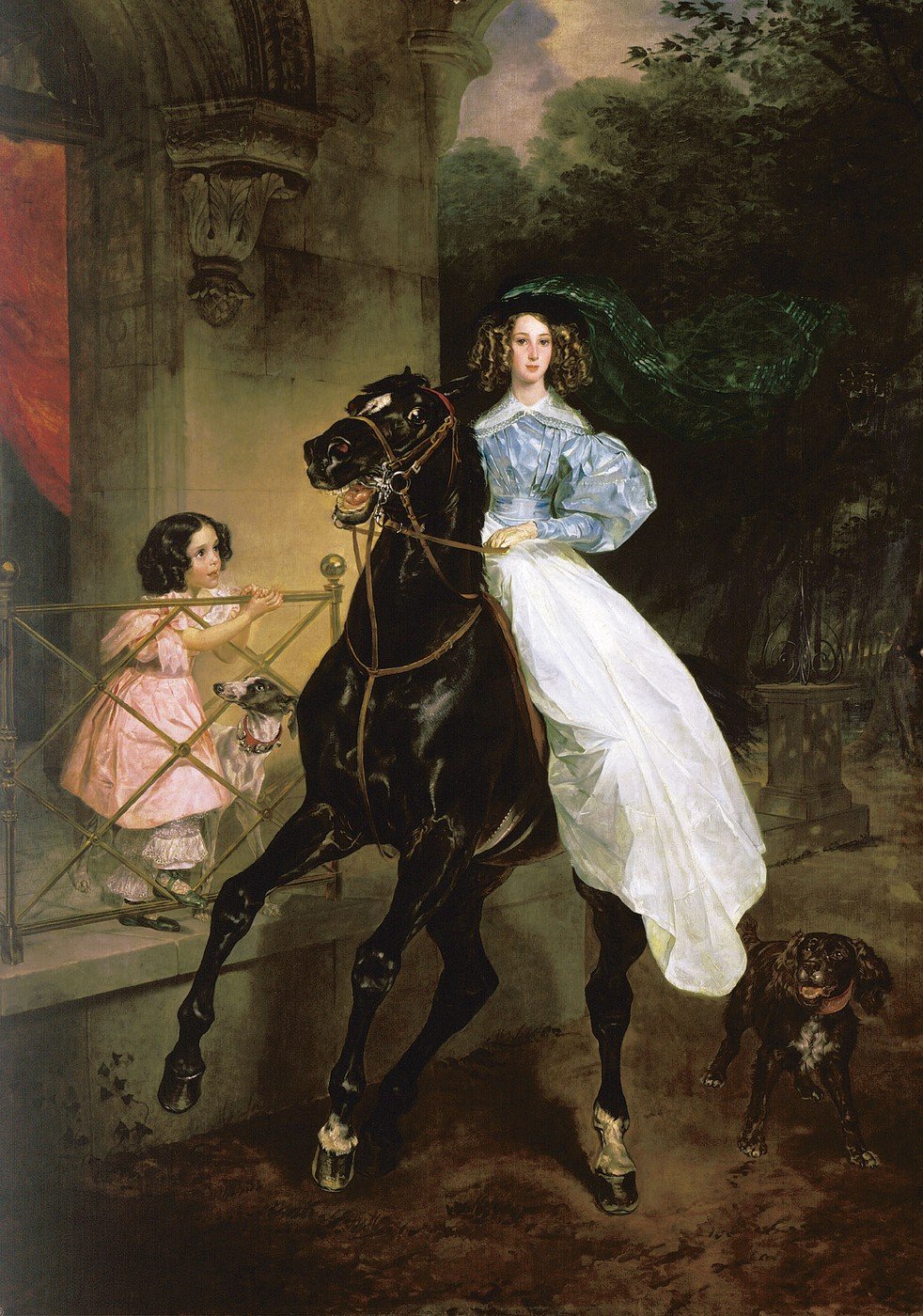
That double identity is why writers keep calling the painting a bridge. It took the Academy’s discipline and aimed it at a story about helplessness. Compare it with the poised surfaces of Bryullov’s 1832 horsewoman, painted in the same years, and you see the same sculptural body rendered with warmth instead of catastrophe.
Why Pompeii Spoke to the 1830s
Bryullov was not alone in finding the subject irresistible. Giovanni Pacini’s opera about the last day of Pompeii reportedly premiered in Naples around 1825, and Bryullov is often said to have seen it. An English novel on the same subject followed in 1834. Disaster, antiquity and moral reckoning were fashionable ingredients across Europe.
Was it really about Pompeii?
Partly. Some contemporaries read the painting as a parable about a civilisation’s last moments, and Russian viewers in the 1830s, living under Nicholas I, could find their own anxieties in it. Whether Bryullov intended this remains a matter of interpretation, not documentation.
Look Closer: The painter in the crowd
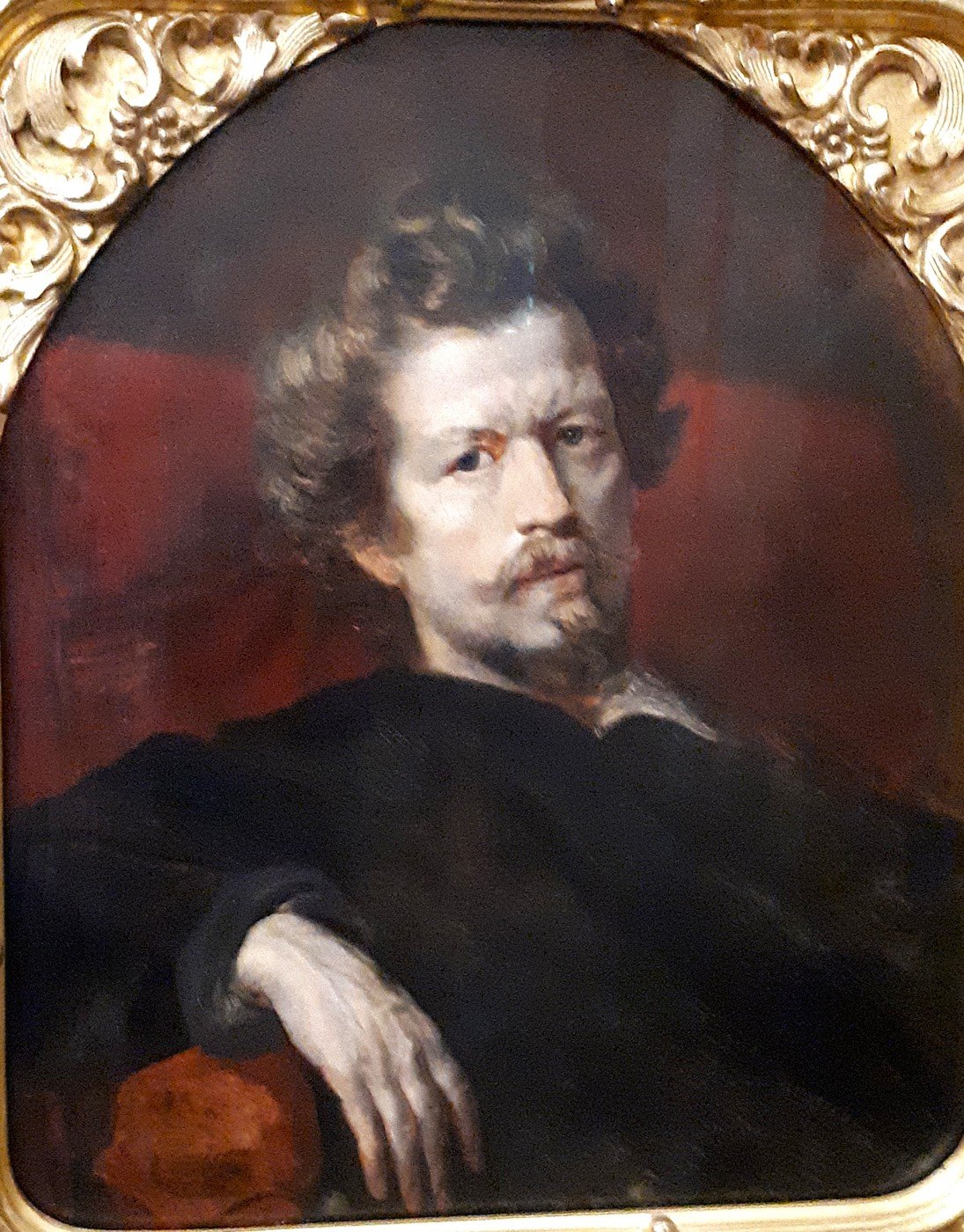
Look at the far left edge of The Last Day of Pompeii. A man hurries away with a box of painter’s tools balanced on his head, and his face is Bryullov’s own. He is one of the few figures who seems more concerned with saving his craft than his family. Set his composure against the panic around him and it reads as a wry signature from a painter who spent six years on this crowd.
Rome, Milan, Paris: The Triumphal Tour
The finished painting went on show in Rome in 1833, where crowds queued to see it. It then travelled to Milan, where critics compared it to the old masters. In 1834 it appeared at the Paris Salon and reportedly earned Bryullov a gold medal.
A popular story says Walter Scott called it not a painting but an epic. Scott visited Italy in 1831 and 1832 and died in September 1832, so if he said it, he saw only the work in progress. Treat it as a good anecdote, not a verified quotation.
Pushkin, Gogol and a Russian Audience
Russian writers took the painting personally. In 1834 Pushkin wrote a verse fragment that begins with Vesuvius opening its mouth, smoke rolling out in a cloud, and idols tumbling from rocking columns. It reads like a description of the canvas, though Pushkin knew the picture mainly from descriptions and engravings. Whether he saw it in person is unclear.
Nikolai Gogol devoted an essay to it, treating the picture as proof that Russian painting could stand beside European work. Until then, Russian art had its pleasures: Kiprensky’s portraits, Venetsianov’s peasant scenes such as the Threshing Barn of about 1822. Yet nothing had been argued over across Europe. Bryullov changed what Russian readers expected from their painters.
Coming Home as a Hero
Demidov presented the painting to Tsar Nicholas I, and it was shown in St Petersburg to enormous crowds. Bryullov himself returned in 1835, travelling through Greece and Turkey on the way, and was greeted as a national celebrity. Admirers called him ‘Karl the Great’, a pun on Charlemagne.
The poet Evgeny Baratynsky is remembered for an epigram saying that for Russian painting the picture was both the last day of Pompeii and the first day of something new. Bryullov joined the Academy as a professor and taught a generation that would carry his methods forward.
Rivals and Contemporaries: Bruni and Ivanov
Bryullov’s success set the terms for everyone else. Fyodor Bruni painted The Brazen Serpent (1841), a crowded Old Testament scene that set out to rival Bryullov’s scale and drama. Bruni, a Russian of Swiss Italian descent, is usually ranked with Bryullov and Ivanov as one of the central painters of Nicholas I’s reign.
Alexander Ivanov took the opposite path. Where Bryullov built a sensation in six years, Ivanov spent most of two decades on The Appearance of Christ Before the People, a quieter and more spiritual picture. Russian critics argued for years over which approach served the nation better.
What Happened to Bryullov Next?
Nothing he made afterward matched the reception of Pompeii. He painted portraits, including the fortune-telling scene Svetlana (1836), and worked on large commissions for St Isaac’s Cathedral. His grand historical project, the Siege of Pskov, was never finished.
His health declined, and in 1849 he left Russia for Madeira and then Italy. He died in Manziana, near Rome, in 1852. The late watercolour and oil studies, like Sweet Waters (1849), show a looser touch than the great canvas, and many scholars find them more personal.
Where to See It
The Last Day of Pompeii hangs in the State Russian Museum in St Petersburg, in the collection of Russian painting. Its size usually earns it a wall to itself. Stand in front of it and the details that reproductions flatten come back: the cracks in the pavement, the faint lightning reflections on marble, the individual expressions of figures far from the centre.
The museum’s online collection and the Google Art Project scan let you zoom into areas that would otherwise be out of reach.
Why It Still Matters
The painting gave Russian art a place in the European conversation, and that place had consequences. Later generations of Russian realists, the Itinerants, rejected the Academy’s love of antique themes and grand theatre. They painted contemporary Russian life instead. Without Bryullov’s example to push against, their programme would have had less to argue with.
Why is it called Russia’s first international sensation?
It was the first Russian painting to be praised abroad on its own terms, in Milan and at the Paris Salon, instead of as a courtesy to a foreign visitor. Earlier Russian artists had worked in Europe, but Bryullov was the first whose work Europeans came to see as an event.
Essential Points
- The painting took roughly six years (c. 1827 to 1833), long enough that its patron and its painter both had time to change their minds about it.
- Bryullov blended a Neoclassical, sculptural arrangement of bodies with a Romantic subject and dramatic lighting, which is why critics keep arguing over which label fits.
- The eruption story came to Bryullov through Pliny the Younger’s letters and the excavations, but also through the popular Pompeii craze, including an opera on the same subject in 1825.
- Pushkin and Gogol both wrote about the picture in 1834, which tied a painting to the Russian literary conversation, something few canvases had achieved.
- Demidov gave the painting to Tsar Nicholas I, so a private commission became a national possession and a symbol of imperial prestige.
- Bryullov’s fame at home produced the nickname ‘Karl the Great’, a pun on Charlemagne and a measure of how badly Russian art wanted an international hero.
- His rivals Fyodor Bruni and Alexander Ivanov answered with very different large canvases, so the work started a decade of competing visions of Russian history painting.
- Later Russian realists reacted against this kind of grand academic theatre, which makes the painting a useful starting point for understanding what came after it.
Frequently Asked Questions
- What is The Last Day of Pompeii and who painted it?
- It is a monumental oil painting by Russian artist Karl Bryullov, completed in Rome in 1833. It shows the eruption of Vesuvius in 79 AD through many small human dramas rather than one hero. It is considered the work that first made Russian painting famous across Europe.
- How did Bryullov’s painting become so famous so quickly?
- Timing and staging helped. The Pompeii subject was already fashionable in Europe, the canvas was shown in Rome, Milan and Paris within about a year, and a gold medal reportedly awarded at the 1834 Paris Salon gave it official prestige. Pushkin and Gogol then made it a talking point in Russia.
- What techniques make The Last Day of Pompeii look so dramatic?
- Bryullov used two competing light sources, the red glow of the volcano and a cold flash of lightning, to model figures like sculpture. He built the crowd from studies of individual models, then arranged them in groups that echo each other, which keeps the eye moving around the canvas.
- Who was Karl Bryullov and what else did he paint?
- Karl Bryullov (1799 to 1852) was a Russian painter trained at the Imperial Academy of Arts who spent years in Italy. Besides Pompeii he painted society portraits, the fortune-telling scene Svetlana (1836), and religious works for St Isaac’s Cathedral. He left the Siege of Pskov unfinished.
- Where can I see The Last Day of Pompeii today?
- The painting is in the State Russian Museum in St Petersburg, usually displayed on its own wall because of its size. If you cannot travel, high-resolution scans on Google Arts & Culture and Wikimedia Commons let you zoom into details that are hard to notice in reproductions.
This guide was written and reviewed by the rus-art.com editorial team, specializing in Russian art history. We cross-check dates, attributions, and museum holdings against museum and academic sources.