Quick Answer
Boris Kustodiev (1878 to 1927) was a Russian painter who turned the merchant towns of the Volga into some of the warmest images in Russian art. Trained in Ilya Repin‘s studio and later linked to the Mir iskusstva circle, he painted full-figured merchant wives, fairs, bathhouses and Maslenitsa (Shrovetide) festivities in saturated colour. From about 1916 spinal illness confined him to a wheelchair, yet he kept painting, drawing on memory, sketches and a stubborn affection for a provincial Russia that was disappearing.
What Makes a Kustodiev Look Like a Kustodiev?
Boris Kustodiev is easy to spot from across a gallery. Snow glows pink and blue instead of grey. Church domes and bell towers crowd the skyline behind the rooftops. Full-figured women with pale skin sit against patterned tablecloths, in fur and silk, while colour lies in flat, saturated patches held by firm outlines. The mood is affectionate, with a slight wink.
The settings come from the Volga provinces: tea tables, trading rows, sleigh races and steam baths. Kustodiev drew on lubok, the cheap woodblock prints sold at Russian fairs, and on painted shop signs, so his pictures can feel like animated toys. Underneath sits a trained realist’s grip on anatomy and space. The next sections trace it back to its source.
A Fatherless Boy in Astrakhan
Kustodiev was born in Astrakhan, the Volga delta city where Caspian and Persian trade met Russian merchant houses. His father, a seminary teacher, died in 1879, when Boris was a toddler. His mother Ekaterina raised four children on very little money. Merchant households, tea tables and market days surrounded the boy, and they became his lifelong subject.
He studied locally with the painter Pavel Vlasov, who gave him his first professional instruction, before leaving for the capital. The provincial town he left behind never left his work.
Repin’s Studio and the Imperial Academy
In 1896 Kustodiev entered the Imperial Academy of Arts in Saint Petersburg and joined the studio of Ilya Repin, the realist behind Barge Haulers on the Volga (1873). Repin pushed his pupils toward portraiture and psychological observation. In 1903 Kustodiev helped with Repin’s huge Ceremonial Sitting of the State Council, a commission that meant painting dozens of uniformed officials as individuals.
The teacher’s crowd scenes became the pupil’s model. In Reply of the Zaporozhian Cossacks (1880 to 1891), every face in the laughing crowd reacts differently. Kustodiev later swapped Cossack campfires for fairground snow, but he kept the principle: a crowd built from separate people.
Paris, Spain and the Satirical Journals of 1905
After the Academy, Kustodiev travelled to France and Spain to study painting on the spot, and in 1903 he married Yulia Proshinskaya. In 1905 and 1906 he turned out biting political cartoons for the satirical journals Zhupel (Bugbear) and Adskaya Pochta (Hell’s Mail).
It is a sharp-edged chapter in the career of an artist later remembered as gentle. It also shows how quickly he could catch a face in a few lines, a skill that returns in his stage work.
Joining the World of Art
Around 1910 Kustodiev became associated with Mir iskusstva, the Saint Petersburg magazine and movement that steered Russian artists toward design, theatre and a fresh look at the national past. The circle suited him. Painters and illustrators such as Konstantin Somov and Ivan Bilibin prized decorative clarity and stylish wit, and they were glad to see provincial Russia treated with both.
For Kustodiev, the association meant exhibitions, theatre contacts and a community of artists who understood why a tea table could deserve a large canvas.
The Illness That Rewrote His Working Life
Around 1909 Kustodiev began to suffer pain in his arm and spine. Treatment, including time in Switzerland, did not halt the progression, and accounts differ on the exact diagnosis. By about 1916, after a spinal operation, he could no longer walk.
The timing matters. He was in his early thirties when the first symptoms appeared, already an established portraitist with Academy training behind him. The illness did not arrive at the end of a career. It cut across the middle of one.
Painting From a Wheelchair
How did Kustodiev paint after he lost the use of his legs?
He kept working seated, often on large canvases, and relied on memory, earlier drawings and models who posed at home. Reports of how his studio was arranged vary, but the point is consistent. The Volga fairs and tea tables he painted in Petrograd were remembered scenes, not ones he stood in front of.
Did the illness change what he painted?
It limited how far he could go for material, not how much he produced. His output stayed varied: fairs, portraits, posters, book illustrations and stage designs. He continued to exhibit and to accept theatre commissions through these years.
What Is Maslenitsa, and Why Did Painters Love It?
Maslenitsa is the Eastern Slavic folk and religious holiday held in the last week before Great Lent, the eighth week before Orthodox Pascha. Its date moves each year with Easter. It is also called Butter Week or Cheesefare Week, and it keeps traces of older Slavic ritual. Blini, sleigh rides and open-air festivities are its standard companions.
For a painter, the holiday offers crowds, bright winter clothing, horses, snow and swings in a single afternoon. For Kustodiev it offered something more personal as well. The holiday belonged to the provincial world he had grown up in.
Reading Shrovetide (1916) Closely
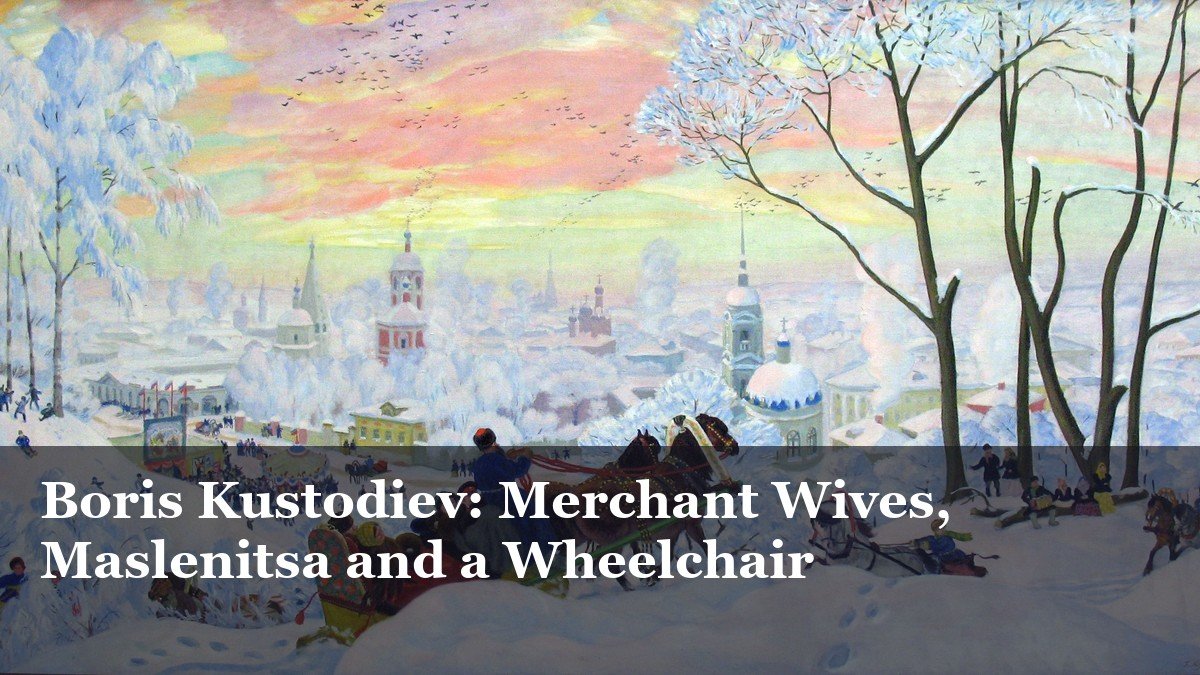
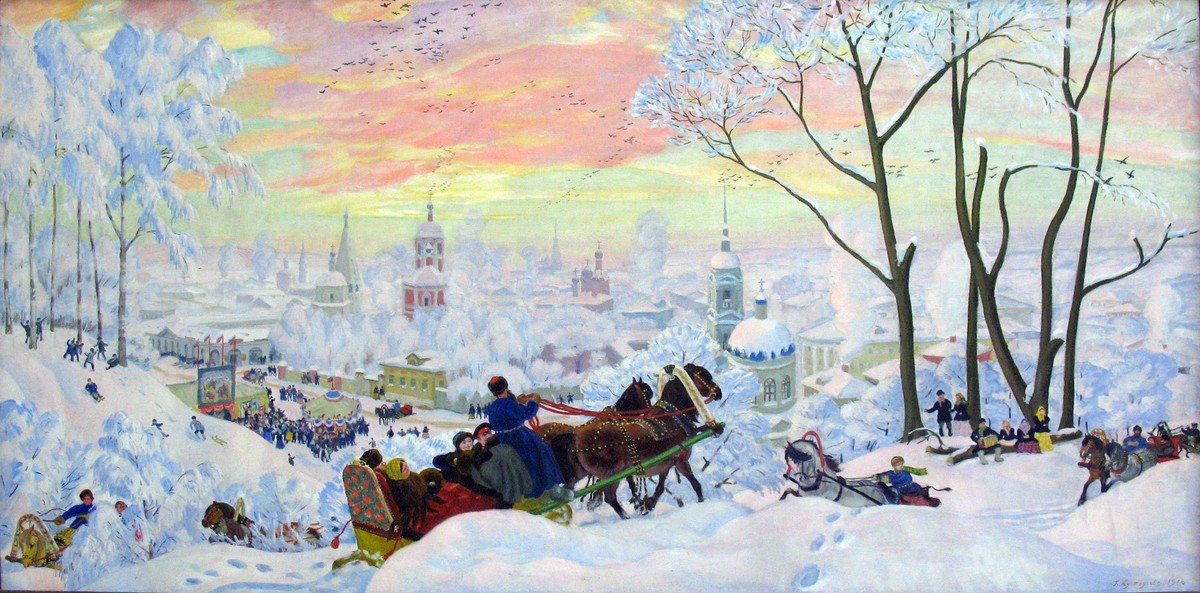
In the 1916 Shrovetide, as in most of his Maslenitsa pictures, the crowd arrives in layers. Sleighs and strollers fill the lower part of the canvas, festival stalls and amusements sit in the middle, and rooftops and church domes close off the top. Seen from a high vantage point, the whole town seems to be on stage.
Colour does the storytelling. Shadows on the snow go blue, walls warm to pink and yellow, and coats and shawls strike red, green and orange notes that repeat across the canvas, so the eye hops from group to group. Nothing is blurred. Each small figure keeps a distinct silhouette. The picture invites counting: riders, strollers and onlookers, each tinted to be told apart at a glance. Kustodiev painted the subject more than once.
Myth vs. Fact: Plenty on the table
Myth: The heaped tables and glowing cheeks in his paintings mean Kustodiev lived in comfort. Fact: Petrograd suffered severe food shortages during the Russian Civil War years, and he painted abundance from a wheelchair while his city went hungry. Many viewers read that contrast as longing rather than record.
Merchant Wives and the Tea Table
Who were the merchant wives Kustodiev painted?
They belonged to the kupechestvo, the merchant estate of provincial towns: families made rich by trades such as fish and grain, living in solid houses with samovars, carpets and heavy silver. In Merchant’s Wife at Tea (1918), the heroine sits beside a samovar, with a sliced watermelon and a cat on the table and a town behind her.
Moscow Tavern (1916) turns the same eye on a public room instead of a private one. The trading-town world gains a second stage.
The Two Beauties
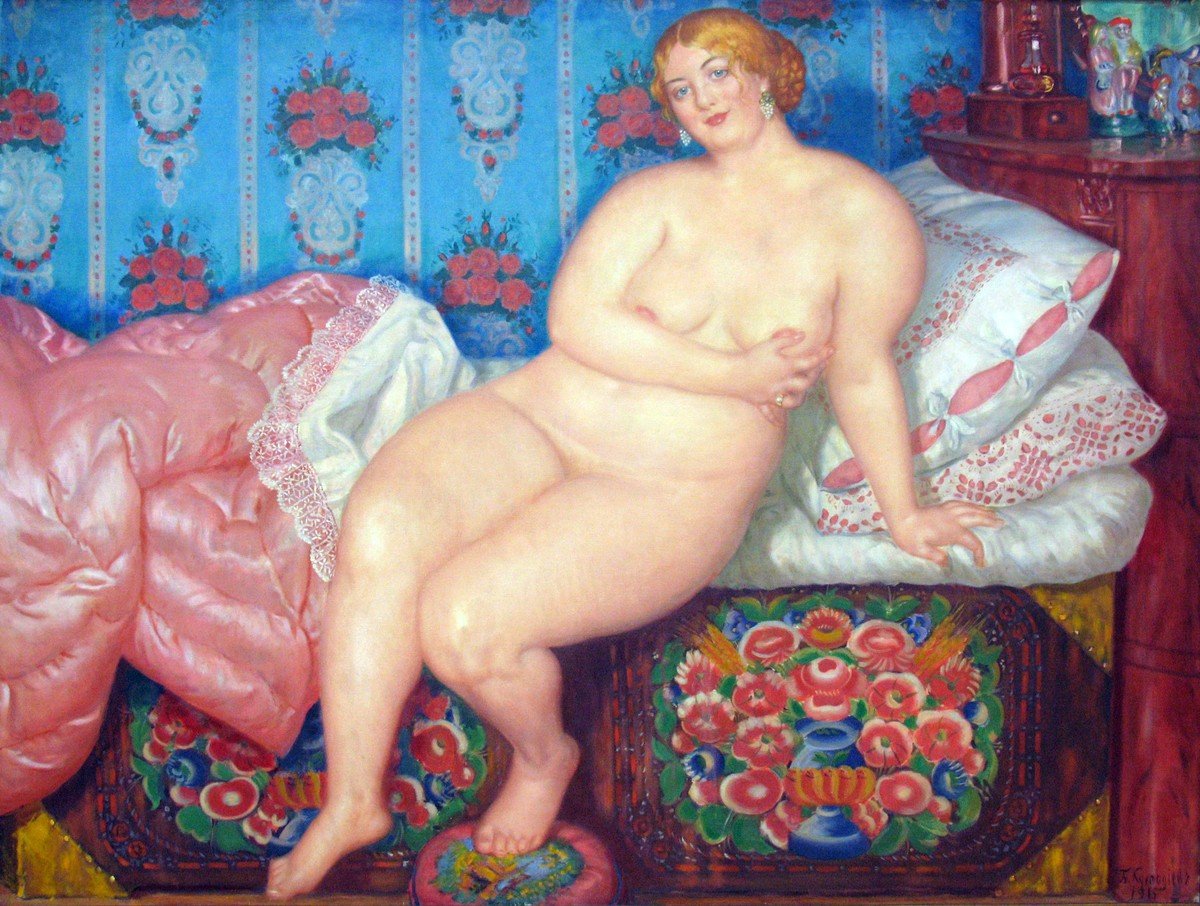
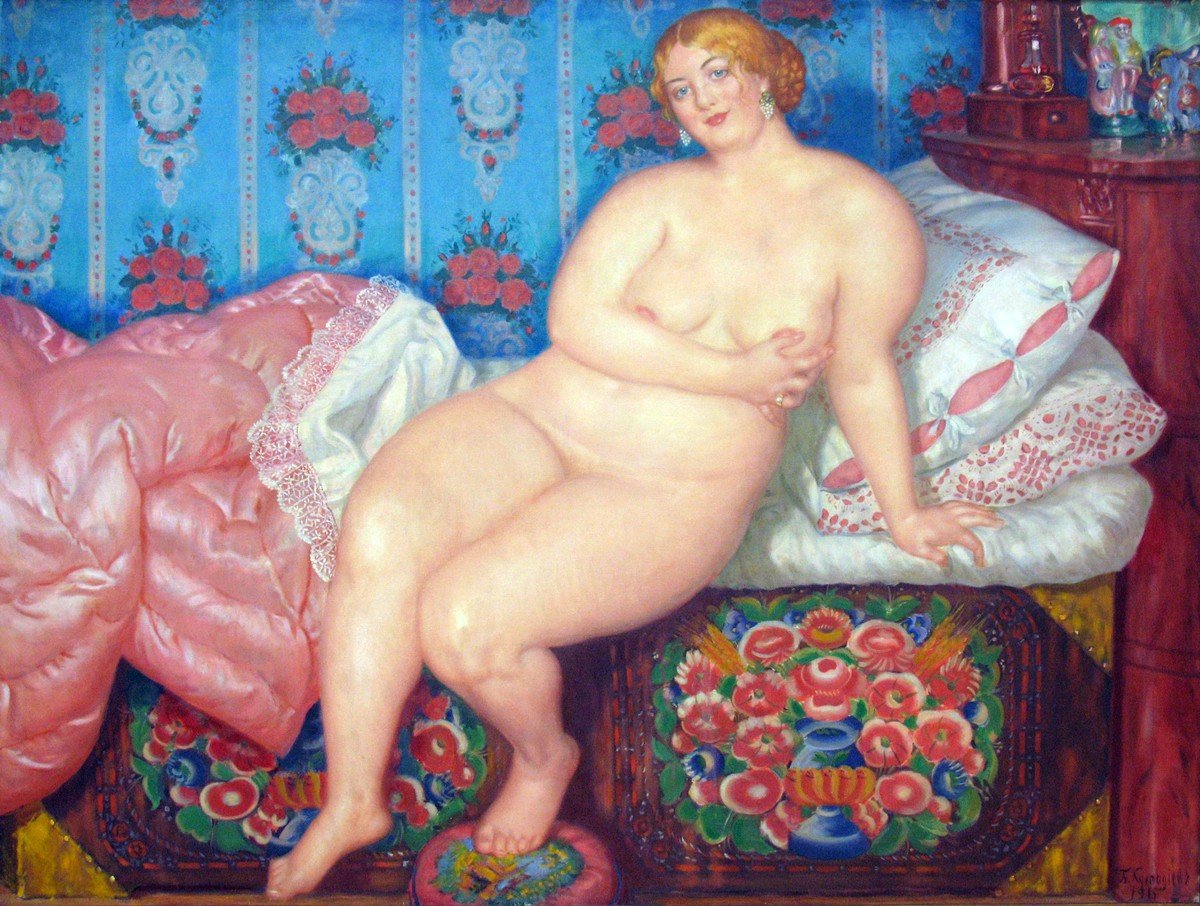
Kustodiev returned to the title Beauty (Krasavitsa) repeatedly, among others in 1915 and 1918. The shared title signals that he is painting an ideal rather than a portrait of a named sitter: his own regional definition of beauty, ample, healthy and unhurried.
Compare the two canvases for how he arranges fabric, furniture and pattern around the figure, and for how a three-year gap changes the handling.
Russian Venus and the Bathhouse
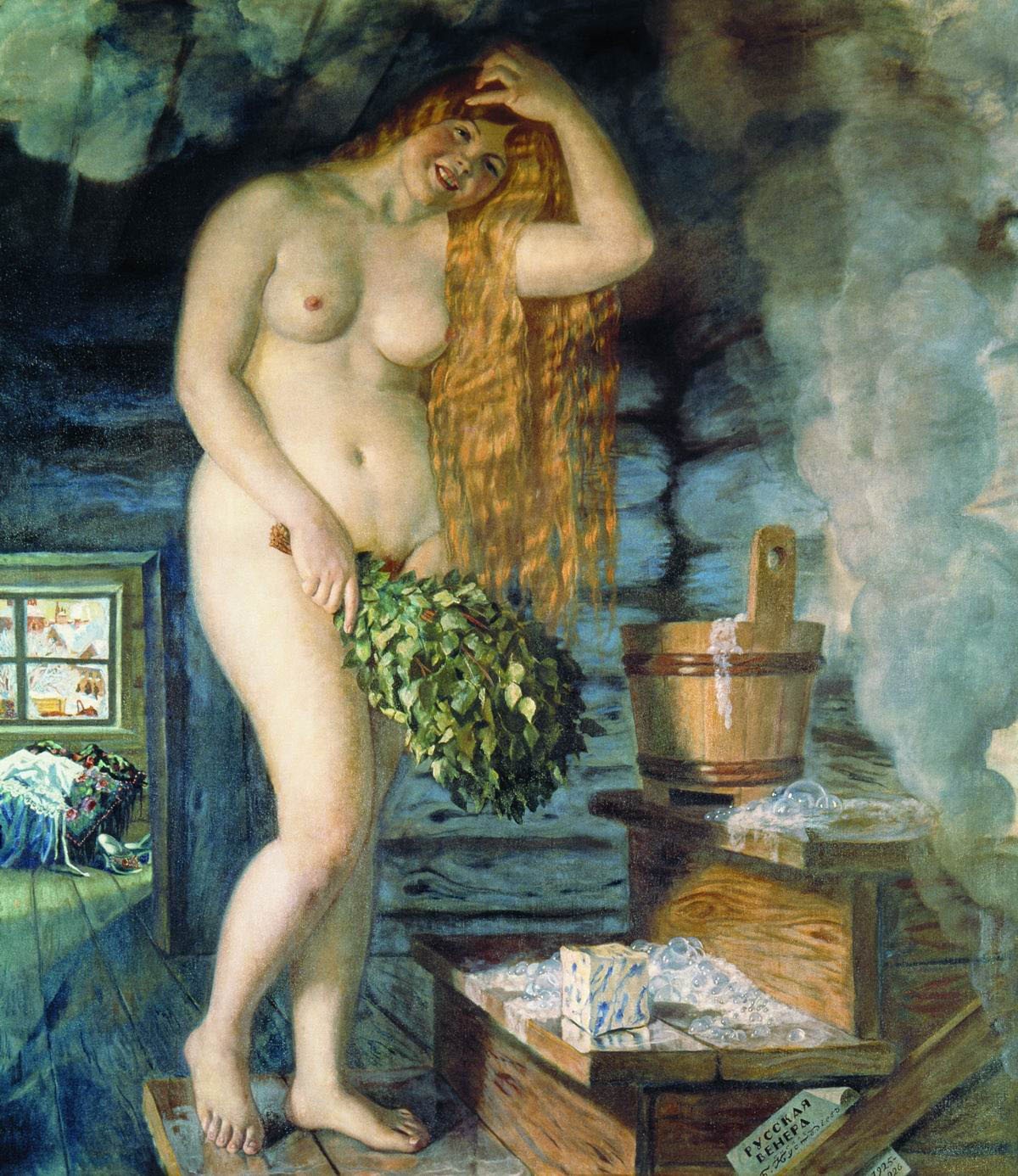
In Russian Venus (1925 to 1926), a monumental nude sits in the steam of a bathhouse, with a window opening onto a winter street. The title recasts the Venus of European painting as a Volga-town woman. The joke works only because the body is painted with complete seriousness.
The reference point is the long tradition of reclining and seated Venuses from the Renaissance onward. Kustodiev keeps the monumentality and swaps the mythology for a bathhouse.
Portraits: Bilibin and Chaliapin
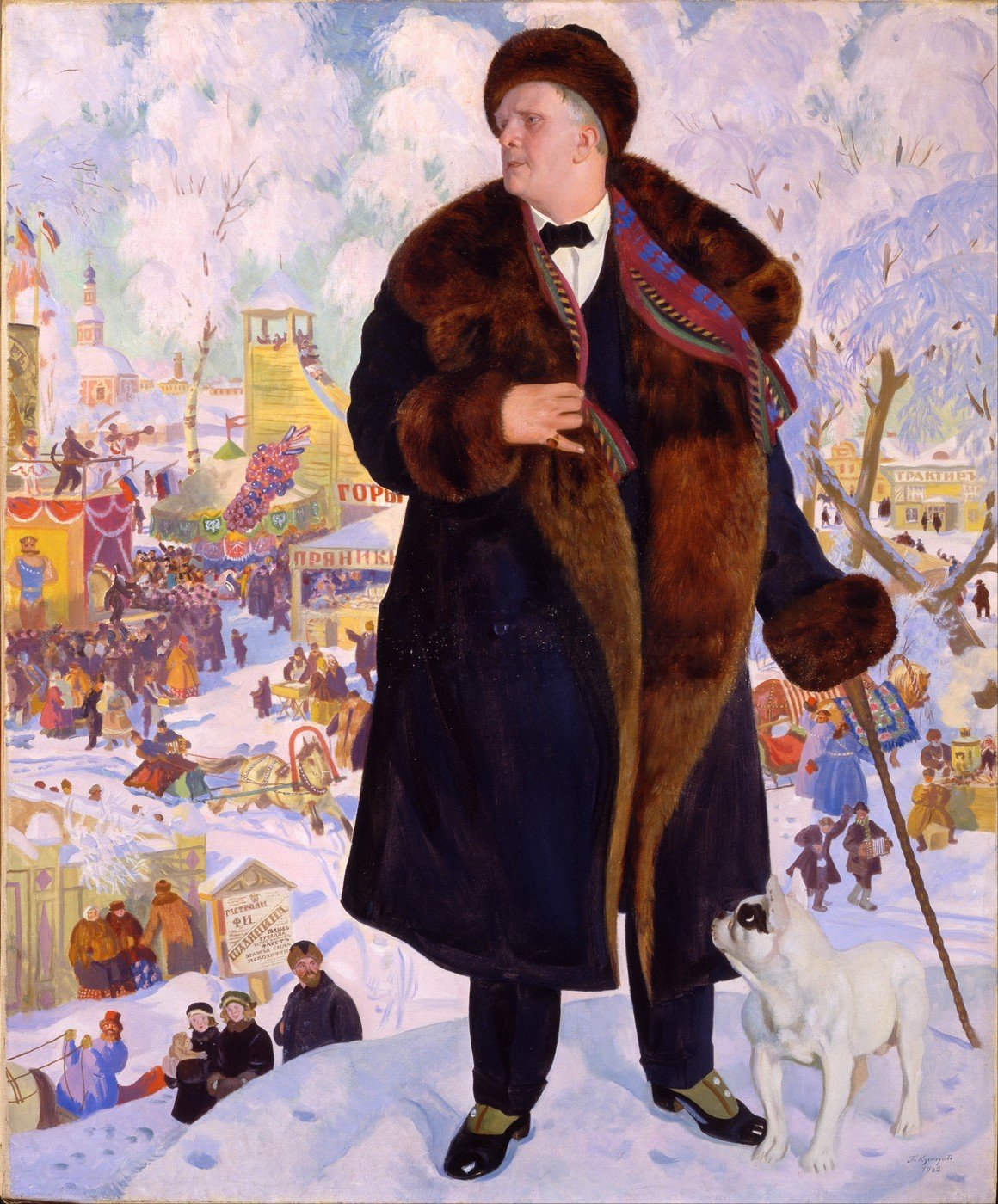
Kustodiev’s portraits show why Repin’s pupil never stopped being a realist. Early in his career he painted Ivan Bilibin (1901), the illustrator whose folk-tale pictures defined the Russian fairy-tale look. Later, in the early 1920s, he painted the bass Fyodor Chaliapin, now in the State Russian Museum. The singer wears a fur coat and stands before a snowy fair, so the man and the Maslenitsa world meet in one frame.
Chaliapin was one of the most celebrated Russian singers of his era, and the portrait gives him the scale of a monument.
Revolution, Stage Designs and The Flea
Kustodiev did not look away from 1917. The Bolshevik (1920) shows a giant figure with a red flag striding over a city crowd, and in 1921 he painted a festival celebrating the Second Congress of the Comintern in Petrograd.
In theatre he designed sets and costumes, most famously for The Flea (1925) at the Moscow Art Theatre, adapted from Nikolai Leskov’s tale of the Tula craftsmen who shod a mechanical flea. His painted-toy sensibility suited the folk comedy.
Neighbours in Colour: Malyavin and Yuon
Kustodiev’s closest comparisons are not other merchant painters but artists who mined Russian provincial life through colour. Filipp Malyavin, born into a peasant family, trained as an icon painter and studied under Repin. He painted peasant women in red dresses in Whirlwind (1906), where the paint itself seems to spin. Kustodiev’s women sit still. Malyavin’s dance.
Konstantin Yuon, also tied to Mir iskusstva, painted Russian towns and monasteries in bright seasonal light, another way of treating provincial Russia as worth a large canvas.
Legacy: The Painter of a Vanished World
Kustodiev died in Leningrad on 28 May 1927, aged 49. By then his imagery had set a template. Illustrators, filmmakers and designers have often reached for his merchant wives and snow-covered fairs when they want a visual shorthand for old provincial Russia.
The images last because they are specific: a particular tea table, a particular rooftop, a particular shade of winter blue.
Essential Points
- Timeline in one line: born 1878, Academy 1896, first symptoms around 1909, unable to walk by about 1916, died 1927.
- His teaching chain runs from Pavel Vlasov in Astrakhan to Ilya Repin in Saint Petersburg to the Mir iskusstva circle.
- Start with Shrovetide (1916) for Maslenitsa, then compare the two Beauty canvases (1915 and 1918) for his merchant-town ideal.
- Russian Venus (1925 to 1926) is the best single picture for seeing his humour and his seriousness at once.
- His later fairs and tea tables were remembered scenes, not observed ones.
- His range was wider than the cheerful reputation suggests: 1905 cartoons, The Bolshevik (1920) and The Flea (1925) for the stage.
- Set him beside Filipp Malyavin for the clearest contrast: Malyavin’s figures spin, Kustodiev’s sit still.
Frequently Asked Questions
- Do I need to know Russian history to enjoy Kustodiev?
- No. Start with the surface: the colour of the snow, the textures of fur and silk, the food on the table. The pictures are built to be read quickly and affectionately. Background on merchants, Maslenitsa and the 1917 upheavals adds layers, but the first look works without any of it.
- What happened to the merchant class Kustodiev painted?
- Soviet decrees in November 1917 abolished the old legal estates, including the merchant estate, and many trading families reportedly lost property and status. Kustodiev painted these households while they were still fresh memory, which gives the pictures a double feeling for many viewers: affection for the people and a sense of a way of life ending.
- What does the Maslenitsa effigy represent?
- The straw effigy, usually burned or buried on the last day, stands for winter being sent away before Great Lent begins. Its roots are generally traced to older Slavic seasonal rites, although local customs differ widely. Kustodiev’s pictures tend to concentrate on the outdoor fun rather than on the ritual itself.
- Was Kustodiev a founder of Mir iskusstva?
- No. The group formed in the 1890s around Alexandre Benois, Sergei Diaghilev and their friends, and the magazine began in 1898. Kustodiev became associated with it around 1910, already trained by Repin and known as a portraitist, and he contributed provincial Russian subjects to its exhibitions.
- Where can I see Kustodiev’s paintings today?
- The State Russian Museum in Saint Petersburg and the Tretyakov Gallery in Moscow hold major works, and the Astrakhan State Picture Gallery, named after him, shows his art in his hometown. Many pieces can also be viewed online through Google Arts and Culture and Wikimedia Commons, and loans travel to international exhibitions.
This guide was written and reviewed by the rus-art.com editorial team, specializing in Russian art history. We cross-check dates, attributions, and museum holdings against museum and academic sources.