Quick Answer
Viktor Vasnetsov (1848 to 1926) painted Russian fairy tales and epic heroes as serious history painting, giving folklore the scale and gravity that academies reserved for scripture and ancient history. His Alyonushka (1881) and Bogatyrs (begun 1881, finished 1898) turned oral tales into national images. Working at Abramtsevo, the artists’ colony supported by Savva Mamontov, he also designed theatre sets, a church and the Tretyakov Gallery facade, helping launch the Russian Revival style that shaped later book illustration and architecture.
What Is Vasnetsov’s Fairy-Tale Painting?
Viktor Vasnetsov (1848 to 1926) was a Russian painter and draughtsman who worked in mythological and historical subjects. He is regarded as a co-founder of Russian folklorist and romantic nationalistic painting, and as a key figure in the Russian Revivalist movement.
In practice, he took characters from byliny (sung heroic epics) and wonder tales, such as mounted heroes, talking wolves, flying carpets and mourning sisters, and painted them at the size and with the gravity that academies reserved for scripture and ancient history. Before him, Russian folk subjects tended to appear as small genre scenes or as book decorations. He gave them the weight of a national past.
A Priest’s Son from Vyatka
Vasnetsov was born in 1848 in the village of Lopyal, in Vyatka province, into a priest’s family. Church services, village fairs and the folk craft of the northern provinces filled his childhood. He studied at the Vyatka seminary before turning to art.
That double inheritance surfaces decades later. The gold grounds and solemn faces of his church murals come from the Orthodox world he grew up in. The carved and painted wood of his Abramtsevo designs draws on the peasant workshop. In 1867 he left for St Petersburg to enrol at the Academy of Arts.
The Academy, Repin and the Wanderers
In St Petersburg, Vasnetsov fell in with a generation of realists that included Ilya Repin. His early mature pictures were not fairy tales at all. Moving House (1876) and Peasant (1878) show poor lodgers and country people in the plain, observed detail that the Wanderers, who sent travelling exhibitions to the provinces, prized.
Then his subjects shifted. After the Battle of Igor Svyatoslavich with the Polovtsy (1880) took its theme from the medieval epic poem about Prince Igor’s failed campaign, and it showed a field of the dead rather than a victory parade. Reactions to such a picture were mixed, but it marked the turn. He kept the realist’s eye for grass, armour and bodies, and aimed it at the legendary past.
Moscow, Mamontov and a New Kind of Patron
In 1878 Vasnetsov moved to Moscow, where he found a circle built around Savva Mamontov (1841 to 1918), a Russian industrialist, merchant, entrepreneur and patron of the arts. Mamontov did more than buy pictures. He hosted artists, staged amateur theatricals and later ran a private opera company, and he treated painters as collaborators on a shared cultural project.
For Vasnetsov this was rare: an audience that wanted Russian legend on stage, on walls and on canvas all at once. It explains why a painter of epic heroes also ended up sketching costumes and drawing building plans.
Abramtsevo: A Colony Built on Folklore
Abramtsevo is a former country estate north of Moscow, near Khotkovo. In the nineteenth century it became a centre of the Slavophile movement and an artists’ colony. Mamontov turned it into a working retreat where painters, carvers and ceramicists shared tables and tools.
Vasnetsov’s contributions there were concrete. With Vasily Polenov he worked on the estate church in the early 1880s. In 1883 he designed the small timber Hut on Chicken Legs, a playful building inspired by the witch Baba Yaga’s home. Other residents and visitors included Repin, Polenov’s sister Elena Polenova and, later, Mikhail Vrubel and Mikhail Nesterov. Folk art was studied, collected and reinterpreted in one place.
Alyonushka: A Fairy Tale Painted on Location
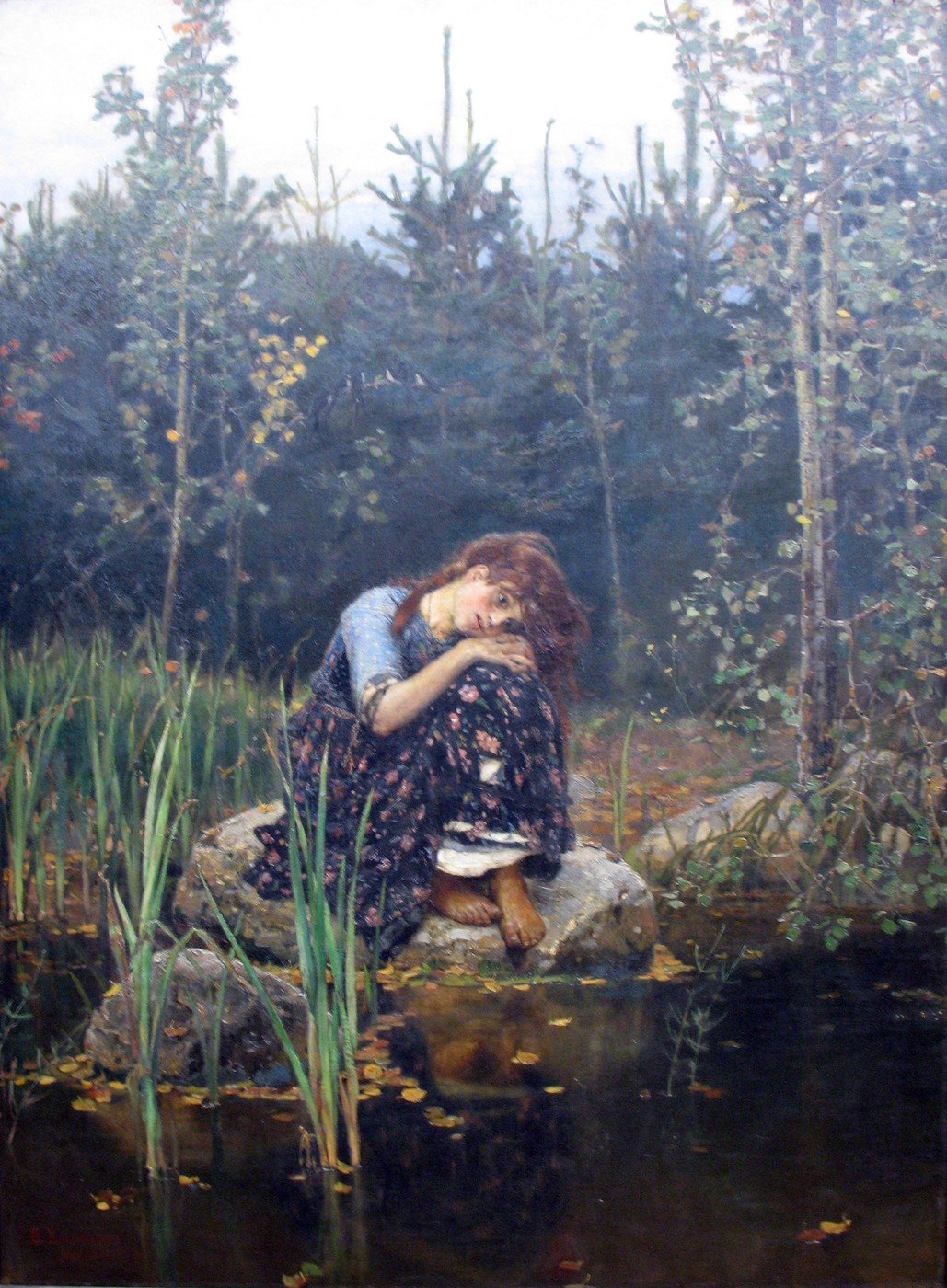
Completed in 1881, Alyonushka shows a barefoot girl on a stone beside a dark pond, her hair loose, her hands clasped around one knee. Aspens crowd the bank and leaves drift on the water. The picture now hangs in the State Tretyakov Gallery, and Vasnetsov reportedly first exhibited it under the title The Fool Alyonushka.
He painted the pond and trees from nature near the village of Akhtyrka, close to Abramtsevo, which gives the fairy tale a specific, damp, autumn air. No witch, no goat and no magic appear. The supernatural rests entirely on mood: the girl’s stillness, the sunken light, the water that holds her reflection.
Who is Alyonushka?
She is the sister in the folk tale of Alyonushka and her brother Ivanushka. Vasnetsov paints her at the moment of grief, after the story’s tragedy rather than during its action. Russian viewers knew the tale from childhood, so the picture could count on memory to supply the plot.
Crossroads, Carpets and Wolves
Vasnetsov’s other fairy-tale pictures were less quiet. Knight at the Crossroads shows a rider in chain mail on a white horse, halted before a great stone in an empty field. Crows perch nearby and bones lie in the grass. The first version dates from 1878. He returned to the subject in later years, and a well-known version in the State Russian Museum is dated 1882.
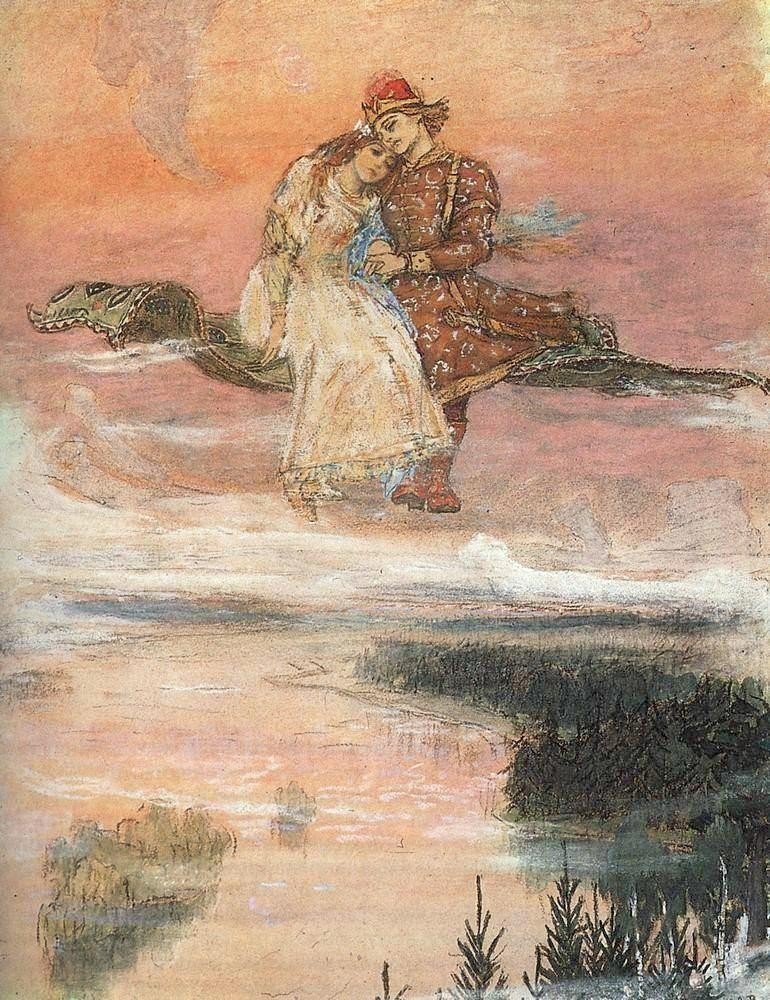
Flying Carpet (1880) is lighter in tone. Two figures drift over a dark forest on a patterned rug, and the carpet’s ornament is handled almost like a rug in the foreground of a still life. Ivan Tsarevich on the Grey Wolf (1889) follows the prince and Elena the Beautiful through a wood where the animal runs with human gravity. In each, the fantasy unfolds in a convincingly drawn place.
Three Bogatyrs: Seventeen Years of Guardians
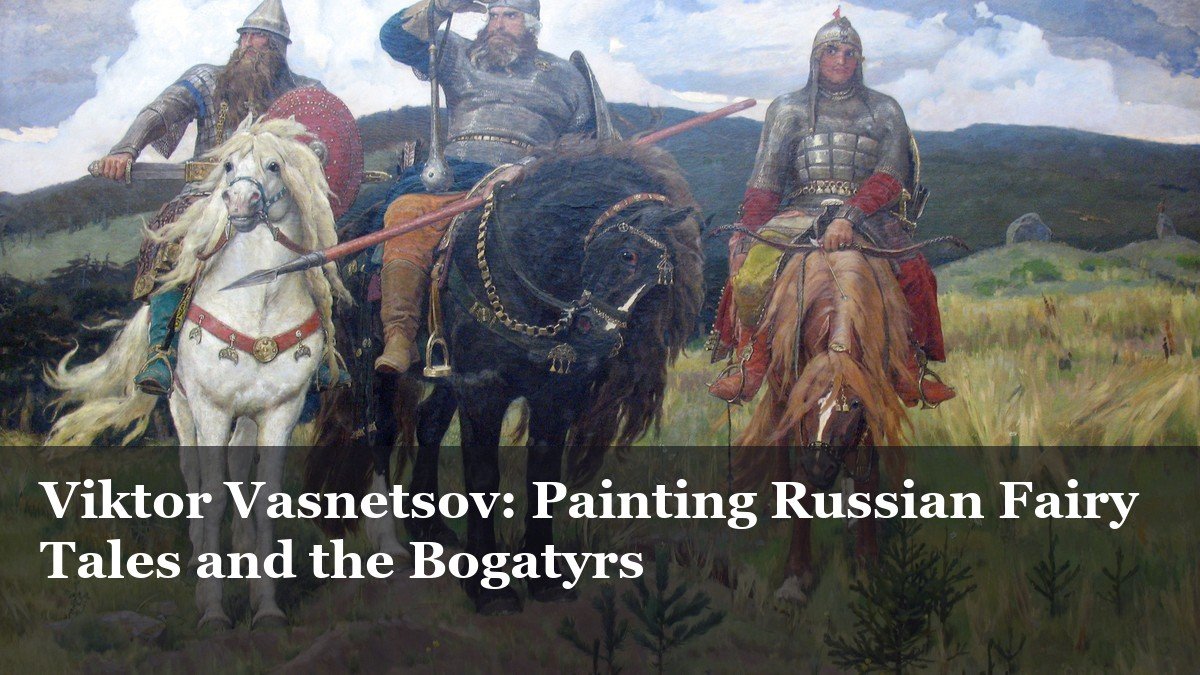
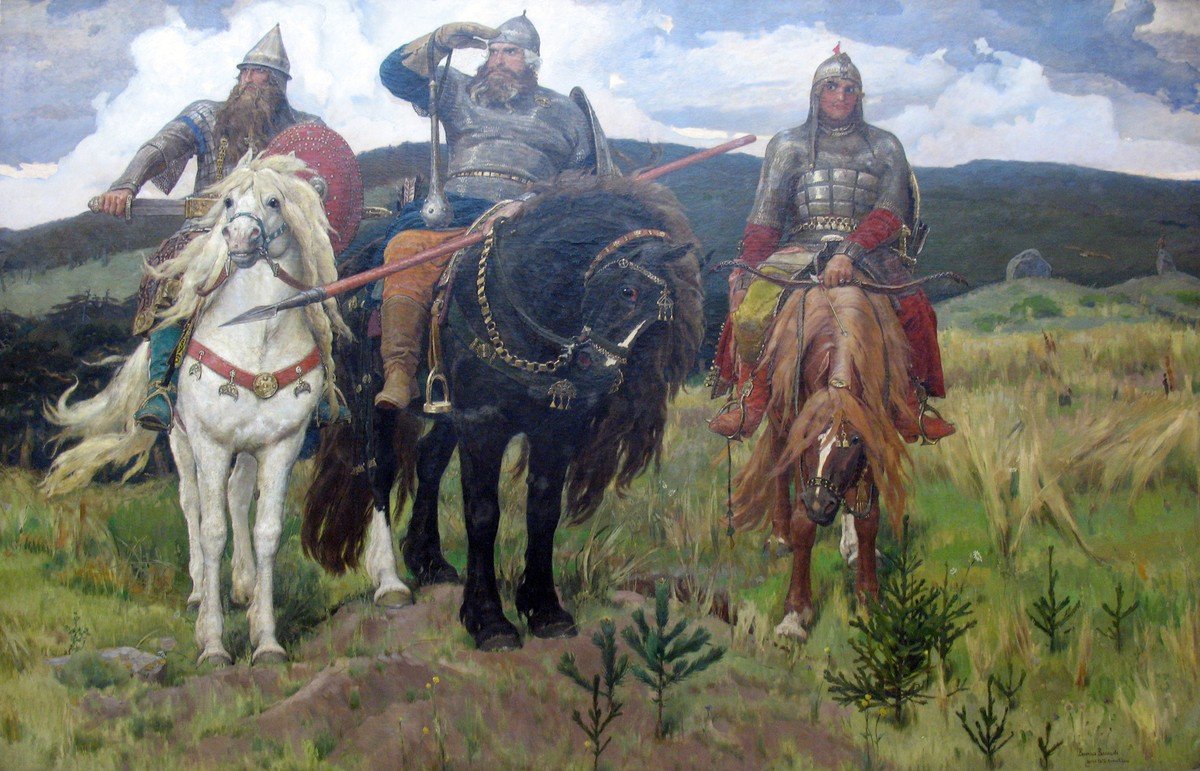
Vasnetsov began work on the Bogatyrs in 1881 and finished it in 1898, seventeen years later. The canvas is monumental, roughly three metres high and over four metres wide (State Tretyakov Gallery). Three horsemen stand shoulder to shoulder at the edge of a steppe: Ilya Muromets in the centre, Dobrynya Nikitich on the left and Alyosha Popovich on the right.
They are not acting out one story. Instead the picture gathers three heroes from the epic cycle into a single watch over the frontier, a kind of national guard portrait. Ilya Muromets shades his eyes and scans the distance. The sky behind the group stays low and overcast, so the riders seem part of the earth they defend.
What is a bogatyr?
A bogatyr is an epic warrior of Russian oral tradition, usually linked in the byliny to the court of Prince Vladimir at Kyiv. The songs were recorded mostly in the Russian north in the nineteenth century, so scholars disagree on how much real medieval history lies behind them. Vasnetsov did not settle that question. He gave the legend a visual form that stuck.
Look Closer: Look closer at the youngest rider
In the Bogatyrs, find Alyosha Popovich on the right. Beside his bow hangs a gusli, a stringed instrument, tied to the saddle. Vasnetsov gave the youngest hero a musician’s tool as well as a weapon, which hints at the quick wit and cunning that the epics attribute to him. Compare his lighter, watchful posture with the heavy stillness of Ilya Muromets in the centre.
How Vasnetsov Made Myth Look Plausible
His method was research disguised as imagination. For armour, saddles and costume he drew on collections of medieval and Muscovite objects in Moscow rather than inventing generic knights. Chain mail hangs with weight. Spear shafts bend slightly against the wind. Horses have individual temperaments instead of identical heraldic poses.
His palette stays close to earth browns, bleached grass and a cool northern grey-blue. Faces are broad and ordinary, closer to peasants than to Romantic heroes. Where he does allow decoration, as in the carpet of Flying Carpet or the patterned borders of church paintings, it stays flat and ornamental against otherwise solid modelling.
The Kyiv Cathedral Murals
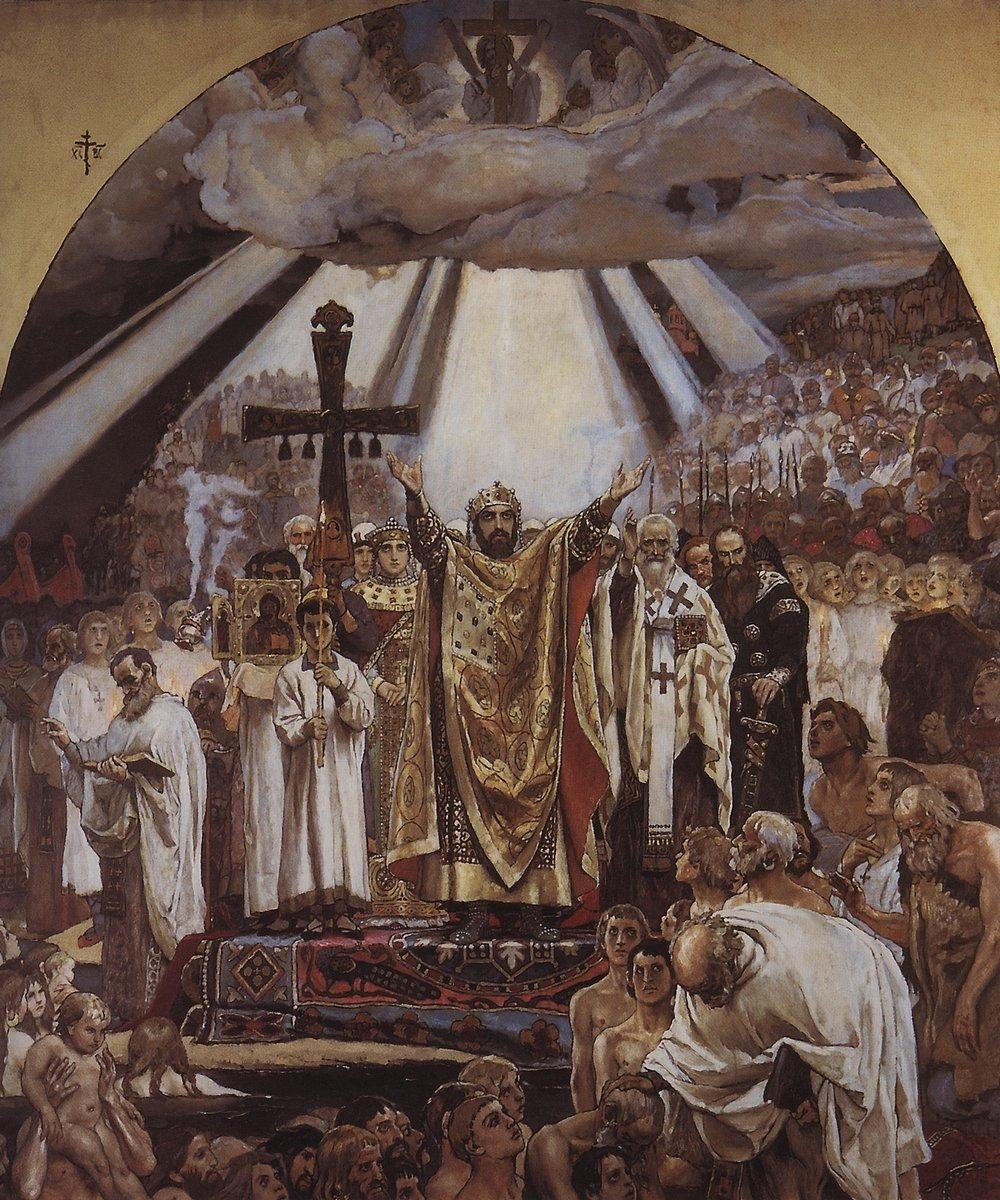
From 1885 to 1896 Vasnetsov led the decoration of St Vladimir’s Cathedral in Kyiv. The commission was huge, and it placed him at the head of a team of assistants that included the young Mikhail Nesterov. His designs for the scheme, among them a study of the Baptism of Rus (1885), recast the conversion of Prince Vladimir as a processional scene with a Byzantine hierarchy of figures.
In the church work his religious and national instincts merged. A darker, more visionary side appears in the Apocalypse study of 1887, where horsemen rush across a stormy sky. These pictures show that his folk imagination could be severe as well as fond.
Stage Sets, a Hut and a Gallery Facade
Away from the easel, Vasnetsov designed for Mamontov’s Private Opera. His sets and costumes for The Snow Maiden, the Rimsky-Korsakov opera drawn from Alexander Ostrovsky’s play, which Mamontov’s company staged in 1885, brought the painted fairy-tale world into three dimensions.
He also built. His own Moscow house, completed in 1894, is now a museum. Between about 1900 and 1904 he designed the facade of the Tretyakov Gallery in Moscow, a tall, frieze-like front with ornament modelled on medieval Russian patterns. The commission works as a neat symbol: the painter of national legend dressed the building that houses the national collection.
Revival, Not Replica
The Russian Revival style arose in the second quarter of the nineteenth century as an eclectic melding of Byzantine elements and pre-Petrine (Old Russian) architecture. It belongs to a wider European interest in national architectures. It is sometimes mislabelled as Old Russian architecture, but most Revival architects did not reproduce the old tradition directly. They stylized it, and the result was later combined with international styles, from Romanticism to the style moderne.
Vasnetsov worked by the same logic. His bogatyrs are not archaeological reconstructions but reinterpretations, filtered through modern oil technique and an academic training. Seen this way, the Hut on Chicken Legs and the Bogatyrs are siblings: one in wood, one in pigment.
Repin, Vrubel and Polenova: Three Other Roads into Folklore
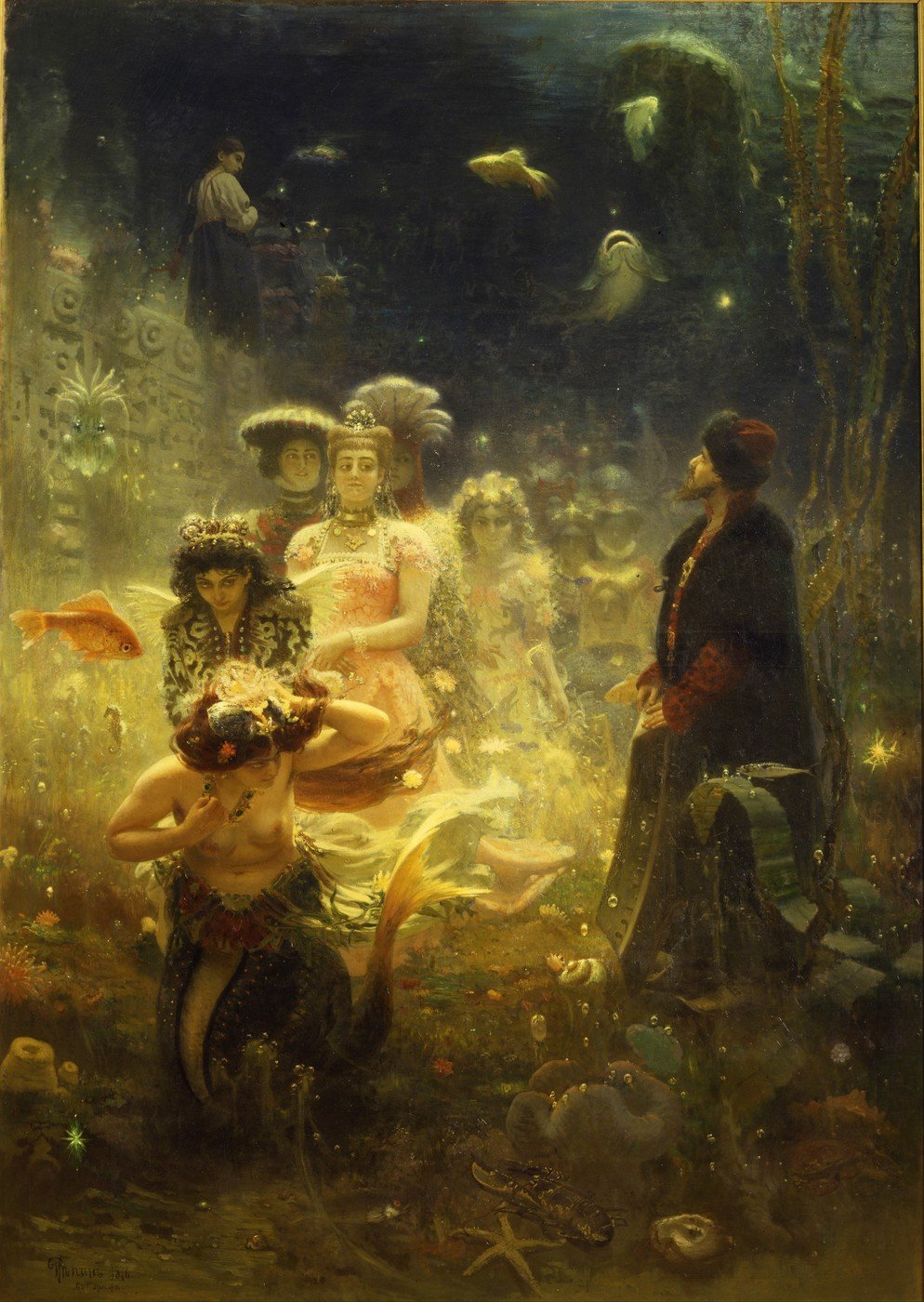
Vasnetsov was not alone, and the comparison sharpens his choices. Repin’s Sadko (1876) sets the merchant-musician of Novgorod’s epic among glowing underwater princesses, with the observant realism of a painter who normally worked from life. It is a fairy tale approached by an observer.
Mikhail Vrubel pushed in another direction. His Bogatyr (1898) is a heavy, faceted armoured rider with a dense, jewel-like surface. His Tsarevna-Lebed (1900), from Pushkin’s tale, melts the swan princess into glittering strokes. Elena Polenova, meanwhile, studied peasant craft and illustrated folk tales such as Synko-Filipko in delicate linear drawings. Beside them, Vasnetsov is the steady narrator who prefers plain forms and clear stories.
Nationalist Myth or Living Tradition?
Scholars disagree about how to read his legacy. One view holds that Vasnetsov gave a living oral culture a respectful visual language at a moment when educated Russians were rediscovering their peasants. Another holds that his tidy, heroic images helped fix a selective national myth, one that suited Slavophile and nationalist ideas better than the messy variety of the actual folklore.
There is also a practical debate about which of his works matter most: the early realist pictures, or the epic and church paintings. Both readings have supporters, and his work allows either.
Apollinary Vasnetsov and the Family Project
Viktor’s younger brother Apollinary (1856 to 1933) carried the same historical impulse into a different subject: the Moscow of earlier centuries. His watercolours and oils, such as Old Moscow (1902) and Kremlin under Ivan Kalita (1921), rebuilt vanished streets and towers from documents and surviving fragments.
Viktor painted heroes and enchanted creatures. Apollinary painted the city those heroes might have walked through. Together they give a two-sided answer to one question: what did Russia’s past look like?
After Vasnetsov: Bilibin and the Storybook Tradition
Ivan Bilibin began illustrating Russian fairy tales at the end of the 1890s. He worked with a crisp contour and flat colour, far from Vasnetsov’s soft oil handling. Still, the idea that a folk tale deserved a rich, researched visual world was already established. His Sadko illustration (1907) shows how far a book artist could take it.
Vasnetsov’s riders and princes have also circulated widely in schoolbooks and reproductions, so many Russians first meet their epic heroes through his faces. He died in Moscow in 1926, but the template he set remains easy to recognise.
Essential Points
- Vasnetsov did not invent Russian folk subjects; he changed their status by painting them at history-painting scale.
- His career turned on a move from Wanderers-style social realism to epic and fairy-tale themes around 1878 to 1881.
- Savva Mamontov’s patronage and the Abramtsevo colony gave him a working community, not just commissions.
- His output crossed media: easel paintings, church murals, opera design, architecture and furniture-like decorative objects.
- Alyonushka and the Bogatyrs sit at opposite emotional poles: private grief and public guardianship.
- The Russian Revival style was stylization, not copying, and Vasnetsov applied the same logic to painting.
- Repin, Vrubel and Polenova each took folklore in a different direction, which makes Vasnetsov easier to place.
- His brother Apollinary extended the family project from myth to reconstructed Old Moscow.
- Bilibin’s illustrations and later popular imagery of heroes owe a clear visual debt to his designs.
Frequently Asked Questions
- What is the difference between a bylina and a fairy tale?
- A bylina is a sung heroic epic about warriors such as Ilya Muromets, usually set around Prince Vladimir’s court in Kyiv. A fairy tale (skazka) is a prose story of magic, animals and enchanted families. Vasnetsov painted both, using bylina subjects for the Bogatyrs and skazka subjects for Alyonushka.
- Why did Russian artists turn to folk tales in the 1870s and 1880s?
- Interest in peasant culture grew after the 1861 emancipation of the serfs. Alexander Afanasyev’s collection of Russian fairy tales, published in the 1850s and early 1860s, made the stories easily available. Patrons like Savva Mamontov and Slavophile ideas about a distinct Russian identity gave painters both an audience and a reason.
- What does the stone in Knight at the Crossroads say?
- In the folk tradition behind the picture, the stone carries a warning about the roads beyond it. Going one way risks death, another costs the hero his horse, and a third promises marriage. The painting leaves the inscription as a choice, so the knight’s pause becomes the drama.
- What did Vasnetsov paint at the end of his life?
- He kept working after the 1917 revolution in Moscow and returned to old subjects. A late picture of Kashchey the Immortal, the skeletal villain of Russian fairy tales, belongs to those years. He died in Moscow in July 1926, still associated with the heroic imagery he created.
- Where can I see Vasnetsov’s paintings today?
- Alyonushka and the Bogatyrs are in the State Tretyakov Gallery in Moscow, and the State Russian Museum in St Petersburg holds works including Knight at the Crossroads. Vasnetsov’s Moscow house is a museum, his church and hut survive at the Abramtsevo museum-reserve, and his Kyiv murals remain in St Vladimir’s Cathedral.

This guide was written and reviewed by the rus-art.com editorial team, specializing in Russian art history. We cross-check dates, attributions, and museum holdings against museum and academic sources.