Quick Answer
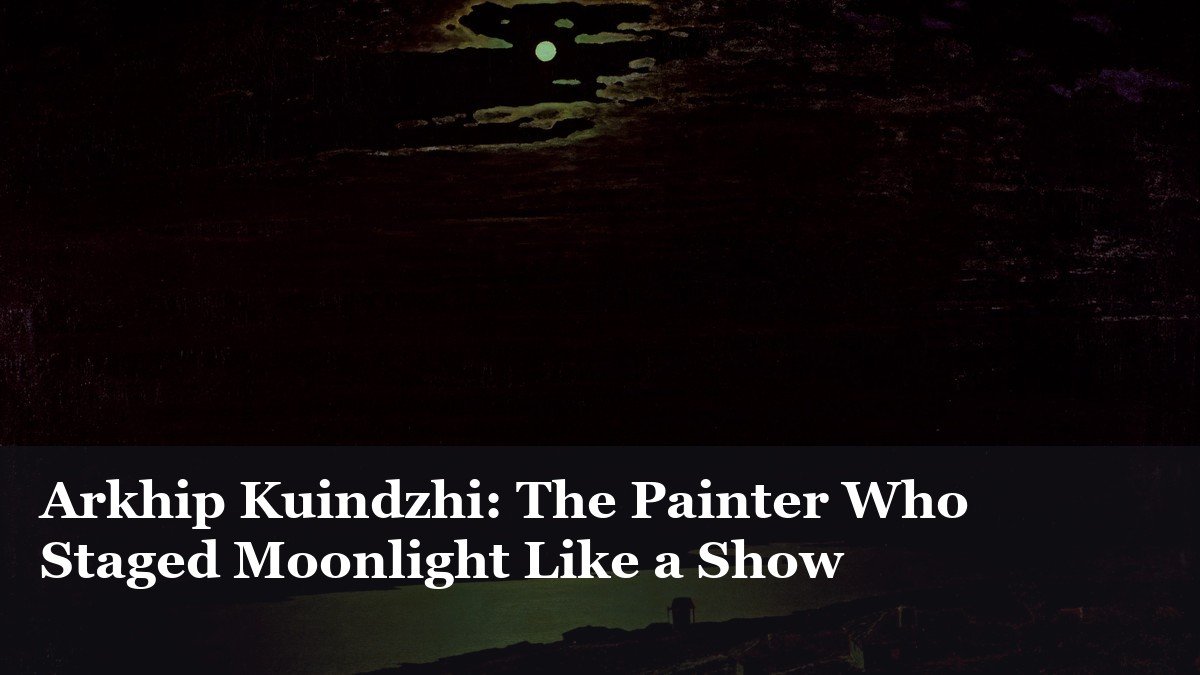
Arkhip Kuindzhi (1841 to 1910) was a Russian landscape painter of Urum origin who made light itself the subject of his pictures. His 1880 single-painting show placed Moonlit Night on the Dnieper alone in a St. Petersburg hall with controlled lighting, and visitors reportedly lined up to enter. He later taught Nicholas Roerich and Konstantin Bogaevsky at the Imperial Academy of Arts. He is remembered for glowing moons, dusks and sunsets built from sharp tonal contrast rather than accumulated detail.
Who Was Arkhip Kuindzhi, the Painter of Light?
Arkhip Kuindzhi (1841 to 1910) was a Russian landscape painter of Urum origin, and the artist most closely tied to painted light in nineteenth-century Russia. His moons, dawns and sunsets rest on a few large zones of dark and bright, not on layered detail. Hold a reproduction at arm’s length and the glow registers at once. Step closer and the surface turns out simpler than you expected.
That economy is deliberate. Kuindzhi worked among realists who prized documentary accuracy, yet he treated the sky like a lit stage. He arranged his pictures so that viewers sense a source of light the paint never states outright. What follows traces how he got there, what he taught, and why his work behaves so oddly in photographs and in museums.
A Boy from Mariupol Under the Azov Sky
Kuindzhi was born in Mariupol, on the northern shore of the Sea of Azov, into the Urum community, Turkic-speaking Greeks who had settled the coast. Orphaned young, he took whatever work he could find, and formal schooling got squeezed out. Biographers often link his later feeling for enormous skies to the flat Azov steppe of his childhood. That link is interpretation, not documented fact, but it fits the compositions: a thin strip of earth under a very large sky.
He is reported to have worked as a photographic retoucher before training as a painter. If that is accurate, it was a useful apprenticeship for an artist who later built pictures from carefully judged greys, since retouching teaches you to read tone before color.
Grinding Colors in Feodosia: The Aivazovsky Connection
Kuindzhi’s route into art ran through Feodosia, the Crimean port where Ivan Aivazovsky lived and worked. Accounts of his youth place him in the older master’s orbit, doing humble studio tasks such as preparing colors, while Aivazovsky turned out seas lit by moon and sun. Scholars disagree on how much formal teaching he received there, and repeated telling has probably polished the story.
The influence is easier to see on canvas. Aivazovsky’s The Ninth Wave (1850) glows because a sun-filled haze sits against dark water and a knot of survivors clinging to wreckage. Kuindzhi absorbed that principle of lit atmosphere set against darkness, then removed the storms, ships and rescue dramas. His pictures keep the glow and drop the plot, so the light itself becomes the only event.
Joining the Wanderers: Realists with a Strange Glow
The Peredvizhniki began as an artists’ cooperative formed in protest of academic restrictions, and became the Society for Travelling Art Exhibitions in 1870. Kuindzhi joined in 1875, just as the group came to dominate Russian exhibiting.
Was Kuindzhi really a Wanderer?
On paper, yes. In temperament, only partly. The Wanderers prized social observation and national subjects, and Kuindzhi offered national scenery with the peasants removed. Ukrainian Night (1876) and Birch Grove (1879), now in the State Tretyakov Gallery, show the pattern. In Birch Grove, sunlit trunks and a bright meadow gather into a single patch of intense color, and the picture carries no social message at all. That is why he is usually described as an outlier in the group: a Wanderer by exhibition record, an effects painter by instinct.
One Painting in a Dark Room: The 1880 Exhibition
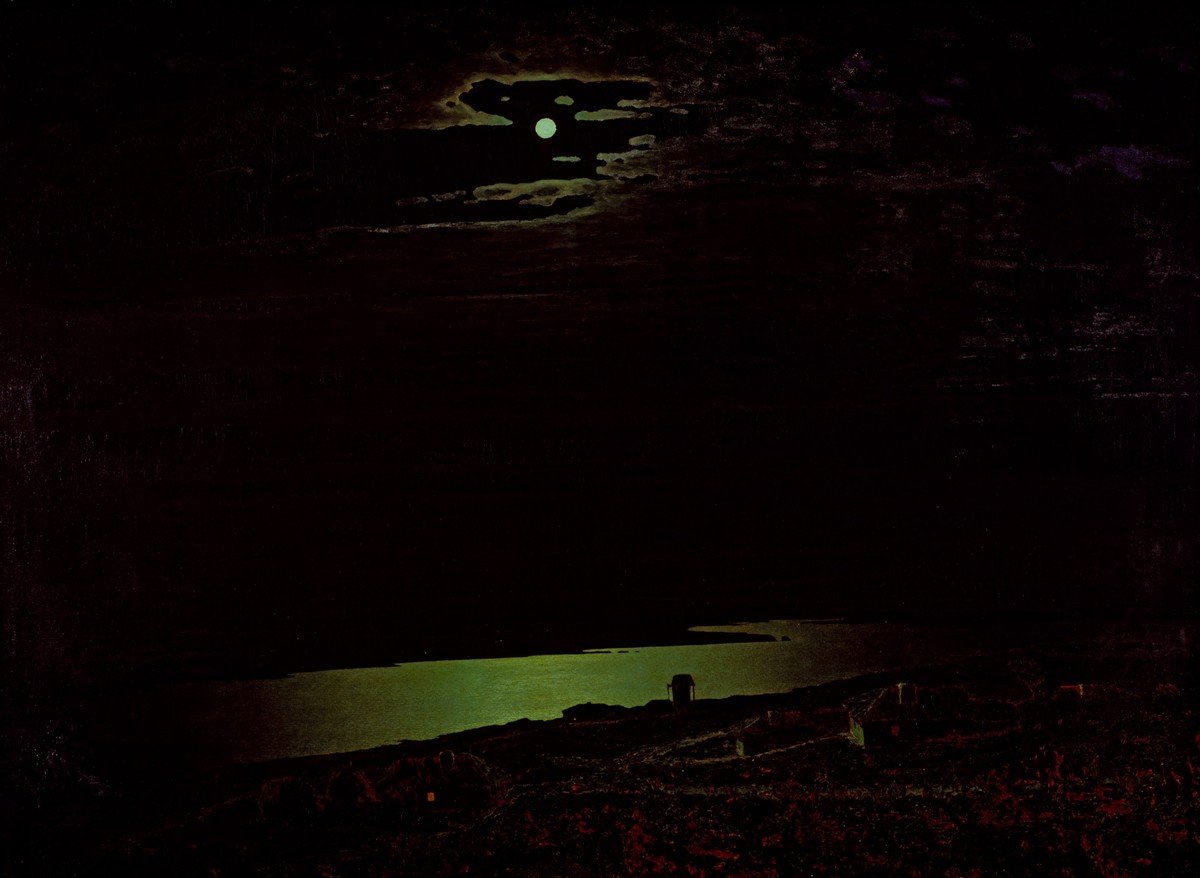
In 1880 Kuindzhi did something unusual for a Russian painter of his day. He showed a single picture, Moonlit Night on the Dnieper, entirely on its own in St. Petersburg. Wanderers exhibitions were crowded rooms of dozens of canvases, so one work alone was closer to a premiere than to a salon. Reports describe long queues, and several memoirs suggest that visitors came to find out whether a moon could really be painted.
Did Kuindzhi really use theatrical lighting?
Contemporary accounts describe a darkened hall with the picture lit by a concealed lamp, and anecdotes say some viewers peeked behind the frame, hunting for the source of the glow. Treat the colorful details with care. They come from memoirs and press recollections written after the fact, and scholars do not agree on how much was deliberate staging. What is solid is the format. A single canvas, controlled viewing conditions and a curious public turned a landscape into an event, and let Kuindzhi test his instinct that the room is part of the painting.
Look Closer: the two kinds of light
Find the small white huts on the bank in Moonlit Night on the Dnieper (1880) and notice their warm, lit windows. Set against the cold greenish moonlight, that small warm note helps the moon read as colder and brighter. The two lights sit side by side without blending, which is one reason the scene often feels staged rather than simply observed.
Building a Glow from Darkness: Kuindzhi’s Method
The glow depends on arrangement, not on bright paint alone. Kuindzhi pushed his darkest masses (trees, earth, the far bank) close to black, then set a narrow band of light directly against them. With little middle tone in between, the eye reads the pale zone as radiant. He also cleared away clutter: few figures, little incident, and a horizon placed to give the sky generous room.
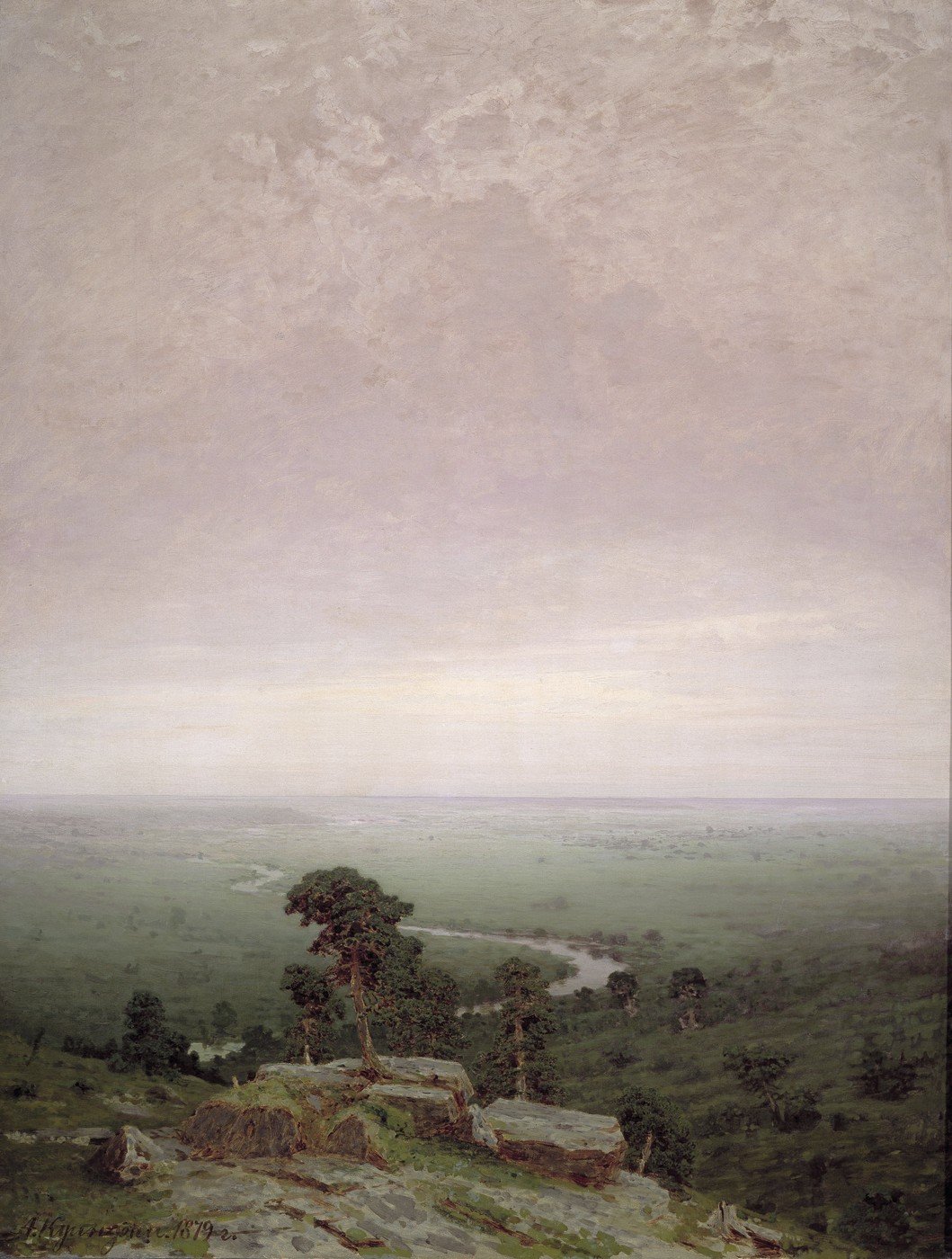
In North (1879) the same logic runs in a cold key. A wintry expanse holds together through tonal range rather than detail, and the mood arrives before the eye has identified a single object. His reported background in photographic retouching would have trained exactly this habit of judging tone first. The result is a style that rewards a long look from a distance and often disappoints at a few centimeters.
From the Dnieper to Ai-Petri: One Method, Many Skies
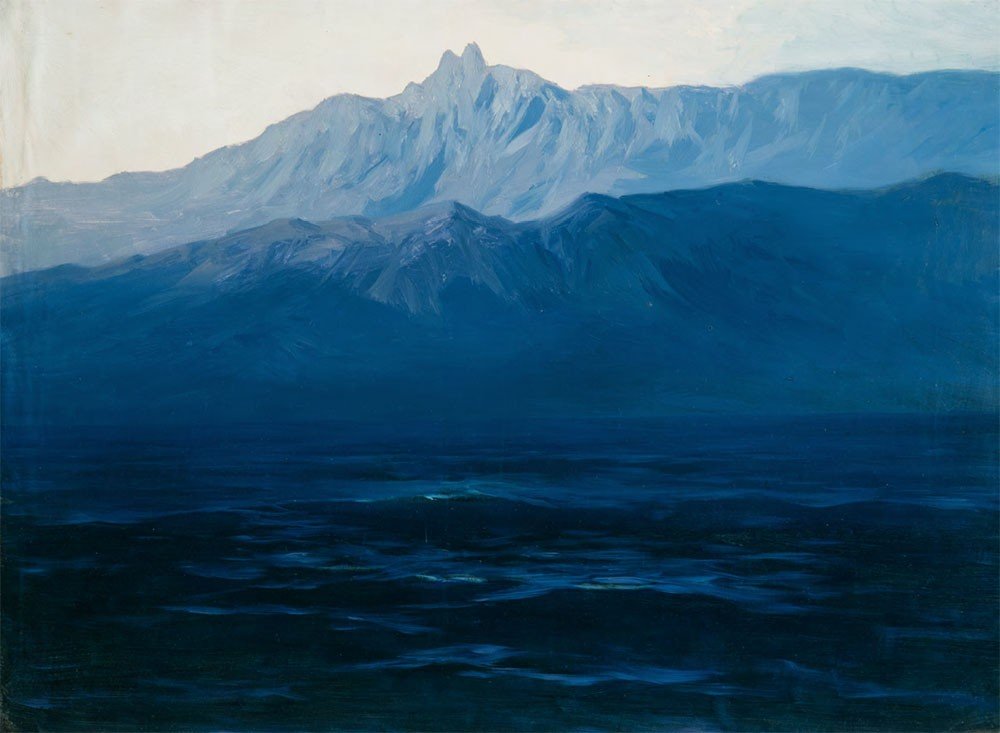
Kuindzhi’s subjects kept changing while his method stayed put. The Ukrainian steppe gave him nights and dawns along the Dnieper. Crimea gave him mountains and sea, and Ai-Petri. Crimea, begun in 1898 and reworked until 1908, turns a peak into a mass of simplified, glowing planes.
Across these years the narrative detail slowly drains away. Early pictures still include huts, roads and recognizable vegetation. Later ones keep the horizon, the light band and the dark mass, and let almost everything else go. By the time he painted the Crimean mountains, the scene works more like a color chord than a place you could walk into.
The Professor Who Taught Roerich and Bogaevsky
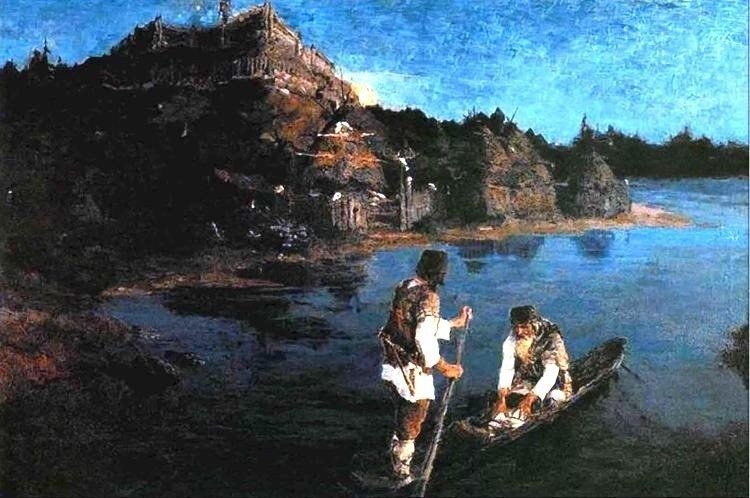
From around 1894 Kuindzhi headed a landscape studio at the Imperial Academy of Arts, and his list of students shows how little he imposed a house style. Nicholas Roerich studied with him in the 1890s and graduated with Messenger (1897), a prehistoric Slavic scene with almost nothing in common with Kuindzhi’s own subjects. Konstantin Bogaevsky went another way, painting the barren, mythologized hills around Feodosia.
Kuindzhi reportedly supported students with his own money, including help with travel. He reportedly left the Academy in 1897 amid a conflict connected with student unrest, though accounts of the details differ. The episode matters because it shows him choosing his pupils’ independence over his institutional position.
The Long Silence After 1882
After 1882 Kuindzhi largely stopped showing his work publicly, and for roughly two decades few outsiders saw what he painted. Why remains debated. Suggested explanations include discomfort with critics, a preference for teaching, and a wish to control exactly how his pictures were seen, but none is conclusive.
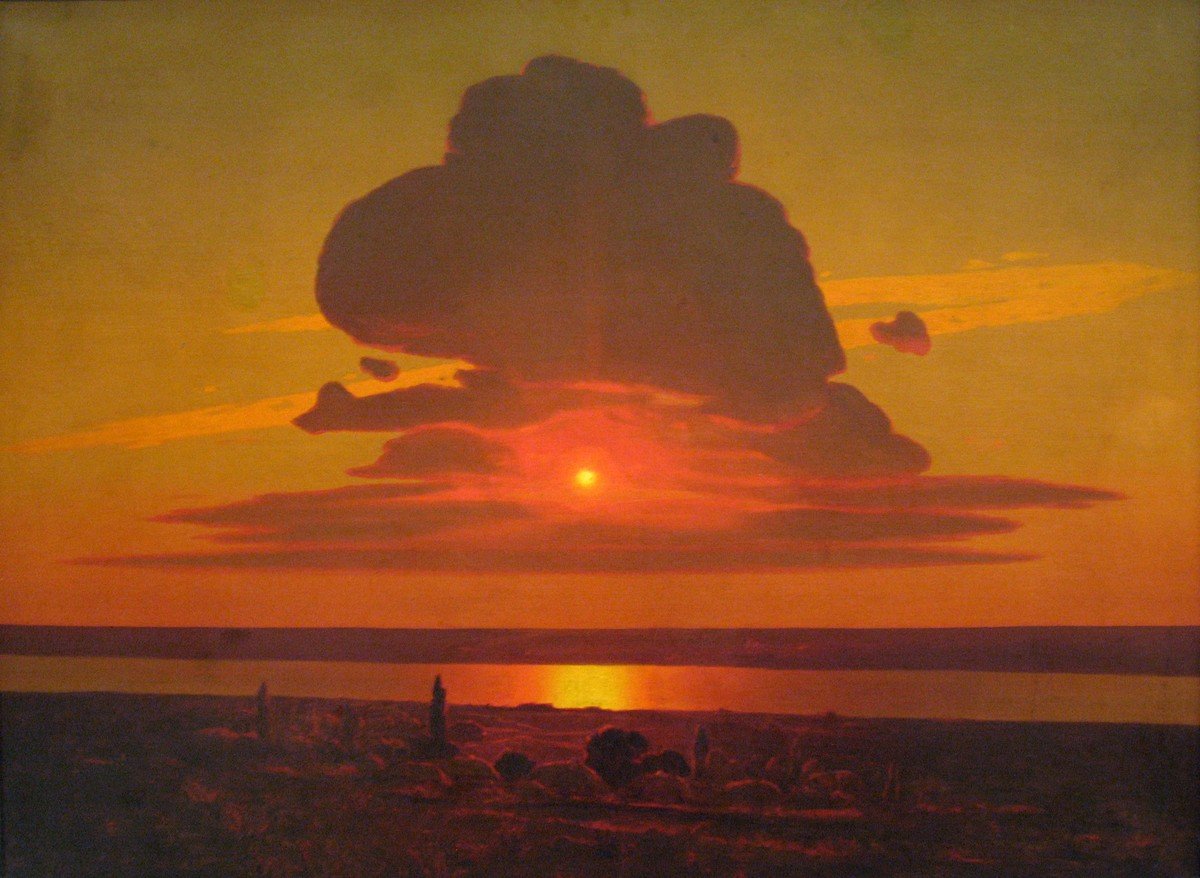
What survives from these years are sketches and late canvases that push his method toward abstraction. Sketch for Cloud (1900 to 1905) isolates a bright mass against darkness with almost no supporting detail. Red Sunset on the Dnieper, from about 1905, reduces river, bank and sky to a few saturated bands. Seen together, they suggest that the silence was a period of experiment rather than retreat.
Why a Kuindzhi Looks Different Today
Anyone standing in front of a Kuindzhi should know the picture has aged. Many nineteenth-century Russian oils darkened as paint layers and grounds changed, and Kuindzhi’s reliance on deep darks and sharp contrast makes any change easy to spot. Some viewers suspect unstable dark pigments, such as the bituminous mixtures common in the period, but the cause varies from painting to painting, and not every work has been studied in published technical literature.
Because the glow depends on the relationship between dark and light, even modest darkening or fading can flatten it. Museums that hold his major canvases, including the State Russian Museum, typically show them in subdued gallery light, partly for conservation and partly because lighting shapes the effect. Reproductions add a second distortion: screens and prints often exaggerate or erase contrast, so the picture you remember may not be the picture on the wall.
Shishkin Catalogues, Levitan Confides, Kuindzhi Performs
How is Kuindzhi different from Shishkin and Levitan?
Three landscape painters of different generations make a useful comparison. Ivan Shishkin (1832 to 1898), a founding member of the Peredvizhniki, built forests tree by tree. In Morning in a Pine Forest (1889), where Konstantin Savitsky painted the bears, every trunk and fallen log is specific. Isaac Levitan (1860 to 1900) advanced the mood landscape, and Golden Autumn. Slobodka (1889) works through quiet tonal harmony and a sense of private reflection.
Kuindzhi stands apart from both. Shishkin catalogues, Levitan confides, Kuindzhi performs. His pictures are designed to be seen from a particular distance under particular light, and their emotional pitch sits closer to theater than to botany or diary.
A Bequest and a School: Kuindzhi’s Legacy
Kuindzhi gave much of his fortune to found a society of artists named after him in 1909, a year before his death in 1910. The gesture reflects the same priorities as his teaching: resources for young painters, with no demand that they imitate him.
The pupils bear that out. Arkady Rylov’s Green Noise (1904) turns spring foliage into a sweeping field of green, a bold simplification that owes something to his teacher’s compression of tone. For modern viewers raised on screens, cinema and darkened immersive exhibitions, Kuindzhi’s staged light arguably reads as familiar rather than strange. He anticipated, by a century, the idea that how you present a picture is part of what the picture says.
Essential Points
- Kuindzhi’s fame rests on staging as much as painting: he treated the viewing conditions as part of the work.
- His glow comes from compressed tonal range, which is why small reproductions and screens often misrepresent it.
- His career has three distinct phases: the Wanderer of the 1870s, the exhibition showman of 1880 to 1882, and the withdrawn teacher and late experimenter.
- His teaching record is unusually varied, since pupils as different as Roerich and Bogaevsky left his studio with no shared house style.
- Condition matters: a canvas in a museum today is not identical to the one visitors saw in 1880.
- Good entry points are Moonlit Night on the Dnieper for the effect, North for the cold key, and Red Sunset on the Dnieper for near-abstraction.
- Treat anecdotes about hidden lamps and ship voyages as sourced stories rather than settled fact.
Frequently Asked Questions
- How do you pronounce Kuindzhi, and what does the name mean?
- It sounds roughly like kwin-JEE, with the stress on the second syllable. The surname is usually explained as coming from a Turkic word for goldsmith, a plausible nickname in the Urum Greek community of Mariupol. English spellings vary, including Kuindzhi, Kuinji and Quindzhi, so search with several forms.
- Who bought Moonlit Night on the Dnieper after the 1880 show?
- The painting was bought by Grand Duke Konstantin Konstantinovich, a member of the imperial family. Accounts say he carried it aboard a naval voyage and that sea damp harmed the paint, though details vary between sources. It later entered public hands and is now in the State Russian Museum in St. Petersburg.
- Did Kuindzhi paint his big pictures outdoors?
- Mostly not. He gathered studies and impressions on trips to places such as Crimea and the Dnieper, then composed the finished pictures in the studio, adjusting tone and scale for effect. That method helps explain why his nights feel designed rather than transcribed, though the balance between study and invention varied from painting to painting.
- Was Kuindzhi friends with any scientists?
- Yes, the chemist Dmitri Mendeleev was a friend and a frequent visitor to Kuindzhi’s circle. Mendeleev wrote about Moonlit Night on the Dnieper and reportedly discussed light and materials with the painter. Most details of their exchanges come from memoirs, so treat specific claims about pigments with caution.
- Where can I see Kuindzhi’s paintings today?
- Many are in Russia. The State Russian Museum holds Moonlit Night on the Dnieper, and the State Tretyakov Gallery holds Birch Grove. As of this writing, the Metropolitan Museum of Art in New York holds Red Sunset on the Dnieper. Ukrainian museums also hold major works, so check collection pages before you travel.

This guide was written and reviewed by the rus-art.com editorial team, specializing in Russian art history. We cross-check dates, attributions, and museum holdings against museum and academic sources.