Quick Answer
Abramtsevo is a country estate north of Moscow where the railway magnate Savva Mamontov hosted painters from 1870 onward. There, Viktor Vasnetsov, Vasily Polenov, Elena Polenova, Mikhail Vrubel and others designed a church, built fairy-tale cottages, revived peasant crafts, and painted folklore subjects. The result, often called the Russian Revival or neo-Russian style, treated medieval and folk forms as raw material for modern design. It became a model for later colonies and a direct source for early twentieth-century Russian modernism.
What Was Abramtsevo?
Abramtsevo is a former country estate, now a museum-reserve, in the village of Abramtsevo near Khotkovo, in the Sergiyevo-Posadsky District of Moscow Oblast, north of Moscow. In the nineteenth century it became a center of the Slavophile movement and then an artists’ colony. That is why the Abramtsevo Colony is the usual name for the circle that gathered there.
The painters signed no manifesto. They shared a house, a home theatre, a workshop yard and one patron, and their daily work produced a visual language drawn from icons, fairy tales and peasant carpentry. Historians place that language at the core of the Russian Revival, a style that blended Byzantine and pre-Petrine forms.
A Slavophile Household Before the Painters
The estate’s earlier owner set the tone. Sergei Aksakov, author of the memoir A Family Chronicle, bought Abramtsevo in 1843, and writers including Nikolai Gogol sat among his guests.
His sons Konstantin and Ivan Aksakov became leading Slavophiles. They argued that Russia’s church, village customs and medieval past held values worth preserving against Western imitation. The painters who came later were mostly not theorists. Still, they inherited a setting where peasant culture was treated as a source of dignity, not backwardness.
Savva Mamontov Buys a House with a History
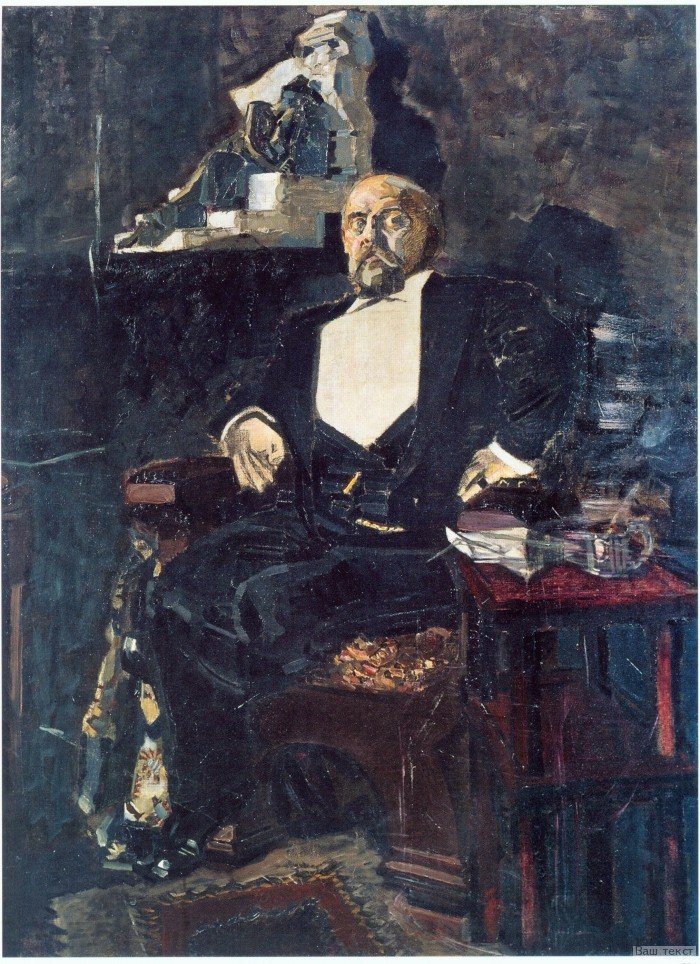
In 1870 Savva Mamontov bought the estate. Born in Yalutorovsk in 1841, he was an industrialist, merchant and patron who made his fortune in railway building. He had also trained as a singer in Italy before returning to business.
He ran Abramtsevo as a working household for the arts. Guests stayed for weeks, amateur theatricals filled the evenings, and he paid for materials and travel. He did not commission pictures from a distance. He fed people, lodged them, and then asked what they wanted to build.
How Did Summer Guests Become a Circle?
They came first as friends of the family. Ilya Repin, Vasily Polenov and Viktor Vasnetsov were among the early visitors. Polenov, a landscape painter linked to the Peredvizhniki realists, was nicknamed the ‘Knight of Beauty’ and held that ‘Art should promote happiness and joy.’ Vasnetsov had moved to Moscow in 1878, and at Abramtsevo he found a place to work on fairy-tale and epic subjects.
The Peredvizhniki tradition leaned toward social critique. The Abramtsevo painters, working side by side each summer, drifted toward national memory and decorative beauty. Shared meals and shared projects turned acquaintances into collaborators.
A Church Built by Painters
In 1881 and 1882 the circle built the Church of the Saviour Not Made by Hands on the estate. Vasnetsov and Polenov shaped the design, taking cues from medieval Novgorod churches. Several members of the group carved details and painted icons themselves.
As a religious project, the commission mattered less than as a trial run. Painters who had never built anything learned that one structure could bring architecture, icon painting, carving and ornament under shared control.
The Hut on Chicken Legs
In 1883 Vasnetsov designed a log cottage on carved posts for the estate’s children: the Hut on Chicken Legs of the Baba Yaga tales. It is a joke and a serious experiment at once.
Most Revival architects did not copy old buildings. They stylized them, and the hut shows how. Start with a real peasant house type, then exaggerate it until it becomes a story. Steep roofs, carved trim and playful proportions took the place of archaeological accuracy.
A Village Pond Becomes Alyonushka
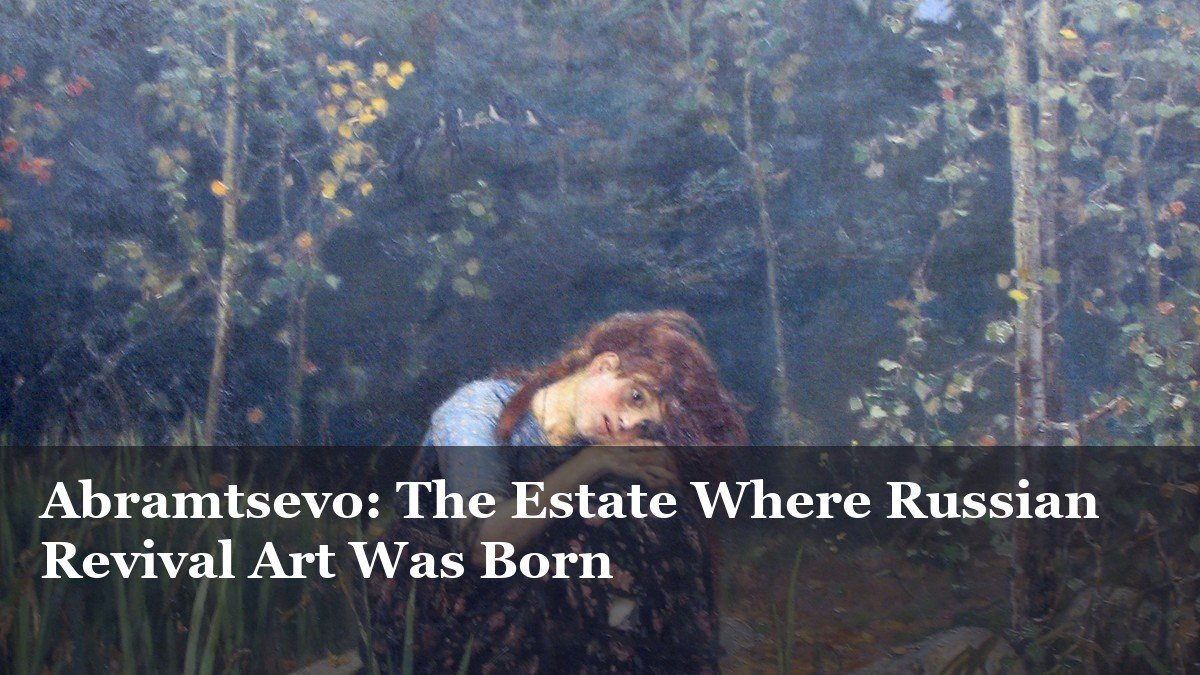
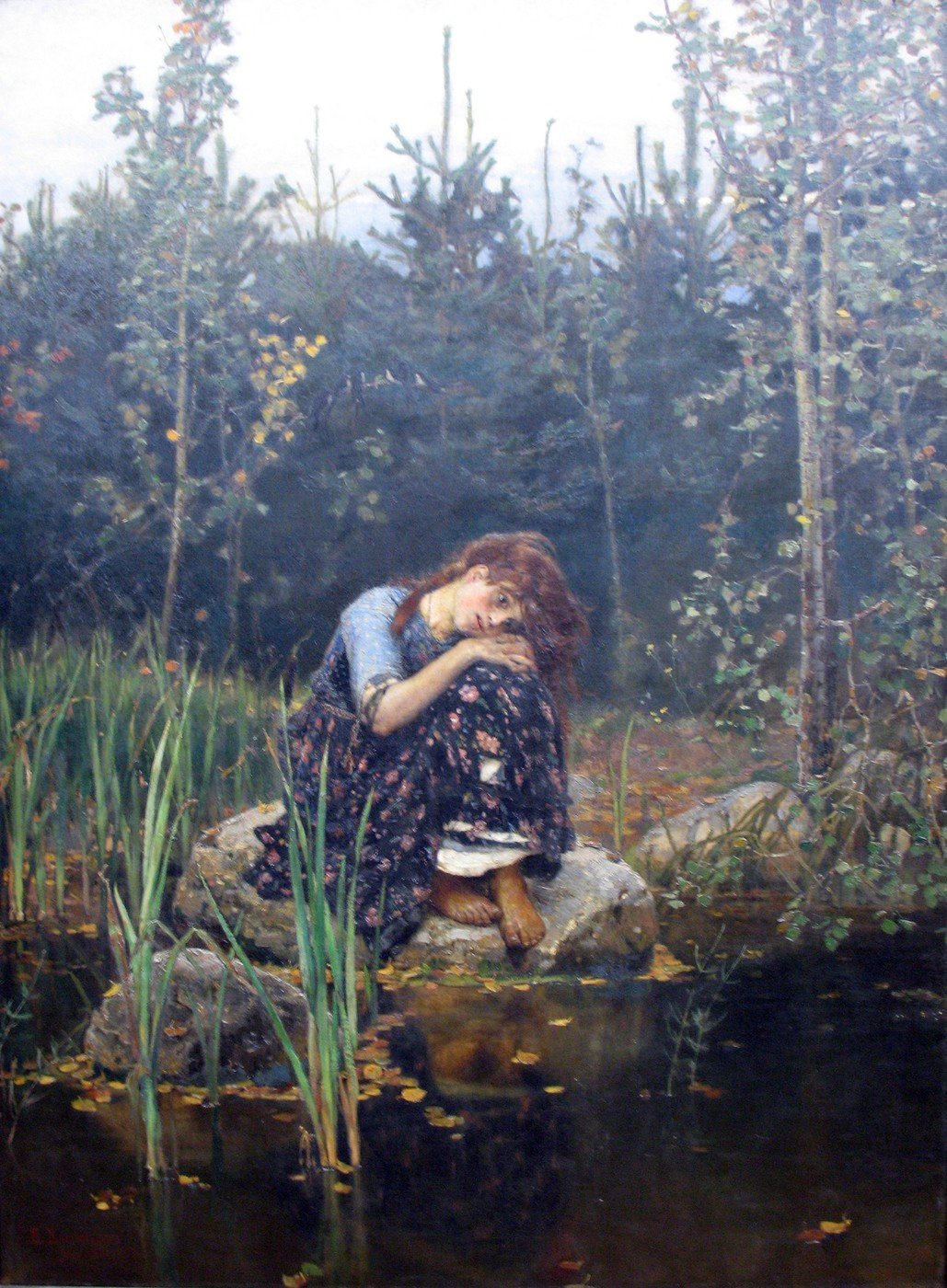
In 1880 Vasnetsov began studies at a pond near the village of Akhtyrka, close to Abramtsevo, and in 1881 he finished Alyonushka. A barefoot orphan girl sits on a stone, arms wrapped around her knees, beside dark autumn water. In the tale she mourns her brother Ivanushka, who was turned into a goat.
Vasnetsov gave a nursery story the scale and seriousness that Russian painters usually reserved for history. The painting now hangs in the State Tretyakov Gallery in Moscow.
Polenova, Yakunchikova and the Carpentry Workshop
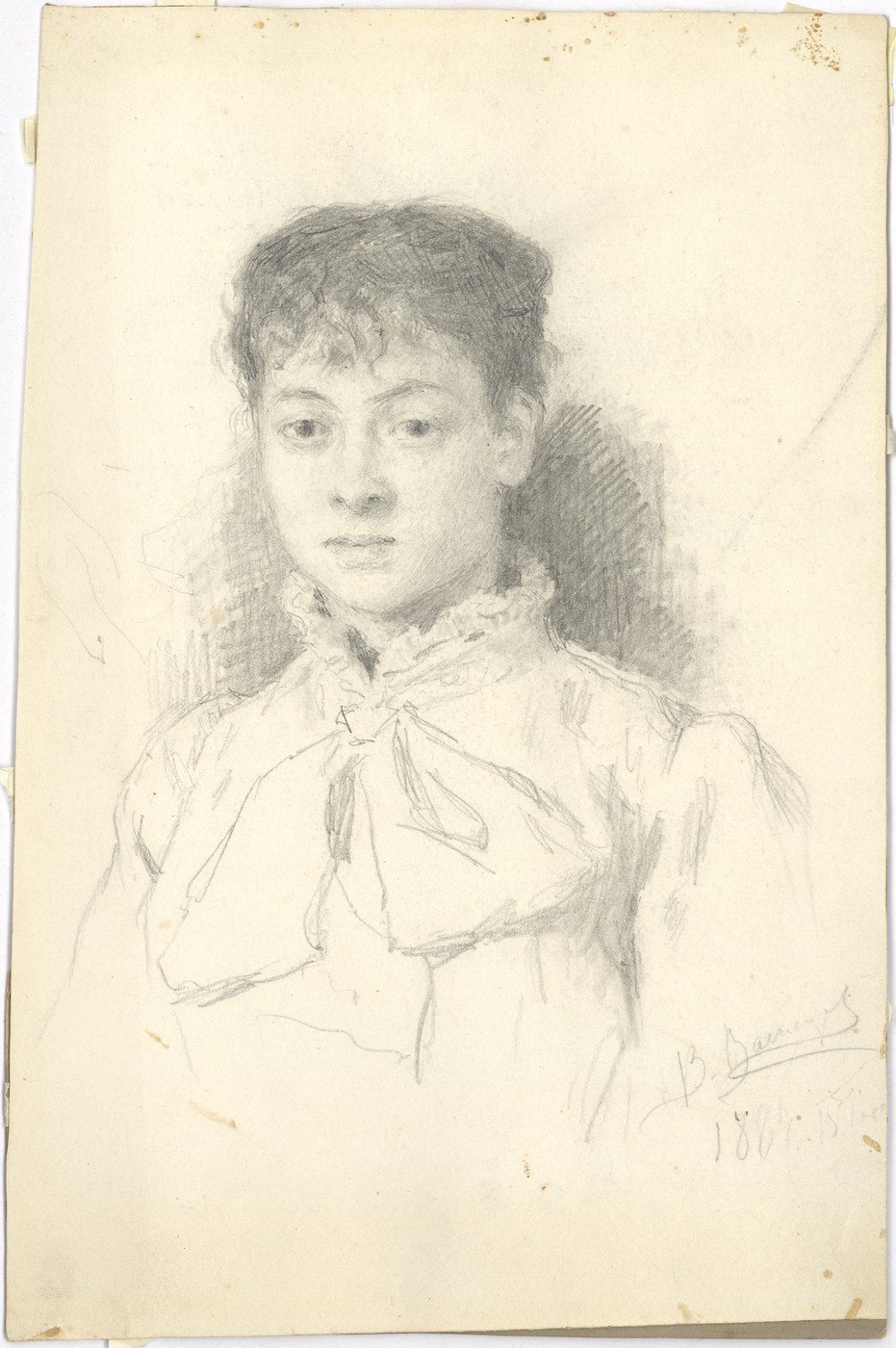
Vasily’s sister Yelena Polenova, a painter and graphic artist, and Maria Yakunchikova set up a carpentry workshop at Abramtsevo in 1885. Polenova was an early pioneer of children’s book illustration in Russia. She brought a draftswoman’s eye to furniture and household objects modeled on peasant carving and embroidery.
The workshop was meant to produce goods for use and for sale, not only studio exercises. Vasnetsov had painted Yakunchikova’s portrait in 1884. The pair’s work shows that women at Abramtsevo shaped the designs rather than hosting the men who did. Polenova died in 1898, aged 47.
Vrubel and the Majolica Workshop
Mikhail Vrubel moved to Moscow in 1890, the year of his Demon Seated, and entered Mamontov’s orbit. From the 1890s he designed majolica for the Abramtsevo ceramic workshop: fireplaces, tiles and sculptural pieces.
Glazed ceramic suited him. Colors pooled and ran unpredictably in the kiln, and the finished surfaces carried an uneven shimmer that smooth academic painting avoided. For Mamontov, the workshop proved that a painter’s imagination could move into three dimensions.
Look Closer: Look closer at Vrubel’s Swan Princess
Look at the water and sky behind the swan princess in Vrubel’s Tsarevna-Lebed (1900). He breaks them into small, angular patches of blue, violet and gold, closer to mosaic pieces than to blended paint. Scholars often connect this habit to his time in Kiev studying Byzantine art. Then look at her eyes, which stay wide and unreadable.
Opera as a Second Studio
Mamontov’s theatre habit moved from the family salon to a public stage in 1885, when he founded the Moscow Private Opera. Painters became designers. Vasnetsov created sets for The Snow Maiden, and Vrubel and Konstantin Korovin worked on later productions, including Rimsky-Korsakov’s Sadko in 1898.
In 1896 the jury for the All-Russian Exhibition in Nizhny Novgorod rejected Vrubel’s decorative panels. Mamontov built a separate pavilion to show them, among them Princess Dream, which draws on Edmond Rostand’s play La Princesse lointaine. The episode showed how far his backing reached beyond Abramtsevo.
The Younger Generation: Serov, Korovin, Nesterov
Valentin Serov grew up around the Mamontov family. In 1887 he painted Girl with Peaches, a portrait of the twelve-year-old Vera Mamontova at Abramtsevo. Broken daylight and a relaxed pose suggest a household where a child could sit still for a friend.
Korovin brought quick, color-led painting to stage work. Mikhail Nesterov, associated with both the Peredvizhniki and Mir iskusstva and an early Symbolist painter in Russia, belongs to the circle’s wider orbit.
What Made the Abramtsevo Style Distinct?
What materials and motifs define it?
Wood, glazed ceramic, tempera and oil dominate. The motifs come from epic ballads (byliny), fairy tales, icon painting and pre-Petrine ornament such as carved window frames and tent-like roofs.
The treatment shifts with the artist. Figures flatten, outlines grow decorative, and color is pushed beyond naturalistic limits. Polenova’s Art Nouveau illustrations for Synko-Filipko (1896) carry the same vocabulary onto the page, showing how easily the style adapted to print.
Why It Mattered Beyond the Estate
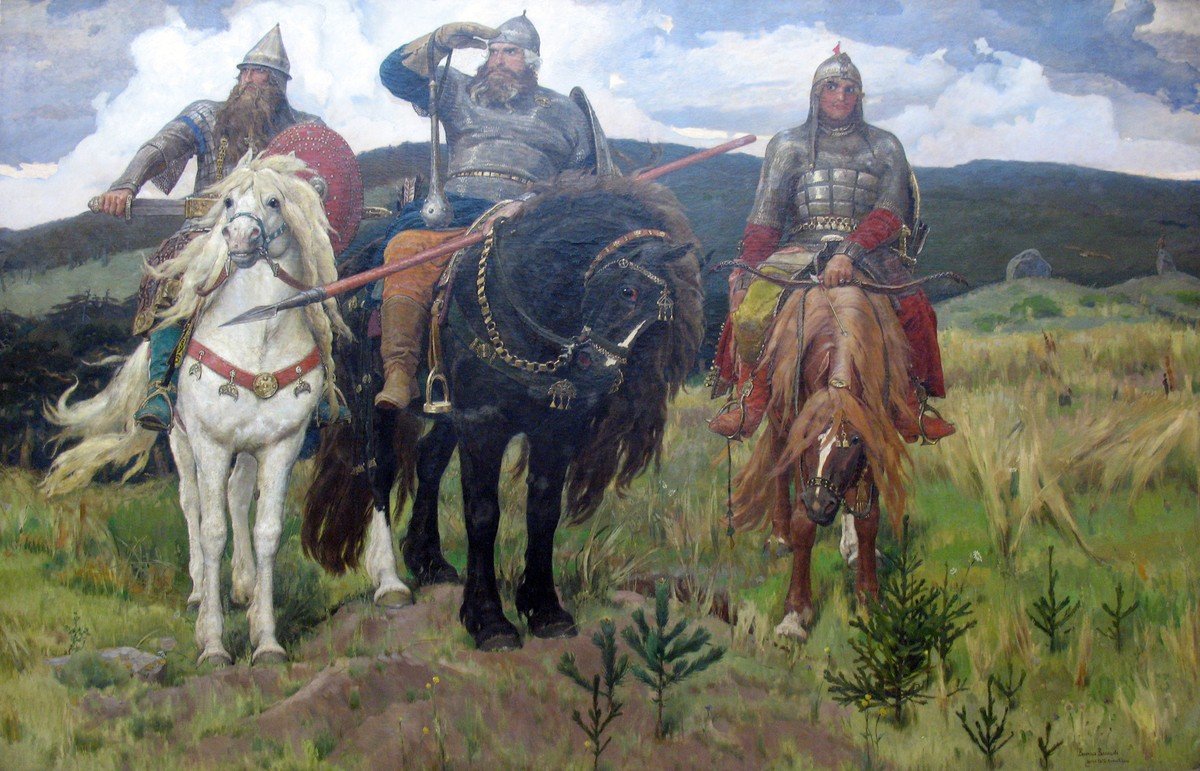
Vasnetsov began Bogatyrs in 1881 and finished it in 1898. Three epic heroes on horseback, Ilya Muromets, Dobrynya Nikitich and Alyosha Popovich, became one of the best-known images in Russian art. The canvas proved that folk subjects could carry monumental scale.
The circle’s influence also reached everyday objects. Sergey Malyutin, who worked in the Abramtsevo orbit, is usually credited with the design of the first matryoshka doll in the 1890s. Scholars disagree about how credit should be shared with the craftsman who carved it.
Mamontov’s Fall and the Estate’s Afterlife
The model had a weak joint: one man’s capital. In 1899 Mamontov was arrested on charges connected with his railway business. He was acquitted the following year but was financially ruined.
The estate outlived his fortune. Summer visits continued, and Nesterov’s 1916 painting records Vasnetsov’s dacha there. Mamontov died in Moscow in 1918, the same year Abramtsevo became a state museum.
Seeing Abramtsevo Today
Can you visit Abramtsevo today?
Yes. Commuter trains on the Yaroslavl line stop at Abramtsevo station, and the grounds hold the church and the hut described above. The estate is an object of cultural heritage in Russia, so expect museum rules and seasonal hours. Check the current schedule before you go.
A visit changes how the pictures read. Seen beside the carved porches and log walls that inspired them, the fairy-tale canvases look less like fantasy and more like scenes drawn from a lived-in village.
What Visitors Often Assume
Many people assume the painters lived at Abramtsevo year-round as a commune. They did not. Most were summer guests with studios and commissions in Moscow and St. Petersburg, and they worked at the estate in bursts. Mamontov was the permanent host. That rhythm explains why projects such as the church and the hut were built by teams in a single season rather than over decades.
Cousins and Heirs of the Colony
Princess Maria Tenisheva’s Talashkino, near Smolensk, adopted the Abramtsevo recipe in the 1890s, with workshops and a school of folk-inspired design. Mir iskusstva, formed in 1898 around Sergei Diaghilev and Alexandre Benois, absorbed several Abramtsevo painters, among them Vrubel and Nesterov. It turned the same interest in folklore toward stage and book design.
Was Abramtsevo similar to the Arts and Crafts movement?
In spirit, yes: both valued handwork and local tradition. In origin, no. Britain’s Arts and Crafts leaders reacted against industrial production, while Abramtsevo was the initiative of an industrialist who used his business wealth to fund it.
Essential Points
- Abramtsevo ran on hospitality rather than instruction: Mamontov offered lodging, stage commissions and workshop space, which let painters try folk subjects away from gallery expectations.
- Several generations overlapped, from the realists Repin and Polenov to Vasnetsov and Vrubel to the Symbolist-leaning Nesterov, so the label covers a range of looks, not one house style.
- Stage design, ceramics, church decoration and book illustration fed one another, and artists moved between them freely.
- Read the pictures for emotional register as well as plot: Alyonushka’s grief and Vrubel’s swan princess are two opposite ways of treating a fairy tale.
- When you meet the phrase ‘Russian Revival’, ask what was borrowed and what was invented; the interest lies in the adjustment, not the quotation.
- Funding from one businessman made the colony possible and also made it fragile, a pattern worth watching in any patron-led art community.
Frequently Asked Questions
- Which Abramtsevo artwork should a beginner look at first?
- Start with Vasnetsov’s Alyonushka. It needs no background, shows a folk tale treated as a serious painting, and introduces the colony’s mood at a glance. Then compare it with Serov’s Girl with Peaches, which shows the same household through a different eye, quiet daylight portraiture rather than myth.
- Why did this movement grow in Moscow rather than St. Petersburg?
- Many historians point to Moscow’s merchant patrons, such as Mamontov and the collector Pavel Tretyakov, who bought national subjects independently of the Imperial Academy in St. Petersburg. Abramtsevo gave that independence a physical home, with money, workshops and a stage under one roof. Scholars still debate how much Slavophile ideas mattered compared with plain market opportunity.
- How did the painters turn peasant craft into designs?
- They collected village objects, including embroidery and carved wood, and studied their patterns as a working vocabulary. Polenova and her colleagues then redrew those motifs for chairs, cabinets and book pages, adjusting proportions and color for urban buyers. The aim was adaptation, not exact copying, so pieces read as Russian without being replicas.
- How does Vrubel’s work differ from Vasnetsov’s?
- Vasnetsov paints clear, storybook scenes with firm outlines and readable emotions. Vrubel breaks surfaces into angular facets, mixes beauty with unease, and leaves psychology ambiguous. Both used folklore and epic subjects, yet Vasnetsov usually tells the story, while Vrubel makes the viewer feel the strangeness around it.
- Where can I see the paintings made at Abramtsevo?
- Many are in the State Tretyakov Gallery in Moscow, including Three Bogatyrs, Girl with Peaches and Vrubel’s Demon Seated and Tsarevna-Lebed. The buildings and workshop collections stay on the estate, so visiting both gives the fuller picture. Check each museum’s current opening hours and loan status before traveling.

This guide was written and reviewed by the rus-art.com editorial team, specializing in Russian art history. We cross-check dates, attributions, and museum holdings against museum and academic sources.