Quick Answer
A journal, an exhibiting society and a design workshop sharing one cast of artists: Mir iskusstva (World of Art) ran in St Petersburg from 1898 to 1904 and reshaped how Russian readers looked at painting. Founded by Sergei Diaghilev with Alexandre Benois, Léon Bakst and Konstantin Somov, it rejected the idea that Russian painting must carry a social message and promoted craft, design and the past. It brought book illustration, stage design and Russian history into serious art, and its artists went on to design the Ballets Russes, which carried Russian taste to Paris from 1909.
What Was Mir iskusstva?
Mir iskusstva (Russian: «Мир искусства», “World of Art”) was a St Petersburg art magazine, published from 1898 to 1904, and the loose artistic movement that grew around it. Its editors held that a picture should be judged by its craft, colour and design, not by the social message it carries. Russian readers, in turn, learned from it to look again at their own past and at Europe’s present.
Who belonged to Mir iskusstva?
The founding circle gathered around Sergei Diaghilev as editor and organizer, with Alexandre Benois, Léon Bakst and Konstantin Somov as leading artists. Ivan Bilibin, Mstislav Dobuzhinsky, Nicholas Roerich and the printmaker Anna Ostroumova-Lebedeva joined in the following years.
Schoolfriends on the Nevsky
It began in the early 1890s with St Petersburg schoolfriends and students who met to play music and argue about pictures. They called themselves the Nevsky Pickwickians, after Dickens. Benois, Somov, Dmitry Filosofov and Walter Nouvel formed the core. Bakst joined later. Filosofov’s cousin Diaghilev arrived from the Perm region to study law.
Irritation held them together. They disliked the widespread Russian expectation that a painting must teach or protest. They preferred Tchaikovsky’s ballets, old Petersburg palaces and recent French and English painting.
The Impresario at the Helm
Diaghilev had little talent as a painter, but he could organize almost anything. In 1897 he staged an exhibition of British and German watercolourists in St Petersburg. In 1898 came a show of Russian and Finnish artists, which hung his future contributors on the same walls.
Later that year the first issue of the magazine appeared, with Diaghilev as editor and Filosofov guiding the literary side. His St Petersburg career, 1898 to 1906, runs almost exactly alongside the journal and its exhibitions.
Who Paid the Bills?
Princess Maria Tenisheva and the industrialist Savva Mamontov are usually named as the early financial backers. Each ran an artists’ colony, Tenisheva at Talashkino and Mamontov at Abramtsevo, where folk crafts and medieval Russian forms were being revived. Their patronage tied the magazine to that craft movement.
Money stayed fragile. Some accounts add an imperial subsidy, but sources differ on its size, so treat any exact figure with caution.
Inside the Pages
Large, handsomely printed and generous with reproductions, the magazine mixed art essays with poetry, criticism and music in every issue. Writers such as Dmitry Merezhkovsky and Zinaida Gippius appeared alongside painters.
French, British and Scandinavian contemporaries sat beside Russian icons and eighteenth-century portraits, so a reader met Rococo and Symbolism on neighbouring pages. Even vignettes, initials and borders were treated as art. Ostroumova-Lebedeva, who took lessons from Whistler in Paris, supplied engravings of Petersburg’s streets and parks.
Art for Art’s Sake Meets the Wanderers
Since the 1870s the Wanderers (Peredvizhniki) had dominated Russian painting with realist scenes of rural poverty and national history, and the critic Vladimir Stasov championed them. The Mir iskusstva writers answered that a canvas succeeds or fails through drawing, colour and composition.
Benois applied that test to the whole century in his survey of nineteenth-century Russian painting, written around 1901 to 1902. His verdicts angered the realists’ defenders. The quarrel was bitter, but it forced Russian criticism to talk about form.
Benois and the Ghost of Versailles
From the 1890s onward Benois (1870 to 1960) painted Versailles in watercolour and gouache, filling its parks with figures in the dress of Louis XIV’s court. He was also an art historian and a preservationist who defended old Petersburg architecture. After 1917 he worked at the Hermitage.
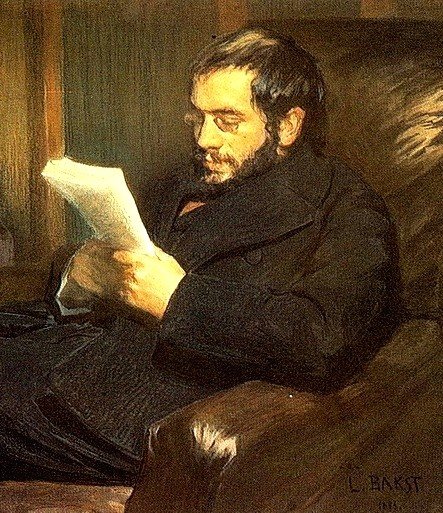
Bakst painted his portrait in 1898, the year the magazine launched, a record of friendship inside the circle. On stage, Benois designed Le Pavillon d’Armide (1909), Petrushka (1911) and Le Malade imaginaire (1913) for the Moscow Art Theatre.
Somov’s Masquerades
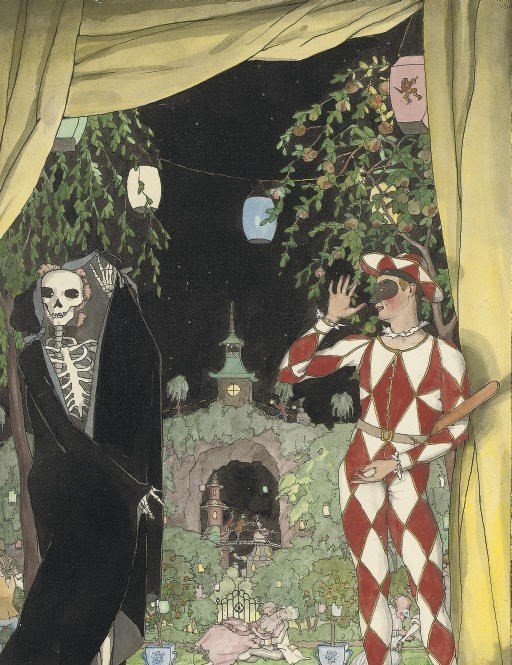
Somov (1869 to 1939) painted lovers in powdered wigs, Pierrots and Harlequins, often with a faint chill beneath the flirtation. His Lady in Blue (1897 to 1900) is the usual starting point.
Eighteenth-century costume let him paint feeling at one remove. A Harlequin meeting Death shows how dark the game could become. After the Revolution he eventually emigrated to Paris, where he died in 1939.
Bakst and Colour Before the Stage
Born Leyb-Khaim Rosenberg, Bakst (1866 to 1924) began as a portraitist and painted the poet Zinaida Gippius in 1906. For Diaghilev he turned to sets and costumes: Carnaval (1910), Spectre de la rose (1911) and Daphnis and Chloe (1912).
His palette ran hot, with saturated oranges, emerald greens and pinks set against deep blues. His 1911 design for Ida Rubinstein as Saint Sebastian shows a habit of drawing costume as a body in motion, not as a pattern on a hanger.
Bilibin’s Fairy-Tale Line
Bilibin (1876 to 1942) won fame illustrating Russian folk tales and Slavic folklore, beginning with the booklets he started in 1899. His method was a firm ink outline filled with flat colour, drawn from Russian woodcut prints and medieval manuscripts.
From 1902 he travelled to the Russian North and drew wooden churches, carved window frames and peasant dress from life. He later returned from emigration and joined the Artists’ Union of the USSR in 1937.
Roerich and Ancient Rus
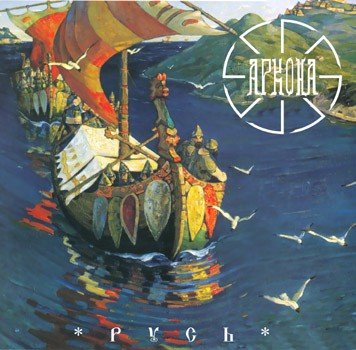
Nicholas Roerich trained as a painter and joined archaeological digs, and his early pictures imagine the Slavic and Viking past. Guests from Overseas (1901) shows Varangian ships approaching a shore.
For Diaghilev he designed the Polovtsian Dances in Prince Igor (1909) and The Rite of Spring (1913). In later decades he turned to Himalayan mountains, a very different subject from his Petersburg years.
Look Closer: a painter’s stage sense
Study the horizon in Guests from Overseas: shore, water and sky are stacked in level bands rather than drawn in naturalistic recession. The composition reads across a room the way a theatre backdrop reads across a stage. That deliberate flattening is a formal choice the Mir iskusstva circle prized, and it is a choice Roerich would draw on again when he moved from the easel to designing for the stage.
Dobuzhinsky’s Restless Streets
Dobuzhinsky (1875 to 1957) is noted for cityscapes of the explosive growth and decay of the early twentieth-century city: tall tenements, and lone figures often dwarfed by blank walls. The circle’s affection for Petersburg’s past found a counterpart in his unsentimental view of its present.
He also designed for the Moscow Art Theatre, including A Month in the Country (1909). His Peter the Great in Holland (1910) belongs to the group’s historical vein.
When Did the Magazine Stop Publishing?
The last issues appeared in 1904. Sources point to several causes, including money, tension among the editors and Diaghilev’s growing interest in organizing exhibitions over editing. Historians do not agree on their weight.
Within two years his Petersburg period ended as well. From 1906 he worked as an emigrant, mostly in Paris.
From Page to Stage: The Ballets Russes
Diaghilev took the circle to Paris. In 1906 he brought a large exhibition of Russian art to the Salon d’Automne, then Russian concerts in 1907 and the opera Boris Godunov in 1908. In 1909 the Ballets Russes opened its first Paris season.
The company commissioned composers such as Stravinsky, Debussy, Prokofiev, Satie and Ravel, and designers including Benois, Korovin, Roerich and Marie Laurencin. From 1909 to 1929 it performed across Europe and the Americas, but never in Russia.
Exhibitions That Outlived the Journal
Exhibitions by the society continued after the journal closed. A new society took the name in 1910 and kept showing work into the 1920s.
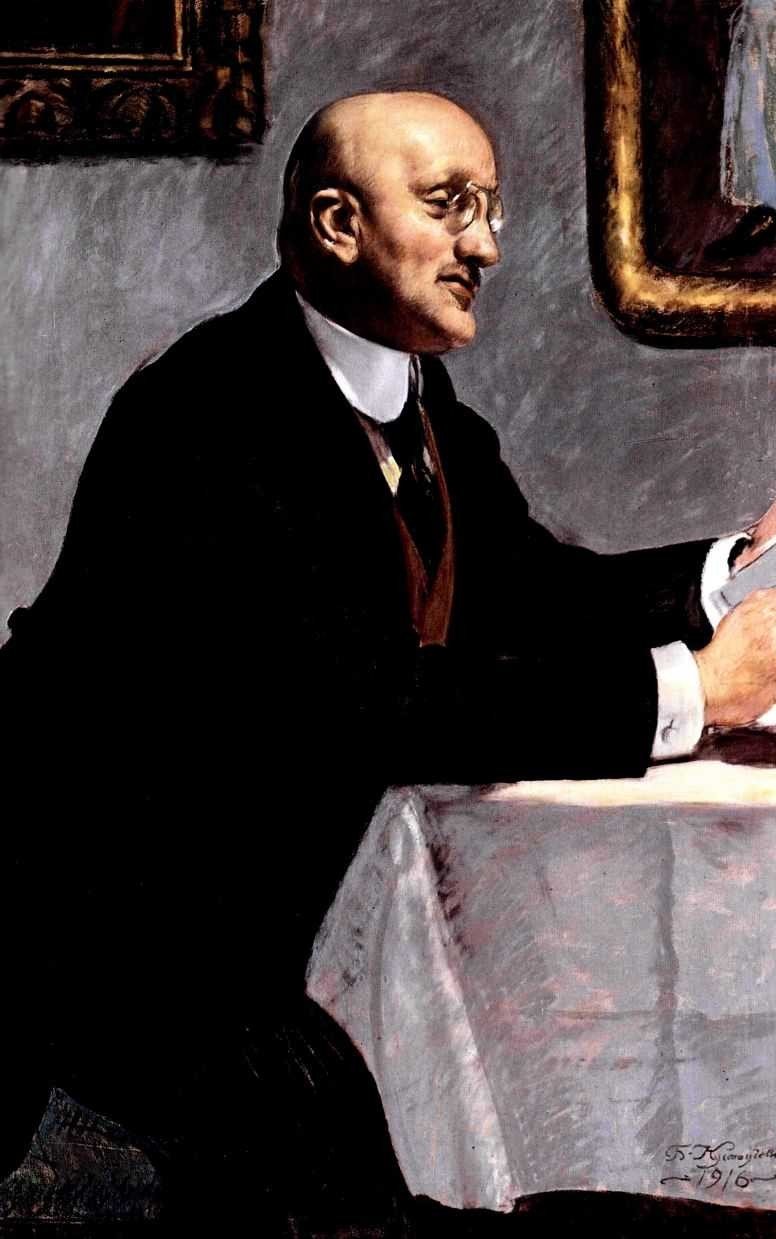
Kustodiev’s group portrait of its artists, begun in 1916 and finished in 1920, gathers the revived circle around a table. By then the Revolution was scattering the members. Benois, Dobuzhinsky and Bilibin all left Russia during the 1920s, and Bilibin came back in 1936.
How Taste Changed
Before the magazine, many Russian readers treated eighteenth-century Petersburg as stale and icons as church property rather than painting. The circle’s essays and reproductions made both worth a second look.
Posters, book covers, bookplates and costumes entered the same conversation as oil painting, and designers began to sign their work. Abroad, the effect was larger than the magazine’s small foreign circulation suggests: audiences in Paris met Russian art through the people who had edited and illustrated it.
Where to See Mir iskusstva Art Today
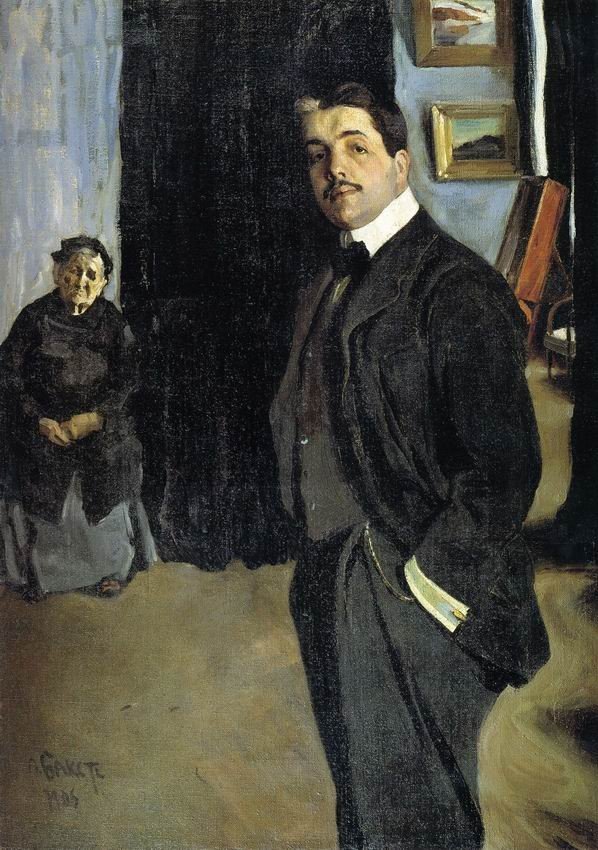
The State Russian Museum in St Petersburg holds Bakst’s portraits of Benois and Diaghilev and Kustodiev’s group portrait. The State Tretyakov Gallery in Moscow holds Roerich’s Guests from Overseas and Dobuzhinsky’s Peter the Great in Holland. The Isabella Stewart Gardner Museum in Boston keeps Bakst costume designs.
The market agrees with the museums. In 2007 Somov’s The Rainbow sold at Christie’s London for GBP 3,716,000, setting an auction record for a Russian work of art at the time.
Were They the Russian Avant-Garde?
Not exactly. The circle fed the avant-garde as a teacher and a foil, not as a member. Younger painters of the 1910s often found its refined historicism too polite. Yet they learned from its exhibitions, its imports of European art and its claim that painting is about painting.
Scholars still debate how direct that debt was.
Neighbours and Descendants
Mir iskusstva ran parallel to European Symbolism and to Art Nouveau, known in Russia as Style Moderne. It overlapped with the Silver Age of Russian poetry, whose writers filled its literary pages.
Among its successors were the younger Moscow groups, such as the Jack of Diamonds, whose members absorbed some of its lessons and rejected others.
Essential Points
- Think of Mir iskusstva as three institutions with one cast: a journal, an exhibiting society and a stage-design workshop. The same names turn up in all three.
- Drawing, print and theatre design were treated as equal to oil painting, which is why so much of the circle’s best work is gouache, watercolour and book illustration.
- Its artists looked backward (Versailles, Rococo masquerade, medieval Rus) in order to make modern art, so nostalgia and modernity coexist in a single image.
- Paris learned what ‘Russian art’ meant largely through this group’s designers, even though the magazine itself sold little abroad.
- Parts of the story remain debated, including why the journal closed and how large its subsidies were.
- Emigration after 1917 scattered the circle, so its work now sits in Russian state museums, Western collections and the auction market.
- A practical test: if you meet a Petersburg view, illustrated tale or stage design from roughly 1900 to 1915, ask whether a Mir iskusstva artist made it.
Frequently Asked Questions
- How do you pronounce Mir iskusstva, and what does it mean?
- Say it as “MEER ee-SKOOST-vah”. Mir means world, though in Russian it can also mean peace or community, and iskusstva comes from iskusstvo, art. English writers usually translate the phrase as World of Art, and some use the transliterated name alone.
- What was the 1905 Tauride Palace exhibition?
- In 1905 Diaghilev organized a huge Historical and Artistic Exhibition of Russian Portraits in the Tauride Palace in St Petersburg. He gathered portraits from private collections across the empire, many never shown publicly, after travelling to find them. It strengthened his conviction that Russian art could be presented as a grand national story.
- What does stylization mean in Mir iskusstva art?
- Stylization means deliberately imitating an older manner while keeping it slightly at a distance, so the viewer sees both the past and the artist’s wit. Somov’s Rococo-flavoured lovers and Bilibin’s woodcut-style folk tale outlines are classic examples. The result looks old and unmistakably modern at once.
- Which Mir iskusstva artist should I look at first?
- Start with Bilibin for instant pleasure, since his fairy-tale outlines read clearly even in small reproductions. Choose Bakst for colour, Somov for irony and Dobuzhinsky for the city. Benois’s writings explain the group’s arguments, so save them for a second round.
- Does Mir iskusstva still influence design today?
- Yes. Bakst’s costumes for the Ballets Russes fed Paris fashion, and the couturier Paul Poiret drew on the Orientalist colours of that era. Illustrated fairy-tale books in Bilibin’s manner still circulate in Russia, and Bakst’s designs remain popular in exhibitions and at auction.
This guide was written and reviewed by the rus-art.com editorial team, specializing in Russian art history. We cross-check dates, attributions, and museum holdings against museum and academic sources.