In October 1906, Sergei Diaghilev filled rooms of the Grand Palais in Paris with Russian art. The French capital met a school of painting it had barely imagined.
Visitors who knew Russia through Tolstoy and Tchaikovsky found icons, eighteenth-century portraits and canvases by young painters who had absorbed Paris and still sounded unmistakably like themselves. This article follows how the show came together, what hung on the walls, and why one autumn season changed Russia’s standing in the West.
Quick Answer
Diaghilev’s 1906 Paris exhibition was a large Russian section he organized at the Salon d’Automne in the Grand Palais. It presented about two centuries of Russian painting, from icons and eighteenth-century portraits to the newest work of the Mir iskusstva circle, including Bakst, Benois, Serov, Vrubel and Roerich. Paris critics and artists met Russian art as a modern tradition with its own roots. The show also launched Diaghilev’s export career, leading to Russian concerts, opera and, in 1909, the Ballets Russes.
What Was Sergei Diaghilev’s 1906 Paris Exhibition?
Diaghilev’s show was a large Russian section inside the 1906 Salon d’Automne, the annual Paris exhibition founded in 1903 by Frantz Jourdain and colleagues as an answer to the conservative official Salon. Diaghilev organized it, selected the works and persuaded the French organizers to hand Russia generous wall space. It spanned roughly two centuries: icons and eighteenth-century portraits hung beside the newest painting from St Petersburg and Moscow.
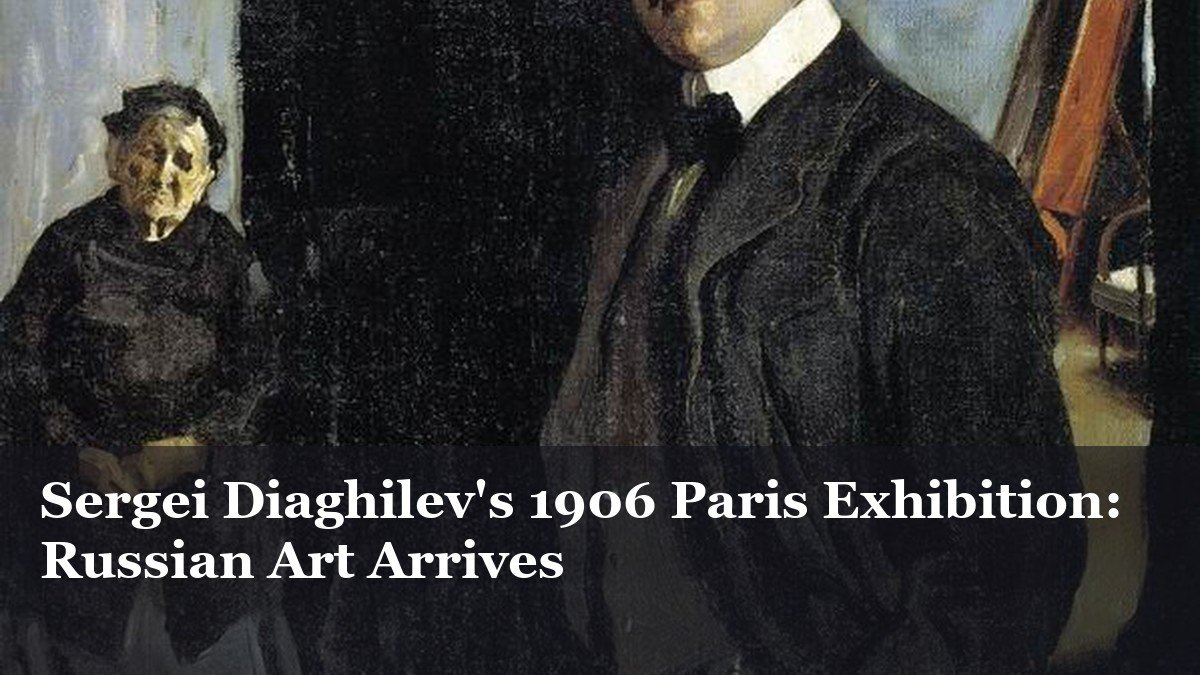
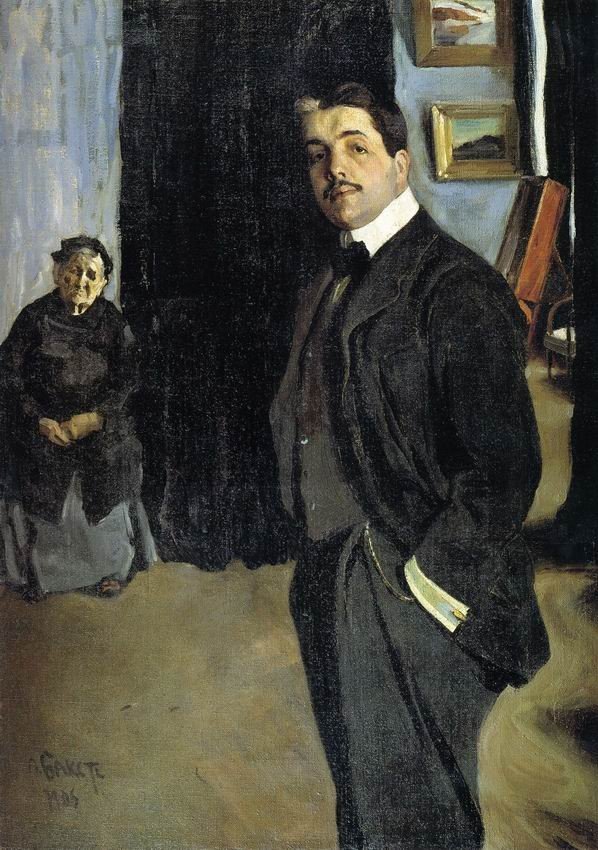
The date marks a hinge in his own life. Diaghilev’s career divides into a St Petersburg period from 1898 to 1906 and an emigrant period from 1906 to 1929, and this show sits at the break. Before it, he edited a magazine and curated exhibitions at home. After it, he worked abroad as an exporter of Russian culture, first in painting, then in music, then in ballet. Léon Bakst painted him that same year, a portrait of the impresario with his nanny.
Look Closer: the impresario and his nanny
In Bakst’s 1906 portrait, Diaghilev fills the foreground in formal dress while his old nanny sits behind him. Bakst needs almost no scenery: the pairing alone sets the impresario’s public poise beside his private world. Notice how restrained the picture is, then compare it with the saturated stage designs Bakst produced a few years later.
From Icon Workshops to the Tauride Palace
Russian painting began in icon workshops, where artists copied approved prototypes for centuries. Peter the Great pulled court taste toward Europe in the early 1700s, and the Imperial Academy of Arts opened in 1757 to train painters in the Western manner. By the 1870s the Wanderers (Peredvizhniki) had rebelled against Academy routine and favored social subjects, such as Ilya Repin’s Barge Haulers on the Volga (1873). Diaghilev’s generation rebelled in turn, against the Wanderers’ moral lessons.
What Made Sergei Diaghilev the Right Organizer?
Sergei Diaghilev was born in 1872 and came to St Petersburg to study law, though music took more of his energy. He never painted. He was a critic, patron and organizer with a rare gift for getting talented people to work together. In 1898 he and friends including Alexandre Benois launched Mir iskusstva, first a magazine and then a movement that prized beauty, craft and book design over anecdote.
Then came the project that taught him his method. In 1905 he assembled a historical exhibition of Russian portraits at the Tauride Palace in St Petersburg, tracking pictures down in provincial estates. A well-sequenced exhibition, he learned, makes an argument.
Why Did the Show Go to Paris?
Paris decided reputations. The Salon d’Automne had become the place where new painting got noticed: in 1905 a critic had dubbed Matisse and his circle the fauves, or wild beasts, after seeing their canvases there. Russia had appeared in Paris before, at the 1900 Exposition Universelle, but largely through craft and academic canvases. The magazine, meanwhile, had limited circulation outside Russia, so French readers hardly knew its artists. Diaghilev’s answer was to bring the pictures themselves. The upheaval after the 1905 revolution at home made leaving practical as well as ambitious.
The World of Art Circle Behind the Selection
Most of the artists Diaghilev chose were friends. They shared a belief that a picture’s job is visual pleasure and invention, not a sermon. They loved eighteenth-century Russia and the court of Versailles, collected old prints, and worked well beyond easel painting, in book illustration, posters and stage design. That habit would later feed straight into theatre.
Who Were the Main Artists Sergei Diaghilev Chose?
Accounts of the show usually name a core group:
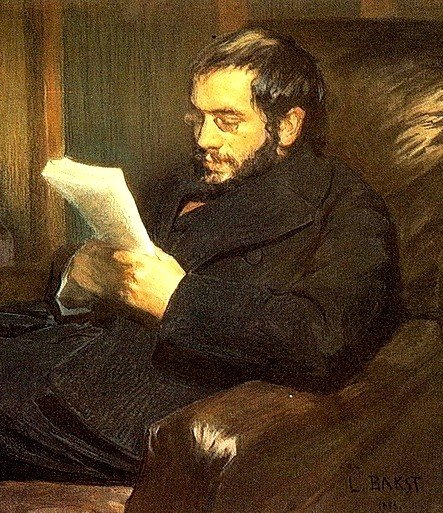
- – Alexandre Benois: painter and historian of Petersburg and Versailles scenes, a friend of Bakst since youth. Bakst painted his portrait in 1898.
- – Konstantin Somov: ironic, masked lovers in powdered costume, a manner fully developed in his work before and during the exhibition year.
- – Valentin Serov: the primary portraitist of his generation, active in both St Petersburg and Moscow.
- – Mikhail Vrubel: the Moscow Symbolist whose work looks like cut crystal.
- – Nicholas Roerich and Ivan Bilibin: painters of the Slavic past, folk epic and fairy tale.
Benois, Bakst and Somov were close personally, which explains how coherent the selection felt.
Inside the Grand Palais Rooms
Diaghilev treated the galleries as a sequence. Visitors began with icons and eighteenth-century portraits, then moved on to living painters, so a Vrubel or a Serov read as the latest link in a long line rather than a surprise from nowhere. Bakst is usually credited with designing the installation, an early sign of the theatrical eye that would define the Ballets Russes years.
What Did Visitors Find in Sergei Diaghilev’s Rooms?
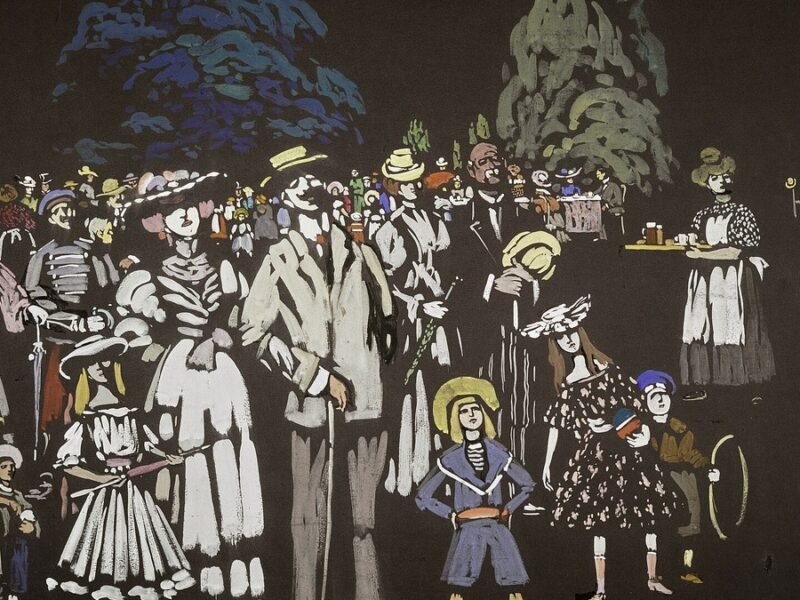
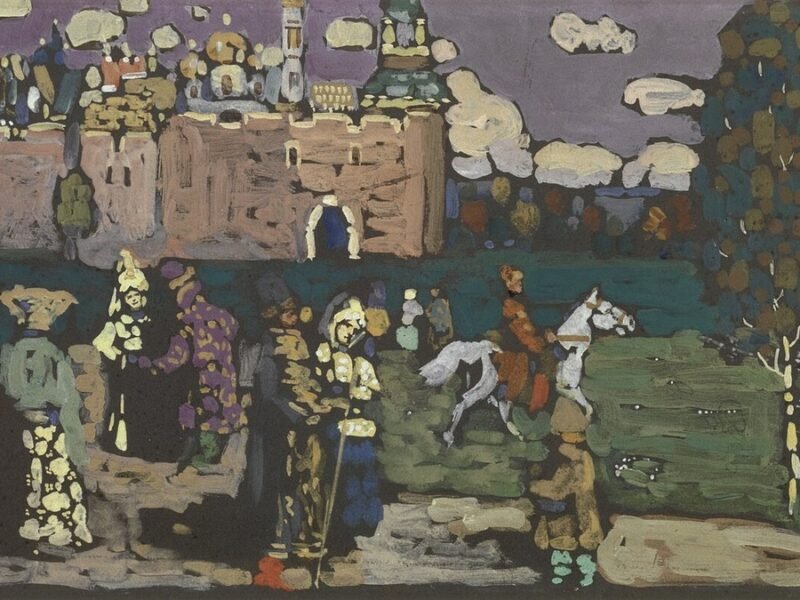
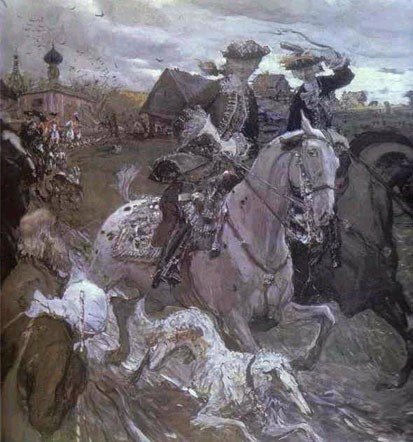
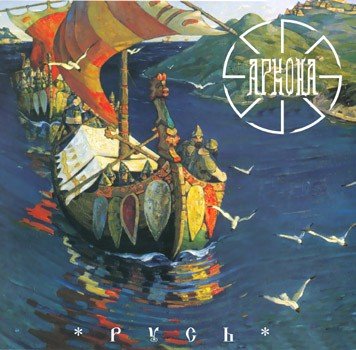
Hundreds of works, from gold-ground icons with flat, steady faces to modern pictures built on pattern and color. Painters of the Mir iskusstva circle supplied courtly pastiche, like Serov’s gouache Peter II and Princess Elizabeth Petrovna Riding to Hounds (1900), and imagined medieval Russia, like Roerich’s Guests from Overseas (1901), where Viking ships with striped sails glide into a pale Slavic harbor. Pictures of that kind, rather than famous single canvases, gave the show its character.
Vrubel, Serov and Roerich: Works That Held the Eye
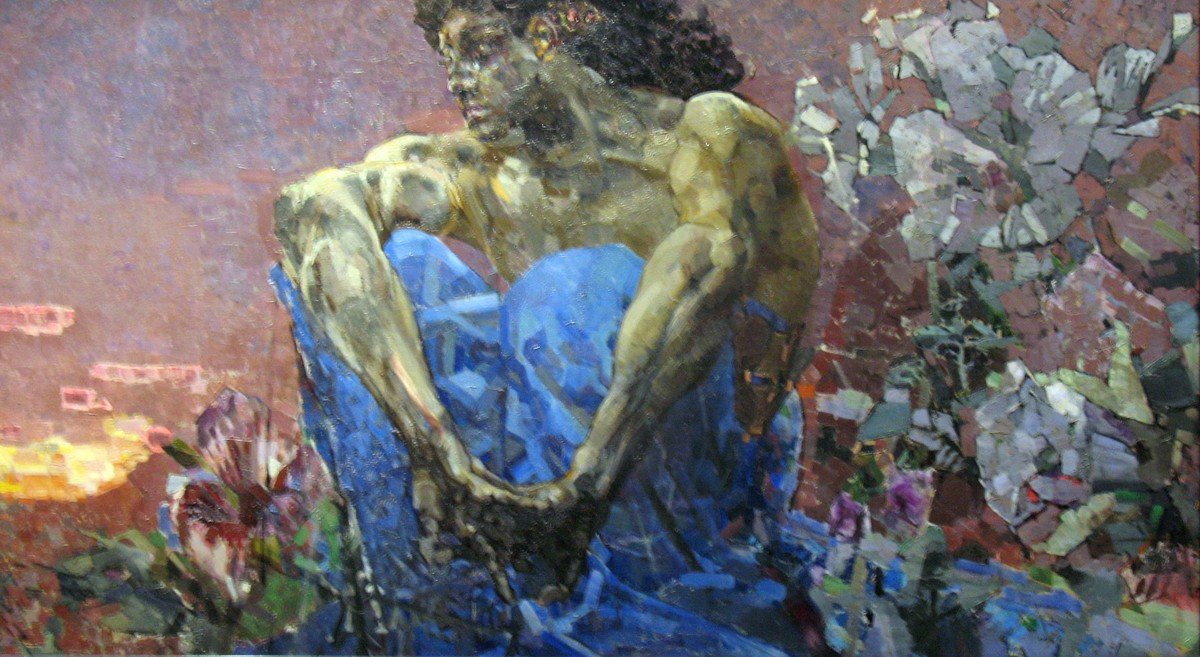
Vrubel is the touchstone. His Demon Seated (1890) breaks a brooding figure into faceted patches of blue, violet and gold, like a mosaic. The effect has a source: he had gone to Kiev in the 1880s to study Byzantine and Christian art. He was reportedly hospitalized around 1902 after painting The Demon Downcast and had lost much of his sight by 1906, so Paris saw the work of an artist whose career was already ending. He died in 1910.
Serov’s lean line and tilted compositions make his later portrait of the dancer Ida Rubinstein (1910) memorable: a nude figure drawn in near-flat contour, with almost no interior modeling. Roerich brought archaic austerity, a Russia of sagas, standing stones and open skies.
Where Does Bakst Fit In?
Bakst, born Leyb-Khaim Rosenberg around 1866, was a painter first and a stage designer second, and Paris soon knew him in the second role. His richly colored sets and costumes for Carnaval (1910), Spectre de la rose (1911) and Daphnis and Chloe (1912) made him the face of the new Russian theatre. The Paris exhibition gave him his first real platform in the city.
How Paris Reacted to Sergei Diaghilev’s Gamble
The reception was attention, not frenzy. The 1906 Salon d’Automne also mounted a large Cézanne memorial tribute (the painter died on 22 October that year), and French critics devoted much of their energy to it. Even so, accounts of the period note that the icon section was arresting to visitors who had encountered almost no Byzantine-derived sacred painting at close range, and that Diaghilev’s sequencing of the rooms, from medieval sacred icons through Enlightenment court painting to living Symbolist canvases, read as a curatorial argument rather than a random gathering. Exact tallies of coverage and sales remain hard to pin down, and historians disagree about how large the Russian rooms loomed against the Salon’s French painters. What is clear is that Diaghilev left Paris with a network of critics, collectors, musicians and officials who now knew his name and trusted his taste, and that this network was the practical foundation for the concerts, opera season and ballet company that followed.
Did Sergei Diaghilev’s Show Create the Ballets Russes?
Not directly, but it built the pipeline. Diaghilev followed the exhibition with five Russian concerts in Paris in 1907, then staged Mussorgsky’s opera Boris Godunov at the Paris Opéra in 1908. In 1909 came the first season of the Ballets Russes, a company that performed in Europe and the Americas until 1929 and never once danced in Russia. Each step used the audience and contacts the previous one had created. The painters of 1906 became the designers of 1909.
The Legacy of Sergei Diaghilev’s 1906 Show
The Ballets Russes is widely regarded as the most influential ballet company of the twentieth century, and its habits trace back to the exhibition. Diaghilev commissioned scores from Stravinsky, Debussy, Prokofiev, Satie and Ravel, and designs from painters such as Benois, Korovin and Roerich, so that composer, choreographer and artist worked as equals. Benois is considered a seminal influence on modern stage design.
The visual language travelled with the company. Bakst’s 1911 watercolor of Ida Rubinstein as Saint Sebastian, and his 1913 studies of Anna Pavlova in Oriental Fantasy, show how far the Mir iskusstva aesthetic had moved from the gallery wall into costume and movement. After 1906, Paris did more than admire Russian art. It began to copy its color and its stagecraft.
What Can Readers Still See Today?
Most of the paintings sit in two Russian collections. The State Tretyakov Gallery in Moscow holds Vrubel’s Demon Seated and Roerich’s Guests from Overseas, among other works of the period. The State Russian Museum in St Petersburg keeps Bakst’s portraits of Diaghilev and Benois and Serov’s portrait of Ida Rubinstein. Check current loan and display status before travelling, since works move between exhibitions.
Related Movements and Connections
Russian Symbolism is the closest relative, with Vrubel as its leading painter, alongside the Art Nouveau decorative style that Western Europe called Jugendstil or the Style Moderne. Mir iskusstva shaped the later Russian avant-garde, partly by example and partly by provocation.
Which Later Movements Grew From It?
Younger painters such as Mikhail Larionov, Natalia Goncharova and Kazimir Malevich pushed against the refinement of the World of Art circle, choosing coarse folk imagery and then abstraction. They also inherited its assumption that Russian art deserved an international audience, a belief Diaghilev had made respectable.
Essential Points
- A venue is a message: showing Russia at an independent, risk-taking Salon placed it among the modern painters, not among the exotic curiosities.
- Read the show in three layers: sacred icons, eighteenth-century court painting, and living Symbolist and Mir iskusstva artists.
- Date carefully: the exhibition is 1906, the Ballets Russes company is 1909, and the years between hold concerts and opera.
- Counts of works, press coverage and sales differ between accounts, so check museum catalogues before quoting figures.
- Bakst and Benois are the bridge figures between easel painting and stagecraft, which is why the show works as a rehearsal for the ballet years.
- Start a visual tour with Bakst’s portrait of Diaghilev, Vrubel’s Demon Seated and Roerich’s Viking ships, then follow the same artists into theatre design.
Frequently Asked Questions
- Was Sergei Diaghilev an artist himself?
- No. Diaghilev was an art critic, patron and impresario, not a painter. His skill lay in choosing artists, sequencing exhibitions and persuading others to collaborate. He edited a magazine, curated shows in St Petersburg, then took Russian painting, music and ballet to Paris, where his organizing talent mattered more than any brush.
- Did the 1906 show travel beyond Paris?
- Accounts record that the Russian section went on to Berlin and later Venice, so Paris was the first stop of a wider European tour rather than a one-off. Moving exhibitions on across Europe became a pattern, and it foreshadowed the touring habits of the ballet company Diaghilev founded a few years later.
- Why did Mir iskusstva artists favor gouache and watercolor?
- Gouache gives flat, opaque color that suits posters, book pages and stage designs, all of which these artists produced alongside easel paintings. Serov’s courtly hunting scenes and many Bilibin illustrations show the effect: crisp outlines, matte surfaces and strong decorative pattern, easy to reproduce in print and easy to scale up for theatre.
- Why is Valentin Serov called the portraitist of his generation?
- Serov painted much of the Russian elite, from writers and collectors to Nicholas II, with direct likenesses that avoided flattery. His 1910 portrait of the dancer Ida Rubinstein shows how far he could push simplification. Many art historians consider him the leading portrait painter of his generation in Russia.
- Where can I see Ballets Russes material today?
- The Victoria and Albert Museum in London holds a major Ballets Russes collection of costumes and designs, and the Isabella Stewart Gardner Museum in Boston keeps Bakst drawings of Pavlova and Rubinstein. Revivals of the ballets and special costume exhibitions also appear regularly, so check current listings.

This guide was written and reviewed by the rus-art.com editorial team, specializing in Russian art history. We cross-check dates, attributions, and museum holdings against museum and academic sources.