Quick Answer
The Imperial Academy of Arts, founded in St Petersburg in 1757, trained Russia’s painters through a fixed ladder: drawing from plaster casts, life classes, competitions for gold medals, and funded years in Italy or Paris. It ranked history painting as the highest goal and gave Russia its first professional class of artists. Losenko, Bryullov, Ivanov, Repin and Surikov all passed through it. Its system shaped both the loyal academicians and the realists who later challenged its rules.
What Was the Imperial Academy of Arts?
The Imperial Academy of Arts was Russia’s state art school and the official judge of artistic rank. Informally it was called the St Petersburg Academy of Arts. It taught painting, sculpture and architecture through a fixed sequence of classes, handed out medals and titles, and sent its strongest students abroad.
For most of its life, a successful career in Russian art ran through its doors. A medal from the Academy opened the way to portrait commissions, church decoration and teaching posts. This article follows the painters: who built the system, who flourished inside it, who walked out, and what survives.
Shuvalov’s Gamble: A Three-Arts Academy in 1757
Ivan Shuvalov, the courtier who also founded the Imperial Moscow University, opened the school in 1757 as the Academy of the Three Noblest Arts: painting, sculpture and architecture. Under Empress Elizabeth, its first teachers were foreign masters. The first Russian students learned from them in borrowed rooms.
Catherine the Great renamed it the Imperial Academy of Arts and made it a showpiece of her reign. The academy promoted the neoclassical style and technique. A pupil’s training therefore meant learning the visual language of Rome, Bologna and Paris before attempting anything Russian.
A Palace on the Neva
Catherine commissioned a new building on the Neva embankment, completed in 1789, twenty-five years after her first plans. The architects were Alexander Kokorinov and Jean-Baptiste Vallin de la Mothe. The plan is a large square block around a circular inner courtyard, so light reached studios and exhibition halls on every side.
Kokorinov was also an Academy director, and Dmitry Levitsky painted his portrait in 1769. The building made a statement. A state that housed its painters in a palace expected them to produce art worthy of one.
How Did a Student Become a Painter There?
How did the training actually work?
Tuition was free, and students from across the country competed fiercely for the few places offered each year. Entrants began with line drawing, then moved to shaded drawing from plaster casts of antique sculpture. Only after that were they allowed to draw from a living model.
Advanced pupils worked on set compositions drawn from the Bible, ancient history or mythology, and attended lectures on anatomy, perspective and art history. Progress was measured in small and large silver medals, then gold. Each rung of the ladder improved a student’s chance of leaving the classroom for Italy.
The Gold Medal and the Road to Rome
Why did the Academy send its students abroad?
Because Russia had almost no collection of Renaissance or antique masterpieces to study at home. A gold medal in the final competition carried a pension: several years of paid study in Rome or Paris. Pensioners copied Raphael and sent finished work back to St Petersburg as proof that the money was well spent.
Italy became a second campus. It also bred a habit that shaped the next century. Russian painters formed their ideas among Roman ruins, then argued over how to bring them home.
History Painting at the Top: Losenko’s Slavic Prince
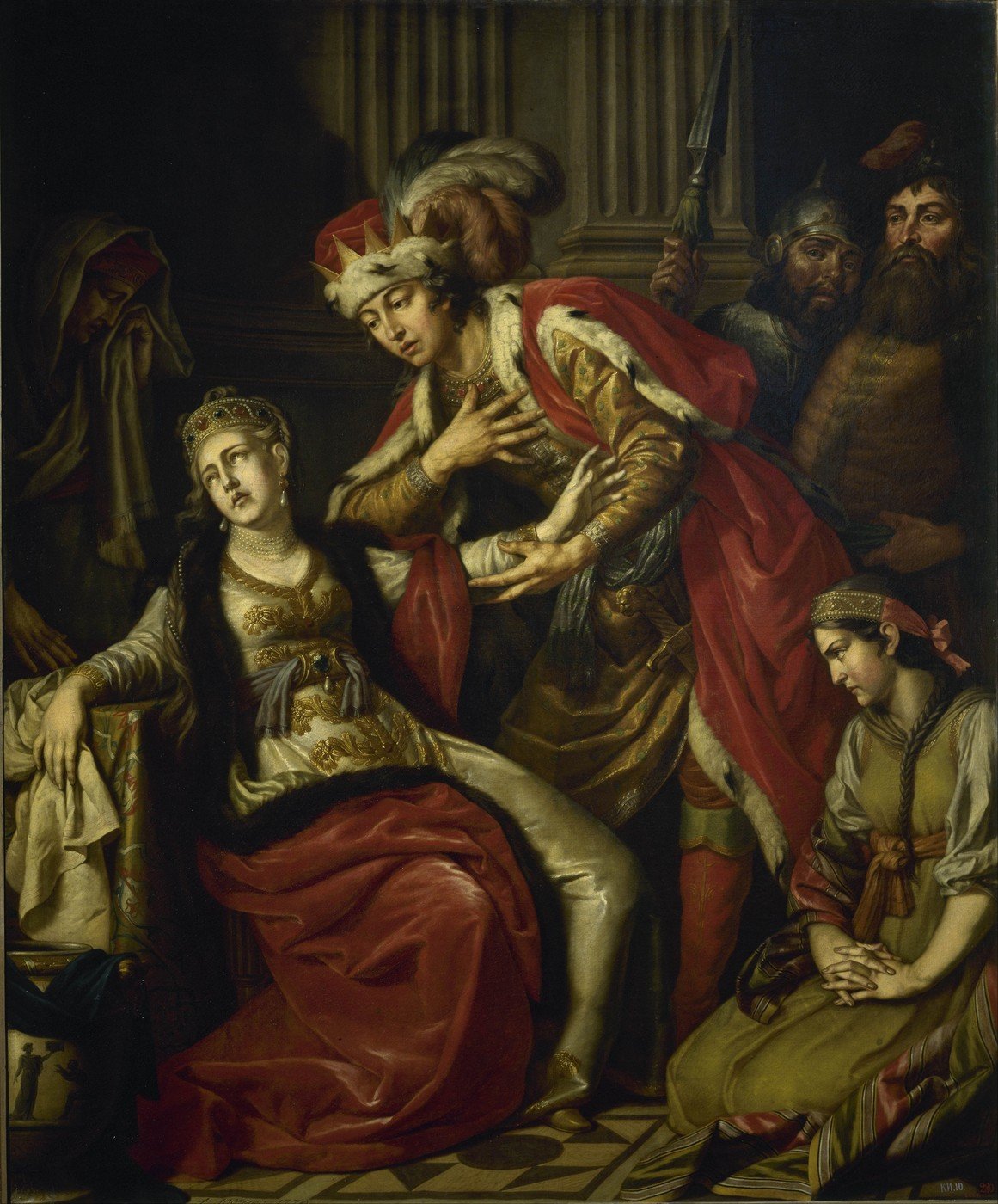
The Academy ranked subjects in a strict hierarchy, with history painting above portraits, landscape and everyday scenes. Anton Losenko shows what that meant in practice. He studied in Paris and Rome, became one of the founders of the Imperial Russian historical movement, and died in 1773 at only thirty-six.
His Vladimir and Rogneda of 1770 takes its story from medieval Rus rather than from Greece or Rome. Yet the figures still strike classical poses, and their drapery falls like that of antique sculpture. The story is Russian. The visual grammar is not. That tension runs through the Academy’s whole history.
Levitsky and the Portrait Under Glass Ceilings
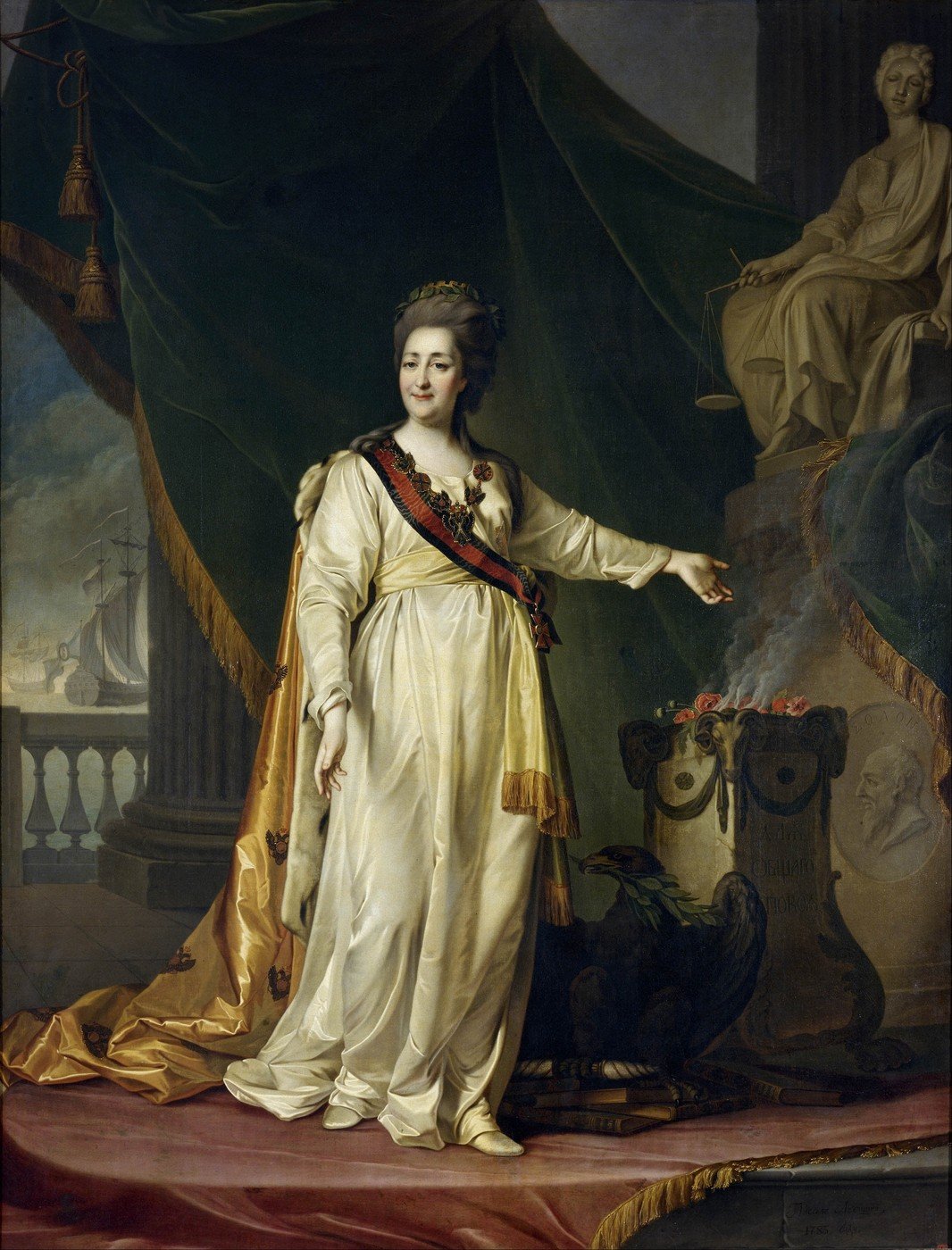
Portraiture stood lower in the hierarchy but paid better, and Dmitry Levitsky raised it to a high art. His Kokorinov portrait of 1769 earned him the title of academician in 1770, and he later taught portrait painting at the Academy.
Look at his Catherine II as Legislator in the Temple of the Goddess of Justice, painted in the early 1780s. The empress wears a laurel crown, burns poppies on an altar, and stands beside the scales and law books. Every object turns a likeness into an argument. Later students learned from it how to load a portrait with allegory.
Bryullov’s Pompeii and the Academy’s Moment of Glory
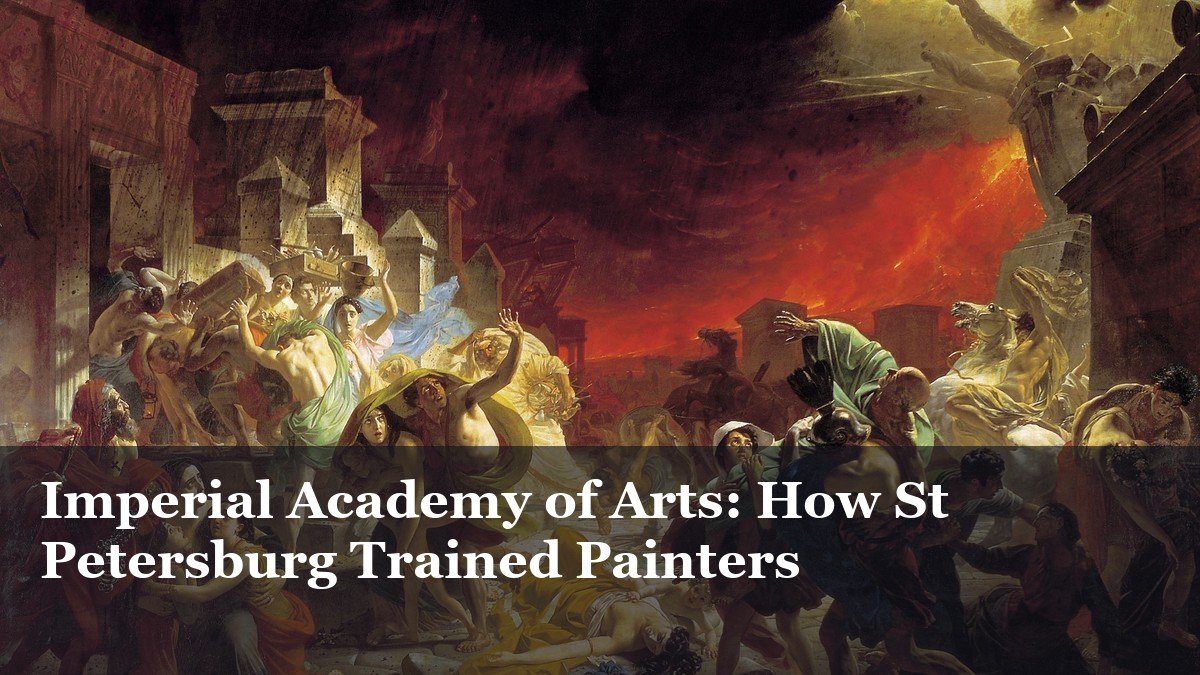
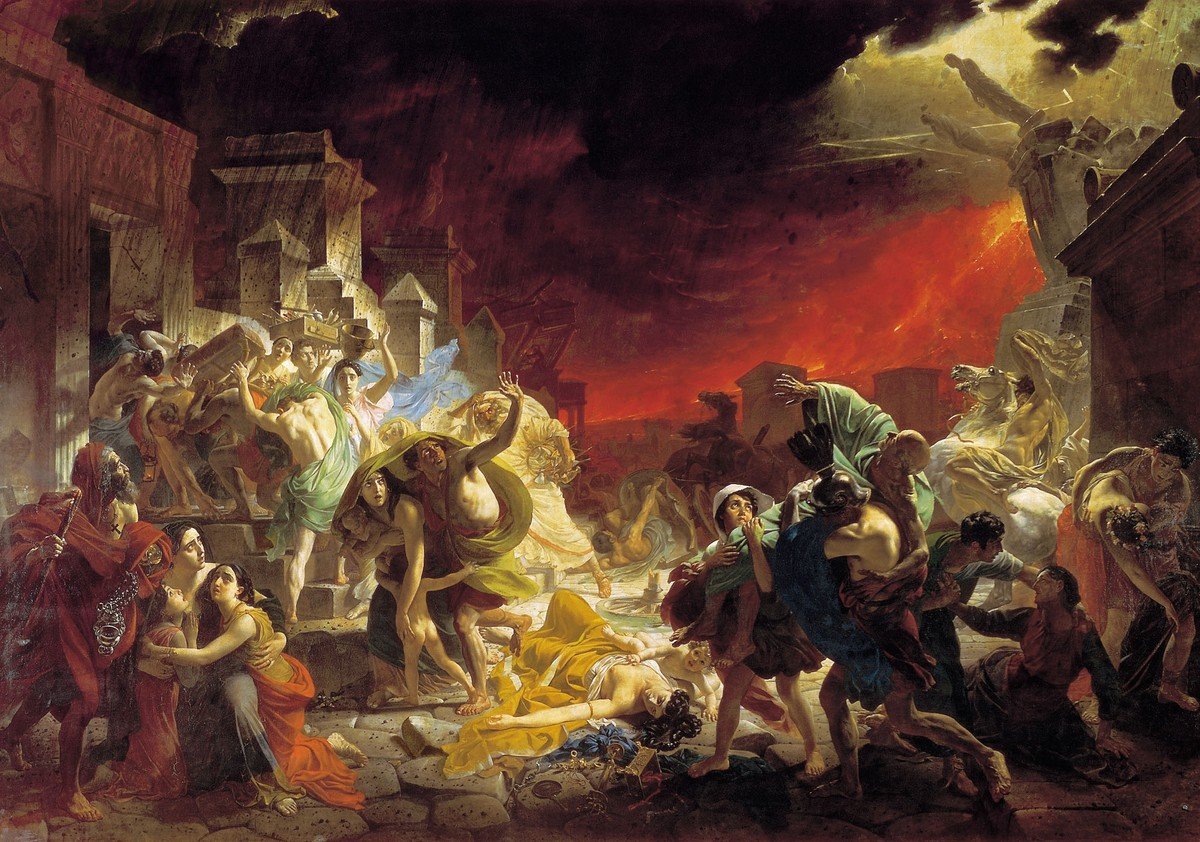
Karl Bryullov went to Rome in 1822 as an Academy-trained painter and spent over a decade there. The Last Day of Pompeii, painted between 1830 and 1833, is a vast history painting of the eruption of Vesuvius in AD 79. It sits between Neoclassicism, the dominant style in Russia, and the Romanticism then spreading from France.
The painting was received with near universal acclaim and placed Bryullov among the first Russian painters to earn wide international recognition. Critics in France and Russia noticed one oddity. Despite the terror around them, the bodies are modelled as perfectly as statues. Back in St Petersburg, Bryullov taught at the Academy, and in 1838 he and friends helped free the serf Taras Shevchenko, who then studied there.
Ivanov: Twenty Years on a Single Canvas
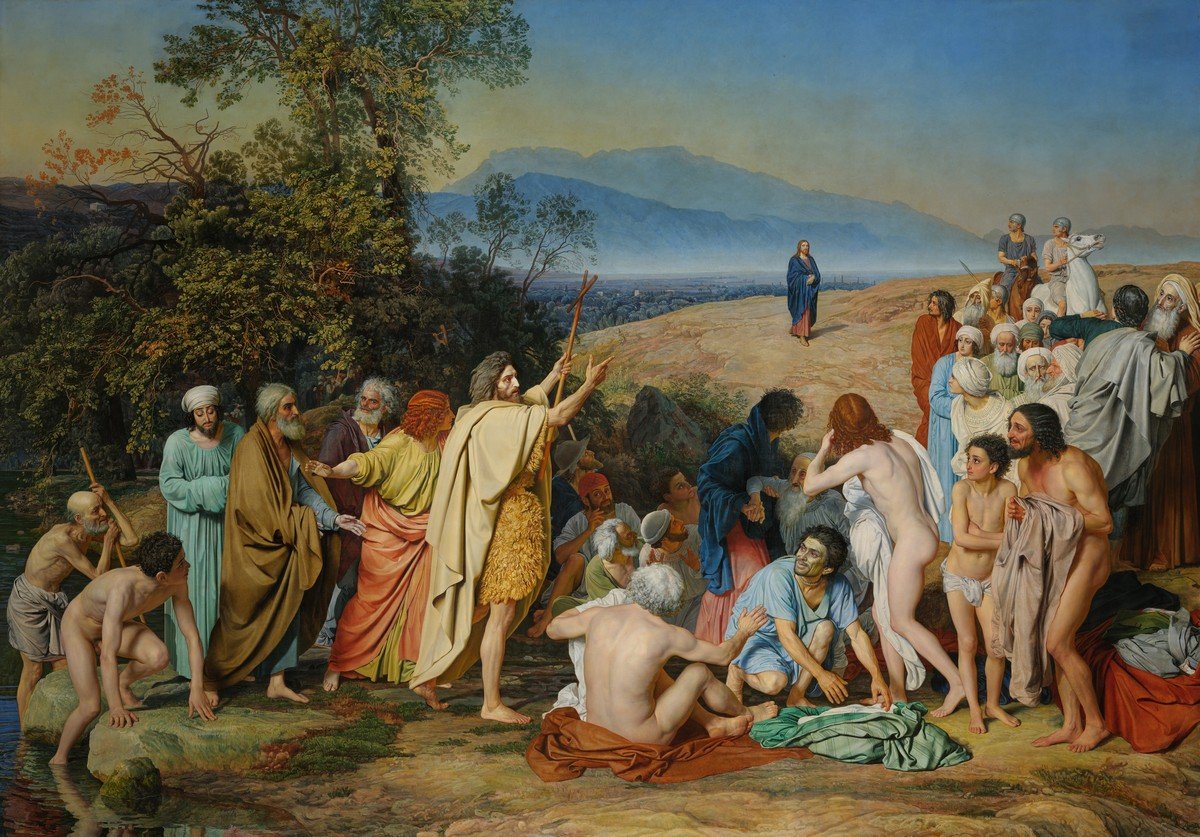
Alexander Ivanov was born in St Petersburg, the son of an Academy professor, and spent most of his life in Rome. He worked on The Appearance of Christ Before the People, begun in 1837 and finished in 1857. All the while he sketched the Italian countryside outdoors in oil.
His studies of water and stones near Palazzuola look strikingly unacademic beside the finished canvas, which is nearly seven and a half meters wide. He adhered to a waning Neoclassical tradition and found little sympathy among his contemporaries. He returned to St Petersburg in 1858 and died within weeks.
Myth vs. Fact: Did the Wanderers reject the Academy?
Myth: the Peredvizhniki were self-taught outsiders who turned their backs on academic training. Fact: many of them, including Kramskoi, Repin and Surikov, learned to draw and compose at the Academy. They objected to its rules on subject matter and its control over careers, not to the craft it taught.
Bruni’s Brazen Serpent: The Academy’s Own Epic
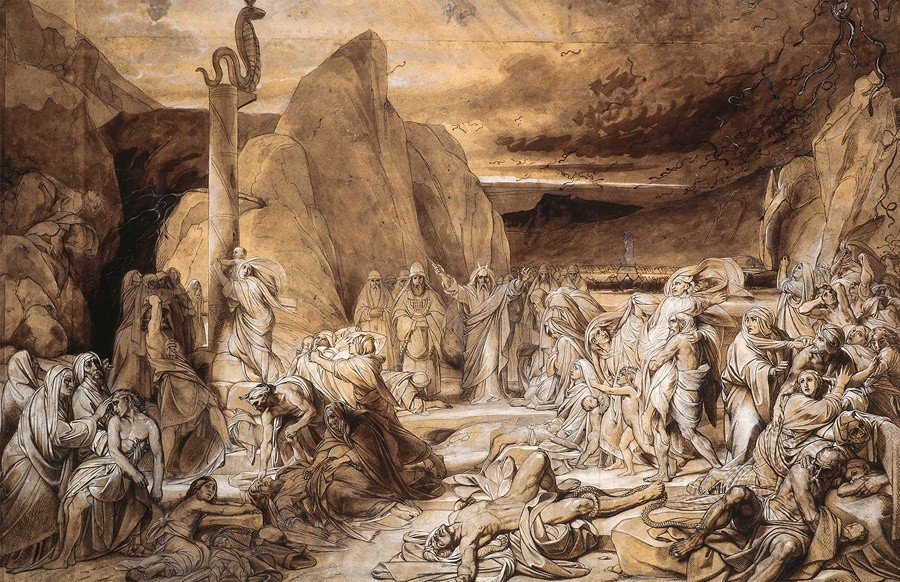
Fyodor Bruni, born in Milan in 1799 and raised in Russia, trained at the Academy and rose to senior teaching posts. His Brazen Serpent of 1841, now in the State Russian Museum, shows Israelites bitten by snakes in the desert and saved by Moses’s bronze serpent.
The canvas packs dozens of figures into a pyramid of suffering and rescue, each pose borrowed from a different antique or Renaissance source. It is the Academy’s idea of greatness in one picture: many bodies, one moral, no wasted gesture. Younger students passed it in the halls and understood what examiners expected.
The Revolt of the Fourteen and the Birth of the Wanderers
What was the Revolt of the Fourteen?
In November 1863, fourteen graduating students refused to paint the assigned gold medal subject, a scene from Norse myth, The Entry of Odin into Valhalla. They asked to choose their own themes. They were refused, and they left. Ivan Kramskoi led them into a cooperative studio, the Artel of Artists.
That group grew into the Peredvizhniki, formally the Society for Travelling Art Exhibitions in 1870, a body of realist artists formed in protest of academic restrictions. Kramskoi’s Christ in the Wilderness of 1872 shows how far they travelled. The subject is sacred, but the figure sits on a bare rock, hunched and uncertain, with no heroic gesture.
Chistyakov: The Teacher Everyone Remembers
Pavel Chistyakov won attention with Patriarch Hermogenes Refuses the Poles in 1860, then built a different reputation as a teacher. He taught students to build a figure from planes and volumes instead of copying outlines, so a head became a set of angled surfaces catching light.
His pupils included Repin, Surikov, Valentin Serov and Mikhail Vrubel, painters with almost nothing in common stylistically. A method that could serve a realist and a symbolist alike explains why Russian painting kept its technical strength even as its subjects moved far from the Academy’s official list.
Repin: From Icon Painter to the Academy’s Name
Ilya Repin began painting icons at sixteen in Chuguev. He failed his first attempt to enter the Imperial Academy of Arts, went to St Petersburg anyway in 1863, audited courses, and won his first prizes in 1869 and 1871. After a trip along the Volga he presented drawings to the Academy, and Grand Duke Vladimir Alexandrovich commissioned Barge Haulers on the Volga, finished in 1873.
As a pensioner in Paris he painted Sadko in 1876, a fairy-tale subject set underwater. His later Reply of the Zaporozhian Cossacks, worked on from 1880 to 1891, packs laughing men around a table in a composition as crowded as any Academy epic. But each face belongs to an individual.
Surikov and Shishkin: Two Very Different Graduates
Vasily Surikov, from Krasnoyarsk, attended the Academy in the early 1870s and made Russia’s past his permanent subject. The Morning of the Streltsy Execution of 1881 shows a moment before a mass hanging in Red Square, with a red-bearded rebel staring down the Tsar’s mounted retinue.
Ivan Shishkin took the Academy’s landscape training in the late 1850s and built on it a lifelong study of forest. In Rye of 1878, a track runs through ripening grain under big pines, and every ear is painted with a draftsman’s discipline. Where Surikov put crowds on stage, Shishkin put a single patch of earth. Both relied on the same hard-won ability to organize space.
After 1918: From Imperial Academy to Repin Institute
The Academy was formally abolished in 1918 after the Russian Revolution and renamed several times. In 1947 the national institution moved to Moscow, and much of its art collection went to the Hermitage. The Neva building was given to the Ilya Repin Leningrad Institute for Painting, Sculpture and Architecture, named after Repin, one of Russia’s foremost realist artists.
Since 1991 it has been called the St Petersburg Institute for Painting, Sculpture and Architecture, still named for Repin. The old competitive entrance system survives in spirit: a few places, many applicants, and drawing as the first test.
Where Academy-Trained Art Hangs Today
To see the Academy’s output, visit two museums. The State Russian Museum in St Petersburg holds Losenko, Levitsky, Bryullov and Bruni, which makes it the best place to follow the system from 1757 to the mid-1800s.
In Moscow, the State Tretyakov Gallery holds Ivanov’s great canvas, Kramskoi’s Christ in the Wilderness, Surikov’s Streltsy and Shishkin’s Rye. Between them you can trace one curriculum from plaster casts to the Wanderers, and see where it bent.
Essential Points
- The Academy worked as a pipeline: classroom, medal, pension abroad, commission. Each step decided who counted as a professional artist.
- Rome mattered as much as St Petersburg. Two of the most ambitious Russian canvases of the 1800s were painted in Italian studios by Academy pensioners.
- Talent could outweigh birth. A serf, a military settler’s son and an icon painter all reached the Academy’s classes.
- The 1863 walkout was about who chose a painter’s subject, so the dispute was over freedom of theme more than over technique.
- Teaching outlasted the institution. Chistyakov’s drawing method passed to painters from very different schools.
- Compare the pictures to see the change: Losenko’s medieval Slavic hero, Bryullov’s volcano and Repin’s Cossacks show history painting moving from borrowed antiquity toward national subjects.
- To read Russian painting from 1757 to 1900, ask who taught whom and who paid for the journey.
Frequently Asked Questions
- What was an academician in Russian art?
- An academician held a title awarded by the Academy to artists who submitted approved work or served as teachers. Ranks ran from student up through free artist and academician to professor. A title shaped an artist’s status, access to state commissions, and income, so painters took the competition seriously.
- Why did Russia found an art academy so late?
- Before the 1700s Russian painting was mostly church work, with icons made in workshops. Peter the Great’s reforms created demand for secular portraits, battle scenes and decoration. A state academy let Russia train its own painters instead of hiring foreigners, which Shuvalov and later Catherine considered a matter of national prestige.
- Why do Academy paintings look so polished?
- Large compositions were planned in stages: pencil sketches, oil studies of heads and drapery, and often a full-scale drawing before the final canvas. Bryullov’s many sketches for his Pompeii painting show this process. Slow, layered planning produced the smooth surfaces and balanced groupings viewers now call academic.
- Did Ilya Repin teach at the Academy?
- Yes. Records indicate Repin taught at the Academy from around 1894, running a studio for advanced students. His name was later given to the institute in the old Academy building, which reflects both his teaching and his reputation as one of the foremost realist painters in Russia.
- Can I visit the Academy building in St Petersburg?
- The building on the Neva embankment still houses the Repin Institute and a museum of the Academy, so parts of it can be visited. Check opening hours before you go. Outside, two ancient Egyptian sphinxes, installed in 1832, face the river and are free to see.
This guide was written and reviewed by the rus-art.com editorial team, specializing in Russian art history. We cross-check dates, attributions, and museum holdings against museum and academic sources.