Quick Answer
Lubok prints are cheap, brightly colored Russian folk pictures, first cut as woodcuts in the late seventeenth century, later made as engravings and, from the mid 1800s, lithographs. Sold by peddlers and pinned to the walls of peasant huts and taverns, they carried saints’ lives, satire, fairy tales, and practical almanacs on a single sheet, often paired with running text, making them a genuine ancestor of the comic strip. Millions circulated through publishers like Ivan Sytin before the style resurfaced in twentieth century avant-garde painting.
What Are Lubki? Russia’s First Mass-Printed Pictures
A lubok (plural lubki, from the Russian лубо́к) is a cheaply printed picture, usually hand colored, pairing a bold image with a caption or short text. The word comes from lub, a board cut from the soft inner bark of a tree, the material early printers carved their designs into before woodblocks proper took over. Lubki decorated the walls of peasant houses, taverns, and merchants’ shops across the Russian Empire from the late seventeenth century into the twentieth.
Scale and reach are what make lubok a mass medium rather than folk decoration. A single carved block, or later a lithographic stone, could print thousands of copies, and those copies traveled by peddler cart to places no bookshop ever reached. Cheap illustrated chapbooks built around the same pictures were known as lubok literature. Together, pictures and books gave illiterate and semiliterate Russians their first shared visual news feed, joke book, and devotional library in one.
From Sacred Woodcuts to Peddler’s Wares: How Lubok Began
The earliest lubki, from the late 1600s and early 1700s, mostly copied the compositions of Orthodox icons and illuminated manuscripts, offering a cheap devotional image to households that could never own a painted icon. As printing shops multiplied around Moscow, subject matter widened fast: almanacs, folk tales, proverbs illustrated as single jokes, and eventually portraits of the tsar and battle scenes.
Distribution ran through a distinct class of traveling merchant known as an ofenya. These peddlers carried rolled sheets of lubki alongside needles, ribbons, and other small goods to village fairs and markets across the empire, well beyond the reach of any bookshop. A lubok bought at a fair for a few kopecks might be the only picture, other than an icon, that a peasant family owned.
Wood, Copper, Stone: How the Lubok Print Technique Evolved
Early lubki were true woodcuts: an artist or carver cut an image into a block of wood along the grain, leaving the printing lines raised while the rest was gouged away, then inked the raised surface and pressed paper against it. Through the eighteenth century, workshops increasingly turned to copper engraving and etching, which allowed finer detail and longer print runs from a single plate.
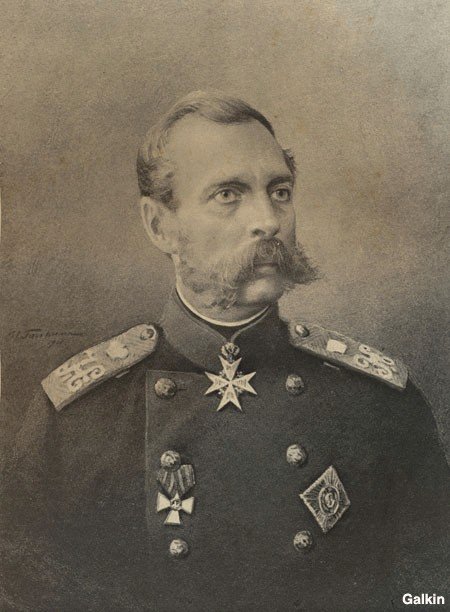
The biggest shift came from the middle of the nineteenth century, when lithography let publishers print far larger editions at lower cost, and photography began feeding directly into popular print. A comparison print built from Sergey Levitsky’s 1870 photographic studies of Alexander II, produced with the printer Galkin, shows photo based sources already merging with the older lubok tradition by that decade, decades before Sytin’s presses pushed print runs into the millions.
Bright Colors, Bold Outlines: The Visual Grammar of Lubok
A lubok reads at a glance, which was the point. Figures are drawn with thick black contour lines and almost no shading, flattened into a shallow stage rather than a deep receding scene. Faces repeat stock expressions, scale is symbolic rather than realistic (a tsar or a saint is drawn larger than everyone around him), and color arrives afterward in flat, quickly brushed patches of red, yellow, green, and blue rather than blended tones.
Text is not an afterthought. Captions, dialogue, and sometimes whole paragraphs of narration are lettered directly onto the sheet, often in a rough hand that mimics manuscript script, wrapped around or tucked beneath the figures. Picture and word were designed together from the start, not added at different stages, and that is exactly what let a lubok work for viewers who could read only a little, or not at all.
Picture and Word Together: Lubok as Russia’s First Comic Strip
Some lubki were sold not as single sheets but as series, several prints meant to be read in sequence, each panel advancing a story with its own caption. Art historians have pointed to these multi sheet sets as an early, homegrown predecessor of the modern comic strip, decades before the term existed anywhere.
How is a lubok different from a comic strip?
A comic strip panel usually belongs to a continuous printed page designed by one artist for one publication. A lubok series was typically sold as separate sheets, meant to be pinned up together on a wall rather than bound, and drew its story from oral folklore or existing chapbooks rather than original authorship. The sequential storytelling logic, though, image plus caption, one beat per sheet, is close enough that the comparison holds.
Anonymous Carvers, Named Publishers: Who Actually Made Lubki?
Most early lubok woodblocks were cut by craftsmen whose names were never recorded, working out of small workshops rather than artists’ studios. That changed as the trade grew: by the eighteenth and nineteenth centuries, specific Moscow printing houses became known for their lubok output, and some individual designers and colorists are documented in guild and censorship records even when their sheets went out unsigned.
The balance tipped further toward named commercial publishers in the nineteenth century, as improved presses made lubok production a real business rather than a village craft. That shift set up the conditions for a single publisher, working a generation later, to turn folk print into something closer to industrial mass media.
Fairy Tale Heroes in Print: Bova, Yeruslan, and the Chapbook Tradition
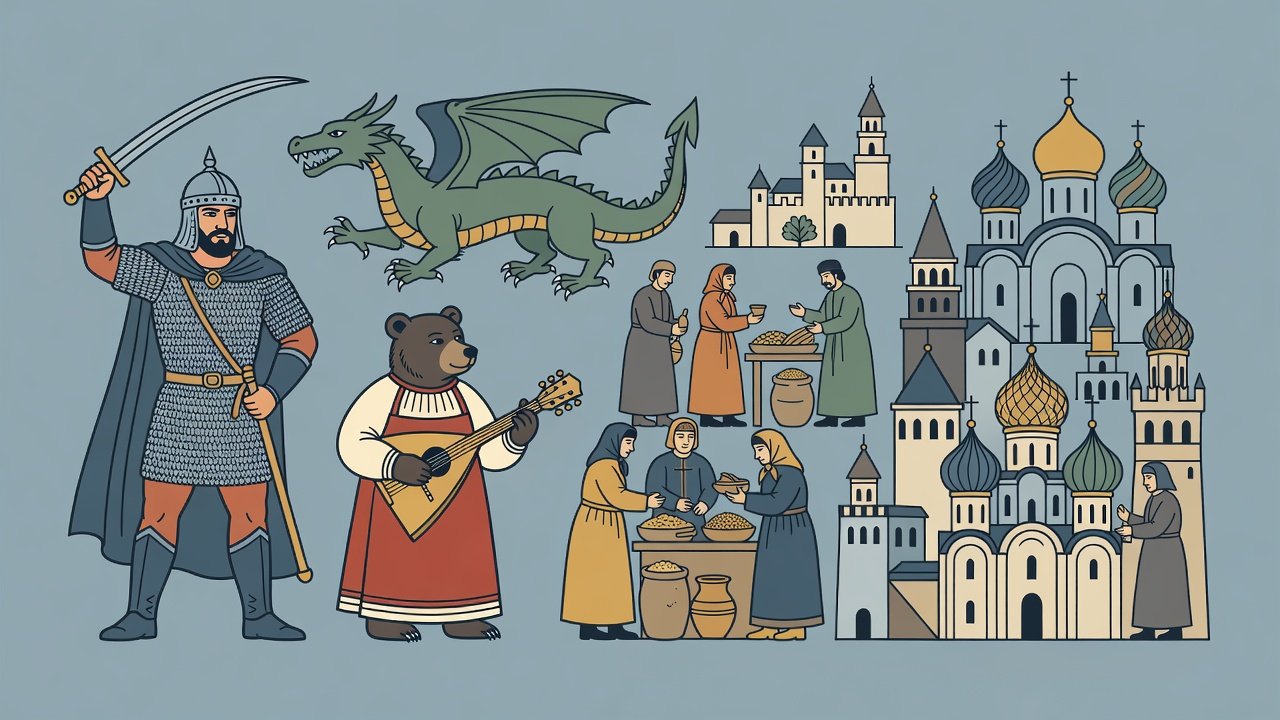
Among the most reprinted lubok subjects were chivalric folk heroes borrowed from older chapbook romances. Bova Korolevich, a Russian folk knight whose tale ultimately traces back to a medieval Western European romance, appeared across generations of hand colored woodcuts and engravings, sword raised, armor rendered in the same flat, bold outline style used for saints and tsars.
Yeruslan Lazarevich, a folk hero adapted from Persian and Turkic epic material, followed a similar path: printed in narrative sequences, paired with rhymed or prose captions, and sold as part of lubok literature alongside the pictures. Both cycles show lubok working as popular entertainment as much as devotion or news, recycling familiar heroic stories into a format cheap enough for any household to own.
Saints, Satire, and Tsars: What Else Lubki Depicted
Beyond fairy tale heroes, lubok subject matter ranged from the sacred to the openly mocking. Hagiographic scenes and biblical episodes sat alongside almanac pages listing saints’ days and practical advice, and alongside prints of the reigning tsar meant to circulate a recognizable royal image into households the court would never visit.
Satire had its own strong lubok tradition. The best known example, widely dated to the second half of the eighteenth century, shows mice carrying a dead cat to burial, its exact political target still debated among scholars (a reading connecting it to Peter the Great’s funeral is popular but not settled). Whatever its original target, it shows that lubok could carry pointed social commentary, not just piety or entertainment.
Was lubok considered real art?
No, not by the academic art establishment of its own time. Trained painters and the Imperial Academy of Arts treated lubok as cheap, anonymous commercial ephemera, closer to a trade good than to fine art. That verdict held for roughly two centuries, until early twentieth century painters began collecting and exhibiting lubki as serious visual sources in their own right.
Look Closer: the coloring was never the printing
The black outline of a lubok came off the woodblock or press in a single pass. Everything else, the reds, yellows, and greens filling the mice, the cart, and the cat’s coffin in How the Mice Buried the Cat, was brushed on by hand afterward, often quickly and by workers paid per sheet rather than per detail. That is why two surviving copies of the same lubok can be colored quite differently.
The Church and the Censor: Lubok Under State Control
Religious imagery in the Russian Empire was never an unregulated market. After Peter the Great’s reforms tightened control over printing and publishing in the early eighteenth century, the Orthodox Synod and state censors kept a close watch on devotional prints, requiring approval for religious subjects and periodically cracking down on lubok workshops that printed icons or saints without authorization.
That pressure pushed publishers toward subjects the censors cared about less: folk tales, satire, calendars, and secular portraiture. Ironically, restricting the sacred side of lubok helped diversify the medium into the broader mix of news, humor, and storytelling that later made it recognizable as an early form of mass media rather than devotional craft alone.
Ivan Sytin and the Industrialization of Folk Print
No single figure did more to turn lubok style publishing into a national industry than Ivan Sytin (1851 to 1934). Born to a peasant family in Soligalich, Sytin arrived in Moscow at thirteen and opened his own bookshop in 1883. He built his fortune on cheap, attractively illustrated almanac style calendars packed with practical information, the direct descendants of the old lubok almanac sheet, and followed them with cut rate editions of Pushkin, Gogol, and Tolstoy priced within reach of working households once their copyrights lapsed.
Maxim Gorky described Sytin as a de facto minister of people’s education, a widely cited characterization crediting his calendars and cheap leaflets with pushing back against illiteracy in the countryside, while Tolstoy, who had released his later works copyright-free, encouraged Sytin to publish cheap editions of his moral writings. Between 1887 and 1916, Sytin’s printing house in the Zamoskvorechye district of Moscow issued several hundred titles at print runs no earlier lubok workshop could have matched.
How did lubok prints reach peasant households?
The same ofeni peddler networks that carried eighteenth century lubki to village fairs still moved Sytin’s output a century later, now supplemented by rail freight and Sytin’s own distribution contracts. He effectively industrialized a distribution channel that already existed, turning a folk craft’s delivery system into something closer to a modern publishing supply chain.
Primitivism Rediscovered: How the Avant-Garde Looked Back at Lubok
By the early twentieth century, Russian painters looking to break from academic realism found an unexpected native resource in the lubok sheets their grandparents had pinned to cottage walls. This paralleled a wider European movement, Primitivism, in which artists such as Paul Gauguin drew on the arts of societies they viewed as untouched by academic convention (a framing scholars now recognize carried real colonial bias) to justify breaking from Western academic style.
Russian artists had a homegrown equivalent close at hand. Natalia Goncharova collected lubki and exhibited alongside them, borrowing their flat color, thick contour, and blunt storytelling directly into her own paintings, and Mikhail Larionov and other members of their circle followed a similar path. For them, lubok was not a distant, exoticized other tradition but a Russian one, which let them claim a radical modern style as authentically their own rather than imported.
Lubok’s Afterlife: From Soviet Windows to Digital Folk Art
Lubok’s core format, a single sheet combining bold image and caption for maximum immediate impact, resurfaced almost intact in the satirical ROSTA and later TASS propaganda windows of the Soviet twentieth century, which used the same flat color and blunt visual punchlines for political messaging instead of fairy tales and saints.
Today, original lubki survive mainly in museum collections such as the State Historical Museum in Moscow and the State Russian Museum in St. Petersburg, while digitized holdings from Russian libraries have made them freely viewable online. Illustrators and folk art revivalists continue to borrow the style’s flat outlines and hand lettered captions, a visual language that has proven durable across three centuries of very different media.
Common Misconceptions About Lubok Prints
Two mix ups come up often enough to address directly. First, lubok is not simply another word for icon painting. Icons follow strict Orthodox theological rules for composition and are treated as sacred objects for veneration, while lubki, even devotional ones, were disposable commercial sheets sold openly at markets alongside satire and fairy tales, never intended for liturgical use.
Second, lubok was not a purely naive, market unaware folk craft. Its distribution ran through the organized ofeni peddler trade network, and by the nineteenth century through commercial publishing houses that tracked what sold and scaled accordingly. Treating lubok as artless and untouched by commerce misses exactly what made it Russia’s first real mass medium.
Related Traditions: Lubok Beside European Broadsides and Chapbooks
Lubok was not unique to Russia. Germany had its Bilderbogen, cheap illustrated broadsheets sold at fairs; England and Ireland had broadside ballads pairing woodcut images with printed verse; and France, from the town of Épinal, produced its own mass market images d’Épinal using very similar flat, bold coloring. Each tradition answered the same problem in roughly the same way: how to sell a picture and a story to people who could not afford, or could not read, a book.
What distinguishes lubok within that broader European family is less the format than its afterlife. Few of its European cousins were later picked up wholesale by a national avant-garde and folded into serious modern painting the way Goncharova, Larionov, and their circle did with lubok in early twentieth century Russia.
Essential Points
- Lubok comes from lub, the bast board early prints were cut on, not from any single artist’s name.
- The medium shifted three times: woodcut in the late 1600s and 1700s, copper engraving and etching after that, then lithography from the mid nineteenth century.
- Peddlers called ofeni carried lubki into villages that had no bookshops, making them Russia’s earliest nationwide picture distribution network.
- Series lubki that told a story panel by panel, paired with captions, are a direct ancestor of the comic strip.
- Ivan Sytin did not invent lubok, but his Moscow printing house scaled its distribution into an industrial, nationwide operation.
- State and church censorship after Peter the Great pushed lubok subject matter toward satire and secular tales alongside devotional images.
- Early twentieth century painters including Natalia Goncharova collected and studied lubki as a homegrown answer to Western Primitivism.
- Lubok’s single sheet, word and image format resurfaced almost unchanged in Soviet propaganda windows decades later.
Frequently Asked Questions
- What exactly is a lubok print?
- A lubok is a large single sheet combining a hand-colored picture with a caption or running text, sold for a few kopecks and pinned to a wall rather than read between covers. What distinguishes it from icon painting is its openly commercial, disposable character; what distinguishes it from a chapbook is its single-sheet format designed for viewers who might be illiterate or only partly literate. That combination of cheap, visual, and wall-sized gave it reach no bound book of the era could match.
- When did lubok prints first appear in Russia?
- Lubok printing began in the late seventeenth and early eighteenth centuries, starting as woodcuts that copied icon style religious imagery. The medium later shifted to copper engraving and etching, then to lithography from the mid nineteenth century, expanding its reach as printing technology improved.
- How were lubok prints colored?
- The printed image supplied only the black outline. Colorists then hand painted each sheet afterward, often working quickly for low pay, which is why surviving copies of the same lubok can differ in color choices. Later, high volume workshops sometimes sped up coloring with stencils rather than fully freehand work.
- Did Ivan Sytin invent lubok prints?
- No. Lubok woodcuts were already circulating before 1700, roughly a century and a half before Sytin was born. The confusion arises because his name dominates the nineteenth-century popular-print story. His actual role was commercial infrastructure: he built the presses, distribution contracts, and low pricing that scaled an existing folk-print trade into a nationwide publishing operation, the same way a railway entrepreneur scales an existing road network without inventing travel.
- Where can you see original lubok prints today?
- Major holdings survive at the State Historical Museum in Moscow and the State Russian Museum in St. Petersburg, with additional examples in Russian state library collections. Many have been digitized and are viewable online, letting researchers and enthusiasts study them without traveling to Russia.

This guide was written and reviewed by the rus-art.com editorial team, specializing in Russian art history. We cross-check dates, attributions, and museum holdings against museum and academic sources.