Quick Answer
The Russian icon began in AD 988, when Kievan Rus’ adopted Christianity from Byzantium and imported its painting conventions wholesale. Over five centuries, masters such as Theophanes the Greek, Andrei Rublev, and Dionisius developed a distinct Russian idiom within those Byzantine rules. In the 1650s, Patriarch Nikon’s liturgical reforms split the Church: the state tradition absorbed Western realism through painters like Simon Ushakov, while the Old Believers preserved the older, stylized manner in exile.
What Is a Russian Icon?
A Russian icon is a devotional panel, usually tempera on wood, that Orthodox Christians treat not as decoration but as a window onto a sacred figure. It depicts Christ, the Virgin Mary, saints, or biblical events through a fixed set of conventions: flattened space, gold backgrounds, elongated and still figures meant to point past the physical world toward a spiritual one. Believers venerate icons; they do not worship the wood and paint itself. The honor given to the image passes through to the person it depicts, a distinction Byzantine theology had already worked out centuries before it traveled north with Christianity and set the terms for everything that followed in Russian religious art.
From Byzantium to Kievan Rus: The Baptism of 988
Russian icon painting has a precise starting point. In AD 988, Grand Prince Vladimir of Kiev adopted Orthodox Christianity from the Eastern Roman, or Byzantine, Empire, and with it came Byzantine painters, church architecture, and a whole visual system for depicting the sacred. Kievan Rus’ did not invent its own religious art from nothing; it inherited one already a thousand years old. Byzantine masters and their manuals traveled first to Kiev, then to Novgorod and other early centers, teaching local painters the strict rules for how a saint’s face, a garment fold, or a halo should look. For roughly three centuries after 988, Russian icons stayed close to their Byzantine models, changing mainly through slow regional adaptation rather than deliberate invention.
Learning the Byzantine Visual Language
What Makes an Icon Look the Way It Does?
Byzantine convention, and the Russian tradition built on it, had no use for the single-point perspective and modeled light of Western painting. Figures stand flat and frontal, gazing straight at the viewer. Backgrounds are gold leaf, removing the depicted scene from earthly time and place. Faces follow set proportions passed down through pattern books called podlinniki, so a given saint looks recognizably the same across centuries and workshops. Early Novgorod icons, like the fifteenth-century Saint George panel now in the State Tretyakov Gallery, already show this vocabulary in confident local use: a warrior saint rendered with the calm, weightless stillness Byzantine icon veneration demanded, adapted with Novgorod’s characteristic bright red grounds and bold outlines.
Theophanes the Greek and the Rise of the Novgorod School
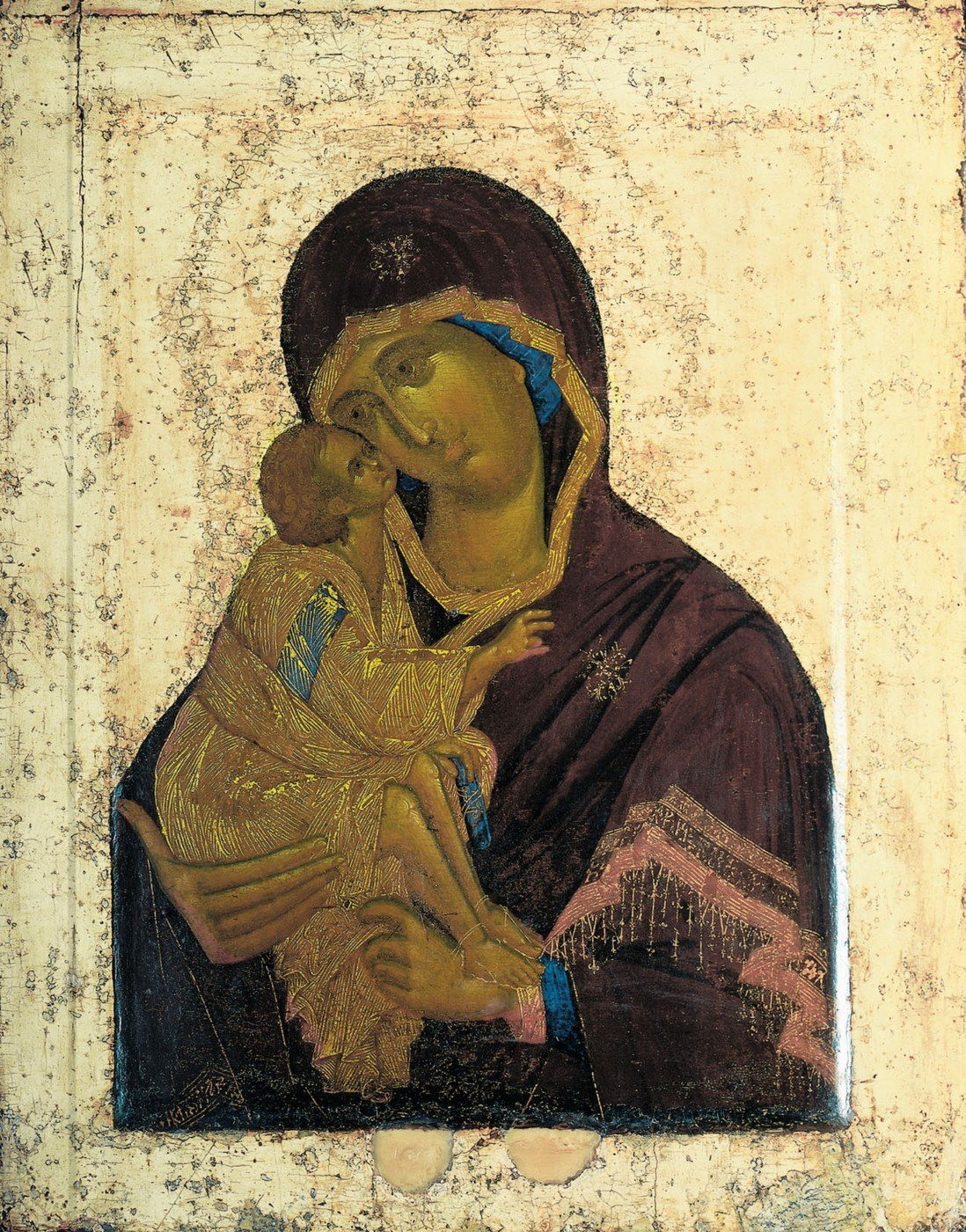
Theophanes the Greek (c. 1330/1340 to c. 1410) was a Byzantine painter who emigrated to Russia and became one of the most influential artists working in Novgorod and Moscow in the late fourteenth century. His brushwork was famously loose and expressive for the period, built from quick highlights laid over dark underpainting rather than careful outline. Tradition links him to the Don Mother of God icon, an image associated with Dmitri Donskoi’s era, and remembers him above all as the teacher of Andrei Rublev. Through Rublev, Theophanes’ influence carried into the next generation even as Russian painting began pulling away from his austere, dramatic Byzantine manner toward something gentler.
Andrei Rublev and the Moscow School
Andrei Rublev (c. 1360 to c. 1430) trained under Theophanes the Greek but painted nothing like him. Where Theophanes favored severity, Rublev favored harmony: rounder forms, softer color, figures that seem to lean gently toward one another instead of confronting the viewer head on. The Eastern Orthodox Church honors Rublev as a saint, with a feast day on 29 January, a measure of how completely Russian tradition absorbed him as a spiritual authority as well as an artistic one.
What Makes Rublev’s Trinity So Important?
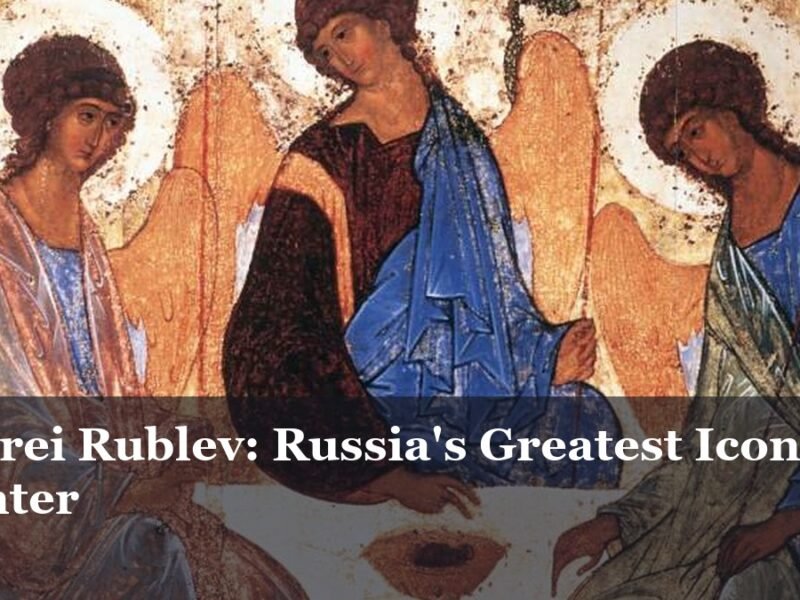
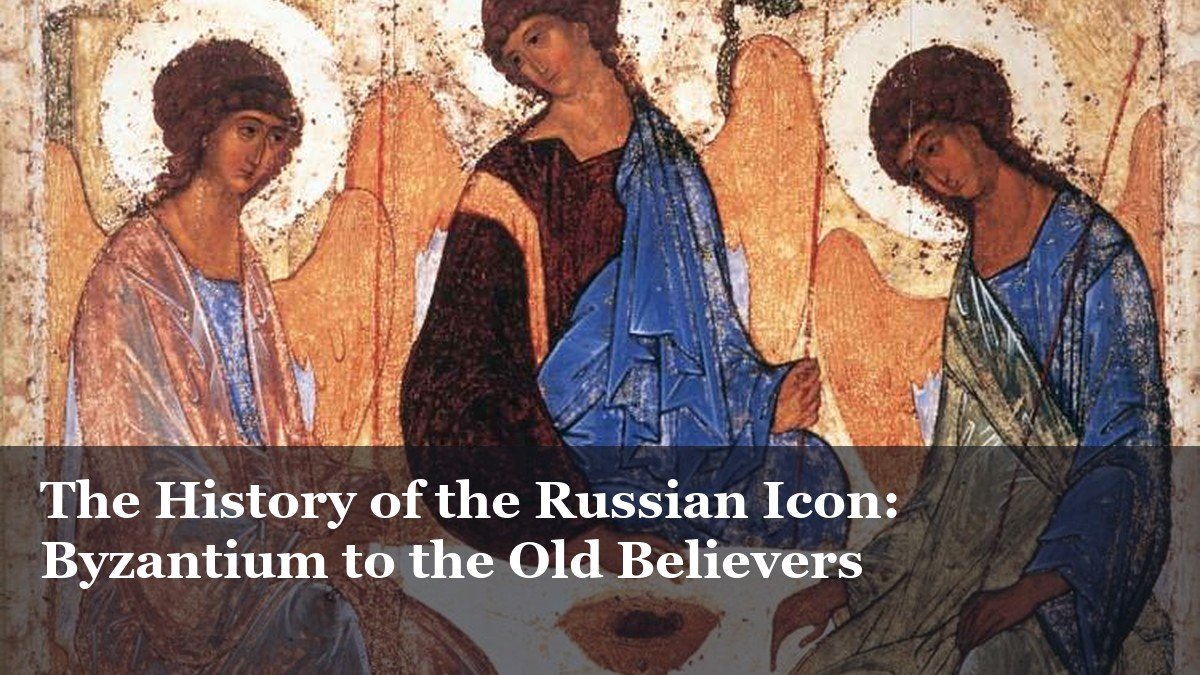
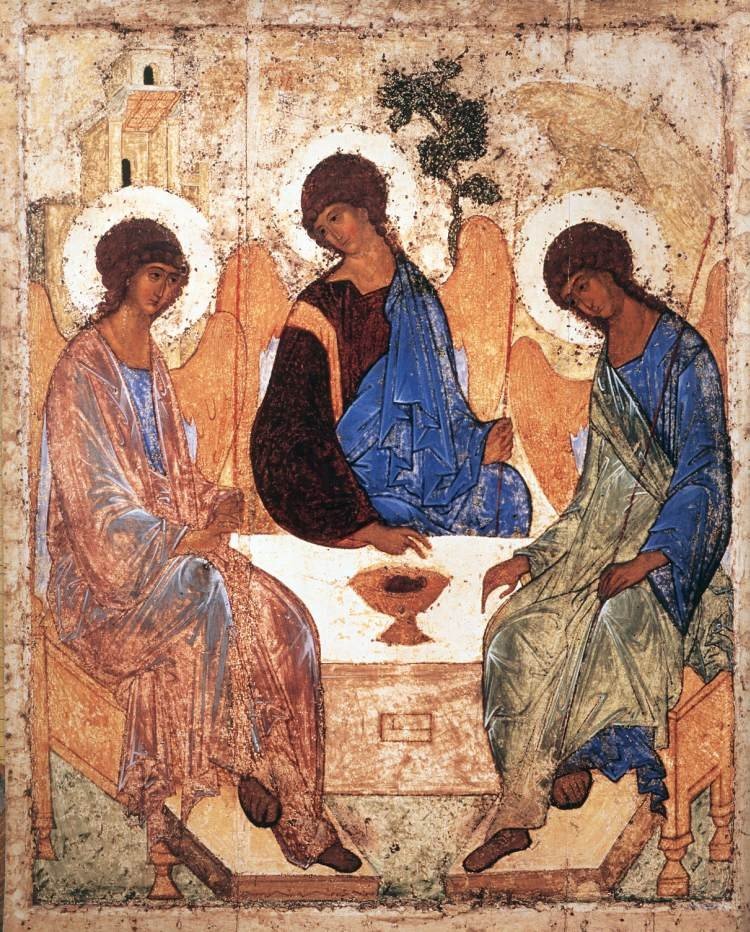
The Trinity, painted for the Trinity Lavra of St. Sergius near Moscow sometime between 1408 and 1427 (scholars debate the exact years), is Rublev’s most famous work and is widely regarded by art historians and the Russian Orthodox Church as the most celebrated icon in Russian art. It shows the three angels who visited Abraham at the Oak of Mamre, read since the Middle Ages as an image of the Holy Trinity itself. Scholars count it among only two works, alongside frescoes in Vladimir’s Dormition Cathedral, that can be attributed to Rublev with real confidence, which is exactly why its authorship and even its precise commission remain subjects of scholarly debate.
Dionisius and the Turn Toward Elegance
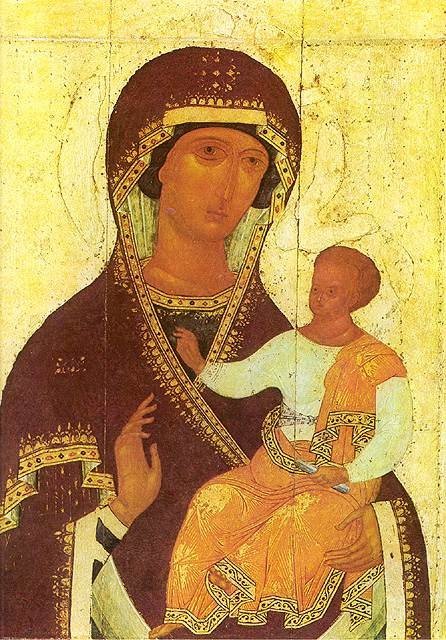
Dionisius (c. 1440 to 1503/1508) carried Rublev’s legacy into the turn of the sixteenth century as the leading figure of the Moscow school. He ran a large, busy workshop rather than working alone, which let his style spread quickly through commissions across Muscovy. His icons, such as the Mother of God Hodegetria of 1502, push Rublev’s harmony even further toward the linear and refined: taller, more slender figures, paler coloring, a lightness some art historians read as almost decorative next to Rublev’s gravity. Dionisius marks the last major flowering of the pre-Western Moscow icon tradition, before outside influence began reshaping Russian painting in the century that followed.
How Russian Icons Were Made
What Materials Went Into an Icon?
An icon began as a wooden panel, usually lime or pine, sometimes reinforced with wooden struts on the back to resist warping. Painters coated the panel with levkas, a chalk and glue gesso, sanding it smooth before sketching the composition. Pigments were bound in egg tempera and applied in thin, deliberate layers built from dark to light, a technique that gives well-preserved icons their luminous, almost glowing quality. Gold leaf, applied to the background and sometimes to halos, was burnished to catch candlelight in dim church interiors. A finished panel from a workshop like Dionisius’s followed the same basic sequence used a century earlier under Rublev, one reason dating an unsigned icon on style alone is often so hard.
Reading the Symbols: Gold, Reverse Perspective, and Proportion
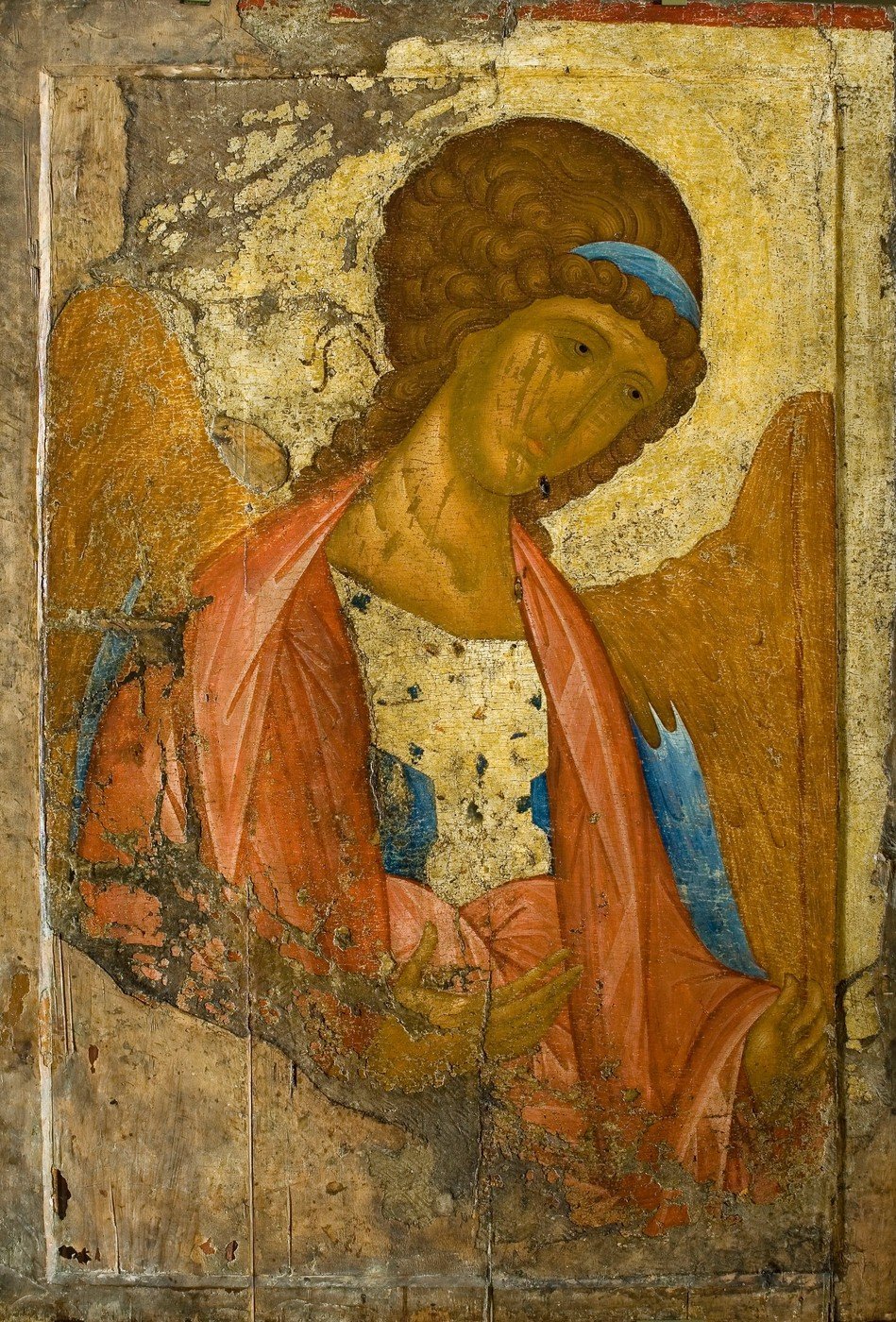
Russian icons use what art historians call reverse perspective: lines that seem to converge toward the viewer rather than recede away, so the sacred space appears to open outward into the room instead of pulling back into an illusionistic distance. This is not a technical failure but a deliberate choice, one that places the viewer inside the divine scene rather than outside looking in. Gold backgrounds signal that the setting is heaven, not any earthly place. Figures are elongated and their gestures restrained, following proportional rules meant to suppress individual bodily presence in favor of spiritual stillness. In Rublev’s Zvenigorod Deesus tier, the Archangel Michael’s calm, slightly tilted head and the deep, uninterrupted gold ground behind him show these rules working together, producing an image of serene authority rather than a portrait of any specific being.
Icons in the Russian Home and Church
Icons were not confined to museums or even to churches. Every traditional Russian home kept a krasny ugol, or icon corner, typically in the room’s eastern-facing corner, where the family gathered for prayer. In church, icons covered the iconostasis, the screen separating the altar from the congregation, arranged in fixed tiers: the Deesus row of saints interceding with Christ, the local tier of the church’s patron saints, rows of feast days and prophets above. This architecture of images gave worshippers a structured, repeatable visual world across thousands of churches, so a peasant in Novgorod and a boyar in Moscow met the same figures in roughly the same arrangement.
The Stoglav Council and the Standardization of the Sacred
In 1551, the Stoglav Council, a synod convened under Ivan the Terrible, addressed church discipline and practice across a hundred chapters, including instructions for icon painters. The council pointed to Andrei Rublev’s work, by then over a century old, as the model painters should follow, effectively freezing his proportions and compositions into an official standard. The effect was lasting and double-edged: it preserved and spread Rublev’s achievements widely, but it also discouraged the kind of stylistic experimentation that had produced his innovations in the first place. For the century after Stoglav, Russian icon painting grew more workshop-driven and formulaic, setting the stage for the more disruptive changes of the 1600s.
Myth vs. Fact: Myth: Icon Painters Were Anonymous Craftsmen
Myth: Russian icons are folk art made by nameless hands. Fact: many of the greatest icons carry known authorship. Andrei Rublev, Dionisius, and Simon Ushakov ran documented workshops, took named commissions from monasteries and the tsar’s court, and are cited by contemporaries in chronicles. Anonymity applies to countless parish icons, not to the masters who set the standards others copied.
The Seventeenth Century Opens a Window West
Personal, inventive religious art of the kind common in Western Europe had been largely absent from Russia before the seventeenth century. That changed as Russian painters gained access to Protestant and Catholic religious engravings and paintings circulating through trade and diplomacy. Icon workshops in the Kremlin Armory, the tsar’s central artistic institution, began folding elements of Western modeling, volume, and even landscape backgrounds into otherwise traditional compositions. It was not a wholesale abandonment of Byzantine convention but a gradual blending, and within a few decades it would become the single most contested issue in Russian religious art.
Simon Ushakov and the Birth of the Parsuna
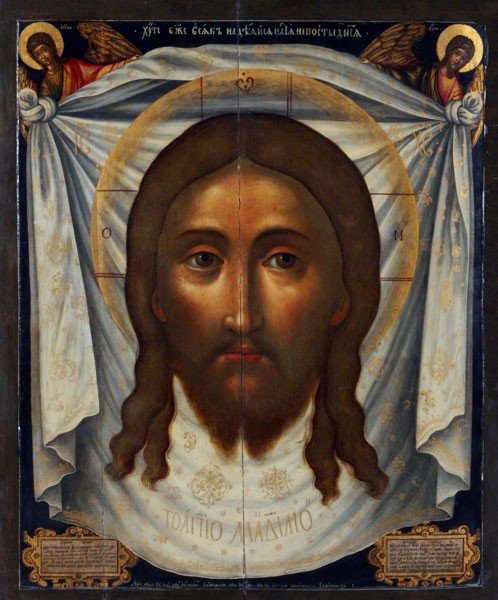
Simon (Pimen) Fyodorovich Ushakov (c. 1626 to 1686) led this stylistic shift from within the Kremlin Armory workshops. His Savior Not Made by Hands, painted in 1658, keeps the traditional subject but models Christ’s face with shading and volume closer to a European painted portrait than to the flat planes of earlier icons.
Why Did Ushakov’s Icons Look More Western?
Ushakov had direct exposure to imported prints and paintings, and he consciously experimented with lifelike faces and spatial depth within icon subjects. He is also credited with popularizing parsuna, an early Russian secular portrait genre that borrowed icon-painting technique to depict living tsars, nobles, and clergy rather than saints, a genuinely new category of Russian art growing straight out of icon workshops.
Patriarch Nikon’s Reforms and the Great Schism
Between 1653 and 1656, Patriarch Nikon of Moscow introduced reforms meant to bring Russian liturgy and ritual closer to contemporary Greek Orthodox practice, changing details like the sign of the cross and the wording of certain prayers. The changes proved explosive. Traditionalists saw them as a corruption of authentic Russian Orthodoxy, the state Church pressed forward anyway, and the old rite and its followers were formally anathematized in 1667. Ushakov himself, along with painters Fyodor Zubov and Fyodor Rozhnov, is tied to the artistic side of this reform program, their more realistic icon style running parallel to Nikon’s liturgical modernizing. His 1685 Last Supper, built on convincing architectural space and modeled figures, shows just how far the state tradition had drifted from Rublev’s flat, gold-ground world within a single century.
The Old Believers: Guardians of the Old Rite
Old Believers, or Old Ritualists, are the communities that rejected Nikon’s reforms and kept the pre-1653 liturgy and ritual. Some among them read the reforms as a sign of the coming End of Days and viewed the reformed Church and state as instruments of the Antichrist, a conviction that hardened their resistance rather than softening it under pressure.
What Happened to Old Believers After 1667?
Facing state persecution after the 1667 anathema, Old Believers fled into remote forests and frontier regions or escaped to neighboring countries, forming tight communities marked by strict morality and religious discipline, including customs like uncut beards for men. They later rejected Peter the Great’s Westernizing reforms too, which made preserving pre-schism Russian culture, icon painting very much included, part of their identity rather than an accident of isolation.
Two Traditions After the Schism
From the mid-seventeenth century on, Russia effectively had two living icon traditions. Old Believer workshops kept painting in the flattened, stylized, gold-ground manner descended from Rublev and Dionisius, treating any drift toward realism as theologically suspect. The state Church, by contrast, increasingly welcomed the blended style Ushakov had pioneered, mixing Russian stylization with Western modeling, perspective, and even landscape. Ushakov’s Tree of the Muscovite State of 1668, which weaves a genealogy of rulers and saints around the Vladimir Mother of God, embodies this hybrid approach: traditional in subject and symbolic structure, but built with a spatial complexity earlier icon painters never attempted.
From Soot to Symbol: The Icon’s Modern Rediscovery
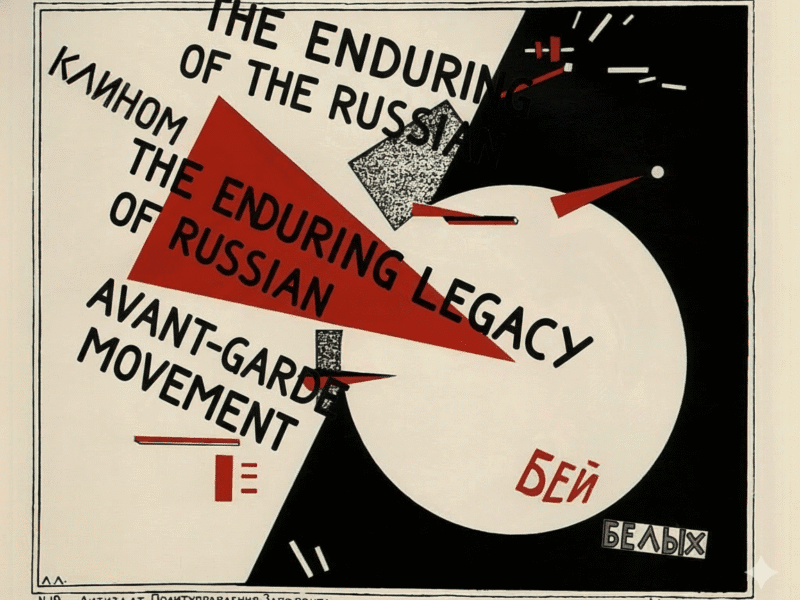
For centuries, older icons in active use darkened under layers of soot, varnish, and metal covers called oklads, so by the nineteenth century many masterpieces sat effectively invisible under grime. Restoration campaigns in the early twentieth century stripped that accumulated darkness away, revealing the bright, confident color of medieval originals for the first time in generations. The effect on Russian art was immediate: painters exploring abstraction, including figures associated with the early avant-garde, looked to the flattened space and pure color of newly cleaned icons as proof that non-illusionistic painting had deep Russian roots. Today, works by Rublev and Dionisius anchor the collections of the State Tretyakov Gallery and the State Russian Museum, drawing scholars and visitors as both religious objects and foundational works of Russian art history.
Common Misconceptions About Russian Icons
One persistent misconception holds that icon painting stopped evolving after the Byzantine period, as if Rublev, Dionisius, and Ushakov were all doing the same thing. In fact each shifted the tradition measurably, from Theophanes’ dramatic brushwork to Rublev’s harmony to Ushakov’s Western modeling, changes traceable across roughly three centuries. Another misconception treats Old Believer icons as a lesser, provincial offshoot. Many Old Believer workshops, particularly around Vetka and later the Urals, maintained technical standards fully comparable to pre-schism Moscow painting, simply aimed at preserving the tradition rather than modernizing it.
Related Traditions: Greek, Serbian, and Ukrainian Icon Painting
The Russian icon tradition did not develop in isolation. Greek icon painting, particularly the Cretan school active from the fifteenth through seventeenth centuries, stayed closer to late Byzantine convention and directly influenced Balkan and Russian workshops through traveling painters and imported panels. Serbian icon painting, rooted in the same Byzantine inheritance Kievan Rus’ received in 988, developed its own regional character within Orthodox monasteries under Ottoman rule. Ukrainian icon painting, sharing Kievan Rus’ as a common origin point with Russia, absorbed Baroque influence from Poland-Lithuania earlier and more thoroughly than Muscovy did, producing a visibly more ornate regional style well before Ushakov’s generation brought comparable change to Moscow.
Essential Points
- Russian icon painting began in AD 988 when Kievan Rus’ adopted Orthodox Christianity from the Byzantine Empire and imported its artistic canon directly.
- Theophanes the Greek, active in Novgorod and Moscow around 1370 to 1405, trained Andrei Rublev before Rublev developed his own softer, more harmonious style.
- Rublev’s Trinity, painted for the Trinity Lavra of St. Sergius sometime between 1408 and 1427, is one of only two works scholars attribute to him with real confidence.
- The 1551 Stoglav Council effectively made Rublev’s work the required model for icon painters across Russia, cementing his influence for a century.
- Simon Ushakov (c. 1626 to 1686) introduced European-influenced modeling and perspective into icons while also popularizing parsuna, an early Russian secular portrait genre.
- Patriarch Nikon’s liturgical reforms of 1653 to 1656 triggered a schism formalized by the 1667 anathema, splitting Russian Orthodoxy into the state Church and the Old Believers.
- Old Believers rejected Nikon’s changes and Peter the Great’s later Westernizing reforms, preserving pre-schism icon style in remote settlements and communities abroad.
- Icons are read through fixed conventions, reverse perspective, gold backgrounds signifying divine light, and standardized proportion, not through the realism Western viewers might expect.
Frequently Asked Questions
- What is the difference between an icon and a regular religious painting?
- The key difference is purpose and convention. Icons are devotional objects governed by fixed rules, pointing toward the sacred rather than showcasing artistic invention. A regular religious painting may use any style or technique. In Orthodox practice, the honor given to an icon passes through to the person depicted, not to the painted wood and pigment.
- Why did Russia adopt Byzantine icon conventions in the first place?
- Kievan Rus’ adopted Orthodox Christianity from the Byzantine Empire in AD 988, and Byzantine painters and pattern books came north as part of that conversion. Russia had no competing native tradition of religious painting at the time, so it inherited Byzantine visual rules wholesale before slowly adapting them.
- Why do Russian icons use gold backgrounds instead of painted skies?
- Gold represents divine, uncreated light rather than a physical setting like sky or landscape. It removes the scene from ordinary time and place, signaling that the viewer is looking at a spiritual reality. This convention came directly from Byzantine practice and stayed central through every phase of Russian icon painting.
- Who taught Andrei Rublev, and how did his style differ from his teacher’s?
- Theophanes the Greek, a Byzantine emigre active in Novgorod and Moscow, is credited by tradition as Rublev’s teacher. The two painters moved in opposite directions: Theophanes used vigorous highlight strokes over dark underpainting, while Rublev pursued calm balance, a lighter palette, and figures that incline gently toward one another rather than confront the viewer.
- Where can I see major Russian icons today?
- The State Tretyakov Gallery in Moscow holds Rublev’s Trinity and major works by Dionisius, while the State Russian Museum in St. Petersburg holds significant Novgorod and Moscow school icons. Both institutions display restored panels that reveal the original medieval color hidden for centuries under soot and varnish.