Quick Answer
The Wanderers, or Peredvizhniki, were a group of Russian realist painters who left the Imperial Academy of Arts in 1863 and later organized as the Society for Travelling Art Exhibitions in 1870. Led by figures such as Ivan Kramskoi, Ilya Repin, Vasily Perov, Vasily Surikov, and Ivan Shishkin, they rejected mandatory mythological subjects in favor of scenes from Russian life: peasant labor, historical drama, and honest portraiture. Their traveling shows carried realist art to provincial cities across the empire, reshaping what Russian painting could depict and whom it could reach.
What Were the Wanderers?
The Wanderers, known in Russian as Peredvizhniki, were a group of Russian realist painters who broke from the Imperial Academy of Arts in Saint Petersburg and built their own system for making and showing art. Rather than compete for state medals and travel stipends tied to Academy-approved subjects, they formed a cooperative that by 1870 had become the Society for Travelling Art Exhibitions. The name describes their method as much as their outlook: instead of waiting for audiences to come to the capital, they packed canvases into traveling shows and carried them to Kazan, Kharkov, Odessa, and dozens of other cities. Their subjects were plain, peasants, soldiers, merchants, saints, the countryside, painted with an honesty that Academy juries had little patience for.
The Revolt of 1863: Fourteen Artists Walk Out
Why did fourteen students leave the Academy?
In 1863, fourteen students competing for the Academy’s Gold Medal were assigned a scene from Scandinavian mythology, a Feast in Valhalla. They asked to choose their own subjects instead. The Academy refused. All fourteen, led by the young painter Ivan Kramskoi, walked out and resigned their Academy standing rather than paint a theme with no connection to Russian life. They formed the Artel of Artists, a cooperative household in Saint Petersburg where members pooled income from commissions and portrait work. The Artel dissolved within a decade, but the habit of working outside Academy control did not. Many of the same painters carried that independence into the group that became the Wanderers seven years later.
From Artists’ Artel to Traveling Exhibition Society
The Peredvizhniki proper took shape in 1870, when painters in Moscow and Saint Petersburg, including veterans of the 1863 walkout, agreed to found the Society for Travelling Art Exhibitions. The plan was simple: pool paintings into a single exhibition each year, then send it touring through provincial cities rather than showing only in the two capitals. Vasily Perov, Ivan Kramskoi, and Ivan Shishkin were among the founding members who signed the society’s charter. Profits from ticket sales and picture sales were split among the participating artists, giving painters outside the Academy’s patronage system a way to earn a living from realist work dealing directly with Russian subjects.
Breaking With the Academy: What Exactly Changed
What did the Wanderers reject about academic training?
The Imperial Academy of Arts, founded in 1757 and rebuilt on the Neva by 1789, trained painters in Neoclassical composition and required history painting drawn from classical mythology, the Bible, or approved episodes of European history. The technical training was rigorous, and most Wanderers, including Kramskoi and Repin, had studied and won prizes inside its walls. What they rejected was the subject matter mandate, the assumption that serious painting had to depict gods, saints, or antiquity rather than a bargeman on the Volga or a village funeral. Their alternative, contemporary Russian life rendered without idealization, put ordinary people at the center of large scale painting for the first time in Russian art.
Key Characteristics of Peredvizhniki Realism
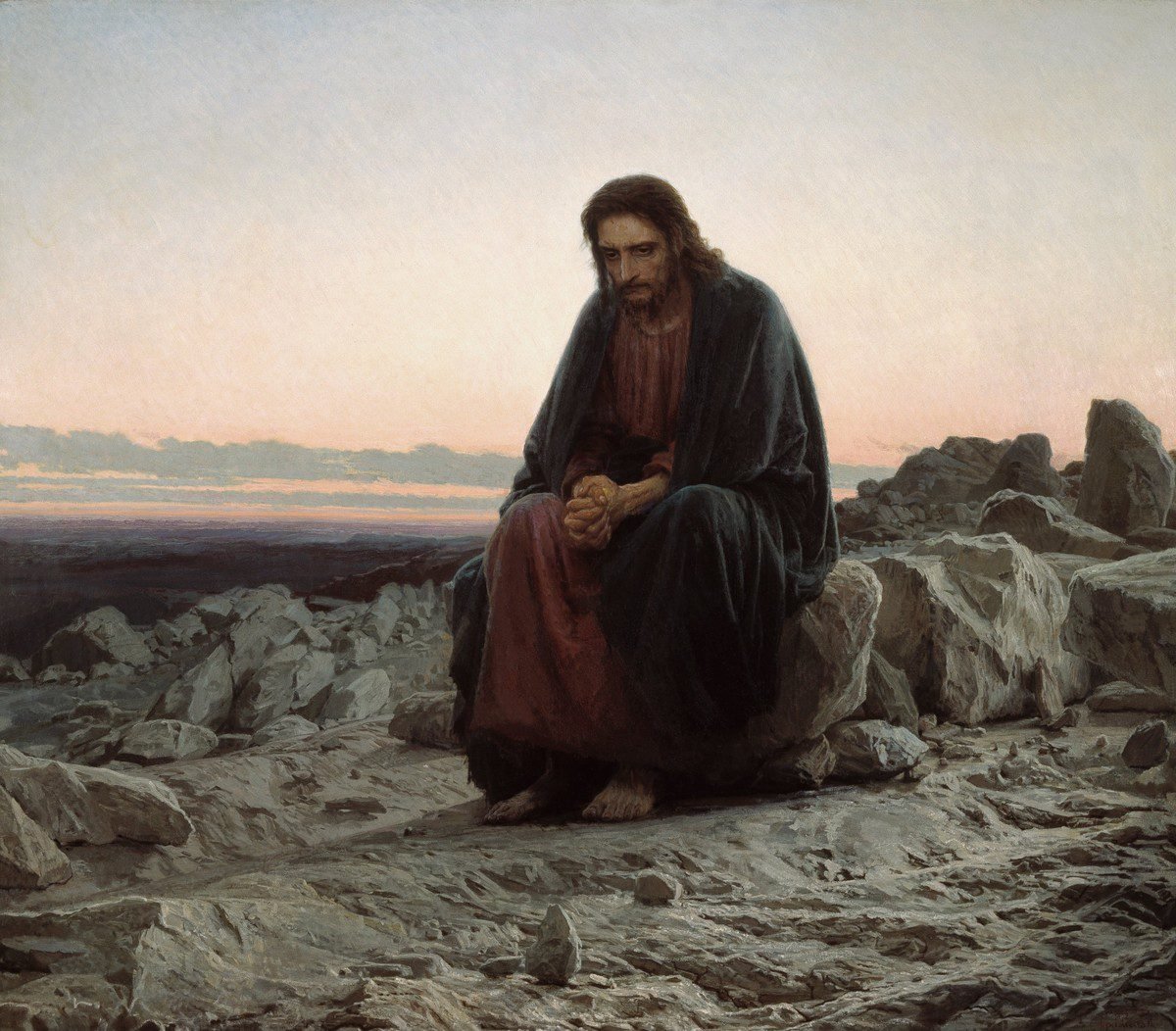
Peredvizhniki paintings share a handful of recognizable traits. Genre scenes drawn from peasant and working life sit alongside psychologically searching portraits and, later, sweeping history paintings. Color tends toward the earthy and restrained, keeping attention on gesture and expression rather than showy effect. Painters often worked from direct observation and travel, as Repin did along the Volga, rather than from studio invention alone. Religious subjects did not disappear, but they were treated as human drama rather than doctrine, as in Kramskoi’s Christ in the Wilderness, which shows Christ as a solitary, exhausted figure wrestling with a decision rather than a glowing icon. Social conscience runs through the movement without curdling into propaganda: the paintings observe hardship and injustice far more often than they preach about it.
Ivan Kramskoi: The Movement’s Public Face
Why is Ivan Kramskoi called the movement’s frontman?
Ivan Kramskoi (1837-1887) was both a painter and an art critic, and he did more than anyone to give the Wanderers a public identity. He organized the 1863 walkout, helped run the Artel of Artists, and became a leading voice and organizer of the Society for Travelling Art Exhibitions after 1870. His own paintings, especially his penetrating portraits of writers and fellow artists, set a standard for psychological honesty that younger members admired. Christ in the Wilderness (1872), his best known work, reads less as religious instruction than as a portrait of a man alone with an impossible choice, the same moral weight Kramskoi brought to his portraits of real, living sitters.
Vasily Perov and the Painter of Social Conscience
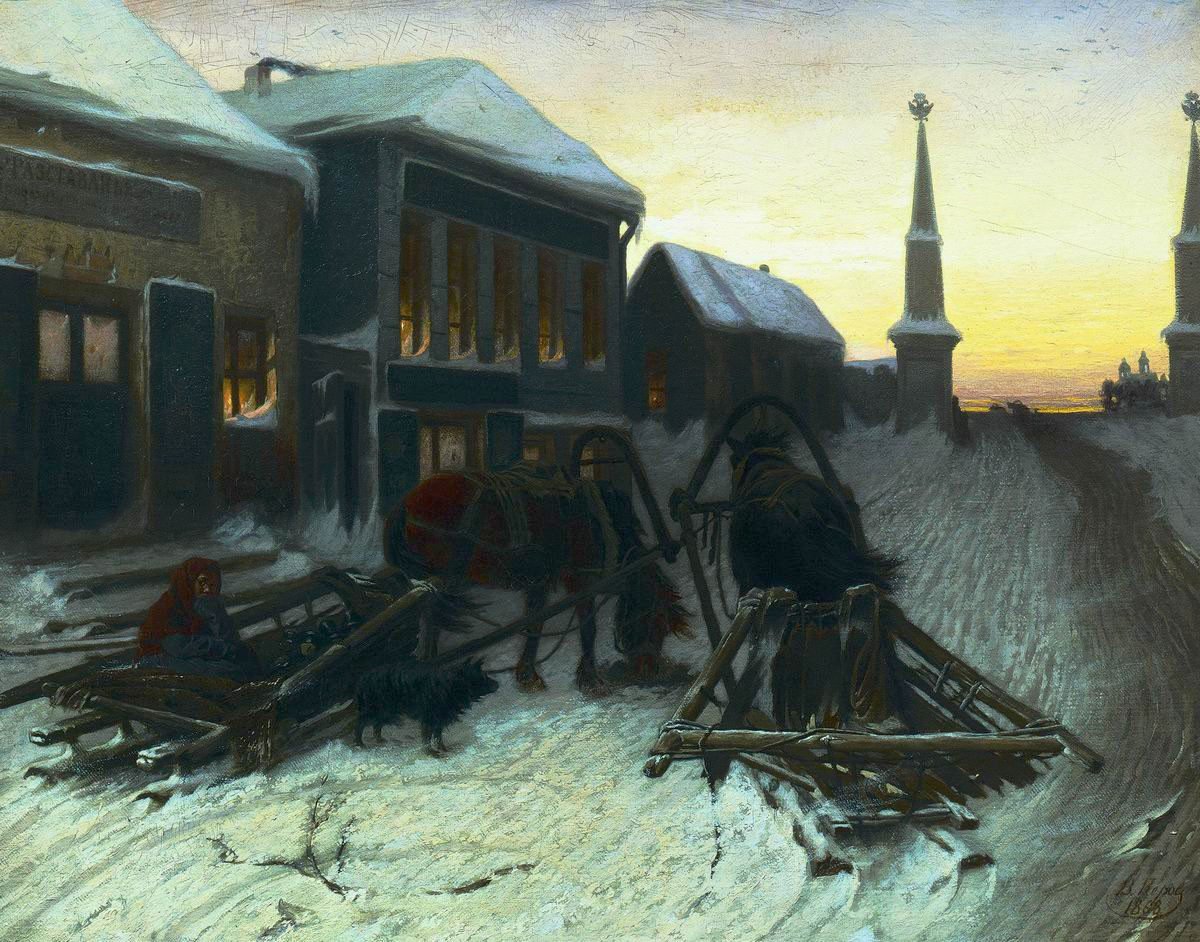
Vasily Perov (1834-1882) was already established as a founder of Russian Realism before the Wanderers formed in 1870, and he became one of the new society’s founding members. His paintings from the 1860s, including The Last Tavern at the Town Gate (1868), look hard at poverty, drink, and the isolation of ordinary people on the edges of Russian towns. Perov painted with an eye for a single telling detail, a huddled figure in a sledge, a lit window at dusk, rather than a crowded narrative scene. That restraint gave his social subjects weight without turning them into simple moral lessons, and it set a tone of quiet observation that many later Wanderers followed.
Ilya Repin and the Art of Everyday Heroism
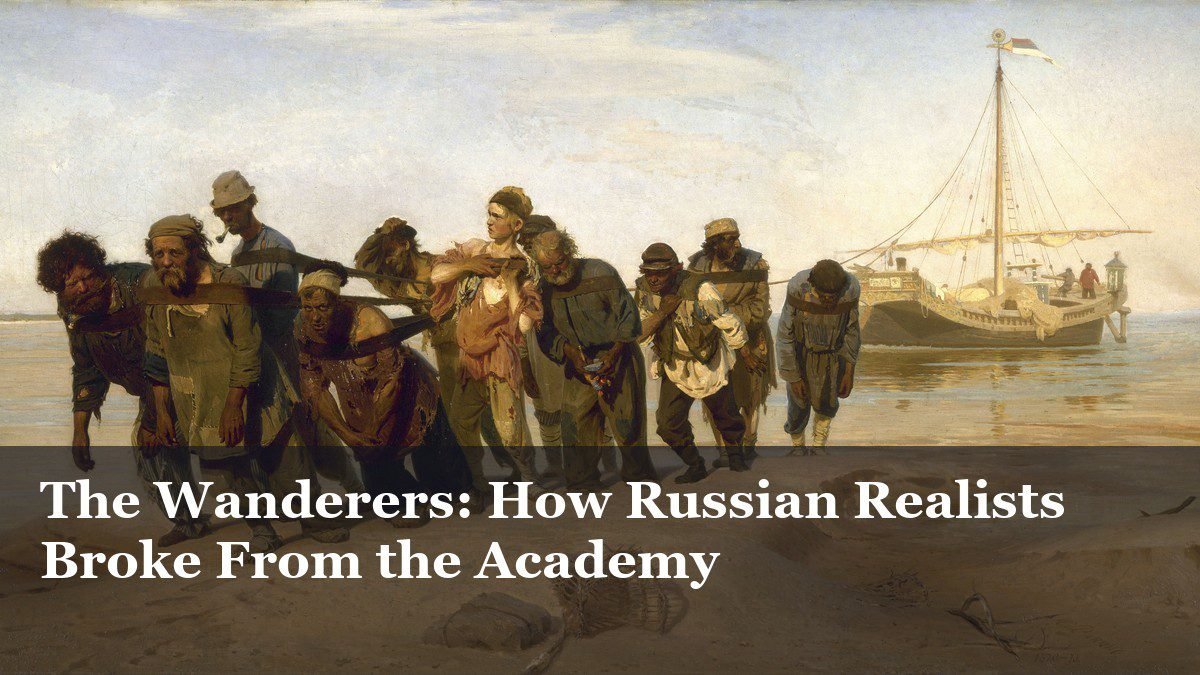
Why is Barge Haulers on the Volga so famous?
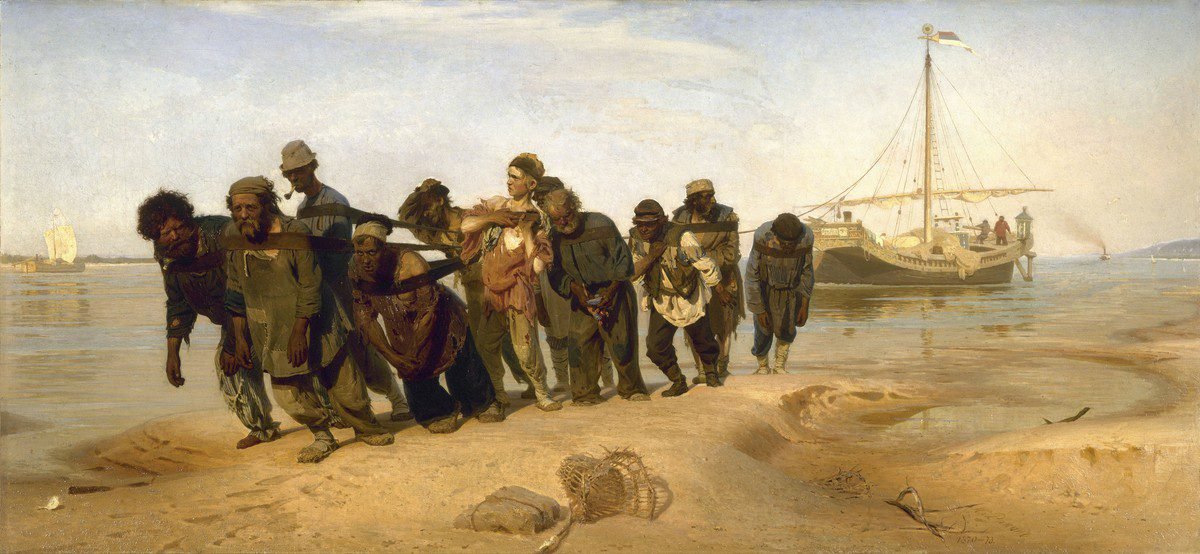
Ilya Repin (1844-1930) joined the Academy in Saint Petersburg in 1863, the same year of the walkout, and by 1873 had produced Barge Haulers on the Volga, eleven men straining against leather straps to haul a barge along the riverbank. Repin had traveled the Volga and sketched real burlaki, and the painting reads as reportage as much as composition, right down to the one young hauler at the canvas’s center who still fights his bindings while the others have gone still with exhaustion. Grand Duke Vladimir Alexandrovich bought the painting soon after it was finished, and it toured Europe as a landmark of Russian realist art. Repin went on to paint Religious Procession in Kursk Province, Ivan the Terrible and His Son Ivan, and Reply of the Zaporozhian Cossacks, along with revealing portraits of Leo Tolstoy, Modest Mussorgsky, and the collector Pavel Tretyakov.
Vasily Surikov and Russia’s Historical Drama
Vasily Surikov (1848-1916) worked mainly from Moscow and gave the Wanderers their strongest history painter. Where the Academy had trained artists to paint ancient and biblical history, Surikov turned to Russian history itself, and to its losers as often as its victors. Boyarina Morozova (1887) shows a noblewoman dragged through Moscow in a sledge for her resistance to church reforms, defiant even in defeat, surrounded by a crowd whose faces range from mockery to pity. The Morning of the Streltsy Execution (1881) depicts the condemned rebel soldiers of Peter the Great’s era in their final hours rather than the moment of execution itself. Both paintings treat a specific historical episode with the same attention to individual faces and reactions that Repin and Perov brought to contemporary genre scenes.
Myth vs. Fact: Trained Rebels, Not Untrained Outsiders
Myth: the Wanderers rejected the Academy because they lacked formal training. Fact: most founding members, including Ivan Kramskoi and Ilya Repin, trained for years inside the Imperial Academy of Arts and won its medals before breaking with it. Their objection was to the subjects they were required to paint, mythological and biblical scenes chosen by the Academy council, not to draftsmanship itself.
Ivan Shishkin, Arkhip Kuindzhi, and the Russian Landscape Tradition
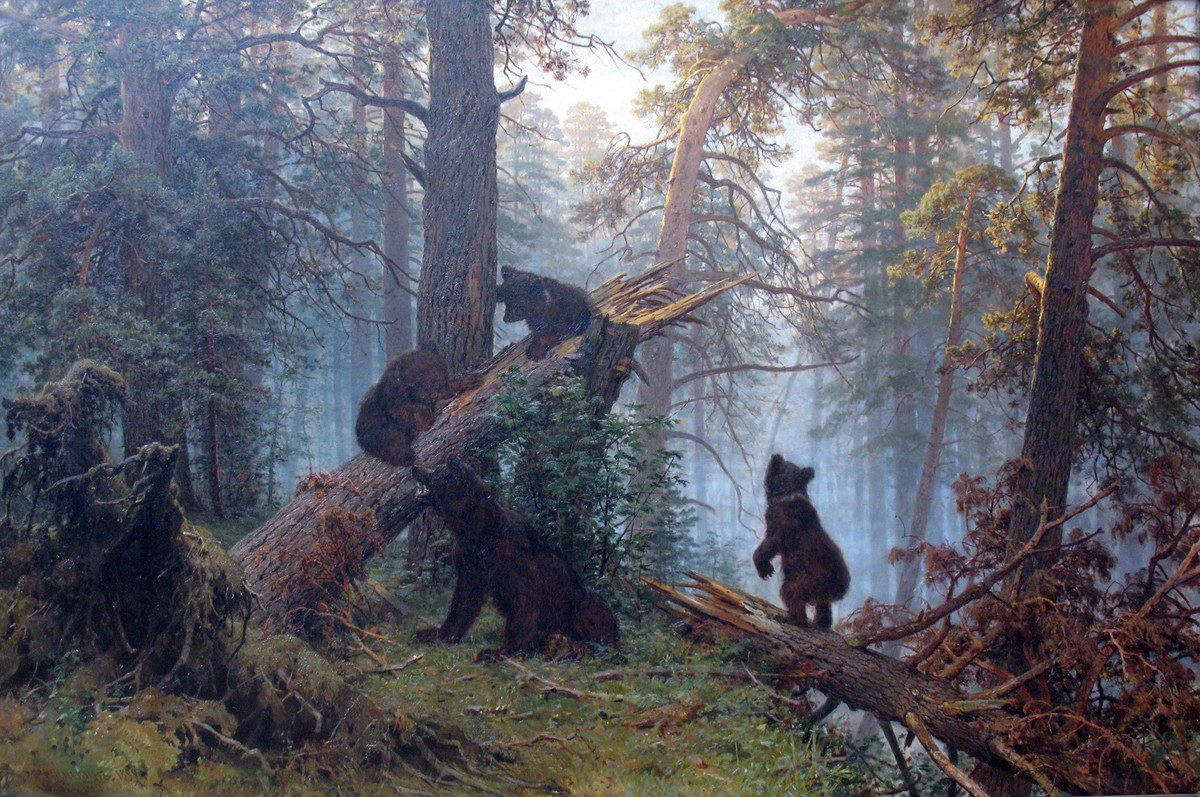
Ivan Shishkin (1832-1898) was a founding member of the Peredvizhniki and its most consistent landscape painter, working directly from forests and fields rather than composing idealized scenery in the studio. His late collaboration with Konstantin Savitsky, Morning in a Pine Forest (1889), pairs his exacting rendering of pine trunks and mist with Savitsky’s playful bear cubs, a combination that became one of the most reproduced images in Russian art. Arkhip Kuindzhi, who exhibited with the group in the late 1870s and 1880s, pushed landscape painting toward something closer to optical experiment. Moonlit Night on the Dnieper (1880) uses a narrow band of luminous green moonlight against a near black riverbank, an effect so convincing that viewers reportedly checked behind the canvas for a hidden light source.
Notable Works That Defined the Movement
A short list of defining Wanderers paintings shows how wide the group’s range was. Barge Haulers on the Volga (1873) fixed Repin’s reputation with its portrait of physical labor. Reply of the Zaporozhian Cossacks (1880-1891) took years to complete and shows Cossacks laughing as they draft an insulting letter to an Ottoman sultan, a scene of collective defiance rather than individual suffering. Surikov’s Morning of the Streltsy Execution (1881) and Boyarina Morozova (1887) reconstructed specific, documented moments from seventeenth century Russian history. None of these paintings illustrate myth or scripture in the Academy sense. Each reconstructs an actual or plausible moment from Russian life, whether that moment is a riverbank in the 1870s or a Moscow street two centuries earlier.
The Tretyakov Connection: Patron and Preserver
The Wanderers found their most important patron in the merchant and collector Pavel Tretyakov, who began buying contemporary Russian painting in the 1850s and bought aggressively from Peredvizhniki exhibitions from 1870 onward. Repin’s portrait of Tretyakov captures a careful, reserved man who nonetheless took real risks on unfashionable Russian subjects when European academies and Russian high society still preferred imported and classical taste. Tretyakov donated his collection to the city of Moscow in 1892, and it became the core holding of the State Tretyakov Gallery, which today still displays the bulk of the movement’s major canvases, including Boyarina Morozova and Christ in the Wilderness, under one roof.
How the Traveling Exhibitions Reached the Public
Between 1871 and the early twentieth century, the Society for Travelling Art Exhibitions organized roughly one touring show a year, moving each exhibition through cities such as Moscow, Kiev, Kharkov, Odessa, Kazan, and Riga after its Saint Petersburg premiere. For audiences outside the two capitals, this was often the first chance to see contemporary Russian painting at all, rather than reproductions or Academy graduation pieces. The touring model also gave member artists direct income from ticket sales and picture sales, independent of Academy commissions or court patronage. That independence let painters choose subjects the Academy would never have approved, from Perov’s tavern scenes to Repin’s studies of manual labor.
Historical Impact: Changing What Russian Art Could Depict
By insisting that Russian life was a fit subject for serious painting, the Wanderers changed what large scale art in Russia was allowed to show. Peasants, workers, and ordinary domestic scenes moved from the margins of Academy training, where they had been treated as minor genre exercises, into the center of major exhibitions and major collections. The movement also tied painting to contemporary debates about serfdom’s legacy, poverty, and Russian national identity in the decades after the 1861 emancipation of the serfs. Critics and writers, including the group’s champion Vladimir Stasov, argued that this shift gave Russian art a subject and a voice distinct from the Academy’s imported European models.
Legacy: From the Wanderers to Twentieth-Century Russian Art
Did the Wanderers influence Soviet Socialist Realism?
The Wanderers’ insistence on legible, socially engaged subject matter outlived the group itself, though the line to twentieth century Soviet art is looser than it is sometimes described. Socialist Realism, adopted as official Soviet doctrine in the 1930s, borrowed the Wanderers’ preference for accessible, narrative realism over abstraction, and Soviet critics openly claimed Repin and Surikov as ancestors of the new style. Scholars disagree on how much continuity that claim really represents, since Socialist Realism served state ideology in ways the Wanderers, an independent commercial cooperative, never did. What is clearer is that the Peredvizhniki established realist genre and history painting as a durable, respected strand of Russian art well into the following century.
Common Misconceptions About the Wanderers
One common misconception is that the Wanderers formed a single political party with a shared program. In practice the Society for Travelling Art Exhibitions was a loose professional cooperative, and its members ranged from the socially pointed genre scenes of Perov to Shishkin’s forest studies, which carried little overt social message at all. Another misconception treats the group as untrained outsiders who rejected craft along with subject matter, when in fact most members were highly trained Academy graduates. A third assumes the Wanderers rejected all religious or historical subjects, when Kramskoi, Ge, and Surikov all painted them, just with a different emphasis on human psychology over doctrine or spectacle.
Related Movements and Connections
The Wanderers followed European Realism, including the French painters of the Barbizon school and Gustave Courbet, in treating everyday and working life as subjects worthy of serious art, though the Russian group developed its own institutions rather than importing a French model wholesale. Within Russia, some Wanderers later connected with the Abramtsevo artist colony outside Moscow, which brought painters, including Repin, together with folk and decorative art traditions. By the 1890s a younger generation, gathered around the Mir Iskusstva (World of Art) journal, pushed back against Peredvizhniki realism in favor of aestheticism and design, arguing that the older group had let social message crowd out formal invention, a debate that shaped Russian art criticism for a generation.
Essential Points
- The Wanderers (Peredvizhniki) formed after fourteen Academy students refused a mandated mythological subject in 1863 and left to form an independent artel.
- The group organized formally as the Society for Travelling Art Exhibitions in 1870.
- Founding and leading members include Ivan Kramskoi, Vasily Perov, Ilya Repin, Vasily Surikov, and Ivan Shishkin.
- They painted scenes of everyday Russian life, labor, and history instead of the mythological and biblical subjects the Academy required.
- Traveling exhibitions carried their work beyond St. Petersburg and Moscow to provincial cities across the Russian Empire.
- Collector Pavel Tretyakov acquired many of their major canvases, forming the core of what became the State Tretyakov Gallery.
- Works such as Barge Haulers on the Volga and Boyarina Morozova remain touchstones of Russian realist painting.
- Their emphasis on social subject matter and national themes shaped later debates in Russian and Soviet art.
Frequently Asked Questions
- What does the word Peredvizhniki mean?
- Peredvizhniki comes from the Russian word for traveling or itinerant, referring to how the group carried its annual exhibition to cities beyond Saint Petersburg and Moscow. In English the members are usually called the Wanderers or the Itinerants, a name describing their touring exhibition method rather than any wandering lifestyle.
- Why did the Wanderers break away from the Imperial Academy of Arts?
- In 1863 fourteen Academy students were told to paint an assigned mythological subject for the Gold Medal competition and asked instead to choose their own themes. When the Academy refused, they resigned and later organized the Society for Travelling Art Exhibitions in 1870, favoring scenes from Russian life over sanctioned classical subjects.
- What makes Barge Haulers on the Volga a realist painting rather than just a genre scene?
- Repin based the painting on burlaki he observed and sketched firsthand along the Volga River rather than inventing a generic labor scene. The individualized faces, visible exhaustion, and the one defiant youth at the center turn a documentary observation into a composed, psychologically specific painting.
- Was Ivan Kramskoi only a painter, or did he shape the movement in other ways?
- Kramskoi painted acclaimed portraits and Christ in the Wilderness, but he also organized the 1863 Academy walkout and helped run the Society for Travelling Art Exhibitions after 1870, making him as much the movement’s organizer and public voice as its most visible artist.
- Where can I see paintings by the Wanderers today?
- Most major Peredvizhniki works, including Boyarina Morozova and Christ in the Wilderness, hang in the State Tretyakov Gallery in Moscow, which grew from Pavel Tretyakov’s original collection. The State Russian Museum in Saint Petersburg holds others, including Barge Haulers on the Volga and Moonlit Night on the Dnieper.
This guide was written and reviewed by the rus-art.com editorial team, specializing in Russian art history. We cross-check dates, attributions, and museum holdings against museum and academic sources.