Quick Answer
Modern Russian iconography refers to the reinterpretation of Orthodox icon painting by artists working from roughly the mid-19th century onward. Painters like Viktor Vasnetsov, Mikhail Nesterov, Kuzma Petrov-Vodkin, and Natalia Goncharova absorbed the formal principles of sacred art, including flat grounds, frontal figures, and symbolic color, then recombined them with Symbolism, nationalist revival, or avant-garde aesthetics. The result is a body of work that neither abandons the icon tradition nor merely preserves it, but actively debates what sacred imagery can mean in a changing world.
What Is Modern Russian Iconography?
Modern Russian iconography names a broad current of sacred and sacred-adjacent visual art that developed in Russia from roughly the 1840s through the Soviet period and beyond. It differs from the medieval icon tradition not by rejecting that tradition but by subjecting it to conscious artistic reinterpretation. A workshop icon painter of the 14th or 15th century worked within a strictly prescribed visual system. The modern painter drawing on iconic forms treats those conventions as a living pictorial language available for creative use.
The term covers several overlapping categories: muralists who decorated new churches in Neo-Byzantine style, easel painters who absorbed the flat symbolic grammar of the icon into otherwise modernist canvases, and avant-garde artists who quoted icon forms to challenge both academic painting and the Church itself. After 1917, it also took in artists who redirected the visual weight of the sacred image toward Soviet heroic subjects.
What distinguishes Russian iconography from Western religious painting?
The Orthodox icon is not merely a picture of a holy figure. Within the theological tradition that produced it, the icon is a window through which the figure is present. That premise shapes every formal choice: gold grounds that dissolve natural space, a spatial organization that pushes the composition toward the viewer rather than receding from it, and color used symbolically rather than to represent light or shadow. Western European religious painting from the Renaissance onward emphasized naturalism, human emotion, and pictorial depth. Russian iconography, even in its most modernized forms, tends to preserve the face-forward gaze, the flattened planes, and the sense that the image participates in what it depicts.
From Constantinople to Kievan Rus: The Foundation of a Visual Language
Russian sacred art begins with the adoption of Orthodox Christianity in 988, when the Byzantine faith arrived in Kievan Rus along with Byzantine artists and craftsmen. Early Russian icons followed the conventions developed in Constantinople: elongated figures with large still eyes, hieratic poses, and a visual grammar refined over centuries across the Eastern Mediterranean.
Over the following centuries, Russian workshops developed distinct regional voices. The Novgorod school, active from the 12th through 15th centuries, favored strong silhouettes and vivid color contrasts, particularly the pairing of white and vermilion. The Moscow school, associated with Andrei Rublev in the early 15th century, introduced warmer, more contemplative color harmonies and a quality of stillness that shaped the subsequent tradition. These regional differences were variations within the Byzantine inheritance, not departures from it.
The 17th-Century Turning Point: When Western Influence Arrived
The most consequential rupture in Russian icon painting came in the mid-17th century, when Patriarch Nikon’s liturgical reforms divided the Orthodox Church. Those who refused to accept the changes became the persecuted Old Believers, and they carried the pre-Nikonian visual style with them as a mark of theological identity. The State Church, meanwhile, opened Russian sacred art to Western European influence, primarily through Protestant and Catholic prints and engravings circulating across Russia’s expanding trade networks.
From this point, two streams ran in parallel. Old Believer workshops maintained the ancient stylized conventions, treating naturalistic representation as a form of spiritual corruption. State Church art increasingly mixed the old symbolic grammar with Western pictorial techniques, producing hybrid images that could look startlingly different from anything a medieval iconographer would have recognized.
Old Believers and the Guardians of Traditional Form
Why did Old Believers refuse to change their icon-painting styles?
For the Old Believers, the pre-Nikonian icon was not a matter of aesthetic preference but of theology. The original forms had been sanctified by centuries of liturgical use, and altering them was equivalent to altering doctrine. Their workshops, concentrated in the Urals, the Volga region, and later Siberia, became repositories of pre-17th-century technique. The Mstera and Palekh villages, known today for lacquer miniature painting, trace their artistic lineage directly to these Old Believer icon traditions.
This parallel current matters for understanding the modern period: 19th-century artists seeking to reconnect with an authentic Russian visual tradition had two competing sources available. The relatively unchanged Old Believer style was one. The more eclectic State Church tradition, which had already absorbed Western influence, was the other. Both streams fed the Neo-Byzantine Revival that followed.
Neo-Byzantine Revival: Rebuilding Sacred Space
The mid-19th century brought a broad European interest in historical architectural styles, and in Russia this took the form of Neo-Byzantine building. The movement emerged in the 1840s and peaked in the last quarter of the 19th century, producing the Church of Christ the Saviour in Moscow, consecrated 1883, and the Vladimir Cathedral in Kiev, whose interior decoration was completed in the mid-1890s. These projects created sustained demand for artists capable of working in Byzantine-derived styles at monumental scale.
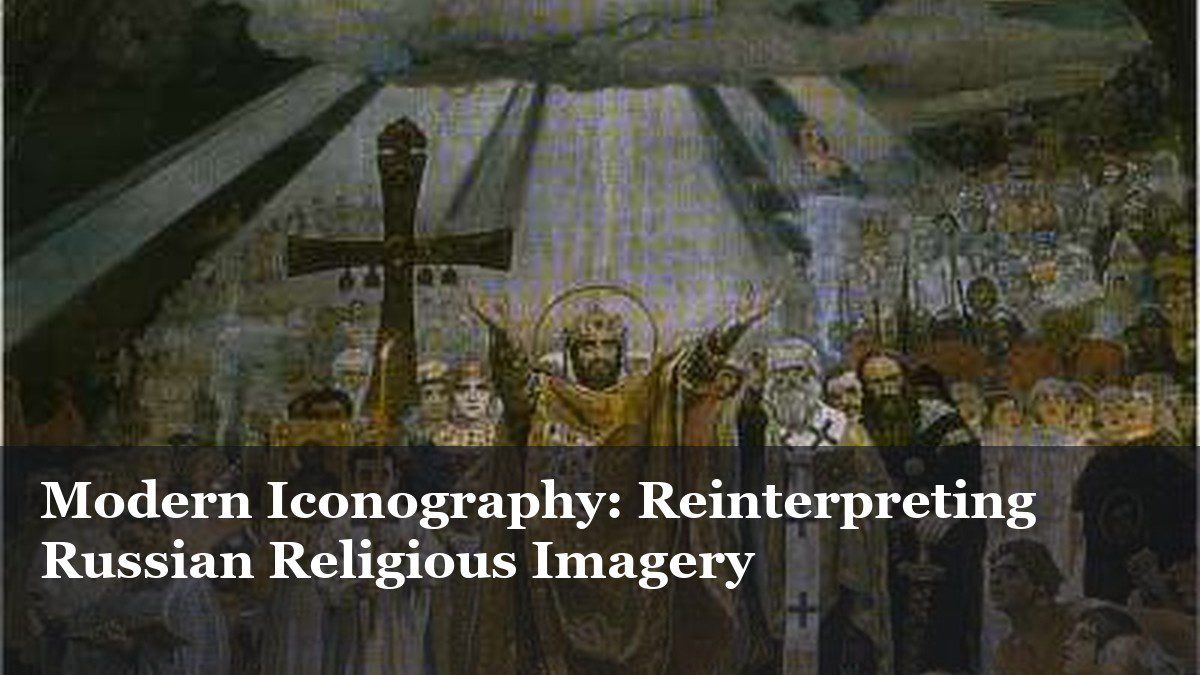
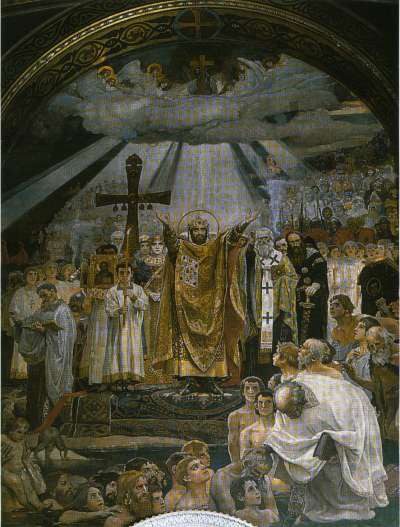
The Vladimir Cathedral commission became the defining project of Russian religious art in the late 19th century. Viktor Vasnetsov painted the central nave murals and much of the cathedral’s principal decorative program. Mikhail Nesterov contributed several chapel compositions. The project gathered artists associated with the Peredvizhniki and the emerging Mir Iskusstva circle, neither of which was primarily religious in orientation, and asked them to produce a coherent sacred decorative program on a medieval model. The results were neither purely traditional nor straightforwardly modernist: something new emerged, Symbolist sacred art set within a Neo-Byzantine architectural framework. The State Tretyakov Gallery holds preparatory materials and related works from this period.
Viktor Vasnetsov: From Folklore Paintings to Cathedral Vaults
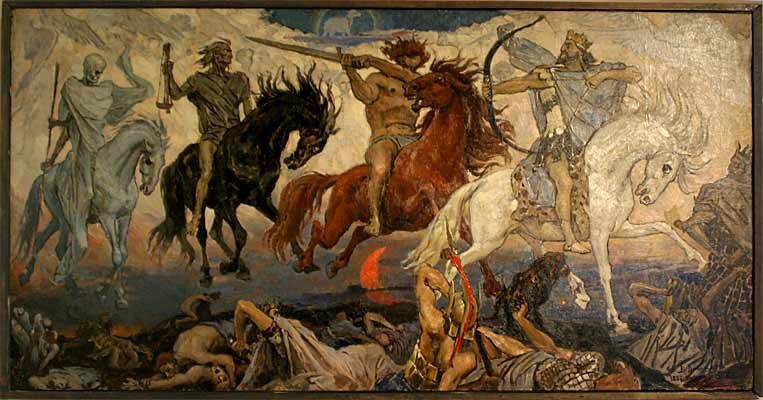
Viktor Vasnetsov (1848-1926) is best known internationally for paintings drawn from Russian folklore and medieval epic. He co-founded the Russian folklorist and romantic nationalistic painting movement and was a central figure in the Russian Revivalist movement. His religious output was equally central to his career and, in terms of practical influence on church decoration, more widely reproduced than his fairy-tale canvases.
His Virgin and Child for the Vladimir Cathedral, painted above the main altar, departed from Byzantine convention in a characteristic way. The Virgin stands against gold ground as tradition demands, but her face carries the soft naturalism of 19th-century academic portraiture, and the Child reaches toward her with a distinctly human gesture. This synthesis, the Byzantine compositional type combined with Westernized facial treatment, defined what became the ‘Vasnetsov style’ in Russian church decoration and shaped a generation of artists who decorated churches across the Russian Empire.
Vasnetsov treated religious imagery and national mythology as two aspects of a single project: the construction of a specifically Russian visual identity that could stand apart from Western academic norms without retreating into pure antiquarianism.
Mikhail Nesterov: The Saint in the Russian Wilderness
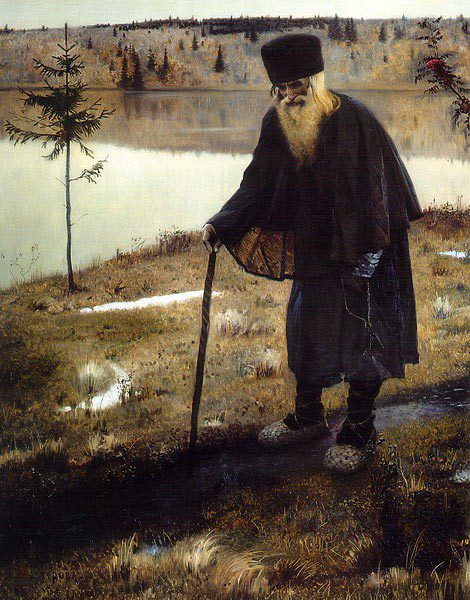
Mikhail Nesterov (1862-1942) approached sacred imagery from a different direction than Vasnetsov. Associated with both the Peredvizhniki and the Mir Iskusstva circle, and among the first exponents of Symbolist art in Russia, he was less drawn to monumental church programs than to the interior life of religious experience as it plays out in the Russian natural world.
His early breakthrough, ‘The Vision of the Youth Bartholomew’ (1889-1890, State Tretyakov Gallery), shows the future St. Sergius of Radonezh as a child encountering a mysterious monk in a birch forest. The composition uses no gold ground and follows no standard Byzantine iconographic type. Instead, the sacred enters through the quality of light, the stillness of the trees, and the monk’s face, which Nesterov painted as simultaneously aged and timeless. The result is a sacred image that works through naturalist means, drawing on the Russian literary tradition of the holy fool and the forest hermit rather than on Byzantine visual theology.
Nesterov contributed to several major church interiors, most notably the Vladimir Cathedral in Kyiv and later the Marfo-Mariinsky Convent in Moscow, but his most enduring contribution was this fusion of sacred subject with Russian landscape painting, a model that influenced the Symbolist strand of Russian religious art well into the 20th century.
Natalia Goncharova: The Icon as Avant-Garde Provocation
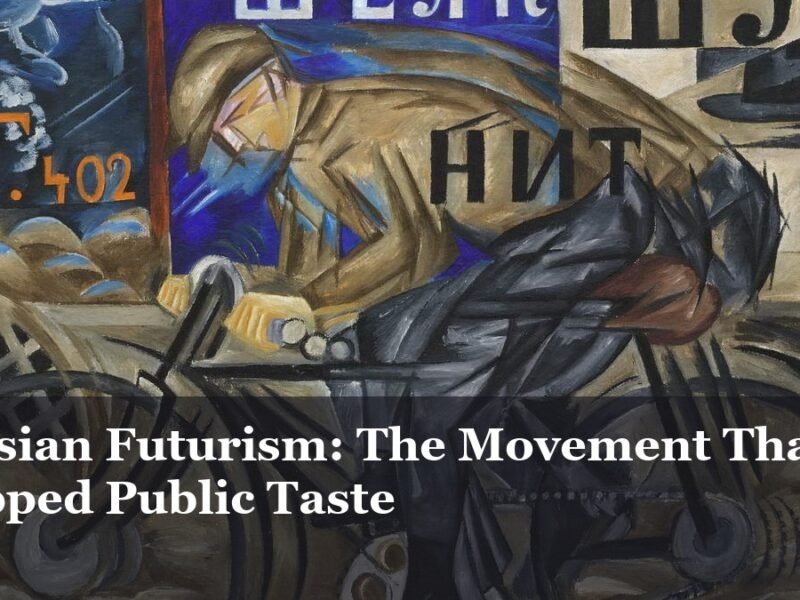
Natalia Goncharova (1881-1962) used the icon tradition in a way that was, as her contemporaries recognized, both transgressive and deeply engaged. A founding member of the Jack of Diamonds group (1909-1911) and the more radical Donkey’s Tail (1912-1913), and co-inventor of Rayonism with Mikhail Larionov, she had no interest in restoring devotional function to sacred images. She treated the flat color fields, strong outlines, and frontal figures of medieval Russian icons as a formal repertoire available to modern painting.
Her series of paintings on religious subjects from around 1910-1912 quoted icon forms directly: figures arranged as in a church tier, gold or bright ground, minimal modeling. These works attracted immediate controversy. The Church objected to their exhibition, and police removed several paintings from her 1910 Moscow show. What the Church found objectionable was precisely what made Goncharova’s work analytically significant: she demonstrated that icon conventions were formal choices, not sacred inevitabilities, and that those choices could produce powerful pictorial effects even when stripped of devotional intent.
In the pre-revolutionary art world, where decorative painting and icon production were established professions, her approach was genuinely disruptive. Her exhibitions in Moscow and St. Petersburg in 1913 and 1914 were among the first promoting a ‘new’ artist by an independent gallery. After she moved to Paris in 1921, where she lived until her death in 1962, Goncharova continued to draw on Russian religious visual forms in theater designs and paintings, though the polemical edge of the Moscow period gave way to a more sustained aesthetic engagement. Tate Modern holds significant holdings from her Paris period.
Kuzma Petrov-Vodkin: Sacred Geometry in a Revolutionary Age
Kuzma Petrov-Vodkin (1878-1939) produced some of the most theoretically conscious engagements with Russian iconographic tradition in the 20th century. His approach centered on what he called ‘spherical perspective,’ a system of curved spatial organization derived from his study of early Russian icons, which do not use linear vanishing-point perspective but instead represent space as if wrapped around the viewer.
His early works on this principle curved the ground plane toward the viewer in the manner of icons rather than receding it toward a horizon, and the Russian Orthodox Church condemned these images as blasphemous. After the 1917 Revolution, Petrov-Vodkin became the first president of the Leningrad Union of Soviet Artists and redirected his iconographic spatial system toward secular subjects. His ‘Death of a Commissar’ (1928, State Russian Museum) applies the tilted, curving ground of an icon to a scene of a fallen Soviet soldier supported by his comrades. The composition echoes the Pieta without quoting it directly. The result reads simultaneously as Soviet subject matter and as sacred art in formal disguise.
How did Petrov-Vodkin use icon techniques in secular paintings?
The key device is the tilted ground plane. In his paintings the earth curves toward the viewer rather than receding toward a horizon, giving figures the frontal presence of icon saints. Combined with his use of deep red and blue, colors carrying strong Orthodox symbolic associations, even a scene with no explicitly religious content carries the visual weight of a sacred image.
Myth vs. Fact: Tradition or Transformation?
Myth: Russian icon painting was a fixed, unchanging tradition. Fact: The tradition has been continuously reinterpreted, most sharply after Patriarch Nikon’s mid-17th-century reforms introduced Western European naturalism into State Church art, and again when avant-garde artists like Natalia Goncharova used icon formal conventions as raw material for modern painting. The Russian Orthodox Church found her approach sufficiently provocative that police removed several works from her 1910 Moscow exhibition.
Pavel Korin and the Painting That Was Never Finished
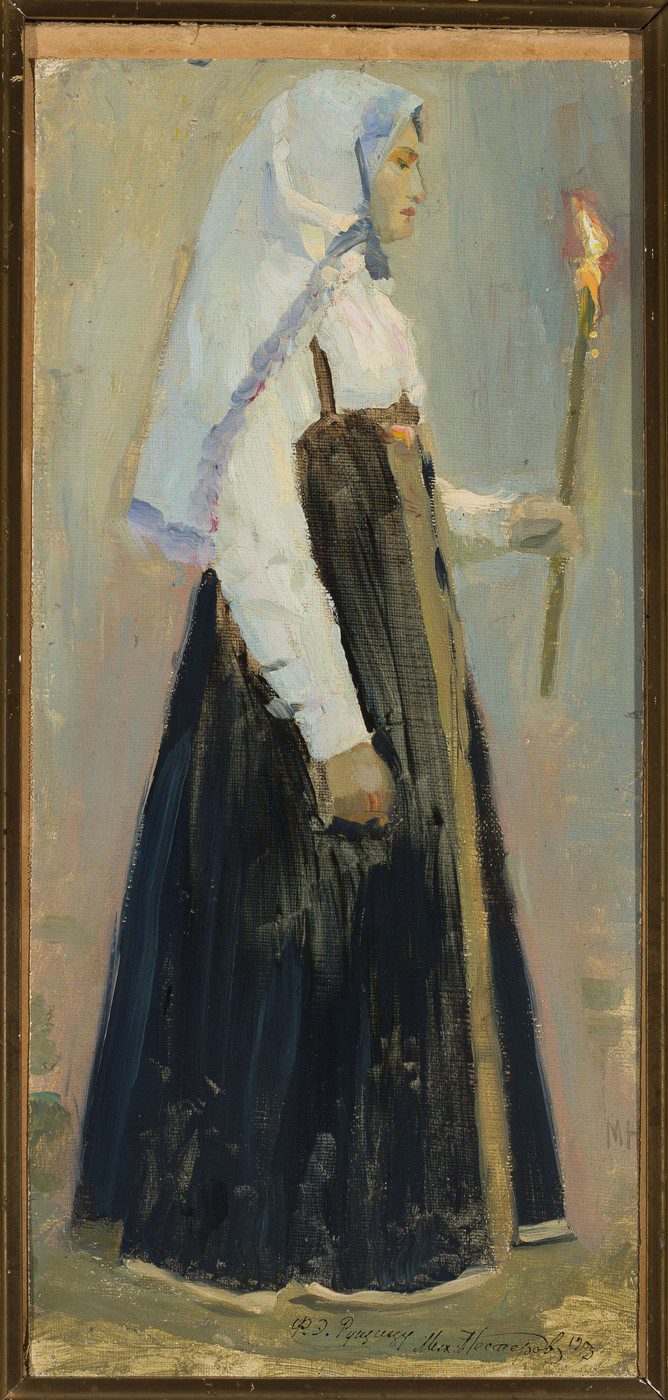
Pavel Korin (1892-1967) began his career as a student of Nesterov and worked as his assistant on the decoration of the Marfo-Mariinsky Convent in Moscow. He became known as a highly skilled painter and art restorer, but his most famous project was never completed.
‘Farewell to Rus’ was conceived in the early 1930s as a monumental painting on a canvas over nine meters wide showing the last procession of the Russian Orthodox Church as it faced Soviet suppression. Korin produced more than twenty preparatory portrait studies of actual clergy and laity. He never painted the main canvas. The empty primed canvas and the preparatory studies are preserved in the Korin Museum in Moscow, a branch of the State Tretyakov Gallery. The gap between intention and execution gives the project a particular historical gravity. The studies themselves, concentrated in their formal severity and psychological focus, form one of the most substantial bodies of Russian religious portraiture produced in the 20th century.
Soviet Pressure and the Sacred in Disguise
After 1917, religious art production in Russia became politically dangerous. Churches were closed, icons were confiscated or destroyed, and artists working on religious subjects risked professional marginalization. Yet the iconographic visual language did not disappear from Soviet art. It migrated into officially sanctioned forms.
The hagiographic portrait, the leader shown in a posture of calm authority against simplified architectural or natural grounds, drew on the same visual grammar as the saint’s icon. Socialist Realist imagery of workers and soldiers in heroic attitudes borrowed the frontality, simplified drapery, and direct gaze of the devotional icon. Whether these borrowings were conscious or the result of a visual culture so saturated with icon conventions that they survived the formal suppression of their source is debated. What is clear is that the Soviet state, which suppressed Orthodox Christianity as an institution, relied on the visual conventions that institution had developed over centuries to produce its own imagery of the heroic and the sacred.
What Makes a Modern Icon Recognizable?
Several formal features recur across the range of modern work that engages with Russian iconographic tradition.
Frontal address: figures look directly at the viewer rather than at each other or at a narrative scene. This creates the sensation of a presence rather than a picture, which is the devotional function of the original icon.
Simplified space: backgrounds reduce to flat color fields, schematic architecture, or landscape treated as backdrop rather than depth. Linear perspective is avoided or actively subverted.
Non-naturalistic color: color functions symbolically. The deep red grounds of Petrov-Vodkin, the blue and white of Nesterov’s forest interiors, the pure flat tones of Goncharova’s icon-derived works all carry associative weight beyond the description of observed surfaces.
Gold grounds and luminosity: traditional icons use gold leaf to represent divine light that precedes natural illumination. Modern works either use actual gold leaf, in works intended for liturgical use, or allude to it through warm ochres and yellows that resist reading as reflected light.
Reverse Perspective and the Gaze That Looks Back
What is reverse perspective in Russian icon painting?
Reverse perspective, sometimes called inverse perspective, is a spatial convention used in Byzantine and early Russian icons where objects appear to widen as they recede from the viewer rather than converging toward a vanishing point. The effect is that the composition opens outward toward the viewer’s space rather than drawing the eye inward. Theologians of the icon tradition interpret this as a representation of divine space, which cannot be mapped onto human perceptual geometry.
Petrov-Vodkin was the first Russian modernist to theorize this device explicitly and apply it systematically to non-devotional painting. His ‘spherical perspective’ connected the curvature of painted earth in early icons to the physical curvature of the globe rather than treating it as a purely spiritual metaphor.
The Russian philosopher Pavel Florensky later wrote at length about reverse perspective as a coherent spatial system expressing a specifically Eastern Christian ontology. His essay, produced in the 1920s, circulated privately before official publication and became a foundational theoretical text for contemporary iconographers seeking grounding for their practice.
Common Misreadings of Russian Sacred Art
A persistent assumption holds that the stylized appearance of Russian icons reflects a lack of technical skill or a failure to achieve the naturalism of Italian Renaissance painting. This misreads the intent entirely. The elongated proportions, flat modeling, stylized drapery, and large still eyes are not failed attempts at naturalism. They are deliberate choices in a visual system designed to represent spiritual rather than physical reality.
A related error is treating all Russian religious art as a single undifferentiated tradition. The 15th-century Novgorod icon, the 18th-century mixed State Church image, the Neo-Byzantine mural of the 1890s, and the avant-garde citation of icon forms in Goncharova’s work of 1910-1912 differ from each other as much as Giotto differs from Caravaggio. Chronology, regional school, patronage, and the painter’s religious and aesthetic commitments all shape what any individual work is doing.
A third misconception is that the Russian avant-garde simply broke with icon tradition. Artists like Goncharova and Petrov-Vodkin engaged with it deeply, even when their engagement was adversarial or formally experimental. The tradition provided the visual vocabulary they were both using and questioning.
Where to Encounter This Tradition Today
The State Tretyakov Gallery in Moscow holds the largest collection of Russian religious art from medieval icons through the 19th century, including major works by Vasnetsov and Nesterov. A dedicated branch of the Tretyakov houses the Korin Museum, where the preparatory studies for ‘Farewell to Rus’ and the empty canvas can be seen directly.
The State Russian Museum in St. Petersburg holds Petrov-Vodkin’s ‘Death of a Commissar’ (1928) and a substantial collection of 19th and early 20th-century religious paintings. For Goncharova’s work in international context, Tate Modern holds significant holdings from her Paris period. The Metropolitan Museum of Art in New York holds Byzantine and early Russian icons that provide comparative context for understanding the tradition these modern artists were reinterpreting. The Victoria and Albert Museum in London holds material relevant to the Neo-Byzantine revival and Russian decorative arts of the period.
A Visual Language That Keeps Evolving
Contemporary iconographers working in the Russian Orthodox tradition continue to produce liturgical icons using traditional materials: egg tempera on gessoed wood, mineral pigments, gold leaf. Major workshops operate in Russia, Greece, Romania, and across Western Europe and North America, where diaspora Orthodox communities maintain the practice.
At the same time, the formal language of the Russian icon continues to attract secular artists who use its conventions for purposes distinct from devotional function. The frontal figure, the gold ground, and the spatially inverted compositions appear in contemporary Russian painting, graphic art, and digital illustration, usually in contexts that are aware of but not bound by the original theological framework.
What connects the entire tradition surveyed here, from the Byzantine inheritance that arrived with the conversion of 988 through the avant-garde provocations of Goncharova and the Soviet-era iconography of Petrov-Vodkin, is the persistence of a set of formal choices that carry meaning beyond their ostensible subjects. The icon taught its visual language to every generation of artists who encountered it, and that language has proven flexible enough to accommodate a remarkable range of beliefs, doubts, and provocations.
—
Essential Points
- Russian icon painting began after Kievan Rus adopted Orthodox Christianity from Byzantium in 988 and evolved through distinct regional schools over the following centuries.
- Patriarch Nikon’s mid-17th-century reforms split the Church into two streams: Old Believers who preserved ancient stylized conventions and a State Church that absorbed Western European naturalism.
- The Neo-Byzantine Revival that emerged in the 1840s produced major church decoration programs employing secular painters, most notably at the Vladimir Cathedral in Kiev in the 1890s.
- Viktor Vasnetsov blended Byzantine compositional types with academic naturalism to create a widely imitated style of Russian church decoration and was a key figure in the Russian Revivalist movement.
- Mikhail Nesterov fused sacred subjects with Russian landscape painting to produce a Symbolist form of religious art independent of direct Byzantine formal conventions.
- Natalia Goncharova used icon formal conventions as a pictorial language for avant-garde painting, drawing censure from the Church for treating devotional forms as aesthetic material.
- Kuzma Petrov-Vodkin theorized and applied icon-derived spherical perspective to secular subjects, including Soviet scenes that carry the visual weight of sacred imagery without religious content.
- Pavel Korin’s preparatory studies for ‘Farewell to Rus,’ a monumental painting he never completed, represent one of the most significant bodies of 20th-century Russian religious portraiture.
Frequently Asked Questions
- What exactly is a Russian icon, and why does it look so different from Western religious art?
- A Russian icon is a devotional image in the Eastern Orthodox tradition, painted on a prepared wood panel using egg tempera and mineral pigments. Its stylized appearance, flat forms, gold grounds, and large still eyes reflects a deliberate visual theology: the icon represents spiritual rather than physical reality, so naturalism would contradict its purpose. Western painting from the Renaissance onward prioritized human anatomy and pictorial depth, goals the icon tradition never shared.
- How did the 17th-century church schism change Russian icon painting?
- Patriarch Nikon’s mid-17th-century liturgical reforms split the Orthodox Church into the State Church and the persecuted Old Believers. Old Believer workshops preserved pre-Nikonian stylized conventions as a matter of theological identity. The State Church opened Russian sacred art to Western European naturalism, creating a hybrid style that mixed Byzantine compositional types with realistic facial treatment and spatial depth, running in parallel with the older tradition.
- What does gold ground in a Russian icon actually represent?
- Gold ground in Orthodox icon painting represents uncreated divine light, the light that existed before the sun was made. It is not a background in the pictorial sense but an assertion that the figure exists in divine rather than natural space. This is why figures in icons cast no shadows: they stand in light that has no directional source because it is itself the source of all illumination.
- Why was Natalia Goncharova’s approach to icons considered controversial?
- Goncharova used icon formal conventions, flat color, frontal figures, hieratic composition, as the foundation for avant-garde paintings with no devotional function. The Russian Orthodox Church objected to her exhibitions around 1910-1912, having several works removed from public display. The controversy centered on her treating sacred visual conventions as aesthetic tools available to any painter rather than as bearers of specific theological meaning.
- Where can I see the most important examples of modern Russian religious art today?
- The State Tretyakov Gallery in Moscow holds major works by Vasnetsov and Nesterov, medieval icons, and the Korin Museum with preparatory studies for ‘Farewell to Rus.’ The State Russian Museum in St. Petersburg holds Petrov-Vodkin’s major paintings. Tate Modern in London holds significant Goncharova works, and the Metropolitan Museum of Art in New York has Byzantine and early Russian icons for comparison.
This guide was written and reviewed by the rus-art.com editorial team, specializing in Russian art history. We cross-check dates, attributions, and museum holdings against museum and academic sources.