Quick Answer
Zinaida Serebriakova (1884-1967) was a Russian painter whose self-portraits, especially At the Dressing Table (1909), broke from academic and Symbolist convention by showing herself as an ordinary working woman rather than an idealized muse. Raised in the artistic Lansere-Benois family and linked to the Mir Iskusstva circle, she extended that same unvarnished honesty to peasant labor, orchards, and domestic scenes at her family estate, Neskuchnoye. Exiled in Paris after 1924, she kept painting self-portraits into old age, quietly asserting her own authorship of Russian art history.
What Is “Quiet Radicalism” in Zinaida Serebriakova’s Self-Portraits?
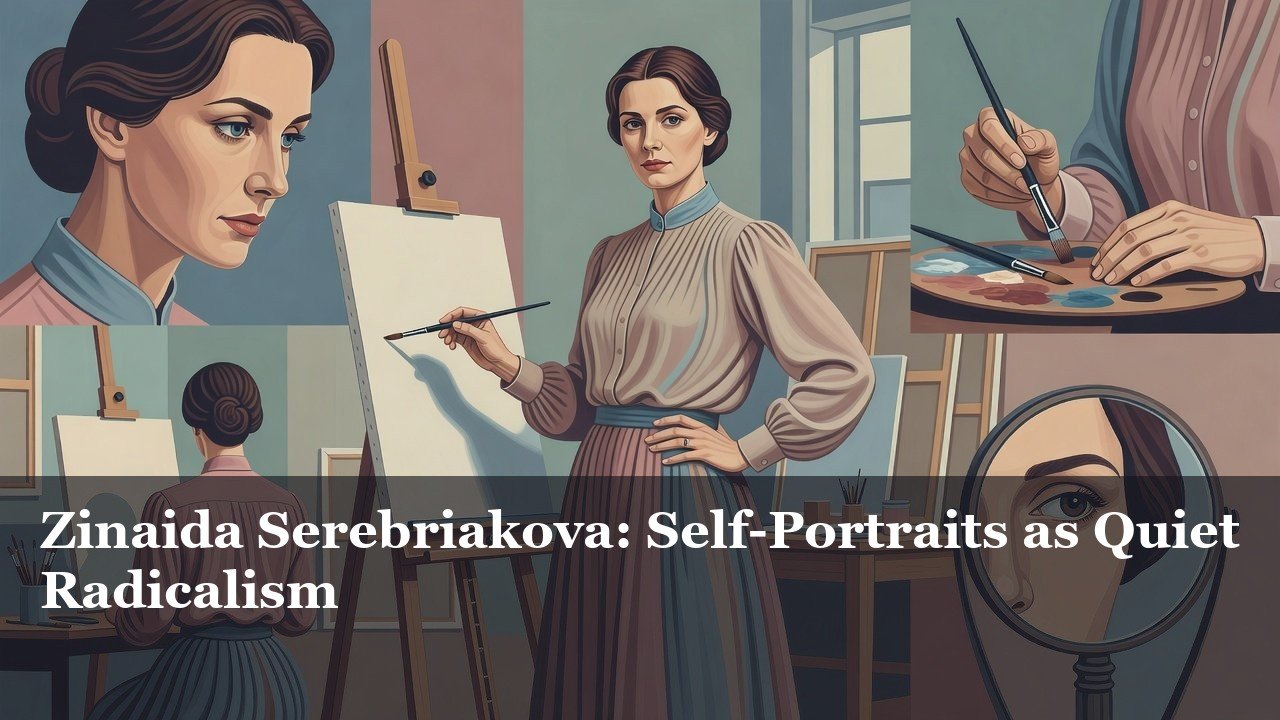
Zinaida Serebriakova painted herself the way she painted everyone else: without flattery, no program, no permission asked to take up space as a professional painter. Her breakthrough self-portrait, At the Dressing Table (1909), offers no allegory, no muse pose, no performance staged for a patron. That plainness carried its own argument. Russian art in that era still leaned on academic idealization or Symbolist mysticism, so a woman painter presenting her own unvarnished morning routine as subject matter worth painting was a genuinely new claim. Call it quiet radicalism: change made not through manifesto but through insistence on ordinary, closely observed truth, applied equally to her own face, to peasant women threshing grain, and to her children eating breakfast.
From the Lansere-Benois Household to Neskuchnoye
She was born into art. Her father, sculptor Yevgeny Lansere, died when she was two. Her mother, Ekaterina Lansere, was a Benois by birth, sister of Alexandre Benois, the painter, critic, and stage designer who cofounded the Mir Iskusstva circle. Growing up inside the extended Lansere-Benois household in St. Petersburg gave her a direct path into professional art training at a moment when few women had one at all. Summers were spent at Neskuchnoye, the family estate in Kursk province, and its orchards, threshing floors, and farmhands supplied the subject matter she returned to for the rest of her working life, first in Russia, later in memory from Paris. Portrait of Olga Lansere (1910) captures a relative from that same close family circle, proof of how tightly her early subjects and her bloodline overlapped.
Learning to Paint: Braz, Italy, and the World of Art Circle
Serebriakova studied briefly at a private art school run by Princess Maria Tenisheva, then more seriously under the portraitist Osip Braz, and traveled to Italy in 1902 to study Renaissance painting firsthand. None of this set her apart from other young painters of her class. What mattered more was her uncle’s circle. Mir Iskusstva, the magazine and movement Alexandre Benois helped found, prized craftsmanship and historical retrospection, and rejected both academic bombast and the heavier social message painting of the previous generation.
What Was Mir Iskusstva, and Where Did Serebriakova Fit In?
Mir Iskusstva favored elegance, decorative line, and often eighteenth-century or theatrical subjects, the world of Benois, Bakst, and Somov. Serebriakova exhibited with the group from 1911 and was elected a member, but her own work pulled the movement’s refinement toward plain rural life and self-observation rather than costume drama. Call it a quieter, more domestic variation within the same circle.
At the Dressing Table: The Self-Portrait That Made Her Famous
At the Dressing Table, painted at Neskuchnoye in the winter of 1909, shows Serebriakova at twenty-four, seated before a mirror crowded with combs, perfume bottles, and hairpins, caught mid-gesture rather than posed. She submitted it to the 1910 Mir Iskusstva exhibition in St. Petersburg, where it drew immediate attention and was purchased for the collection now held by the State Tretyakov Gallery. Contemporaries read it as strikingly direct: a young mother and working artist depicting her own unremarkable morning, in a plain room, in a plain slip, with none of the allegorical dressing-up that self-portraiture by earlier Russian painters often relied on. It remains among her most widely recognized images and the work most responsible for her early reputation, though it was only the first of many self-portraits she painted across the decades that followed.
Self-Portrait as Pierrot and the Theater of Identity
Two years later she painted Self-Portrait as Piero (1911), trading the dressing table for a Pierrot costume borrowed from the theatrical world her uncle and his Mir Iskusstva colleagues designed for. Leon Bakst and Alexandre Benois built careers dressing dancers and actors for Sergei Diaghilev’s Ballets Russes, and Serebriakova, without ever designing for the stage herself, borrowed that visual language to ask a different question: who is underneath the costume. The white ruff and painted sadness of the commedia dell’arte clown, a stock Symbolist motif used by Somov and others for melancholy or irony, becomes here a study of a working woman trying on a role rather than living inside one, closer to self-scrutiny than theater.
Look Closer: Her Hands in Self-Portrait as Piero
Compare her hands to the elongated, stylized hands common in Somov’s and Bakst’s theatrical figures. Serebriakova paints her own hands blunt, square, and unglamorous, an artist’s hands rather than a performer’s. It is the one part of the Pierrot costume she never fully commits to, a small, deliberate crack in the theatrical illusion.
Key Characteristics: How Serebriakova Painted the Ordinary as Extraordinary
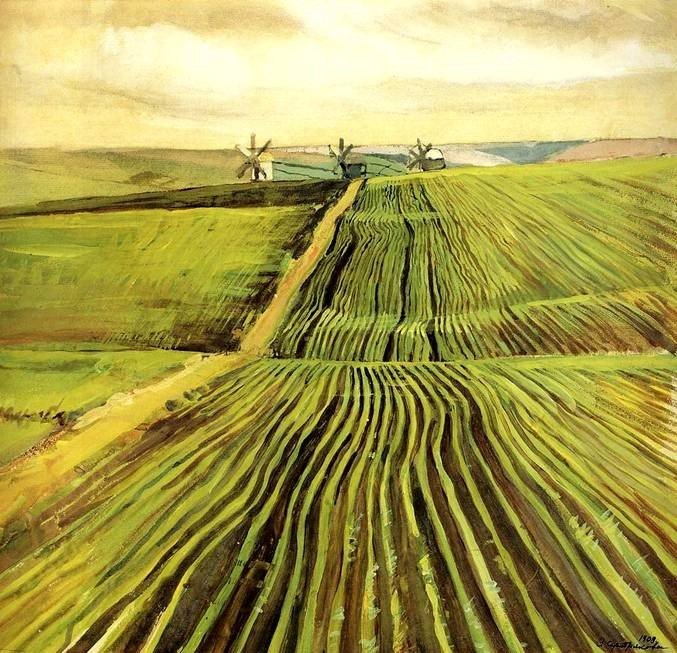
Serebriakova’s mature style paired academic drawing discipline, sharpened by her Italian study trip, with an eye trained on labor rather than leisure. Shoots of Autumn Crops (1908), an early work showing peasant girls at planting, already carries the formula that would define her career: solid, sculptural figures set against open field or orchard, painted with the clarity of a portraitist rather than the looseness of an Impressionist sketch.
Why Do Critics Call Her Radical If Her Subjects Look Traditional?
Her subjects, peasants, orchards, mothers, look conventional next to the abstraction and shock tactics of avant-garde contemporaries like Malevich or Goncharova. The radicalism is formal and social rather than stylistic: a woman painter treating her own body and rural workers’ bodies with the same unsentimental seriousness Serov gave his aristocratic sitters, without irony, satire, or moralizing.
Beyond the Mirror: Peasant Labor, Orchards, and the Body
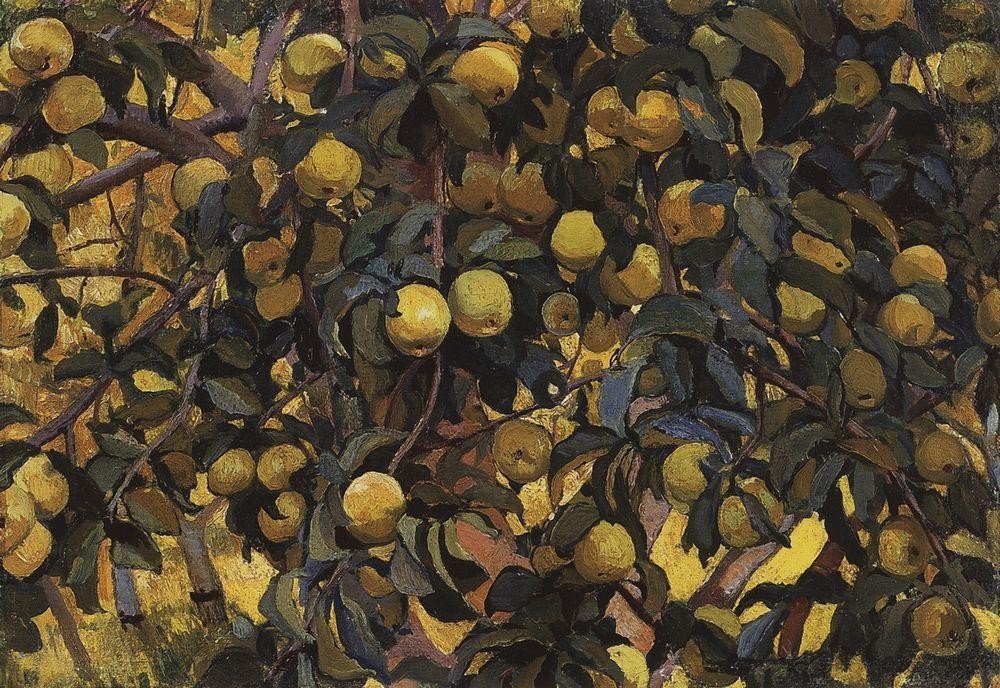
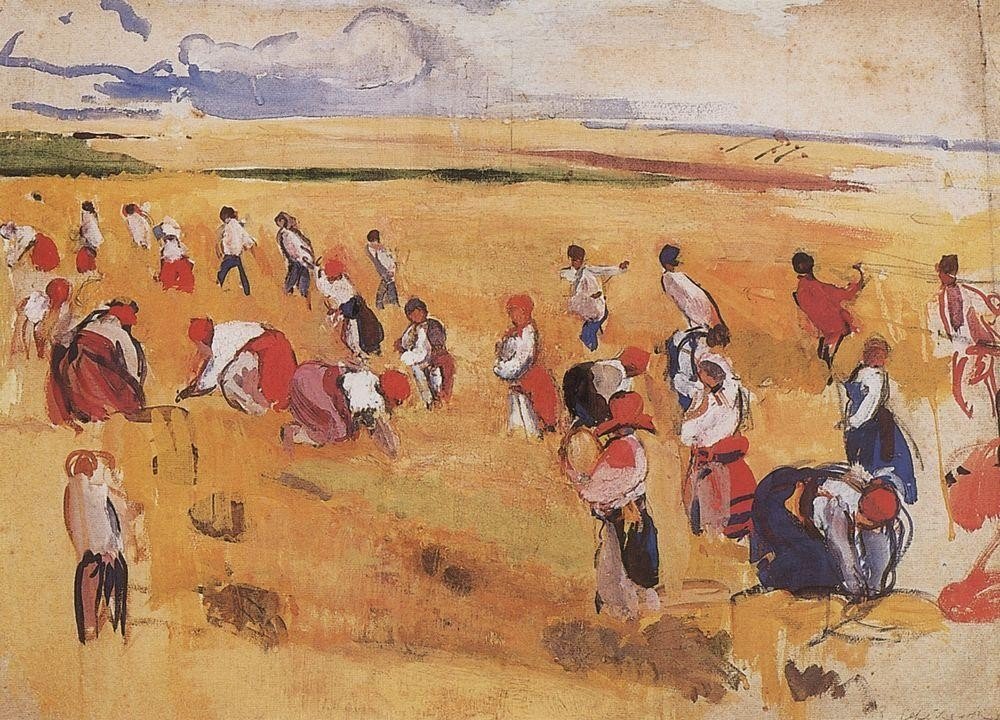
That seriousness extended to the nude. Bather (1911) presents a peasant woman at the water’s edge with the same frank, structural attention Serebriakova gave her own face at the dressing table, not eroticized for a viewer but observed as a body doing something ordinary. Nurse with a Child (1912) and Harvest, both painted at Neskuchnoye, apply the same treatment to labor: a wet nurse holding an infant, threshers bent over a field at midday. None of these women are named, romanticized, or given a narrative beyond the task shown. Apples on the Branches (1910), a quieter orchard study from the same estate, shows the domestic, unpeopled counterpart to these labor scenes, proof that Serebriakova’s radicalism had less to do with subject choice than with refusing to add sentiment her subjects had not earned.
A Marriage of Cousins: Boris Serebriakov and Neskuchnoye’s Golden Years
In 1905 Serebriakova married Boris Serebriakov, a railway engineer and her first cousin, a match her family had reservations about but ultimately accepted. The marriage produced four children and, for roughly a decade, gave her the settled base at Neskuchnoye that produced most of the work she is remembered for. At Breakfast (1914) shows three of her children at the family table, painted with the same unposed directness as her self-portraits, proof that domestic life at the estate was not separate from her artistic project but its main subject. Contemporaries increasingly recognized her as a serious painter in her own right during these years, not as an artist working in her uncle’s shadow.
1917 and After: Revolution, Widowhood, and a Fractured Family
The 1917 revolution and the civil war that followed dismantled that life fast. Neskuchnoye was looted and burned by 1919, and Boris Serebriakov, arrested by Bolshevik authorities that same year, died of typhus shortly after his release. Left with four children and no income, Serebriakova moved the family to Petrograd, took work cataloguing museum collections, and kept painting when materials and time allowed, producing some of her starkest, least decorative work of the period. The stability that had made Neskuchnoye’s orchards and harvests possible was gone, and with it the estate that had supplied her subject matter for nearly two decades.
Paris Without Her Children: The Exile Years
In 1924 Serebriakova traveled to Paris for a portrait commission and, amid tightening Soviet exit controls, could not return. She left two of her four children, Tatiana and Alexander, in the Soviet Union, taking only her older son and, later, her daughter Ekaterina with her.
Did Serebriakova Ever See Her Children Again?
Yes, but not for decades. Correspondence continued, but travel between Paris and the Soviet Union was effectively closed for most of the Stalin period. Serebriakova supported herself in France with portrait commissions and two documented trips to Morocco, in 1928 and 1932, funded by a Belgian patron, producing a body of figure studies distinct from her Russian work. Only after political conditions eased in the 1960s was she able to reconnect with her Soviet-based children and eventually visit her home country again.
Contemporaries in Focus: Benois, Bakst, Somov, Serov, and Kustodiev
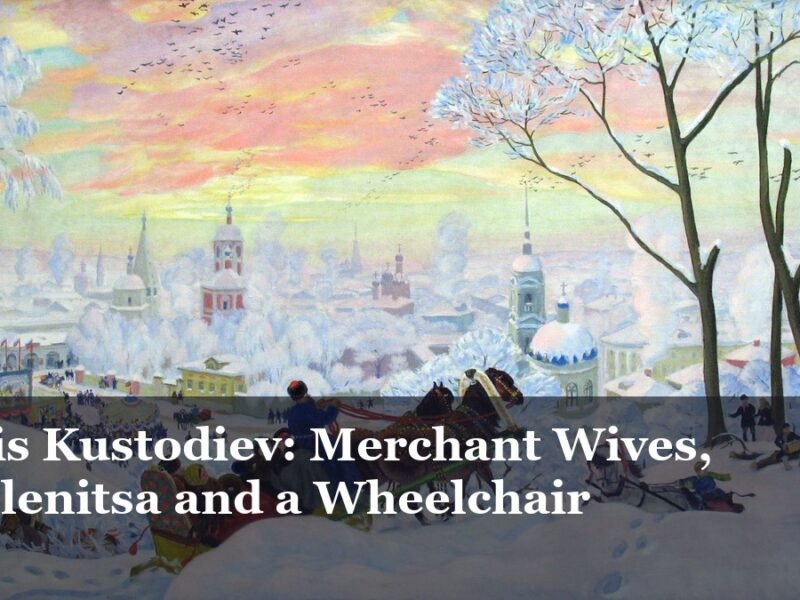
Serebriakova worked alongside, and was shaped by, a specific generation of Russian painters. Her uncle Alexandre Benois and his close collaborator Leon Bakst defined Mir Iskusstva’s decorative, theatrical wing through their designs for the Ballets Russes. Konstantin Somov, another founding member, painted the same commedia dell’arte and eighteenth-century pastoral themes Serebriakova borrowed for Self-Portrait as Piero, though his version leaned toward irony and ambiguity where hers stayed introspective. Valentin Serov, not formally a Mir Iskusstva member but closely associated with the circle, was the era’s dominant portraitist and a model for the psychological directness Serebriakova brought to her own sitters. Boris Kustodiev, by contrast, painted provincial merchant life with a bright, folk-art exuberance, a useful counterpoint to Serebriakova’s more restrained, structurally rigorous peasant scenes: two very different answers to the same turn-of-the-century interest in Russian rural subject matter.
Historical Impact: Why Her Self-Portraits Matter to Art History
Serebriakova’s importance rests on a combination rare in Russian art before her: sustained, unsentimental attention to both female self-representation and rural labor, delivered in a technically conservative style that made the content, not the brushwork, the source of its challenge. Harvest (1910), with its monumental threshers set against open sky, treats field labor with the compositional weight usually reserved for history painting, giving an unglamorous subject a seriousness it had rarely received, without romanticizing it. That combination shaped how later scholars read Russian realism‘s final generation before the avant-garde took over public attention, and gave art historians a clear, well-documented case of a woman painter building a major reputation on her own terms rather than through a movement built around her.
Legacy: Rediscovery in the Soviet Union and in Museums Today
Serebriakova’s Soviet-era work stayed in Russian public collections even after she left the country. A landmark 1965-1966 exhibition, held in Moscow, Leningrad, and Kiev after decades in which her name had gone largely unmentioned in the USSR, reintroduced her to Soviet audiences shortly before her death in Paris in 1967.
Common Misconceptions About Serebriakova’s Life and Work
A common misconception treats Serebriakova as a one-painting artist, known only for At the Dressing Table, when in fact she painted self-portraits at intervals across roughly six decades, from student studies before 1905 into her final years in Paris, tracking her own aging face with the same directness she once gave her twenty-four-year-old self. Another misconception holds that her marriage to a first cousin was scandalous by the standards of her time and family. First-cousin marriage among the Russian gentry, while not universally approved, was not unusual, and the couple’s relatives ultimately supported the match rather than opposing it outright.
Related Movements: From Mir Iskusstva to Realism and Beyond
Mir Iskusstva itself grew partly out of dissatisfaction with the Peredvizhniki, the socially engaged realists of the 1870s and 1880s whose message-driven genre painting Benois and his circle considered artistically conservative even when politically progressive. Serebriakova’s rural subjects put her closer to that earlier realist territory than most of her Mir Iskusstva colleagues, but her formal restraint and lack of overt social commentary kept her firmly within her uncle’s circle rather than its predecessor. Her self-portraiture also connects to a broader European tradition of women painters who used self-representation partly to assert professional legitimacy in a field that assumed a male practitioner by default.
Essential Points
- Zinaida Serebriakova (1884-1967) is best known for At the Dressing Table (1909), a self-portrait that broke with idealized convention in Russian art.
- She was the niece of Alexandre Benois and grew up inside the family network that helped found Mir Iskusstva.
- Her Neskuchnoye estate paintings, harvest scenes, orchards, and family portraits, apply the same unsentimental observation as her self-portraits.
- Widowed and dispossessed after 1919, she left for Paris in 1924 and was unable to return to the USSR.
- Two of her four children stayed in the Soviet Union; she was reunited with the country and its museums only in the 1960s.
- She kept producing self-portraits and portrait commissions in France for more than four decades, including work from two trips to Morocco.
- Within her circle, Somov’s theatrical irony and Kustodiev’s folk-art exuberance both contrast with her restrained, introspective approach to Russian subject matter.
- Major holdings of her pre-1924 work remain at the State Tretyakov Gallery and the State Russian Museum in Russia.
Frequently Asked Questions
- Who was Zinaida Serebriakova?
- Zinaida Serebriakova (1884-1967) was a Russian painter known for self-portraits and rural scenes painted with unusual directness for her time. Niece of Alexandre Benois and linked to the Mir Iskusstva circle, she built her reputation on At the Dressing Table (1909) before revolution and exile reshaped her career after 1917.
- Why did Zinaida Serebriakova leave Russia?
- After her husband died in 1919 during the civil war and the family estate at Neskuchnoye was destroyed, Serebriakova struggled financially in Petrograd. In 1924 she traveled to Paris for a portrait commission and, as Soviet exit controls tightened, was unable to return, leaving two of her four children behind.
- Why is At the Dressing Table considered a radical self-portrait?
- It shows Serebriakova in a plain slip doing her hair, with no allegory, muse pose, or idealization typical of earlier Russian self-portraiture. Painted by a young working mother rather than staged for a patron, it presented an ordinary domestic moment as serious subject matter, a quietly assertive claim to professional authorship.
- Was Zinaida Serebriakova related to Alexandre Benois?
- Yes. Her mother, Ekaterina Lansere, was Alexandre Benois’s sister, making Serebriakova his niece. She grew up inside the extended Lansere-Benois family network in St. Petersburg, which gave her early access to the circle that became Mir Iskusstva, though her own style stayed more rural and introspective than his theatrical work.
- Where can I see Zinaida Serebriakova’s paintings today?
- Most of her pre-1924 work, including several self-portraits and Neskuchnoye scenes, is held by the State Tretyakov Gallery and the State Russian Museum in Russia. Later Paris-period paintings are more scattered, held mainly in French and emigre private collections and occasional loan exhibitions on Mir Iskusstva or women in Russian art.
This guide was written and reviewed by the rus-art.com editorial team, specializing in Russian art history. We cross-check dates, attributions, and museum holdings against museum and academic sources.