Quick Answer
Russian Constructivism was an art movement founded in 1915 by Vladimir Tatlin and Alexander Rodchenko that rejected painting for illusion’s sake in favor of building compositions from real industrial materials: metal, wood, glass, wire. Constructivists saw themselves as engineers of a new Soviet society, applying art to posters, textiles, theater sets, and architecture. The movement flourished through the 1920s in Moscow institutions like INKhUK and VKhUTEMAS before Stalin’s government suppressed it in favor of Socialist Realism during the 1930s.
What Is Russian Constructivism?
Russian Constructivism, an early twentieth century movement, treated the artist less like a painter and more like an engineer, building compositions from real industrial materials rather than representing objects on canvas. Founded in 1915 by Vladimir Tatlin and Alexander Rodchenko, it is abstract and austere by design, rejecting decorative stylization in favor of assembling metal, wood, glass, and wire into structures that announce their own construction. Constructivists believed art should serve the modern industrial society taking shape around them, so easel painting gave way to posters, textiles, stage sets, and architectural proposals meant for practical use. The movement grew directly out of the Russian avant-garde and stayed closely bound to Bolshevik politics, as much a social project as an artistic one. Read the fuller definition at Constructivism.
From Icon Workshops to the Factory Floor: Origins in Revolutionary Russia
Before 1917, most artists who would become Constructivists trained in academic painting or studied Cubo-Futurist collage, absorbing ideas from Paris and Italy while developing a distinctly Russian visual language rooted partly in icon painting’s flat planes and gold grounds. The October Revolution of 1917 gave that generation a new client: the Soviet state itself, hungry for posters, monuments, and a visual identity to match its politics. Within three years, Moscow had the Institute of Artistic Culture (INKhUK, founded 1920), where artists debated whether art belonged in galleries at all, or whether it should dissolve entirely into industrial production. That debate, not a shared style, held the Constructivist circle together.
Tatlin’s Counter-Reliefs and the Birth of an Idea
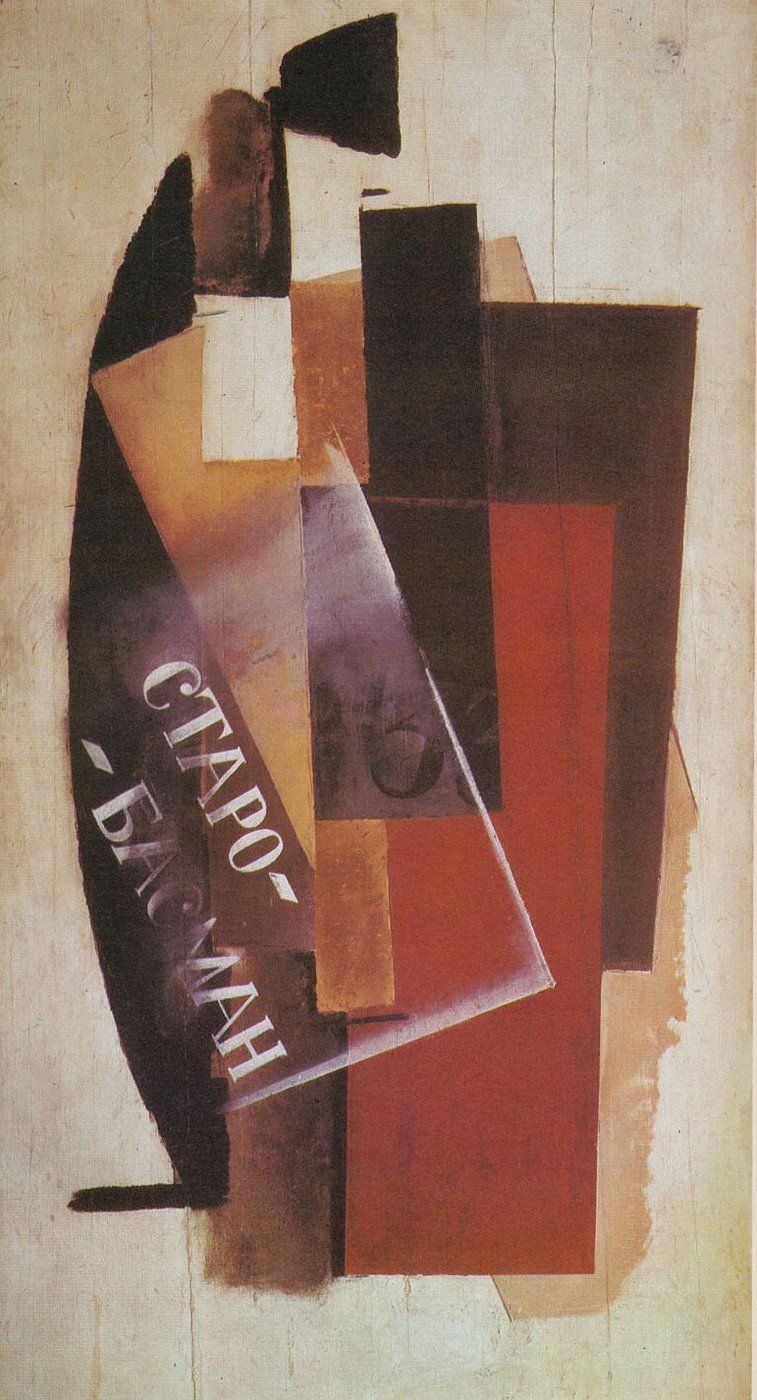
Tatlin spent his early career painting sailors and fishmongers in a Cubist influenced style, works like Sailor (1911) and Fishmonger (1911) that still sit inside the picture frame. A 1913 trip to Pablo Picasso’s Paris studio changed that. Seeing Picasso’s guitar constructions built from scrap materials, Tatlin returned to Russia and began building his own counter reliefs: compositions of sheet metal, wood, and glass suspended directly on gallery walls, with no canvas or paint at all. Board No. 1, Staro Basman (1917) shows this shift already underway, a rough wooden panel treated as a structural object rather than a support for imagery.
What makes a counter-relief different from a painting?
A counter relief has no illusionistic space. It is a real, three dimensional assembly of actual materials, mounted in real space, so the surface texture (faktura) and the tension of the materials themselves become the subject.
Art for Utility: Defining Characteristics of Constructivism
Constructivist work shares a handful of recurring traits. Geometric abstraction replaces recognizable subjects. Industrial materials (steel, glass, plywood) replace oil paint wherever possible. Faktura, the treatment of a material’s own surface and texture, becomes as important as composition. Tectonics describes how a structure’s construction is left visible rather than concealed. And a firm hostility to decoration ties every piece back to a stated social purpose, whether that purpose is a poster, a chair, or a workers’ club interior. These principles connected the movement’s origins in the Russian avant-garde to a broader European turn toward functional design during the same decade.
The Tower That Was Never Built: Tatlin’s Monument to the Third International
Tatlin’s best known project, the Monument to the Third International, was designed between 1919 and 1920 as headquarters for the Communist International in Petrograd. The plan called for a leaning iron spiral roughly 400 meters tall, enclosing a glass cylinder, cube, and cone that would each rotate at a different speed: once a year, once a month, once a day. Wartime shortages of steel and glass, plus the sheer scale of the design, meant it was never built. What survives are wooden models, a handful of period photographs, and drawings, yet the tower remains the single image most people picture when they hear the word Constructivism, despite never existing at full size.
Alexander Rodchenko and the Turn to Photomontage
Rodchenko started as a painter and graphic designer before turning to photomontage and photography in the mid 1920s, and his work stayed socially engaged and formally inventive throughout. He deliberately shot his subjects from odd angles, sharply from above or below, to interrupt easy recognition and force a viewer to look again. He explained the logic himself: a photographer “has to take several different shots of a subject, from different points of view and in different situations, as if one examined it in the round rather than looked through the same key-hole again and again.” Rodchenko also designed the early corporate identity of the Soviet airline Dobrolyot, later Aeroflot, including its winged hammer and sickle logo, a rare case of Constructivist design surviving in commercial use for decades.
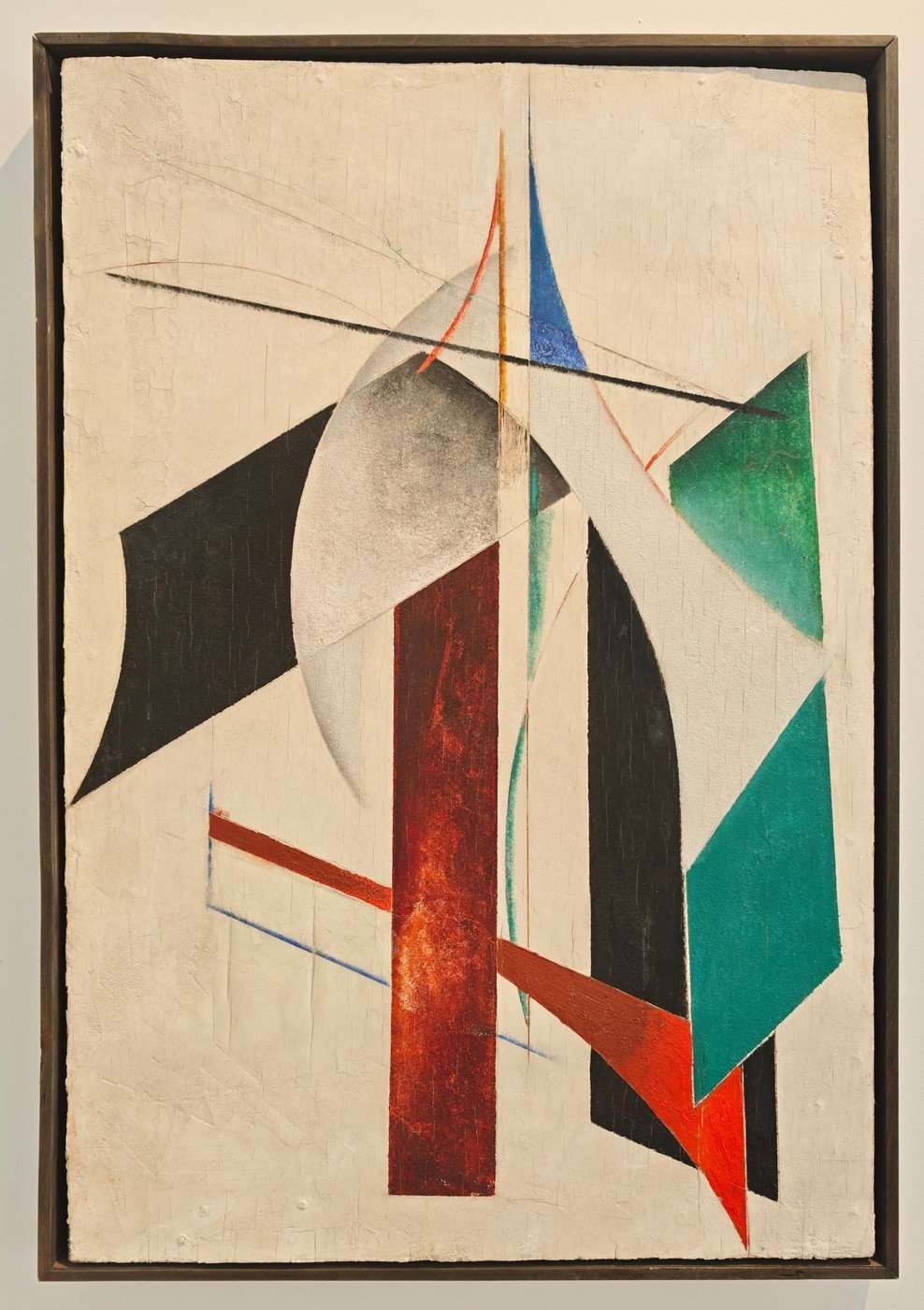
Lyubov Popova and the Painterly Architectonics
Lyubov Popova (1889-1924) approached Constructivism through a series she called Painterly Architectonics, paintings that treat color planes as if they were load bearing structural elements rather than decorative shapes. Working from around 1916 through 1918, she layered overlapping diagonals in restrained palettes of red, ochre, gray, and black, building a sense of architectural depth without depicting any building at all. Popova later carried the same structural logic into fabric patterns for Moscow’s First State Textile Factory and into stage designs for Vsevolod Meyerhold’s theater, proving that a painting based idea could move directly into mass production and performance without losing its logic along the way. She died of scarlet fever in 1924, at just 35.
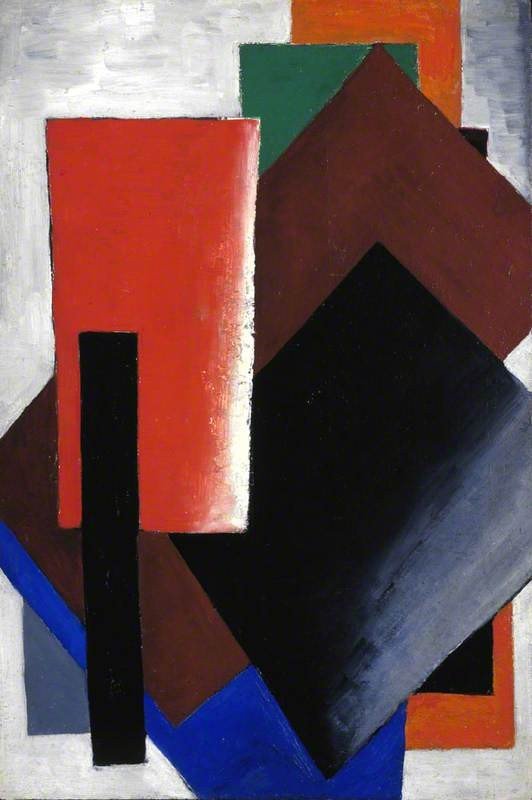
El Lissitzky’s Prouns: Between Suprematism and Architecture
El Lissitzky began as an illustrator of Yiddish children’s books before studying under Kazimir Malevich and helping develop Suprematism within the UNOVIS group. Around 1919 he started a personal series called Proun, short for “Project for the Affirmation of the New,” abstract compositions that behave like architectural drawings viewed from several angles at once, floating geometric volumes with no fixed horizon. Proun 4 B (1919-1920) is typical: cubes and lines seem to tilt and recede simultaneously, refusing a single stable viewpoint. In 1921 Lissitzky moved to the Weimar Republic, where he brought Constructivist and Suprematist ideas directly into contact with German and Dutch designers, reshaping typography, exhibition design, and photomontage far beyond Russia’s borders.
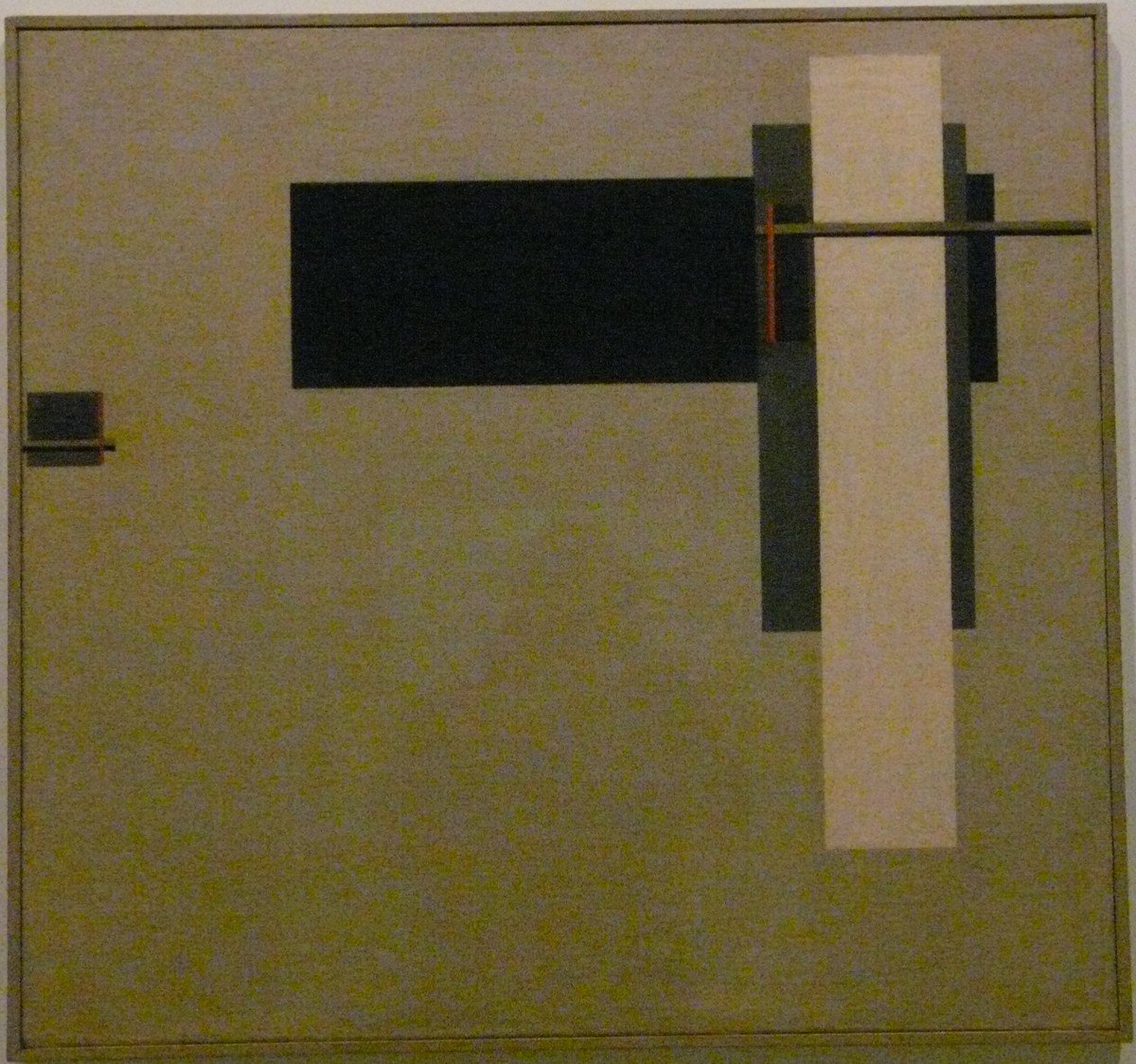
Varvara Stepanova, Aleksandra Exter and the Constructivist Women
Varvara Stepanova, married to Rodchenko, worked across propaganda, poetry, stage scenery, and textile design, rejecting purely aesthetic values in favor of what she saw as revolutionary usefulness. Aleksandra Exter brought a Constructivist vocabulary to stage design, most famously for Yakov Protazanov’s 1924 science fiction film Aelita, and continued exploring pure construction in works like Construction (1922), where angular colored forms interlock without any illusion of depth.
Did women play a central role in Constructivism?
Yes. Stepanova’s sports uniforms (prozodezhda), designed for Soviet athletics demonstrations, put Constructivist geometry onto everyday participants rather than gallery walls, a strand of applied production that Popova matched in textiles and Exter in stage design.
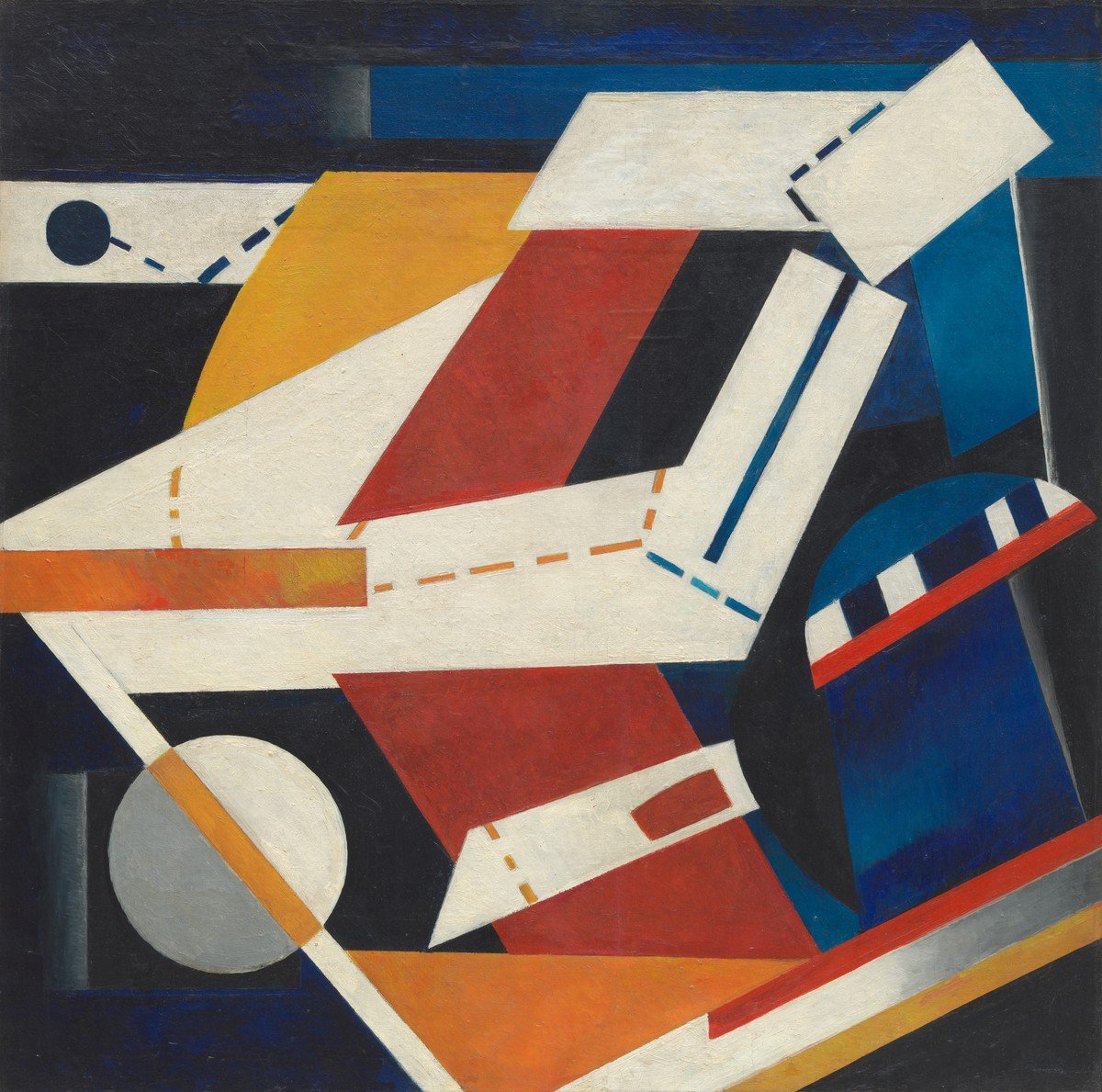
Gustav Klutsis and the Power of Political Photomontage
Gustav Klutsis, a Latvian photographer and major figure in the Constructivist avant-garde, developed photomontage into a tool built specifically for Soviet propaganda, working alongside his wife Valentina Kulagina. His posters combined scaled, layered photographs of workers and leaders into dynamic diagonal compositions designed to be read at a glance from a distance. Klutsis belongs to the small number of Soviet poster artists who did not survive the political system they served: he was arrested and executed in the Great Terror of 1937-38, a fate that marks how quickly the state turned on the very artists who had built its visual language.
Constructivism on Stage and in Print: Theatre, Textiles, Typography
Constructivist ideas spread fastest through applied fields, where the movement’s insistence on utility found an immediate outlet. Meyerhold’s theater productions used Popova’s and Exter’s set designs to strip the stage down to functional platforms, ramps, and moving parts, actors performing on structures rather than in front of painted backdrops. Textile factories issued fabric printed with Stepanova’s and Popova’s geometric patterns, putting abstract art directly onto clothing worn on Moscow streets. In publishing, book and journal covers adopted bold sans serif type, diagonal layouts, and photomontage, a visual language that reached far more Soviet citizens than any gallery painting could.
INKhUK, VKhUTEMAS and the Institutions Behind the Movement
Two Moscow institutions gave Constructivism its structure. INKhUK, the Institute of Artistic Culture, opened in 1920 as a research body where artists argued out the movement’s theory, including the split between artists who wanted to keep making objects for display and those who wanted to abandon art for factory production entirely. VKhUTEMAS, the state art and technical school founded the same year, trained students in painting, sculpture, and industrial design side by side with engineering coursework, and counted Rodchenko among its instructors. Together the two institutions functioned like a laboratory and a training ground, turning Constructivist theory into a curriculum that shaped an entire generation of Soviet designers.
Constructivism versus Suprematism: A Necessary Distinction
Constructivism is often lumped together with Suprematism, the movement Kazimir Malevich launched around 1915 with his Black Square, but the two rest on different logic. Suprematism treats pure geometric form as a route to spiritual feeling, detached from any material or social use. Constructivism insists on the opposite: form justified by material, structure, and function, with no interest in transcendence for its own sake. Lissitzky sits at the hinge between them, trained under Malevich yet pulling Suprematist geometry toward architecture and design, which is why his Prouns can look like either movement depending on which side of his career you examine.
From Moscow to Weimar: Constructivism’s Reach Abroad
Constructivism’s influence traveled west quickly during the early 1920s, carried largely through exhibitions and Lissitzky’s own relocation to Germany. The 1922 First Russian Art Exhibition in Berlin introduced Constructivist painting and design to Western European audiences directly, and Lissitzky’s teaching and writing afterward fed straight into the Bauhaus under Walter Gropius and into the Dutch De Stijl circle around Theo van Doesburg. Shared ground was easy to find: all three movements favored primary colors, straight lines, and a belief that art and design should serve everyday life rather than sit apart from it.
How far did Constructivism’s influence spread outside Russia?
Far enough to reshape typography, furniture, and architecture across interwar Europe, well before most Western audiences had seen a Constructivist painting in person.
Stalin’s Turn: Why Constructivism Was Silenced
Constructivism’s alliance with the Soviet state, its greatest advantage in the 1920s, became a liability once Stalin’s government tightened control over culture at the decade’s end. Officials began branding abstraction “formalist,” meaning disconnected from ordinary workers, and by the early 1930s Socialist Realism, with its literal depictions of heroic labor, became the only approved style. Tatlin spent his later years designing a personal glider called Letatlin and working in theater, far from the architectural ambition of his Tower. Klutsis was executed in 1938. By the mid 1930s, Constructivism as an active movement inside the Soviet Union had effectively ended, its surviving members either silenced, sidelined, or dead.
Common Misconceptions
One persistent mix up has nothing to do with Russia at all: Constructivism is frequently confused with Deconstructivism, an architectural movement of the 1980s associated with Frank Gehry and Zaha Hadid. The two share a root word and an interest in exposed structure, but Deconstructivism developed six decades later, in a capitalist context, with no direct lineage from Tatlin or Rodchenko beyond a shared visual fascination with fragmented geometry.
Constructivism’s Legacy in Design Today
Constructivist geometry never really left graphic design. Its stripped down grids, diagonal emphasis, and red black white palette fed into the International Typographic Style that Swiss designers developed at mid century, which in turn shaped the corporate branding, transit signage, and poster design still used worldwide. Design students studying Kārlis Johansons’s diagrammatic Graphic Representation of a Construction (1921) today will recognize the same structural thinking behind modern data visualization and information design, a century old habit of making structure itself the image.
Related Movements: De Stijl, Bauhaus and Productivism
Constructivism belongs to a family of interwar movements that all treated design as a social responsibility rather than private expression. De Stijl, centered on Piet Mondrian and Theo van Doesburg in the Netherlands, shared the commitment to primary colors and right angles but stayed closer to painting and furniture than to industrial engineering. Inside Russia itself, Productivism split off as the movement’s most extreme wing, artists who abandoned galleries entirely to design textiles, ceramics, and furniture for direct factory production, arguing that art for art’s sake had no place in a socialist economy.
Essential Points
- Constructivism began in 1915 with Vladimir Tatlin and Alexander Rodchenko, who replaced painted illusion with actual industrial materials assembled in relief.
- Tatlin’s Tower (1919-20), a spiral iron monument planned for Petrograd, was never built and survives only through models and drawings.
- The movement split into two camps: laboratory Constructivism, which kept working in galleries, and Productivism, which pushed artists into factories to design everyday objects.
- Lyubov Popova, Varvara Stepanova, and Aleksandra Exter were central figures, not supporting players, shaping textiles, stage design, and painting alike.
- El Lissitzky carried Constructivist ideas to Germany after 1921, feeding directly into the Bauhaus and De Stijl.
- Gustav Klutsis turned photomontage into a tool of state propaganda, then was executed in the Great Terror of 1937-38.
- Stalin’s cultural bureaucracy branded Constructivism ‘formalist’ in the early 1930s and replaced it with Socialist Realism.
- Constructivist geometry and red-black-white palettes still shape graphic design, from Swiss typography to modern branding.
Frequently Asked Questions
- What is Russian Constructivism in simple terms?
- It is an art movement from 1915 onward where artists built compositions out of real materials like metal and wood instead of painting illusions. Constructivists wanted their work to serve modern industrial society directly, through posters, textiles, and building designs rather than gallery paintings.
- When and where did Constructivism begin?
- It began in 1915 in Russia with Vladimir Tatlin and Alexander Rodchenko, gaining momentum after the 1917 Revolution when the new Soviet state needed a visual language for propaganda, architecture, and everyday design.
- What materials did Constructivist artists actually use?
- Sheet metal, plywood, glass, wire, and industrial paint, assembled directly rather than represented through illusion. The technique, called faktura, treated a material’s own texture as part of the artwork’s meaning.
- Who were the most important Constructivist artists?
- Vladimir Tatlin and Alexander Rodchenko founded the movement; Lyubov Popova, Varvara Stepanova, El Lissitzky, Aleksandra Exter, and Gustav Klutsis each shaped its painting, textile, theater, and propaganda output through the 1920s.
- Where can you see Constructivist art today?
- Major holdings sit in the State Tretyakov Gallery and Pushkin Museum in Moscow, plus Western collections including MoMA and Tate. Tatlin’s Tower survives only as reconstructed models, several of which have toured international museums.
This guide was written and reviewed by the rus-art.com editorial team, specializing in Russian art history. We cross-check dates, attributions, and museum holdings against museum and academic sources.