Quick Answer
A Fabergé egg is a jeweled Easter egg created by the House of Fabergé in Saint Petersburg, most famously as an annual Imperial gift from Tsar Alexander III and Tsar Nicholas II to their wives and mothers between 1885 and 1917. Peter Carl Fabergé‘s workshop produced 50 delivered Imperial eggs, 44 of which survive today, each built around a hidden surprise and finished with guilloché enamel over engine-turned metal. Beyond craftsmanship, the eggs fused goldsmithing, miniature painting, and precision mechanics into a single object.
What Is a Fabergé Egg?
A Fabergé egg is a jeweled egg made by the House of Fabergé in Saint Petersburg, best known as the annual Easter gift Tsar Alexander III and his son Nicholas II gave the women of the Russian imperial family between 1885 and 1917. Alexander III commissioned ten eggs for his wife, Empress Maria Feodorovna. Nicholas II continued the tradition with forty more, split between his mother and his wife, Tsaritsa Alexandra Feodorovna. Fifty Imperial eggs were delivered in total, and forty four survive today, whole or in fragments. Open one and a hidden object waits inside, a portrait, a tiny model, a mechanical bird, what the workshop simply called the surprise. Goldsmithing, enamel work, and precision mechanics all meet in a single object, which is why historians tend to talk about the eggs as engineering achievements as much as jewelry.
From Goldsmith’s Bench to Imperial Court: The Origins of the House of Fabergé
The House of Fabergé started small. Gustav Fabergé, a goldsmith of Baltic German and French Huguenot descent, opened a modest jewelry shop in Saint Petersburg in 1842. His son Peter Carl Fabergé took the family business over in the 1870s and, working alongside his brother Agathon, built it into one of the most respected jewelry houses in Europe. The firm supplied court jewelers, aristocrats, and eventually the tsar himself, and it did so through a network of independent workmasters rather than one central workshop. Specialists in enamel, stone carving, and metalwork each ran a semi-autonomous studio under the Fabergé name and hallmark, drawing on their own particular skills. By the 1880s the firm had earned enough trust at court to receive the most sensitive commission in Russian jewelry: a private Easter gift for the empress.
The First Gift: How the Hen Egg Began a Tradition
How did the Fabergé egg tradition begin?
In 1885, Alexander III asked Peter Carl Fabergé to make an Easter gift for his wife, Maria Feodorovna, reportedly inspired by an ivory egg from her Danish childhood that opened to reveal smaller treasures nested inside. Fabergé answered with the Hen Egg, a shell of white enameled gold that opens to a matte gold yolk. Inside the yolk sits a small gold hen, and the hen itself once held a diamond replica of the imperial crown and a tiny ruby pendant, both now lost. The empress was delighted, and Alexander granted Fabergé the title of Goldsmith by Special Appointment to the Imperial Court. A single gift turned into an annual commission that continued, with one interruption during the Russo-Japanese War, until the monarchy fell in 1917.
Peter Carl Fabergé and the Rise of the Imperial Commission
Peter Carl Fabergé (1846 to 1920) trained as a goldsmith in Saint Petersburg, Dresden, and Frankfurt before coming home to run his father’s firm. He rarely touched the eggs himself. His job was to design and to judge, setting a bar every workmaster had to clear. One rule he held to without exception: no two Imperial eggs could repeat the same design, which forced constant invention across three decades of production. Fabergé also kept a close relationship with the imperial family, meeting privately with Nicholas II to settle on a theme for each year’s egg, often tied to a specific event: a coronation, an anniversary, the completion of a railway. That habit, folding a real historical moment into each object, is part of why the eggs remain unusually well documented compared with most decorative art of the period.
The Workmasters: Michael Perkhin, Henrik Wigström, and the Hands Behind the Eggs
Who actually made the Fabergé eggs?
Fabergé’s name sits on every piece, but the actual building fell to independent workmasters. Michael Perkhin, who arrived in Saint Petersburg from Olonets Governorate, served as head workmaster from 1886 until his death in 1903 and is credited with most of the Imperial eggs made in that stretch. His chief assistant, the Finnish craftsman Henrik Wigström, took over from him and carried the workshop through the firm’s final, most elaborate eggs. Earlier still, Erik Kollin held the post of head workmaster from 1870 to 1886, producing gold jewelry in the Scythian style that followed the Kerch treasure discoveries in Crimea. Each workmaster stamped his own hallmark next to Fabergé’s, so a trained eye can often tell which studio, and so which pair of hands, actually built a given piece.
Alma Pihl and the Women of the Fabergé Workshops
Not every Fabergé designer was a man, or trained as a metalworker. Alma Pihl joined the workshop her uncle ran within the firm and became one of only two women ever recognized as a Fabergé workmaster. She is credited with the frost pattern on the Winter Egg, reportedly inspired by ice crystals she noticed on a window and rendered as a lattice of platinum and rock crystal set with diamonds. Pihl’s career is a reminder that the House of Fabergé, for all that men ran its formal workmaster hierarchy, still let exceptional design talent through, as long as the finished work met the firm’s exacting standard for originality and precision.
The Engineering Secret: Guilloché Enamel
What is guilloché enamel?
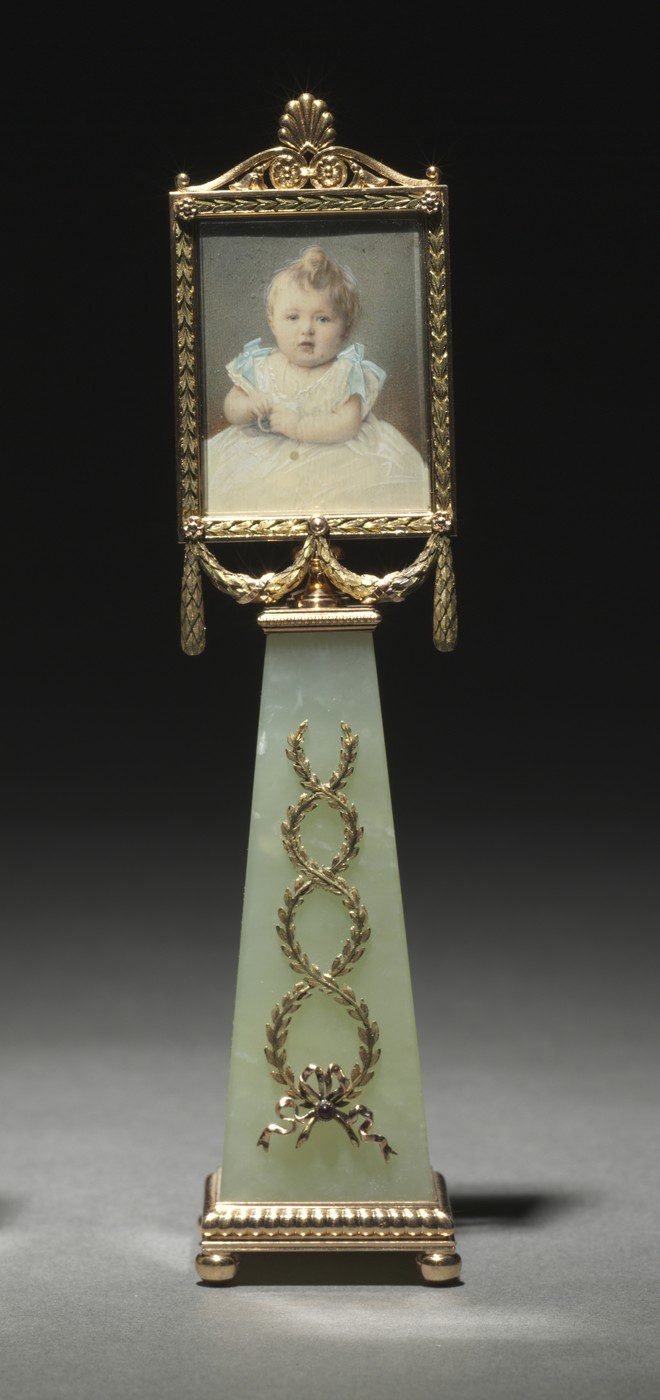
Much of a Fabergé egg’s visual character comes from a mechanical technique called guilloché. A rose engine lathe cuts a precise, repeating pattern, sunbursts, waves, basketweave, into the metal surface. Translucent enamel is then fired over that engraved ground in several thin layers, so light passes through the colored glass and bounces back off the machine-turned metal underneath, giving the surface a shifting glow that flat enamel simply cannot produce. Fabergé’s workshops mastered dozens of guilloché patterns and an equally wide palette of enamel colors, and the technique turns up well beyond the eggs, on cigarette cases, clocks, and small frames like the miniature portrait frames the firm made for the imperial family. That same precision makes guilloché enamel hard to fake convincingly, which is why condition and hairline cracking get close attention whenever a disputed piece is authenticated today.
Anatomy of an Egg: Materials, Surprises, and Construction
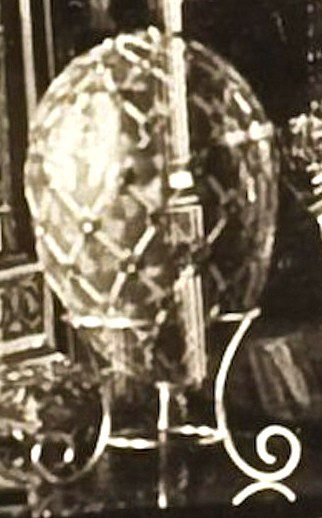
Beneath the enamel, an Imperial egg is a small feat of mechanical engineering. Workmasters built the outer shell from gold or silver gilt, then engineered a hinge, catch, or spring mechanism to release the surprise inside, sometimes a folding easel holding miniature portraits, sometimes a tiny automaton. The 1898 Lilies of the Valley Egg hides a mechanism that raises three small oval portraits of Nicholas II and his daughters on retractable gold stems when a pearl button is turned, so the surprise climbs out of the egg rather than just sitting inside it. A mechanism that fine, reliable enough to survive over a century of winding and handling, took close collaboration between the goldsmith, the enameler, and often a specialist watchmaker, since several eggs double as miniature clocks.
Notable Imperial Eggs and Their Stories
Several Imperial eggs are landmarks in their own right. The 1897 Coronation Egg marks the coronation of Nicholas II and Alexandra: yellow enamel and a laurel trellis enclose a miniature replica of the coronation coach, working wheels and doors included, a project so demanding it reportedly took months of dedicated work on its own. The 1900 Trans-Siberian Railway Egg celebrates the completion of the Trans-Siberian Railway with a wind-up gold and platinum model train as its surprise, its headlamp a bead of ruby glass, its carriages marked for ladies, for smokers, for a chapel car, all reproducing the actual route on an engraved map that circles the shell. As the Encyclopaedia Britannica notes, the eggs increasingly doubled as historical records, each one a compact monument to a specific year in the reign of the last Romanovs.
Myth vs. Fact: Not every Fabergé egg was made for the Tsar
Myth: any jeweled egg bearing the Fabergé name was made for the Russian Imperial family. Fact: only 50 Imperial Easter eggs were delivered to Alexander III and Nicholas II. The House of Fabergé also made non-Imperial eggs for private clients like the Kelch family, plus countless frames, boxes, and clocks that carry the same hallmark but were never eggs at all.
Defining Characteristics of the Fabergé Style
A handful of features recur across nearly every Fabergé piece, egg or otherwise. Guilloché enamel over engine-turned metal shows up constantly, paired with restrained, symmetrical ornament rather than the heavier historicist styles common elsewhere in European court jewelry of the same decades. Fabergé’s workshops favored semiprecious and decorative stones, rock crystal, nephrite, bowenite, alongside gold and platinum, keeping diamonds and pearls for accents instead of covering a piece in them. The 1894 Renaissance Egg makes the approach plain: a banded agate shell shaped like a jewel casket, closed with a ruby clasp, its restraint a deliberate contrast to the ornate, gem-crusted style many European courts preferred at the time. Understatement, precision, and a refusal to repeat a design are what consistently separate genuine Fabergé work from its many later imitators.
Beyond the Eggs: Fabergé’s Wider Body of Work
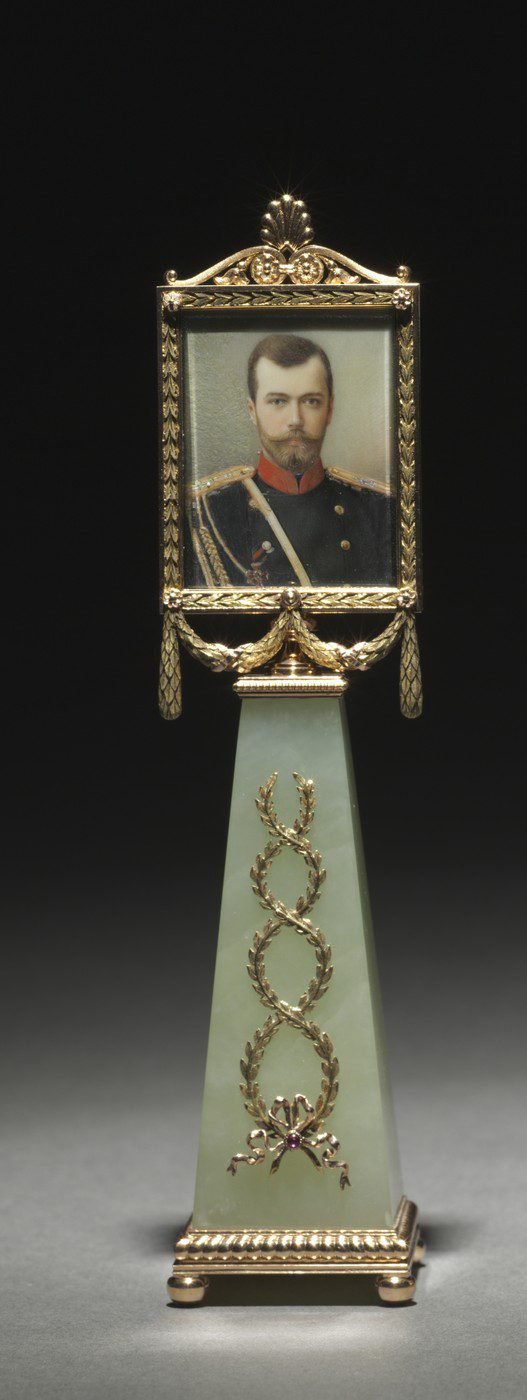
The Imperial eggs made Fabergé famous, but they were only a small slice of the firm’s output. The House of Fabergé also produced cigarette cases, parasol handles, desk clocks, and picture frames for a much wider clientele across Russia and Europe. The framed miniature portrait of Czar Nicholas II, now in the Cleveland Museum of Art, shows the same guilloché enamel technique applied to a small object meant for a writing desk rather than an Easter gift. Frames pairing miniature portraits of imperial family members were a recognizable Fabergé product line, sold and given as gifts quite apart from the Imperial eggs, a useful reminder that most surviving Fabergé pieces in museum collections today are not eggs at all but these smaller decorative objects.
The Fall: Revolution and the Scattering of the Collection
What happened to the Fabergé eggs after the Russian Revolution?
The Bolshevik Revolution of 1917 ended the Romanov dynasty and Fabergé’s business in almost the same stroke. The new Soviet government nationalized the firm’s stock and seized the Imperial eggs along with other court treasures, moving many of them into the Kremlin Armoury. Peter Carl Fabergé fled Russia and died in Switzerland in 1920, reportedly never recovering from the loss of his life’s work. Through the late 1920s and 1930s the Soviet government sold a number of Imperial eggs abroad to raise hard currency, scattering them into private collections in Europe and the United States. That sell-off is why the eggs’ current locations are so spread out, and why the whereabouts of several eggs delivered before 1917 are still unknown today.
Rediscovery and the Forbes Collection
For most of the twentieth century, Fabergé eggs were curiosities known mainly to a small circle of collectors and dealers. That changed largely through the efforts of publisher Malcolm Forbes, who assembled the largest private collection of Imperial eggs outside Russia and put them on public display in New York. The Forbes collection did more than any single institution to bring the eggs to a general audience, and when the Forbes family sold the collection in 2004, businessman Viktor Vekselberg bought nearly the whole group and brought it back to Russia, where it now anchors the Fabergé Museum in Saint Petersburg. That one acquisition reversed decades of dispersal and returned a significant share of the surviving Imperial eggs to the city where they were made.
Legacy: How Fabergé Shaped Luxury Design
Fabergé’s influence outlasted the empire that commissioned his most famous work. Twentieth-century jewelry houses studied his combination of restrained form and technically difficult enamel and stonework, and the phrase Fabergé egg settled into everyday language as shorthand for an object of extreme, hidden craftsmanship. The market has kept pace with that reputation: the 1913 Winter Egg, carved from rock crystal to look like melting ice and mounted with a platinum flower-basket surprise designed by Alma Pihl, sold at auction for 30.2 million dollars in 2025, a price that reflects both its rarity and its documented Imperial provenance. Few decorative objects from any period draw that kind of market attention, which is itself a measure of how thoroughly the eggs have come to stand for the idea of luxury craftsmanship.
Common Misconceptions About Fabergé Eggs
Are all Fabergé eggs Imperial eggs?
No, and this is the misunderstanding that trips up most people. Only fifty Imperial Easter eggs were made, for Alexander III and Nicholas II, plus two more that were finished but never delivered before the revolution. The firm also made a smaller series of so-called Kelch eggs for a wealthy industrialist family, and it sold countless other enameled objects, boxes, frames, jewelry, that are genuine Fabergé pieces yet were never eggs at all. One more wrinkle: the Fabergé name and trademark have been used commercially since the 1920s on jewelry with no connection to the original Saint Petersburg workshop, so an object labeled Fabergé today is not, by itself, proof that Peter Carl Fabergé’s firm made it.
Where to See Fabergé Eggs Today
Can you still see Fabergé eggs in museums?
Yes. The Fabergé Museum in Saint Petersburg holds the largest single group, built around the Vekselberg acquisition of the former Forbes collection, including the Coronation Egg and the Lilies of the Valley Egg. The Moscow Kremlin’s Armoury Chamber holds Imperial eggs that never left Russia, among them the Trans-Siberian Railway Egg. Smaller groups and individual eggs sit in the Virginia Museum of Fine Arts, the Cleveland Museum of Art, the Royal Collection in London, and the Hermitage, and private collections occasionally lend pieces for exhibition too. Ownership has shifted so many times since 1917 that checking a museum’s current collection listing before visiting is worth the trouble, since eggs do travel between institutions for temporary shows.
Essential Points
- Only 50 Imperial Fabergé eggs were delivered between 1885 and 1917, and 44 are known to survive today.
- Peter Carl Fabergé designed and approved every piece but rarely built the eggs himself; workmasters Michael Perkhin and later Henrik Wigström carried out the construction.
- Guilloché enamel, translucent color fired over machine-engraved metal, produces the shifting glow characteristic of Fabergé’s surfaces.
- Alma Pihl, one of only two women recognized as Fabergé workmasters, designed the frost pattern used on the Winter Egg.
- Every Imperial egg conceals a surprise, a portrait, a model, or a mechanism, and some function as miniature clocks or automatons.
- The 1917 Revolution scattered the collection; the Soviet government sold many eggs abroad in the 1920s and 1930s to raise currency.
- Publisher Malcolm Forbes assembled the largest private collection, which Viktor Vekselberg bought in 2004 and returned to Russia.
- Not every object marketed as a ‘Fabergé egg’ is an Imperial egg; the firm made non-Imperial eggs and vast numbers of smaller decorative objects too.
Frequently Asked Questions
- What is a Fabergé egg?
- A Fabergé egg is a jeweled Easter egg made by the House of Fabergé in Saint Petersburg. Between 1885 and 1917, the firm delivered fifty Imperial eggs to the Russian tsars as gifts for the empress and tsaritsa, each built around enamel, precious metal, and a hidden surprise inside.
- Why did the Fabergé egg tradition start?
- Tsar Alexander III commissioned the first egg in 1885 as an Easter gift for his wife, Maria Feodorovna, reportedly inspired by an egg from her childhood. She was delighted, and Fabergé became the imperial court’s official jeweler, producing a new egg nearly every year until the 1917 revolution ended the tradition.
- What makes Fabergé eggs so hard to reproduce?
- Their surface relies on guilloché enamel: a lathe engraves a precise repeating pattern into metal, then translucent enamel is fired over it in layers so light reflects through the color. Combined with hidden mechanical surprises built by hand, the process demands skills modern manufacturing rarely replicates at that scale.
- Did Peter Carl Fabergé make the eggs himself?
- Rarely. Fabergé designed, approved, and set the standard for every piece, but workmasters like Michael Perkhin and Henrik Wigström, along with designers such as Alma Pihl, actually built the eggs in semi-independent studios operating under the Fabergé name and hallmark.
- Where can you see Fabergé eggs today?
- The Fabergé Museum in Saint Petersburg and the Moscow Kremlin’s Armoury Chamber hold the largest groups. Smaller collections are on view at the Cleveland Museum of Art, the Virginia Museum of Fine Arts, and the Royal Collection in London, with pieces occasionally traveling for temporary exhibitions.

This guide was written and reviewed by the rus-art.com editorial team, specializing in Russian art history. We cross-check dates, attributions, and museum holdings against museum and academic sources.