Quick Answer
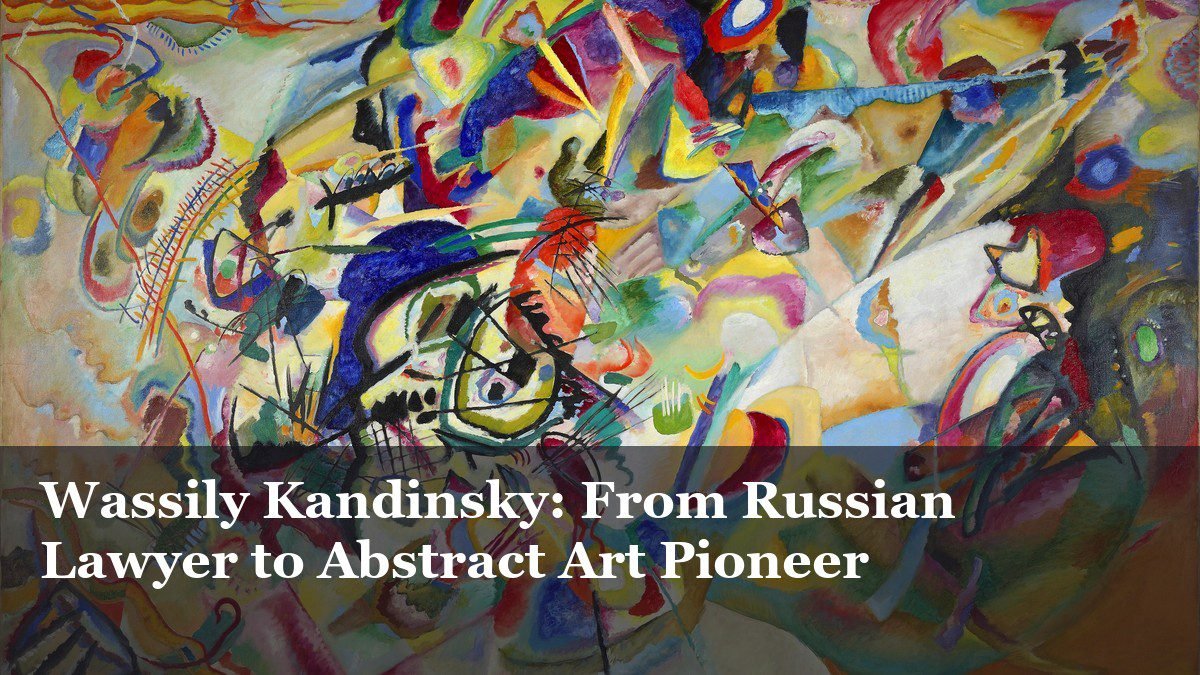
Wassily Kandinsky (1866-1944) was a Russian painter who trained as a lawyer before turning to art at 30 and became one of the first painters in Western art to abandon recognizable subject matter entirely. After studying in Munich, he co-founded Der Blaue Reiter with Franz Marc, developed a theory linking color to music and spirituality, and produced landmark works including Composition VII (1913). He later taught at the Bauhaus until the Nazis closed it in 1933, then spent his final years in France, reshaping how Western art understood color, form, and meaning.
Who Was Wassily Kandinsky?
Wassily Kandinsky (16 December 1866, Moscow, 13 December 1944, Neuilly-sur-Seine) was a Russian painter and art theorist, and historians credit him as one of the first artists in Western art to paint in a fully non-representational style. He trained as a lawyer and economist and did not begin formal art study until his thirties, then spent most of his working life in Germany and, later, France. He co-founded the Munich group Der Blaue Reiter, taught at the Bauhaus, and wrote a detailed theory linking color, sound, and inner spiritual experience.
Why Is Kandinsky Called the Father of Abstract Art?
Historians credit him with removing recognizable subject matter from painting almost entirely between 1910 and 1913. Many contemporaries arrived at abstraction gradually and without comment, but Kandinsky backed the shift with published theory rather than instinct alone.
From Law Lectures to Life Class: Kandinsky’s Late Start in Art
Kandinsky grew up in a merchant family and studied law and economics at Moscow University, where he later lectured. By his own account, seeing one of Claude Monet’s Haystacks paintings at an exhibition in Moscow in 1895, and almost failing to recognize it as a haystack at all, pushed him further toward painting, feeding a fascination with color he had carried for years. In 1896, at 30, he turned down a professorship to study art instead, starting with life drawing, sketching, and anatomy, the standard academic groundwork rather than anything experimental. That late, deliberate start matters. His abstraction grew out of exhaustive traditional training, not a rejection of technique.
Munich, 1896: Anton Ažbe’s School and the Academy of Fine Arts
Kandinsky settled in Munich in 1896, then one of the liveliest art centers in the German-speaking world. He first studied at the private school run by Slovenian painter Anton Ažbe, working alongside other Eastern European artists including Alexej von Jawlensky, before entering the Academy of Fine Arts for further training in draftsmanship and composition. These years were unglamorous and slow. Kandinsky spent nearly a decade absorbing academic technique, traveling, and experimenting with Jugendstil-influenced graphics, and none of it looked anything like the abstract canvases that would make him famous after 1910.
Teacher and Partner: Kandinsky and Gabriele Münter
Gabriele Münter enrolled in a Munich painting class Kandinsky taught around 1901 to 1902. Their relationship shifted from teacher and pupil to partners, and the two traveled together across Europe and North Africa before settling in the Bavarian town of Murnau am Staffelsee around 1908. Münter was an accomplished painter in her own right, and the house she bought in Murnau, later nicknamed the “Russians’ House” by locals, became a working base for Kandinsky, Jawlensky, and Marianne von Werefkin. The relationship ended around the time Kandinsky returned to Russia in 1914. Münter safeguarded many of his paintings through both World Wars.
The New Munich Artists’ Association and Its Fracture
In 1909, Kandinsky helped found the Neue Künstlervereinigung München (New Munich Artists’ Association, NKVM), a group that included Jawlensky, Werefkin, and Münter and aimed to show work too experimental for Munich’s conservative exhibition societies. Landscapes he painted around Murnau in this period, loose, high-key, and increasingly simplified, show him moving toward abstraction step by step rather than in one leap. The NKVM fractured in 1911 when a jury rejected one of Kandinsky’s more radical canvases for a group show. Kandinsky, Marc, Münter, and a few allies resigned and organized their own exhibition instead, a split that led directly to Der Blaue Reiter.
Der Blaue Reiter: The Almanac and the Two Exhibitions
Der Blaue Reiter was not a formal art group with membership rules. It was a name Kandinsky and fellow painter Franz Marc gave to their joint exhibition and publishing project. The two organized two exhibitions in Munich, in 1911 and 1912, and edited an almanac of essays and reproductions, first published in mid-May 1912, arguing for a spiritual, non-naturalistic art. Contributors and exhibitors included Marc, Jawlensky, Werefkin, August Macke, and, briefly, Paul Klee. Traveling versions of the exhibition reached other German and European cities before the project ended with the outbreak of World War I in 1914, when its members scattered across opposing sides of the front.
Franz Marc, Jawlensky, and Werefkin: The Circle Around Kandinsky
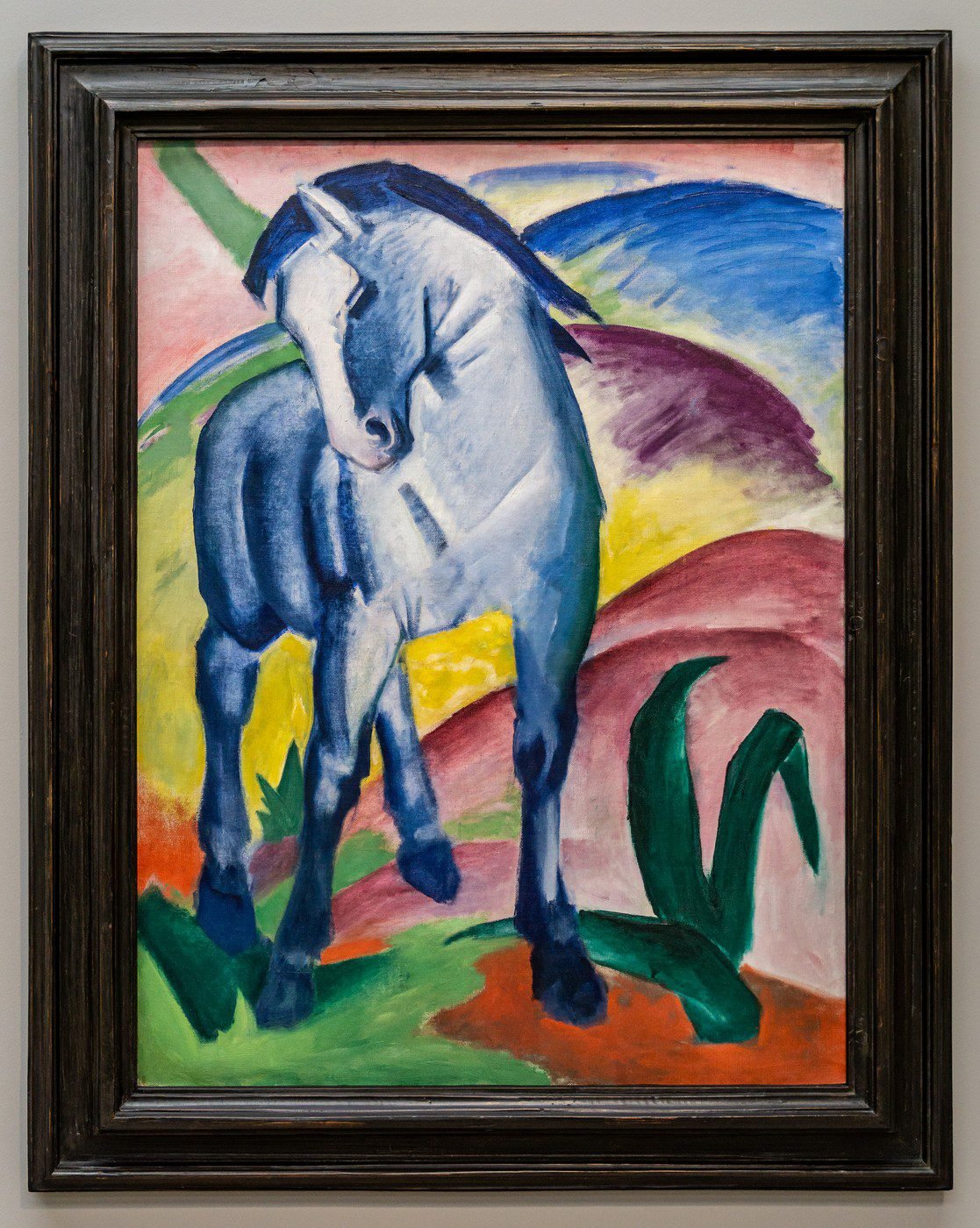
Alexej von Jawlensky brought a Fauvist-inflected color sense to the circle, building on his own path from Russian military officer to painter. His intense, mask-like portraits sit alongside Kandinsky’s landscapes as one of the clearest bridges between Russian and German Expressionism. Franz Marc contributed color-coded animal paintings, in which blue signified the masculine and spiritual. Marianne von Werefkin, an established painter who had largely stepped back from exhibiting to support Jawlensky’s career, hosted the salon where the group hashed out its theory. None of them painted alike. What held the circle together was a shared belief that color and form could carry meaning independent of realistic depiction.
Defining Features of Kandinsky’s Abstraction
Kandinsky sorted his own output into three categories: Impressions (responses to external nature), Improvisations (spontaneous expressions of inner feeling), and Compositions (deliberate, slowly built works he considered his most important statements). Across all three, abstract art for Kandinsky meant using color, line, and shape with a kind of independence from visible subject matter, ranging in degree from simplified landscape to fully non-objective canvases. He treated color almost like a musical instrument, assigning warmth, weight, and sound-like qualities to specific hues, and believed a triangle or a curve could trigger an emotional response the way a musical chord does, without representing anything at all.
What’s the Difference Between an Improvisation and a Composition?
Improvisations were made quickly, in a burst of feeling. Compositions were planned over weeks or months, closer to how a symphony is scored than how it is played.
Composition VII: Anatomy of a Breakthrough
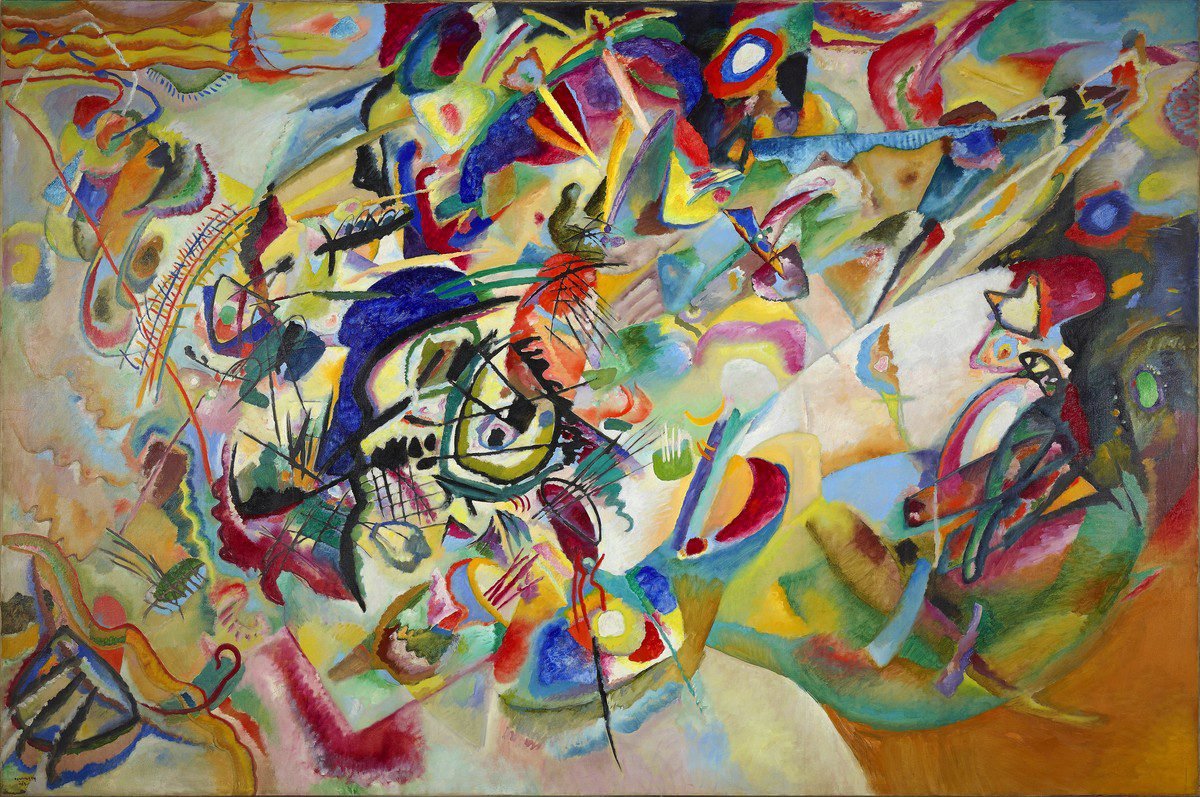
Composition VII, painted in 1913 and now held at the State Tretyakov Gallery in Moscow, is widely considered the most complex canvas of Kandinsky’s pre-war period. He reportedly made dozens of preparatory studies and sketches before the final version, which took him roughly four days to execute once he began. Art historians reading the swirling, layered forms have identified overlapping references to the Resurrection, the Last Judgment, the biblical Flood, and the Garden of Eden, themes of apocalypse and renewal that recur throughout his pre-war work. No single motif dominates. The painting works instead through color relationships and rhythm, exactly the argument he was making in his theoretical writing of the same years.
War, Return to Moscow, and the Russian Revolution
Kandinsky returned to Moscow in 1914 after the outbreak of World War I, leaving Münter, Munich, and most of his German career behind. Russia in wartime and then revolution offered little market for abstract painting, and his output slowed and shifted, part of it more geometric, part of it a return to Russian and folk imagery. He remarried in Moscow and largely stepped back from international exhibiting during these years, a gap in his biography that is easy to overlook next to the more famous Munich and Bauhaus chapters but that reshaped his later, more geometric style.
Myth vs. Fact: Abstraction by Accident?
Myth: Kandinsky discovered abstraction in one sudden flash, famously after seeing one of his own canvases turned on its side and not recognizing it. Fact: scholars dispute how much weight that anecdote deserves, and even if it happened, it only accelerated a shift already visible in his Murnau landscapes years earlier. His move away from recognizable subject matter unfolds gradually across paintings from 1908 to 1913, not in a single moment of insight.
Kandinsky Under Lunacharsky: Building Soviet Art Institutions
Following the Russian Revolution, Kandinsky became an insider in the cultural administration led by Anatoly Lunacharsky, the Bolshevik commissar responsible for early Soviet arts policy. He helped establish the Museum of the Culture of Painting and took on teaching and organizing roles meant to fold avant-garde art into the new state’s institutions. He worked alongside figures associated with Constructivism and Suprematism, even though his own spiritual, mystical approach to painting sat uneasily next to their more materialist, engineering-influenced ideas, a tension that only grew as Soviet cultural policy hardened.
Did Kandinsky Support the Russian Revolution?
He took active institutional roles under it in its early years, but his mystical outlook increasingly clashed with the movement’s growing emphasis on utilitarian, materialist art.
Why Kandinsky Left Russia Again in 1920
By 1920, Kandinsky’s spiritual outlook toward art, rooted in ideas about inner necessity and non-material meaning, had become foreign to the increasingly argumentative materialism of Soviet cultural politics. Opportunities in Germany, by contrast, were opening up. Kandinsky left Russia for good and returned to Germany in 1920, where a new, experimental school of art and design was recruiting exactly the kind of internationally connected, theory-minded teacher he had become. He would never live in Russia again.
The Bauhaus Years: Weimar, Dessau, Berlin
The Bauhaus was a German art school founded by architect Walter Gropius, combining crafts and fine art training under one roof. It operated in Weimar from 1919 to 1925, Dessau from 1925 to 1932, and Berlin from 1932 to 1933. Kandinsky joined the staff in 1922 and taught there until the Nazis forced the school to close in 1933, working alongside colleagues including Paul Klee and Gunta Stölzl. His teaching formalized ideas he had developed since the Munich years into structured courses on color theory and the psychological effects of basic forms. Paintings from this period, geometric, precise, often built from circles and grids, look markedly different from his freer pre-war canvases.
Why Did the Nazis Close the Bauhaus?
The Nazi government viewed the school’s modernist, internationalist approach as culturally and politically suspect, and pressured it into closing in 1933.
Exile in France and Kandinsky’s Final Style
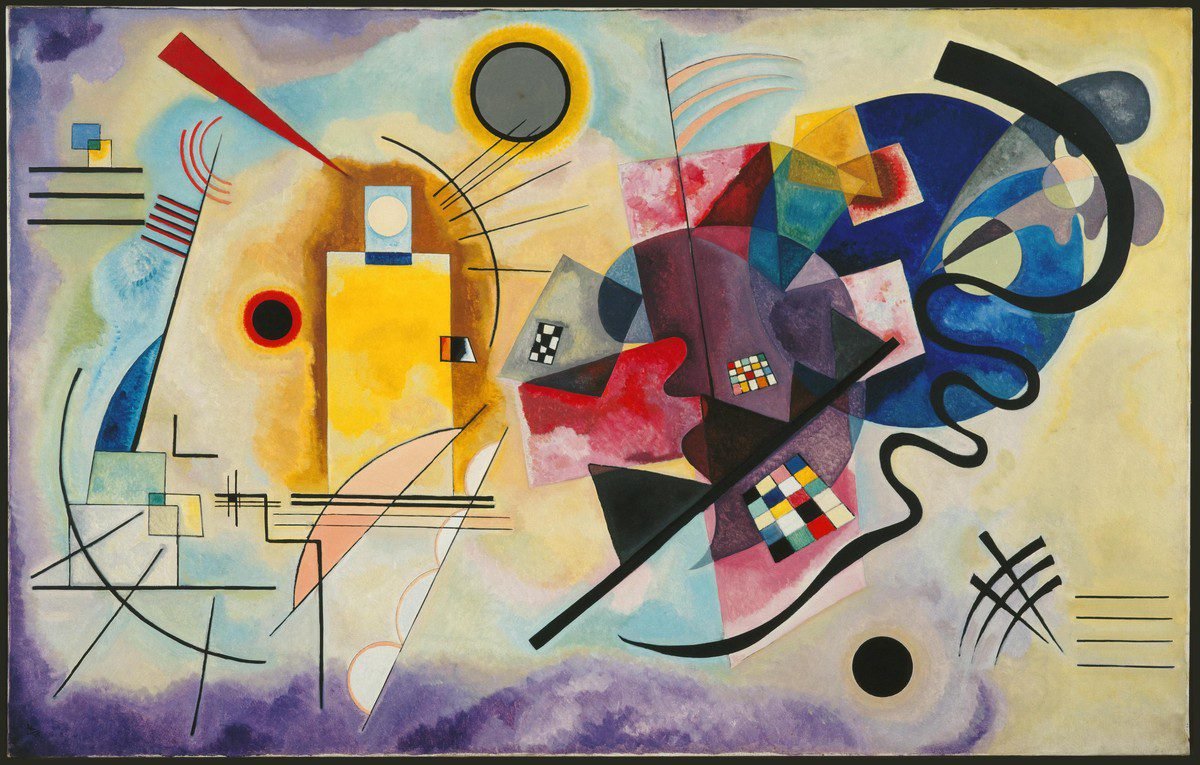
When the Bauhaus closed in 1933, Kandinsky moved to France, settling near Paris, where he lived for the rest of his life and eventually became a French citizen. His late paintings loosened again, incorporating biomorphic, almost embryonic shapes alongside the geometric vocabulary he had refined at the Bauhaus. He continued to paint and exhibit through the German occupation of France, working in relative isolation, until his death in Neuilly-sur-Seine in December 1944, days after his 78th birthday.
Kandinsky’s Theory: Color, Sound, and Spiritual Abstraction
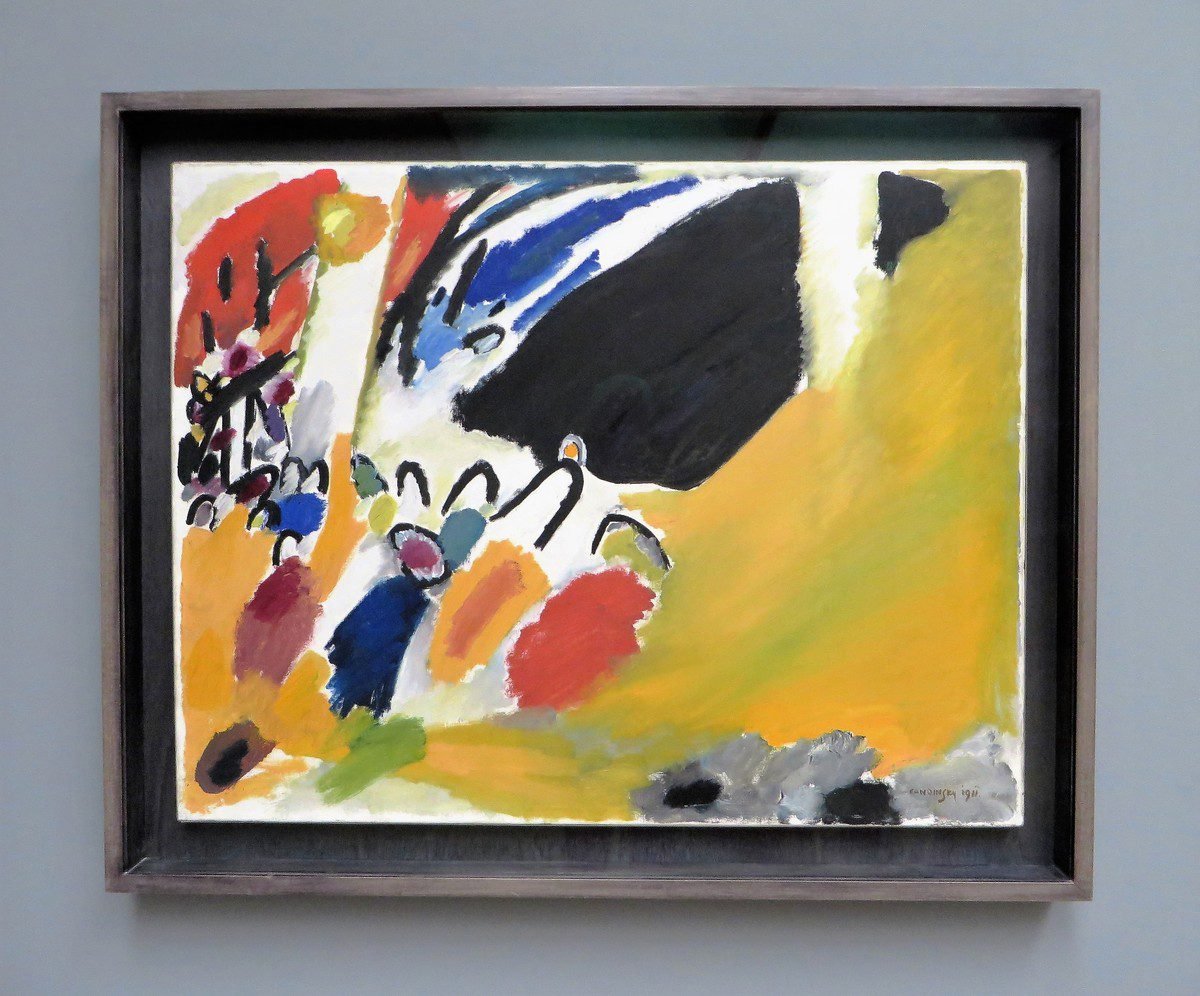
Kandinsky’s core theoretical text, Concerning the Spiritual in Art, published in 1911, argued that art was moving away from materialism toward inner, spiritual expression, and that color and form could function like music, striking the soul directly rather than through recognizable imagery. He described a form of synesthesia in which colors, sounds, and specific musical instruments seemed connected, an experience scholars still debate the precise nature of. Works titled Impression III (Concert), painted after he attended a performance by composer Arnold Schoenberg in 1911, make that cross-sensory ambition explicit in their very title.
Common Misconceptions About Kandinsky
A persistent misconception holds that Kandinsky simply woke up one day and decided to paint without any subject, as if abstraction arrived by accident, an anecdote often repeated about a canvas seen sideways in his studio. In fact, the shift from landscape to abstraction unfolds gradually across his Murnau paintings from 1908 to 1911, each one a little further from recognizable form than the last. Another misconception treats him purely as a German artist. He trained, taught, and exhibited across Russia, Germany, and France, and his Moscow years under Lunacharsky are often left out of popular accounts entirely.
Kandinsky’s Legacy in Modern and Contemporary Art
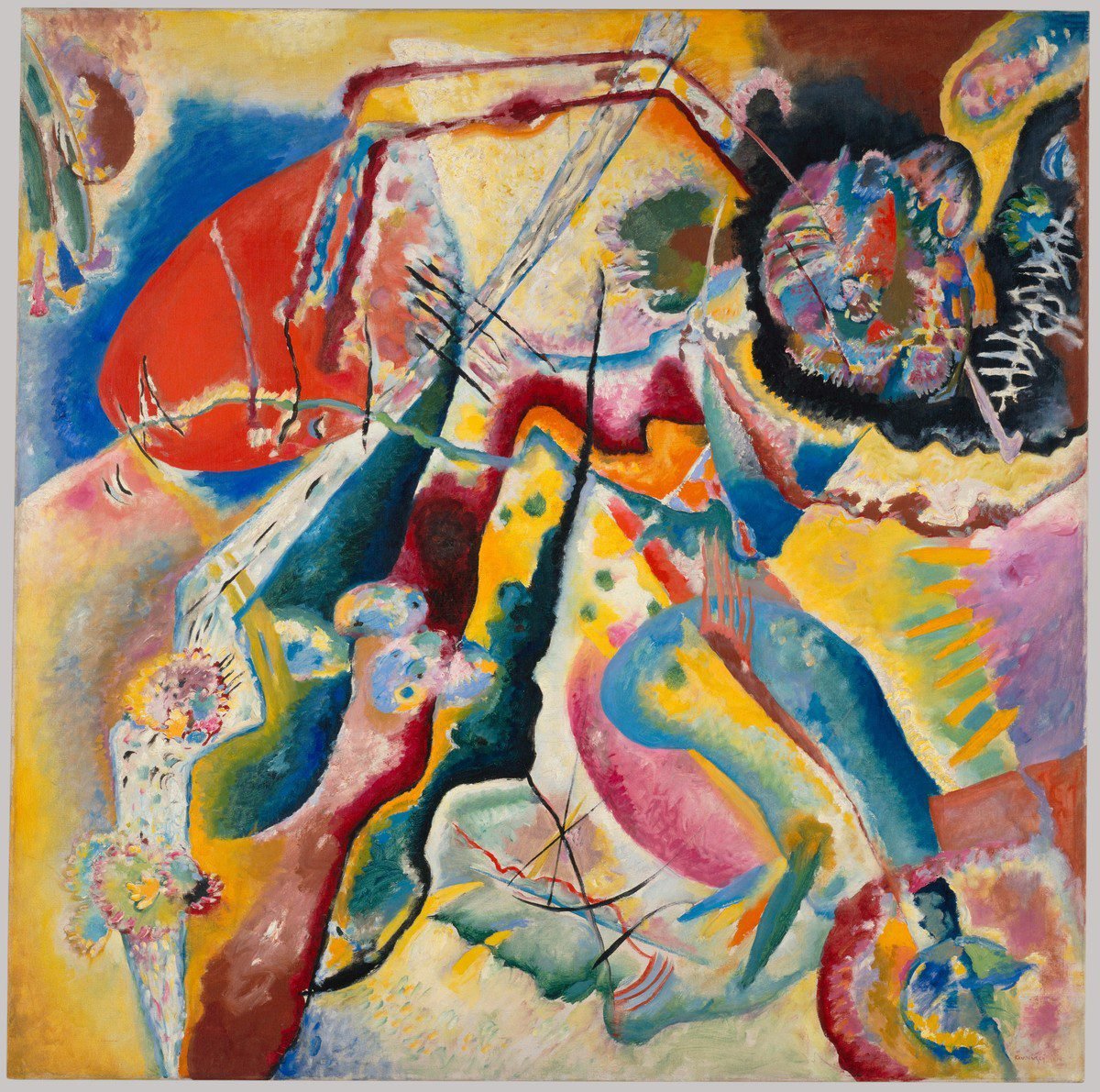
Kandinsky’s influence reaches well beyond the artists who trained directly under him at the Bauhaus. His argument that painting could function like music, independent of subject matter, underpins later American Abstract Expressionist and color field painting, even where there was no direct contact with him. Museums including the Solomon R. Guggenheim Museum in New York built early collecting strategies specifically around his non-objective work. Paintings like Bild mit rotem Fleck (Picture with a Red Spot), from the Blaue Reiter years, remain among the most reproduced works in surveys of early twentieth-century painting.
Related Movements: The Russian Avant-Garde Connection
Kandinsky’s abstraction developed largely in Munich, in dialogue with German Expressionism, but Russia was producing its own parallel break from representation at nearly the same moment. Natalia Goncharova and Mikhail Larionov were developing Cubo-Futurism and Rayonism in Moscow in the years just before World War I, arriving at fragmented, near-abstract compositions from a different direction, one rooted in folk art and Italian Futurism rather than in Kandinsky’s spiritual theory. The two currents barely overlapped directly, but together they mark Russia’s disproportionate role in the birth of abstraction.
Essential Points
- Kandinsky trained as a lawyer and economist in Moscow and did not begin formal art studies until age 30.
- He settled in Munich in 1896, studying under Anton Ažbe and then at the Academy of Fine Arts.
- With Franz Marc, he founded Der Blaue Reiter in 1911 and published its almanac in mid-May 1912.
- Composition VII (1913, State Tretyakov Gallery) layers themes of Resurrection, Judgment Day, the Flood, and Eden into a single abstract canvas.
- Gabriele Münter was both his painting student and long-term partner during the Munich and Murnau years.
- After the Russian Revolution, he worked under Anatoly Lunacharsky to build early Soviet art institutions before returning to Germany in 1920.
- From 1922 to 1933 he taught at the Bauhaus, until the Nazis forced the school to close.
- He spent his final years in France, developing a looser, biomorphic late style until his death in 1944.
Frequently Asked Questions
- What is Wassily Kandinsky known for?
- Kandinsky is best known as one of the first Western painters to create fully abstract works, art without a recognizable subject. He linked color and form to music and spirituality, co-founded the Munich group Der Blaue Reiter, and later taught color theory at the Bauhaus in Germany.
- Why didn’t Kandinsky start painting until he was 30?
- He trained as a lawyer and economist in Moscow and even lectured at Moscow University. Only in 1896, at 30, did he move to Munich to study art formally, turning down an academic law post to begin life drawing and anatomy classes instead.
- What do the shapes in Composition VII actually mean?
- Art historians read overlapping references to the Resurrection, the Last Judgment, the biblical Flood, and the Garden of Eden in its swirling forms. No single image dominates; Kandinsky built meaning through color and rhythm rather than illustration, central to his theory of abstract painting.
- Was Gabriele Münter more than Kandinsky’s student?
- Yes. Münter began as his painting student around 1901 but became his partner and an accomplished Expressionist painter in her own right. She bought the Murnau house that anchored the Blaue Reiter circle and preserved many of Kandinsky’s paintings through two World Wars.
- Where can you see Kandinsky’s paintings today?
- Major holdings include the State Tretyakov Gallery in Moscow (Composition VII), the Lenbachhaus in Munich, the Centre Pompidou in Paris, and the Solomon R. Guggenheim Museum in New York, which built one of the world’s largest Kandinsky collections around his non-objective work.
This guide was written and reviewed by the rus-art.com editorial team, specializing in Russian art history. We cross-check dates, attributions, and museum holdings against museum and academic sources.