Quick Answer
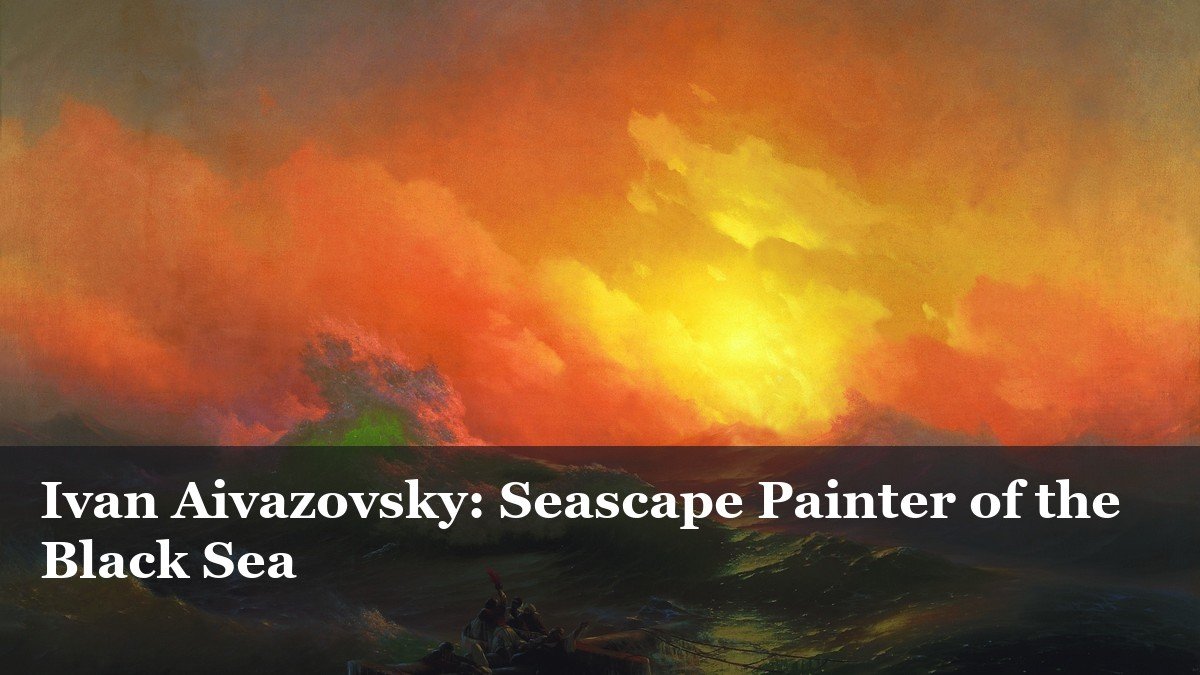
Ivan Aivazovsky (1817-1900) was a Russian Romantic painter of Armenian descent, born in the Crimean port of Feodosia, who became the leading marine artist of his era. Trained at the Imperial Academy of Arts in Saint Petersburg and later appointed chief painter of the Russian Navy, he spent nearly sixty years painting the Black Sea and other waters, producing thousands of canvases. His 1850 painting The Ninth Wave remains his most famous work, prized for its dramatic light and depiction of human survival against the sea’s power.
What Is a Seascape Painter? Defining Aivazovsky’s Art
A seascape painter turns the sea itself, its light, weather, and motion, into the subject of a painting rather than the setting for one. Ivan Aivazovsky (1817-1900) is the most celebrated Russian painter to work this way, spending a lifetime studying how the Black Sea‘s mood changes from hour to hour.
Born in the Crimean port of Feodosia, Aivazovsky worked almost exclusively in marine art for nearly sixty years and left behind an estimated 6,000 canvases, far more than most of his 19th century peers managed. He belongs to the broader European tradition of maritime painting that ran from the 17th through the 19th centuries, but he pulled the genre toward Romantic drama: storms, moonlight, shipwrecks, and open water lit with an almost unnatural glow.
Earlier ship portraitists painted vessels. Aivazovsky painted the sea itself as a character, capable of menace, beauty, and something close to the sublime.
From Feodosia to St. Petersburg: An Armenian Boy’s Path to the Academy
Aivazovsky was born on 29 July 1817 in Feodosia, a Black Sea port in Crimea, to Armenian parents, and baptized Hovhannes Aivazian. Local patrons noticed his talent for drawing early and arranged his schooling, first in Simferopol, then at the Imperial Academy of Arts in Saint Petersburg, the step that shaped the rest of his career.
The Academy gave him the formal grounding of European landscape and marine painting, but what stayed with him came from watching the sea directly: how its color shifts hour by hour, how a wave breaks, how storm light bends through cloud and spray. By his early twenties he had already set himself apart from classmates working in conventional landscape modes. Water was his subject, at a time when almost no Russian painter had made that choice.
Naples and the European Years: Sharpening a Signature Style
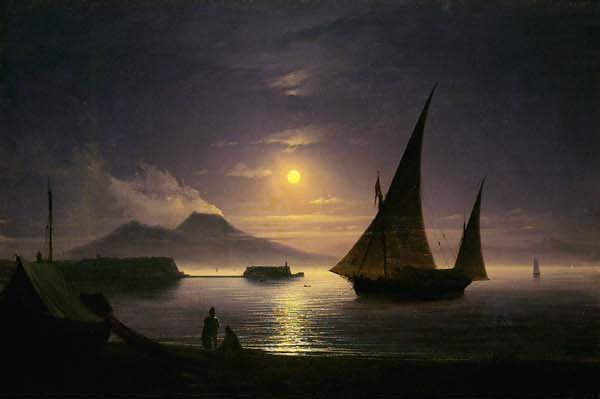
In the early 1840s, once his Academy training ended, Aivazovsky traveled through Europe and settled for a time in Naples. The Bay of Naples, with its volcanic light and its harbor traffic, offered him a different coastal vocabulary than the Black Sea had taught him, and he picked it up fast, exhibiting in Italy and elsewhere in Europe to genuine acclaim.
Why Did Aivazovsky Travel to Italy Early in His Career?
Italy was the usual finishing stop for Academy-trained Russians, but for a marine specialist it offered something more particular: warm coastal light, working ports, and an audience already inclined to admire seascapes. His years there sharpened his handling of luminosity, moonlight and sunset over water especially, qualities that would define his mature style once he was back in Russia.
Chief Painter of the Imperial Navy
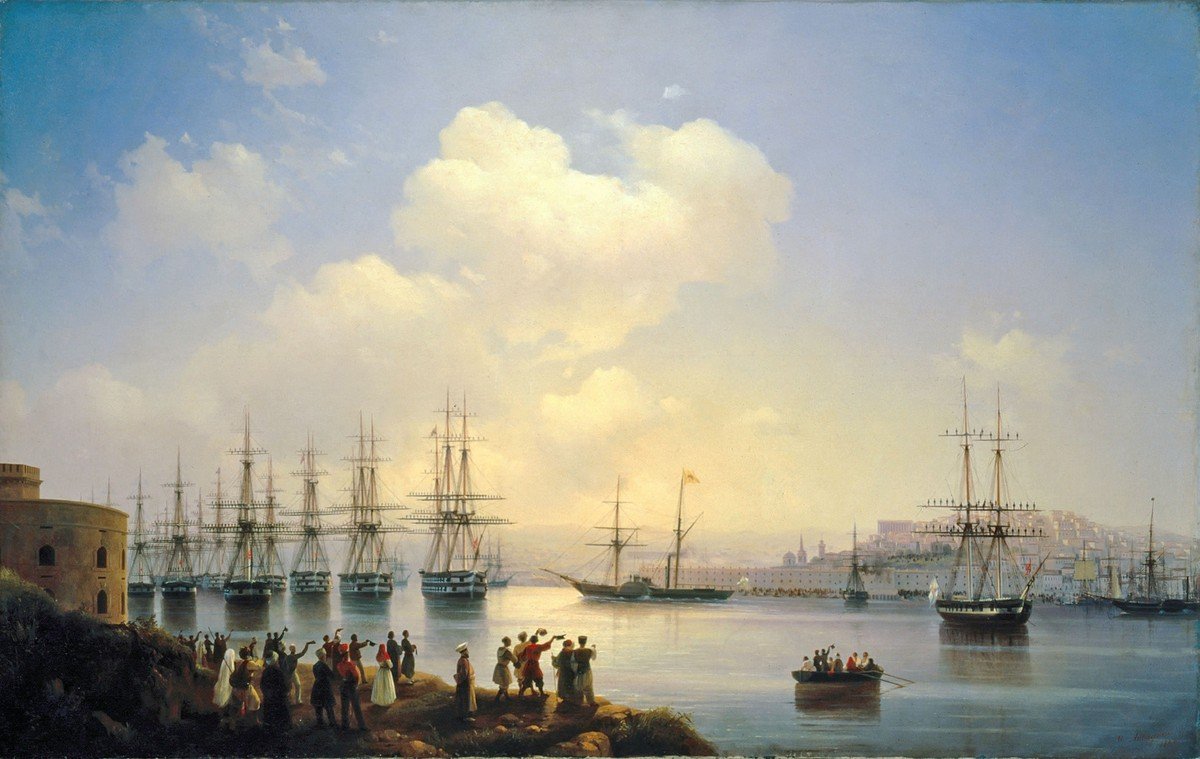
Back in Russia, Aivazovsky was appointed main painter of the Russian Navy, a post that opened doors to fleets, ports, and military campaigns most artists never saw. He built close ties with the Empire’s military and political elite and often watched maneuvers in person, studying ships and formations he would later rebuild on canvas.
The Russian Squadron on the Sebastopol Roads (1846) shows the practical side of the job: naval strength recorded with the same dramatic light he brought to his invented storms. The appointment also brought him a level of state support few painters of his time could count on.
What Makes The Ninth Wave Aivazovsky’s Masterpiece?
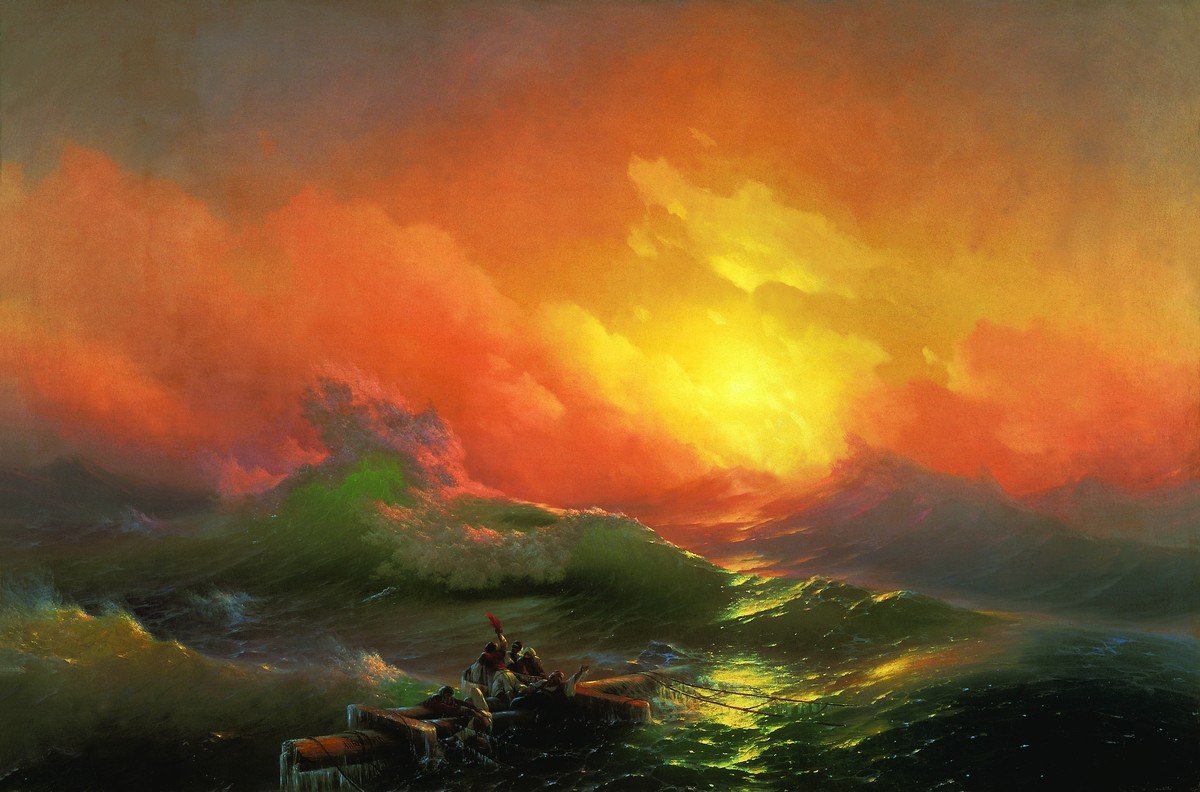
Painted in 1850 and held today at the State Russian Museum in Saint Petersburg, The Ninth Wave shows shipwreck survivors clinging to floating debris after a night of storm, waiting out the ninth wave, an old sailing term for the outsized wave sailors believed followed a run of smaller ones. The wreckage settles into a rough cross shape, a detail widely read as a Christian metaphor for salvation.
What sets the painting apart is its warmth. Aivazovsky lit the scene with a golden sunrise instead of cold, hostile tones, softening the sea’s menace and leaving the survivors’ fate genuinely open rather than decided. Violence and beauty share the same frame, and that balance is why the painting remains his most reproduced and most discussed work.
Defining Features: Light, Motion, and Memory Over Observation
A handful of traits mark Aivazovsky’s mature style: dark storm clouds set against glowing horizons, waves painted with a sense of continuous motion rather than a single frozen instant, and a pull toward extreme light, moonlight, sunrise, sunset, over flat daylight.
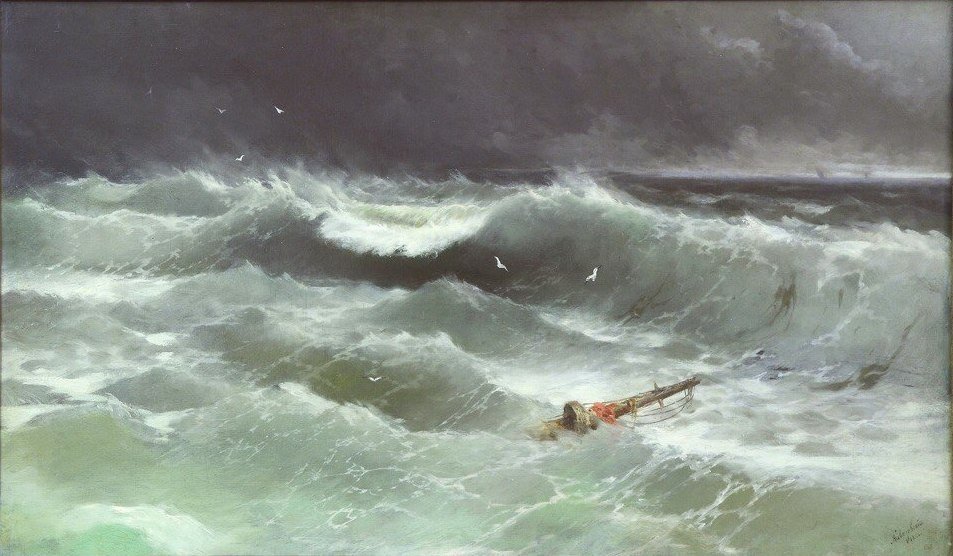
Breaking Wave (1895), painted in his late seventies, shows these habits still intact decades into his career: thin, luminous glazes over the water and a tight focus on one dramatic swell rather than a full panoramic view. Set against the more documentary marine painters of his generation, Aivazovsky consistently chose emotional intensity over topographic accuracy.
Painting From Memory: How Did Aivazovsky Work Without Sketching at Sea?
Unlike many landscape painters of his time, Aivazovsky is described by his biographers as having worked mainly from memory in the studio rather than painting directly from nature at the shoreline. He trained himself, by most accounts, to take in a wave or a sky in a brief glance and reconstruct it later on canvas, a method that let him work fast and turn out paintings at a pace few contemporaries could match.
This method explains both the size of his output and a criticism that follows him still: seen in large groups, individual paintings can feel formulaic, because he was drawing on a repertoire of remembered effects rather than a single observed scene each time.
Rivals and Contemporaries: Lagorio, Bogolyubov, and the Marine Painting Scene
Aivazovsky did not work alone. Lev Lagorio (1826-1905), linked to the so-called Cimmerian school active in southern Crimea, also built a career largely on seascapes, moving between Crimea and Saint Petersburg through the reigns of several tsars. Alexey Bogolyubov (1824-1896) likewise specialized in landscape and marine subjects, often working along the Black Sea and Europe’s coastlines.
Was Aivazovsky the Only Notable Russian Marine Painter of His Time?
No. He was the most famous and the most prolific, but he worked alongside a real community of marine specialists. What set him apart was less the subject itself than sheer output, state patronage, and a handling of light so distinctive that his canvases are recognizable even to viewers who know nothing else about the genre.
Notable Works Beyond The Ninth Wave
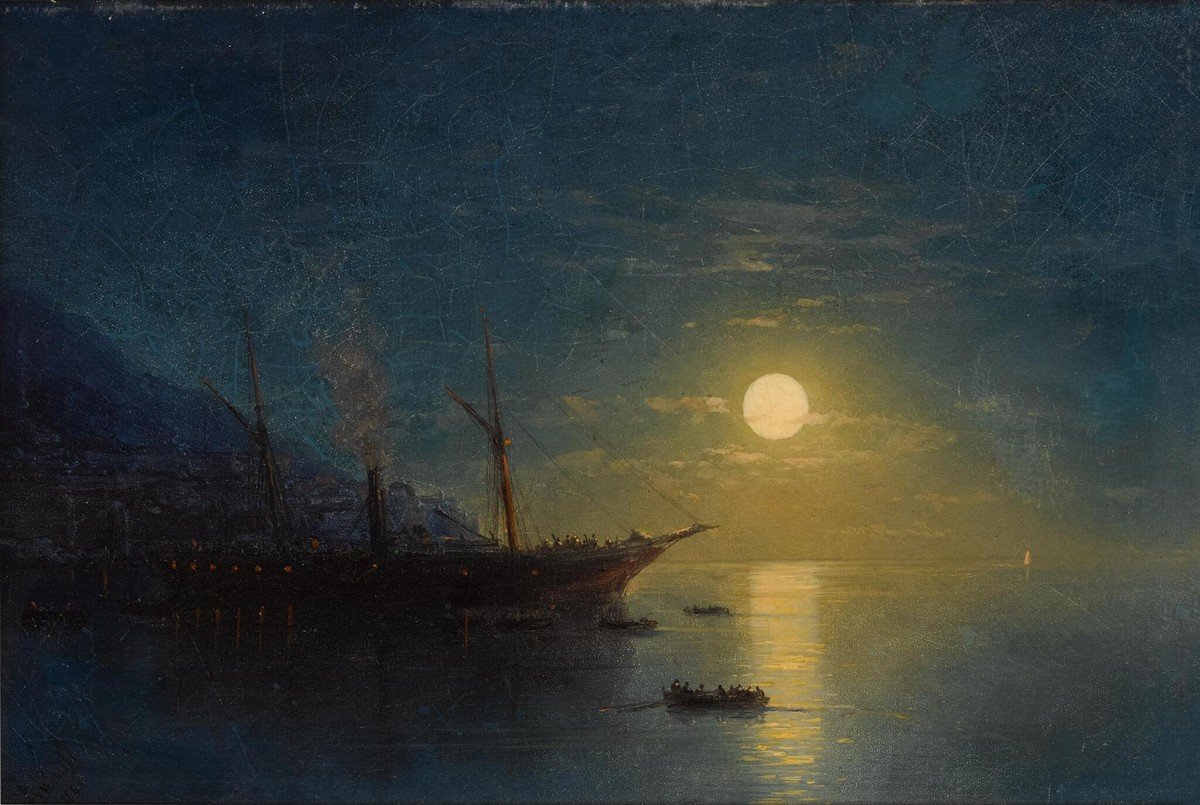
Aivazovsky’s catalogue goes well beyond his single best known painting. Steamship on a Moonlit Night (1884) shows his continuing interest in nocturnal effects late in his career, a single vessel and a narrow band of moonlight organizing an otherwise dark composition. Ships on a Misty Morning (1888) works in a quieter register, atmospheric haze standing in for the storm drama of his more famous canvases.
Taken together, these works show an artist circling back again and again to a narrow set of conditions, storm, calm, dawn, moonlight, and finding a different effect inside each one rather than repeating a single formula.
Myth vs. Fact: Did Aivazovsky Paint at the Water’s Edge?
Myth: Aivazovsky set up his easel on the shore to capture the sea as it moved. Fact: he worked mostly from memory in his Feodosia studio, relying on a trained visual recall of storms and light rather than painting en plein air, a method many biographers describe as central to his speed and output.
War, Diplomacy, and the Brush: Aivazovsky’s Political Role
His Navy appointment and his ties to the imperial court meant Aivazovsky’s paintings often carried a documentary, even diplomatic function. A Ship of the Russian Navy off the Coast (1875) reflects that dual purpose: part artwork, part visual record of naval presence and capability.
Standing this close to military and political power meant his work was regularly seen by the very people deciding the fate of the fleets he painted, access that shaped both his subject matter and his standing within the Empire.
Was Aivazovsky Really That Prolific?
Yes, by most accounts strikingly so. Across nearly sixty years, Aivazovsky is often credited with roughly 6,000 finished paintings, a figure that would place him among the most productive major painters of the 19th century in any country. That pace demanded both speed of execution and a willingness to return to familiar subjects.
His range went beyond the Black Sea. Frozen Bosphorus Under Snow (1874) shows he handled ice and winter light just as capably, proof that his reputation as a specialist meant a consistent focus on water in all its states, not a narrow one.
The Feodosia Years: Founding a Gallery and Giving Back
Though he traveled and exhibited widely, Aivazovsky stayed based in Feodosia for most of his life and used his success to benefit the city directly. He founded a picture gallery there and gave it a significant body of his own work, effectively creating one of Russia’s first artist-founded regional museums.
Contemporaries painted him too. Konstantin Makovsky’s 1887 portrait catches Aivazovsky at the height of his fame, already established as one of the most recognized painters in the Russian Empire.
Legacy in Russian and Armenian Culture
Aivazovsky died on 2 May 1900 in Feodosia, the city where he was born. He remains hugely popular in Russia today, and the Russian phrase “worthy of Aivazovsky’s brush,” popularized by Anton Chekhov, is still used to describe a scene of striking natural beauty.
His Armenian heritage gives him a distinct place in Armenian cultural memory too, where he is claimed as one of the most significant Armenian artists of the modern era, even though nearly his entire career played out within the Russian Empire’s institutions and patronage networks.
Why Do Collectors and Museums Still Compete for His Work Today?
Technical polish, dramatic subject matter, and his historical importance to the Russian Navy keep Aivazovsky’s paintings in steady demand at auction and in museum acquisitions. Because he was so prolific, a relatively large number of authentic works remain in circulation compared to rarer 19th century painters, and that abundance has sharpened collector interest rather than dulled it.
His exhibition history matters too: solo shows in Europe and the United States during his lifetime mean his work was never confined to Russian collections, giving him a wider global market presence than most of his marine painting contemporaries.
Common Misconceptions About Aivazovsky
One misconception won’t die: that Aivazovsky painted only calm, decorative seascapes suited to a drawing room wall. A large share of his output actually depicts storms, shipwrecks, and naval battles, subjects with real violence and stakes, not decoration.
Another common error labels him simply “a Russian painter,” skipping past his Armenian birth name and heritage, or assumes he painted straight from observation at the coast, when his method leaned heavily on memory and studio reconstruction rather than plein air practice.
Connections to Romanticism and Later Russian Landscape Painting
Dramatic lighting, an emphasis on nature’s overwhelming scale, and a fascination with extreme weather place Aivazovsky firmly within Romanticism, the broader European movement that valued emotional intensity and the sublime over restrained classical order. His work came before the more naturalistic, socially engaged landscape painting that would later dominate Russian art through groups like the Peredvizhniki.
He never founded a school of direct followers the way some contemporaries did, but as the country’s foremost marine specialist, he had effectively defined the field for decades before any later Russian seascape painter picked up a brush.
Where to See Aivazovsky’s Paintings Today
Aivazovsky’s best known painting, The Ninth Wave, hangs in the State Russian Museum in Saint Petersburg. The State Tretyakov Gallery in Moscow also holds significant examples of his work, and the Aivazovsky Gallery he founded in Feodosia, still dedicated entirely to his output, remains something of a pilgrimage site for his admirers.
Beyond Russia, museums and private collections across Europe and the United States hold paintings from his decades of international exhibitions, evidence of just how widely his work traveled during and after his lifetime.
Essential Points
- Ivan Aivazovsky (1817-1900) was born Hovhannes Aivazian to Armenian parents in Feodosia, Crimea, on the Black Sea coast.
- He trained at the Imperial Academy of Arts in Saint Petersburg before spending the early 1840s in Italy, including Naples.
- Russia’s Navy appointed him its official painter, giving him access to fleets, maneuvers, and military elites.
- The Ninth Wave (1850), held at the State Russian Museum, is his best known work and a landmark of Russian Romanticism.
- He is estimated to have completed around 6,000 paintings over a roughly sixty year career, an unusually high output for the period.
- He founded and donated a picture gallery to his native Feodosia, which still bears his name today.
- Contemporaries such as Lev Lagorio and Alexey Bogolyubov worked in the same marine genre but never matched his fame or volume.
- The Russian phrase “worthy of Aivazovsky’s brush,” popularized by Anton Chekhov, is still used to describe something strikingly beautiful.
Frequently Asked Questions
- What is Ivan Aivazovsky most famous for?
- Aivazovsky is best known as Russia’s leading marine painter, famous above all for The Ninth Wave (1850), a dramatic depiction of shipwreck survivors facing a giant wave at dawn. He spent nearly sixty years painting the sea, mostly around the Black Sea, and completed an estimated 6,000 works.
- Why did the Russian Navy appoint Aivazovsky as its painter?
- His skill at rendering ships, fleets, and sea conditions convincingly made him valuable for both artistic and documentary purposes. The appointment gave him access to naval maneuvers and the imperial military elite, and in return his paintings recorded and celebrated Russian naval power.
- Did Aivazovsky paint outdoors by the sea?
- Rarely, according to most biographical accounts. He is described as working mainly from memory in his Feodosia studio, having trained himself to recall wave patterns and light effects rather than painting directly at the shoreline, which allowed him to produce work at an unusually fast pace.
- Was Ivan Aivazovsky Armenian or Russian?
- Both, in different senses. He was born Hovhannes Aivazian to Armenian parents in Feodosia, Crimea, then part of the Russian Empire. He built his entire career within Russian imperial institutions, and today he is claimed as a major figure in both Russian and Armenian art history.
- Where can I see Aivazovsky’s paintings today?
- The State Russian Museum in Saint Petersburg holds The Ninth Wave, his most famous work. The State Tretyakov Gallery in Moscow and the Aivazovsky Gallery he founded in Feodosia also hold major collections, alongside museums in Europe and the United States from his international exhibitions.

This guide was written and reviewed by the rus-art.com editorial team, specializing in Russian art history. We cross-check dates, attributions, and museum holdings against museum and academic sources.