Quick Answer
Isaac Levitan (1860-1900) was a Russian landscape painter who created the mood landscape, a style where weather, light, and empty space carry emotion rather than narrative. Trained under Alexei Savrasov and Vasily Polenov at the Moscow School of Painting, Sculpture and Architecture, Levitan painted the Volga River towns and the fields around Moscow, producing works like Golden Autumn and Above Eternal Peace that shaped how generations of viewers picture the Russian countryside.
What Is a Mood Landscape?
A mood landscape is a painting where weather, light, and empty space are the subject, not backdrop for a story or a person. Russian critics of the 1880s and 1890s reached for the word nastroenie, mood or state of feeling, to name exactly this shift in Isaac Levitan‘s work. Earlier Russian landscape painting, even skilled work by artists like Ivan Shishkin, tended toward careful botanical or topographic record: a specific forest, rendered with near scientific attention to bark and needle. Levitan asked a different question: what did a late afternoon in October, or a wet road at dusk, feel like to stand inside? He stripped almost all human figures from his mature paintings, letting a bend in a river or a line of birches carry the emotional weight a portrait or genre scene would normally hold. No formal school grew up around the approach, no manifesto, no rules. It developed through Levitan’s own practice, and only after his major exhibitions in the late 1880s did critics name it and other painters begin to imitate it.
A Student Without a Home: Levitan’s Early Years
Isaac Ilyich Levitan was born on 30 August 1860 in Kibarty, in the Kaunas region of what is now Lithuania, into a poor Jewish family. He enrolled at the Moscow School of Painting, Sculpture and Architecture around age thirteen, and by his mid teens both his parents had died, leaving him and his siblings without steady income. Fellow students later recalled him sleeping in the school building because he had nowhere else to stay. Even so, his talent showed early: a landscape he submitted as a student won a small silver medal, and teachers began treating him as a serious prospect rather than a charity case. Isaac Levitan later remembered these years as formative for the attentiveness to atmosphere that would define his mature work, an attentiveness sharpened, perhaps, by how much time he spent simply outdoors with nowhere better to go.
Savrasov’s Lesson: Painting a Feeling, Not a Field
Who taught Isaac Levitan to paint?
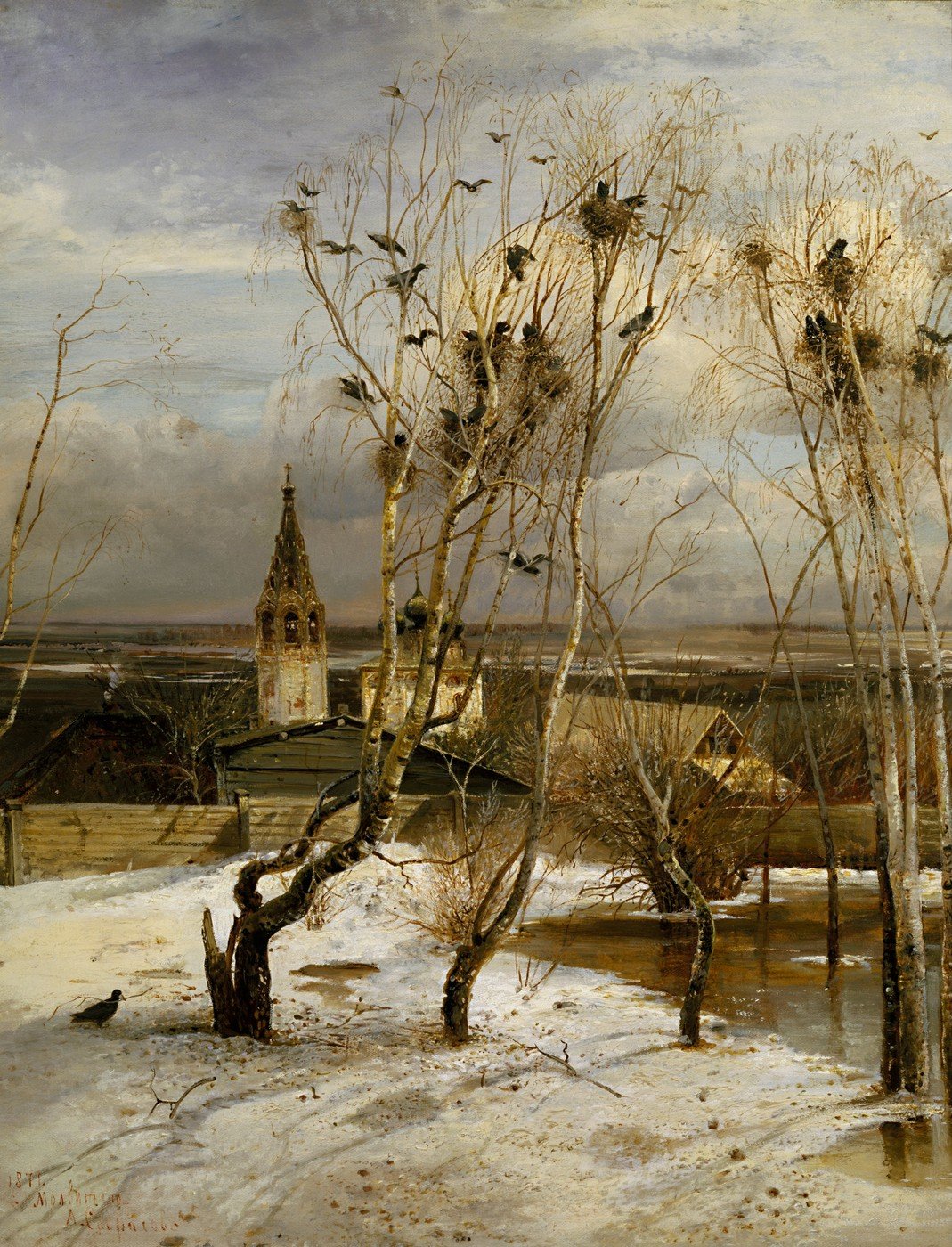
Levitan’s most direct influence was Alexei Savrasov, who taught the landscape class at the Moscow School and had already broken with strict topographic painting in his own work. Savrasov’s The Rooks Have Returned (1871), with its bare birches and dirty melting snow around a village church, treats an unglamorous early spring scene as worthy of full attention: proof that a landscape did not need grandeur to carry meaning. Savrasov called this approach the lyrical landscape, and it stands as the direct ancestor of what critics would later call Levitan’s mood landscape. Savrasov took students on painting excursions outside Moscow and insisted they paint from direct observation rather than studio invention, a habit Levitan kept for the rest of his career. By the late 1870s, though, Savrasov’s alcoholism had worsened, and the school dismissed him in 1882, leaving Levitan and his classmates to finish their training under Vasily Polenov instead.
Expelled from Moscow: Levitan and the Residency Laws
Levitan’s career was interrupted twice by residency restrictions targeting Jewish subjects of the Russian Empire. In 1879, following an assassination attempt on Tsar Alexander II, authorities expelled Jewish residents from Moscow, and the teenage Levitan was forced out to the suburb of Saltykovka, a period he later recalled as one of real hardship. Supporters intervened to let him back into the city, but in 1892 a second, broader expulsion order forced him out again, by then an established painter with gallery sales behind him. He settled temporarily outside the city until friends secured another exemption. These expulsions were not incidental biography. They pushed Levitan toward long stays in provincial towns and river landscapes rather than Moscow subjects, reinforcing the rural, often solitary character of his mature work.
What Makes a Levitan Landscape Look Like a Levitan?
What are the defining features of Levitan’s painting style?
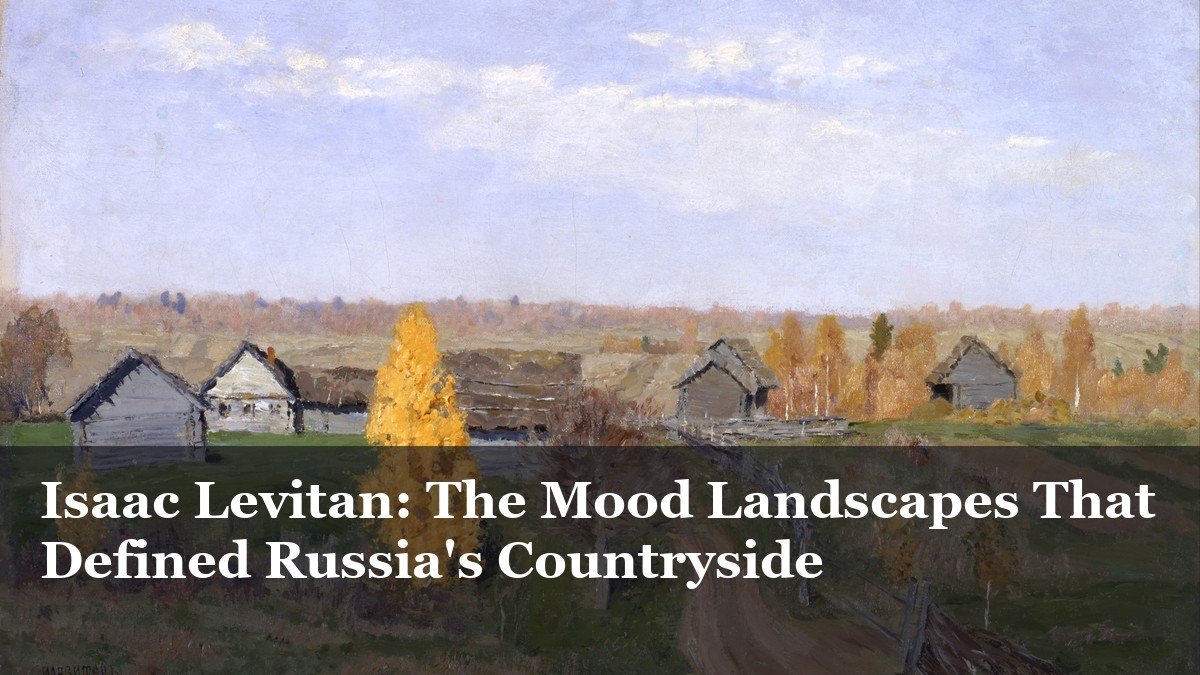
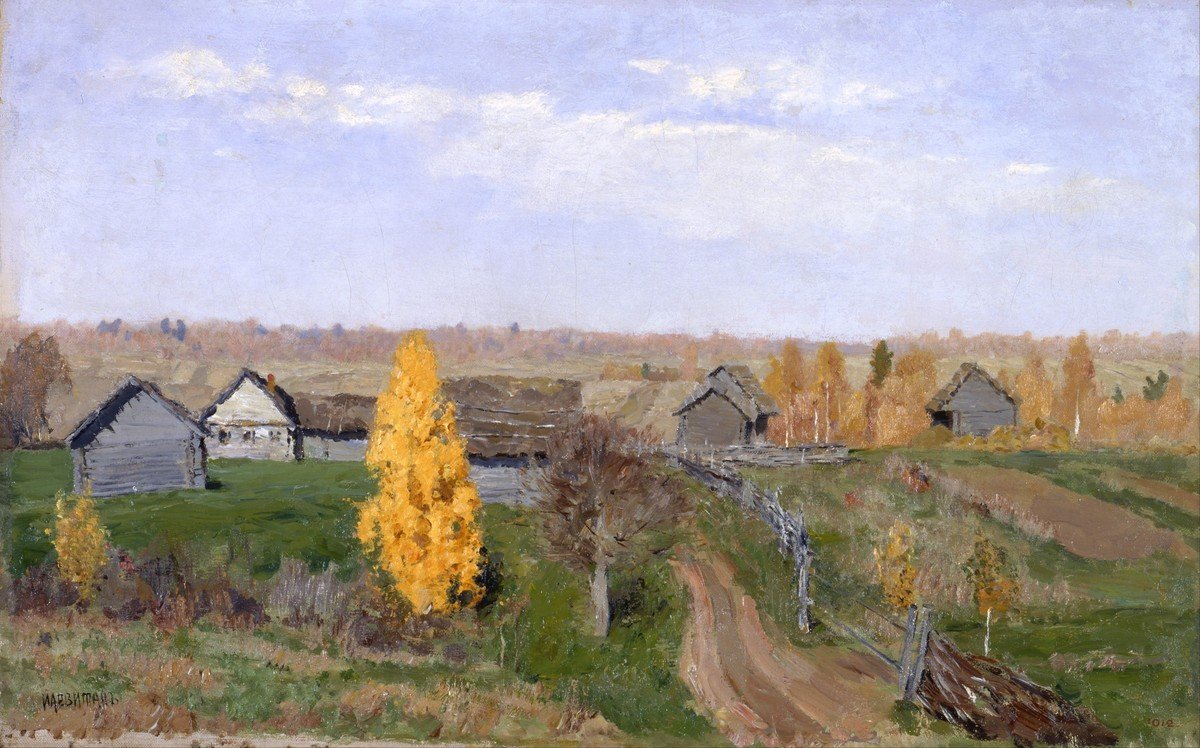
Three habits recur across Levitan’s mature work. First, he favored transitional light: dawn, dusk, or the low sun of early autumn, moments when color shifts quickly and shadows stretch long. Second, he built his compositions around a single strong diagonal, usually a river, road, or tree line, pulling the eye into deep space rather than arranging the canvas as a flat, decorative pattern. Third, he all but eliminated narrative incident. Where a Peredvizhniki genre painter would place a peasant or a cart in the scene to anchor a story, Levitan left the road or field empty, letting the viewer supply the emotional reading. Golden Autumn (Slobodka), painted in 1889 near the village of Slobodka outside Moscow, shows all three traits at once: a river bending away under a stand of birches lit low and gold, with no figure in sight.
The Volga Years: Plyos and the Making of a Style
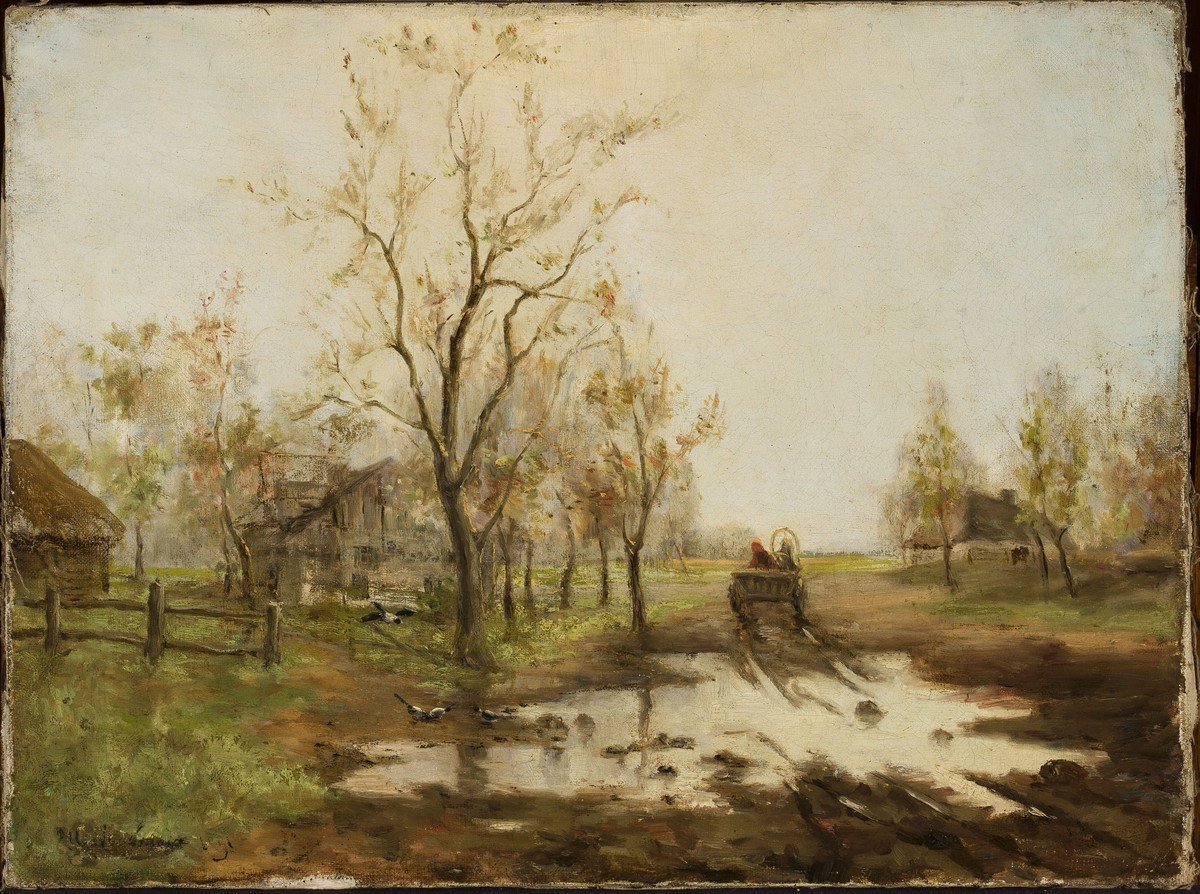
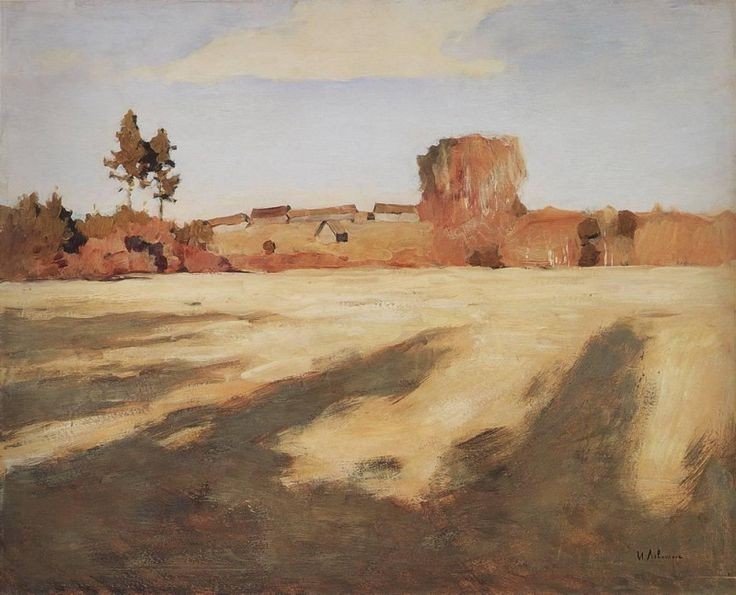
Between 1888 and 1890, Levitan spent three summers in Plyos, a small town on the Volga River northeast of Moscow, and the paintings from those seasons are usually treated as the point where his mature style crystallized. Away from the pressures of Moscow exhibitions, he painted the same modest views again and again under different light and weather, treating the same wooden church or riverbank almost as a study subject, the way Savrasov had taught him. Motley Field, from around 1890, and Springtime in the Countryside, from 1891, both come from this stretch of intensive plein air work in the countryside, and both show the looser, more atmospheric brushwork that set his output apart from his student years. Critics and buyers noticed the change quickly. Dealers and collectors, including Pavel Tretyakov, began actively seeking out his new canvases rather than waiting for him to bring work to them.
The Vladimirka and Landscape as Moral Statement
Not every Levitan landscape is purely about weather. The Vladimirka, painted in 1892, shows a long dirt road stretching to the horizon under a heavy sky, a road historically used to march convicts to Siberian exile. Levitan recognized the road while sketching near it and understood at once what it meant to any Russian viewer of the period. No figures appear in the painting, yet the empty road itself carries the full weight of forced exile, a subject with personal resonance given his own expulsions from Moscow that same year. It is one of the clearest cases in his output where an apparently plain rural scene functions as social commentary, aligning him, for once, with the Peredvizhniki’s interest in Russian social conditions even while he kept his usual distance from painting people directly.
Above Eternal Peace: Landscape as Philosophy
By the mid 1890s, Levitan was pushing the mood landscape toward openly philosophical territory. Above Eternal Peace, completed in 1894, shows a small wooden church and graveyard on a bluff over a vast lake under a churning sky, painted from studies made on Lake Udomlya. Levitan described the painting in letters as an attempt to capture something like the relationship between an individual human life and eternity, with the tiny church standing in for all of human settlement against the scale of water and sky. The canvas marks the furthest point of his movement away from Savrasov’s more intimate lyrical landscapes toward something closer to religious or existential meditation, a direction that reflected Levitan’s own poor health and recurring bouts of depression in this period.
Look Closer: Look closer at Golden Autumn
In Golden Autumn (Slobodka), 1889, look at the birch trunks against the river: Levitan paints them with almost no outline, just shifts of cool blue and warm ochre paint laid side by side. Step back and the trunks snap into focus. It is a trick borrowed from how the eye actually blends color at a distance, not from careful line drawing.
Chekhov, Serov, and the Circle Around Levitan
Was Levitan connected to other major Russian artists of his time?
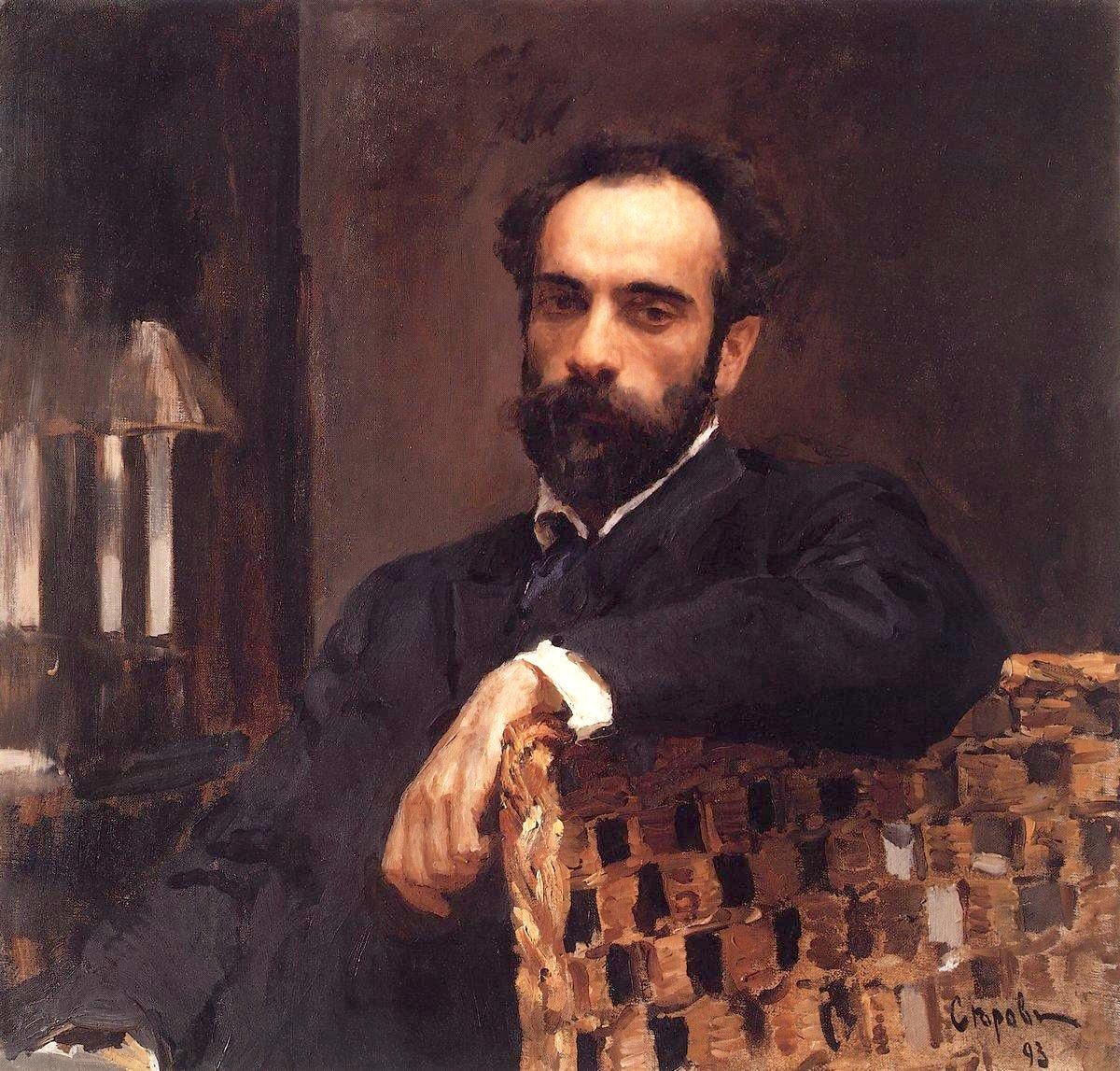
Levitan’s closest friendship outside painting was with the writer Anton Chekhov, whom he met as a student in the 1870s. The two spent summers together in the countryside, and Levitan painted a small portrait of Chekhov in 1885. The friendship briefly fractured after Chekhov published ‘The Grasshopper’ in 1892, a story whose unflattering landscape painter character readers recognized as partly based on Levitan, though the two later reconciled. Within painting circles, Levitan was close to Valentin Serov, who painted a formal portrait of him in 1893 showing a slightly built, intense man that matches contemporary descriptions of his temperament. These relationships placed Levitan inside Moscow’s overlapping literary and artistic worlds even as his own paintings remained almost entirely free of the human presence that defined his friends’ portraiture and prose.
Polenov and Kuindzhi: Contemporaries, Different Paths
Levitan’s landscape style developed alongside, and partly against, two other major figures. Vasily Polenov, who taught Levitan after Savrasov’s dismissal, painted lighter, more domestic scenes such as Moscow Courtyard (1878), which treats an ordinary backyard with the same warmth Levitan brought to open fields, though Polenov kept the figures and architectural detail Levitan increasingly dropped. Arkhip Kuindzhi took a more theatrical route, exploiting dramatic contrasts of light, as in his moonlit Dnieper river scenes, to produce landscapes closer to spectacle than mood. Levitan admired both but settled on a quieter register than either, favoring the muted transitional light of dawn and dusk over Polenov’s clear daylight or Kuindzhi’s engineered glow. Set side by side, the three show how varied Russian landscape painting had become by the 1880s, even among artists trained in the same Moscow institutions.
Common Misconceptions About Levitan
One persistent misconception holds that Levitan painted only cheerful, idyllic countryside scenes. In fact, works like The Vladimirka and his final unfinished painting, Lake, engage directly with exile, mortality, and isolation, and his own letters describe long periods of depression that shaped his subject choices. Another common error treats him as a founding member of the Peredvizhniki (Wanderers) society. He exhibited with the group starting in the 1880s and shared some of its exhibition infrastructure, but he joined well after its 1870 founding by artists including Ivan Kramskoi, and his subject matter, near total avoidance of human figures and social narrative, sat apart from the group’s core social realist mission.
Teaching the Next Generation
In 1898, two years before his death, Levitan was appointed head of the landscape studio at the Moscow School of Painting, Sculpture and Architecture, the same institution where he had once slept in classrooms for lack of housing. Tuberculosis, which had troubled him since the early 1890s, limited how actively he could teach, but students in his studio absorbed his emphasis on working directly from nature and treating light as the primary carrier of meaning in a landscape. He died on 4 August 1900 in Moscow at age thirty nine, leaving an unfinished painting titled Lake on his easel. His influence carried forward less through direct pupils than through the wide acceptance of the mood landscape as a legitimate, serious mode of painting, one that later Russian and Soviet landscape painters continued to work within.
Levitan’s Legacy in Russian Art
By the time of his death, the mood landscape had moved from an individual innovation to an accepted category in Russian art criticism, and museums began actively collecting Levitan alongside established Peredvizhniki figures. The State Tretyakov Gallery in Moscow, whose founder Pavel Tretyakov had bought Levitan’s work during his lifetime, holds the core of his major paintings today, including Above Eternal Peace and Golden Autumn’s related studies. His example gave later Russian landscape painters, working across the very different political conditions of the early Soviet period, a precedent for treating landscape as a vehicle for interior feeling rather than only topographic record or social message, a precedent critics still cite when discussing the emotional register of Russian landscape painting.
Where to See Levitan’s Paintings Today
Where can visitors see Isaac Levitan’s original paintings?
The State Tretyakov Gallery, in Moscow, holds the largest and most significant collection of Levitan’s work, including Above Eternal Peace and numerous Plyos period canvases, making it the essential destination for viewing his output in depth. The State Russian Museum in St. Petersburg holds additional major paintings and works on paper. Smaller but genuine holdings appear in regional Russian museums and in collections such as the National Museum in Warsaw, which holds Springtime in the Countryside and other works that left Russia through the art market over the past century. Outside Russia, Levitan remains less consistently represented in Western museum collections than contemporaries like Ilya Repin, so most focused study of his output still means a trip to Moscow or St. Petersburg.
Related Movements: The Peredvizhniki and Beyond
Levitan’s career sits at the edge of the Peredvizhniki, the Wanderers, a group of realist artists who broke from the Imperial Academy of Arts in 1870 to bring exhibitions directly to provincial audiences and to prioritize socially engaged Russian subject matter over academic historical and mythological themes. Levitan exhibited with the group and knew its major figures personally, but his landscapes, largely emptied of people and social message, read as something closer to a specialized branch within the broader movement than its central program. His mood landscape approach also anticipates elements of early Russian Symbolism, where atmosphere and suggestion likewise took priority over direct depiction, connecting a realist trained painter to concerns that would dominate Russian art in the following two decades.
Essential Points
- Levitan coined no manifesto, but critics used the term nastroenie (mood) specifically to describe his landscapes, distinguishing them from the topographic landscapes that came before.
- He trained under Alexei Savrasov and Vasily Polenov at the Moscow School of Painting, Sculpture and Architecture between 1873 and 1885.
- As a Jewish subject of the Russian Empire, Levitan was expelled from Moscow in 1879 and again in 1892 under residency restrictions, interruptions that shaped both his biography and his choice of rural subjects.
- His close friendship with writer Anton Chekhov, who modeled a landscape painter character partly on him in the story ‘The Grasshopper,’ placed Levitan at the center of Moscow’s literary and artistic circles.
- Levitan exhibited with the Peredvizhniki (Wanderers) but painted almost no people, a deliberate departure from the movement’s social realist subjects.
- He worked extensively in Plyos, a small Volga town, producing dozens of paintings across three summers between 1888 and 1890.
- In his final two years, tuberculosis limited his output, yet he was appointed head of the landscape studio at the Moscow School, teaching the next generation of landscape painters.
- Golden Autumn and Above Eternal Peace remain in the State Tretyakov Gallery, the museum most closely tied to Levitan’s reputation.
Frequently Asked Questions
- What is Isaac Levitan best known for?
- Levitan is best known for creating the mood landscape, a style of Russian painting where weather, light, and empty rural space convey emotion directly, without human figures or narrative incident. Paintings like Golden Autumn and Above Eternal Peace are the clearest examples of this approach.
- Why was Isaac Levitan expelled from Moscow?
- Levitan was Jewish, and imperial Russian residency laws periodically expelled Jewish subjects from Moscow, in 1879 following an assassination attempt on Alexander II and again in 1892. Both expulsions interrupted his career and pushed him toward extended stays painting in provincial towns.
- How did Levitan’s technique differ from earlier Russian landscape painters?
- Earlier painters like Shishkin recorded specific locations with near botanical precision. Levitan instead emphasized transitional light, diagonal compositions leading into deep space, and near total removal of human figures, letting atmosphere itself carry the painting’s emotional content.
- Who taught Isaac Levitan to paint?
- Levitan trained at the Moscow School of Painting, Sculpture and Architecture under Alexei Savrasov, whose lyrical landscape style directly shaped Levitan’s approach, and later under Vasily Polenov after Savrasov’s dismissal in 1882 due to alcoholism.
- Where can you see Isaac Levitan’s paintings in person today?
- The State Tretyakov Gallery in Moscow holds the largest collection of Levitan’s major works, including Above Eternal Peace. The State Russian Museum in St. Petersburg and several regional and international collections, including the National Museum in Warsaw, hold additional paintings.
This guide was written and reviewed by the rus-art.com editorial team, specializing in Russian art history. We cross-check dates, attributions, and museum holdings against museum and academic sources.