Quick Answer
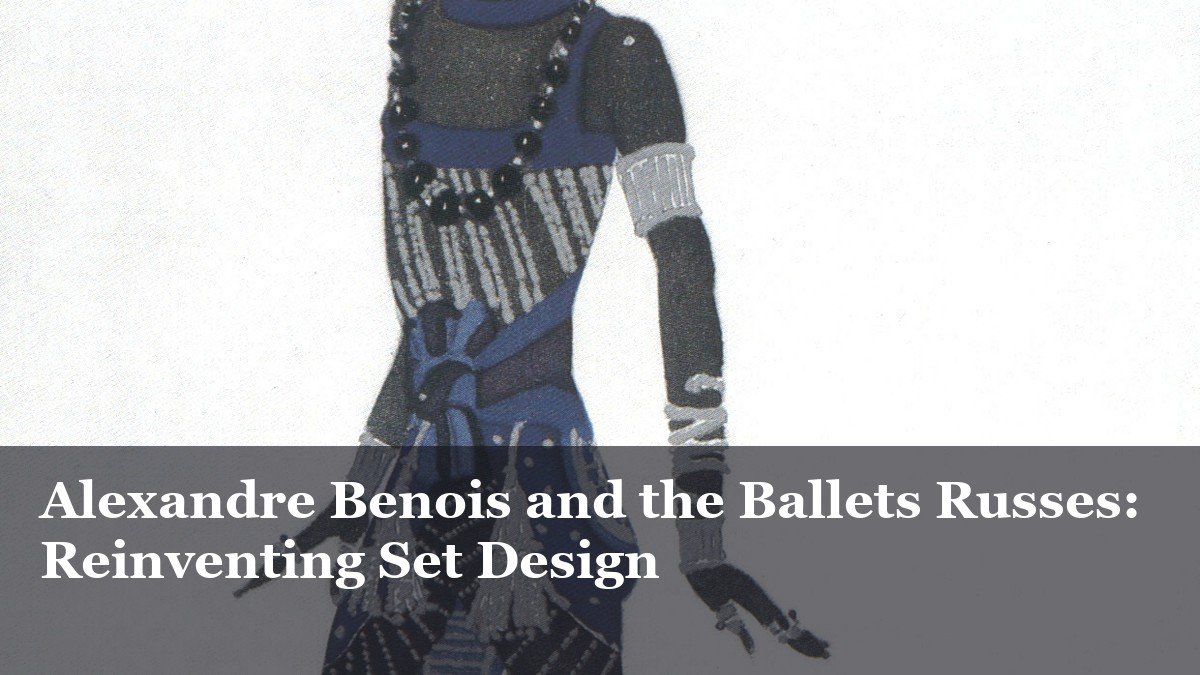
Alexandre Benois (1870 to 1960) was a Russian painter, critic and founding member of Mir Iskusstva who became a principal designer for Sergei Diaghilev‘s Ballets Russes. His sets and costumes for Petrushka (1911), built on his historical eye and painter’s training, helped turn stage design into unified, artist-authored work rather than generic backdrop painting, influencing designers and audiences across Paris, London and beyond during the company’s 1909 to 1929 run.
What Was Alexandre Benois’s Role in the Ballets Russes?
Alexandre Benois (3 May 1870, 21 April Old Style, to 9 February 1960) painted, wrote criticism and history, preserved historic buildings, and designed for the stage, work that with the Ballets Russes shaped modern ballet and stage design at its root. Before Diaghilev ever brought him into the theater, Benois had already made his name as a founding member of Mir Iskusstva, pairing careful historical research with a painter’s feel for atmosphere. For the company he built sets and costumes that gave each production a coherent world: the crowded fairground of a Saint Petersburg Shrovetide fair, the gilded rooms of an eighteenth century court, not a loose stack of painted backdrops. Alongside Léon Bakst and Nicholas Roerich, he pushed European stage design toward unified, artist-led visions instead of stock scenery churned out by theater craftsmen.
From Icon Corners to the Imperial Academy: Benois’s Formation
Benois grew up in Saint Petersburg inside a family of architects and artists, and that inherited eye for buildings and interiors turns up in nearly everything he painted. He studied law at Saint Petersburg University while teaching himself art on the side, reading deep into French and Italian painting and falling under the lasting spell of the city’s eighteenth century past: its parks, its palaces, the reign of Peter the Great. His 1910 painting of Peter I walking in the Summer Garden and his 1912 Appearance of Catherine II show the same instinct that later served him on stage, a wish to reconstruct a vanished moment with enough specific, observed detail that it feels inhabited rather than staged. That instinct, more than any academy training, prepared him to build worlds an audience could believe in.
Mir Iskusstva and the Circle That Reshaped Russian Art
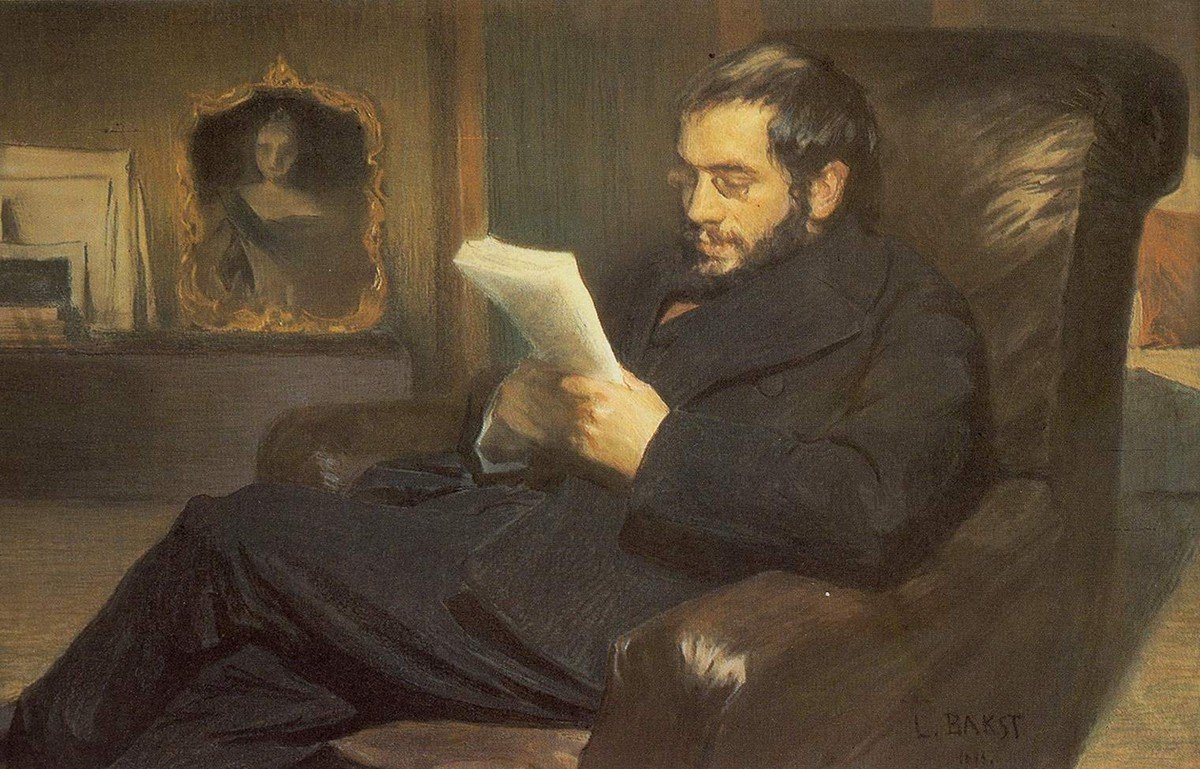
In the 1890s Benois joined a circle of young Saint Petersburg artists and writers, Léon Bakst and Diaghilev among them, who founded Mir Iskusstva, both a magazine and the movement built around it. Few copies traveled beyond Russia, but inside the country the publication helped shape the coming avant garde, arguing that art should be judged on aesthetic quality rather than social usefulness, a position that set the group against the older, message-driven Peredvizhniki painters. Bakst’s 1898 portrait of Benois, painted inside this same circle, shows a serious, watchful young man already thinking in terms of composition and character. The friendships and arguments formed at Mir Iskusstva meetings carried straight into the Ballets Russes a decade later: Diaghilev drew much of his early design talent from this very group.
Diaghilev, Benois, and the Birth of a Traveling Company
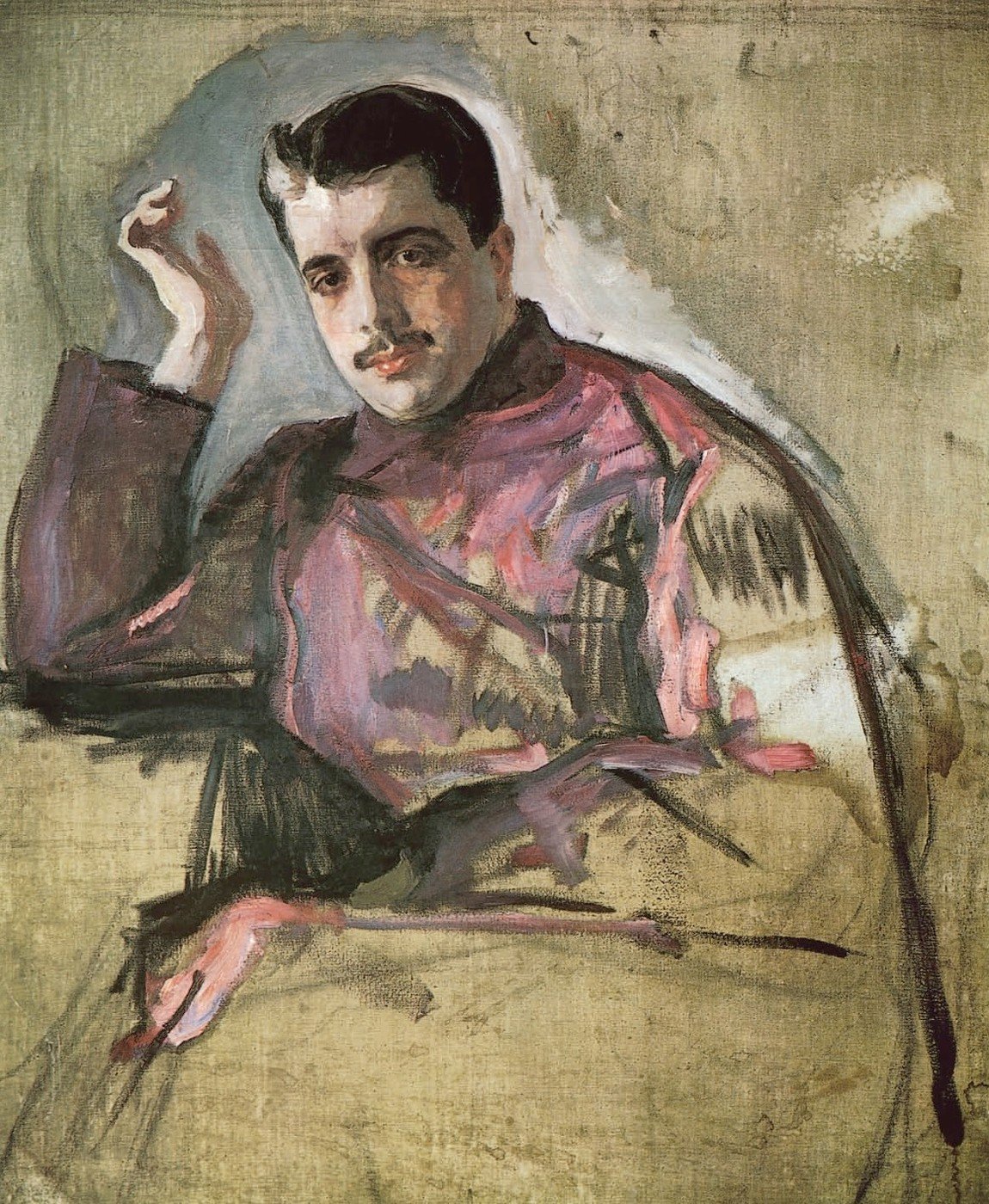
Sergei Diaghilev built his career in two distinct phases: first in Saint Petersburg from 1898 to 1906, then abroad as an emigrant organizing exhibitions, concerts and, eventually, ballet seasons. The Ballets Russes grew out of those Paris seasons starting in 1909 and never once performed in Russia. After that first Paris season the company had no permanent home and no formal institutional ties, touring instead through Europe and later North and South America until 1929. Valentin Serov’s 1904 portrait of Diaghilev, all sharp tailoring and cool self-possession, hints at the man who could talk Stravinsky, Ravel, Picasso and Matisse into working for a company with no fixed theater. Benois, already trusted from the Mir Iskusstva years, became one of his first and most consistent design collaborators.
What Made Benois’s Stage Designs Distinct?
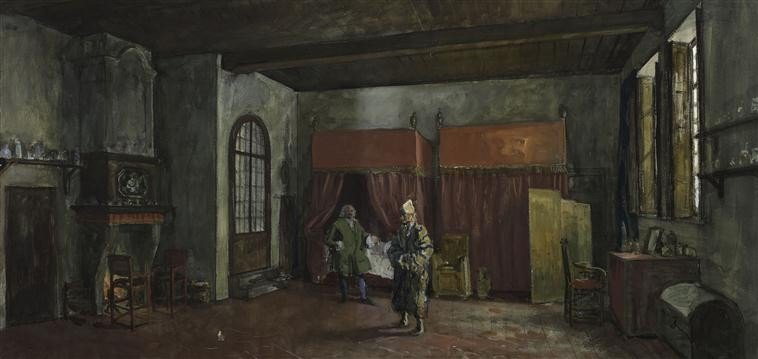
Where other designers of the period reached for exotic color or abstraction, Benois worked from research. He treated a stage set the way a historian treats an archive, gathering costume references, architectural detail and period furnishings until a scene from 1830s Saint Petersburg looked lived in rather than invented. His 1913 design for Molière’s Le Malade Imaginaire shows the same method applied outside the Ballets Russes, a stage image built from careful period observation rather than decorative flourish.
How Did Benois Prepare a Set?
He usually began with drawings grounded in specific historical sources, working out architecture, costume and crowd composition together, so the finished set read as one continuous world rather than a backdrop standing apart from the performers in front of it.
Petrushka: Benois’s Signature Achievement
Petrushka remains the clearest proof of what Benois brought to the Ballets Russes. Written for the 1911 Paris season, with music by Igor Stravinsky and choreography by Michel Fokine, the ballet premiered at the Théâtre du Châtelet on 13 June 1911, with Vaslav Nijinsky as Petrushka, Tamara Karsavina as the Ballerina, Alexander Orlov as the Moor and Enrico Cecchetti as the Charlatan. Benois did more than design the sets and costumes: he helped Stravinsky shape the libretto itself, a story about three puppets brought to life during a Shrovetide fair in 1830s Saint Petersburg. Petrushka loves the Ballerina, she prefers the Moor, and the jealousy that follows ends with Petrushka’s death at the Moor’s hands. The specificity of Benois’s fairground, its crowds, its stalls, its organ grinders, gave Stravinsky’s score a concrete world to stand in rather than an abstract setting.
Collaborators in Color: Bakst, Roerich, and Korovin
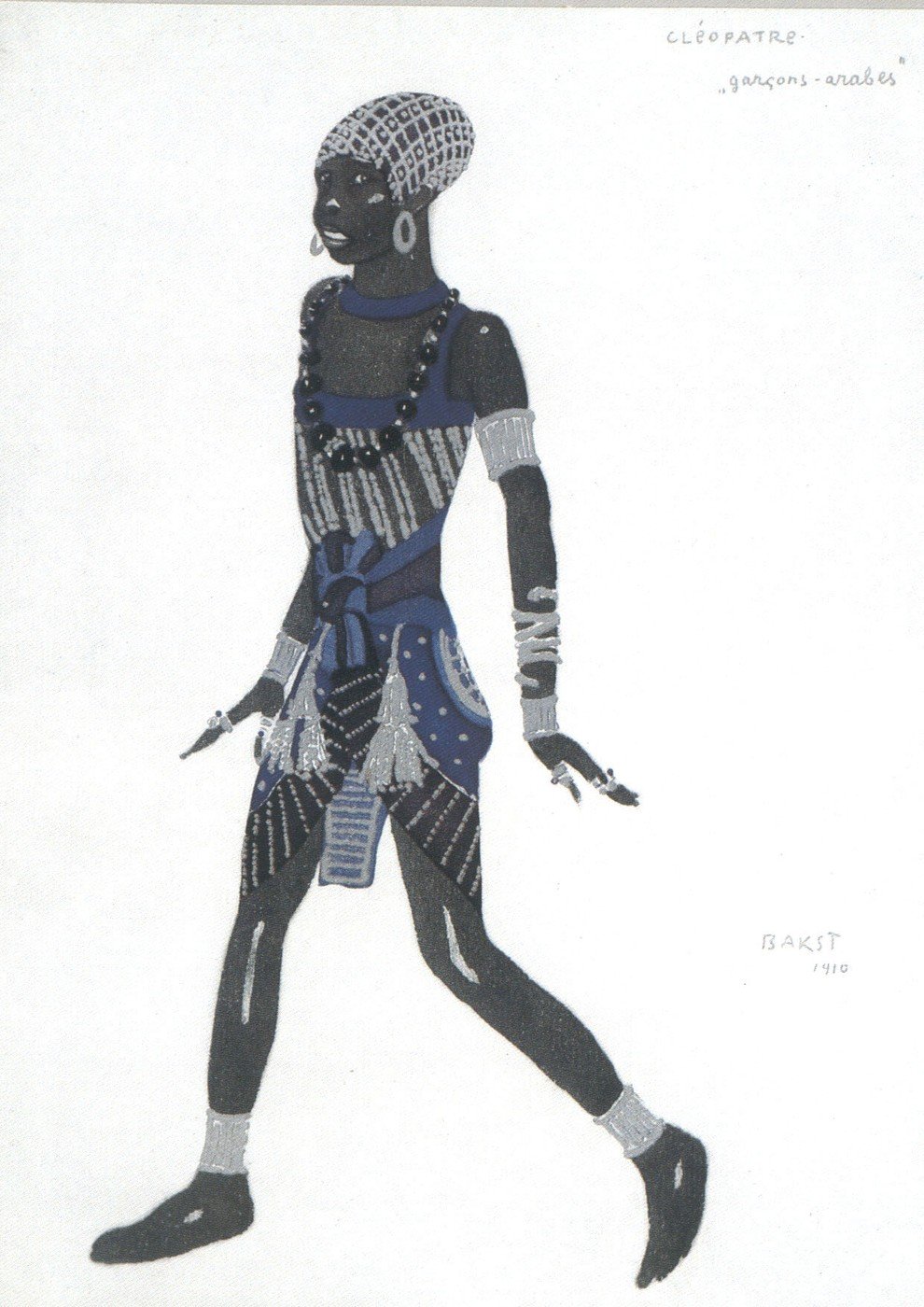
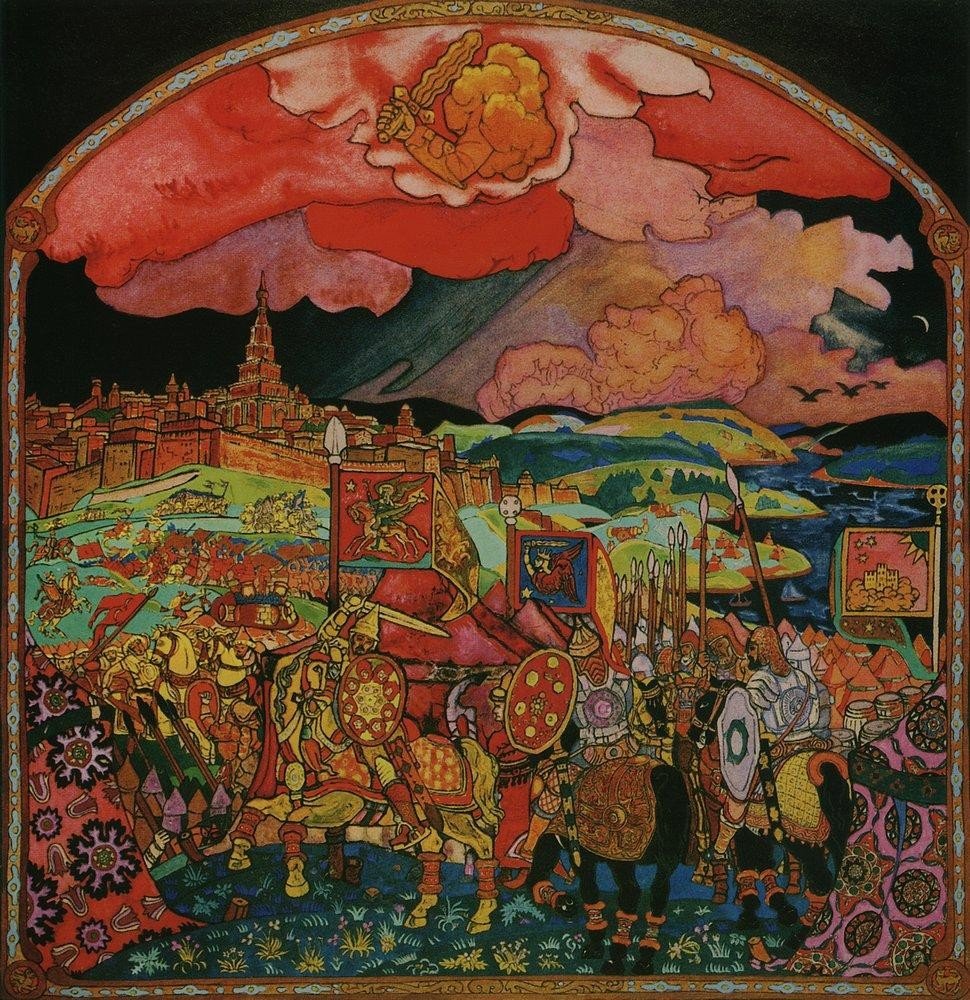
Benois did not work alone, and the company’s visual range came from real differences among its designers. Léon Bakst, born Leyb-Khaim Izrailevich Rosenberg, favored dense, saturated color and exoticized settings, visible in his designs for Carnaval (1910), Le Spectre de la rose (1911) and Daphnis et Chloé (1912), including his costume work for Cléopâtre. Konstantin Korovin, already known in Russia for loose, light-filled Impressionist canvases, brought a softer palette to Imperial and Ballets Russes productions alike. Nicholas Roerich, a painter, archaeologist and writer with more than 7,000 works to his name, approached design through his interest in prehistoric and early Slavic culture rather than court history. Set side by side, Benois’s historicism, Bakst’s color and Roerich’s archaic imagery show how much the company’s identity depended on holding several distinct artistic voices in active tension.
How Did the Ballets Russes Shock Paris?
Before 1909, Paris audiences knew ballet as polite decoration: pretty dancers in front of painted scenery that rarely asked to be looked at on its own terms. The Ballets Russes flipped that hierarchy. Diaghilev commissioned composers such as Stravinsky, Claude Debussy, Sergei Prokofiev, Erik Satie and Maurice Ravel, and visual artists including Benois, Korovin, Marie Laurencin, Roerich, Pablo Picasso and Henri Matisse, alongside costume designers Bakst, Ivan Bilibin and, later, Coco Chanel. The productions became genuine artistic collaborations rather than one department serving another, and this reordering gets much of the credit for reinvigorating the art of performing dance while pulling many of these visual artists into wider public view for the first time outside Russia.
The Rite of Spring and the Edges of Benois’s Aesthetic
The Rite of Spring shows where the company’s design language moved past what Benois himself was working toward. Written for the 1913 Paris season, with choreography by Nijinsky and stage designs by Roerich, the ballet premiered at the Théâtre des Champs-Élysées on 29 May 1913, the third major Diaghilev project after The Firebird (1910) and Petrushka (1911). Roerich’s costumes and sets, drawn from his study of early Slavic ritual rather than eighteenth century court life, matched Stravinsky’s dissonant, rhythmically fractured score in a way Benois’s more historically literal manner never attempted. The avant garde music and choreography caused a genuine sensation on opening night, though the now-famous description of that reaction as a riot did not reach print until reviews of later performances in 1924.
Myth vs. Fact: The Rite of Spring Riot
Myth: newspapers reported a riot on the opening night of The Rite of Spring in 1913. Fact: the word riot for that Paris premiere first appears in reviews written around 1924, more than a decade later. Contemporary accounts describe a loud, divided audience rather than the brawl later retellings suggest.
Benois Beyond the Stage: Painter, Critic, Historian
Design work made up only part of Benois’s output. He wrote extensively as an art critic and historian, helping define how Russians understood their own eighteenth and nineteenth century painting, and later worked as a preservationist, pushing for the protection of historic buildings and museum collections. His paintings of Saint Petersburg interiors, such as the hall of the Katalnaya Gorka pavilion, painted around 1901, carry the same archival instinct visible in his stage work: an interest in exact period detail for its own sake, not just raw material for a theater commission.
Was Benois Only a Designer?
No. He worked at once as painter, critic, historian and preservationist throughout his career, and his stage design grew directly out of that wider scholarly practice rather than sitting apart from it.
Did the Ballets Russes Influence Painters Like Picasso and Matisse?
Diaghilev’s willingness to commission established modern painters, not only trained scene painters, changed what both dancers and gallery-going audiences expected from a stage. Picasso and Matisse both contributed designs for the company, working alongside Russian émigré designers such as Benois, Bakst and Roerich on productions that toured internationally rather than staying put in one city’s repertoire. The crossover ran in both directions. Bakst’s costume designs, seen in works such as his depiction of Ida Rubinstein as Saint Sebastian, circulated among painters and decorative artists in Paris much as any gallery exhibition might, and the line between fine art and applied stage design grew a good deal harder to draw as a result.
The Company’s Afterlife: Design, Fashion, and Museums
The Ballets Russes closed with Diaghilev’s death in 1929, but its design archive did not go with it. Costume and set designs by Benois, Bakst, Roerich and Korovin were picked up by museums and private collectors across Europe and North America, and many now sit in major public collections alongside the artists’ easel paintings, a sign that contemporaries and later curators alike treated the stage work as art in its own right rather than disposable theatrical material. The company’s habit of hiring painters as equal partners to choreographers and composers also became a reference point for later dance companies and opera houses looking to unify their productions visually, a working method that outlived the company itself by decades.
Common Misconceptions About Benois and the Ballets Russes
One frequent mistake is assuming the Ballets Russes performed in Russia. It never did. The company formed in Paris in 1909 and, after that first season, had no formal ties there either, touring instead across Europe, North America and South America until 1929. Another common mix-up credits Benois with designs that actually belong to Bakst or Roerich, since all three tend to get lumped together under one generic Ballets Russes look. Their approaches differed sharply: Benois’s historical realism, Bakst’s saturated exoticism, Roerich’s archaic austerity. Treating them as interchangeable erases exactly the tension that made the company’s visual identity distinctive.
Related Movements: Symbolism, World of Art, and the Avant-Garde
Benois’s career sits at a hinge point in Russian art history. Mir Iskusstva grew partly out of a reaction against both academic realism and the social-message painting of the Peredvizhniki, favoring aestheticism and historical revival instead. Roerich’s designs, by contrast, drew on Russian Symbolism’s fascination with mysticism and pre-Christian antiquity, a different strand of the same broader turn away from realist convention. Together these overlapping circles fed straight into the Russian avant-garde of the 1910s, even though Benois, working in a historicist mode, and the younger Futurist and Cubo-Futurist painters ended up pursuing very different visual languages from largely the same starting point.
Where Can You See Benois’s Work Today?
Benois’s paintings, along with sketches and preparatory drawings tied to his stage work, are held in Russian institutions including the State Russian Museum and the State Tretyakov Gallery, alongside regional collections such as the Ivanovo art museum. Ballets Russes design material more broadly is spread across museums in Paris, London and the United States, a reflection of the company’s touring history rather than any single home institution. Because the company itself never settled anywhere and never performed in Russia, its surviving visual record is scattered to match, which is part of why museum exhibitions devoted to the Ballets Russes tend to draw loans from many collections rather than one archive.
Why Benois Still Matters
Benois’s lasting contribution was less a single style than a working method: treating the stage as a space for the same historical seriousness and observational discipline he brought to painting and criticism. Tested alongside Bakst’s color and Roerich’s archaism inside Diaghilev’s company, that approach helped establish stage design as a field where painters could do their most public and widely seen work. Modern opera and ballet productions that commission contemporary artists to design an entire production, rather than handing the job to an in-house scenic department, are still working within a model the Ballets Russes helped build, Benois among its founding figures.
Essential Points
- Alexandre Benois (1870 to 1960) was a founding member of Mir Iskusstva and a principal designer for Sergei Diaghilev’s Ballets Russes.
- Benois designed the sets, costumes and helped write the libretto for Petrushka, which premiered at the Théâtre du Châtelet on 13 June 1911.
- The Ballets Russes never performed in Russia. It formed in Paris in 1909 and toured Europe and the Americas until 1929.
- Benois worked alongside Léon Bakst, Nicholas Roerich and Konstantin Korovin, each bringing a distinct visual language to Diaghilev’s productions.
- Diaghilev also commissioned composers including Igor Stravinsky, Claude Debussy and Maurice Ravel, making the company a meeting point of painting, music and dance.
- Roerich designed The Rite of Spring (1913), whose premiere is often remembered as a riot, though that framing dates to later reviews rather than same-night reports.
- Mir Iskusstva, the magazine and movement Benois helped found, had limited circulation outside Russia but strongly shaped Russian modernism.
- Benois’s historicist paintings of eighteenth century Saint Petersburg reveal the same eye for period atmosphere he later brought to the stage.
Frequently Asked Questions
- Who was Alexandre Benois?
- Alexandre Benois (1870 to 1960) was a Russian painter, art critic, historian and stage designer. He co-founded the Mir Iskusstva movement and later became one of the principal set and costume designers for Sergei Diaghilev’s Ballets Russes.
- Did the Ballets Russes ever perform in Russia?
- No. The Ballets Russes formed in Paris in 1909 and never performed in Russia. After its first Paris season it kept no formal institutional home there either, touring instead across Europe and the Americas until the company ended in 1929.
- What made Benois’s set designs different from Bakst’s or Roerich’s?
- Benois worked from historical research, building sets that reconstructed specific eras like eighteenth century Saint Petersburg. Bakst favored saturated, exoticized color, while Roerich drew on early Slavic and prehistoric imagery, giving each designer a distinct visual signature.
- What is Alexandre Benois’s most famous Ballets Russes work?
- Petrushka, which premiered on 13 June 1911 at the Théâtre du Châtelet, is Benois’s best known contribution. He designed its sets and costumes and helped Stravinsky write the libretto, grounding the score in a specific Saint Petersburg fairground world.
- Where can I see Ballets Russes design work today?
- Benois’s paintings and related material are held at the State Russian Museum and State Tretyakov Gallery in Russia. Ballets Russes costume and set designs more broadly appear in museum collections across Paris, London and the United States, reflecting the company’s touring history.

This guide was written and reviewed by the rus-art.com editorial team, specializing in Russian art history. We cross-check dates, attributions, and museum holdings against museum and academic sources.