Quick Answer
Palekh miniature is a Russian folk art in which tempera paintings on black-lacquered papier-mache boxes replaced the icon commissions that vanished after 1917. Former icon painters in the village of Palekh, Ivanovo Oblast, formed the Artel of Ancient Painting in December 1924, adapting egg tempera, gold linework, and flattened composition from centuries of icon painting to depict fairy tales, folk epics, and eventually Soviet subjects on cigarette cases and powder boxes.
What Are Palekh Miniatures?
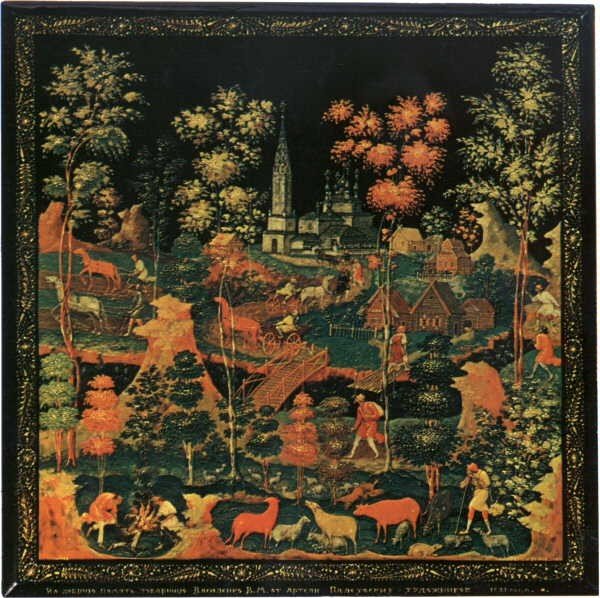
A Palekh miniature is a small tempera painting on lacquered papier-mache, usually the lid of a box, a cigarette case, or a powder case. The technique itself is centuries old. The subjects painted with it are barely a hundred years old. Artists mix pigment with egg yolk, the same binder used in traditional icon painting, and apply it in thin layers over a glossy black lacquer ground. Figures and drapery get outlined in fine gold lines, then the whole surface is sealed under several more coats of lacquer.
What separates Palekh from other decorative lacquer work is its origin. The tempera, the gold linework, the flattened space, the elongated figures: all of it came straight out of Russian Orthodox icon painting. Only the subjects changed. Where an icon painter once depicted saints and biblical scenes, a Palekh miniaturist paints troikas racing through snow, firebirds, Pushkin’s fairy tales, and folk epics like the Battle of Kulikovo. That shift in subject matter is the whole story of how the craft survived.
From Icon Workshops to Enforced Silence
Palekh had been an icon-painting center for generations before 1917. Its workshops didn’t only serve monasteries and cathedrals; they supplied ordinary households too, painting the small devotional panels that hung in the corner of nearly every Russian home. An icon in this tradition was a portrait of Christ, Mary, or a saint, painted to strict conventions rather than an artist’s free invention, and Palekh masters had specialized in that exacting, formulaic craft for generations.
The collapse of Imperial Russia wiped out that market almost overnight. Church commissions dried up as the new Soviet state moved against religious institutions, and private demand for devotional panels shrank under the same pressure. Icon painters had no other trade, and in a village like Palekh that meant most of the working population was left holding a highly refined skill with no buyer for it.
Why did icon painters stop working after the Russian Revolution?
Church and private commissions for religious icons collapsed as the Soviet government moved against organized religion after 1917. Painters in icon-producing towns like Palekh lost their livelihood almost entirely, since their training had prepared them for religious commissions and little else.
The 1924 Founding of the Palekh Artel of Ancient Painting
The solution came from an unlikely source: papier-mache lacquer boxes, a craft already established in other Russian towns, most notably Fedoskino near Moscow. In December 1924, a group of Palekh icon painters organized themselves into a cooperative, the Artel of Ancient Painting, to turn their icon-derived skills toward this different object. Among the founding masters were Ivan Golikov, Ivan Ivanovich Zubkov, and Ivan Bakanov, all of whom had trained and worked as icon painters before the Revolution.
The artel model mattered as much as the technique. It gave painters a collective workshop, shared materials, and a route to sell finished pieces, much like the icon workshops they had left behind, only now producing decorative boxes instead of devotional panels. Moving an entire craft tradition from wood panel to lacquered box is what let Palekh’s painters keep working at all while pure icon painting was suppressed elsewhere in Russia.
Painting on Papier-Mache: Materials and Technique
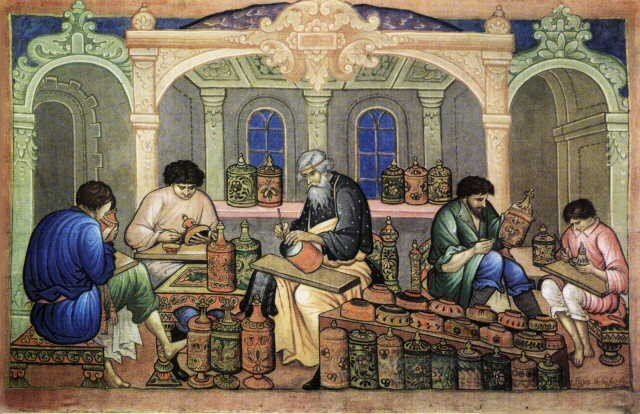
The base object required its own craft before any painting began. Layers of cardboard were glued and pressed into molds, then soaked in linseed oil and left to dry for weeks. That process hardened the papier-mache into a surface strong enough to be sanded, lacquered, and handled daily as a functional box or case. Only after the base was finished, primed, and coated in black lacquer did the painter begin work.
The painting itself proceeds in stages familiar from icon workshops: an underdrawing, blocked-in color fields, then fine linear detail added last. The final object is small, often no larger than a deck of cards, so a whole composition, a battle scene, a fairy tale, a troika in mid-gallop, has to be built at miniature scale without losing the clarity of a much larger icon panel.
Black Lacquer, Egg Tempera, and Gold: The Palekh Palette
Three materials define the look of a Palekh miniature. The black lacquer ground works the way a dark icon background once did, throwing painted figures into sharp relief. Egg tempera, the same binding medium Russian icon painters had used for centuries, gives the colors their matte brightness, since tempera dries quickly and sits close to the surface rather than sinking into it. Gold, applied as fine linear highlights along drapery folds, armor, and manes, does the job that gold assist lines did in icon painting: marking divine or heroic light without resorting to shading.
What materials do Palekh artists actually use?
Palekh painters use egg tempera pigment on a black-lacquered papier-mache base, then finish the piece with fine gold linework and several additional coats of clear lacquer. Every material choice, tempera, black ground, gold line, was carried over directly from pre-revolutionary icon-painting workshops.
Ivan Golikov: The Artist Who Defined Palekh Style
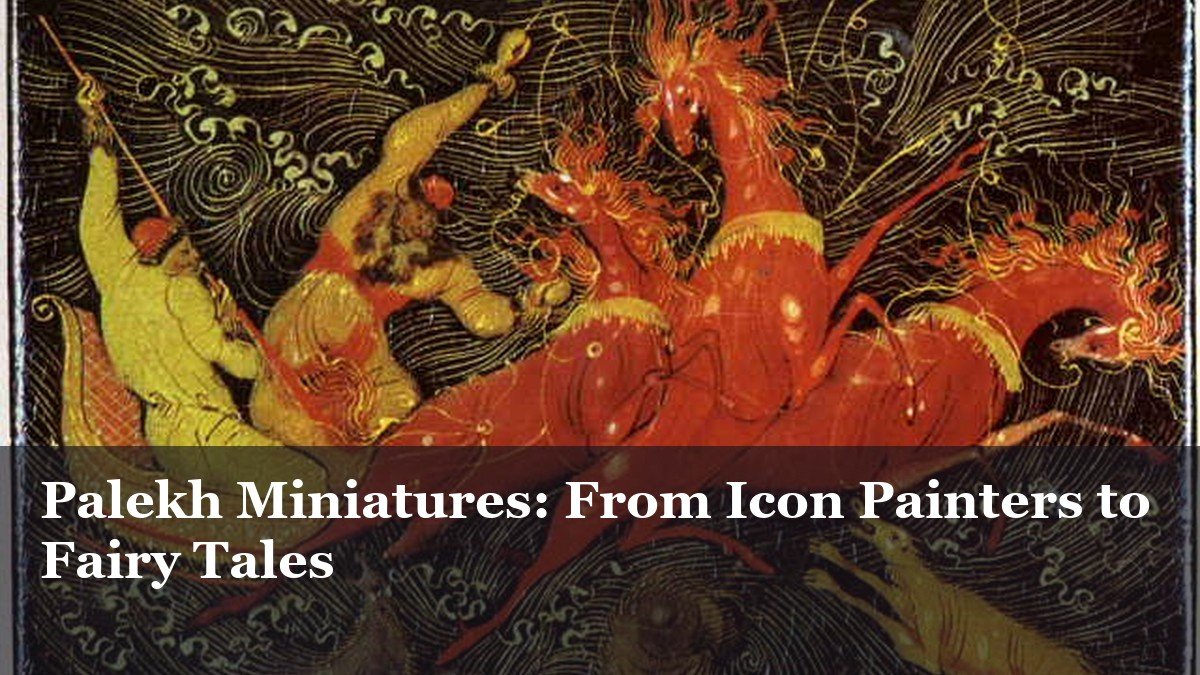
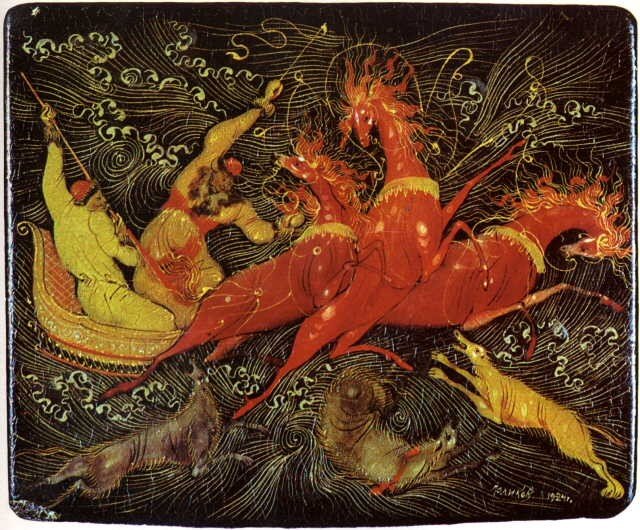
Ivan Ivanovich Golikov is the name most closely tied to Palekh’s early success. A former icon painter and one of the artel’s founders, Golikov set the visual vocabulary later masters followed: swirling, densely packed compositions, figures caught mid-motion, and a fondness for the troika, the Russian three-horse carriage, as a recurring subject. His 1925 Troika, its horses straining against gold-traced harnesses, became one of the artel’s signature images.
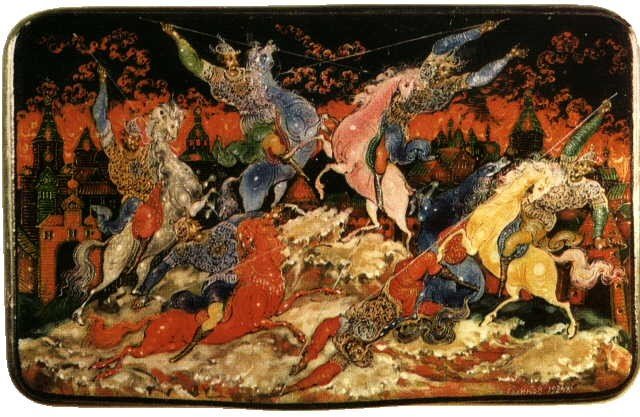
Golikov also painted historical subjects at ambitious scale for such small objects. His Battle of Kulikovo appears on both a 1924 cigarette case and a 1928 lacquered box, reworking the same fourteenth-century battle, in which Russian forces under Dmitry Donskoy defeated the Golden Horde, into two different miniature compositions. By 1927 he had also begun painting contemporary Soviet subjects, proof of how far the artel’s range extended beyond fairy tales within its first few years.
Ivan Zubkov and the Icon-Painting Inheritance
Palekh is small enough that its painters often shared surnames without sharing a workshop, and the name Zubkov makes the point well. Ivan Vasilievich Zubkov (around 1863 to 1916) was a working icon painter in the pre-revolutionary sense, producing devotional panels through the 1890s in the traditional egg-tempera-on-wood technique described by Britannica. He died in 1916, a year before the Revolution, and never made the transition to lacquer miniature painting himself.
It was a different man, Ivan Ivanovich Zubkov (1883 to 1938), who carried the family name into the new craft. He was among the founders of the Artel of Ancient Painting in 1924, and by 1931 he was painting scenes like Palekh Town, depicting the village itself rather than a fairy tale or an icon. The two Zubkovs were not the same artist. Conflating them erases exactly the transition, from devotional icon to secular miniature, that defines Palekh’s history.
Ivan Bakanov and the Second Generation
Ivan Mikhailovich Bakanov (1870 to 1936) was another founding member of the 1924 artel and, like Golikov and Zubkov, had spent his earlier career as an icon painter. Bakanov’s surviving work, including a 1934 piece held among the artel’s later production, shows the style settling into a more consistent house manner: tighter figure grouping, more restrained color relative to Golikov’s denser compositions, and continued reliance on gold linear detail.
By the mid-1930s, painters like Bakanov were training a generation of artists who had never worked as icon painters at all. Within a decade the craft had become self-sustaining as a secular art form rather than a stopgap for displaced icon masters.
Look Closer: Look closer: the icon frame hiding in plain sight
Ivan Golikov’s Troika does not just show galloping horses. Trace the thin gold ornamental border running around the edge of the lid. That border descends directly from the gilded oklad frames that once encased icon panels. Palekh painters kept the frame and swapped the saint for a fairy tale.
Notable Works: Fairy Tales in Miniature
Fairy tales and folk epics gave Palekh painters subjects that were visually rich, politically uncontroversial, and well suited to the flattened, densely patterned style they had brought from icon painting. Golikov’s 1924 Troika of Wolves reworks the same galloping-horse motif as his 1925 Troika, this time set against a winter hunting scene, showing how a single popular subject could be painted repeatedly with different narrative details.
Why did Palekh painters choose fairy tales as subjects?
Fairy tales and folk epics were safe, popular, and visually suited to the dense, ornamental style Palekh painters had developed for icons. They also avoided the religious content the Soviet state was actively suppressing, making them a practical as well as an artistic choice.
When Soviet Politics Entered the Miniature
Palekh’s turn toward Soviet subject matter began even before the artel formally existed. A 1923 piece, Bolsheviks Writing a Reply to Englishman Curzon, by an unrecorded Palekh hand, responds to that year’s Curzon ultimatum, a British diplomatic crisis with the Soviet government, by borrowing its entire composition from Ilya Repin’s famous Reply of the Zaporozhian Cossacks and swapping seventeenth-century Cossacks for Bolshevik officials. It’s an early, striking example of icon-trained painters redirecting their compositional habits toward current events rather than saints or fairy tales.
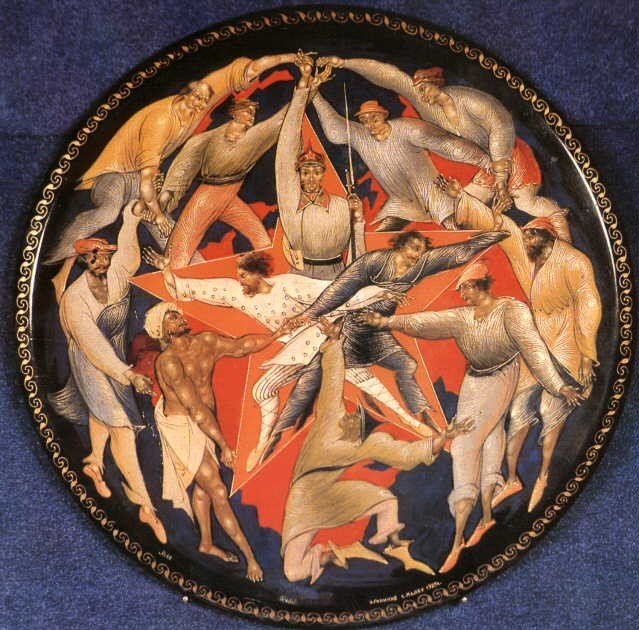
Golikov’s 1927 Comintern pushed the same idea further, treating a Soviet political institution as a subject worthy of the same gold-lined, densely composed treatment once reserved for battle scenes and religious figures. These political pieces stayed a minority within Palekh’s output, but they show how flexible the inherited icon technique proved to be.
The Compositional Language: Circles, Ovals, and Elongated Figures
Palekh compositions favor curved, often circular or oval arrangements that fit naturally onto the rounded lids of boxes and cases, a habit inherited from icon painters who had long organized scenes around a central figure or event. Figures tend to be elongated and gesture-driven rather than anatomically naturalistic, following icon conventions where posture and drapery, not muscular structure, conveyed meaning and movement.
Space stays flat rather than receding into realistic depth, so a battle or a troika chase reads as a pattern of interlocking shapes as much as a scene with a foreground and background. Gold linear ornament, both within the scene and as a border framing it, ties the composition together and signals its descent from the gilded icon frame.
Why Palekh Survived When Other Icon Centers Didn’t
Not every icon-painting town found a path forward after 1917. Palekh’s advantage was proximity, in skill and in geography, to an existing lacquer miniature tradition already established at Fedoskino, which gave its painters a working model to adapt rather than an art form to invent from nothing. The artel structure mattered just as much: organizing as a cooperative let painters pool materials and buyers at a moment when individual commissions, religious or otherwise, were scarce.
Subject flexibility counted too. Painters who could redirect their technique toward fairy tales, folk epics, and eventually Soviet themes had a product the new state tolerated and even encouraged, unlike devotional icon painting, which stayed politically fraught for decades.
Common Misconceptions
One persistent misconception holds that every Palekh miniaturist trained as an icon painter, as though the craft simply continued its founders indefinitely. In fact, the Palekh Art School, opened in 1935, began training painters directly in lacquer miniature technique. Many painters working from the late 1930s onward had never painted a religious icon at all; they learned tempera, gold linework, and composition as a secular art form from the start.
Palekh Today: A Living Craft in a Shrinking Town
Palekh remains a small settlement in Ivanovo Oblast, with a population of 4,633 recorded in the 2021 census, down from over 6,200 in 1989. Despite that decline, the craft the 1924 artel established has outlasted the political conditions that produced it. The State Museum of Palekh Art in the town holds work by the original founding masters alongside later generations, and lacquer miniature painting continues to be taught and practiced locally.
Ivan Ivanovich Zubkov’s 1931 Palekh Town, painted by one of the artel’s own founders, is itself a record of the village at the moment the craft was consolidating, making it as much a historical document as a decorative object.
Where can you see Palekh miniatures today?
The State Museum of Palekh Art, located in Palekh itself in Ivanovo Oblast, holds the largest concentrated collection of founding-generation and later Palekh work. Individual pieces also appear in broader Russian decorative arts collections and in private holdings internationally.
Related Traditions: Fedoskino, Kholuy, and Mstyora
Palekh is one of four recognized Russian lacquer miniature centers, and the differences between them trace back to each town’s starting point. Fedoskino, near Moscow, developed first and uses oil paint rather than tempera, producing a softer, more naturalistic style closer to conventional easel painting. Kholuy and Mstyora, like Palekh, grew directly out of icon-painting workshops and share its tempera-and-gold technique, though each developed its own preferred color range and compositional habits.
What sets Palekh apart within this group is the density and darkness of its backgrounds, and how far its early masters, Golikov especially, pushed the icon-derived style toward crowded, rhythmic composition rather than the more spacious arrangements typical of Mstyora work.
Essential Points
- Palekh is a small town in Ivanovo Oblast whose icon workshops supplied both churches and private homes before 1917.
- After the Revolution ended church commissions, Palekh painters had no market left for their only trade.
- The Artel of Ancient Painting, founded in December 1924, redirected icon technique onto lacquered papier-mache boxes, cigarette cases, and powder cases.
- Palekh miniatures keep egg tempera, gold linear highlighting, and flattened perspective from icon painting, but drop religious subjects for fairy tales and folk epics.
- Not every Palekh surname belonged to one artist: two unrelated-in-craft painters named Zubkov worked a generation apart, one purely an icon painter, one a founding miniaturist.
- By the late 1920s some masters, Golikov among them, painted Soviet subjects like the Comintern onto the same black lacquer surfaces once reserved for saints.
- A dedicated Palekh Art School, opened in 1935, trained later generations directly in miniature painting rather than icon painting.
- Palekh is one of four Russian lacquer miniature centers, alongside Fedoskino, Kholuy, and Mstyora, each with a distinct technique.
Frequently Asked Questions
- What exactly is a Palekh miniature?
- It is a small tempera painting on a black-lacquered papier-mache object, usually a box, case, or lid. The technique, egg tempera and gold linework, comes from Russian icon painting, but the subjects are secular: fairy tales, folk epics, and occasionally Soviet themes.
- When did Palekh miniature painting begin?
- The craft dates to December 1924, when former icon painters in Palekh founded the Artel of Ancient Painting after church commissions collapsed following the 1917 Russian Revolution, redirecting their icon training onto lacquered papier-mache boxes.
- Why do Palekh miniatures use gold lines so heavily?
- Gold linework marks drapery, armor, and highlights, a direct carryover from the gold assist lines used in icon painting to indicate divine or heroic light. In Palekh miniatures the same technique now outlines fairy tale and folk epic figures instead.
- Who was the most influential early Palekh painter?
- Ivan Golikov, a founding member of the 1924 artel and former icon painter, is generally considered the most influential. His troika and battle scenes, including a 1925 Troika and two versions of the Battle of Kulikovo, set the style later painters followed.
- Can you still see Palekh miniatures today?
- Yes. The State Museum of Palekh Art in the town of Palekh, Ivanovo Oblast, holds work from the original founders through later generations. The craft is still taught locally, and individual pieces appear in Russian decorative arts collections worldwide.
This guide was written and reviewed by the rus-art.com editorial team, specializing in Russian art history.