Quick Answer
The Jack of Diamonds (Bubnovy Valet) was among the earliest organized breaks from academic painting in Moscow, a loose society of artists who exhibited together starting in 1910 and built a shared style on Cezanne’s structure, Fauvist color, and the raw energy of Russian shop signs and folk prints. Founders and members included Ilya Mashkov, Pyotr Konchalovsky, Aristarkh Lentulov, Robert Falk, Mikhail Larionov, and Natalia Goncharova. The name mocked the group’s own reputation for scandal. By 1911-1912 Larionov and Goncharova split off to found the more radical Donkey’s Tail, pushing Russian painting toward abstraction.
What Is the Jack of Diamonds Group?
The Jack of Diamonds, Bubnovy Valet in Russian, was a society of Moscow painters who banded together around 1910 to show their work outside the Imperial Academy’s exhibition system. It was not a school with a single manifesto. It was a coalition, and a combative one: young artists who had studied in Paris and Munich, absorbed Cezanne and the Fauves, and wanted a Moscow venue willing to hang paintings that the Academy’s juries would have rejected on sight. Founding and core members included Pyotr Konchalovsky, Ilya Mashkov, Aristarkh Lentulov, Robert Falk, Mikhail Larionov, and Natalia Goncharova. Within two years the group had already split, but for that short window it was the loudest, most visible face of new painting in Russia, and the training ground for artists who would shape Soviet art for decades after.
A Card From a Convict’s Uniform: Where the Name Came From
Why Was the Group Called “Jack of Diamonds”?
In Imperial Russia, convicts sentenced to hard labor wore a diamond-shaped patch of fabric sewn onto the back of their uniform, a mark of disgrace visible from across a prison yard. Bubnovy Valet, the jack of diamonds in a Russian card deck, carried the same association: a card linked with dishonesty, low company, and scandal. The Moscow painters chose the name for themselves, before critics could choose it for them. Calling their own exhibition society after a convict’s mark meant accepting the insult the press was already throwing at their canvases (thick paint, distorted figures, colors with no interest in matching nature) and turning it into a badge. The gesture set the tone for everything that followed: provocation as strategy, not accident.
Moscow Money, Not St. Petersburg Academies
St. Petersburg had the Imperial Academy of Arts, the court, and a conservative exhibition culture built around the Peredvizhniki (Wanderers) generation. Moscow had something the new painters could actually use: a class of merchant collectors, the Morozovs and Shchukins among them, who had been buying Cezanne, Matisse, and Gauguin directly from Paris dealers for years before most Russian critics had seen a Cezanne in person. Young Moscow painters could walk into a private collection and study French modernism firsthand, something almost impossible in the capital. That access shaped the Jack of Diamonds from the start. Its members were not reacting against French painting from a distance. They had seen it, in Moscow, on Moscow walls, and treated it as a set of tools to apply to Russian subjects: provincial towns, market stalls, still-life tables loaded with melons and bread.
The December 1910 Exhibition That Shocked Moscow
The group’s first exhibition opened in Moscow in December 1910, filling rented rooms with a large body of work. Russian paintings hung beside pieces by French and German modernists, an arrangement meant to argue, wordlessly, that Moscow’s new painters belonged in that company. Reviewers did not agree. The paint looked crude to eyes trained on the smooth finish of academic portraiture, the color combinations looked arbitrary, and the subjects, market vendors, circus performers, plain domestic interiors, looked deliberately unrefined. That reaction was, in part, the point. Natalia Goncharova showed alongside the Cezannist wing at these early exhibitions, her own neo-primitivist scenes of Russian streets and peasant labor adding a second, distinct current to a show already resistant to easy summary.
What Held Bubnovy Valet Together: Cezanne, Fauvism, and the Marketplace
If one influence unified the group’s founding wing, it was Paul Cezanne, filtered through the merchant collections Moscow’s painters had access to. Cezanne offered a way to rebuild a picture from planes of color and visible brushwork rather than smooth academic modeling, and Pyotr Konchalovsky and Ilya Mashkov applied that logic most consistently, especially in still life, where a bowl of fruit or a vase of flowers became an exercise in structure as much as observation. Fauvism supplied the second ingredient: color used for weight and contrast rather than description. The combination produced paintings that looked, to contemporaries, aggressively unfinished and oddly cheerful at once, a mood some critics read as market-stall vitality rather than gallery refinement. That commercial, unpretentious energy was not incidental. It was the visual argument the group was making against academic good taste.
Ilya Mashkov and the Grammar of a Loud Still Life
What Makes Mashkov’s Still Lifes Look So Loud?
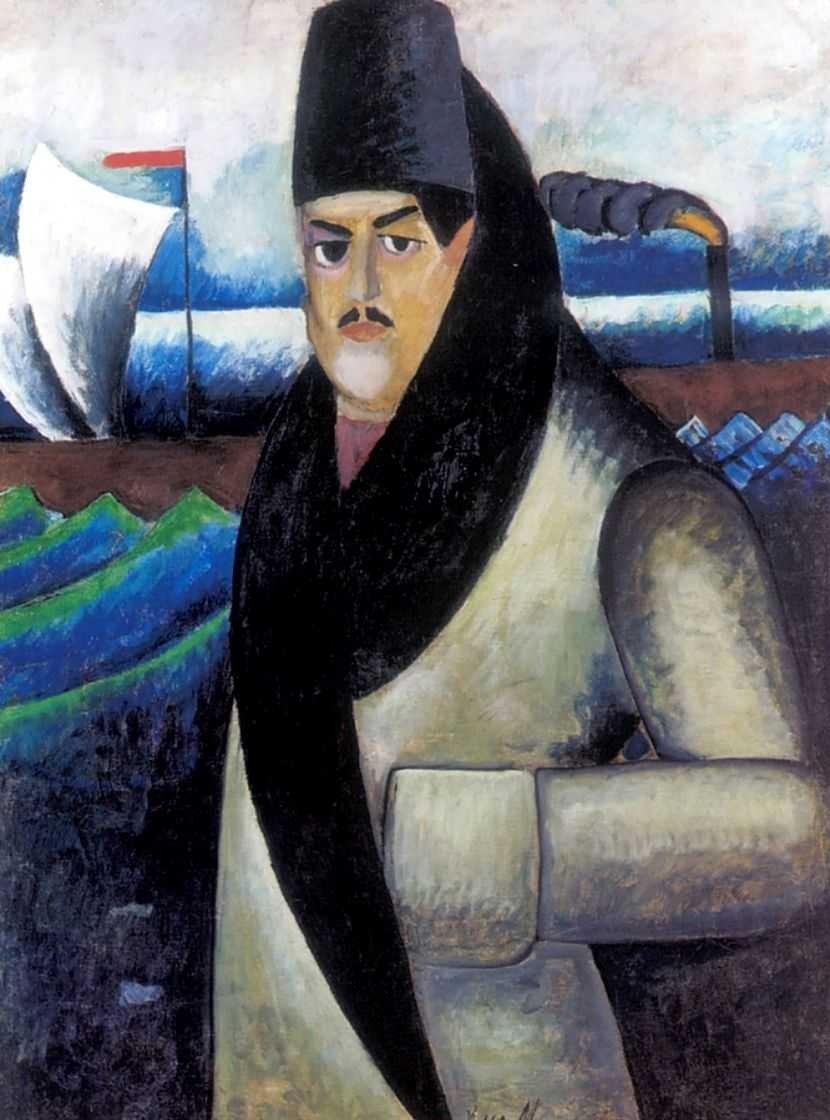
Ilya Mashkov (1881-1944) painted fruit, bread, and flowers the way other artists painted battle scenes, with scale, weight, and confrontational color. A Mashkov still life crowds its table to the frame’s edge and refuses to soften a single form for the sake of elegance. That approach extended to his self-presentation: his self-portraits from this period show the same appetite for bold, frontal, unapologetic construction that defines his tabletop compositions. Mashkov had studied in Moscow and traveled to Paris, and he treated Cezanne’s structural lessons as license for exaggeration rather than restraint. He remained one of the group’s most consistent Cezannist painters through its Jack of Diamonds years and continued working in a related, if softened, style well into the Soviet period.
Pyotr Konchalovsky: Chairman, Cezannist, Co-Founder
Pyotr Konchalovsky (1876-1956) served as a founding member and chairman of the group, giving the loose alliance of painters an organizational anchor. Trained partly in Paris, he built his reputation on still lifes and portraits that translated Cezanne’s faceted brushwork into a distinctly Russian register, thick, tactile paint applied with visible confidence rather than concealment. Konchalovsky and Mashkov are often discussed as a pair because their painting shared this Cezannist backbone, but Konchalovsky’s compositions tend toward a steadier, more architectural balance where Mashkov pushes toward excess. As chairman, Konchalovsky also had to manage a society that included painters heading in openly different directions, from Lentulov’s fractured cityscapes to Larionov and Goncharova’s folk-derived neo-primitivism, a balancing act that did not hold for long.
Aristarkh Lentulov’s Cubo-Futurist Moscow
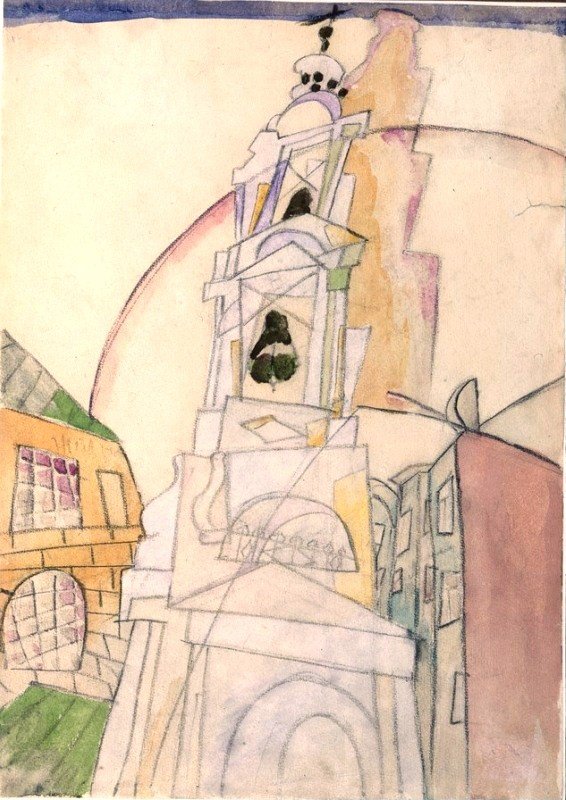
Aristarkh Lentulov (1882-1943) took the group’s Cezannist foundation somewhere none of his colleagues followed: toward Cubo-Futurism. His paintings of Moscow’s churches and bell towers break the architecture into overlapping colored planes, gold, red, and blue fragments that suggest bells ringing and crowds moving at once, rather than a single fixed viewpoint. It is a technique closer to what Italian Futurists and French Cubists were developing at the same moment, and Lentulov absorbed both while keeping his subject matter stubbornly Russian, onion domes and provincial townscapes rather than Parisian cafes. Within the Jack of Diamonds, his work stood as proof that the group’s shared interest in structure and color could produce results as different from Mashkov’s still lifes as from Goncharova’s icon-inflected scenes.
Robert Falk, the Quiet Dissenter Inside a Loud Group
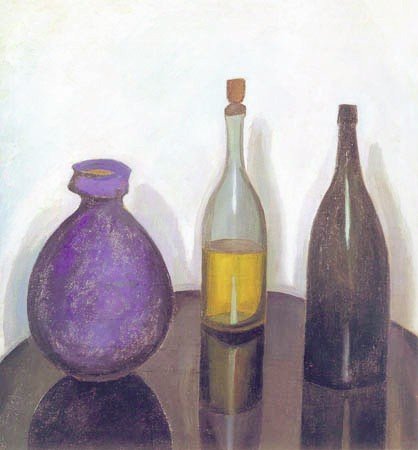
Robert Falk (1886-1958) belonged to the Jack of Diamonds but never fully matched its reputation for bravado. His still lifes and landscapes from these years share the group’s Cezannist debt, visible structure, faceted brushwork, but Falk favored muted, often somber color harmonies over his colleagues’ brighter contrasts. Where Mashkov’s tables shout, Falk’s compositions of bottles and interiors hold a quieter, more searching tone, closer to Cezanne’s own late restraint than to the Fauvist brightness other members leaned on. That difference in temperament mattered later: Falk went on to a long, independent career, working through decades when Soviet cultural policy grew hostile to any painting that looked like formal experiment, and his work is now valued precisely for the lyrical, undogmatic quality that set him apart even within his own founding circle.
Myth vs. Fact: One Group, Two Directions
Myth: the Jack of Diamonds painters all worked in one recognizable style. Fact: the society covered Konchalovsky and Mashkov’s Cezanne-inflected still lifes, Lentulov’s fractured Cubo-Futurist cityscapes, and Larionov and Goncharova’s folk-art neo-primitivism at the same time, an alliance loose enough that the last two founders quit within two years to start their own group, Donkey’s Tail.
Larionov, Goncharova, and the Neo-Primitivist Wing
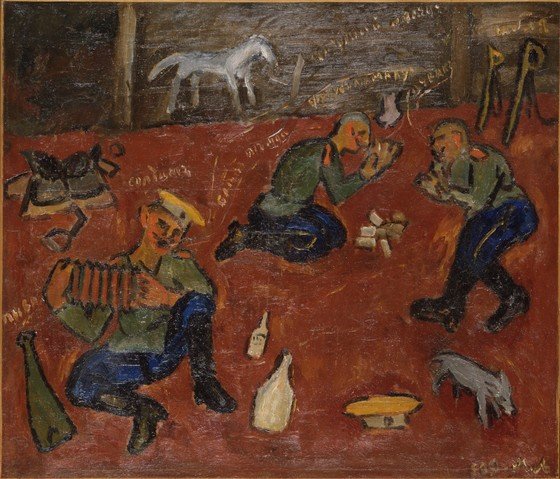
Mikhail Larionov (1881-1964) and Natalia Goncharova (1881-1962) formed the Jack of Diamonds’ second current, one that owed less to Cezanne than to Russian folk sources: icon painting, lubok woodblock prints, carved shop signs, and provincial embroidery. Larionov’s scenes of soldiers and street life apply a deliberately crude, flattened drawing style borrowed from those popular sources, a rejection of academic refinement that ran parallel to, but was not identical with, the group’s Cezannist still-life painters. Goncharova, his lifelong partner, pursued the same neo-primitivist vocabulary in her own scenes of Russian labor and street life, work she would later carry into her celebrated Moscow and St. Petersburg exhibitions of 1913 and 1914. The pairing of Cezannist still-life painters and neo-primitivist figure painters under one banner is a large part of why the Jack of Diamonds never settled into a single house style.
The 1911-1912 Split: Donkey’s Tail and the Birth of Rayonism
Why Did Larionov and Goncharova Leave the Group They Founded?
By 1911-1912, the gap between the Cezannist and neo-primitivist wings had become a fracture. Larionov and Goncharova broke away to found Donkey’s Tail (1912-1913), a group deliberately positioned as more radical than the society they had helped build, and named, again, to court insult rather than avoid it. The split was not simply personal. It marked a real divergence in ambition: Konchalovsky’s and Mashkov’s wing kept refining a Cezanne-based, representational style, while Larionov and Goncharova pushed past representation altogether. Between 1912 and 1914 the pair developed Rayonism, a style built from intersecting rays of color meant to depict light itself rather than objects, one of the first sustained steps toward abstraction to come out of Russian painting, and a direction the Jack of Diamonds’ still-life painters never followed.
What Paris Gave Moscow: French Modernism Reimagined
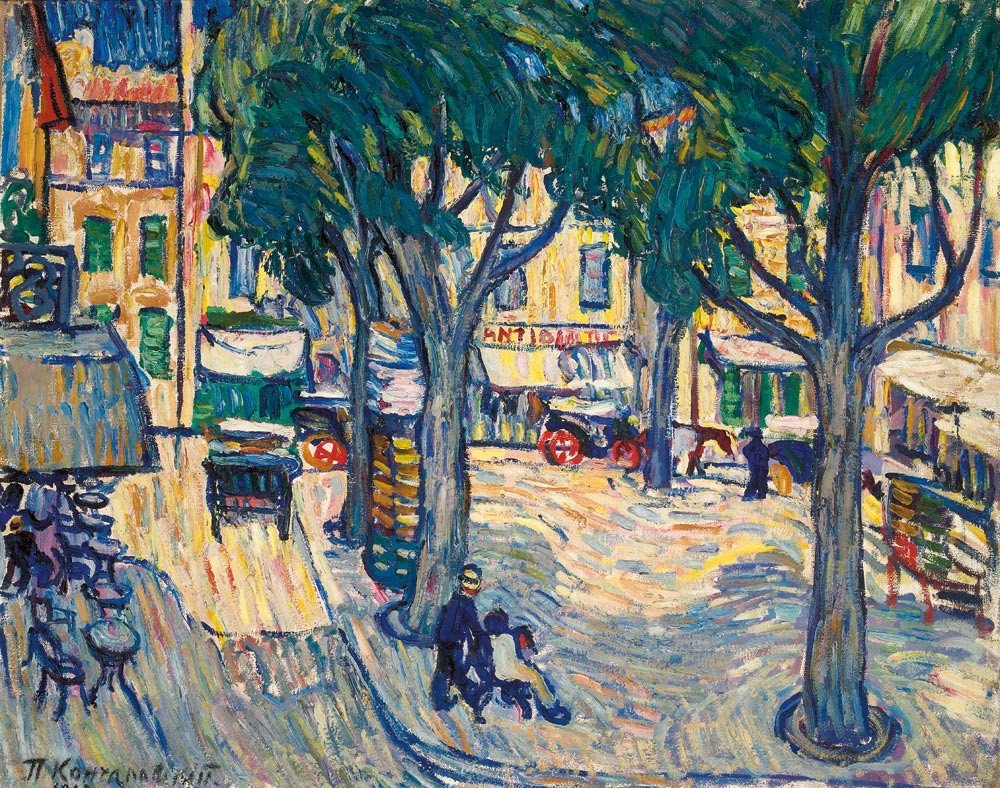
Konchalovsky’s early Cezannist paintings, made during and after time spent in France, are among the clearest surviving evidence of how directly the group’s founders worked from their French sources. The ‘Arles. Square’ (1908), painted on site before the society formed, shows that absorption at its most legible: a French provincial setting rendered in Cezannist planes, the vocabulary still near its origin. What followed back in Moscow was a deliberate rerouting of those same tools toward Russian market stalls, provincial churches, and domestic interiors, applied with a bluntness that French Post-Impressionism rarely permitted itself. That willingness to take a foreign formal language and apply it without apology to local, deliberately unglamorous subjects became one of the clearest fingerprints of the whole Russian avant-garde, not just the Jack of Diamonds.
Becoming an Institution: The Society After the Split
After Larionov and Goncharova’s departure, the Jack of Diamonds did not collapse. It formalized. Konchalovsky, Mashkov, Lentulov, and Falk continued exhibiting under the name for several more years, and the society increasingly functioned as a recognized institution rather than an outsider provocation, staging regular exhibitions and absorbing newer members drawn to its Cezannist, structurally grounded style. The group that had started as a scandal became, within a few years, closer to an establishment itself, a common trajectory for early twentieth-century avant-gardes, where yesterday’s provocateurs become today’s gatekeepers. That institutional phase gets less attention than the group’s founding scandal, but it is where much of the group’s lasting technical influence on Russian painting, particularly in still life and portraiture, was actually consolidated.
Historical Impact: Seeding a Generation of Soviet Painters
The Jack of Diamonds’ Cezannist wing left a technical legacy that outlasted the society itself. Mashkov, Konchalovsky, and Falk all continued painting into the Soviet period, and the structural, color-driven approach to still life and portraiture they had developed before 1917 fed directly into how an entire generation of Moscow-trained painters understood form. That legacy grew complicated after Socialist Realism was imposed as official Soviet doctrine in the early 1930s, a doctrine with little patience for visible brushwork or formal experiment for its own sake. Some former members adapted; Falk, by contrast, spent much of his later career working in relative isolation, his paintings unseen by the public that had once found the Jack of Diamonds’ work scandalous. The group’s other line, the neo-primitivist and Rayonist path taken by Larionov and Goncharova, had already left Russia and Soviet art history behind, developed instead in Paris.
Legacy: From Suppression to Rediscovery
Is the Jack of Diamonds Group Still Influential Today?
For much of the Soviet period, the Jack of Diamonds’ work sat outside official art history, too formally experimental for a doctrine that prized legible, heroic realism. Rediscovery came later, through Soviet-era museum retrospectives from the 1960s onward and through Western scholarship on the Russian avant-garde that treated Larionov, Goncharova, and their Moscow contemporaries as central rather than marginal figures. Today, paintings by Mashkov, Konchalovsky, Lentulov, and Falk hang in the State Tretyakov Gallery and other major Russian collections, studied as the moment Moscow painting stopped importing polish from St. Petersburg and started building its own, rougher formal language. Mashkov’s late Soviet-era still lifes, painted decades after the group disbanded, still carry the same structural confidence that marked his Jack of Diamonds years.
Related Movements: Neo-Primitivism, Cubo-Futurism, and the Wider Avant-Garde
The Jack of Diamonds sits at a junction point in the Russian avant-garde, the broad wave of experimental Russian art that ran from roughly 1890 into the 1930s. Its neo-primitivist wing, led by Mikhail Larionov and Natalia Goncharova, fed directly into Donkey’s Tail and Rayonism, and Goncharova’s later work connected her to the German-based Der Blaue Reiter circle as well. Its Cezannist wing, through Konchalovsky and Mashkov, shares direct roots with Cubo-Futurism, the style Lentulov brought into the group’s exhibitions and that would later echo, at a further remove, in Kazimir Malevich’s move toward Suprematism. No single later movement claims the Jack of Diamonds as its sole ancestor. Instead, the group functions as a hinge, the place where Moscow’s absorption of French modernism split into the several distinct paths Russian painting would take over the following two decades.
Essential Points
- Jack of Diamonds (Бубновый Валет) was among the earliest independent exhibiting societies in Moscow built around Cezanne-influenced painting rather than Imperial Academy rules.
- Its first exhibition opened in Moscow in December 1910, showing Russian painters alongside French and German modernists on the same walls.
- The name referenced the diamond-shaped patch sewn onto convict uniforms in Imperial Russia, a self-mocking nod to the group’s reputation for scandal.
- Founders Ilya Mashkov and Pyotr Konchalovsky anchored the group’s Cezannist wing with bold, structurally built still lifes.
- Aristarkh Lentulov brought Cubo-Futurist fragmentation to Moscow architecture and city scenes within the same exhibitions.
- Mikhail Larionov and Natalia Goncharova represented a neo-primitivist wing drawing on icons, lubok prints, and shop signs before splitting off in 1911-1912 to found Donkey’s Tail.
- The 1911-1912 split pushed Larionov and Goncharova toward Rayonism, one of the earliest steps toward abstraction in Russian art.
- Robert Falk stayed inside the society but painted with a quieter, more lyrical palette than his louder colleagues.
Frequently Asked Questions
- What does “Jack of Diamonds” mean as an art term?
- It names a Moscow society of painters active from 1910, who broke from academic art using Cezanne-inspired structure and bold color. The name (Bubnovy Valet in Russian) referenced the diamond patch sewn on convict uniforms, a self-mocking nod to the group’s scandalous reputation among Moscow critics.
- When and where did the Jack of Diamonds group first exhibit?
- The group’s first exhibition opened in Moscow in December 1910, showing a large body of work by Russian painters alongside French and German modernists in rented exhibition rooms, a deliberate statement that Moscow’s new painters belonged in that international company.
- What painting techniques united the Jack of Diamonds artists?
- Most members shared a debt to Cezanne: building forms from visible planes of color rather than smooth academic modeling. Konchalovsky and Mashkov applied this to Cezannist still life, while Larionov and Goncharova combined it with neo-primitivist sources like icons and folk prints.
- Why did Larionov and Goncharova leave the group they helped found?
- By 1911-1912 their neo-primitivist, folk-derived style had diverged sharply from the Cezannist still-life painting favored by Konchalovsky and Mashkov. They founded the more radical Donkey’s Tail instead, and soon developed Rayonism, pushing toward abstraction rather than representation.
- Where can you see Jack of Diamonds paintings today?
- Works by Mashkov, Konchalovsky, Lentulov, and Falk are held in major Russian collections including the State Tretyakov Gallery in Moscow, alongside international museums that acquired individual paintings as scholarly interest in the Russian avant-garde grew from the mid twentieth century onward.
This guide was written and reviewed by the rus-art.com editorial team, specializing in Russian art history. We cross-check dates, attributions, and museum holdings against museum and academic sources.