Quick Answer
The matryoshka, Russia’s stacking nesting doll, is not an ancient folk craft. It was designed in the 1890s by painter Sergey Malyutin, a member of the Abramtsevo artists’ colony near Moscow, and carved by woodturner Vasily Zvyozdochkin. Malyutin’s outer figure was a peasant girl in a sarafan; inside sat smaller figures ending in a swaddled baby. The set drew on Abramtsevo’s revival of Russian folk craft under patron Savva Mamontov, and within a decade the toy had become a national emblem.
What Is a Matryoshka Doll?
A matryoshka doll is a set of wooden dolls of decreasing size, each one opening at the waist to reveal a smaller doll inside, down to a single solid figure at the center. The name comes from Matryona, a common Russian peasant name. Matryoshka is its affectionate diminutive, so the word itself means something close to “little Matryona.” Traditionally the outermost doll is a woman in a sarafan, the everyday dress of rural Russia, and the smallest, innermost piece is a swaddled baby carved from one block of wood. The matryoshka feels like an artifact of deep folk history, but it is a design from the 1890s, credited to a specific painter and a specific woodturner working for a specific patron. It sits closer in age to the Eiffel Tower (1889) than to the icon-painting traditions it borrows from. According to Britannica, the form spread quickly after its debut and became one of the most recognized objects of Russian material culture within a single generation.
Before the Doll: Wood Turning and Folk Toys in Imperial Russia
Russia had a long tradition of turned and painted wooden toys before the 1890s, especially around Sergiev Posad, a town northeast of Moscow known for carved dolls, animals, and religious souvenirs sold to pilgrims visiting the Trinity Lavra monastery. What Sergiev Posad lacked before Malyutin’s design was the nesting structure that later became the matryoshka’s signature. That piece came from a different direction: the fine-art illustrators and craft revivalists gathered at Abramtsevo, who were busy turning peasant motifs into consciously designed art objects rather than anonymous folk production. Elena Polenova, a painter in that same circle, illustrated Russian fairy tales such as Synko-Filipko in the 1890s, giving concrete visual form to the same rural, storybook aesthetic that Malyutin would later carve into the matryoshka’s painted apron and headscarf. The doll arrived at the end of a decade of artists deliberately studying and stylizing peasant material culture, not at the start of one.
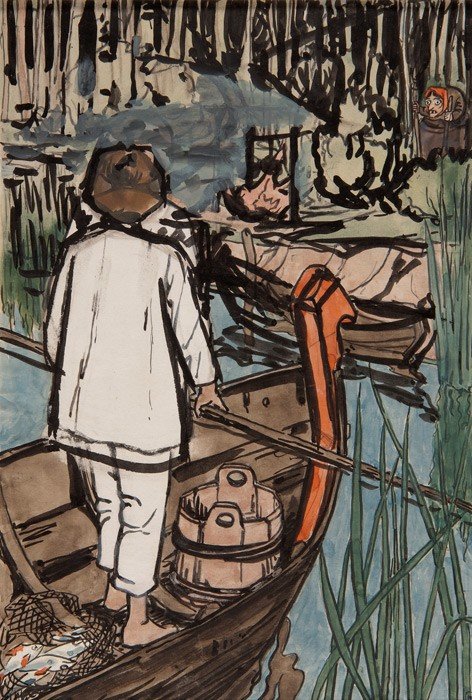
Abramtsevo: The Artists’ Colony Behind the Idea
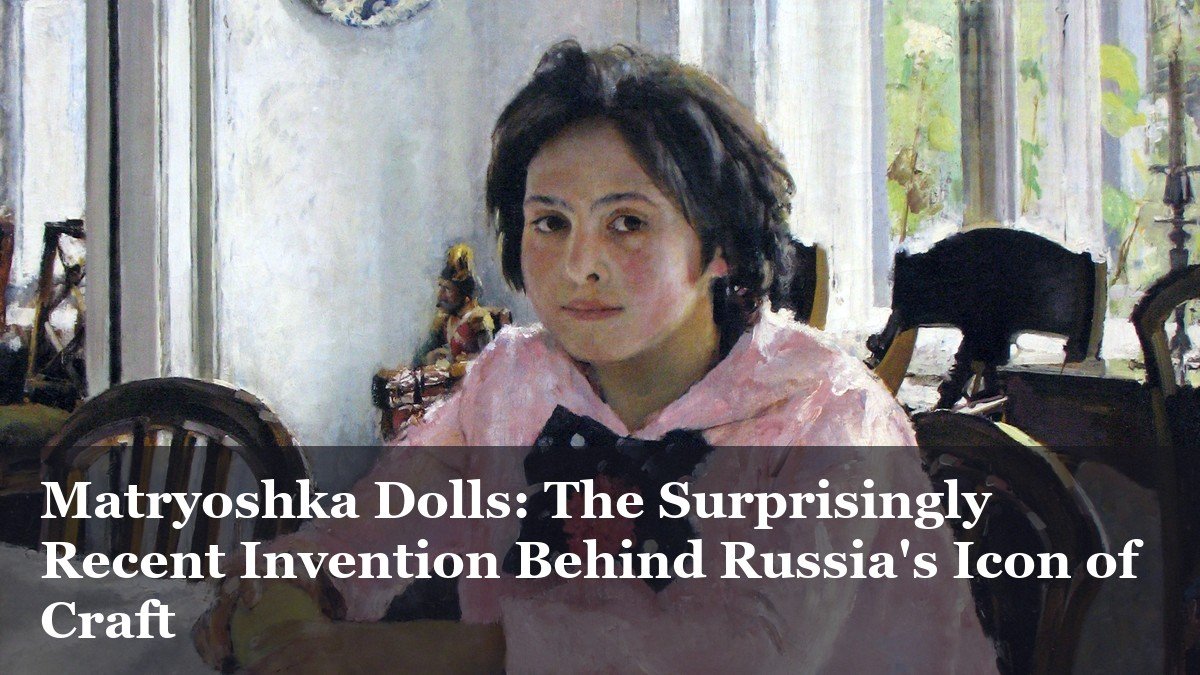
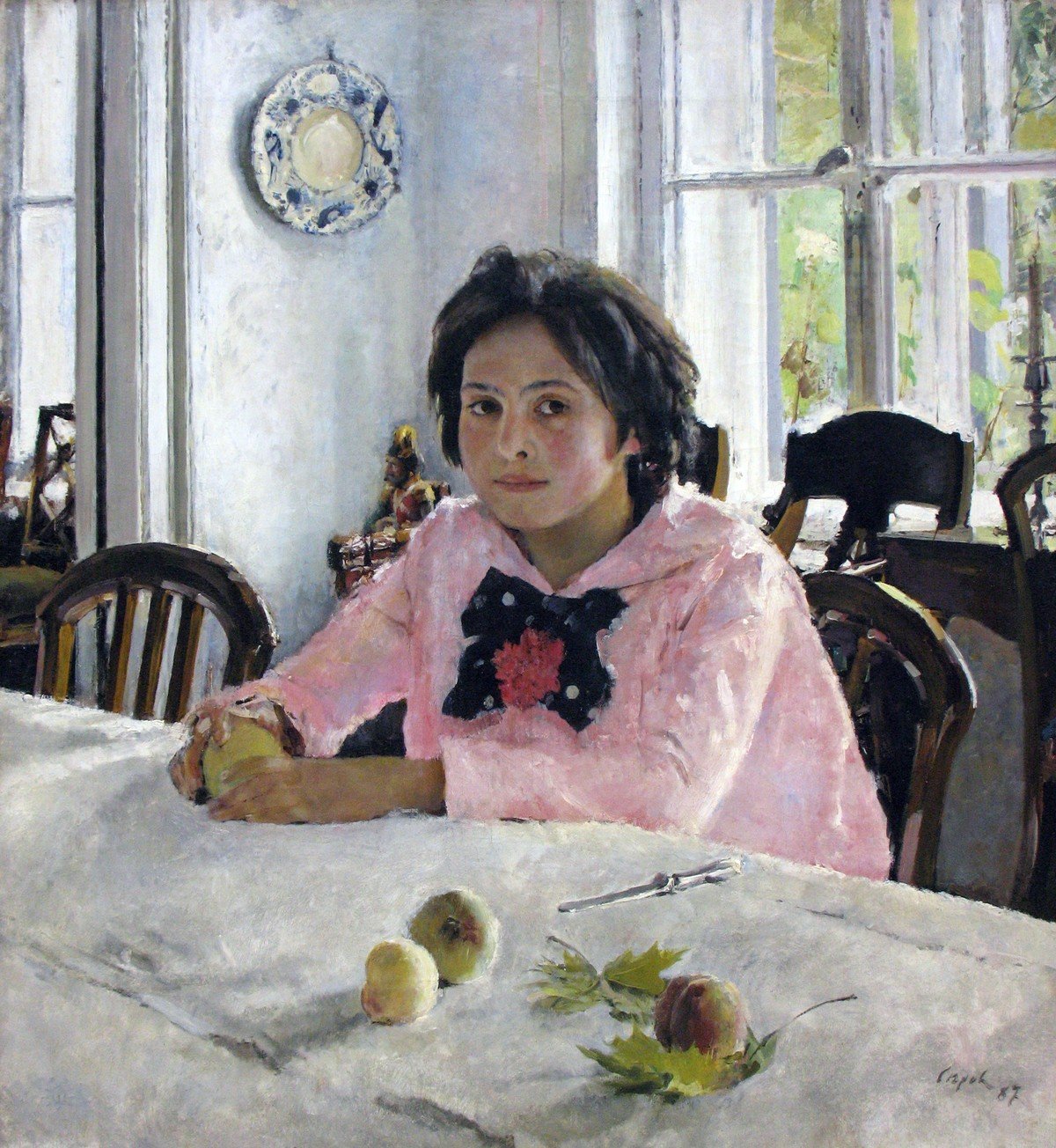
Abramtsevo was a country estate north of Moscow that became the center of a Slavophile artists’ colony in the 19th century, gathered around the industrialist and patron Savva Mamontov. Mamontov bought the estate and turned it into a working retreat where painters, sculptors, and craftsmen lived and collaborated, deliberately reviving Russian folk forms (embroidery, woodcarving, ceramics, fairy-tale illustration) as subjects worthy of serious art rather than rustic curiosities. Valentin Serov’s Girl with Peaches (1887), painted at Abramtsevo and showing Mamontov’s daughter Vera in the estate’s dining room, captures exactly the informal, sunlit domestic world the colony cultivated. It was inside this environment, saturated with folk-revival craft projects and Mamontov’s patronage, that Sergey Malyutin worked as a painter of fine crafts in the 1890s. That gave him both the material (peasant costume, storybook imagery) and the workshop access to design something as specific as a nested wooden family.
Sergey Malyutin’s Design and Vasily Zvyozdochkin’s Craft
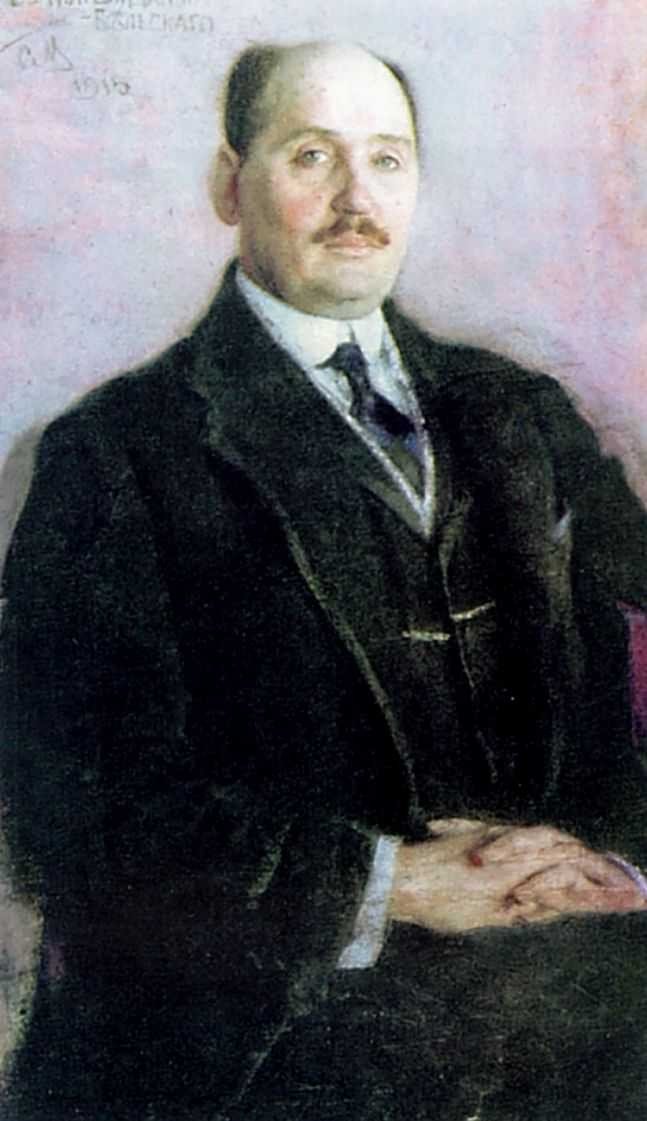
The first matryoshka set was made during the 1890s by woodturning craftsman, or more precisely, by woodturner Vasily Zvyozdochkin from a design by Sergey Malyutin, a folk-crafts painter at Abramtsevo. Malyutin supplied the concept and the painted decoration. Zvyozdochkin executed the actual turning, the harder technical skill of shaping each hollow shell so it fit snugly inside the next. That division of labor, a fine artist designing and a craftsman turning, mirrors exactly how Abramtsevo’s other workshops operated, where trained painters supplied patterns for peasant artisans to execute in wood, ceramic, or embroidery. Malyutin went on to a long career primarily as a portraitist. His 1918 self-portrait shows the same direct, unfussy observation he brought to the doll design decades earlier. Zvyozdochkin, by contrast, remained the technical craftsman of the pair, and it is his lathe work, not any single painter’s brush, that made the nesting mechanism possible at all.
Did a Japanese Souvenir Really Inspire the Matryoshka?
A popular account holds that Malyutin encountered a nesting figure of the Japanese sage Fukurokuju, one of the Seven Lucky Gods, at Abramtsevo and adapted its hollow, stacking structure into a Russian form. The story is widely repeated in general histories of the doll, though it rests on secondhand accounts rather than a documented object trail, so it is best treated as a plausible influence rather than a settled fact. What is firmly established is the outcome: a Russian peasant-girl figure, designed by Malyutin and turned by Zvyozdochkin, that had no exact precedent in earlier Russian toymaking.
Anatomy of a Matryoshka: Defining Features
A classic matryoshka set separates horizontally at the middle of the figure, top from bottom, so each doll opens like a hollow egg to reveal a smaller one nested inside. The outer layer is conventionally a woman in a sarafan, and the inner figures can be any gender or age, ending in a single, solid, unpainted-inside baby turned from one piece of wood. Sets traditionally use an odd number of dolls, commonly five, seven, or more, though large decorative sets can run past twenty. Almost all of the artistic labor happens after the turning is finished: the painting, which can range from simple folk florals to elaborate scenes, is what distinguishes a fine matryoshka from a basic souvenir version. The wood must be turned green and dried in stages between cuts to prevent cracking, so a full set can take a craftsman weeks to rough out even before any paint is applied.
Talashkino and Princess Tenisheva’s Workshop
Talashkino, an estate near Smolensk, became Abramtsevo’s rival and heir as a center of folk-craft revival after Princess Maria Tenisheva bought it in 1893. Tenisheva, an artist herself and a serious collector, ran a free art studio there from 1894 under the supervision of Ilya Repin, and in 1900 she opened an artisan workshop producing ceramics and carvings. She invited Sergey Malyutin, fresh from his matryoshka design at Abramtsevo, to supervise the new workshop and select its apprentices from local peasants. Malyutin stayed at Talashkino until 1903, and while there he also designed a fairy-tale-themed house at the nearby village of Flyonovo, extending the same storybook peasant aesthetic from the doll into architecture. Talashkino’s explicit goal, in Tenisheva’s own words, was to create a “genuine Russian style.” That meant the matryoshka form Malyutin brought with him found a second, well-funded home just as it was beginning to circulate beyond Abramtsevo.
The Doll Meets the World: Paris 1900
Within a decade of its design, the matryoshka moved from a single Abramtsevo workshop to international recognition, exhibited at the 1900 Paris World’s Fair alongside other examples of the Russian craft revival that Mamontov and Tenisheva had spent the 1890s funding. Foreign buyers and exhibition organizers responded to the doll as something distinctly Russian, and Sergiev Posad, already established as a woodturning center for religious and folk souvenirs, absorbed the design into its regular production. That geographic shift matters: the matryoshka’s invention belongs to Abramtsevo and Malyutin, but its mass manufacture, and its association in most people’s minds with a single traditional toy town, belongs to what happened at Sergiev Posad afterward. The two stories are often collapsed into one, which is part of why the doll is so often mistaken for an object with no single point of origin.
The Painters of Abramtsevo: Repin, Serov, Vrubel, and Polenov
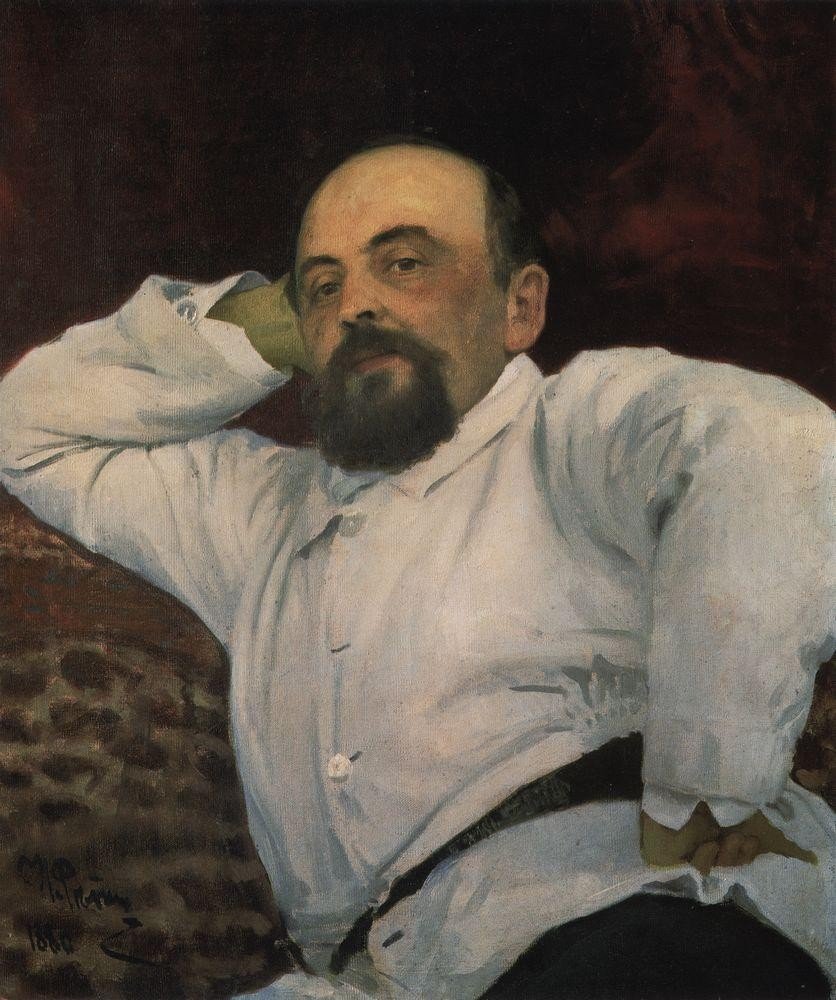
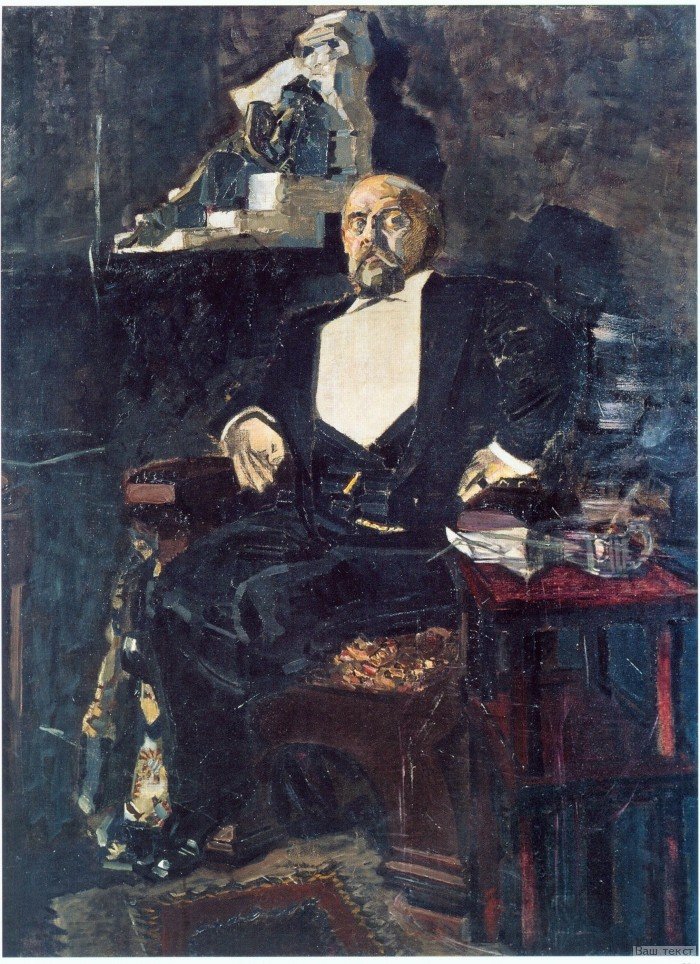
Malyutin did not design the matryoshka in isolation. He worked inside a circle of major painters who had all passed through Abramtsevo under Mamontov’s patronage. Ilya Repin painted Mamontov’s portrait as early as 1880, and Mikhail Vrubel’s 1897 portrait of the same patron shows how central Mamontov remained to the colony’s artists across nearly two decades. Vasily Polenov, another Abramtsevo regular, painted quieter domestic scenes of the estate, such as Mamontov and a guest at the piano in 1882, documenting the informal, workshop-like atmosphere in which craft projects like the matryoshka took shape alongside easel painting.
What Was Savva Mamontov’s Role in Russian Art?
Mamontov was not a painter but the industrialist patron who funded and hosted the Abramtsevo colony, giving artists like Malyutin, Repin, Serov, Vrubel, and Polenov both a working retreat and the resources to pursue folk-craft revival projects that had no obvious commercial payoff at the time, the matryoshka among them. His wealth came from railway construction, and he deployed it across a wider cultural front than Abramtsevo alone: the Moscow Private Russian Opera, which he ran from the mid-1880s, staged productions with sets designed by Vrubel and other colony painters, giving them large-scale public commissions outside the estate’s workshops. His model was participatory rather than purely financial; he directed theatrical productions himself and worked inside the craft studios alongside the artists he supported, which turned Abramtsevo into an active working atelier rather than a gentleman’s retreat.
Notable Early and Historic Matryoshka Sets
The original Malyutin and Zvyozdochkin set, a peasant girl holding a black rooster and opening to reveal seven more figures ending in a swaddled infant, is usually cited as the founding design, now held in Russian museum collections devoted to toys and folk art. Later Sergiev Posad workshops expanded on the formula quickly, producing sets themed around fairy tales, historical figures, and folk festivals rather than the single peasant family of the original. By the early 20th century, workshops were also producing matryoshkas shaped as entire boyar or merchant families, moving the design away from Malyutin’s plain sarafan figure toward more elaborate costume painting. None of these later variations changed the underlying mechanism Zvyozdochkin engineered in the 1890s. They only expanded what could be painted onto it.
How a Matryoshka Is Made
Production starts with linden or birch wood, chosen for being soft enough to turn easily but firm enough to hold fine detail once dry. The wood is cut, dried for months to prevent later cracking, then turned on a lathe from the smallest, solid doll outward, since each larger shell has to be shaped to fit precisely around the one turned before it. Only after all the pieces are turned and dried again does the painting begin, typically starting with a base coat, then facial features, then the costume detail that gives each set its individual character. This sequence, solid figure first, then progressively larger hollow shells, then paint last, is why the craftsman’s turning skill and the painter’s decorative skill have historically been treated as two separate trades, exactly as they were between Zvyozdochkin and Malyutin at the very beginning.
From Craft Object to National Emblem
The matryoshka’s rise from a single Abramtsevo commission to a recognized symbol of Russia happened largely because it fit two separate agendas at once: it satisfied the craft-revival movement’s search for an authentically Russian folk form, and it worked as an easily exported, visually striking souvenir once Sergiev Posad began producing it at scale. Few late 19th-century Russian craft objects managed both at the same time. By the early 20th century, the doll had outgrown its origin story in most buyers’ minds entirely, which is exactly how it came to be assumed as ancient rather than recognized as a specific 1890s design.
Political and Satirical Matryoshkas
Later in the 20th century, and especially after the Soviet Union’s collapse, matryoshka sets took on a second life as political caricature, with painted portraits of Soviet and Russian leaders stacked inside one another for tourist markets. This use has nothing to do with Malyutin’s original design intent. It is a commercial adaptation of a recognizable form, in the same way souvenir shops elsewhere repaint familiar objects with celebrity likenesses. The practice shows how completely the matryoshka’s stacking mechanism, rather than any specific peasant imagery, became the object’s real identity.
The Matryoshka in Global Culture Today
Outside Russia, “matryoshka” has become a general metaphor for anything nested inside progressively larger or smaller versions of itself, used in fields from software architecture to narrative structure, well beyond the wooden object it describes. Tourist markets in Sergiev Posad and elsewhere in Russia still produce both traditional peasant-family sets and themed variations, and collectors distinguish hand-painted artisan sets from mass-produced tourist versions largely by the fineness of the facial painting, a distinction that traces directly back to Malyutin’s original emphasis on decoration over the plain turned form.
Common Misconceptions
One remaining misconception is worth addressing directly: many buyers assume every matryoshka set nests down to a single fixed number of dolls, usually imagining exactly the original set’s count. In practice, set size was never standardized by Malyutin or Zvyozdochkin. It varies by workshop and era, from small three-piece souvenir sets to elaborate sets exceeding twenty, and only the odd-number convention, not any specific count, has held reasonably consistent across producers.
Related Traditions: Nesting Dolls Beyond Russia
Nesting object traditions exist elsewhere, most notably in the Japanese Fukurokuju figures sometimes cited as a partial inspiration for Malyutin, and in various European turned-wood toy traditions that predate the matryoshka without using its exact stacking mechanism. What sets the Russian form apart is not the nesting principle itself but the specific costume iconography Malyutin attached to it, the sarafan-clad peasant woman, which made the object legible as distinctly Russian the moment it left the country. That specificity, more than the mechanism, is why the matryoshka became a national symbol while comparable nesting toys elsewhere did not.
Where Malyutin and Zvyozdochkin’s Legacy Lives On
Sergiev Posad remains the best-known center of matryoshka production today, a legacy of the craft-revival network that ran through Abramtsevo and Talashkino in the 1890s and 1900s. Malyutin’s later career moved almost entirely into portraiture, and Zvyozdochkin’s name survives mainly in histories of the doll itself rather than in a wider body of independent work, a reminder that the matryoshka’s fame has always outpaced recognition of the two people who actually made it.
Essential Points
- The matryoshka was invented in the 1890s, not in some undated peasant past; Malyutin designed it and Zvyozdochkin turned the wood.
- Malyutin worked at Abramtsevo, the artists’ colony run by industrialist and patron Savva Mamontov, where folk craft was deliberately revived as fine art.
- The original set showed a peasant girl in a sarafan opening to reveal smaller figures, ending in a single carved baby.
- Princess Maria Tenisheva’s rival colony at Talashkino, where Malyutin later supervised the workshop, spread the matryoshka form beyond Abramtsevo.
- The dolls owe their production center, Sergiev Posad, to the same 1890s craft-revival network rather than a single ancient workshop town.
- Matryoshka sets are painted, not carved, with most of their artistry: each doll is turned first, then decorated.
- Political and satirical matryoshkas (leaders, celebrities) are a 20th and 21st century commercial layer on top of the original folk design, not part of its origin.
- The doll’s stacking logic (largest to smallest, always an odd number of pieces in classic sets) became a template copied well beyond Russia.
Frequently Asked Questions
- What does the word matryoshka actually mean?
- Matryoshka is an affectionate diminutive of Matryona, a common Russian peasant woman’s name in the 19th century. The word itself roughly means “little Matryona,” reflecting the outer doll’s traditional identity as a peasant woman in a sarafan.
- When and where was the first matryoshka doll made?
- The first set was made in the 1890s at the Abramtsevo artists’ colony near Moscow, designed by painter Sergey Malyutin and turned by craftsman Vasily Zvyozdochkin, under the patronage of industrialist Savva Mamontov.
- Why do matryoshka sets usually have an odd number of dolls?
- The odd-number convention became common practice among Sergiev Posad workshops after the original design, though it was never fixed by Malyutin or Zvyozdochkin themselves. Set size otherwise varies widely by workshop, era, and intended market.
- Did Sergey Malyutin only design matryoshka dolls?
- No. Malyutin worked mainly as a portrait painter throughout his career, painting figures such as writer Dmitry Furmanov and educator Nikolai Bogdanov-Belsky, alongside architectural and folk-craft design work at Abramtsevo and Talashkino.
- Where can you see matryoshka dolls today?
- Sergiev Posad, near Moscow, remains the main production center and has a dedicated toy museum. Original and historic sets also appear in Russian decorative-arts and folk-craft collections, alongside modern artisan and tourist-market versions sold across the country.

This guide was written and reviewed by the rus-art.com editorial team, specializing in Russian art history.