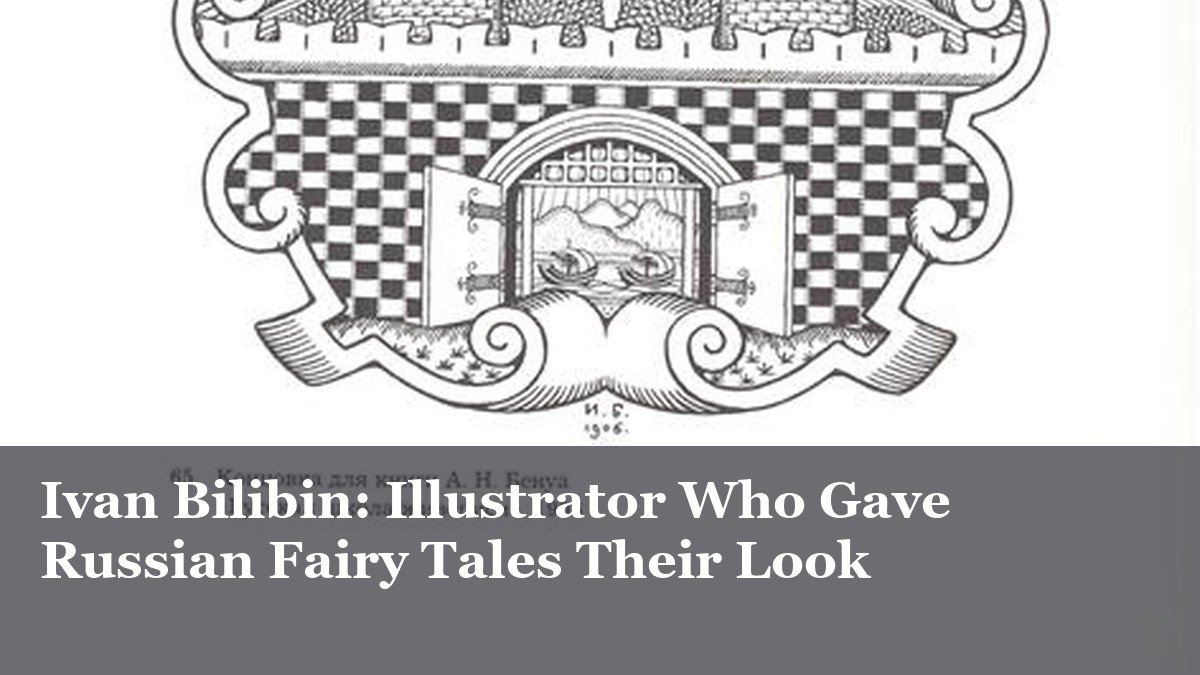
Ivan Bilibin gave Russian fairy tales the look most readers still picture: a confident black outline, flat watercolor, and a page framed like a carved wooden chest. Think of Baba Yaga’s hut on its chicken legs, or a tsarevich riding a grey wolf. The image in your head probably descends from the booklets he drew between 1899 and 1910. This article follows how a trained lawyer from near St Petersburg built that look from icons, village carving, Japanese prints and Art Nouveau, and how it travelled from the printed page to the Paris stage and finally to a besieged Leningrad.
Quick Answer
Ivan Bilibin (1876 to 1942) gave Russian fairy tales the look most readers now picture: a firm black ink outline filled with flat watercolor and framed by borders of folk ornament. Between 1899 and 1910 his illustrated booklets for folk tales and Pushkin’s verse tales fixed that style in print. He drew on icons, carved wooden buildings, lubok prints and Japanese prints, then took it to the stage for Diaghilev. Later Russian picture books still echo his method.
What Is the Ivan Bilibin Style?
The Ivan Bilibin style is a method of book illustration built on three elements: ink outline, flat watercolor and ornamental border. Each has its own source in a different tradition, and each gets its own section below.
The combination stands apart because of its attitude to the story. Bilibin drew fairy tales as if they had happened in a specific medieval Russia, with particular kinds of caftan, roof and lettering, rather than in a generic storybook past.
A Law Student in Repin’s Studio
Ivan Bilibin was born on 16 August 1876 (4 August in the old Russian calendar) near St Petersburg. He did not set out to be an illustrator. He studied law at St Petersburg University, finishing the degree in 1900, and drew on the side. In 1898 he spent time in Munich at the private school of Anton Ažbe, which also trained Wassily Kandinsky. Back in St Petersburg he studied under Ilya Repin.
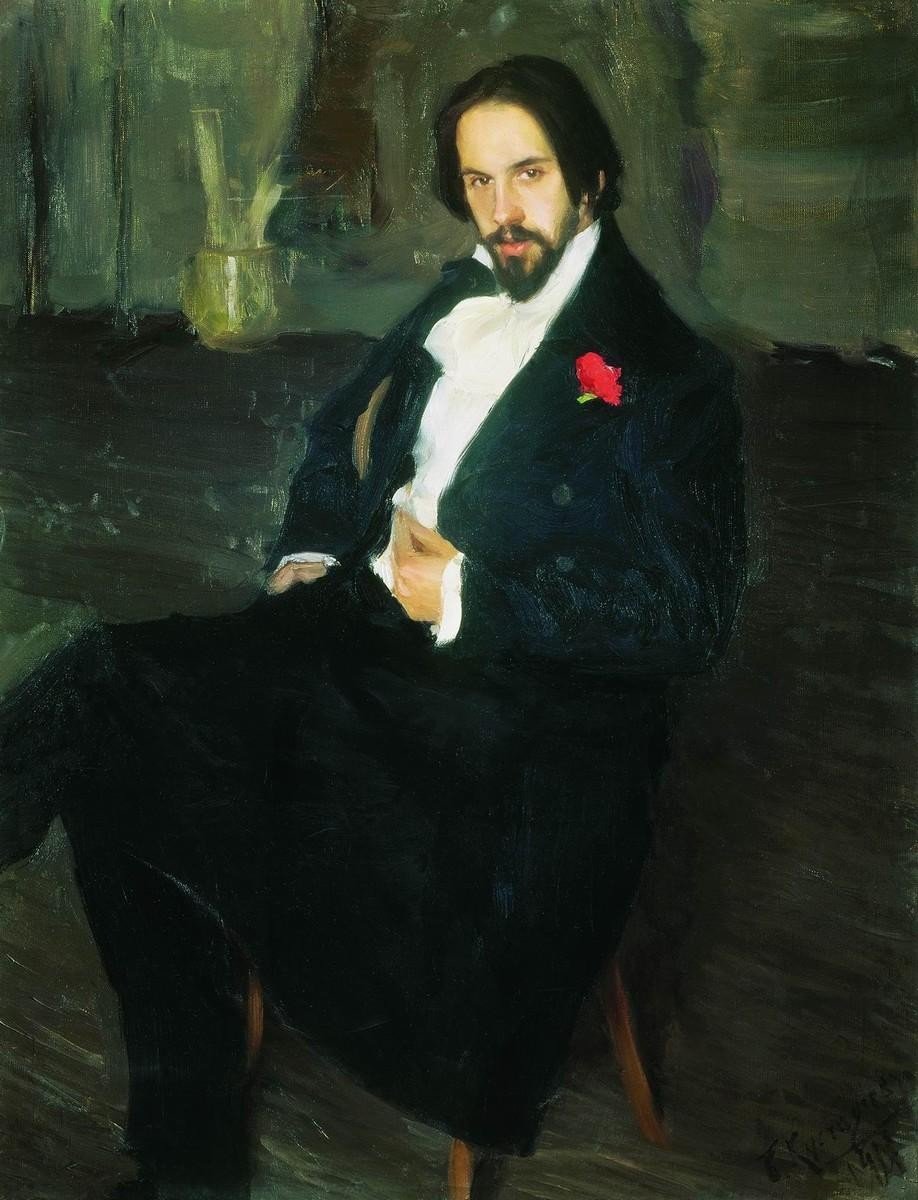
Repin taught painters to model volume and catch a psychological moment, as in his Barge Haulers on the Volga (1873). Bilibin went the other way. Contour, pattern and the printed page held his attention. Boris Kustodiev, another of Repin’s pupils, painted his portrait in 1901, when the young lawyer was becoming the artist the public would come to know.
Before Ivan Bilibin: Vasnetsov, Polenova and Abramtsevo
Painting Russian folklore was not Bilibin’s idea. By the 1880s the Abramtsevo estate north of Moscow had become an artists’ colony and a centre of Slavophile enthusiasm for peasant culture. Painters there studied carving, embroidery and old church architecture, and some tried to carry them into modern work.
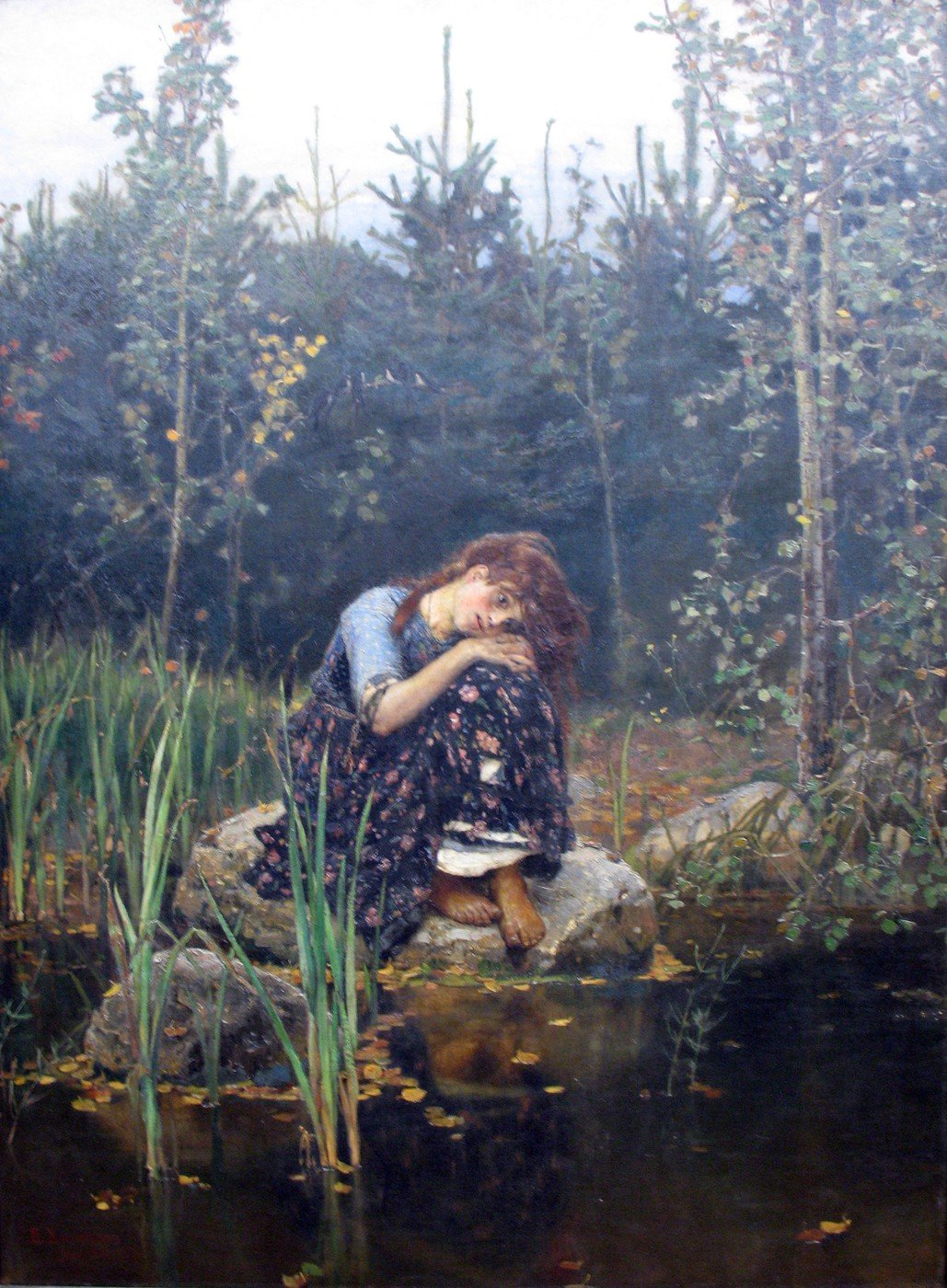
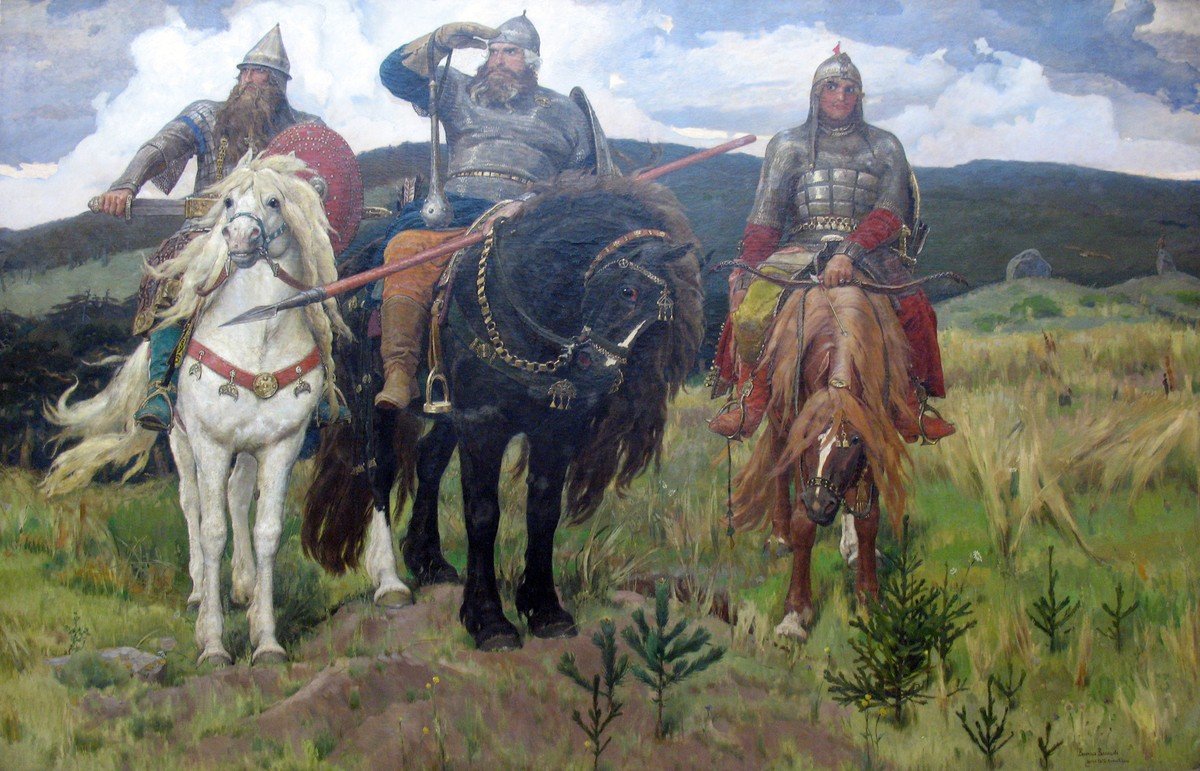
Viktor Vasnetsov was the most famous of them. He painted Alyonushka in 1881, a barefoot girl on a stone beside dark water, taken from the tale of Sister Alyonushka and Brother Ivanushka. From 1881 to 1898 he worked on Bogatyrs, with its three mounted heroes. In 1883 he also designed a wooden hut on hen’s legs at Abramtsevo. Vasnetsov painted in oil, across a full tonal range, for the gallery wall.
Yelena Polenova (1850 to 1898) worked on a smaller scale. She was among the first illustrators of children’s books in the Russian Empire. Her watercolor scenes for tales such as Synko-Filipko, dated 1896, already join folk ornament to the curving lines of Art Nouveau.
Who Illustrated Russian Fairy Tales Before Bilibin?
Mostly anonymous makers of cheap woodcut and lithographed lubok sheets, plus the Abramtsevo circle around Polenova and Vasnetsov. What no one had supplied was a book designer: someone who would make cover, lettering, border and pictures speak one visual language. Bilibin’s booklets filled that gap.
The Northern Journeys
In 1902 Bilibin travelled to the Russian North, and he returned in the years that followed. His routes ran through Vologda, Olonets and Arkhangelsk provinces, where wooden building and village crafts had survived with little interference. He photographed and sketched log churches with tented roofs, carved window frames, painted chests, embroidered towels and everyday dress.
The trips turned a vague enthusiasm into a catalogue. When a Bilibin tsar sits under a roof with stepped gables, or a heroine wears a headdress of a particular regional cut, he is quoting something he saw and recorded. Many scholars note that he treated the North as a preserved archive of an older Russia. Wooden villages were his reference library, and the pages show it.
How Ivan Bilibin Drew: Line First, Color Second
Bilibin worked in a fixed order. First came every form in black ink, drawn with pen or fine brush in a line of nearly even thickness, so that a profile, a fold of cloth and a roof tile carry similar visual weight. Only then did he lay in watercolor, as flat areas with little modeling. Distance is built by stacking shapes up the page rather than by atmospheric blur.
The method has several ancestors. Russian icons supplied the habit of outlining and the glowing, flat color. Lubok prints supplied narrative bluntness. The Jugendstil and Art Nouveau periodicals he met in Munich supplied a taste for decorative curves. Japanese woodblock prints, widely collected by European artists around 1900, are the other usual reference point.
Why Does a Bilibin Illustration Look Like a Woodblock Print?
Largely because it was drawn to be printed. Outlined drawings with flat color areas translate cleanly into color printing, where each hue is a separate plate or stone. Bilibin designed for the press, and the press rewarded clarity of line. The resemblance to Japanese prints is real, though scholars debate how direct the borrowing was and how much arrived through Art Nouveau intermediaries.
Borders, Lettering and the Page as One Design
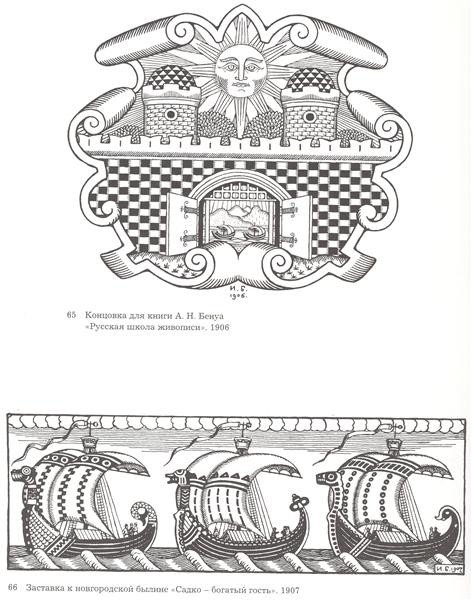
Open one of the booklets and the picture turns out to be only part of the design. The cover carries a title in letters modeled on medieval Russian manuscripts, with ligatures that squeeze characters together. Border bands repeat patterns from carved wood, embroidered towels and illuminated books. The text block sits inside its own ruled frame, and the pictures often press right to the edge, so figures seem to sit in a carved panel rather than in open space.
Some historians point out that this Old Russia is a composite. Bilibin mixed motifs from different centuries and regions, so the world he drew never existed as a single place. He was an inventor of a tradition as much as a recorder of one.
The Fairy Tale Booklets That Made Ivan Bilibin Famous
The series that made his name began in 1899, when the Expedition for the Preparation of State Papers in St Petersburg, the state printing house that also produced banknotes, published his first illustrated folk tale. Over the next few years it issued more, in a large, thin format at prices ordinary buyers could manage.
The list includes Ivan Tsarevich, the Firebird and the Grey Wolf; Vasilisa the Beautiful, a tale collected by Alexander Afanasyev in his Narodnye russkie skazki; The Frog Princess; Maria Morevna; and The Feather of Finist the Bright Falcon. A consistent layout made the series recognizable at a glance, an early case of a house style in children’s books.
Look Closer: Look closer: where is the shadow?
In Bilibin’s Baba Yaga page for Vasilisa the Beautiful, forms are separated by black contour and color, not by shading, so the eye reads pattern before depth. Set it beside Vasnetsov’s Alyonushka, where dusk and damp air do that work in oil paint. The contrast shows how deliberately Bilibin designed for the printing press rather than the gallery wall.
Pushkin’s Tales Through Ivan Bilibin’s Eyes
Between 1905 and 1910 Bilibin turned to Pushkin, illustrating the verse tales of Tsar Saltan, the Fisherman and the Fish, and the Golden Cockerel. These are literary works, written in the 1830s from folk plots, and Bilibin gave them more scenic ambition than the anonymous tales. Ships, towns and royal chambers fill the page, and many of his costumes borrow from seventeenth-century Muscovy.
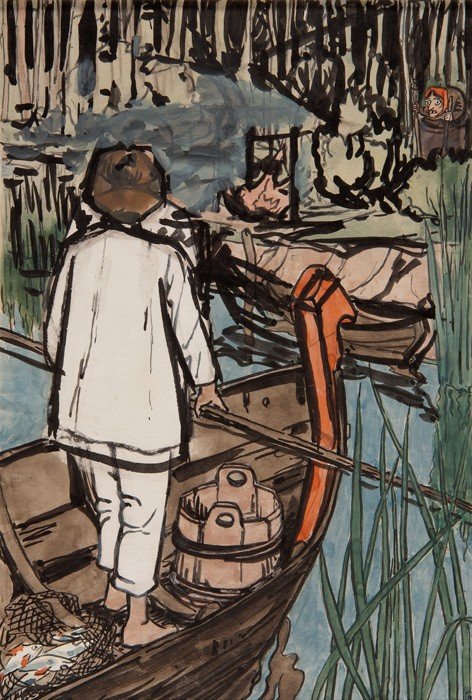
In Tsar Saltan (1905), the barrel tossed on stylized waves shows the method at its best. The sea becomes a repeating textile pattern, and the story’s danger is carried by one small dark shape against it.
Satire in 1905 and 1906
Not all of Bilibin’s work in these years was fairy tale. During the unrest of 1905 and the brief loosening of censorship after it, he drew for satirical magazines, among them Zhupel (Bugbear) and Adskaya pochta (Hell’s Mail). The authorities closed such journals quickly.
His caricatures use the same crisp contour as the fairy tales, now sharpened into attack. The pages show something easily missed: the Bilibin line was never tied to enchantment. It was a graphic tool good at sudden, legible statements, which is why it also suited posters and stage sketches.
Mir iskusstva and the Stage
Around 1900 Bilibin took part in Mir iskusstva (“World of Art“), the St Petersburg circle and magazine led by Sergei Diaghilev together with Alexandre Benois, Leon Bakst, Konstantin Somov and Mstislav Dobuzhinsky. The group argued that books, posters and theatre sets deserved the same seriousness as easel painting. That view suited an illustrator who thought in whole pages.
Did Ivan Bilibin Design for the Stage?
Yes. In 1908 he worked on Diaghilev’s Paris production of Mussorgsky’s Boris Godunov, and in 1909 he designed Rimsky-Korsakov’s The Golden Cockerel for the Zimin Opera in Moscow. Stage work suited him because his pictures were already built from flat planes and strong silhouettes, which read well under theatre light. He is counted among the contributors to the Ballets Russes.
Exile in Egypt and Paris
After the revolutions of 1917 and the Civil War, Bilibin left Russia in 1920. He lived first in Egypt, in Cairo and then Alexandria, before moving to Paris in 1925. The years abroad were no pause. He kept working in the same idiom, now for an audience that tended to treat Old Russia as something lost.
Return to Leningrad and Death in the Siege
In 1936 Bilibin returned to the Soviet Union and settled in Leningrad. He was in his sixties and still working, taking up Pushkin and the epic songs again. He died in the besieged city on 7 February 1942, in the first winter of the blockade.
The Influence of Ivan Bilibin on Later Illustrators
Few Russian illustrators after 1905 could ignore him. Georgy Narbut, who began in the same St Petersburg circle, developed a more austere version of the decorated page. In Soviet children’s publishing, the template of outline plus ornament often returned for folktales.
Western picture books of Russian folktales still lean on borders and outlines descended from his pages, usually at several removes. His look became shorthand for Russian folklore far beyond the country that produced it.
Where to See Ivan Bilibin’s Work Today
The State Russian Museum in St Petersburg and the State Tretyakov Gallery in Moscow both hold his work, and the Tretyakov also owns Vasnetsov’s Alyonushka and Bogatyrs. Drawings and watercolors on paper are light-sensitive, so museums often show them only in rotation. Check collection pages before you travel. The Abramtsevo museum-reserve north of Moscow preserves the setting where Vasnetsov and Polenova worked.
Neighbors in the Same Circle
Bilibin’s closest neighbors are the other Mir iskusstva figures. Alexandre Benois evoked eighteenth-century Versailles and St Petersburg. Konstantin Somov painted ironic costume scenes. Mstislav Dobuzhinsky drew the modern city. Leon Bakst turned color into theatre.
Nicholas Roerich reached for the same medieval Rus in Guests from Overseas (1901, Tretyakov Gallery), with its Varangian ships. Roerich later designed for the Ballets Russes, including The Rite of Spring in 1913.
Essential Points
- Three questions identify a Bilibin page fast: is there a black contour, is the color flat, does a border echo folk ornament?
- Treat his Old Russia as a designed composite, not as documentary evidence of medieval life.
- His career crossed three worlds: tsarist publishing, exile in Egypt and France, and Soviet Leningrad.
- Vasnetsov and Polenova supplied the subject matter; Bilibin supplied the system that made it repeatable.
- The same contour served fairy tales, satire and stage sketches, so he is best judged as a designer of images for reproduction.
- For his clearest manner, start with the early folk-tale booklets; for his most ambitious scenes, go to the Pushkin books.
Frequently Asked Questions
- Which Bilibin book should I look at first?
- Start with Vasilisa the Beautiful from around 1900 and Pushkin’s Tale of Tsar Saltan from 1905. The first shows his compact folk-tale format with Baba Yaga and the forest, the second his larger scenes of ships, towns and royal rooms. Reading them in that order shows how his manner grew more ambitious.
- Why did Bilibin leave Russia in 1920 and come back in 1936?
- He left in 1920, as the Civil War upended the tsarist-era publishers and patrons he had worked for, and spent sixteen years abroad. Sources differ on why he returned in 1936. Homesickness and an offer of work in Leningrad are the explanations most often given, but no single motive is documented beyond doubt.
- Why does Baba Yaga fly in a mortar in Bilibin’s Vasilisa the Beautiful?
- The mortar, pestle and broom come from the tale, not from Bilibin’s invention. In folklore they mark Baba Yaga as a witch whose domestic tools have turned monstrous, and her fence of skulls in Vasilisa the Beautiful completes the picture. Scholars still disagree about her origins.
- Did Ivan Bilibin join any artists’ organizations?
- After returning to the Soviet Union in 1936, Bilibin taught in Leningrad, and in 1937 he became a member of the Artists’ Union of the USSR. He was also a member of the Union of Russian Artists from around 1903, a pattern of belonging to artists’ groups across very different political eras.
- Are Bilibin’s illustrations in the public domain?
- Bilibin died in 1942, so in countries that protect works for the artist’s life plus 70 years, his art entered the public domain on 1 January 2013. Other jurisdictions, including the United States, apply different rules, especially for works first published abroad. Check the rights statement of each image before you reuse it.
This guide was written and reviewed by the rus-art.com editorial team, specializing in Russian art history. We cross-check dates, attributions, and museum holdings against museum and academic sources.