Pavel Filonov (1883 to 1941) painted pictures that look grown rather than composed. Every square centimeter is divided into small facets of color, each worked with a thin brush. He called his method analytical art, wrote a doctrine for it, and trained a school of followers in Leningrad. When the Soviet state moved toward a single official style in the early 1930s, he did not adjust. Officials wanted legible stories and idealized faces. Filonov gave them crystalline heads, dense crowds and cosmic scenes that demand slow reading. He kept working on his own terms until he died in the besieged city in December 1941. This article follows his method, his quarrels and the afterlife of his work.
Quick Answer
Pavel Filonov was a Russian avant-garde painter (1883 to 1941) who developed analytical art, a method of building a picture from tiny, individually worked units of form and color instead of copying a visible scene. He taught it to a school of students in Leningrad. Because his dense, unheroic images fit neither the state’s demand for legible, idealized narratives nor the programs of other avant-garde groups, he was denied the public career his talent warranted. He died of starvation during the Siege of Leningrad, and his work is now held mainly in the Russian Museum.
Who Was Pavel Filonov? A Quick Definition
Pavel Nikolayevich Filonov was a Russian avant-garde painter, art theorist and poet. He was born in Moscow on January 8, 1883, and died in Leningrad on December 3, 1941. He belongs to the Russian avant-garde, the wave of modern art that ran from about 1890 to 1930 across the Russian Empire and the Soviet Union and included Suprematism, Constructivism and Cubo-Futurism.
His own label, analytical art, described a way of working more than a look. It explains why his canvases are crowded, faceted and built up from small units. It also explains why the Soviet state, which by the early 1930s wanted something very different from its painters, had no use for them.
From Moscow Childhood to Academy Rebel
Filonov was born in Moscow and moved as a teenager to St Petersburg, where he paid his way with decorative and house-painting jobs while he trained. In 1908 he entered the Imperial Academy of Arts. Its training in idealized anatomy and finished surfaces was exactly what he would spend his career arguing against. He left in 1910. His painting Heads dates from that year, and it is a good place to watch him working out his handling of the human face before his method had a name.
Why Was Pavel Filonov Expelled From the Academy?
Accounts say he clashed with his professors over academic drawing, and he is usually described as expelled in 1910. The anecdotes shift in the retelling, so treat the exact circumstances with caution. The direction of travel is clear enough. He turned away from polished academic finish and toward a rough, self-directed program.
The Circle Around Matyushin and Khlebnikov
In St Petersburg, Filonov moved close to the Union of Youth, an association of Russian Futurists active from 1910 to 1913. Its key members were the composer and amateur painter Mikhail Matyushin (1861 to 1934) and his wife, the poet Elena Guro (1877 to 1913). Filonov also befriended the poet Velimir Khlebnikov.
Matyushin studied the physiology of the human senses and later taught his students to widen their field of vision. He summarized his findings in Reference of Colour (1932). He and Filonov differed in method, but both treated perception as something an artist must train, not something nature hands over for free. That shared premise made the circle a natural home for Filonov’s early experiments.
Feast of Kings and the Holy Family: Sacred Subjects, Broken Surfaces
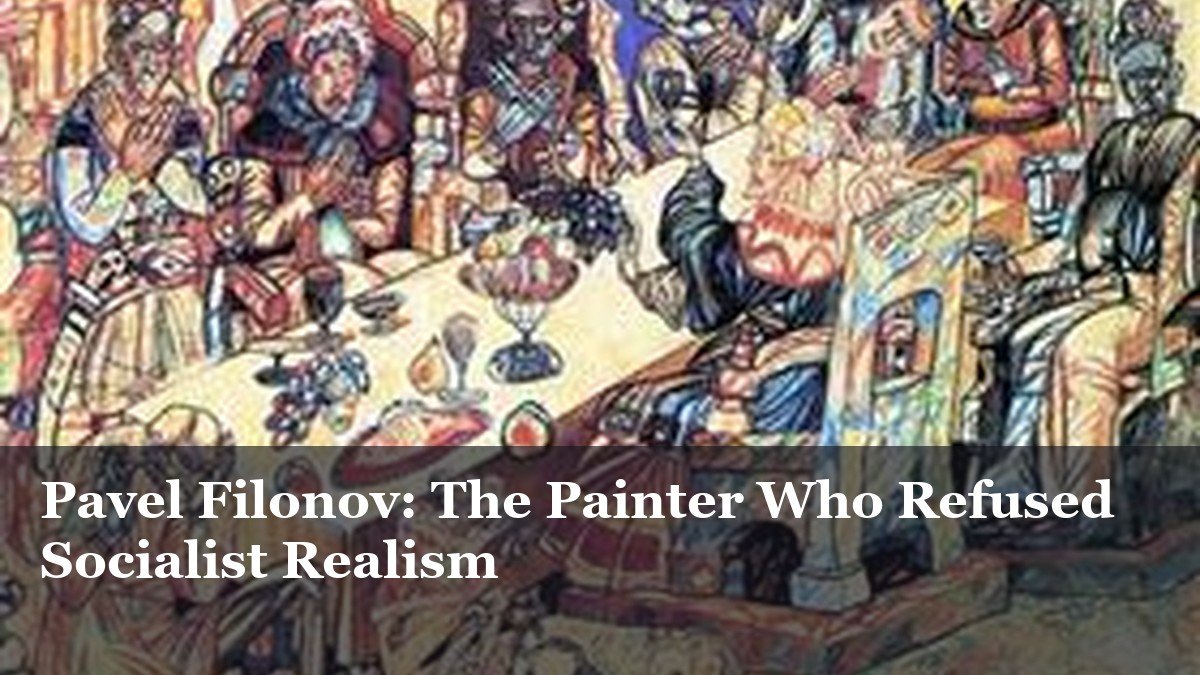
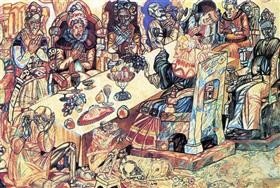
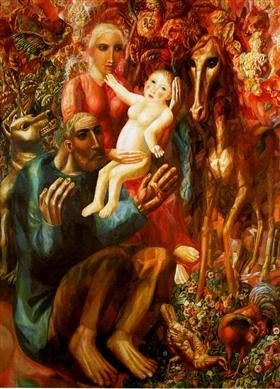
Between about 1912 and 1914 Filonov made the pictures that first fixed his reputation: Feast of Kings (1912-13), The Adoration of the Magi (1913) and the Holy Family, also catalogued as Peasant Family (1914). All three take Christian or ritual subjects, yet none behaves like an illustration. Forms break into small colored facets. Figures are pressed into the surface like pieces of a mosaic instead of standing in a stage-like space.
Scholars debate how far these works rest on icon painting and folk art, and how far on Filonov’s own reading of Old Master pictures. The evidence on either side is circumstantial. What the three paintings do establish is that his interest in breaking a surface into cells predates the written doctrine by about a decade.
What Is Analytical Art in Pavel Filonov’s Practice?
Filonov named his method analytical art and spelled it out in manifestos and teaching notes. In his usage, a picture should be analyzed into its smallest working units, and each unit should be developed with the same care as the whole. His texts are dense and sometimes contradictory, and scholars disagree about how literally to read his borrowings from biology and crystallography. Treat the method as a working discipline first and a theory second.
How Does Pavel Filonov Paint From the Particular to the General?
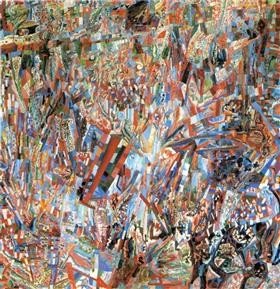
Filonov described the painter’s task as moving from the particular to the general. In practice that meant starting with a small area and filling it with a fine brush. Neighboring cells then answered it in color and shape until the whole surface held together. No loose underpainting waits for a final polish. The finishing happens everywhere at once. Formula of Spring (1927-28) shows the result, which to many viewers reads like living tissue seen under magnification.
Made Picture Versus Seen Picture
He set the ‘made’ picture against the merely ‘seen’ one. A seen picture records a motif as the eye happens to catch it, in the manner of academic copying or Impressionist sketching. A made picture is built from knowledge. In Filonov’s terms the artist needs a ‘knowing eye’ that registers what a thing is composed of, not only how light falls on it. That distinction is the hinge of his teaching.
Look Closer: a patch the size of a postage stamp
Pick a patch of Formula of Spring (1927-28) no bigger than a postage stamp. In many of Filonov’s works, a patch like this splits into smaller faceted cells, each with its own tone, so the passage can look finished even when you isolate it. Step back and the cells merge into the larger form. That shift between two scales is the method made visible.
A Declaration, a Collective and a Flowering World
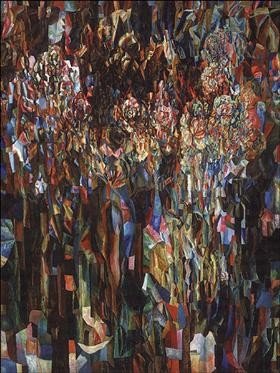
In 1923 Filonov published his Declaration of Universal Flowering, a text that joins art theory to a vision of a transformed world. The painting Universal Flowering (1915) predates it by eight years. The idea of a world in bloom came first in paint and only later in prose.
By the mid-1920s he had gathered students into a group that called itself the Collective of Masters of Analytical Art. It worked as a studio and shared commissions, and its members were trained in his method rather than in a portable house style. The collective model might have matched Soviet talk of shared labor. Instead it produced a stubborn workshop that answered to Filonov’s doctrine, not to any institution.
War Before the Front: The German War
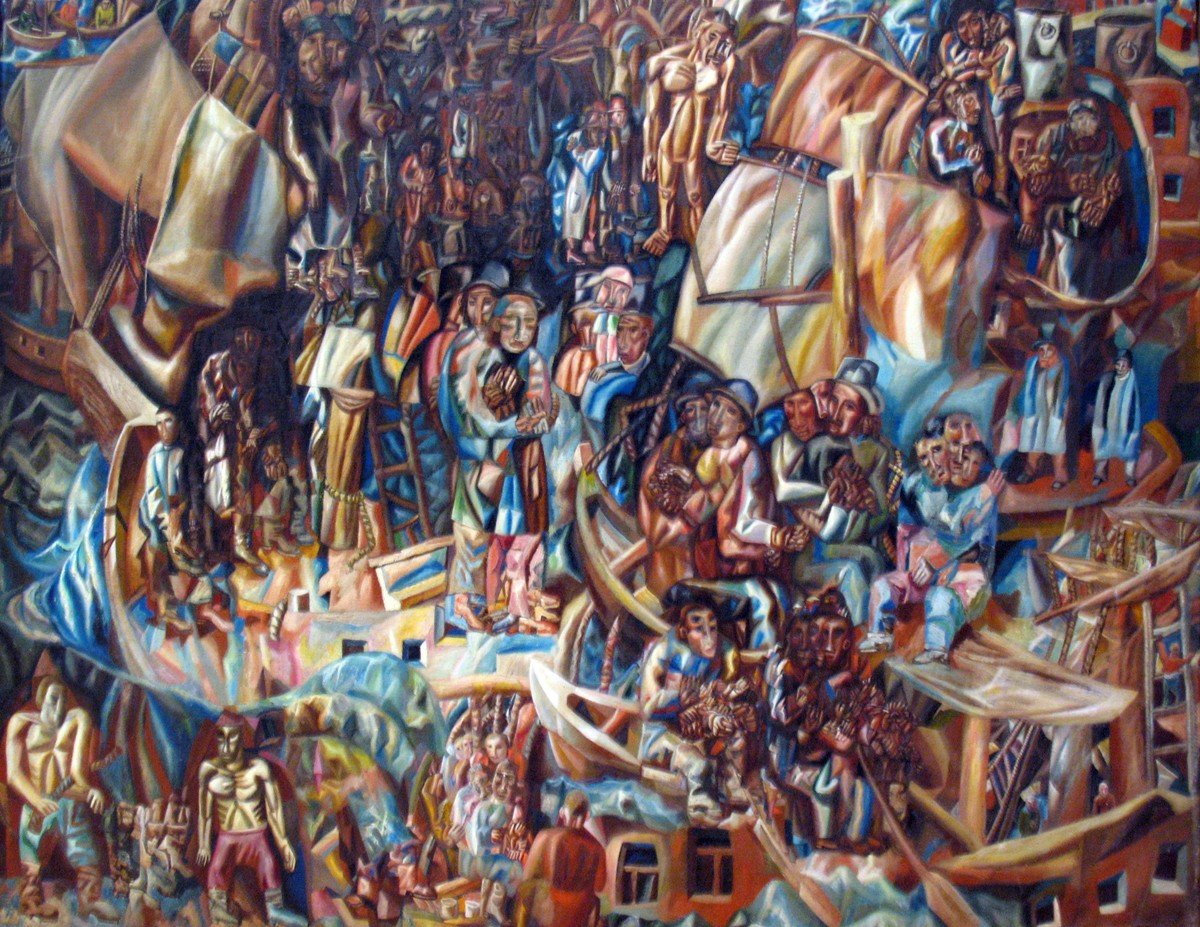
Filonov was painting war before he served in it. The German War (1915) belongs to the first year of the First World War, and it shows the conflict without a single heroic figure to follow. In 1916 he was called up and served on the Romanian Front. He returned after 1917 to a country remaking its institutions.
For this article the painting matters because it applies his method to a subject that official art would later claim for itself. Soviet war pictures offered a clear cause and a clear victor. Filonov’s war image offers a crowded field that the viewer must work through piece by piece.
How Pavel Filonov Differed From Malevich and Matyushin
Filonov’s closest contemporaries were not enemies but neighbors who answered the same question differently: what should painting keep once it stops copying the visible world?
Kazimir Malevich (1879 to 1935) answered by removing objects. His Black Square (1915), first shown at the Last Futurist Exhibition 0,10 in Petrograd, marked a decisive break with representational painting. Vladimir Tatlin moved toward material construction, first with counter-reliefs in 1914-15 and later with the project for the Monument to the Third International (1919-20). Matyushin carried the question into the physiology of sight and into color theory.
Filonov, by contrast, kept the figure and the crowd, and he kept adding rather than subtracting: more cells, more detail, more worked surface. Even Malevich later returned to figures, as in Carpenter I (1928-29), which suggests that figuration stayed open to the avant-garde as a whole.
Why Socialist Realism Had No Place for Pavel Filonov
The doctrine of socialist realism was the official cultural policy of the Soviet Union, a style of idealized realistic art whose formal aim was to depict reality as it develops toward socialism. No definitive guidelines on style or subject were published. In practice the works leaned on academic conventions and on unambiguous narratives about workers and Marxist-Leninist ideology. The Russian avant-garde reached its height between 1917 and 1932, when it clashed with this newly state-sponsored direction.
A Filonov painting offers no single hero and no one-sentence message. Understanding it takes time, the opposite of what the doctrine asked of an image. His quarrel with the state was about method, not allegiance. He supported the revolution and did not present himself as its opponent.
What Happened to Pavel Filonov’s Russian Museum Show?
A retrospective of his work at the State Russian Museum was planned for 1929-30. Reports describe the works prepared for display and the show cancelled before it opened to the public, after criticism of his style as formalist. Accounts differ on the details. After that, his work was rarely shown, and he lived in poverty, teaching and painting on his own terms.
Siege, Starvation and a Sister’s Rescue Mission
Filonov spent his last months in Leningrad during the Siege of Leningrad. He died there of starvation on December 3, 1941, at the age of 58, in the first winter of the blockade.
The pictures survived because someone chose to guard them. His sister, Evdokia Glebova, preserved the works, and decades later they entered the collection of the Russian Museum. Without that act of stubborn custody, the paintings discussed here might not exist, and the history of Russian modern art would read quite differently.
Where to See Pavel Filonov Today
The State Russian Museum on Arts Square in St Petersburg holds one of the world’s largest collections of Russian fine art, and it is the main home of Filonov’s work.
Works such as Peasant Family (Holy Family) belong to the permanent holdings, though not every work is on view every day, and displays rotate. Check the museum’s current exhibitions before a trip. Stand close to a canvas first, then step back, since the paintings are built to be read at both distances.
Legacy: Why Pavel Filonov Still Matters
For decades Filonov was known mostly to specialists. In recent decades, as museums and scholars have reopened the history of the Russian avant-garde, he has moved from footnote to central figure.
Two connections make him feel current. His belief that a picture should hold up at every scale resembles the way people look at images now, zooming from the whole to the detail and back. His collective, with shared authorship and a common doctrine, resembles later studio and workshop models. Neither parallel is a claim of direct influence. They are connections a viewer can draw, not documented lineages, and they are best offered as such in an essay.
Two Labels That Do Not Fit
Is Analytical Art the Same as Analytic Cubism?
No. Analytic Cubism names the phase of Picasso and Braque from about 1909 to 1912, which broke objects into planes within a restrained, mostly monochrome range of color. Filonov’s analysis concerns structure and growth, built cell by cell in saturated color. The shared word is a coincidence of vocabulary, and there is no documented line of descent between the two programs.
Was Filonov Simply a Futurist?
He moved among Futurist circles and is sometimes labeled with them, but his own doctrine owes more to his working method than to any group program. Scholars still disagree on how best to file him, which is itself a sign of how self-contained his position was.
Essential Points
- Start with the 1913-14 religious pictures, where figures are still easy to find, and only then move to the dense late works with formula-style titles.
- Filonov’s collective shows that the avant-garde could be a workshop culture, with shared training and joint commissions, and not only a gallery culture.
- For essays, the strongest thesis is not ‘persecuted genius’ but a sharper question: what counts as legible to a state, and what happens to art that refuses to be read quickly?
- Pair one Filonov painting with Malevich’s Black Square for a clean exercise in how differently two artists can understand ‘analysis’ of form.
- His manifestos are dense and partly contradictory, so read them alongside a museum catalogue and cautious secondary scholarship.
- Accounts of his exit from the Academy and the fate of the 1929-30 exhibition vary by source; treat the specific circumstances as approximate rather than settled fact.
Frequently Asked Questions
- Do I need to know Russian history to enjoy Pavel Filonov?
- Look first, read later. Pick one painting, give it five minutes, and note where your eye settles and where it gets lost. Context helps afterward, especially the decline of the avant-garde in the early 1930s, but the pictures work without it. A museum label with title and year is enough to begin.
- How did Futurist circles shape Filonov’s thinking?
- Mainly through poetry and a shared interest in perception. He was close to Velimir Khlebnikov, and the Futurist poets prized experiments with language that paralleled his experiments with form. The friendships gave him an audience and a vocabulary, though he kept his own doctrine rather than joining a group program.
- Do Filonov’s titles hold symbolic meanings?
- Often suggestively. Titles such as Universal Flowering and Formula of Spring point toward growth, systems and cosmic order, and his 1913-14 religious subjects invite symbolic reading. Interpretations differ, and his texts emphasize construction over message, so treat any single decoding as a hypothesis.
- Was Pavel Filonov also a poet?
- Yes. Besides painting and theory, he wrote poetry, and his manifestos carry the dense, charged language you would expect from a poet. His verse is far less known in English than his paintings, so look for Russian editions and scholarly translations if you want the whole picture of his thought.
- Can I see Filonov’s paintings online if I can’t get to St Petersburg?
- Partly. Museum websites and Wikimedia Commons carry public-domain images of many works, which is enough to study composition and subject. Screens flatten the cell-by-cell surface, though, and colors vary between reproductions, so treat online images as a preview and use them alongside a printed catalogue.
This guide was written and reviewed by the rus-art.com editorial team, specializing in Russian art history. We cross-check dates, attributions, and museum holdings against museum and academic sources.