The Imperial Porcelain Factory in Saint Petersburg made dishes for tsars. Within a few years of 1917 it was turning out plates painted with slogans and abstract squares. Few workshops changed masters and visual language so abruptly while keeping the same kilns, the same craftspeople, and sometimes the same stock of unpainted blanks. This article follows the factory from the court of Empress Elizabeth to the circle of Kazimir Malevich, and asks what it meant to put a state’s ideas on a dinner plate.
Quick Answer
The Imperial Porcelain Factory, founded in Saint Petersburg in 1744 by Dmitry Vinogradov, made tableware for the Russian court until 1917. After the revolution the state kept it running, and artists reshaped it: Sergey Chekhonin painted propaganda plates, while Nikolai Suetin and Ilya Chashnik, students of Kazimir Malevich, applied Suprematist geometry to porcelain. Within six years of 1917, plates that once carried gilded crests carried abstract squares and bars. The factory still produces hand-painted ceramics today, known for its Communist-era name, Lomonosov.
What Is the Imperial Porcelain Factory?
The Imperial Porcelain Factory (in Russian, Imperatorskii Farforovyi Zavod) makes hand-painted ceramics in Saint Petersburg. Dmitry Ivanovich Vinogradov established it in 1744, and Russian tsars backed it from the reign of Empress Elizabeth onward.
For most of its first two centuries, its only customer was the household that owned it. After the revolution it took new names, and the one many people still use is the Communist-period title, the Lomonosov Porcelain Factory. Art historians find this single institution rare because court taste, graphic design, and pure abstraction all meet on one type of object: the plate.
Vinogradov’s Workshop: Cracking Europe’s Porcelain Secret
In the 1700s, Europe wanted porcelain badly. Chinese export ware set the standard. Meissen in Saxony matched it in 1710 and guarded its formula as a state secret. Russia’s court paid heavily for imported services.
Vinogradov had studied mining and metallurgy in Germany in the 1730s, which put him in a good position to attempt a domestic version. Elizabeth’s patronage gave him a workshop in Saint Petersburg. He is generally credited with developing a Russian porcelain recipe from Russian raw materials, though the early decades were full of trial and error, and the first output ran to small objects such as snuffboxes and cups. Vinogradov died in 1758. By then the court owned a workshop of its own, and the habit of imperial commissions was set.
Court Tableware: How the Imperial Porcelain Factory Served the Palace
Everything produced before 1917 followed the court’s calendar and tastes. Services were ordered for palaces, figures and vases furnished reception rooms, and finished pieces traveled as gifts that carried the tsar’s prestige abroad. Imperial pieces often bear the reigning tsar’s cipher on the back, which helps scholars date a piece to a reign.
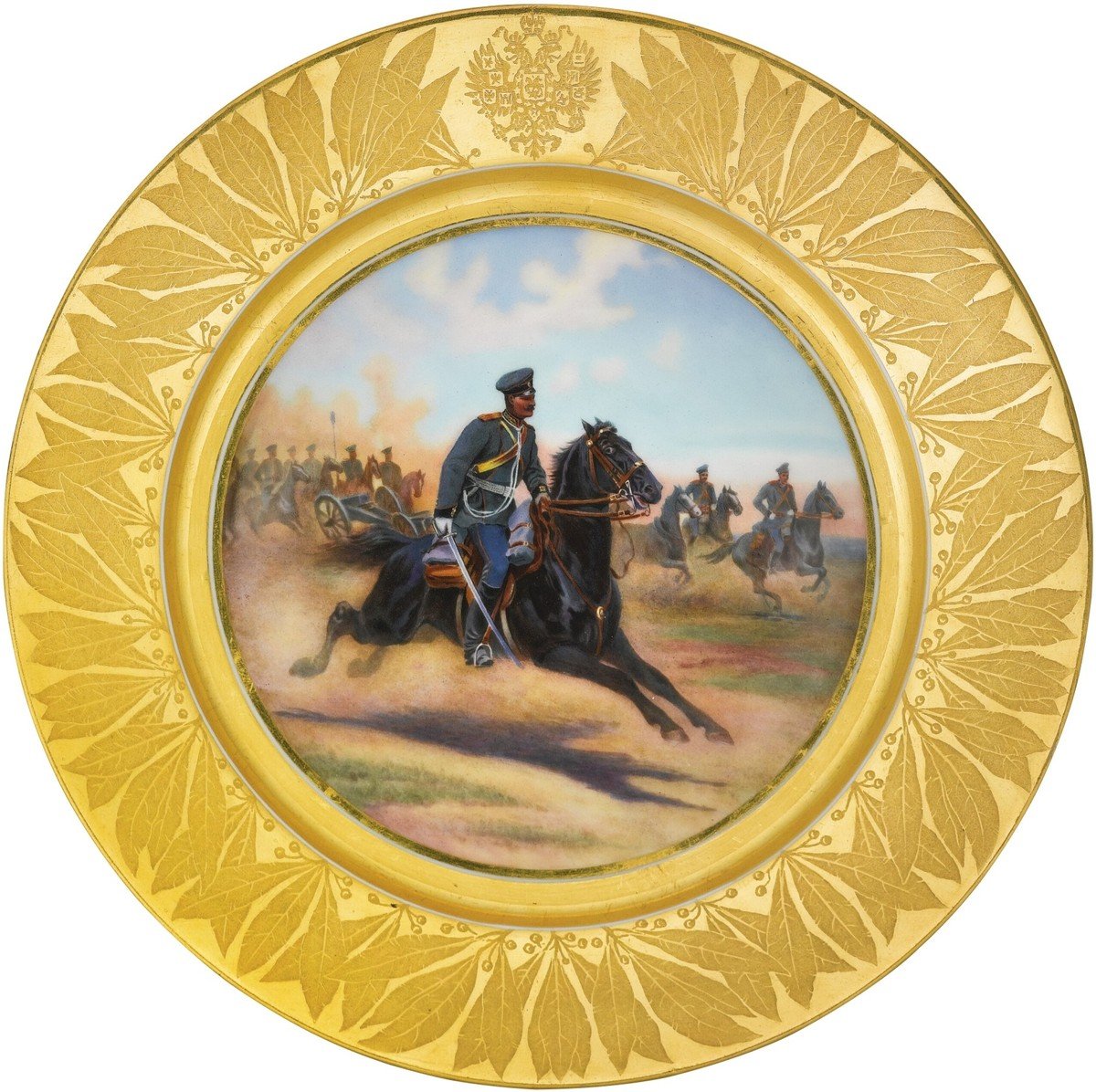
A plate from 1909, painted by Iv. Nazarov, shows how specific the work could be. It belongs to a military service and depicts an officer of the Horse Guard Artillery as he appeared in 1893. Sixteen years separate the uniform from the plate, so the series looked backward at regimental dress instead of recording the present. At table, such plates presumably turned dinner into a lesson in regimental history.
In factories of this kind, designers, figure painters, and gilders usually worked as separate hands. That division of labor would matter again in the 1920s.
1917: What to Do With an Imperial Porcelain Factory
After the revolution, the kilns, workshops, and warehouses belonged to a government that had overthrown their former owner. The works was renamed the State Porcelain Factory in 1918 and placed under the new cultural authorities. Its later name honors the eighteenth-century scientist Mikhail Lomonosov.
Why Did the Soviets Keep the Imperial Porcelain Factory Running?
Historians usually point to three practical reasons. The state had inherited a working industrial plant, and closing it would have scattered skilled painters at a time of scarcity. The warehouses held stock, including unpainted ware that could be redecorated. And porcelain reached places posters could not: offices, canteens, and the tables of officials. A plate gets picked up, turned over, and read at close range. That made it an unusually intimate vehicle for a message.
Sergey Chekhonin and the Propaganda Plate
Sergey Chekhonin (1878 to 1936) gave the factory’s earliest Soviet style its look. He came out of the World of Art circle and worked as a graphic artist, portrait miniaturist, and illustrator before turning to what is now called propaganda porcelain.
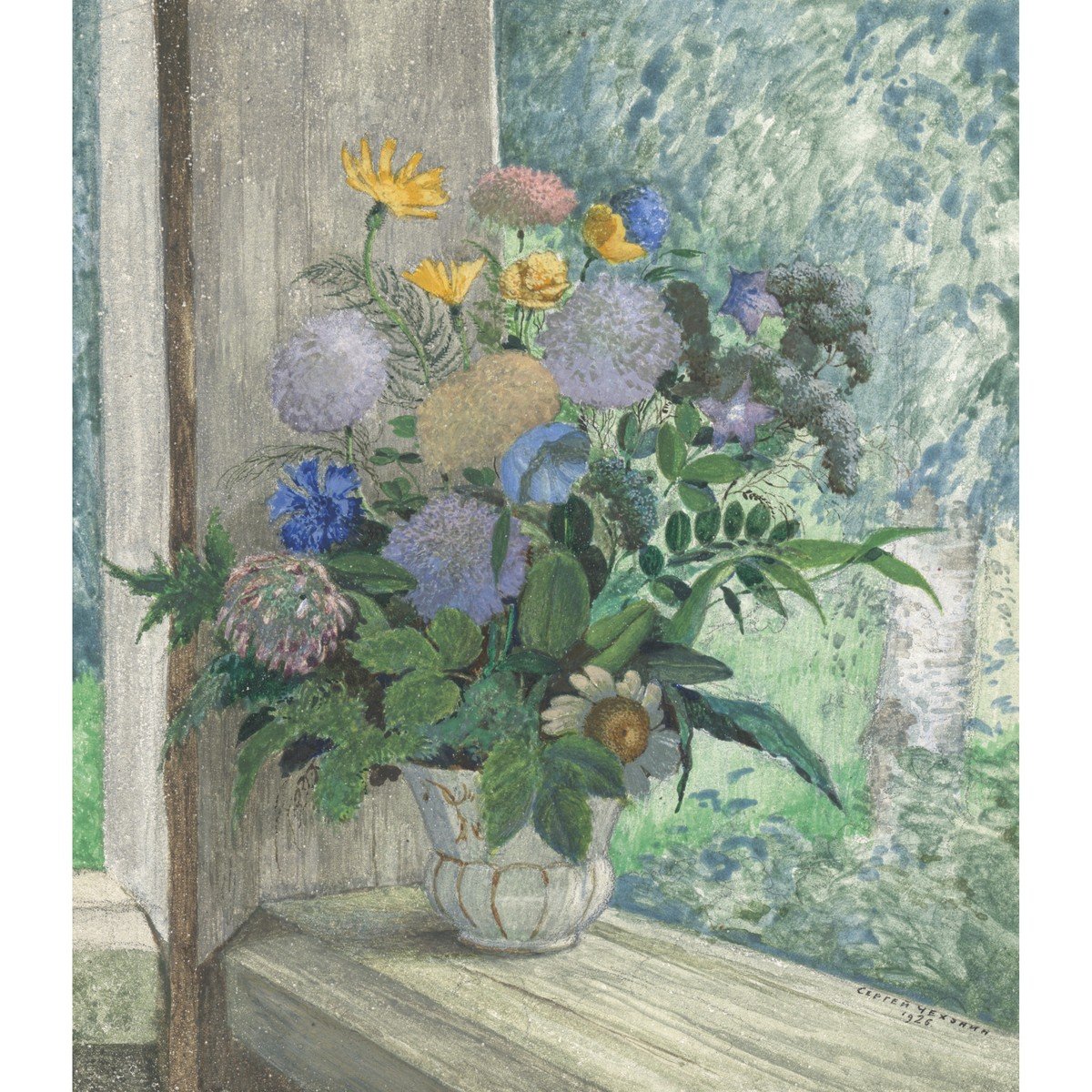
His method was pragmatic. Slogans, stars, and emblems of the new state were applied to existing tableware forms, often shapes designed for tsars. The clash was deliberate: a teacup made for a palace, carrying a worker’s motto in ornamental lettering. The lettering did the political work, while the shapes carried the weight of the old order. His 1916 still life with cornflowers, painted a year before the revolution, shows the training he brought to the factory, where flowers and script could sit on a plate rim as comfortably as on paper.
Malevich, Suprematism, and the Plate as Canvas
Suprematism is an abstract art built on circles, squares, and rectangles in a limited range of colors. It rests on what Malevich called the supremacy of pure artistic feeling over the depiction of real-life subjects. Malevich introduced it in 1915. His Black Square, first shown at the Last Futurist Exhibition 0,10 in Petrograd that year, marked a decisive break with representational painting.
Malevich was a teacher as much as a painter. His students formed the UNOVIS school, and by 1923 the group was working with the State Porcelain Factory in Petrograd. The factory offered what no studio could: kilns, trained painters, and objects that people would actually handle.
Did Malevich Design Porcelain Himself?
Partly. He is credited with Suprematist forms, notably a teapot and tea service built from cubes and cylinders, designed in 1923. Much of the surface painting was done by his pupils. Scholars disagree about the attribution of individual designs. Studio practice treated compositions as shared property, and many pieces carry factory marks rather than personal signatures.
Suetin and Chashnik: The Pupils at the Kiln
Nikolai Suetin (1897 to 1954) worked as a graphic artist, designer, and ceramics painter, and no one is more closely tied to Suprematist porcelain. A pupil and close collaborator of Malevich, he painted Suprematist designs on porcelain in the 1920s and later held senior artistic roles at the factory.
Ilya Chashnik (1902 to 1929) was also a pupil of Malevich and a founding member of UNOVIS. His Suprematist Pattern of 1922 shows how portable the vocabulary was. A handful of bars and planes, repeated or rotated, can fill a sheet, a rim, or a bolt of cloth. He died at 27, so his body of work is small, but it records the movement at its most inventive.
Look Closer: geometry without gravity
Chashnik’s Suprematist Pattern of 1922 scatters short geometric forms across the surface without anchoring any of them to a floor or horizon. That floating quality suited porcelain directly: a round rim has no top or bottom, so the same arrangement can turn in your hands and read correctly from every angle.
How a Suprematist Plate Broke With Imperial Porcelain Factory Tradition
An imperial plate builds its design from the center outward: a medallion or figure, a framing border, gilding that traces the rim. A Suprematist plate dissolves that hierarchy. In many Suprematist designs, bars and planes run across the rim as if the plate were a window onto a larger composition. The eye finds movement instead of a fixed center.
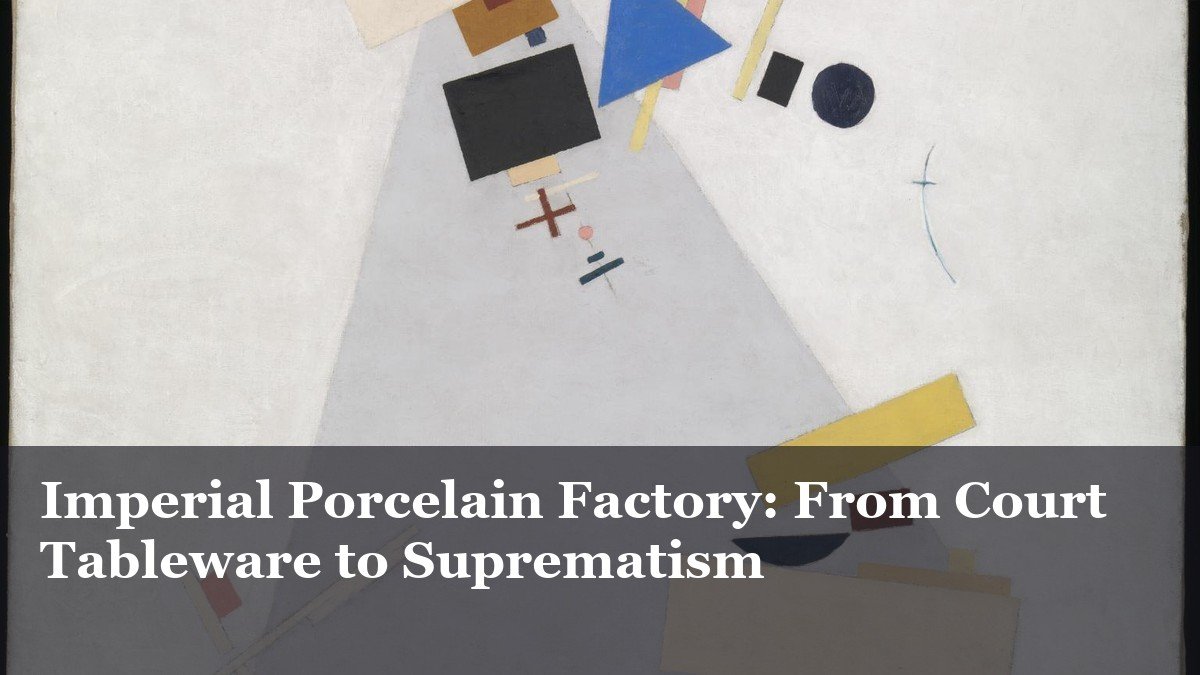
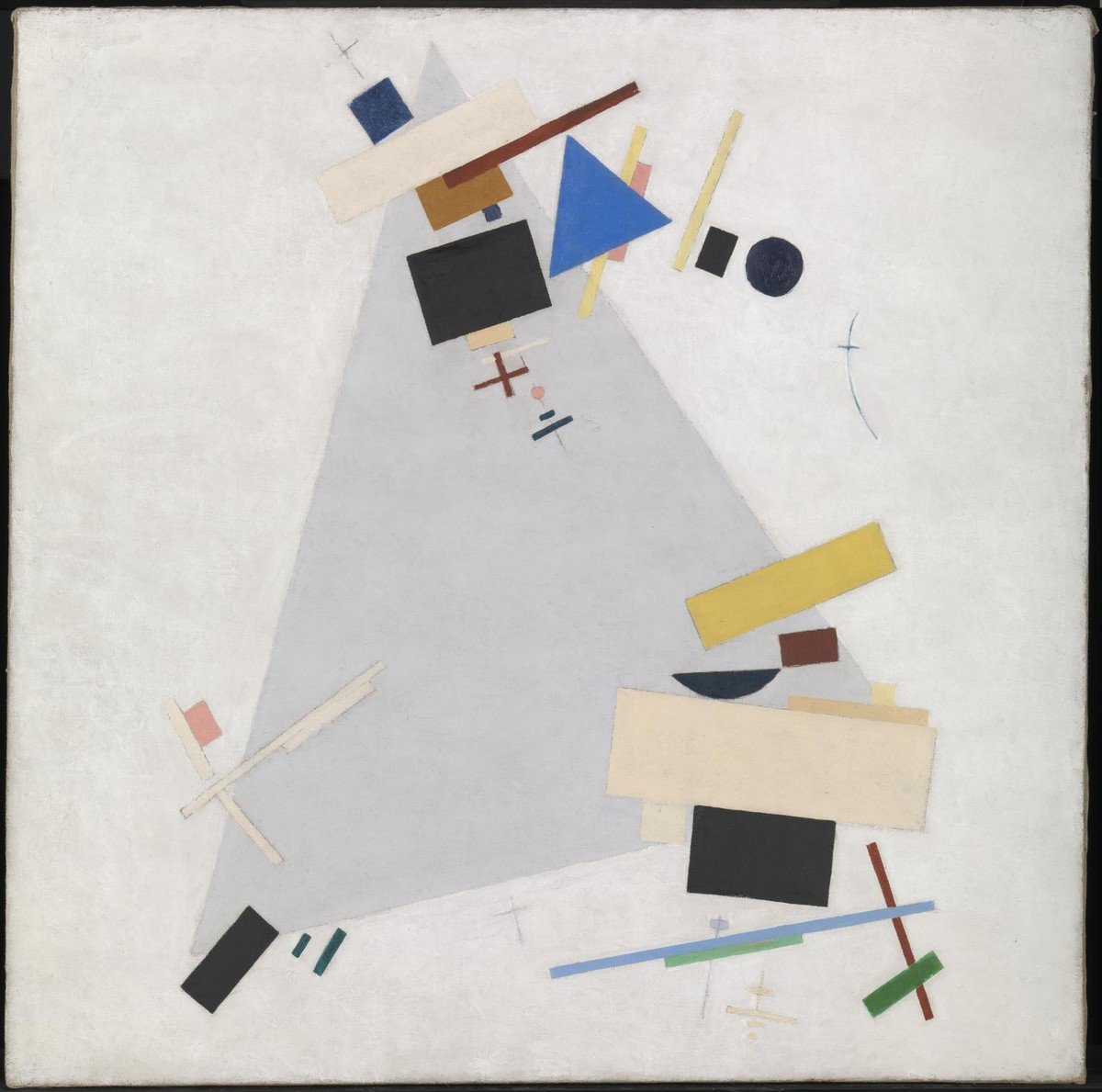
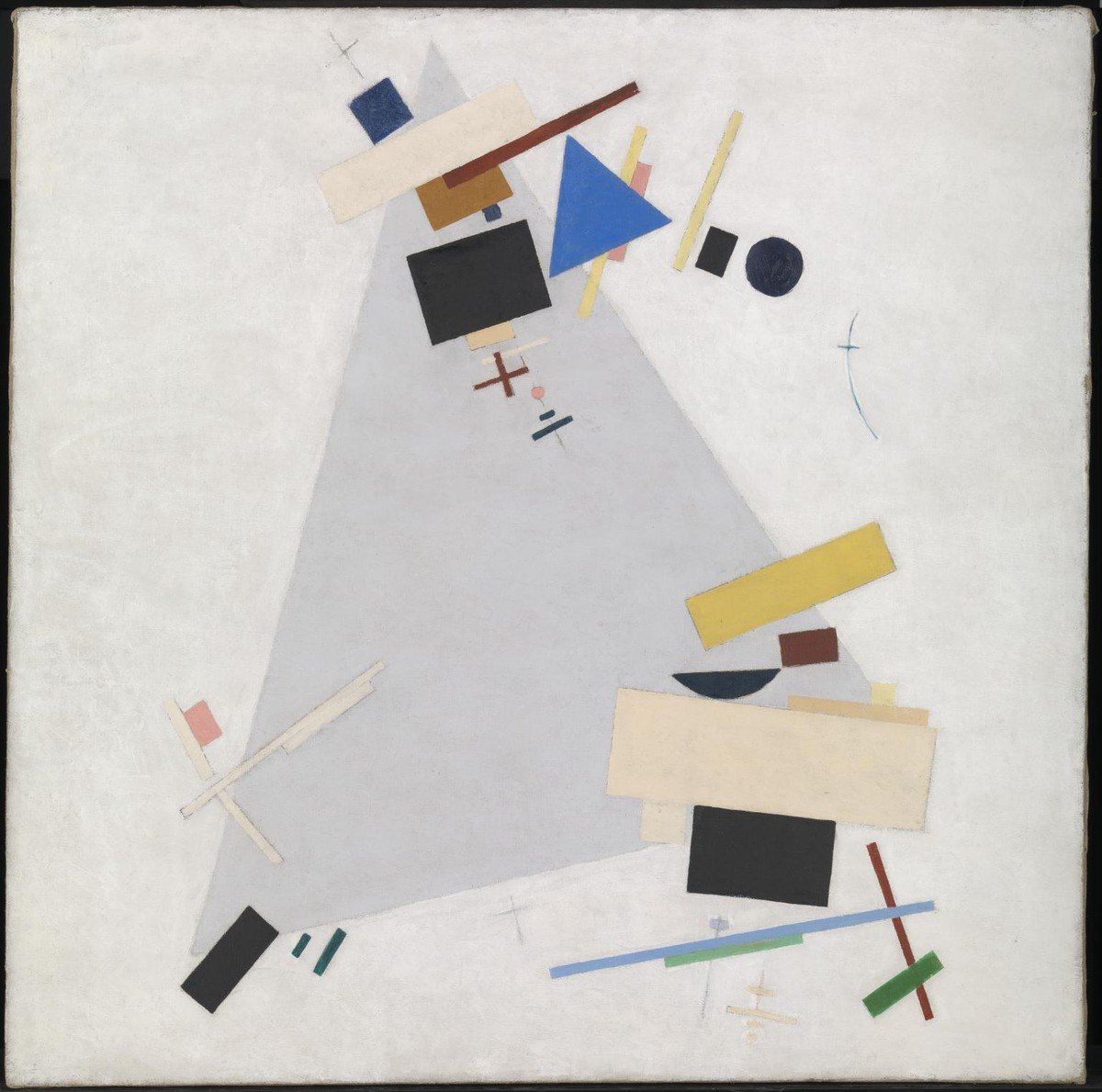
The palette narrows to a few flat colors, with red, black, and white dominating, set against porcelain that already supplies the white. Malevich’s Dynamic Suprematism of 1916 shows the principle on canvas: forms set at different angles that imply motion.
How Do You Paint Geometry on a Curved Surface?
Porcelain painters generally work in enamel colors fired onto the glaze, then refire the piece. Flat color and hard edges are difficult in this medium, since pigment can pool or shift. A Suprematist design demands exactly the clean edge the medium resists. The surviving pieces show how skilled the factory’s painters were.
Beyond Malevich: Rozanova and the Wider Circle
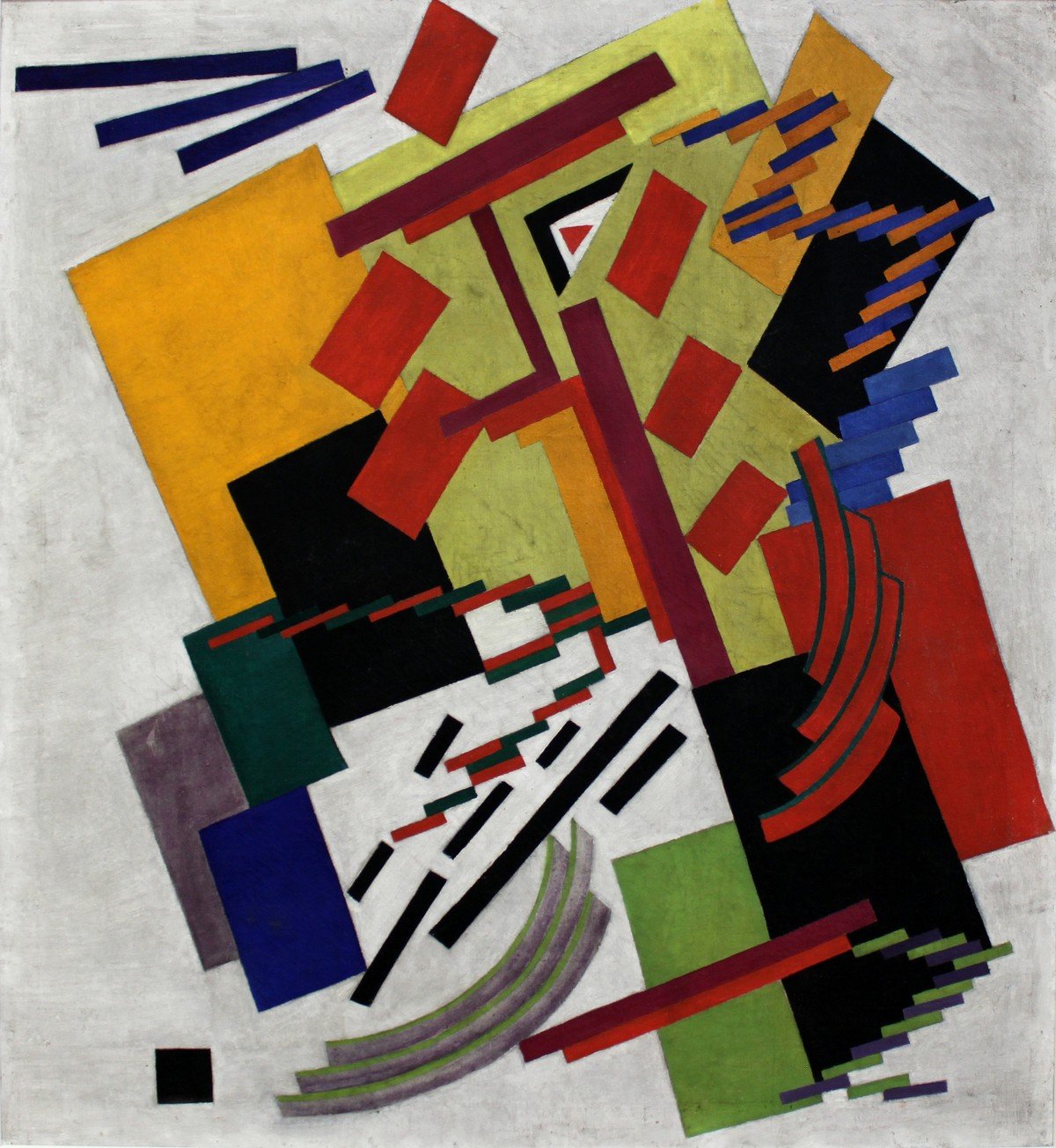
Malevich led a group that included Aleksandra Ekster, Liubov Popova, Olga Rozanova, Ivan Kliun, Ivan Puni, Nadezhda Udaltsova, Nina Genke-Meller, and Ksenia Boguslavskaya. It has been described as the first attempt to found a Russian avant-garde movement independently, seceding from the trajectory of prior Russian art history.
Olga Rozanova’s Suprematism of 1916 belongs to this wider conversation. She died in 1918, before the porcelain experiments, so her canvases show the visual language available to the factory’s designers rather than factory work itself. Ivan Kliun pushed the same vocabulary toward curved volumes in his Spherical Suprematism.
After the Avant-Garde: The Lomonosov Era
Suprematist porcelain flourished briefly. By the late 1920s Chashnik was dead, and the cultural climate was turning toward figurative, easily readable art. Under the Lomonosov name, the factory moved toward Soviet subjects, with painted figures and decorative patterns.
Suetin outlasted the shift. After Malevich died on 15 May 1935, Suetin is credited with designing the funeral arrangements and grave marker, a white form carrying a black square. Chekhonin’s works survive in several former Soviet state museums, and the factory’s early Soviet output remains a study subject for historians of propaganda design.
Legacy: Why the Imperial Porcelain Factory Still Matters
The factory shows that the Russian avant-garde did not stay in galleries. Its geometry moved into teapots, plates, and textiles, which tested whether abstraction could survive daily use. It also shows how an institution can outlast regimes by changing what it paints while keeping what it knows: glazes, firing, and a workforce trained in hand decoration.
Is the Imperial Porcelain Factory Still Making Porcelain Today?
Yes. It continues to produce hand-painted ceramics in Saint Petersburg. Its best-known pattern, Cobalt Net, was reportedly created in 1944 by Anna Yatskevich. A blue grid with gilded details, it has become the Lomonosov name’s most recognizable product.
Beyond the Kiln: Textiles, Constructivism, and Related Movements
Suprematism grew out of Malevich’s study of Cubism, which he admired for deconstructing art, and from his Cubo-Futurist work of 1915. Chekhonin’s graphic approach descends from a different lineage, the World of Art. The two met on porcelain.
Chashnik’s Drawing for Fabric of 1922 shows Suprematism moving onto textiles with the same design logic it applied to porcelain. That crossover anticipates the Constructivist interest in useful objects, where abstract form served clothing, furniture, and tableware rather than only the museum wall.
Essential Points
- The factory’s imagery followed its patron: a tsar’s cipher, then a Soviet slogan, then an abstract composition.
- Sergey Chekhonin and Malevich’s circle came from different artistic traditions, yet worked in the same building within a few years of each other.
- Suprematist porcelain was a pupils’ and teacher’s collaboration, so attribution to a single hand is often uncertain.
- The 1909 military plate and the 1922 Chashnik pattern sit at opposite ends of the same workshop’s range: documentary figure painting and pure geometry.
- Porcelain is a useful test case for the avant-garde’s ambition to reshape everyday objects, not only paintings.
- Chashnik died at 27, while Suetin’s career stretched into the 1950s, so the movement’s porcelain legacy rests largely on the survivor.
- The Cobalt Net pattern of 1944 shows the factory outliving every regime that owned it.
Frequently Asked Questions
- What is porcelain and how is it different from ordinary pottery?
- Porcelain is a ceramic made from fine white clay, typically kaolin, fired at very high temperatures until it becomes hard, dense, and often translucent. Ordinary earthenware is fired cooler and stays porous and opaque. That hardness lets painters apply sharp, bright enamel decoration, which is why porcelain became a prestige medium at courts.
- Why did the Soviet state hand avant-garde artists a porcelain factory?
- A working porcelain factory offered kilns, trained painters, and state control over what was made, so artists could test designs at scale instead of in studios. For Malevich’s circle, which wanted abstraction to shape everyday objects, plates and teapots were a natural testing ground.
- What does the black square mean on Suprematist porcelain?
- Malevich first showed his Black Square in 1915 and presented it as a break with depicting objects. On porcelain, a square works less as a symbol than as a building block, a pure shape that organizes a composition. Scholars still debate how far Malevich intended spiritual meaning versus formal reduction.
- Was Sergey Chekhonin an avant-garde artist?
- Not in the Suprematist sense. Chekhonin (1878 to 1936) belonged to the second generation of the World of Art, alongside Heorhiy Narbut and Dmitry Mitrokhin, and worked as a graphic artist, miniaturist, and illustrator. He is best known for propaganda porcelain, which married decorative lettering to Soviet slogans.
- Where can I see imperial and Suprematist porcelain today?
- Start in Saint Petersburg, where the State Hermitage Museum and the State Russian Museum hold Russian porcelain from several eras, and the factory itself runs a museum and shop (check current opening details). Some museums outside Russia hold works on paper by Chekhonin; check individual institution databases for current holdings.
This guide was written and reviewed by the rus-art.com editorial team, specializing in Russian art history. We cross-check dates, attributions, and museum holdings against museum and academic sources.