In roughly seventy years, Russian portraiture of the eighteenth century grew from a handful of stiff court likenesses into a confident national school. Three painters carry most of that story. Fyodor Rokotov was born a serf and ended his life as one of the most admired portraitists in Moscow. Dmitry Levitsky, born in Ukraine, became the court’s master of polished theater. Vladimir Borovikovsky, of Ukrainian Cossack origin, closed the century with portraits built on private feeling. This guide follows their careers, their sitters and the world that paid for them.
Quick Answer
Eighteenth-century Russian portraiture was the work of a first native school of painters trained at or around the St Petersburg Academy of Arts. Fyodor Rokotov (1736 to 1808) painted intimate, softly lit likenesses, Dmitry Levitsky (1735 to 1822) staged imperial and allegorical portraits, and Vladimir Borovikovsky (1757 to 1825) brought sentiment to the court around 1800. Their sitters were nobles, empresses and Smolny pupils, and their best canvases hang in the Tretyakov Gallery and the State Russian Museum. Together they show a school that learned European polish, then bent it toward Russian faces.
What Is Russian Portraiture in the Eighteenth Century?
Here is the secular, individual likeness as Russia learned it after Peter the Great turned the country toward Western Europe. Before 1700, painting belonged mostly to the church. Faces were icon faces. The few portraits of tsars and nobles, called parsunas, recorded rank more than appearance. The eighteenth century put a new question to the painter: what does this particular person look like, and what do they want us to believe about them?
The Academy of Arts opened in St Petersburg in 1757 and gave painters a formal route to an answer. Surveys of Russian art often treat portraiture as the first secular genre in which Russian artists matched European standards, though scholars still argue over how much of that skill was borrowed and how much grew at home. The three painters here mark three points along that road.
From Icons to Faces: The First Native Portraitists
Before the famous trio came painters who trained in icon workshops or foreign studios, and they prepared the ground.
Who were the first Russian portrait painters?
Ivan Argunov (1729 to 1802) is counted among the founders of the Russian school of portrait painting, and he worked in the orbit of a great noble household. Aleksey Antropov (1716 to 1795) painted in oil, made miniatures and icons, and frescoed churches in Kiev. His portrait of Peter III from 1762 shows what that mixed training produced: a firmly outlined face set in a stiff, frontal pose. Ivan Vishnyakov (1699 to 1761) painted the Fermor portraits of 1749 and 1755, which sit between the old workshop manner and European polish.
Why did Russian portraiture begin so late?
Three things held it back. The church controlled image-making. Training meant apprenticeship, not the study of anatomy or perspective. And the clients who could pay were few, mostly at court. Then the Academy and the 1760s court of Catherine II widened the market, and the next generation went further than these teachers had.
Rokotov: A Serf Who Painted the Empire
Fyodor Rokotov (1736 to 1808) was born in Vorotsovo, now part of Moscow, into a family of serfs belonging to the Repnins. Much of his early life is obscure. He studied at the St Petersburg Academy of Arts, bought his freedom near the end of the 1750s, and became a fashionable painter.
In 1765 he was elected an Academician. Teaching at the Academy lasted only briefly, since it interfered with his painting, and in that same year he returned to Moscow, where he lived for the rest of his life. Scholars debate how much he learned from the French portraitist Louis Tocqué, who worked in St Petersburg from 1757 to 1759. The direction he took is clear enough. His portrait of Alexander Rimsky-Korsakov (1760) shows a young nobleman painted with restraint, far from the heavy ornament of ceremonial court portraits.
Smoke and Light: Rokotov Reshapes Russian Portraiture
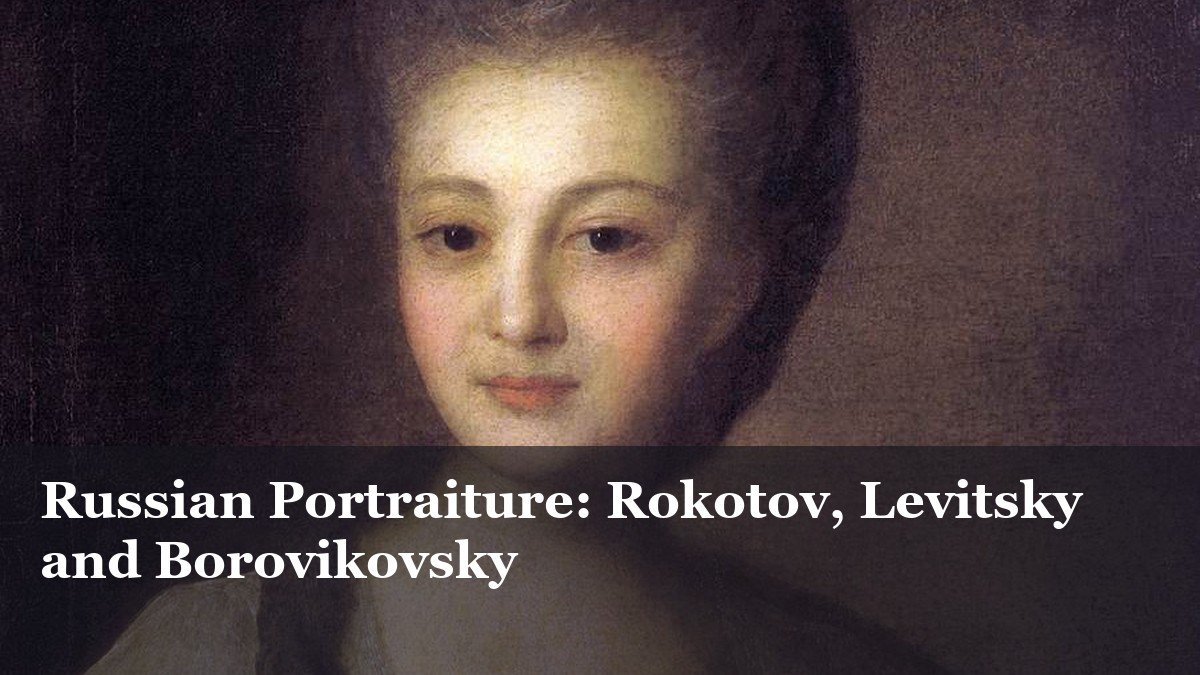
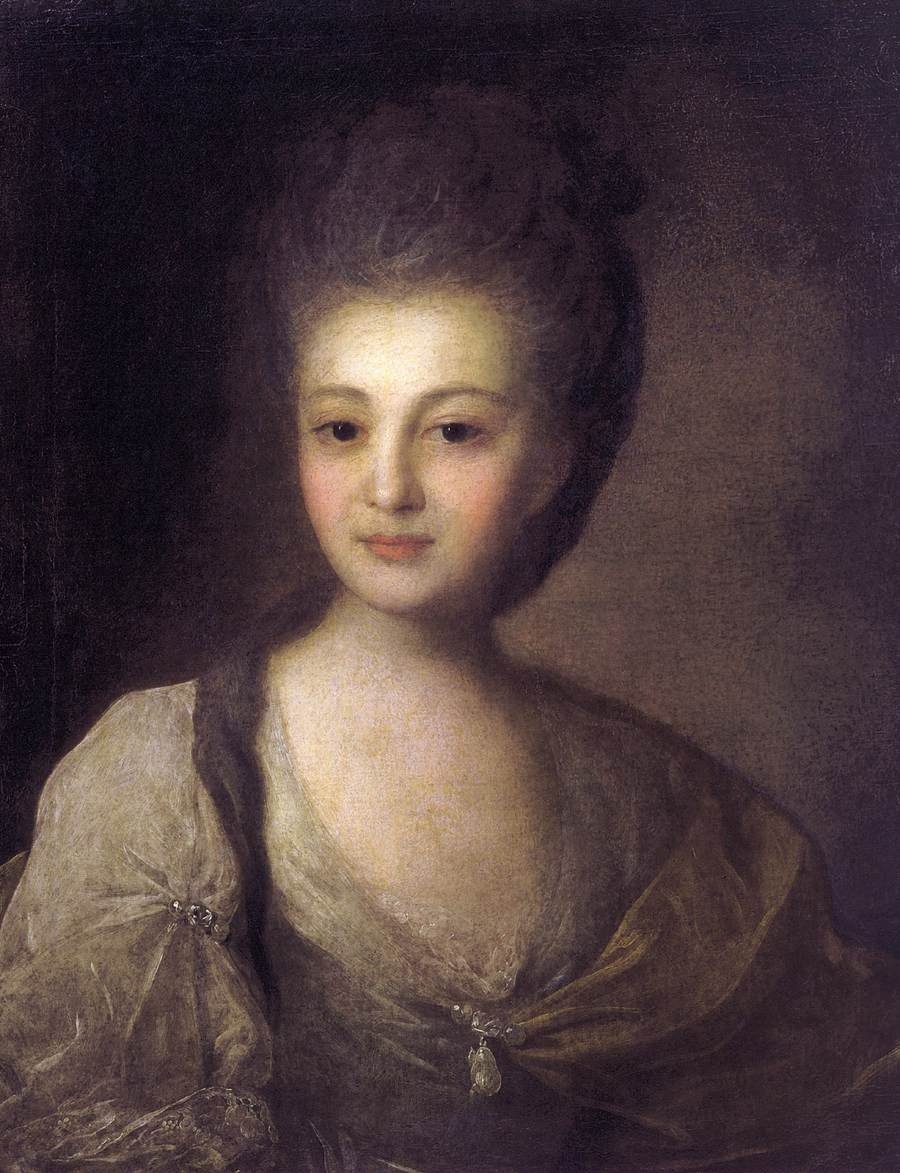
Rokotov’s best-known canvas is the Portrait of Alexandra Struyskaya (1772), now in the State Tretyakov Gallery. People sometimes call it the Russian Mona Lisa, and it is widely regarded as the most celebrated Russian painting of its century. The sitter, wife of a provincial landowner, turns her head slightly. Her eyes are narrowed, her mouth hovering at the edge of a smile. Behind her there is no column, curtain or coat of arms, only a dark ground that lets her pale face and light dress carry the picture.
Rokotov avoided heavily decorated formal portraits. His edges are soft and his paint tends to be thin, so the skin seems to glow from within. He kept that approach in Lady in a Pink Dress (1770s), the Portrait of Vasily Maykov (1775) and the Portrait of Countess Elisabeth Santi (1785). His sitters are poets, officials and Moscow gentry, painted as people rather than as office-holders.
Levitsky: Ukrainian Roots, Imperial Court
Dmitry Levitsky was born in 1735 in Ukraine and lived until 1822, long enough to watch the whole century turn. He reportedly worked with Antropov in Kiev in the 1750s before settling in St Petersburg. His portrait of the architect Alexander Kokorinov (1769) brought him the title of Academician in 1770. He then painted Denis Diderot during the philosopher’s stay in St Petersburg in 1773 and 1774, a measure of how far he had risen.
Levitsky is at his most inventive when he turns to character. In the Portrait of Prokofy Demidov (1773), the sitter wears a dressing gown and nightcap and leans on a watering can, with the Moscow Foundling Home he supported in the background. A man of enormous fortune chose to appear as a hobby gardener beside his charity. Levitsky painted the pose without mockery.
The Smolny Girls on Stage
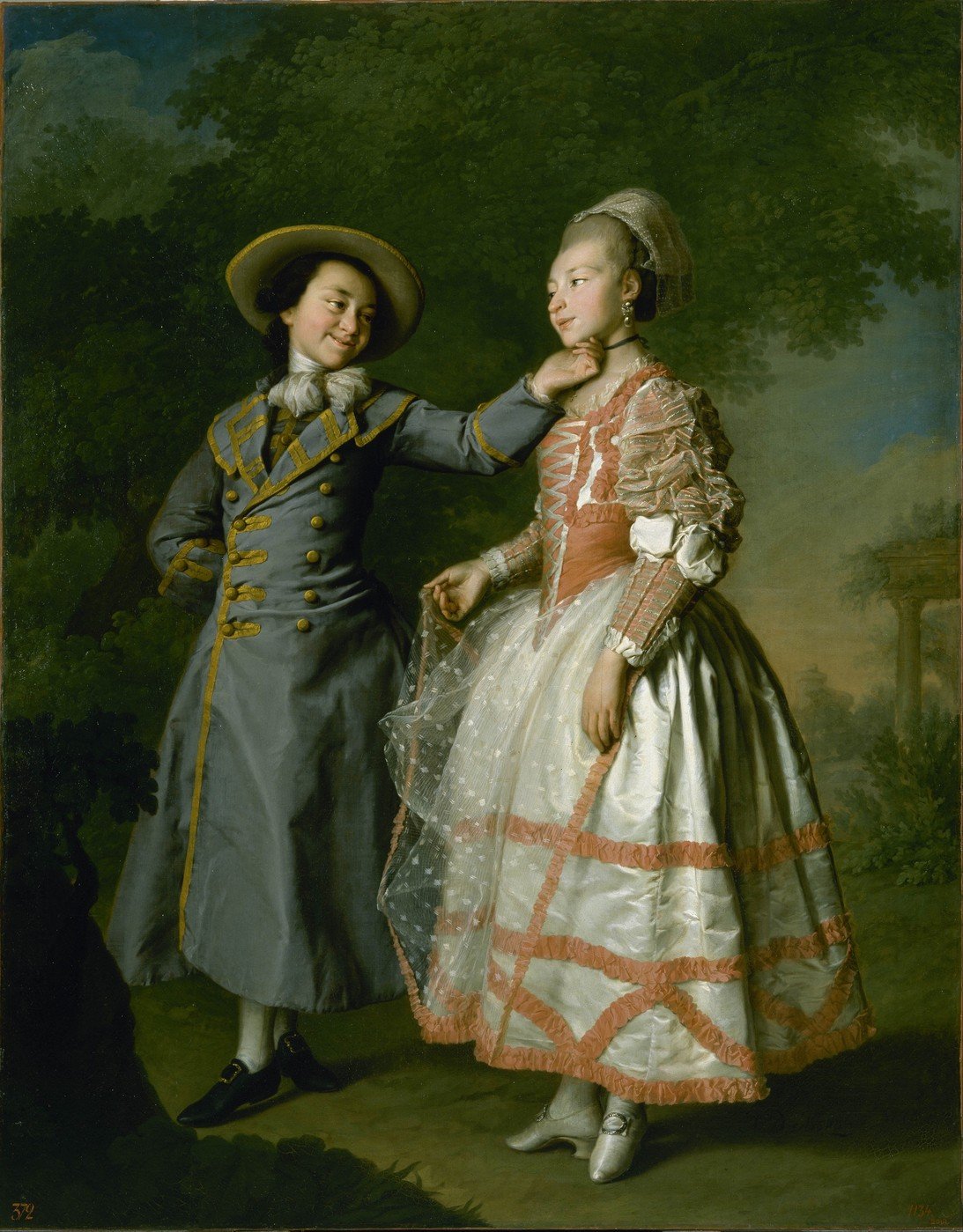
The Smolny Institute in St Petersburg, a Palladian building, became a center of women’s education in Russia. Between 1773 and 1776 Levitsky painted a series of its pupils. In the Portrait of Ekaterina Khruschova and Ekaterina Khovanskaya (1773), two girls pose as if caught mid-performance, dressed in stage costume rather than school uniform.
Why did Levitsky paint schoolgirls in costume?
Catherine II took a personal interest in the school, and its curriculum included theater and dance. The portraits record that training. The girls hold their poses with the ease of practiced performers, and the costumes let Levitsky paint fabric, flushed cheeks and playful glances in a single picture. Taken together, the series gave Russian portraiture its liveliest young faces of the century.
Catherine as Lawgiver: Allegory in Russian Portraiture
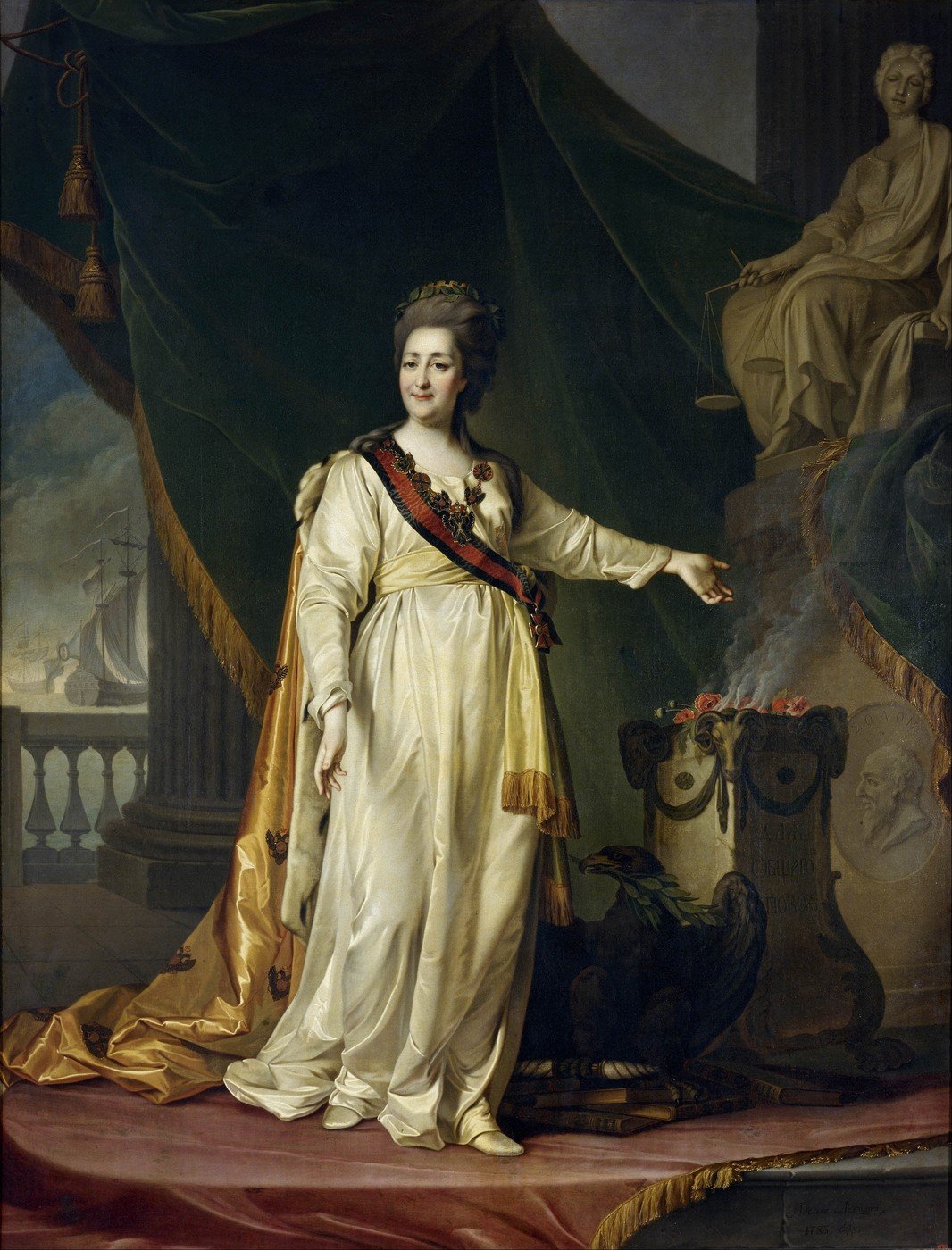
In 1783 Levitsky painted Catherine II as Legislatress in the Temple of the Goddess of Justice, now in the State Russian Museum. The empress appears in the robe of an ancient lawgiver, a laurel wreath on her head, inside a classical temple. The picture turns her Nakaz of 1767, an Instruction written for a new law code, into a monument in the manner of antiquity.
Allegorical portraits of rulers were a European habit, and Levitsky had the training to match the best of them. Historians still debate how seriously the Nakaz was meant to be applied in practice. The painting leaves less room for doubt. It shows the empress as she wished to be seen: wise, selfless and ruling by law.
Look Closer: Look closer: the burning poppies
In Levitsky’s Catherine II as Legislatress (1783), find the altar beside the empress, where poppies burn as an offering. Poppies stood for sleep, so the gesture tells viewers that she gives up her own rest for her subjects. The canvas reads like a rebus in which every prop is one word of a sentence about her reign.
Borovikovsky: From Mirgorod to St Petersburg
Vladimir Borovikovsky was born in Mirgorod in 1757 into a Ukrainian Cossack family, and his father worked as an icon painter. He came to St Petersburg in 1788 and entered the circle of the architect and poet Nikolai Lvov. He studied with Levitsky and with the Austrian painter Johann Baptist Lampi the Elder, became an Academician in 1795, and served at the court of Catherine the Great. By the turn of the century he dominated portraiture in Russia.
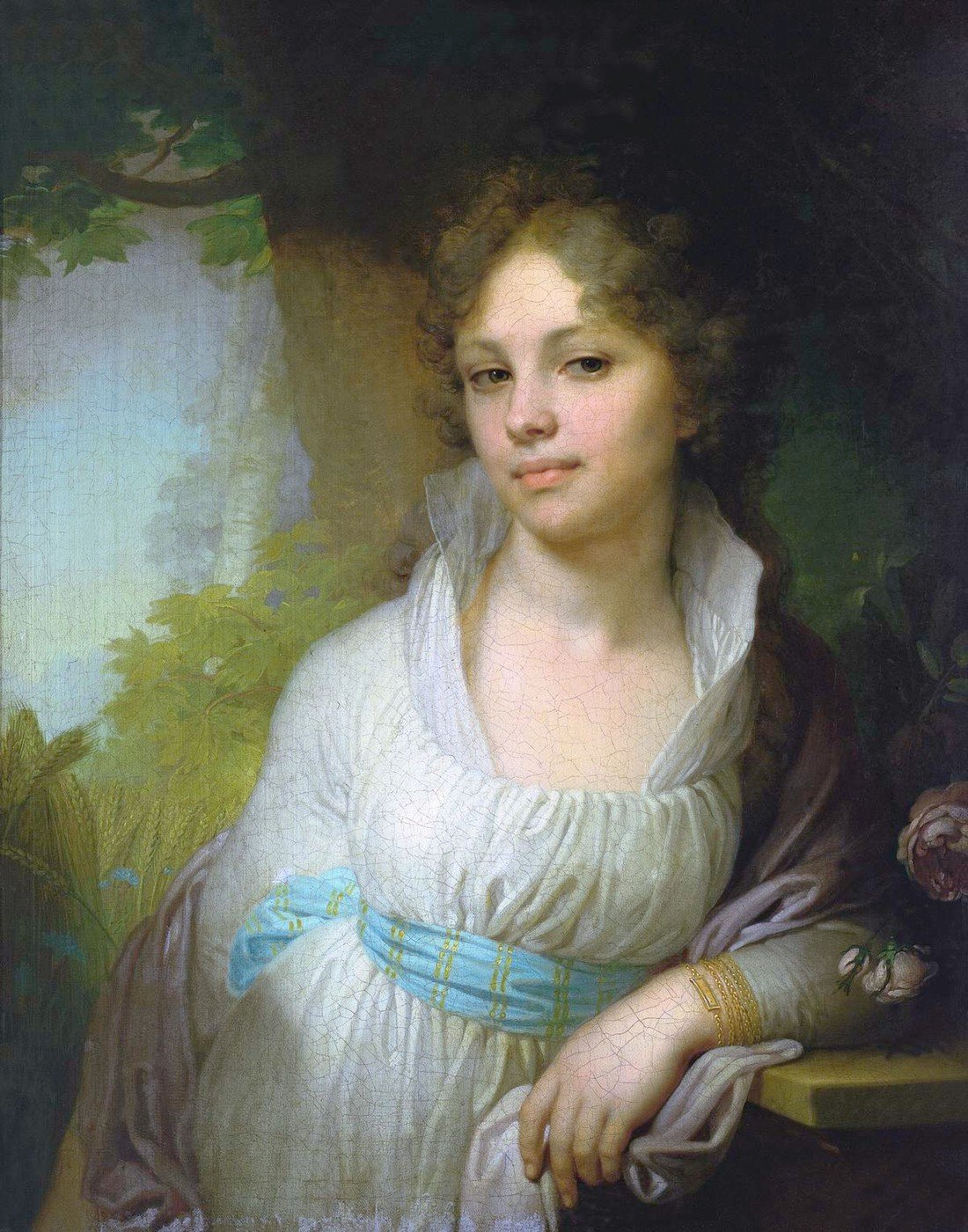
His Portrait of Maria Lopukhina (1797) shows a young woman of about eighteen in a garden, her sash loose and her head tilted. She reportedly died young, in 1803, and that knowledge colors how many viewers read the picture today.
Feeling Over Ceremony: Sentiment in Russian Portraiture
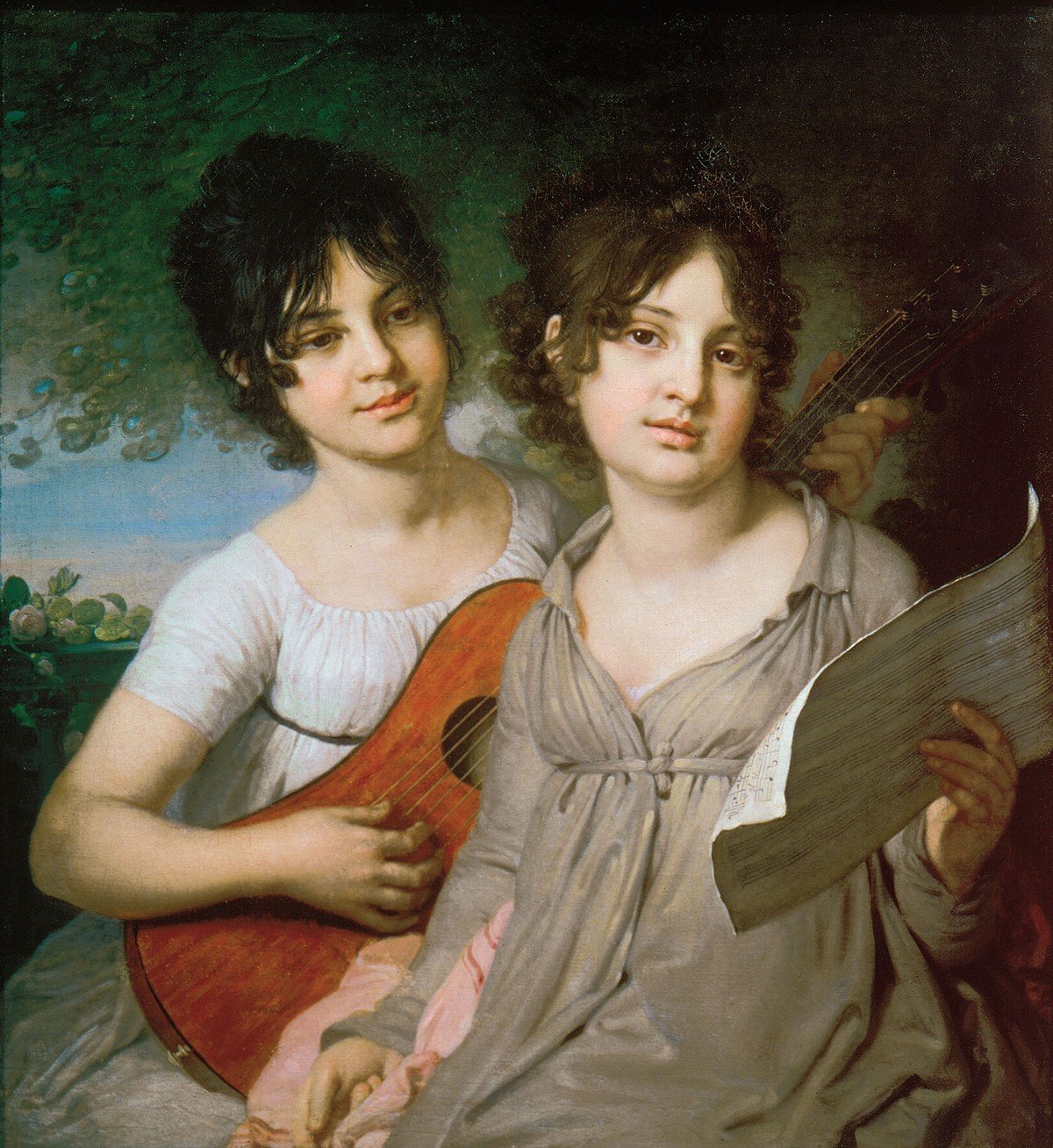
Around 1800 Russian literature turned toward private feeling. Nikolai Karamzin’s Poor Liza (1792) became the best-known example, and Lvov’s circle of poets and architects shared the mood. Borovikovsky belonged to that circle, and his portraits reflect it. In the Portrait of the Gagarin sisters (1802), two young women stand close together against a softly shaded background. The arrangement reads as affection instead of rank.
How did Borovikovsky differ from Levitsky and Rokotov?
Rokotov dissolves a sitter into light and shadow. Levitsky stages the sitter in a role or an allegory. Borovikovsky lets the sitter seem to be thinking of something else. Rokotov asks what a person is like, Levitsky asks what they stand for, and Borovikovsky asks what they feel. That is the quickest way to tell their canvases apart on a gallery wall.
Who Paid, Who Posed: Patronage and Serf Painters
Portraits were commissioned for family halls, estates, schools and the court. The sitters were nobles, officials, wealthy patrons, and the empress herself. The painters often came from very different social worlds. Argunov worked inside a noble household, and Mikhail Shibanov, painter of Celebration of a Wedding Contract (1777), was a serf painter too. Rokotov’s route to freedom was the exception, not the rule.
Argunov’s Portrait of an Unknown Woman in Russian Costume (1784) shows the result. The sitter wears a sarafan and a kokoshnik, a style that grew fashionable in Catherine’s reign as interest in national dress spread among the nobility. The painting is a reminder that Russian portraiture was commissioned by people who wanted to be seen as both modern and Russian.
Western Teachers, Russian Results
Foreign painters shaped the scene long before the Russian trio matured. Pietro Rotari arrived from Italy in 1756 and died in St Petersburg in 1762. Louis Tocqué worked there from 1757 to 1759. The Swedish painter Alexander Roslin visited in 1775 and stayed until 1777. Johann Baptist Lampi arrived in 1792, and Elisabeth Vigee Le Brun worked in Russia from 1795 to 1801.
Russian painters watched, copied and competed with them. Levitsky took allegorical formats from European court painting and fitted them to Russian institutions such as the Smolny Institute and the Foundling Home. Borovikovsky learned from Lampi but kept an informal, intimate tone. The pattern holds throughout. A Western model arrives, then a local sitter and a local setting change what that model can say.
Afterlife: How Russian Portraiture Reached the Romantics
The three painters did not vanish with the century. Their work set the standard against which the next generation measured itself. Their reputation was reportedly rebuilt in 1905, when Sergei Diaghilev organized a vast exhibition of Russian portraits at the Tauride Palace in St Petersburg. Thousands of portraits hung together, and Rokotov, Levitsky and Borovikovsky emerged as central figures of the century.
Who followed Rokotov, Levitsky and Borovikovsky?
Alexey Venetsianov studied with Borovikovsky, and Vasily Tropinin and Orest Kiprensky carried the tradition into the Romantic age. Kiprensky’s inward-looking likenesses of the 1810s and 1820s have a clear ancestor in Borovikovsky’s tender heads, though each painter also moved in directions of his own.
Where to See Russian Portraiture Today
The best single place to start is the State Tretyakov Gallery in Moscow, which holds Struyskaya, Lopukhina, Demidov and Novosiltseva. In St Petersburg, the State Russian Museum has Levitsky’s Catherine as Legislatress and his Smolny series, and the Hermitage holds Borovikovsky’s portrait of Grand Duchess Elena Pavlovna.
Many of these paintings are also available as high-resolution images through Google Arts & Culture, which makes close comparison easy before a visit. Look at the edges of faces and the backgrounds first. Rokotov’s soft transitions, Levitsky’s props and Borovikovsky’s tilted heads become obvious within minutes.
Essential Points
- Rokotov’s Struyskaya (1772) and Levitsky’s Smolny series (begun 1773) were painted within about a year of each other, so these contrasting styles were simultaneous, not successive.
- Treat attributions with care: some works tied to these painters carry labels such as ‘presumably’ or ‘attributed to’, so check the museum’s own catalogue entry.
- This was an imperial project, not a purely Russian one: a freed serf, Ukrainian-born painters, Western visitors and Catherine’s court all fed the same school.
- Clothing is a text. Dressing gowns, stage costume, laurel and Russian court dress each tell you what the sitter wanted to be taken for.
- Most of these portraits were made for family halls, schools and estates, so their original setting shaped pose, scale and tone more than museum display does.
- A three-picture primer works well: Struyskaya for Rokotov, Catherine as Lawgiver for Levitsky, and Lopukhina for Borovikovsky.
Frequently Asked Questions
- What is 18th century Russian portraiture, in plain terms?
- It is Russia’s first large body of painted likenesses of named individuals, made for nobles, officials and the imperial court. Painters borrowed European poses and brushwork, then adapted them to Russian sitters and settings. When you look at one, check three things: the sitter’s clothing, the background, and what the person holds.
- Why did portraits multiply under Catherine the Great?
- Her reign, from 1762 to 1796, combined three supports: steady court commissions, a nobility eager to record rank and family, and Academy graduates ready to work. Catherine also cultivated an image as an enlightened ruler, so painters were asked for flattering, thoughtful likenesses of her and of the people around her.
- What did these painters use, and does it affect how the portraits look today?
- Most major portraits are oil on canvas, though Antropov also made miniatures and icons. Age, varnish and restoration can change how a painting reads, so a face may look warmer or a background darker than the artist intended. Comparing a museum photograph with a gallery visit often shows the difference.
- When did Rokotov, Levitsky and Borovikovsky die?
- Rokotov died on 24 December 1808, Levitsky on 16 April 1822 (4 April, Old Style), and Borovikovsky on 18 April 1825 (6 April, Old Style). Levitsky reached about 86, the longest life of the three, so he outlived Rokotov by thirteen years and saw the Napoleonic era end.
- Can I see these painters outside Russia?
- Yes, a few examples travel well. As of this writing, the Louvre holds Borovikovsky’s portrait of Sergei Yakovlev, the National Museum in Warsaw has several Borovikovsky portraits, and Geneva’s Musée d’art et d’histoire has Levitsky’s Diderot, though museum holdings can change. Most masterpieces remain in Moscow and St Petersburg, so check each museum’s online collection before planning a trip.
This guide was written and reviewed by the rus-art.com editorial team, specializing in Russian art history. We cross-check dates, attributions, and museum holdings against museum and academic sources.