Quick Answer
Andrei Rublev (circa 1360 to 1430) is considered the greatest icon painter of medieval Russia, canonized as a saint in the Eastern Orthodox Church with a feast day on January 29. Trained partly under the Byzantine master Theophanes the Greek, Rublev developed a softer, more luminous style that culminated in the Trinity icon, one of only two works confidently attributed to him and the most celebrated icon in Russian art. His techniques shaped generations of painters, from Dionisius to Simon Ushakov, and his legacy still defines how Russians understand Orthodox sacred art today.
What Is an Icon, and Why Does Rublev Matter?
An icon is a painted image of Christ, the Virgin Mary, or a saint, made for veneration rather than decoration, its forms passed down through generations of workshop training. Andrei Rublev stands as the most celebrated painter to work within that tradition in Russia. Active in the late 1300s and early 1400s, he painted in tempera on wood panel and fresco, first among Moscow’s monastic circles and later at the Trinity Lavra of St Sergius near modern Sergiyev Posad. The Russian Orthodox Church canonized him as a saint, with a feast day on January 29. Of the many works once assigned to him, historians today accept only two with real certainty: the Trinity icon and the fresco fragments in the Dormition Cathedral in Vladimir. Everything else rests on stylistic judgment and centuries of tradition, not a signature or contemporary record, a gap that shapes nearly every scholarly debate about his career.
From Byzantium to Rus: The World Rublev Was Born Into
Icon painting arrived in the Russian lands after Kievan Rus adopted Orthodox Christianity from the Byzantine Empire in 988. Early Russian icons followed Byzantine models closely, and only over centuries did local schools in Novgorod, Pskov, and Moscow develop their own colors and figure types. By Rublev’s time, Moscow was consolidating power as the political and religious center of the Russian lands, and its workshops absorbed both Novgorod’s brighter palette and the example of Byzantine painters who traveled north for commissions. As the wider history of Russian icon painting shows, this Byzantine grounding held for centuries: the personal experimentation typical of Western European religious painting did not reach Russian practice until the 1600s, two hundred years after Rublev’s death.
A Monk’s Life: What We Know (and Don’t) About Rublev
Documentary record on Rublev’s early life is thin. He was born around 1360, likely in or near Moscow, and took monastic vows, which is why only a monastic name survives rather than a birth name. Chronicles first mention him in 1405, already working as an established painter alongside Theophanes the Greek and Prokhor of Gorodets on the Annunciation Cathedral in the Moscow Kremlin, a commission that placed a young Russian monk beside the most sought after icon painter of the age. Rublev died around 1430, probably at the Andronikov Monastery in Moscow, where a museum today bears his name. A miniature portrait, painted more than a century later in the 1500s, is the closest surviving visual likeness, itself a product of later veneration rather than firsthand observation.
Learning from a Master: Theophanes the Greek and the Novgorod Style
Who Was Rublev’s Teacher?
Russian sources name Theophanes the Greek as Rublev’s teacher and mentor. Born around 1330 or 1340, probably in Constantinople, Theophanes reached Novgorod by the 1370s and spent decades painting frescoes and icons across Novgorod and Moscow before his death around 1410. His figures are dramatic, built from bold, almost calligraphic brushwork and a restricted, smoky palette of ochre, white highlight, and deep red. Working beside him on the 1405 Kremlin commission gave Rublev direct exposure to that Byzantine intensity, even as his own hand moved toward something calmer. Where Theophanes favored sharp contrast and visible motion, Rublev softened contour lines and widened the space between figures, a shift scholars read as a deliberate departure from his teacher rather than a failure to match his energy.
The Zvenigorod Deesis and Rublev’s Emerging Voice
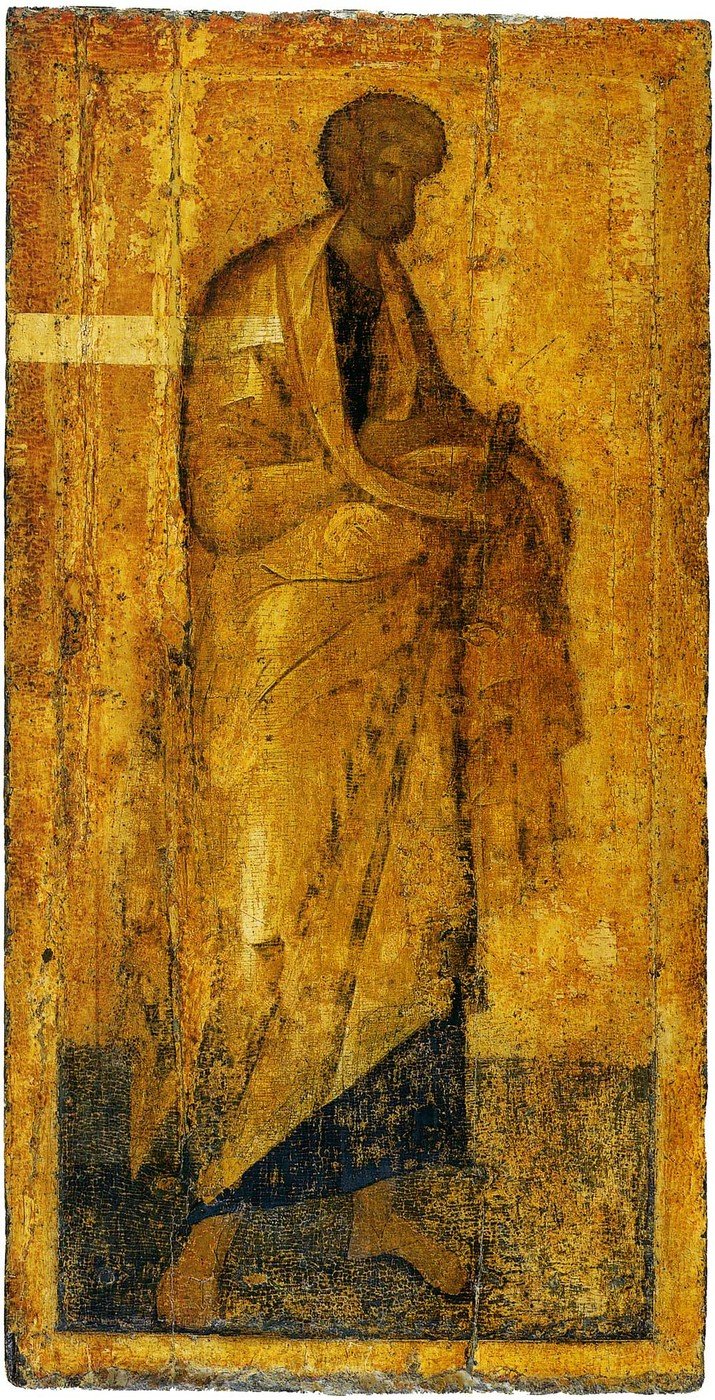
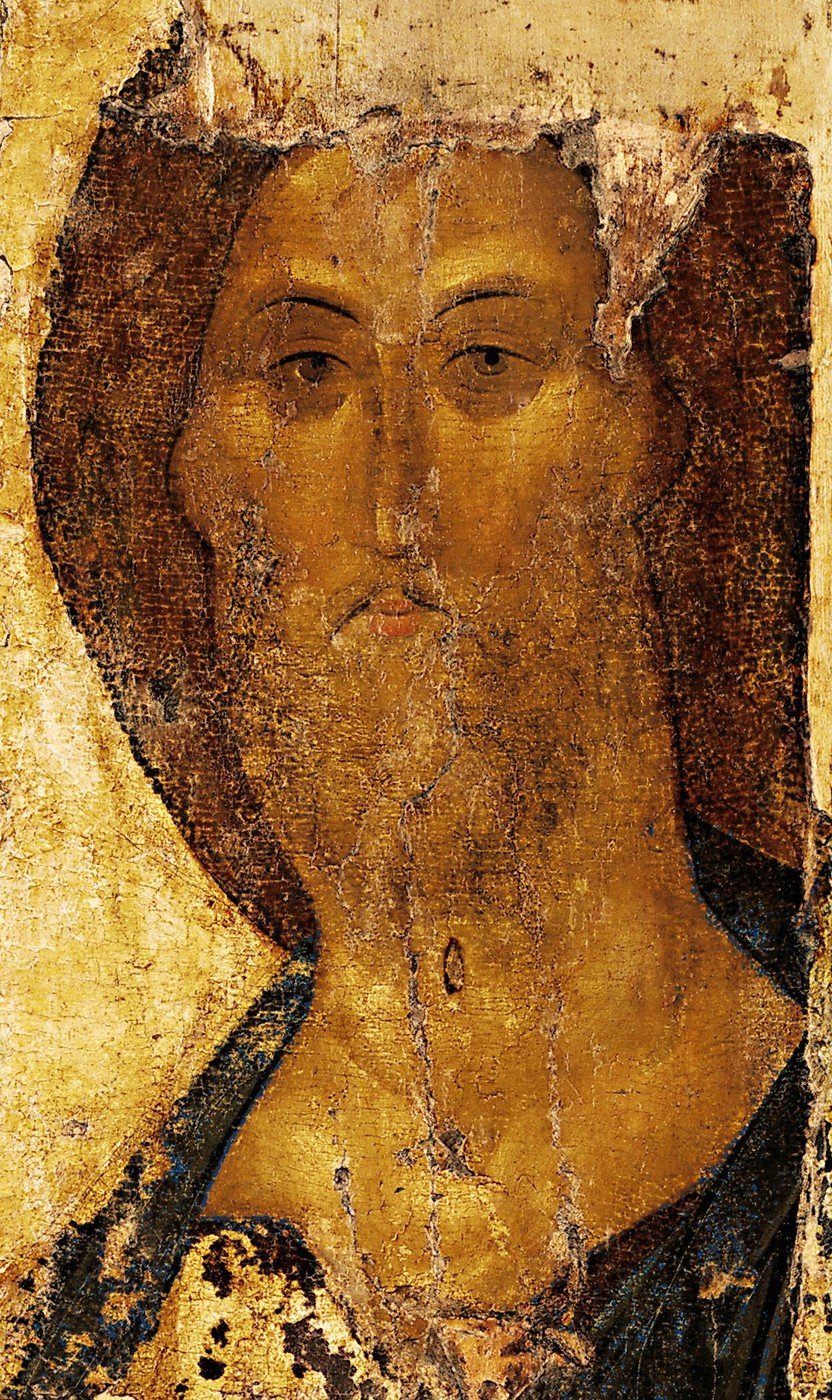
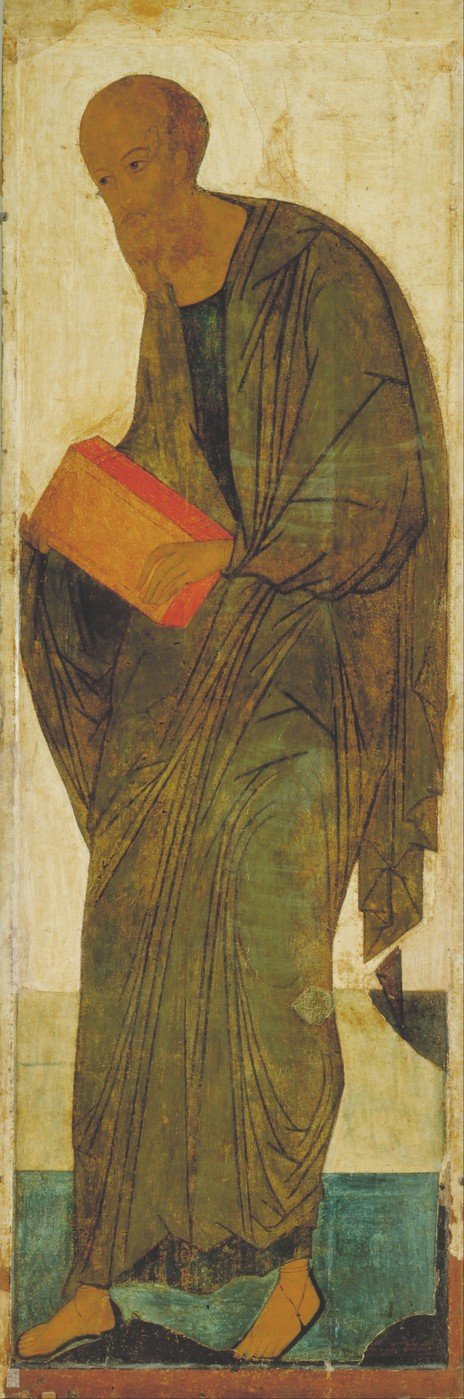
Among the works most often attributed to Rublev is a partial Deesis row of icons discovered in 1918 in the town of Zvenigorod, showing Christ flanked by the Archangel Michael and the Apostle Paul. Only three panels survive, but they carry the qualities that define mature Rublev: rounded faces, warm ochre skin tones, and a gentleness in the eyes that earlier Byzantine models rarely allowed. Scholars often point to the Archangel Michael panel as evidence that, by the early 1400s, Rublev had developed a visual language distinct from the Theophanes school, though the attribution rests on stylistic analysis rather than a signature or contemporary document.
The Dormition Cathedral Frescoes in Vladimir
In 1408, chronicles record Rublev and the monk Daniil painting the Dormition Cathedral in Vladimir, a commission from Grand Prince Vasily I. The surviving fragments, most prominently a Last Judgment cycle, are one of only two works, alongside the Trinity, that scholars accept as securely tied to Rublev through documentary evidence rather than stylistic guesswork. Unlike the stern, punitive Last Judgment scenes common in earlier Byzantine painting, the apostles and angels here appear calm and welcoming, a tonal choice later writers connect to Rublev’s broader emphasis on mercy over judgment.
Inside the Trinity: Reading Rublev’s Masterpiece
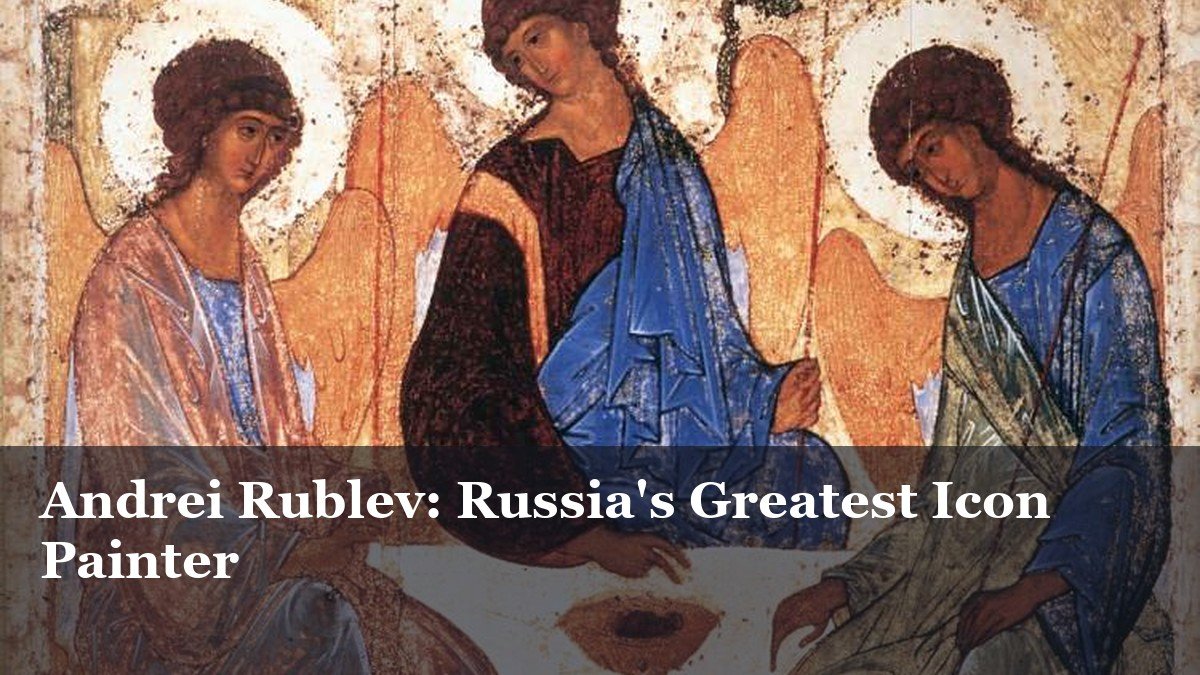
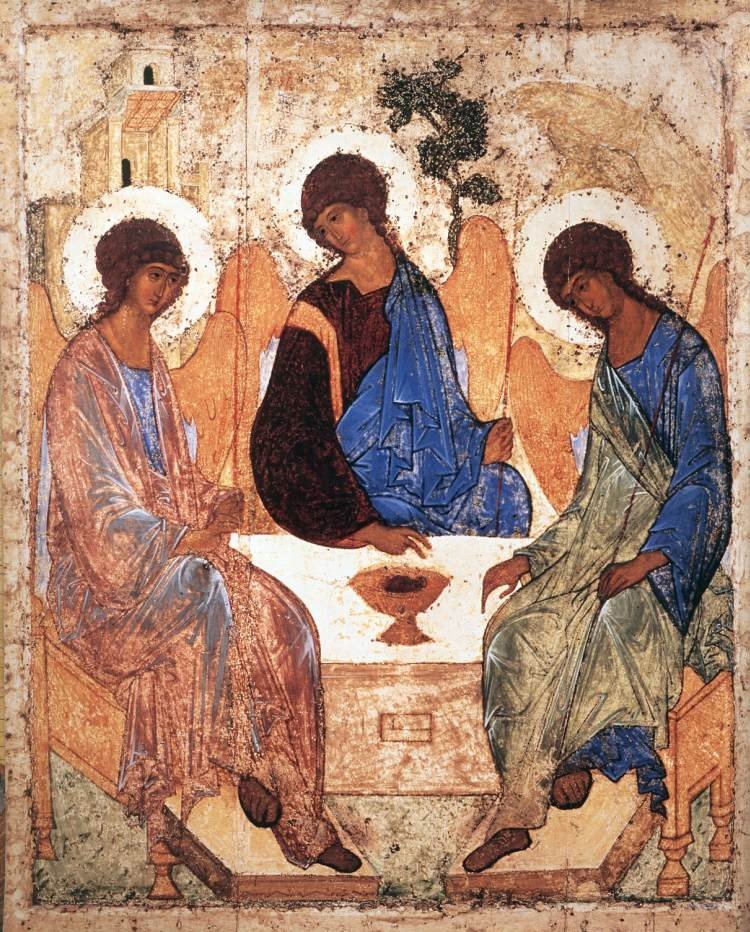
The Trinity depicts three angels seated around a table, illustrating the Old Testament story of the three visitors who appeared to Abraham at the Oak of Mamre (Genesis 18:1 to 8). Rublev painted it for the Trinity Lavra of St Sergius, near Sergiyev Posad, to honor the monastery’s founder, Sergius of Radonezh. Scholars still debate exactly when: proposed ranges include 1408 to 1425, 1422 to 1423, and 1420 to 1427, and even Rublev’s authorship, though widely accepted, has been questioned given how thin the documentary trail is. Read theologically, the three angels stand for the three persons of the Trinity, bound in what Rublev’s contemporaries understood as spiritual unity, peace, and mutual love, ideas of particular weight in a Russia still recovering from Mongol rule and internal princely conflict.
The Rublev Touch: Color, Line, and Quiet Emotion
Several traits recur across the works attributed to Rublev. His palette favors a clear, luminous blue, sometimes called Rublev blue, paired with soft ochres and muted reds rather than the sharper contrasts of Theophanes’ generation. His figures lean toward one another in gentle curves, heads inclined, producing a sense of quiet conversation rather than static frontal address. Faces are rounded and calm, with small, deliberate eyes that avoid the intense stare typical of earlier Byzantine models. Compositionally, Rublev often arranges figures within an implied circle, a device visible in the Trinity’s three angels, drawing the viewer’s eye inward and reinforcing the sense of unity among the figures shown. Later icon painters treated these choices less as one artist’s preference and more as a template for how a Russian icon should look.
The Council of 1551 and the Canonization of a Style
More than a century after Rublev’s death, the Stoglav Council of 1551, a church synod convened under Ivan IV, instructed icon painters to follow Rublev’s Trinity as the model for representing the Holy Trinity, turning his personal style into official church guidance. That endorsement cemented Rublev’s authority for generations of workshop painters who never studied under him and knew his work only through copies and the instruction to imitate it. It also explains why so many later Trinity icons echo his composition almost panel for panel: deviation risked doctrinal as well as artistic censure.
Look Closer: Look Closer at the Trinity
Trace the outline formed by the three angels’ bowed heads and inclined bodies: it traces a near perfect circle, a compositional device that pulls the eye inward rather than out toward the frame. Notice too that a single chalice sits at the center of the table, shared rather than divided among the three figures, a quiet visual argument for unity that the accompanying inscriptions never spell out directly.
Dionisius: Carrying the Rublev Line Into a New Century
Did Dionisius Train Directly Under Rublev?
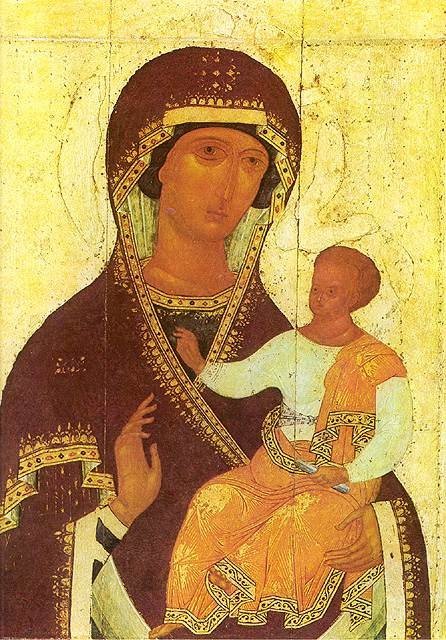
No direct evidence links the two men as master and student. Dionisius, active from around 1440 until his death in 1503 or 1508, became the leading painter of the Moscow school at the turn of the sixteenth century, roughly seventy years after Rublev died, and is generally described as continuing his traditions rather than learning at his side. Unlike Rublev, Dionisius ran a large, commercially successful workshop, producing icons such as the Hodigitria Mother of God for major Moscow churches and the Ferapontov Monastery. His figures are more elongated and his color range brighter than Rublev’s, but the calm expressions and interwoven compositions descend directly from the earlier master, evidence that Rublev’s innovations had become the working vocabulary of an entire school rather than one artist’s signature.
Simon Ushakov and the Turn Toward the West
By the mid-1600s, Russian icon painting began absorbing influences from Protestant and Catholic European printmaking, a shift Simon Ushakov, active from around 1626 to 1686, embodied more than any other painter. Ushakov worked alongside Fyodor Zubov and Fyodor Rozhnov during Patriarch Nikon’s reform of the Russian Orthodox Church, and his icons, including several versions of the Not Made by Hands image of Christ, show a modeled, almost sculptural treatment of faces that owes more to Western realism than to Rublev’s flattened, symbolic space. Ushakov is also credited with popularizing parsuna, an early Russian genre of secular portraiture that borrowed icon painting technique to depict living rulers and nobles, a step unthinkable within the purely devotional framework Rublev worked in two centuries earlier.
The Schism, the Old Believers, and a Divided Tradition
Patriarch Nikon’s mid-1600s reforms to liturgy and religious practice split the Russian Orthodox Church. Traditionalists, known as the Old Believers, rejected the changes and kept painting in the older, stylized, non-realistic manner descended from Rublev and his contemporaries, while the official State Church increasingly accepted the blended Russian and Western European realism associated with Ushakov’s generation. Ushakov’s own Tree of the Muscovite State, painted in 1668 to celebrate the veneration of the Vladimir Mother of God icon by Muscovite rulers, shows how far state-sanctioned painting had moved toward this new realism within a single century of Rublev’s death. From the 1650s onward, two visibly different icon traditions coexisted in Russia: one looking backward to Rublev’s flattened, symbolic figures as a mark of doctrinal fidelity, the other looking to Western Europe as a sign of modernization.
Rublev’s Afterlife: From Forgotten Monk to National Symbol
For centuries after his death, Rublev’s individual reputation faded even as the Trinity remained venerated, since icons were valued as sacred objects rather than as the work of a named artist. Interest in Rublev as a historical figure revived sharply in the early twentieth century, when conservators cleaned centuries of darkened varnish and later overpainting from the Trinity, revealing colors far brighter than anyone alive had seen. That restoration, carried out in stages between 1904 and the 1920s, coincided with a broader Russian rediscovery of medieval icon painting as fine art worthy of museum display rather than only liturgical use, and the Trinity moved from monastery keeping into the collection now held by the State Tretyakov Gallery.
Andrei Tarkovsky and the Twentieth-Century Rediscovery
Rublev’s modern fame owes a great deal to filmmaker Andrei Tarkovsky, whose 1966 film Andrei Rublev, heavily fictionalized and held back from wide release by Soviet censors for years, introduced the painter to international audiences as a symbol of artistic conscience under political pressure. The film shows Rublev painting only briefly, focusing instead on the violence and hardship of his era, but its final sequence, shot in color against the icons themselves, cemented the Trinity as shorthand for Russian spiritual and artistic achievement, an association that persists in how the icon gets discussed today, well beyond specialist art history circles.
Common Misconceptions
Rublev did not invent the blue pigment associated with his name. The rich blue seen in the Trinity is ultramarine, ground from imported lapis lazuli, a pigment already used across Byzantine and Russian icon painting for centuries. What later writers call Rublev blue describes how he deployed that costly color, concentrated on key figures for emphasis, not a chemical innovation he introduced.
Rublev was also not a freelance artist selling work to buyers. Medieval Russian icon painters worked under commission from monasteries, bishops, and princes, tied to specific building or liturgical projects like the Kremlin’s Annunciation Cathedral or the Trinity Lavra. No open art market for icons existed in Rublev’s lifetime, not in the sense familiar from later European painting.
Where to See Rublev Today
The Trinity hangs in the State Tretyakov Gallery in Moscow, moved there from the Trinity Lavra of St Sergius in the early Soviet period and displayed behind climate controlled glass after decades of conservation work. Fragments of the Dormition Cathedral frescoes remain in place in Vladimir, viewable inside the still functioning cathedral. The Andronikov Monastery in Moscow, where Rublev is believed to have died, now houses a museum dedicated to early Russian icon painting from his era onward. For readers outside Russia, high resolution reproductions through Google Arts & Culture make it possible to examine brushwork and color relationships that are hard to see from behind museum glass in person.
Essential Points
- Only two works, the Trinity and the Dormition Cathedral frescoes in Vladimir, are attributed to Rublev with real documentary certainty; everything else rests on stylistic judgment.
- Rublev trained alongside Theophanes the Greek on the 1405 Annunciation Cathedral commission, then moved his own style toward softer contours and calmer expressions.
- The 1551 Stoglav Council made Rublev’s Trinity the official model for depicting the Holy Trinity in Russian icon painting, turning personal style into church guidance.
- Dionisius and Simon Ushakov represent two different directions after Rublev, one extending his workshop tradition, the other pulling Russian icon painting toward Western European realism.
- The mid-1600s Nikonian reforms split icon painting into two visible lineages, the Old Believers preserving Rublev-era stylization and the State Church adopting a more Western look.
- Conservators cleaning the Trinity in the early twentieth century revealed colors hidden under centuries of darkened varnish, transforming how scholars judged Rublev’s technical skill.
- Andrei Tarkovsky’s 1966 film brought Rublev to international audiences less as a painter than as a symbol of art surviving political hardship.
- Rublev was canonized a saint in the Orthodox Church, with a feast day of January 29, a status separate from and older than his modern reputation as a historical artist.
Frequently Asked Questions
- What is Andrei Rublev best known for?
- Rublev is best known for the Trinity icon, painted in the early 1400s for the Trinity Lavra of St Sergius. It depicts three angels seated at Abraham’s table and is considered the finest surviving example of Russian icon painting, now displayed at the State Tretyakov Gallery in Moscow.
- Why is so little documented about Rublev’s life?
- Medieval Russian icon painters worked anonymously within monastic workshops, and chroniclers rarely recorded artists by name. Rublev appears in written sources only a handful of times, first in 1405, leaving historians to reconstruct his career mainly through stylistic comparison rather than biography or dated correspondence.
- What does the Trinity icon actually symbolize?
- The icon shows three angels around a table, illustrating Genesis 18, the story of Abraham’s three visitors, reinterpreted as an image of the Holy Trinity. Their circular arrangement and shared gesture toward a single chalice express the spiritual unity, humility, and mutual love that Rublev’s era associated with divine harmony.
- Did Andrei Rublev have a teacher?
- Yes. Chronicles link Rublev to Theophanes the Greek, a Byzantine painter active in Novgorod and Moscow, whom sources describe as his mentor. Rublev worked alongside him on the 1405 Annunciation Cathedral frescoes before developing his own calmer, more rounded style distinct from Theophanes’ dramatic Byzantine intensity.
- Where can I see Andrei Rublev’s work today?
- The Trinity hangs in the State Tretyakov Gallery in Moscow. Fragments of his Dormition Cathedral frescoes remain in Vladimir, and the Andronikov Monastery, where he likely died, now houses a museum dedicated to early Russian icon painting, alongside high resolution reproductions available online.
This guide was written and reviewed by the rus-art.com editorial team, specializing in Russian art history. We cross-check dates, attributions, and museum holdings against museum and academic sources.