Quick Answer
Mikhail Vrubel’s Demon paintings are a series of works, chiefly The Demon Seated (1890), The Flying Demon (1899), and The Demon Downcast (1902), inspired by Mikhail Lermontov’s 1839 poem The Demon. Vrubel returned to the fallen angel obsessively for over a decade, developing a fractured, crystalline style unique to Russian Symbolism. Painting the final canvas coincided with a mental collapse that led to his hospitalization in 1902 and his eventual blindness before his death in 1910.
What Is the Demon Cycle?
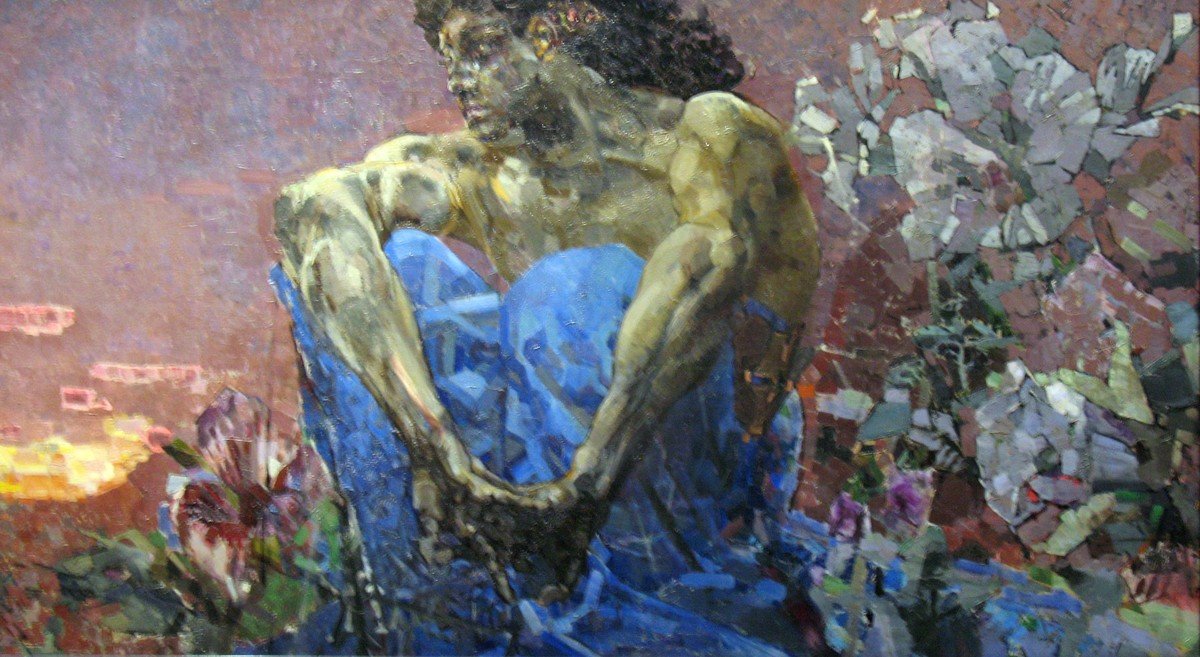
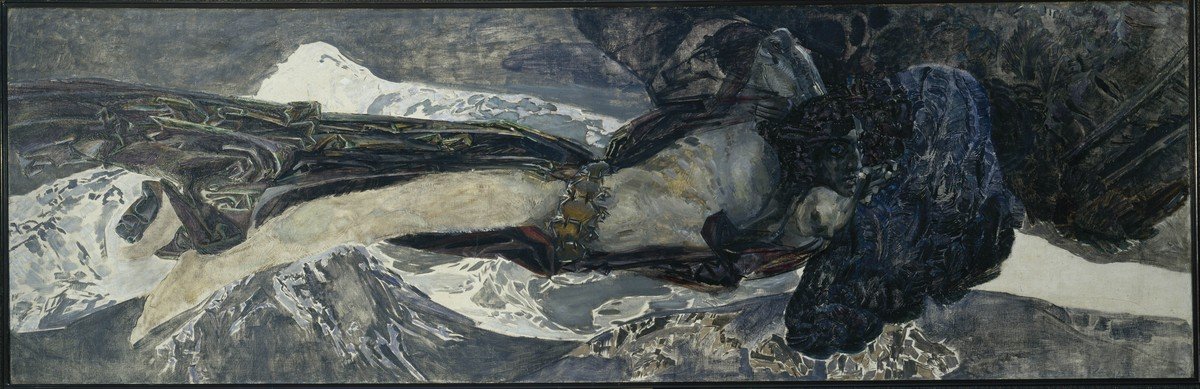
Vrubel’s Demon cycle is not one painting but a body of work, paintings, drawings, illustrations, that he produced between roughly 1885 and 1902, all circling one figure: a fallen, sorrowful spirit drawn from Mikhail Lermontov‘s 1839 narrative poem The Demon. Vrubel did not paint a monster. He painted a being caught between grandeur and grief: seated among crystalline rocks, flying over jagged peaks, finally broken and twisted across a mountainside. The three major oil paintings, The Demon Seated (1890), The Flying Demon (1899), and The Demon Downcast (1902), trace the arc of the obsession. Each grows larger, darker, more physically strained than the last, tracking Vrubel’s own state of mind as much as any line of poetry.
From Lermontov’s Poem to Vrubel’s Canvas
Why did Vrubel paint the demon so many times?
The fixation began with a commission, not a private vision. In 1890, publisher Pyotr Konchalovsky hired Vrubel to illustrate a lavish jubilee edition of Lermontov‘s The Demon, marking the poem’s rise to classic status. Vrubel produced dozens of drawings for the project, testing pose after pose until the demon’s form became an obsession in itself. That same year he painted The Demon Seated, the first of the three major canvases, while the illustration work was still underway. Lermontov’s poem follows a spirit exiled from heaven who falls in love with a mortal woman, Tamara, and loses her in the act of loving her. Vrubel read the demon less as evil than as a figure of isolation, and that reading shaped every version he painted afterward.
Kyiv and the Byzantine Apprenticeship
Vrubel trained at the Imperial Academy of Arts in St. Petersburg under Pavel Chistyakov, but the education that mattered most for the Demon paintings came later, in Kyiv. In 1884 he was hired to restore twelfth century frescoes at St. Cyril’s Church, and he later contributed designs for St. Vladimir’s Cathedral. Studying Byzantine mosaics up close taught him to build a face or a fold of drapery from separate, angular planes of color rather than smooth gradients. That faceted handling, closer to stained glass or cut stone than to academic painting, became his signature. When he later painted the demon’s shoulders and the rock formations around him as clusters of sharp, jewel-like facets, he was applying a method learned from twelfth-century church walls to a nineteenth-century Symbolist subject.
The Moscow Period Begins: The Demon Seated
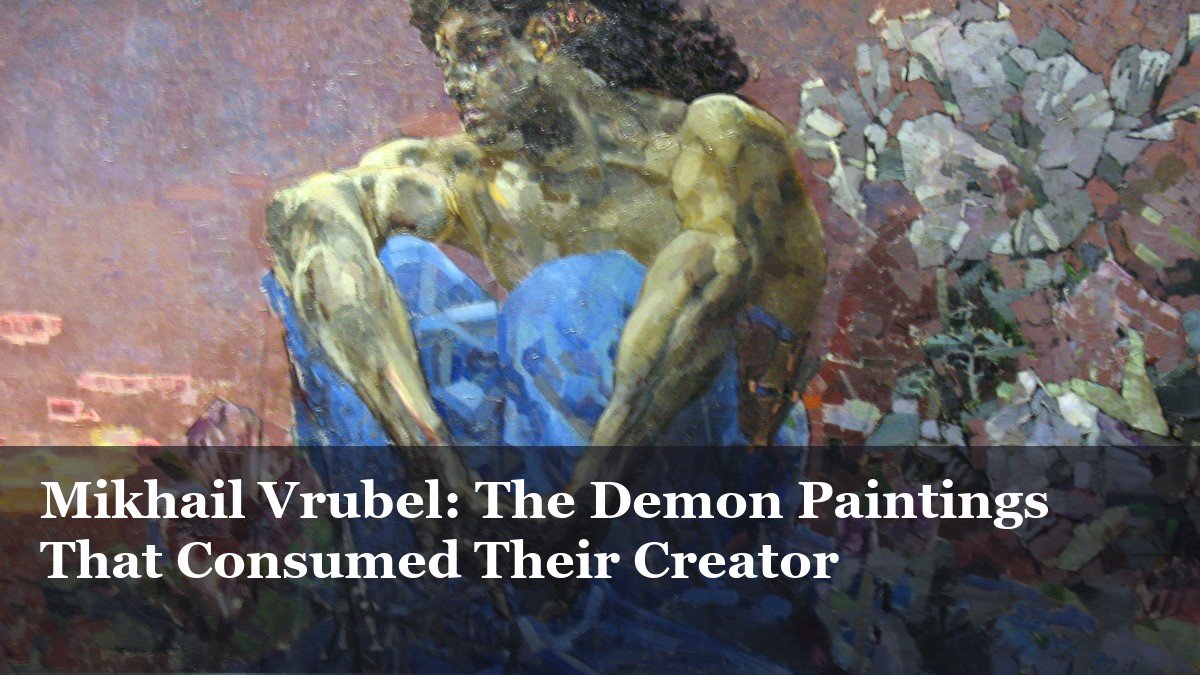
Vrubel moved to Moscow around 1889 and painted The Demon Seated the following year, now held at the State Tretyakov Gallery. The figure sits hunched among crystalline boulders at dusk, muscular and androgynous, hands clasped, staring past the viewer. Nothing about the pose suggests immediate menace. Instead, the painting reads as a portrait of confinement: the demon’s body is too large for the space he occupies, knees drawn up, the horizon compressed into a narrow band of purple sky. Critics at the time split sharply. Some dismissed the picture as ugly and unfinished-looking. Others, including younger artists at Abramtsevo, saw in it a new visual language for Russian painting, one that owed nothing to the Wanderers’ realism dominating exhibitions of the period.
Savva Mamontov and the Abramtsevo Circle
Who supported Vrubel when critics did not?
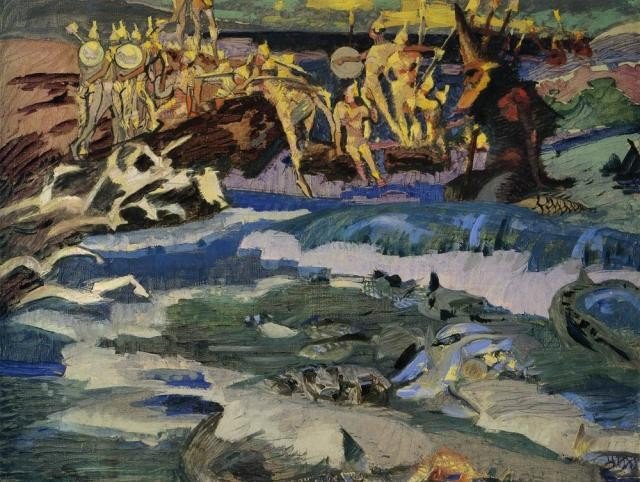
The railway magnate and patron Savva Mamontov gave Vrubel steady work through the 1890s, commissioning ceramics, majolica sculpture, and stage designs at his estate and artists’ colony, Abramtsevo. Vrubel’s glazed majolica figure Bogatyr (1898), a hulking medieval warrior rendered with the same crystalline surfaces as his demons, came out of the ceramics workshop Mamontov funded there. Mamontov also cast Vrubel in his private opera productions, designing sets and costumes, and it was through this circle that Vrubel met the young opera singer Nadezhda Zabela. Abramtsevo mattered because it kept Vrubel financially afloat and artistically connected during years when the official academy and press treated his painting as, at best, an eccentric failure.
Marriage to Nadezhda Zabela-Vrubel
Vrubel married Nadezhda Zabela-Vrubel, a soprano with Mamontov’s private opera, in 1896. She became his most consistent model and, by most accounts, the steadying presence in a life increasingly strained by debt and self-doubt. He painted her repeatedly, most famously as the Swan Princess in Tsarevna-Lebed (1900), a role she sang in Rimsky-Korsakov’s opera The Tale of Tsar Saltan, and he designed the sets and costumes for productions she appeared in. Marriage did not resolve the instability building underneath his work. Their only child, born in 1901 with a cleft palate, died in 1903, a loss that arrived in the same narrow window as Vrubel’s hospitalization and compounded it.
Defining Features: Crystalline Facets and Mosaic Brushwork
Three traits separate Vrubel’s mature style from both academic realism and the Wanderers he grew up alongside. First, the faceted surface: forms built from distinct, jewel-cut planes rather than blended tone. Second, a restricted, often violet-and-gold palette that gives even daylight scenes a stained-glass density. Third, a refusal to finish edges cleanly: figures blur into their backgrounds, rock becomes drapery becomes wing, so no single form reads as fully separate from its surroundings. These features show up as early as Girl Against the Background of a Persian Carpet (1886), painted in Kyiv, where the sitter’s face and the carpet’s pattern compete for the eye with nearly equal weight.
The Demon Downcast and the Break
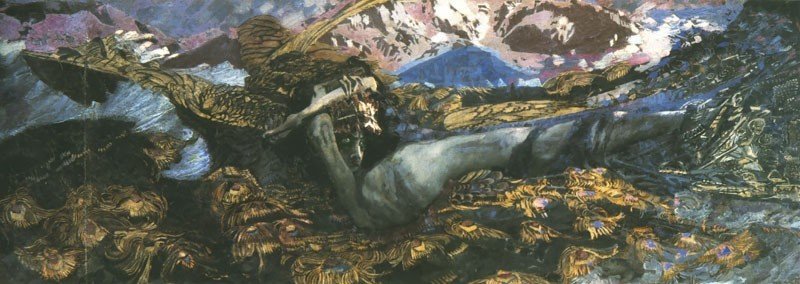
Vrubel painted The Demon Downcast through 1901 and 1902, and its exhibition history is part of the work itself. He kept revising the canvas after it was hung for the World of Art exhibition in St. Petersburg in early 1902, arriving before viewing hours to repaint the demon’s face and the peacock feathers scattered around the shattered body. Witnesses described the expression changing almost weekly, growing harsher and more agitated. The demon here is not seated in contemplation but broken across a mountain ridge after his fall, limbs twisted, eyes wide. Days after the exhibition, Vrubel’s behavior turned erratic enough that his family had him committed to a psychiatric clinic, a collapse his contemporaries, and later biographers, read as inseparable from the painting’s obsessive repainting.
Look Closer: The face that never settles
Vrubel repainted The Demon Downcast’s face constantly, even after it left his studio for exhibition, arriving early to touch up the canvas on the wall. Contemporaries reported the demon’s expression shifted from sorrowful to menacing between visits. Look closely at the jaw and eye sockets: the paint sits in thick, unresolved ridges, unlike the smoother finish of the 1890 Demon Seated.
Hospitalization and the Final Years
Did Vrubel keep painting after 1902?
Yes, intermittently. Vrubel moved between clinics and periods of relative stability for the rest of his life, and he kept working when he could. His 1905 self-portrait, made during one such period, shows a gaunt, unflinching face rendered in the same faceted technique he had applied to the demon a decade earlier, now turned on himself. He also produced Vision of the Prophet Ezekiel around 1906, an ambitious, unfinished religious composition that returned to the Byzantine sources of his Kyiv years. Failing eyesight forced him to stop painting entirely around 1906. He spent his last years largely blind, cared for in a St. Petersburg clinic, and died on April 14, 1910.
Beyond the Demon: Tsarevna-Lebed and Fairy Tale Subjects
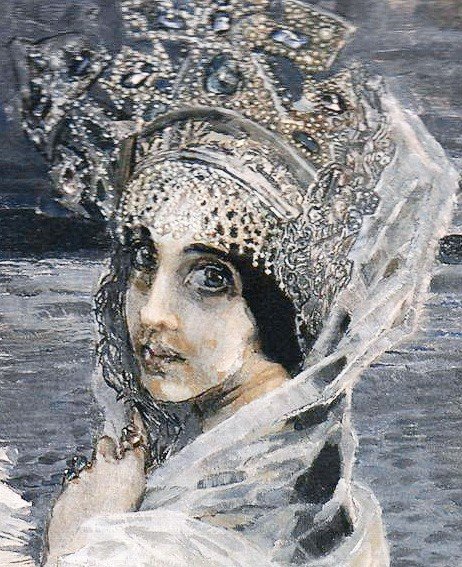
Vrubel’s output outside the Demon cycle deserves its own attention, and much of it is gentler in subject even when it shares the same visual language. Tsarevna-Lebed (1900) shows Zabela-Vrubel’s Swan Princess turning to glance back over her feathered shoulder, caught mid-transformation between woman and bird. Princess Dream (Принцесса Грёза, 1896), a monumental panel originally painted for the facade of an art pavilion at the 1896 Nizhny Novgorod exhibition, illustrates a medieval troubadour legend rather than anything drawn from Lermontov. Both works use the same jewel-toned palette and faceted drapery as the Demon paintings, evidence that Vrubel’s style was a consistent method, not something he switched on only for his darkest subject.
Vrubel’s Place in Russian Symbolism
Russian Symbolism developed independently of the French and Belgian movements that share its name, and Vrubel is usually named as one of its earliest painters. Where poets like Alexander Blok pursued Symbolism through language and Sophiological mysticism, Vrubel pursued it through surface and form, using fractured color and ambiguous, half-dissolved figures to suggest meaning beyond the literal subject. He rarely wrote about theory and left almost no explanation of his intentions, which has made him harder to slot into the movement’s literary side. Art historians place him closer to a visionary tradition that runs from Byzantine icon painting through his own faceted technique toward the more decorative Symbolism of Viktor Vasnetsov and, later, the artists of the World of Art group.
Legacy: Influence on Russian Modernism
Vrubel died five years after being honored by the Academy of Arts, a recognition that came too late to register with an artist who was, by then, blind and largely withdrawn. His influence outlasted the neglect. The World of Art circle around Léon Bakst and Alexandre Benois, active in St. Petersburg through the 1900s and 1910s, treated Vrubel as a direct forerunner for their fusion of painting, theater, and decorative design. His faceted surfaces also anticipated formal concerns that would preoccupy Russian avant-garde painters within a decade of his death, though Vrubel himself worked entirely outside any Cubist or Futurist framework: the resemblance is a matter of visual logic, not shared movement. Soviet-era scholarship, including Nina Dmitrieva’s 1990 biography, later reframed his life as a structured tragedy in three acts, a framing that has shaped how the Demon paintings are read ever since.
Common Misconceptions
One misconception is worth correcting directly: Vrubel’s demon is not Lermontov’s demon transcribed onto canvas. Lermontov’s poem gives the character dialogue, a seduction plot, a clear narrative arc. Vrubel’s paintings strip nearly all of that away, leaving isolated, wordless bodies in landscapes with no surrounding story. Readers who come to the paintings expecting an illustration of the poem’s events, the demon’s courtship of Tamara, her death, are often surprised to find no such scene in any of the three major canvases. Vrubel used Lermontov as a starting point for a mood and a figure, not as a script to illustrate panel by panel.
Related Movements and Connections
Vrubel’s career threads through several overlapping circles rather than one clean lineage. Abramtsevo connected him to Viktor Vasnetsov and Valentin Serov, both working nearby on folkloric and portrait subjects with very different technical means. The World of Art group that formed in St. Petersburg in the late 1890s, including Léon Bakst and Konstantin Korovin, absorbed his interest in theater design and the decorative unity between painting and craft. His faceted technique also echoes forward, without direct contact, into the visionary landscapes of Nicholas Roerich, who shared Vrubel’s interest in myth and archaic sources even though the two developed independently. None of these figures painted a demon. What they shared with Vrubel was a conviction that Russian painting could carry symbolic weight without abandoning craft.
Essential Points
- Vrubel’s Demon cycle grew from his illustrations for a 1890 jubilee edition of Lermontov’s poem The Demon, not from a single inspiration.
- His faceted, mosaic-like brushwork developed first in Kyiv, where he restored medieval frescoes at St. Cyril’s Church in 1884.
- Savva Mamontov’s Abramtsevo colony gave Vrubel steady work in ceramics and theater design during years when critics dismissed his painting.
- Nadezhda Zabela-Vrubel, his wife and an opera singer, modeled for the Swan Princess and sang roles Vrubel designed sets and costumes for.
- The Demon Downcast (1902) was reworked so heavily during its exhibition that viewers saw the canvas change from week to week.
- Vrubel entered a psychiatric clinic in 1902, shortly after finishing The Demon Downcast, and never fully recovered.
- He continued working after hospitalization, including the unfinished Vision of the Prophet Ezekiel, until blindness stopped him around 1906.
- Vrubel’s fractured surfaces anticipated aspects of Cubism and directly shaped the World of Art generation that followed him.
Frequently Asked Questions
- What is Mikhail Vrubel’s Demon Seated actually about?
- The Demon Seated (1890) shows a muscular, sorrowful figure crouched among crystalline rocks at dusk, inspired by Lermontov’s poem The Demon. It is not a scene from the poem’s plot but a mood portrait of isolation, rendered in Vrubel’s signature faceted, jewel-like brushwork.
- Why did Vrubel keep returning to the same demon subject?
- He first developed the figure while illustrating a jubilee edition of Lermontov’s poem in 1890, then kept refining it across three major paintings over twelve years. Each version reflects a different emotional state, ending with the agitated repainting of The Demon Downcast in 1902.
- Where did Vrubel’s crystalline painting style come from?
- It developed in Kyiv, where Vrubel restored twelfth-century frescoes at St. Cyril’s Church starting in 1884. Studying Byzantine mosaics up close taught him to build forms from distinct angular color planes rather than smooth blending, a method he carried into every later work.
- How did Vrubel’s marriage affect his art?
- His 1896 marriage to opera singer Nadezhda Zabela-Vrubel gave him a steady model and collaborator; she sang roles he designed sets for and posed for works like Tsarevna-Lebed. The couple’s later loss of their infant son coincided with his 1902 hospitalization.
- Where can you see Vrubel’s Demon paintings today?
- The Demon Seated and The Demon Downcast both hang in the State Tretyakov Gallery in Moscow. The Flying Demon is held by the State Russian Museum in St. Petersburg, which also holds several of Vrubel’s later works, including his 1905 self-portrait.
This guide was written and reviewed by the rus-art.com editorial team, specializing in Russian art history. We cross-check dates, attributions, and museum holdings against museum and academic sources.