Quick Answer
The 0,10 Exhibition (December 19, 1915 to January 17, 1916) at the Dobychina Art Bureau on Marsovo Pole in Petrograd introduced Suprematism to the public. Kazimir Malevich showed 39 abstract paintings, including Black Square, which he hung high across a corner, the spot Russian homes reserved for religious icons. Fourteen artists took part, though the show’s name pointed to an original plan for ten. It marked the end of Cubo-Futurism as Russia’s leading avant-garde style.
What Was the 0,10 Exhibition?
The 0,10 Exhibition was a group show staged by the Kazimir Malevich circle at Nadezhda Dobychina’s Art Bureau in Petrograd, running from December 19, 1915 to January 17, 1916. Its full name, printed on the catalog, was The Last Futurist Exhibition of Paintings 0,10. Fourteen artists took part, all working at the edge of Cubo-Futurism, and several were about to leave representational subject matter behind entirely.
The show is remembered today mainly for one painting: Kazimir Malevich’s Black Square, shown here for the first time and hung in a way that made its meaning unmistakable to anyone who walked into the room. But 0,10 was never a one-artist event. A whole generation of Russian painters, working independently, arrived at the same conclusion within months of each other: painting could shed the object altogether and still mean something. The result was Suprematism, one of the first abstract art movements to emerge from Russia.
Petrograd in Wartime: The World Behind the Show
By December 1915, Russia had been at war for a year and a half, and the capital itself had shed its old name. St. Petersburg became Petrograd in 1914, a patriotic deGermanization prompted by the war against the Kaiser’s empire. Paper was scarce, travel was harder, and the city’s mood swung between anxious and defiant.
Exhibitions continued anyway. The disruption even gave younger, less established painters room to organize shows the prewar academic system would have ignored. Dobychina’s Art Bureau was a private venture, not a state institution, and that let its artists set their own terms. The independence mattered: a state-sanctioned exhibition in 1915 would not have hung an all-black canvas at all, let alone made it the centerpiece.
From Cubo-Futurism to “Zero-Ten”: Why the Name
Decoding the Exhibition’s Name
The numbers carried two meanings at once. Zero pointed to the idea that painting needed to be stripped down to nothing, cleared to its bare elements, before it could start again from a true foundation. Ten referred to the number of artists originally scheduled to take part. Fourteen ended up participating, but the title kept its original math even after the roster grew.
The rest of the name, The Last Futurist Exhibition of Paintings, was chosen by the show’s chief organizer to make an equally blunt point: Cubo-Futurism, the fractured, motion-obsessed style that had dominated Russian avant-garde painting since around 1912, was finished. A manifesto distributed at the show, signed by Malevich, Ivan Kliun, and Mikhail Menkov, spelled out the reasoning without softening it. Representational form itself, the three argued, stood between the artist and pure painterly feeling.
Dobychina’s Gallery on Marsovo Pole
Nadezhda Dobychina ran one of Petrograd’s few independent art bureaus willing to give the avant-garde wall space, and her venue on Marsovo Pole, the Field of Mars, hosted 0,10 by arrangement with the artists themselves, not any academy. A lecture on Suprematism ran during the exhibition, advertised on posters printed and distributed around the city, part of the effort to explain work most visitors had no vocabulary for yet.
Funding came in part from Ksenia Boguslavskaya, a painter in her own right and the wife of organizer Ivan Puni. Her backing let the group mount the show on their own terms instead of competing for space in a juried academic exhibition.
Malevich’s Corner: Hanging a Painting Like an Icon
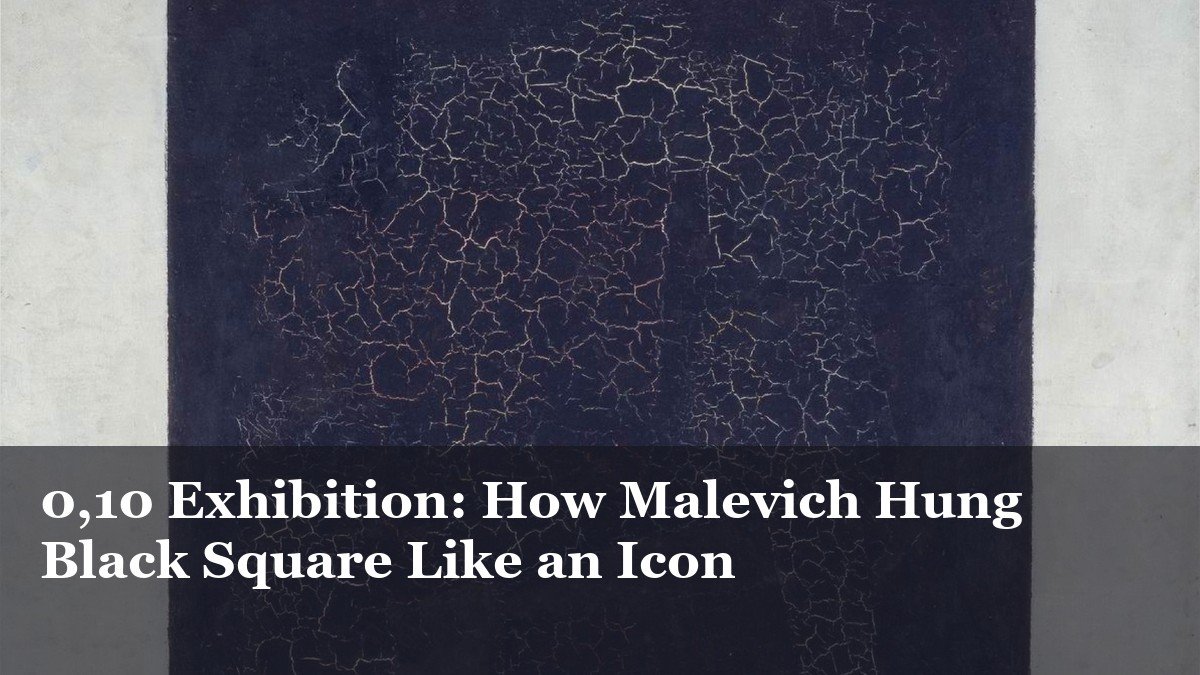
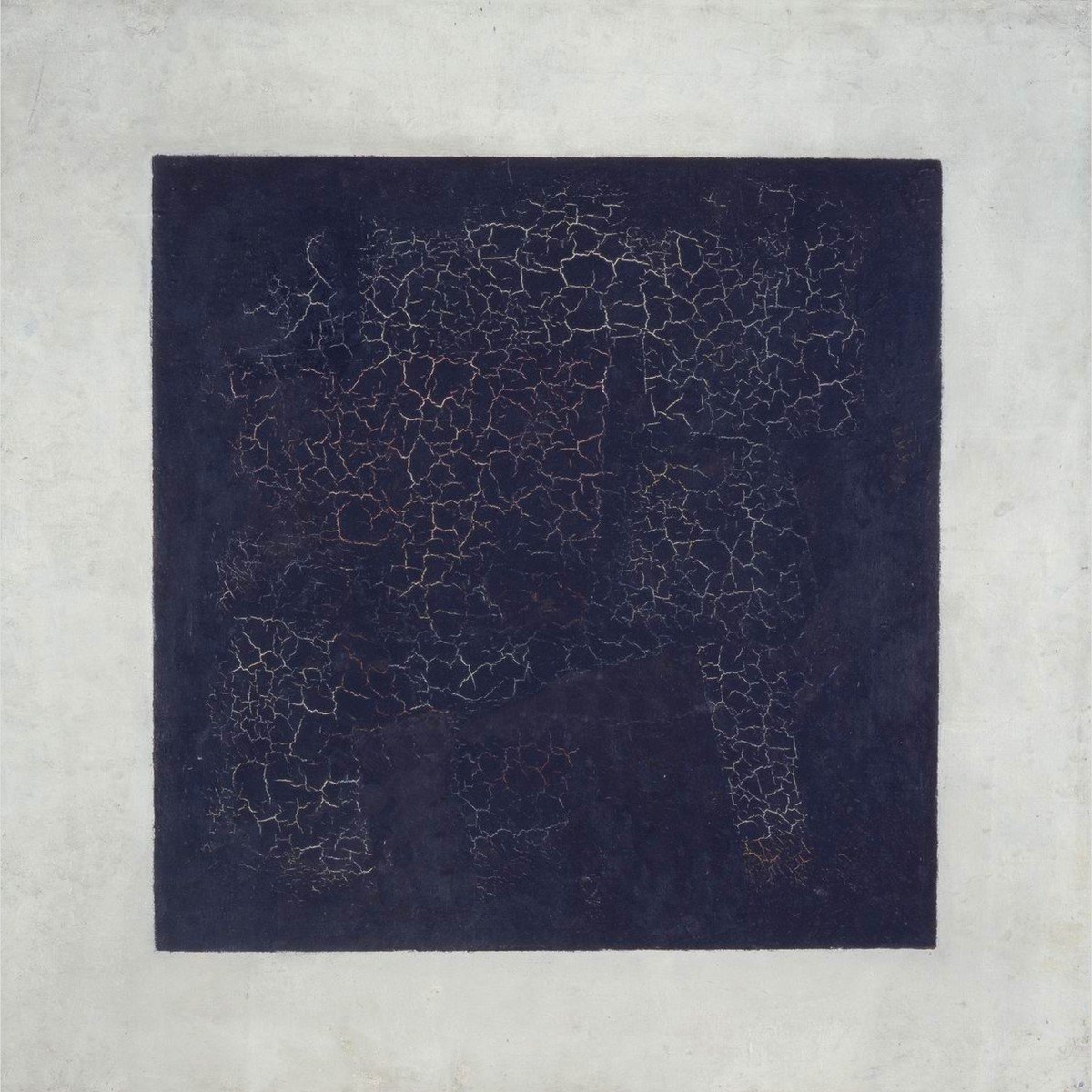
The detail that made 0,10 famous came down to the placement of a single canvas. Black Square, oil on linen, was hung high across the top corner of the room, the exact spot where Russian Orthodox households traditionally placed their icon of the Mother of God or Christ Pantocrator, the krasny ugol, or “beautiful corner.”
Malevich left no written explanation at the time, but the gesture spoke for itself to anyone raised in a Russian home. He was asking viewers to extend the reverence owed a devotional image to a canvas that depicted nothing beyond a black square on a white ground. Around it, in the same room, he hung 38 more paintings grouped under the collective title Suprematism, the first time the word had been used publicly to describe a body of work. In his own writings, Malevich called the effort “a desperate struggle to free art from the ballast of the objective world.”
Look Closer: What’s hiding under Black Square
Conservators at the State Tretyakov Gallery X-rayed Black Square and found two earlier compositions underneath the paint, one in a Cubo-Futurist style and a handwritten phrase referencing a proto-Dada joke about a fight between two figures. Malevich painted over his own earlier work rather than starting a fresh canvas.
The Fourteen Artists of 0,10
Malevich drove Suprematism forward, but 0,10 was a group exhibition. Beside him stood Ivan Puni and Ksenia Boguslavskaya, who helped organize and finance the show; Aleksandra Ekster, a painter equally at home in Kiev and Paris and already known for her Cubo-Futurist color studies; and Olga Rozanova, Ivan Kliun, and Nadezhda Udaltsova, all of whom had been working in Cubo-Futurist idioms before the show and shifted toward pure abstraction around the same time.
Vladimir Tatlin exhibited too, though his contribution pointed in a different direction entirely: toward material construction rather than painted illusion. So many independent painters arriving at abstraction within months of each other, rather than one artist alone, is part of why 0,10 reads less like a single-artist show and more like a coordinated break with the past.
Key Characteristics of Suprematism
What makes a painting Suprematist rather than simply abstract?
Suprematism kept to basic geometric forms, squares, circles, rectangles, and crosses, arranged on plain or near-plain grounds and painted in a limited range of colors. Malevich called the underlying idea the “supremacy of pure artistic feeling” over any attempt to depict a real object, which is where the movement got its name.
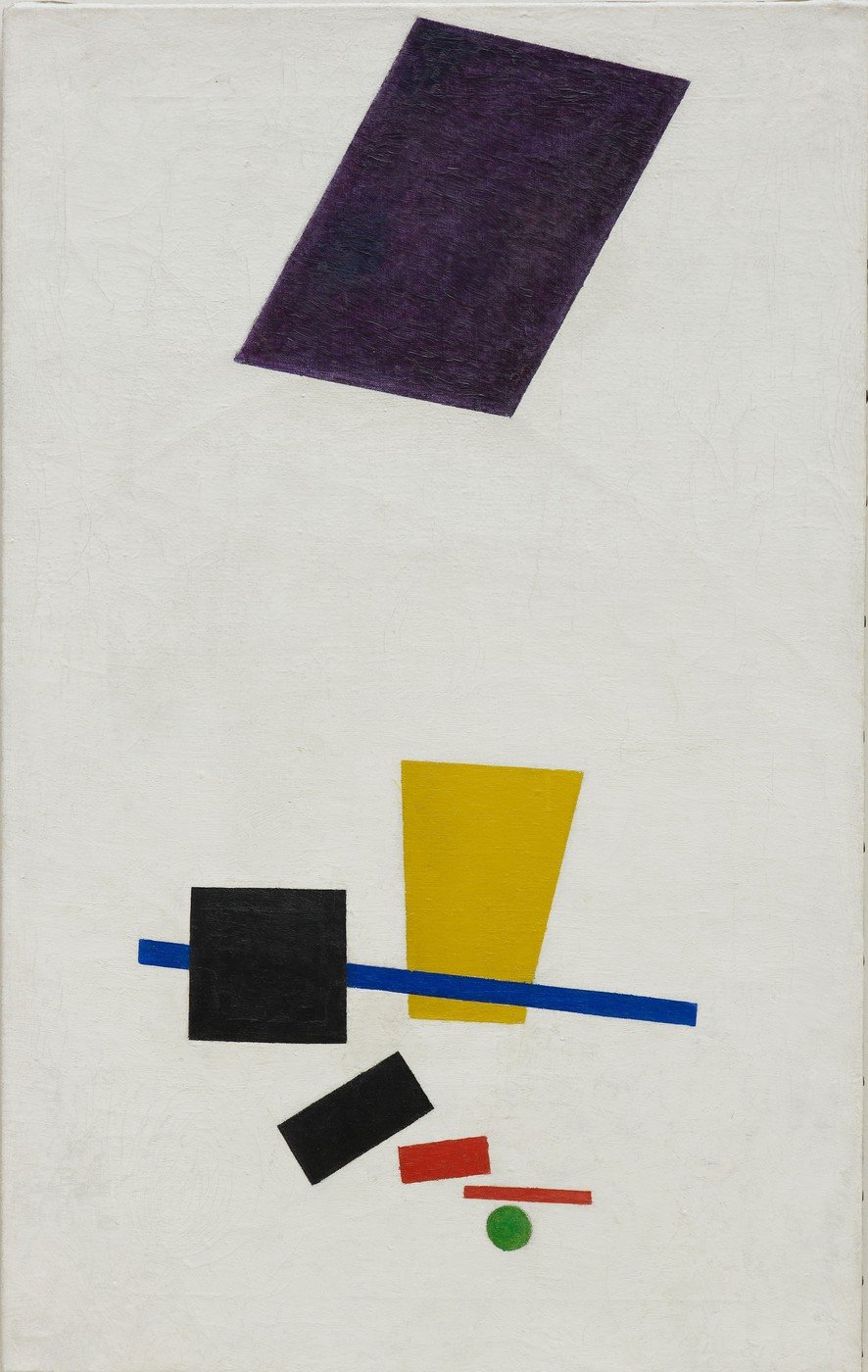
Works like Painterly Realism of a Football Player, Color Masses in the Fourth Dimension, one of the paintings Malevich showed at 0,10, show how far this went even before he reached the total reduction of Black Square. Shapes float free of gravity and perspective, arranged by color relationship and implied motion rather than by any scene they once depicted. The Cubist deconstruction of form that Malevich had studied and admired became, in his hands, a starting point for abandoning the object rather than simply distorting it.
Olga Rozanova and the Pared-Down Palette
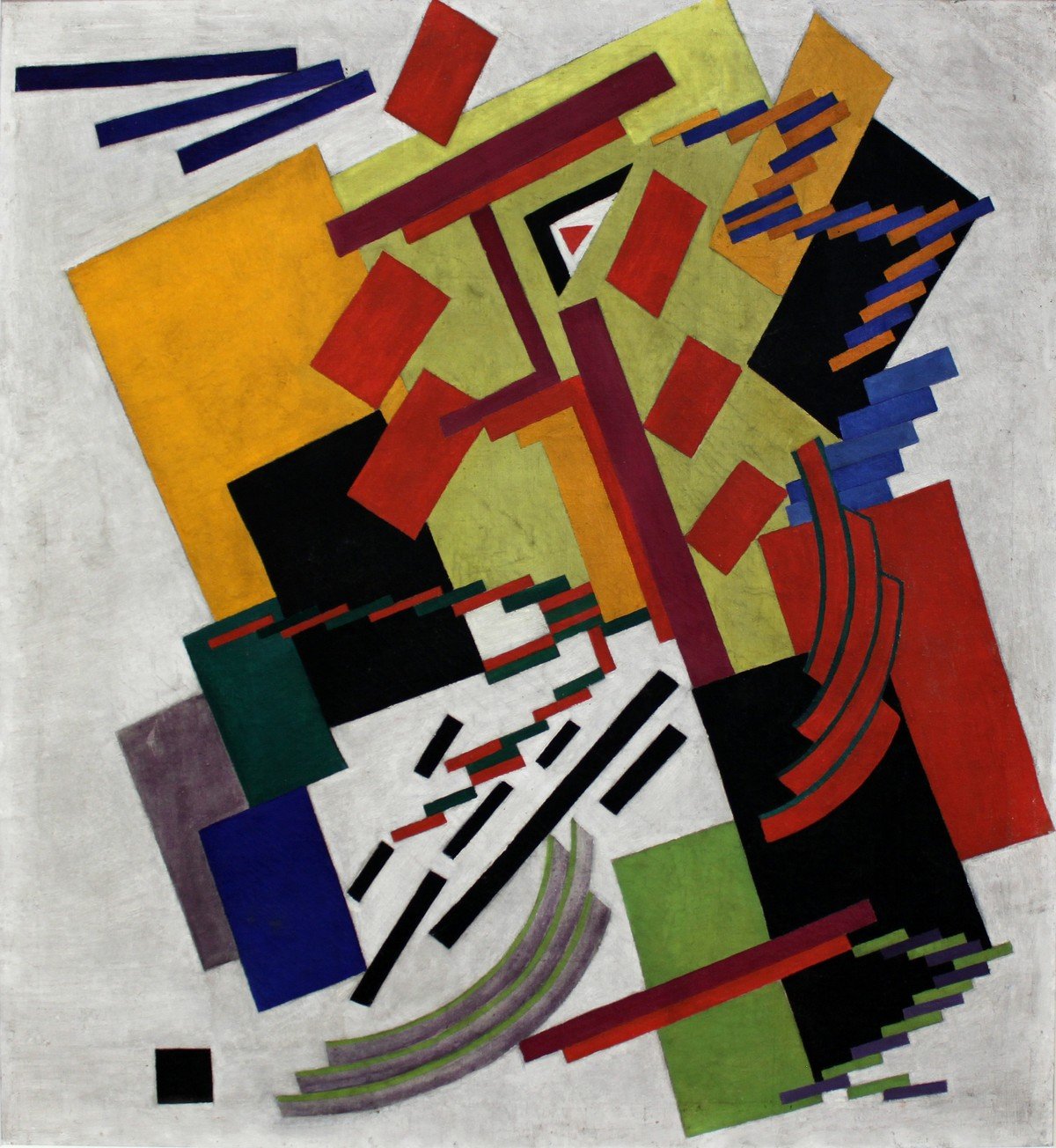
Olga Rozanova arrived at 0,10 already fluent in Cubo-Futurism and Neo-Primitivism, styles built from fractured, energetic compositions of urban and rural subjects. Her Suprematist canvases pushed toward flatter, more restrained color fields than Malevich’s, often built from two or three shapes and a narrow palette rather than his more crowded arrangements.
Rozanova carried the same geometric vocabulary into textile and applied art design after the Revolution, work she continued until her early death in 1918 at the age of 32. Her version of Suprematism, calmer and more color-driven than Malevich’s, showed that the movement was never a single house style but a shared set of principles each artist interpreted on their own terms.
Ivan Puni and the Non-Objective Camp
Ivan Puni helped organize 0,10 alongside his wife, Ksenia Boguslavskaya, and his own painting was moving quickly toward abstraction by 1915. Even so, earlier portraits like his Portrait of the Artist’s Wife from 1914 still show him working in a more representational, painterly mode just a year before the show. That range matters: Puni did not arrive at non-objective painting from nowhere. He passed through Cubism and portraiture first, the same route several of his 0,10 colleagues took.
After the Revolution, Puni left Russia and eventually settled in Paris under the name Jean Pougny, where his style loosened into a lyrical, figurative mode closer to Pierre Bonnard than to the geometry he helped introduce at 0,10.
Ivan Kliun’s Suprematist Experiments
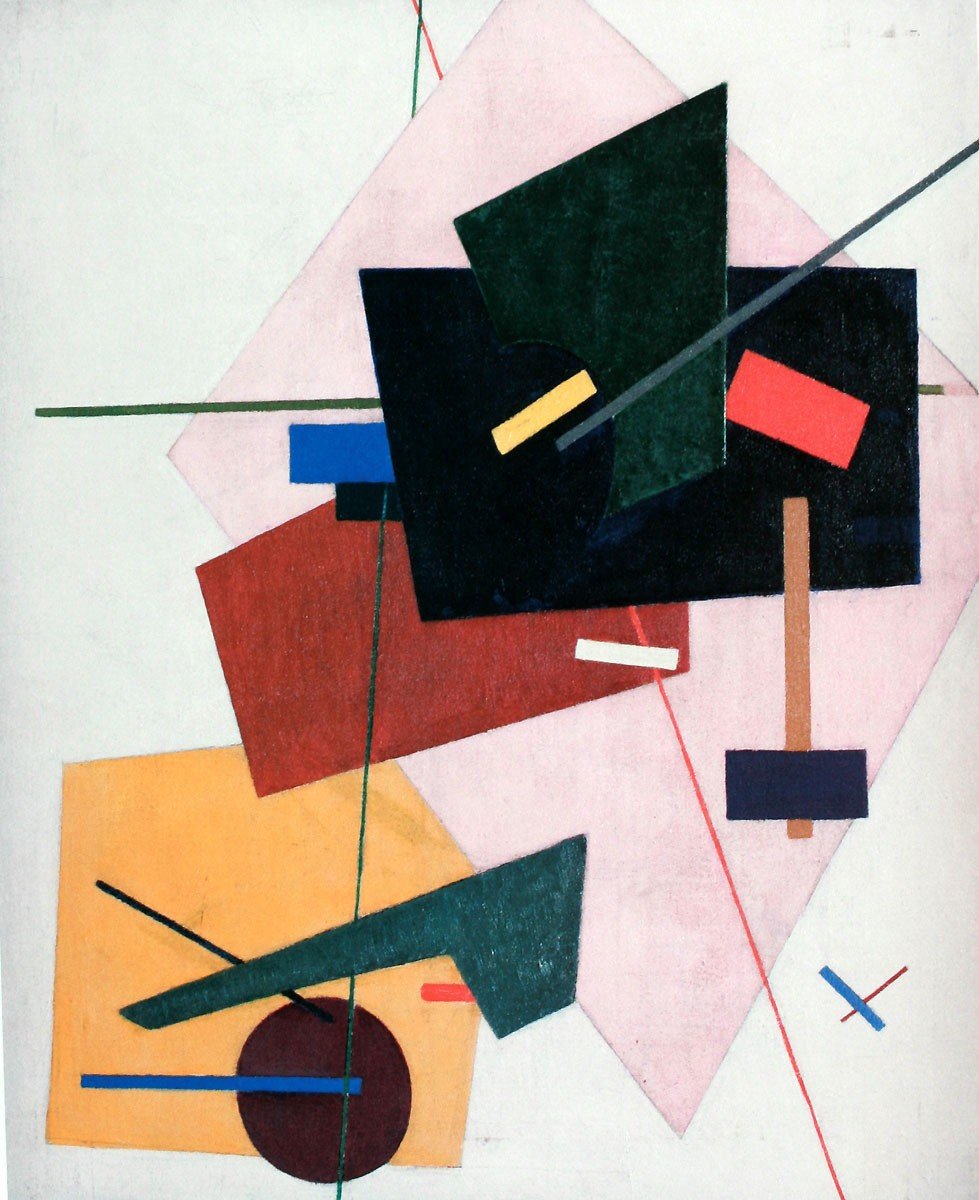
Ivan Kliun was one of Malevich’s closest collaborators and a co-signer of the manifesto distributed at 0,10. He showed several canvases titled simply Suprematism, built from overlapping colored planes that shared Malevich’s vocabulary but carried a softer, more atmospheric edge in their color transitions.
Kliun kept developing the language of geometric abstraction well past 1915, moving into work like Spherical Space in the early 1920s, and he remained a theorist of the movement as much as a practitioner, writing on non-objective art alongside his painting. His presence at 0,10 is a reminder that Suprematism was, from its first public showing, a genuinely collective project rather than one man’s invention paraded with disciples in tow.
The Rift: Tatlin’s Counter-Reliefs vs. Malevich’s Squares
Not every artist at 0,10 agreed on what abstraction should be for. Vladimir Tatlin showed his corner counter-reliefs, sculptural constructions of wood, metal, and wire mounted across the angle of a room rather than painted on canvas. Where Malevich pursued abstraction as a spiritual, almost religious project, hence the icon-corner placement of Black Square, Tatlin treated it as a question of real materials occupying real space, a materialist answer to Malevich’s idealism.
Accounts from the exhibition describe open friction between the two men over how their work should be displayed and understood. That disagreement hardened over the following years into two distinct movements, Suprematism and Constructivism, each claiming to be the true heir of the Russian avant-garde’s break with painting’s past.
Reception: Critics, Cartoons and Confusion
The Petrograd press treated 0,10 as a target for ridicule as often as for serious criticism. The newspaper Petrogradskiy listok ran a piece by Boris Lopatin in December 1915 mocking the show’s abandonment of recognizable subject matter, part of a wider pattern of local coverage that framed the artists as either charlatans or a passing fad.
Few critics in 1915 gave Black Square the reading Malevich intended, an emotional and near-religious weight comparable to a devotional image. Most saw only an empty canvas and treated the exhibition as proof that Futurism, having exhausted its ideas, had collapsed into self-parody. It took years, and the rise of Constructivism and international modernism, before the show’s importance was recognized outside the small circle that produced it.
Notable Works Beyond Black Square
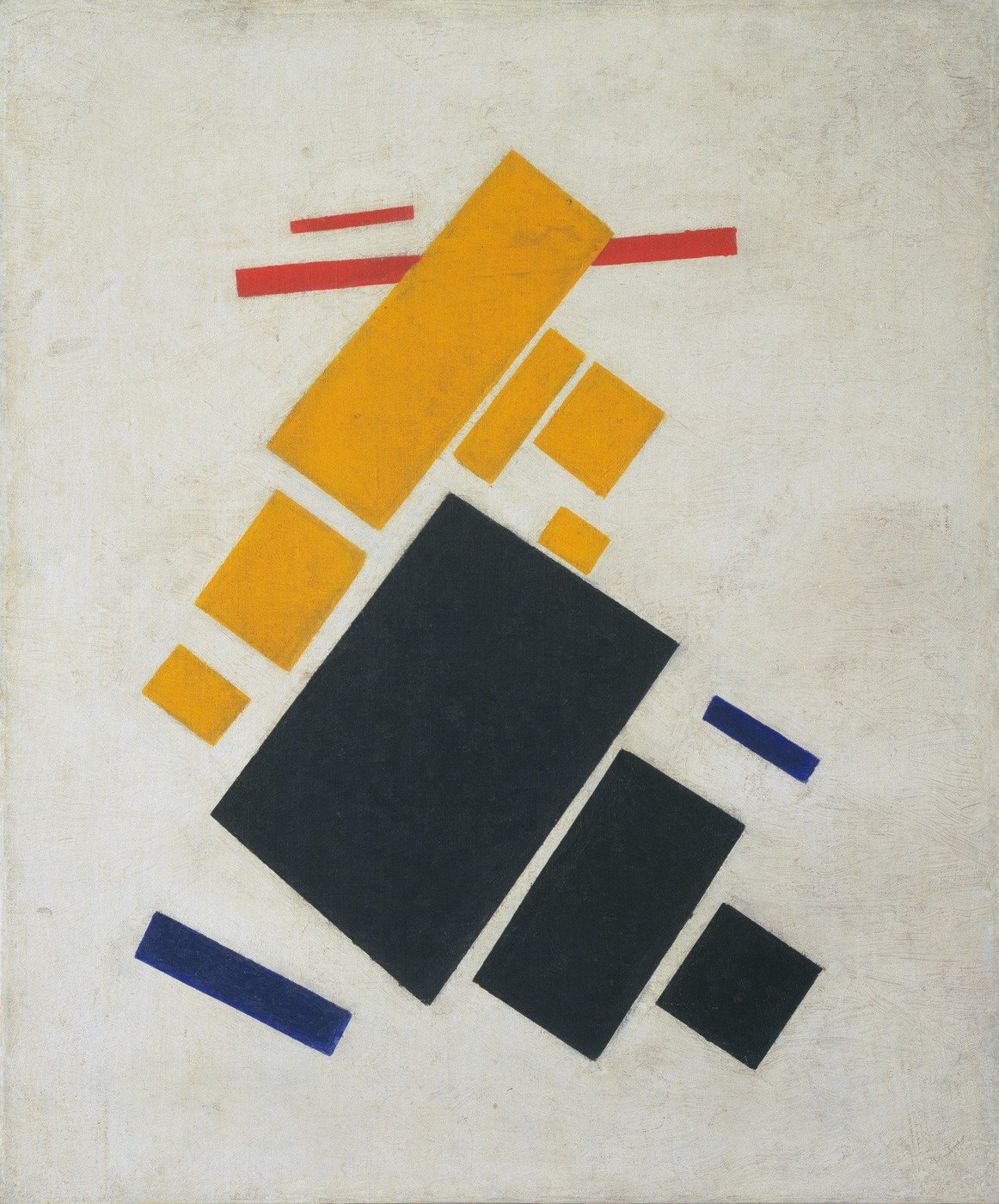
Black Square draws most of the attention, but Malevich hung 38 other canvases at 0,10 under the same Suprematism title, including Suprematist Composition: Airplane Flying, now in the collection of the Museum of Modern Art in New York. Its scattered rectangles suggest motion and altitude without depicting an aircraft directly, a good example of how Malevich used implied movement in place of illustration.
The original Black Square eventually entered the collection of the State Tretyakov Gallery in Moscow, where it is among the gallery’s most visited works. Painterly Realism of a Football Player, Color Masses in the Fourth Dimension, another work shown at the exhibition, is now held by the Art Institute of Chicago, giving international audiences direct access to paintings that once hung in that one Petrograd room.
Historical Impact on the Russian Avant-Garde
0,10 marks the point where Cubo-Futurism, the style that had defined the Russian avant-garde since around 1912, stopped being the movement’s leading edge. After the show, painters who had worked in fractured, motion-based compositions dispersed across those two emerging currents, some following Malevich toward pure form, others gravitating toward the material and engineering orientation Tatlin had introduced at the same exhibition.
The timing mattered too. Just over a year before the 1917 Revolution, the show’s ideas entered a Soviet cultural apparatus hungry for new visual languages to represent a new society. Malevich, Kliun, and Rozanova’s students carried Suprematist principles into design, typography, and propaganda art through the following decade, well beyond what a single gallery show would normally be expected to produce.
Legacy: From Suprematism to Constructivism and Beyond
After 1915, each movement built its own institutional base, Suprematism through Malevich’s teaching at the Vitebsk art school, Constructivism through the workshop and factory-art debates centered in Moscow. El Lissitzky, who studied under Malevich, spent much of the 1920s working to bridge the two, carrying Suprematist geometry into architecture, exhibition design, and graphic work that fed directly into the Bauhaus in Germany.
Outside Russia, Suprematism’s flat planes of pure color anticipated concerns that Piet Mondrian and the De Stijl group were pursuing independently in the Netherlands around the same years, though the two movements developed without direct contact. The line from a single black canvas hung in a Petrograd corner in 1915 to European geometric abstraction a decade later runs through more countries and more artists than the original show’s fourteen participants ever anticipated.
Common Misconceptions About 0,10
Was Black Square painted specifically for this exhibition?
Not entirely. The square motif traces back to 1913, when Malevich designed sets and costumes for the Futurist opera Victory over the Sun, work that included an early black-and-white geometric backdrop. The 1915 canvas shown at 0,10 was where that idea reached its final, standalone form, not where it originated.
A second misconception treats all four painted versions of Black Square as identical objects. Malevich painted three further versions, in 1923, in 1929, and a fourth between the late 1920s and early 1930s, and each differs slightly in size, surface texture, and the visible craquelure of its paint layer. They are related works, not copies of a single original.
Related Movements and Connections
Suprematism grew directly out of Cubo-Futurism, the movement 0,10 explicitly declared finished in its own title, and it shared early audiences and exhibition spaces with Neo-Primitivism, the folk-inspired style several of the same artists, including Rozanova, had worked in earlier in the decade. Its most direct rival and counterpart was Constructivism, born from Tatlin’s material-based work at the same show.
None of these connections were coincidental exchanges of style alone. They trace back to specific people and decisions made in that one room on Marsovo Pole in December 1915, whose consequences spread through Soviet design, graphic art, and architecture across the following decade.
Essential Points
- 0,10 ran from December 19, 1915 to January 17, 1916 at Nadezhda Dobychina’s Art Bureau on Marsovo Pole, Petrograd.
- Malevich hung Black Square across the top corner of the room, the placement traditionally kept for icons in Russian homes.
- The title referred to zero (a fresh start after discarding old painting) and ten (the number of artists first planned; fourteen ultimately showed).
- Malevich exhibited 39 works as a group titled Suprematism, his first public statement of the movement.
- Vladimir Tatlin showed his corner counter-reliefs at the same exhibition, setting up the Suprematism versus Constructivism split that shaped Soviet art for the next decade.
- Olga Rozanova, Ivan Puni, Ivan Kliun, and Nadezhda Udaltsova were among the other artists moving toward non-objective painting alongside Malevich.
- The exhibition ended Cubo-Futurism’s run as Russia’s leading avant-garde style, redirecting the movement toward geometric abstraction.
- Malevich later painted three more versions of Black Square (1923, 1929, and one from the late 1920s or early 1930s), each slightly different in size and surface.
Frequently Asked Questions
- What does “0,10” mean in the exhibition’s title?
- The zero signaled a deliberate erasure, painting reduced to its most fundamental elements before any new vocabulary could take shape. Ten named how many artists were originally expected; the final count reached fourteen, though the organizers never updated the title. Its full form in the catalog: The Last Futurist Exhibition of Paintings 0,10.
- When and where did the 0,10 Exhibition take place?
- It ran from December 19, 1915 to January 17, 1916 at Nadezhda Dobychina’s Art Bureau on Marsovo Pole (the Field of Mars) in Petrograd, the wartime name for St. Petersburg. It was a privately organized show, not a state-sponsored exhibition.
- Why did Malevich hang Black Square in the corner of the room?
- He placed it across the top corner traditionally reserved in Russian homes for religious icons, known as the krasny ugol. The positioning asked visitors to treat the painting with the same reverence given to a devotional image, reinforcing his claim that abstract form could carry emotional weight.
- Did any other artists besides Malevich show non-objective work at 0,10?
- Yes. Ivan Puni, Ivan Kliun, Olga Rozanova, and Nadezhda Udaltsova all exhibited paintings moving toward pure abstraction alongside Malevich’s Suprematism series. Vladimir Tatlin showed material-based counter-reliefs instead, setting up the split that later became Constructivism.
- Where can you see paintings from the 0,10 Exhibition today?
- Black Square is at the State Tretyakov Gallery in Moscow, where it draws some of the museum’s heaviest visitor traffic. Other canvases from 0,10 can be found outside Russia: Suprematist Composition: Airplane Flying is in MoMA’s collection in New York, and Painterly Realism of a Football Player, Color Masses in the Fourth Dimension is at the Art Institute of Chicago.
This guide was written and reviewed by the rus-art.com editorial team, specializing in Russian art history. We cross-check dates, attributions, and museum holdings against museum and academic sources.