Quick Answer
Marc Chagall (1887-1985) grew up in a Hasidic Jewish family near Vitebsk, in the Russian Empire’s Pale of Settlement, and spent his career translating that childhood, its synagogues, fiddlers, goats, and wedding processions, into modern painting. Trained first by Yehuda Pen in Vitebsk, then exposed to Cubism and Fauvism in Paris, Chagall combined fractured perspective and expressive color with specific Jewish folklore and Vitebsk memories rather than generic fantasy. Works like ‘I and the Village‘ (1911, MoMA) and his founding of the Vitebsk Museum of Modern Art show this fusion in both painting and institution building.
What Is Chagall’s Russian-Jewish Style?
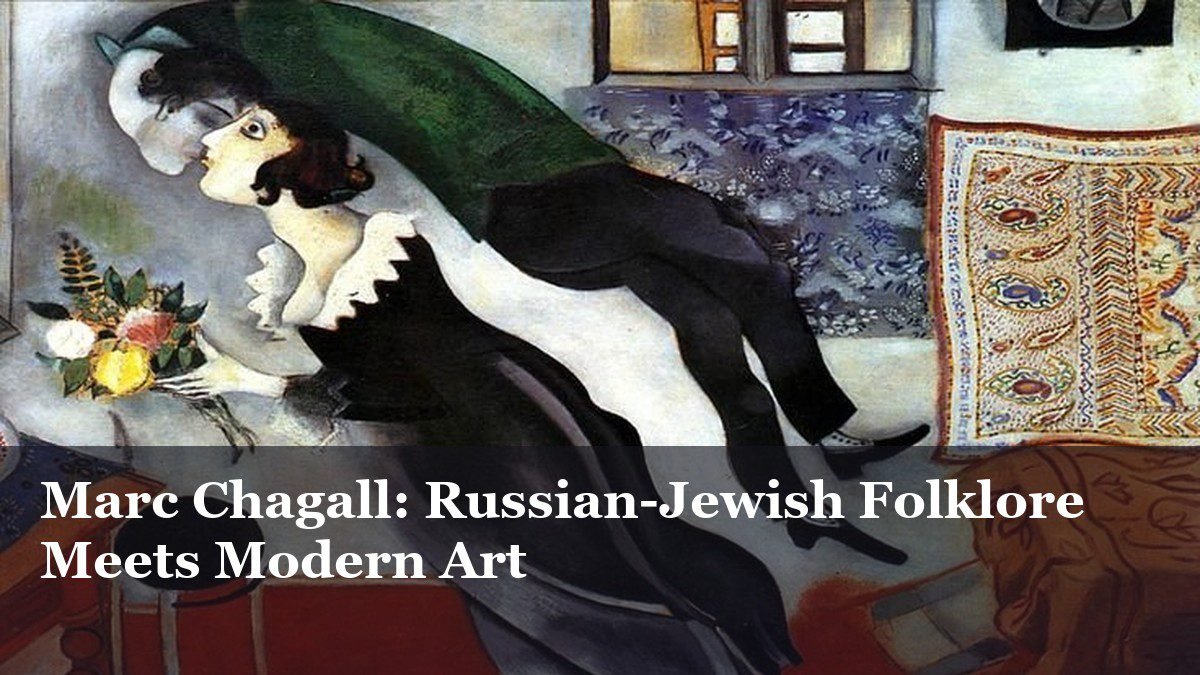
Marc Chagall fused the folk imagery of his Jewish upbringing in the Pale of Settlement with the formal experiments of early twentieth century Paris. Born Moishe Shagal on 6 July 1887 near Vitebsk, in what is now Belarus, he grew up among synagogue cantors, wandering fiddlers, and the wooden houses of a shtetl world that later reappeared, transformed, in his canvases. His style is not simply whimsical. Floating brides, upside-down houses, and green-faced fiddlers each reference specific memories, Yiddish expressions, or Hasidic stories, rendered through the fractured planes he absorbed from Cubism and the high color of Fauvism. The result reads as personal mythology painted in a modern grammar.
What Makes a Painting Instantly Recognizable as Chagall’s?
Look for three things at once: an object or figure defying gravity, a Vitebsk rooftop or synagogue silhouette anchoring the scene in a real place, and color used to signal emotion rather than to copy nature. When all three appear together, a floating violinist over snow covered roofs, a bride rising past a fence, the hand is almost certainly Chagall’s.
A Childhood in the Pale of Settlement
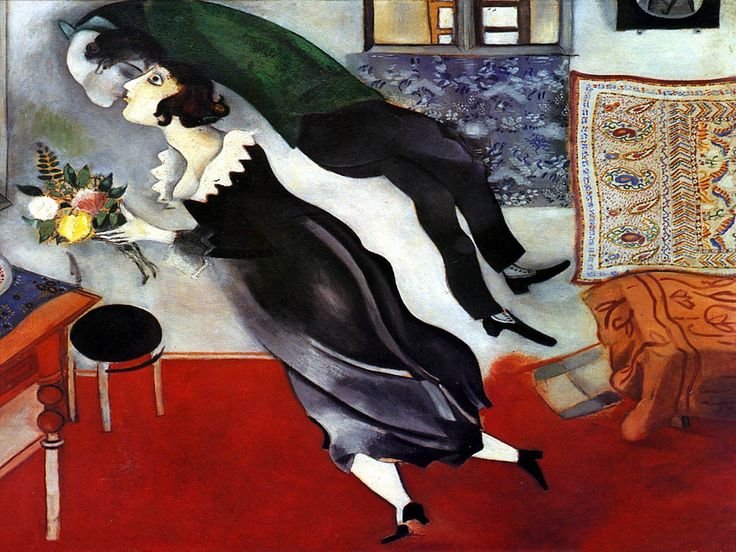
Chagall grew up in a Hasidic Jewish family on the edge of Vitebsk, then part of the Russian Empire’s Pale of Settlement, the region where imperial law confined most Jewish residents. Wooden synagogues, ritual slaughterers, matchmakers, and traveling klezmer musicians filled the streets he later painted from memory in Paris and New York. Vitebsk itself, a city in what is today north-eastern Belarus, was no rural backwater. It held a functioning Jewish community with its own artistic culture well before Chagall picked up a brush. He returned to these images again and again, not as ethnographic record but as remembered fragments reassembled to fit a canvas, a way of carrying a vanishing world forward into modern art.
Learning to Paint: From Yehuda Pen to the Imperial Capital
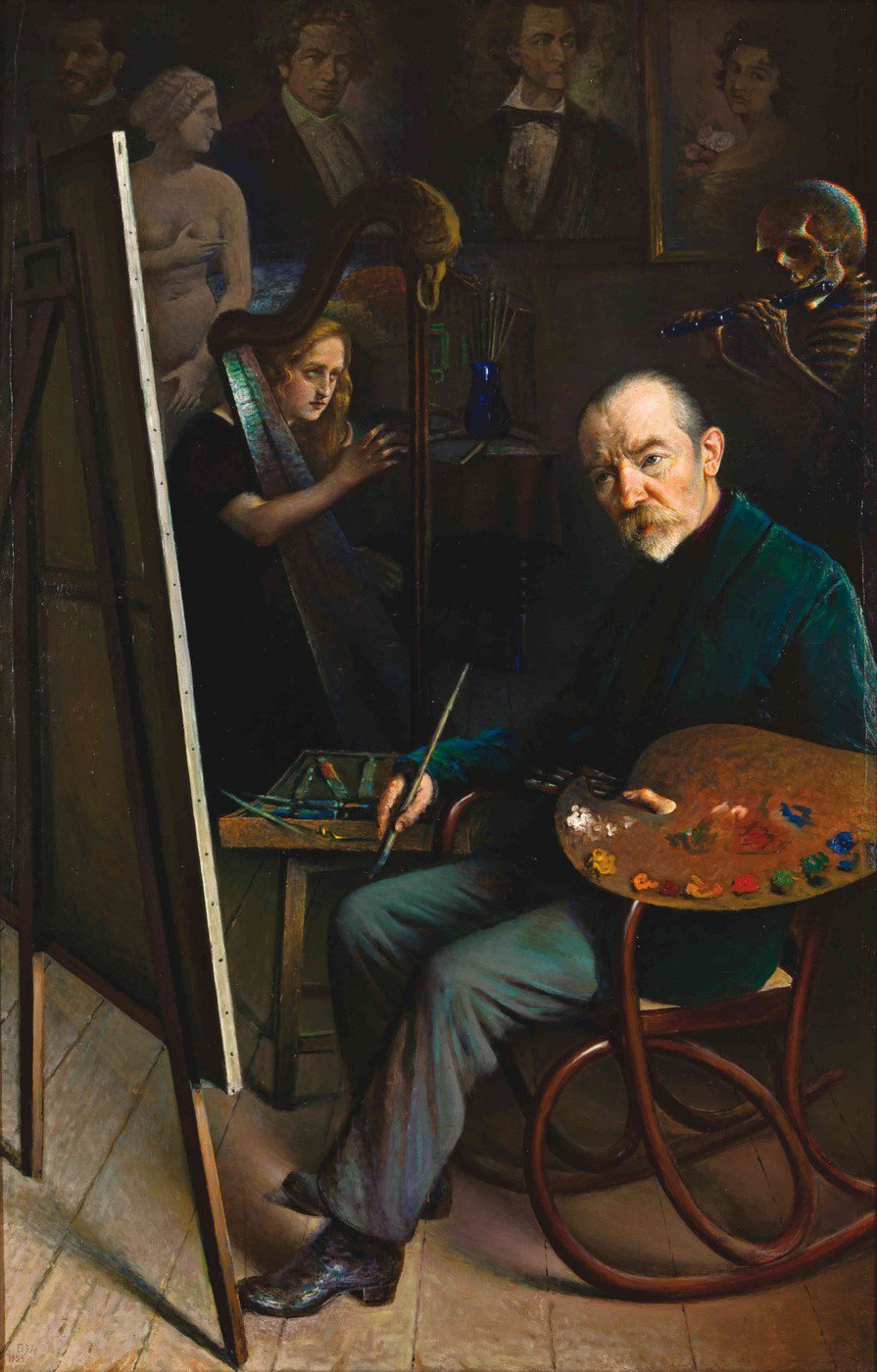
Chagall’s first formal training came from Yehuda Pen, a Jewish painter who opened an art school in Vitebsk and taught, often for free, students who could never have afforded academic tuition elsewhere. Pen had trained at the Saint Petersburg Academy of Arts and built a reputation painting Jewish life in the Pale of Settlement with unusual directness, earning him the nickname ‘the Sholem Aleichem of painting.’ Alongside Chagall, Pen also taught El Lissitzky and the sculptor Ossip Zadkine, making his modest studio one of the most consequential classrooms in Russian-Jewish art history. From Vitebsk, Chagall moved on to Saint Petersburg, then still closed to many Jewish students by quota, before continuing his education and eventually reaching Paris. Pen was murdered in 1937. His surviving paintings are now divided between the National Art Museum in Minsk and the Vitebsk Regional Museum of Local History.
Paris and a New Visual Language
What Was the School of Paris?
Paris in the years before World War I housed dozens of emigre artists from the Russian Empire, many of them Jewish. Critic Andre Warnod later named this loose community the School of Paris, not a single movement but a recognition that Paris, not Saint Petersburg or Moscow, had become the real center of Western art between 1900 and 1940. Before 1917, Jewish students faced quotas or outright exclusion from Russia’s leading academies, so many built careers first in Odesa, Vilnius, Kyiv, or Munich before arriving in Paris, drawn by ambition, by the wish to escape the pogroms of the Russian Empire, and by hope that France’s exoneration of Alfred Dreyfus in 1906 signaled a state willing to side with justice. Chagall arrived into this environment and encountered Cubism and Fauvism directly, adapting their broken perspective and saturated color to subjects no other Parisian painter was working from: Vitebsk weddings, cattle markets, and Sabbath candles.
Defining Features of Chagall’s Painting
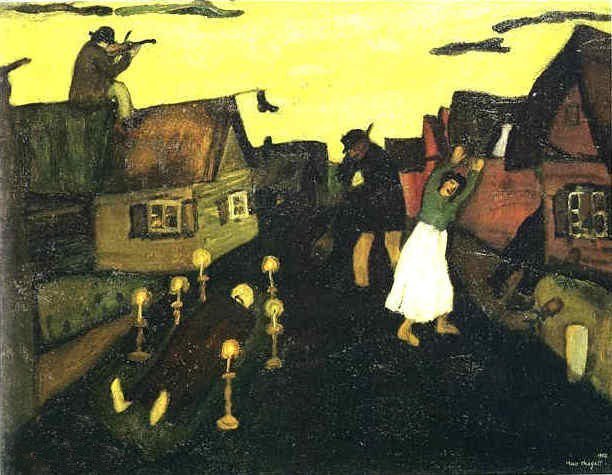
Three habits define Chagall’s mature work. First, gravity is optional: lovers, animals, and violinists hover above rooftops as if weightless, a device he used to paint emotional states rather than physical scenes. Second, scale answers to feeling, not to what the eye would actually measure, so a beloved face might dwarf the house beside it. Third, color carries meaning on its own terms. A blue cow or a green face is not decorative distortion but a way of pushing a memory toward myth. Early paintings like ‘The Dead Man’ already show Chagall building a scene from disconnected fragments of a real Vitebsk funeral: a fiddler on a roof, a street sweeper, a wailing figure, held together by instinct rather than single point perspective.
Recurring Symbols: Goats, Fiddlers, and Flying Lovers
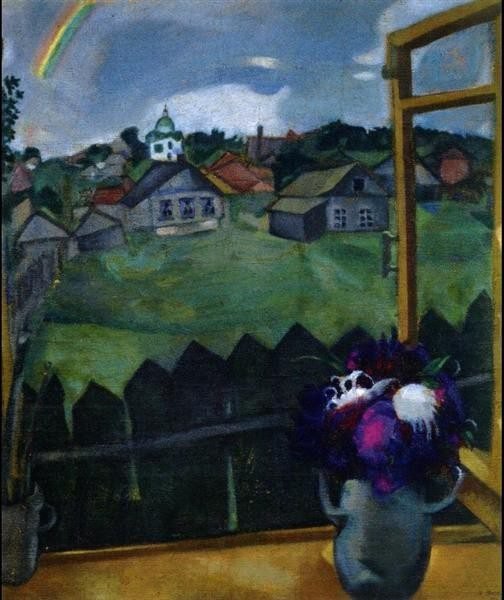
Certain images return across Chagall’s whole career, functioning almost like a private vocabulary. The fiddler stands for the klezmer musicians of Vitebsk weddings and for Yiddish culture more broadly, later made familiar to English speaking audiences through the phrase ‘fiddler on the roof.’ The goat and other farm animals recall shtetl life and Jewish dietary custom, and often appear beside human figures as equals rather than background detail. Flying or floating couples usually represent love itself outrunning gravity, a literal rendering of the Yiddish habit of describing infatuation as a kind of weightlessness. Clocks, candles, and open windows, as in his 1915 ‘Window in the Country (Liozna),’ frequently mark the boundary between the remembered shtetl and the present moment of painting, folding past and present into a single frame.
I and the Village: A Close Reading
I and the Village (1911, oil on canvas, Museum of Modern Art, New York) is Chagall’s clearest early statement of this visual grammar. A green-faced man and a white goat face each other in profile, their heads overlapping inside interlocking circles that recall stained glass more than academic composition. Behind them, small inverted houses and a peasant carrying a scythe float in unconnected fragments of Vitebsk. Painted in Paris, the canvas reconstructs a Belarusian shtetl entirely from memory, using the circular, faceted space Chagall picked up from Cubism to hold together images that share no single, consistent scale or vantage point. The same layered window logic recurs in smaller, less famous canvases such as ‘Window in the Country (Liozna),’ a sign of how consistently Chagall returned to this device across two decades of work.
Building an Art World in Vitebsk
When World War I confined Chagall to Russia, he spent the war years moving between Vitebsk and Petrograd, quickly becoming one of the most distinguished artists in the country and a recognized figure of the modernist avant-garde. After the Bolshevik Revolution, he did not simply keep painting; he built institutions. Chagall founded the Vitebsk Museum of Modern Art and the People’s Art School, an ambitious attempt to make his home city, not Moscow or Petrograd, into a genuine center for new Russian art. Quiet, snow covered street scenes from these years, almost monochrome studies of Vitebsk rooftops, show a more observational side of Chagall that rarely survives in his later, more fantastical Paris work.
Chagall and El Lissitzky: Two Paths Out of the Same Studio
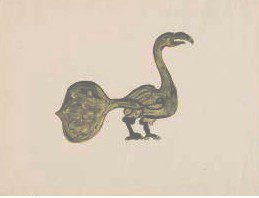
El Lissitzky, born Lazar Markovich Lissitzky in 1890, studied under the same teacher, Yehuda Pen, before taking Russian-Jewish modernism in an entirely different direction. Lissitzky began his career illustrating Yiddish children’s books to promote Jewish culture, work that included documenting and painting folk motifs like the peacock murals of the Mohilev synagogue. Chagall invited Lissitzky to teach at the Vitebsk People’s Art School, but Lissitzky soon fell under the influence of Kazimir Malevich, helping develop Suprematism and the abstract Proun series. Where Chagall kept returning to figures, animals, and remembered towns, Lissitzky moved toward pure geometric abstraction and, later, propaganda design and typography for the Soviet state. Their split illustrates two competing answers to the same question: what should Jewish and Russian avant-garde art look like after 1917?
Myth vs. Fact: Not Just Whimsy
Myth: Chagall’s floating brides and green-faced fiddlers are pure decorative fantasy with no real basis. Fact: many of these images trace to specific Hasidic stories, Vitebsk street life, or Yiddish expressions taken literally, such as describing someone ‘flying’ with love or grief. The distortion works as symbolic shorthand, not random invention.
Other Painters of the Jewish-Russian Imagination
Chagall was not alone in mining Jewish folklore for modern painting. Issachar Ber Ryback, working in a similar ethnographic vein, painted synagogues, musicians, and shtetl streets with a comparable mix of tenderness and formal distortion. Robert Falk and Nathan Altman, both associated with Russian avant-garde circles, brought related concerns about identity and modern form into portraiture and still life rather than folklore scenes directly. Together with Chagall and Lissitzky, these artists formed a loose network responding to the same conditions: restricted access to Russia’s official academies, the pull of Jewish Jewish art traditions rooted in centuries of religious practice, and the wider European experiments of Cubism, Fauvism, and Expressionism arriving through Paris and Berlin.
Revolution, Hardship, and a Second Departure
Life after 1917 grew difficult for Chagall, as it did for most artists across the new Soviet state. He worked in and near Moscow through years of shortage and political pressure before finally leaving again for Paris in 1923, ending his direct involvement in Vitebsk’s art institutions. The move split his career cleanly: a Russian period defined by Vitebsk, revolution, and institution building, and a second, longer Paris period in which folklore memories were reworked at a distance, filtered through nostalgia rather than daily proximity to the shtetl world that produced them.
Common Misconceptions About Chagall’s ‘Naive’ Style
Was Chagall a Self-Taught, Naive Painter?
No. Chagall trained for years, first under Yehuda Pen in Vitebsk, then in Saint Petersburg, and later by studying directly from Cubist and Fauvist painters working in Paris. His apparently simple, dreamlike scenes rest on deliberate formal choices, fractured perspective and calculated color relationships adapted from specific modern movements, not on a lack of technique. Another common misconception treats his subjects as generic ‘old world’ nostalgia. In fact, most scenes point to a specific place, Vitebsk, and a specific religious and cultural context, Hasidic Jewish life in the Pale of Settlement, rather than a vague, imagined past.
Historical Impact: Painting Jewish Life Into Modern Art
Before Chagall, Jewish subjects rarely appeared in painting as anything other than genre curiosities or religious illustration. Chagall, working alongside Pen, Ryback, and others, helped make specifically Jewish memory and folklore legitimate subject matter for ambitious modern painting, at the same moment Cubism and Fauvism were redefining what painting could depict at all. His example gave later Jewish and non-Jewish artists alike a working model for treating personal and communal memory as material worthy of formal experimentation, rather than requiring realistic, documentary treatment. As Britannica documents in its biographical account, this fusion of local memory and international modernism is central to why Chagall’s reputation outlasted many of his Paris contemporaries.
Legacy: Stained Glass, Stage, and Beyond
After returning to France and later working internationally, Chagall extended his visual vocabulary well beyond oil painting, into stained glass windows, theater sets, ceramics, tapestries, and fine art prints. The same floating figures and Vitebsk rooftops recur across these mediums, carried by a consistent personal iconography rather than by any single technique. This range kept his imagery visible to audiences who might never see his early Russian period paintings in person, carrying a specifically Russian-Jewish folk sensibility into synagogues, opera houses, and public buildings across Europe, Israel, and the United States.
How Chagall Connects to Cubism, Fauvism, and Surrealism
Chagall borrowed Cubism’s fractured, multiple viewpoint space and Fauvism’s willingness to use color for feeling rather than accuracy, but he never adopted Cubism’s near total abstraction or Fauvism’s focus on still life and coastal scenes. Surrealists later claimed him as a forerunner because of his dreamlike logic, though Chagall himself resisted the label, insisting his imagery came from memory and religious tradition rather than from the unconscious mind that Surrealism claimed to access. The distinction matters: his floating figures are remembered and symbolic, not the product of automatic drawing or free association.
Where to See Chagall Today
Major Chagall paintings are held across several institutions worth visiting in person. The Museum of Modern Art in New York holds ‘I and the Village.’ The State Russian Museum and State Tretyakov Gallery in Russia, along with the Vitebsk Regional Museum of Local History in Belarus, preserve work from his early Russian period and that of his Vitebsk contemporaries, including Yehuda Pen. The Centre Pompidou in Paris and the Musee National Marc Chagall in Nice hold major later paintings and stained glass studies. Together these collections trace the full arc of a career that began in a small Belarusian shtetl and ended as part of international modern art’s core canon.
Essential Points
- Marc Chagall (born Moishe Shagal, 1887-1985) grew up in a Hasidic Jewish family near Vitebsk, in the Russian Empire’s Pale of Settlement.
- His first teacher, Yehuda Pen, ran a Vitebsk art school that also trained El Lissitzky and Ossip Zadkine.
- Chagall fused Cubist fractured space and Fauvist color with specific Jewish folklore, not generic fantasy imagery.
- ‘I and the Village’ (1911, Museum of Modern Art) remains the clearest early example of this fusion.
- During and after World War I, Chagall founded the Vitebsk Museum of Modern Art and the People’s Art School.
- He left for Paris again in 1923 after difficult postrevolutionary years working near Moscow.
- Contemporaries including El Lissitzky, Issachar Ber Ryback, Robert Falk, and Nathan Altman worked through related questions of Jewish and Russian modern identity.
- Chagall’s imagery later extended into stained glass, theater design, and prints, carrying Vitebsk memories into new mediums worldwide.
Frequently Asked Questions
- What is Marc Chagall’s art actually about?
- Chagall’s paintings recombine memories of his Jewish childhood near Vitebsk, synagogues, weddings, fiddlers, farm animals, with the fractured perspective and bright color of early modern art movements like Cubism and Fauvism. Rather than realistic scenes, his canvases work like a personal visual language built from specific folklore and Yiddish expressions.
- Why did Chagall keep moving between Russia and Paris?
- Chagall trained in Vitebsk and Saint Petersburg, then moved to Paris before World War I to study modern painting directly. War confined him to Russia, where he founded art institutions in Vitebsk, but postrevolutionary hardship near Moscow led him to leave permanently for Paris again in 1923.
- Why do Chagall’s figures float or defy gravity?
- Floating lovers and animals represent emotional states, love, grief, or memory, rather than physical events. The device also reflects Yiddish idioms that describe strong feeling as a kind of weightlessness, giving Chagall a visual shorthand for internal experience within otherwise recognizable Vitebsk scenes.
- Who taught Marc Chagall to paint?
- Chagall’s first formal teacher was Yehuda Pen, who ran a Vitebsk art school and also trained El Lissitzky and Ossip Zadkine. Pen, trained at the Saint Petersburg Academy of Arts, was known for depicting Jewish life in the Pale of Settlement with unusual directness.
- Where can I see Marc Chagall’s paintings today?
- The Museum of Modern Art in New York holds ‘I and the Village.’ The State Russian Museum, State Tretyakov Gallery, and Vitebsk Regional Museum of Local History preserve his early Russian period work, while the Centre Pompidou and Musee National Marc Chagall in Nice hold later paintings and stained glass.
This guide was written and reviewed by the rus-art.com editorial team, specializing in Russian art history. We cross-check dates, attributions, and museum holdings against museum and academic sources.