Quick Answer
Russian sculpture spans more than a thousand years, opening with Byzantine-influenced relief carvings and carved wooden icons in medieval Kievan Rus, where religious restrictions on three-dimensional figures delayed a Western-style sculptural tradition. The Imperial Academy of Arts, founded in 1757, introduced European academic training and produced the first major Russian sculptors. The Soviet period redirected the tradition toward state-sanctioned monumentalism under socialist realism. Underground artists like Ernst Neizvestny resisted from the margins. After 1991, the field fragmented into installation, contemporary practice, and a global diaspora art scene.
What Is Russian Sculpture?
Russian sculpture runs more than a thousand years, from Byzantine-influenced relief carvings and wooden sacred figures to the Soviet steel monuments that towered over city squares and on to the installation art that replaced them after 1991.
At its broadest, the tradition moves through four phases: a medieval period shaped by religious function and anonymous craftsmen; an Imperial academic era beginning in the 18th century, when Russia opened to European training; a Soviet period that put scale and symbolism to political ends; and a contemporary era of fragmentation and experiment. What sets the Russian account apart is how abruptly each phase broke from the last, often by decree rather than gradual drift, and how persistently artists on the margins pushed back against those breaks.
Carved in Prayer: Byzantine Roots and the Problem of the Idol
When Christianity reached Kievan Rus in 988, it carried a specific visual theology. The Byzantine tradition shaping Russian church art was built around flat surfaces: mosaics, frescoes, and icons painted on wooden panels. Figurative sculpture fully in the round, figures meant to be walked around, was associated in Byzantine thought with the pagan idols Christianity had displaced. That association persisted in Russian Orthodox practice for centuries, which is why Russia produced nothing comparable to the carved figures that crowd Gothic cathedral facades in Western Europe.
What Russian craftsmen produced instead was relief carving, a form that gave depth to a surface without crossing into the fraught territory of the three-dimensional object. The Cathedral of Saint Demetrius in Vladimir, completed around 1194, shows this tradition at its most ambitious. Its limestone facade carries hundreds of carved figures organized in horizontal registers. The carving is shallow by Western Romanesque standards, but the figurative program is systematic and considerable in scope.
Wood remained the primary sculptural medium through the medieval period. Craftsmen trained in icon workshops carved reliquary covers and frames for miracle-working icons, working anonymously in the same sense that icon painters did: the maker’s identity mattered less than the object’s spiritual function. Full-round wooden figures appeared mainly in northern regions, where contact with Catholic Central Europe loosened Orthodox restrictions on three-dimensional form.
Why did Russia develop free-standing sculpture later than Western Europe?
The delay was theological before it was technical. Byzantine Christianity discouraged figurative sculpture in the round because of its resemblance to pagan idols. Russian Orthodoxy held to that position well into the early modern period. It took Peter the Great’s Westernization campaign in the early 18th century to open Russia to the European tradition of free-standing public sculpture, portrait busts, and academic figure work.
The Academy Changes Everything
Peter the Great traveled through Western Europe between 1697 and 1698, and what he saw in the gardens of Versailles and the studios of Amsterdam and London convinced him that large-scale, politically legible sculpture belonged in a modern state. He began importing European sculptors and commissioning portrait busts of himself in the manner of Roman emperors. The Summer Garden in St. Petersburg, laid out in the early 18th century, filled with marble allegories in the Western European style.
The decisive institutional change came in 1757, when the Imperial Academy of Arts was established in St. Petersburg. The Academy sent its most promising students to Rome and Paris on stipends, with the explicit instruction to master Western academic technique and bring it home. Those who returned came with training in anatomy, in the handling of marble and bronze, and in the formal conventions of ancient and Renaissance sculpture. Within roughly two generations, Russia had acquired the full technical infrastructure of European academic sculpture.
Fedot Shubin: The Face Behind the Chisel
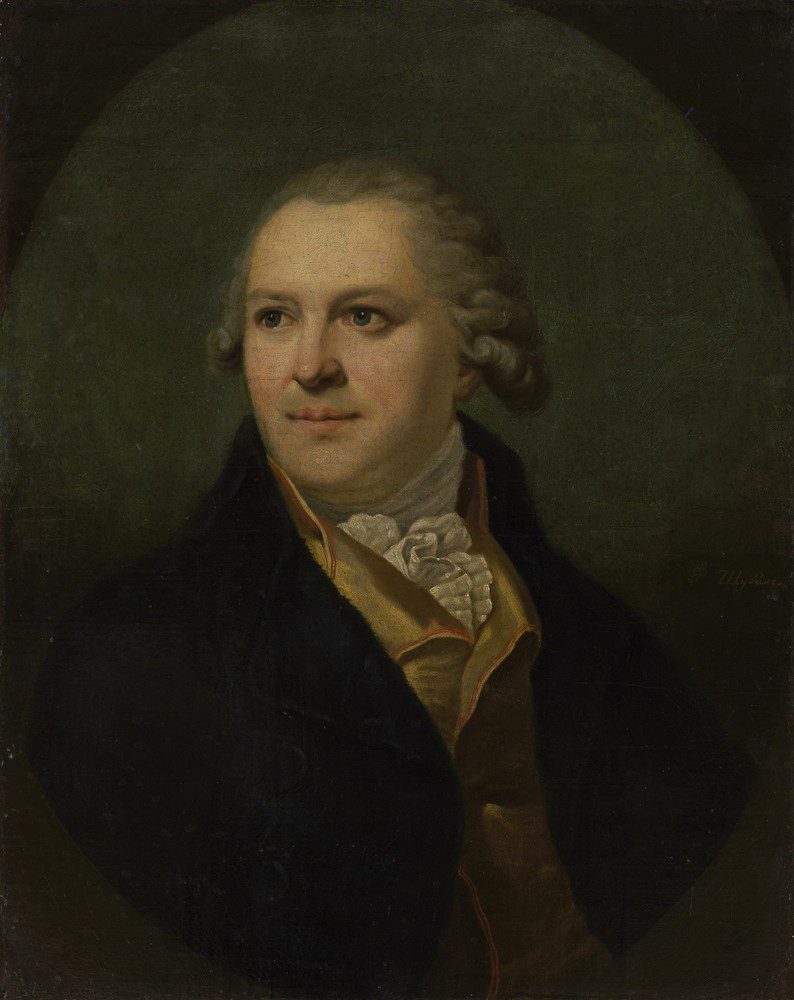
The Academy’s first sculptor of lasting reputation was Fedot Ivanovich Shubin, born on May 28, 1740, in a village near Kholmogory in northern Russia, the same region that produced Mikhail Lomonosov. He enrolled at the Academy in 1761 and spent six years in Rome and Paris between 1767 and 1773, moving through the studios and sculpture gardens that constituted European academic formation in the period.
He came back technically equipped, but what made him exceptional was something training cannot produce: a capacity to carry individual psychology into marble. Over his career he made approximately sixty portrait busts, most of them of Russian aristocrats and court figures. What sets them apart from comparable European work is that the faces are never resolved into ideal types. Cheekbones catch light differently from one sitter to the next. Eyes sit at varying depths. A specific person, not a generalized image of social rank, looks back at you.
Fedot Shubin died on May 24, 1805, and remains one of the few 18th-century Russian sculptors whose reputation has traveled outside Russia without significant translation difficulties.
What is Fedot Shubin best known for?
Shubin is best known for his marble portrait busts, approximately sixty in number, spanning the major figures of Russian court life in the late 18th century. What distinguishes them is psychological observation rather than idealized likeness. A Shubin bust follows the specific contours of a particular face rather than the generalized ideal of a Roman emperor.
Ivan Martos: Monuments for a New Nation
Where Shubin worked at the intimate scale of the portrait bust, Ivan Martos (1754-1835) operated in the public square. His best-known work is the monument to Kuzma Minin and Dmitry Pozharsky, installed in Red Square in Moscow in 1818. The two figures, a butcher and a prince who organized the resistance that expelled Polish forces from Moscow in 1612, stand in the formal arrangement of classical civic virtue. Minin gestures toward the Kremlin; Pozharsky, wounded, accepts the sword being offered.
The monument was the first major Russian public sculpture financed through public subscription rather than imperial patronage. It went on view at the height of national sentiment following Napoleon’s defeat, and its subject drew a direct line to that moment. Martos worked in the neoclassical idiom he had absorbed during years in Rome, but the monument’s emotional charge belonged to the specific historical circumstances of its installation, not to the ancient models behind its forms.
Realism and the Turn Inward
The neoclassicism of Shubin and Martos lost ground across the mid-19th century to a more direct engagement with historical psychology and social reality. Russian sculpture followed the same current that produced the Peredvizhniki in painting: a turn away from idealized form toward subjects drawn from Russian history and human experience. Sculptors were looking for the emotional weight inside a gesture, the particular angle of a head, the fatigue in a set of shoulders. The ideal human figure, derived from antique models and refined in Rome, was no longer a sufficient answer to the questions Russian artists were asking.
Mark Antokolsky: History as Living Form
Mark Matveyevich Antokolsky was born on October 21, 1843, in Vilna (now Vilnius), and came to St. Petersburg as a wood-carver’s apprentice before enrolling at the Academy of Arts in 1862. His Lithuanian-Jewish background placed him outside the mainstream of Russian court culture, and it shaped the subjects he chose: figures defined by isolation, intellectual intensity, or historical suffering.
His Ivan the Terrible, completed in 1871 and now held at the State Tretyakov Gallery in Moscow, shows the tsar seated and drained, his staff still in his hand. The figure carries no heroic weight. It holds the psychological residue of a man who used power to destroy what he loved. The work caused a sensation when it appeared, partly because it brought the scale and technical confidence of academic bronze to a subject that was explicitly Russian, historical, and morally unresolved.
Antokolsky followed Ivan the Terrible with Peter the Great (1872) and a series of figures from Jewish history and the ancient world, including Socrates and Spinoza. The thread connecting them is the intellectual or moral figure pressed to extremity by circumstance. Mark Antokolsky died on July 9, 1902, having spent much of his later career in Paris and Rome, where the European critical establishment recognized him on terms that made his Russian origins complicated.
Was Antokolsky considered a Russian or a Jewish sculptor?
Both designations were applied during his lifetime, and both carry limitations. He was born in the Russian Empire and trained at the St. Petersburg Academy, but his background shaped his subject matter, and he worked largely outside Russia for his final decades. Today he is recognized within Russian art history while also being claimed by Jewish cultural history as one of the first major sculptors to address Jewish subjects directly.
Art as Ideology: The Arrival of Socialist Realism
The Bolshevik Revolution of 1917 did not immediately produce the monumental socialist realism most people associate with Soviet sculpture. Lenin’s Plan for Monumental Propaganda, issued as a decree in April 1918, called for removing tsarist statues and replacing them with monuments to figures from the revolutionary tradition. The difficulty was that the sculptors with the most relevant training had strong attachments to European modernism, to Constructivism and abstraction, forms the new state found incomprehensible.
The tension between modernist ambition and political utility ran through the 1920s. Vladimir Tatlin’s proposed Monument to the Third International, designed in 1919-1920 and never built, would have been a rotating iron tower taller than the Eiffel Tower. It excited Constructivist circles and baffled nearly everyone else.
The resolution came by force. The First Congress of Soviet Writers in 1934 proclaimed socialist realism the only acceptable method for Soviet cultural production. The doctrine required depicting reality “in its revolutionary development,” which in practice meant figurative, technically conventional, optimistic, and ideologically legible work. Abstract or formally experimental sculpture had no place in this framework. The official doctrine held until 1988.
Vera Mukhina and the Monumental Body
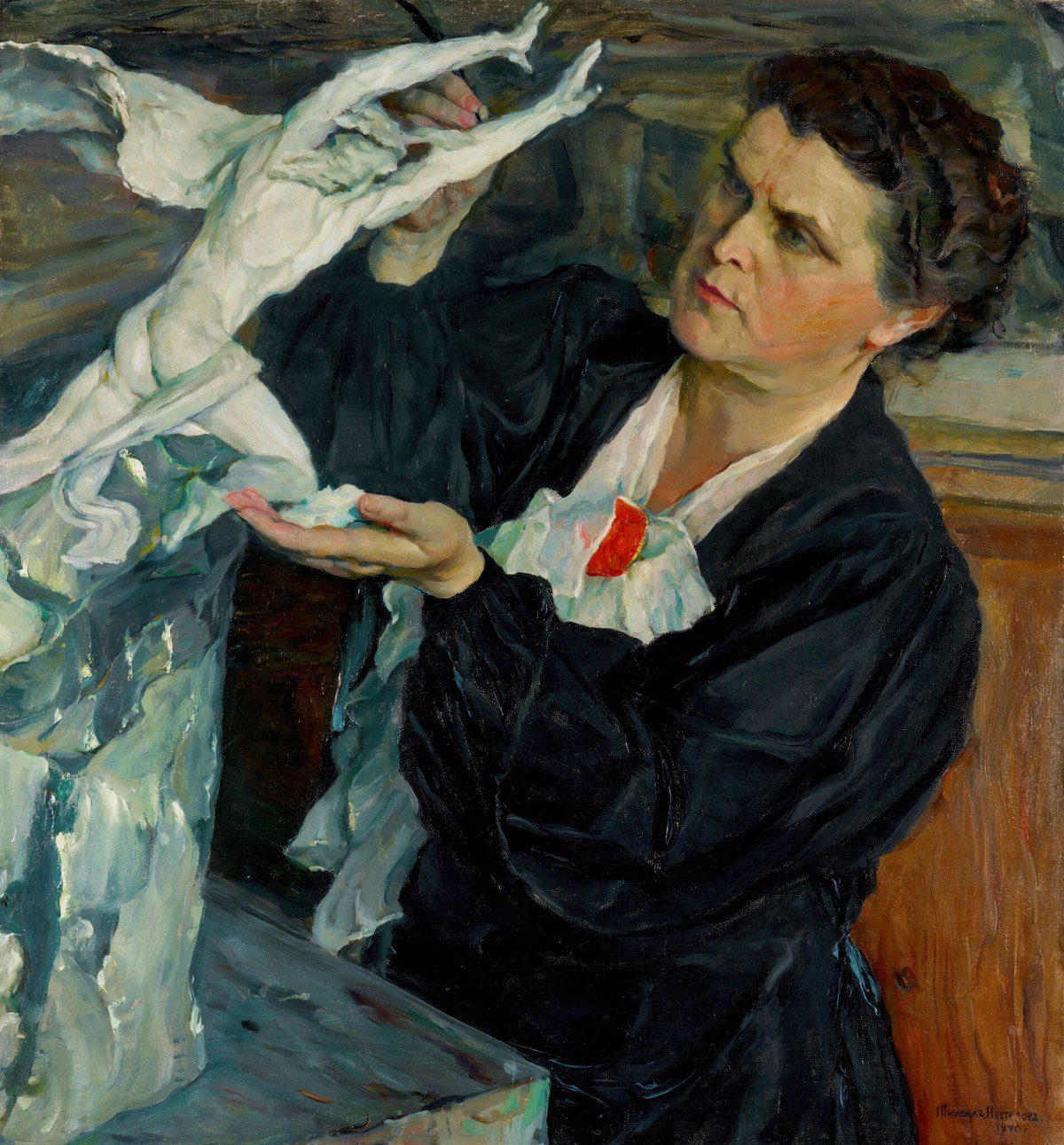
No Soviet sculptor embodied the possibilities and contradictions of socialist realism more fully than Vera Ignatyevna Mukhina, born on July 1, 1889. She had trained in Paris in the years before the First World War, working in studios shaped by Rodin and Cubism under the direct guidance of Antoine Bourdelle. The sculptor who became the face of Soviet monumentalism had a formation that was almost entirely European modernist.
That formation shows even in her most officially approved work. Mukhina brought a kinetic energy to the monumental idiom, a sense of bodies caught in motion rather than frozen in pose. The Soviet state recognized her value. She was a member of the art association “The Four Arts” in Moscow and Leningrad from 1924 to 1931, and she went on to earn the nickname “the queen of Soviet sculpture,” a title that carried genuine professional authority within the system.
Vera Mukhina made numerous official pieces, from decorative glass objects to architectural sculpture, but the work that defined her career was made for a building she did not design, as part of a project whose concept she did not originate.
Myth vs. Fact: Whose Idea Was Worker and Kolkhoz Woman?
Myth: Vera Mukhina conceived the Worker and Kolkhoz Woman as her own independent artistic vision. Fact: the concept and compositional design came from Soviet architect Boris Iofan, who developed the project for the 1937 Paris World’s Fair pavilion. Mukhina was selected through a competition to execute Iofan’s vision, and she contributed the material choice of stainless steel and the flowing scarf detail that gives the two figures their sense of forward motion.
Worker and Kolkhoz Woman: Steel, Symbol, and Five Stories High
The concept for Worker and Kolkhoz Woman did not begin with Vera Mukhina. The compositional design belonged to Soviet architect Boris Iofan, who developed the project as the centerpiece of the Soviet pavilion for the 1937 World’s Fair in Paris. Iofan’s idea was a pair of figures, a male worker raising a hammer and a female collective farm worker raising a sickle, their arms forming the hammer-and-sickle symbol above their heads.
Mukhina was selected through a competition to execute Iofan’s vision. What she contributed was the specific formal solution: 24.5 metres (78 feet) of stainless steel assembled from stamped and welded panels. For 1937, stainless steel at that scale was a serious technical undertaking. The flowing scarf trailing behind the two figures was Mukhina’s addition, a formal device that carries the sense of forward motion and holds the composition together visually.
The sculpture won the Grand Prix at the Paris exhibition. It was disassembled and shipped back to Moscow, installed near what is now the All-Russian Exhibition Centre. The piece sits at the intersection of socialist realism and an Art Deco formal vocabulary: figures handled with neoclassical confidence in the body but given the clean surface treatment of the era’s design culture. Worker and Kolkhoz Woman
Who actually designed Worker and Kolkhoz Woman?
The concept and compositional design came from architect Boris Iofan. Vera Mukhina was the sculptor selected through a competition to execute that concept. She contributed the material choice, specific formal refinements, and the trailing scarf that gives the group its forward momentum. Crediting Mukhina as the sculptor is accurate, but the originating creative vision was Iofan’s.
The Nonconformists: Sculpture Against the State
Soviet cultural policy had a predictable effect: it produced a parallel world of unofficial art made in private studios, shown in apartments, and circulated among a small community willing to accept the risk. The Bulldozer Exhibition of September 1974, in which a group of Moscow artists attempted to show unofficial work outdoors and had it literally bulldozed by municipal authorities, became a symbol of both the risk and the determination behind it.
Unofficial sculpture in the Soviet period tended toward abstraction, psychological intensity, and material improvisation. Artists working outside the official system could not access state supplies of bronze and marble. They welded metal scraps, assembled found objects, and worked with cement and plaster in ways academic training would not have sanctioned. The result was work the official system could not accommodate, and for that reason it was often the most formally alive sculpture being made in Russia.
Ernst Neizvestny: The Conscience That Would Not Stay Quiet
Ernst Iosifovich Neizvestny was born on April 9, 1925, fought in the Second World War, was declared dead in combat, and was found alive. That experience of violence and survival marked his formal concerns throughout his career. His work was figurative but not restful: bodies in extremity, limbs in tension, faces caught in something that reads as existential pressure rather than triumph.
At the Manezh Exhibition in December 1962, Nikita Khrushchev toured the hall of unofficial and experimental work and arrived at Neizvestny’s sculptures. His response was contemptuous. The confrontation that followed, Khrushchev dismissing the work as degenerate and Neizvestny arguing back, became one of the most documented encounters between Soviet authority and artistic independence. What is less often noted is that Khrushchev’s family later commissioned Ernst Neizvestny to design the former leader’s tombstone, installed at Novodevichy Cemetery in Moscow in 1974. The piece, alternating blocks of black and white marble framing a bronze head, turned the conflict the two men had embodied into something like formal resolution.
American playwright Arthur Miller described Neizvestny as an “artist of the East” who represented “the philosophical conscience of his country.” The American sculptor Alexander Calder, after seeing his work, told him: “All my life I create the world of children, and you create the world of man.”
Neizvestny emigrated to the United States in 1976 and lived and worked in New York City until his death on August 9, 2016. His most sustained project was the Tree of Life, a monumental synthesis connecting his entire body of thought, which he continued across decades.
After the Soviet Union: Pluralism and the Installation Turn
The collapse of the Soviet Union in 1991 removed the framework of official culture without immediately providing a replacement. The monumental commission, the primary way a Soviet sculptor engaged with the public, became economically and politically unfeasible. The market for bronze heroes of the proletariat had disappeared.
What replaced it was a pluralism that looked like chaos in the early years and gradually resolved into distinct tendencies. Some sculptors moved into installation and time-based work, borrowing formats from the international contemporary art world that required no permanent materials and could be shown in gallery spaces. The AES+F collective, formed in 1987 and working across photography, video, and sculpture, became one of the most internationally recognized Russian art groups of the post-Soviet period.
Moscow’s Muzeon park, along the Moscow River, became an inadvertent archive. Statues removed from public squares across Russia, including the large figure of Felix Dzerzhinsky that had stood outside KGB headquarters, were relocated there, creating an outdoor collection that reads as both graveyard and historical record.
A Stubborn Misconception About Russian Sculpture
A common assumption holds that Russian sculpture drew its distinctive character from folk art and indigenous material traditions. The reality is more direct: Russian academic sculpture was formed almost entirely by Western European academic training, specifically the Rome and Paris studios that Academy stipend-holders attended in the 18th and 19th centuries. Shubin, Martos, Antokolsky, Mukhina: all of them spent years in European studios. What reads as distinctively Russian in their work came from applying European technique to Russian subjects and historical moments, not from a separate indigenous sculptural tradition.
The folk carving tradition is real and substantial, but it operated largely outside the art history that produced the major portrait busts and public monuments. The two traditions rarely crossed.
Where to See Russian Sculpture Today
The two institutions with the most significant holdings of Russian sculpture are the State Russian Museum in St. Petersburg and the State Tretyakov Gallery in Moscow. The Russian Museum holds major Shubin portrait busts, including several considered among his strongest work. The Tretyakov holds key Antokolsky bronzes and has strong coverage of the 19th-century and Soviet periods.
Worker and Kolkhoz Woman stands outside the All-Russian Exhibition Centre (VDNKh) in Moscow, restored and reinstalled in 2009 on a taller pavilion base proportionally closer to the original Paris installation. Muzeon park holds a substantial collection of Soviet-era monumental sculpture removed from public spaces across the country.
State Tretyakov Gallery sculpture collection and State Russian Museum sculpture both provide online access to their collections, with significant portions of the sculpture holdings documented in detail.
What Russian Sculpture Left the World
Russian sculpture’s most lasting contribution to international art history may not be the Soviet monumental commissions but the early 20th-century Constructivist experiments: Tatlin’s Tower, the spatial constructions of Naum Gabo, the work of Antoine Pevsner. Their ideas about structure, movement, and the integration of engineering and art fed directly into the mainstream of European and American abstract sculpture and remain reference points for contemporary practice.
The Soviet period’s other contribution was inadvertent: the work it suppressed. The sculpture made by Neizvestny and others under conditions of real political risk showed what figurative work could carry when stripped of institutional comfort and official approval. That is, in the end, the argument for studying this tradition at all: not only what the state commissioned, but what survived despite it.
Essential Points
- Byzantine theology associated free-standing sculpture with pagan idols, which delayed Russia’s development of three-dimensional figure sculpture by several centuries compared to Western Europe.
- The Imperial Academy of Arts, founded in 1757, introduced European academic training through stipends to Rome and Paris, producing technically accomplished sculptors within roughly two generations.
- Fedot Shubin (1740-1805) created approximately sixty marble portrait busts notable for psychological specificity, capturing individual rather than idealized faces.
- Worker and Kolkhoz Woman (1937, 24.5 metres, stainless steel) was conceptually designed by architect Boris Iofan, not by its sculptor Vera Mukhina, who was selected through a competition to execute the work.
- Soviet socialist realism doctrine (1932-1988) required figurative, ideologically legible work, driving formally experimental sculpture entirely underground.
- Ernst Neizvestny (1925-2016) argued directly with Khrushchev at a 1962 exhibition and later designed Khrushchev’s tombstone, a biographical arc that captures the contradictions of Soviet cultural life.
- After 1991, the disappearance of the Soviet monumental commission pushed Russian sculpture toward installation formats and the international contemporary art market.
- Russia’s Constructivist experiments of the 1910s-1920s (Tatlin’s Tower, Gabo, Pevsner) were the tradition’s most influential contribution to international sculpture, shaping abstract practice globally.
Frequently Asked Questions
- What is Russian sculpture, and how old is the tradition?
- Russian sculpture as a formal academic discipline is roughly three hundred years old, dating from the founding of the St. Petersburg Academy of Arts in 1757. As a broader practice, including carved wooden icons and stone relief panels in the Byzantine tradition, it extends back more than a thousand years to the Christianization of Kievan Rus in 988.
- Why did the Soviet Union commission such large sculptural monuments?
- The Soviet state used monumental sculpture as a tool of political communication, visible to citizens who might not read newspapers or attend official events. Lenin’s Plan for Monumental Propaganda (1918) explicitly tied the removal of tsarist statues and installation of new monuments to building ideological consensus. Scale was part of the message: larger figures implied greater authority.
- What materials did Russian sculptors use historically?
- The early tradition relied on wood for icon frames and religious figures, and limestone for architectural relief carving. The 18th-century academic tradition introduced marble and bronze, following European practice. Soviet monumental sculpture added stainless steel, most dramatically in Mukhina’s Worker and Kolkhoz Woman. Post-Soviet sculptors working outside official channels often used found and improvised materials.
- What made Ernst Neizvestny different from other Soviet sculptors?
- Neizvestny refused to adapt his subjects to socialist realist expectations. His figures are defined by physical and psychological extremity rather than optimism or triumph. He argued directly with Khrushchev at a 1962 exhibition. After emigrating in 1976, he continued the same formal concerns in New York, producing work with no Soviet audience in mind.
- Where can I see significant Russian sculpture today?
- The State Russian Museum in St. Petersburg holds major Shubin portrait busts. The State Tretyakov Gallery in Moscow has strong 19th-century and Soviet holdings. Worker and Kolkhoz Woman stands outside VDNKh in Moscow. Muzeon park along the Moscow River displays Soviet-era monuments removed from public spaces, creating an outdoor collection of substantial historical scope.
This guide was written and reviewed by the rus-art.com editorial team, specializing in Russian art history. We cross-check dates, attributions, and museum holdings against museum and academic sources.