Quick Answer
The Blue Rose group was a short-lived Russian Symbolist artist circle active in Moscow from 1906 to 1908, named for a single landmark exhibition held in March 1907. Led by Pavel Kuznetsov and including Martiros Saryan, Nikolai Sapunov, Serge Sudeikin, and Piotr Utkin, the group drew inspiration from the late Victor Borisov-Musatov‘s misty, decorative canvases. Where French Impressionism chased fleeting outdoor light, Blue Rose painters built dreamlike, blue toned interiors and gardens charged with mysticism, following Symbolist poetry rather than optical observation. The exhibition, funded by patron Nikolai Ryabushinsky, remains a landmark in Russian modern art.
What Was the Blue Rose Group?
The Blue Rose group (Golubaya Roza in Russian) exhibited exactly once, in March and April 1907, and had scattered by 1908. The name comes from that single Moscow show, not from any society with a charter or manifesto. Roughly fifteen artists took part, most of them former students of the Moscow School of Painting, Sculpture and Architecture, tied together less by shared technique than by a common mood: hazy blues, violet shadows, gardens that feel remembered rather than observed. Blue Rose documents the exhibition as the clearest statement of Russian Symbolist painting, distinct from the literary Symbolism of poets such as Alexander Blok and Andrei Bely, though the two circles read and influenced each other closely.
Borisov-Musatov: The Painter Who Never Saw the Exhibition
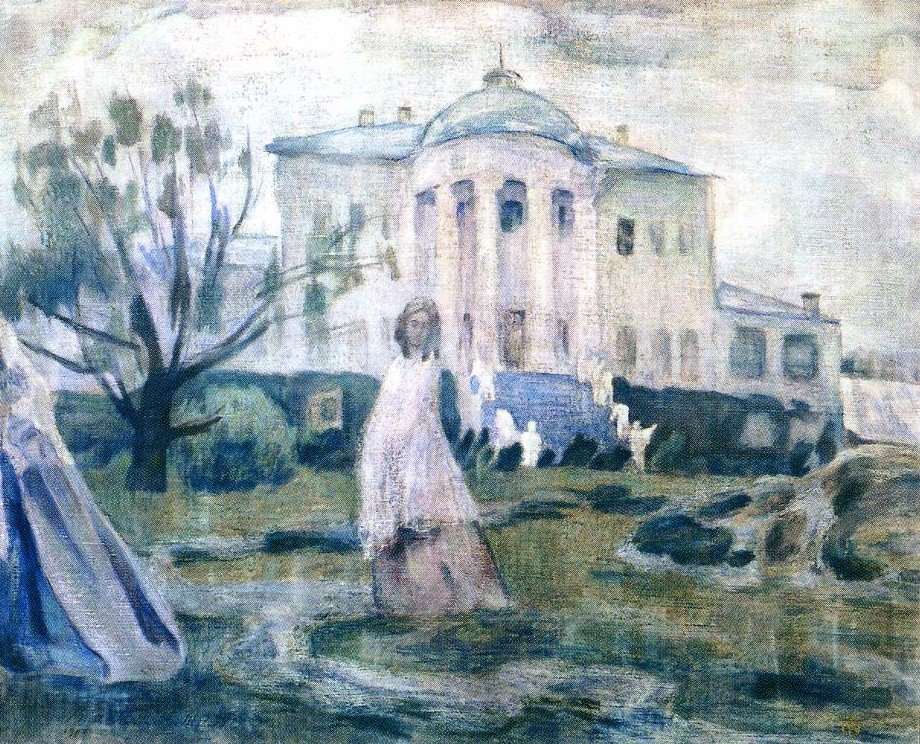
Victor Borisov-Musatov (1870, Saratov, 1905, Tarusa) died about a year and a half before the Blue Rose exhibition opened, yet almost every account of the group starts with him. Victor Borisov-Musatov built a Post-Impressionist style that folded Symbolism, decorative flattening, and careful realism into pale, twilight scenes of women in old fashioned dress drifting through overgrown parks. In Phantoms (1903), painted at the Zubrilovka estate, the figures dissolve into mist rather than stand in daylight, the opposite instinct from an Impressionist chasing a specific hour’s sunlight. Kuznetsov, Sapunov, and Utkin had studied alongside Musatov in Saratov and Moscow, and his work hung in the 1907 exhibition as a guiding influence even though he could not attend.
From Saratov to Moscow: Building Toward 1907
Several core members, Kuznetsov, Utkin, Sapunov, and Sudeikin, first met as students in Saratov before continuing their training at the Moscow School of Painting, Sculpture and Architecture. By the mid 1900s this loose circle had already shown work together under other banners, a rehearsal for what became Blue Rose. The Moscow exhibition that gave the group its name opened in March 1907, gathering paintings, sculpture, and decorative art alongside music and poetry readings, closer to a total artistic environment than a conventional gallery hang.
Who organized the Blue Rose exhibition?
Pavel Kuznetsov led the organizing, drawing on his Saratov and Moscow classmates and on the financial backing of publisher Nikolai Ryabushinsky, whose money made the ambitious, multi-disciplinary format possible.
Nikolai Ryabushinsky and the Golden Fleece Connection
The 1907 exhibition existed because of one patron: Nikolai Ryabushinsky, a wealthy publisher who financed it and used his journal Zolotoye Runo (Golden Fleece) to promote the artists before and after the show. Zolotoye Runo positioned the Blue Rose painters as heirs to French Symbolism and the Nabis, reproducing their work in color plates unusually lavish for a Russian periodical of the period. Without that funding and publicity, a group this loosely organized, with no shared studio, no manifesto, and only partial overlap in style, would likely have left little trace beyond a handful of scattered reviews.
Defining Features: Blue Twilight and Dreamlike Space
Blue Rose paintings share a recognizable palette before they share anything else: cool blues, lilac, grey green, and muted pink, often laid down in thin, watery layers that let the canvas texture show through. Figures tend toward near silhouette, gardens and fountains recur as settings, and perspective flattens into decorative pattern rather than measured depth. Russian Symbolism notes that Russian Symbolism grew independently of French Symbolism and leaned on Sophiology, the mystical idea of divine wisdom embodied in the world, which shows up in Blue Rose canvases as a hushed, otherworldly stillness rather than any specific religious iconography.
What makes a painting look distinctly Blue Rose?
The combination matters more than any single trait: a cool, restricted palette, flattened decorative space, and a subject drawn from memory or imagination rather than a specific observed scene.
Pavel Kuznetsov: The Group’s Central Voice
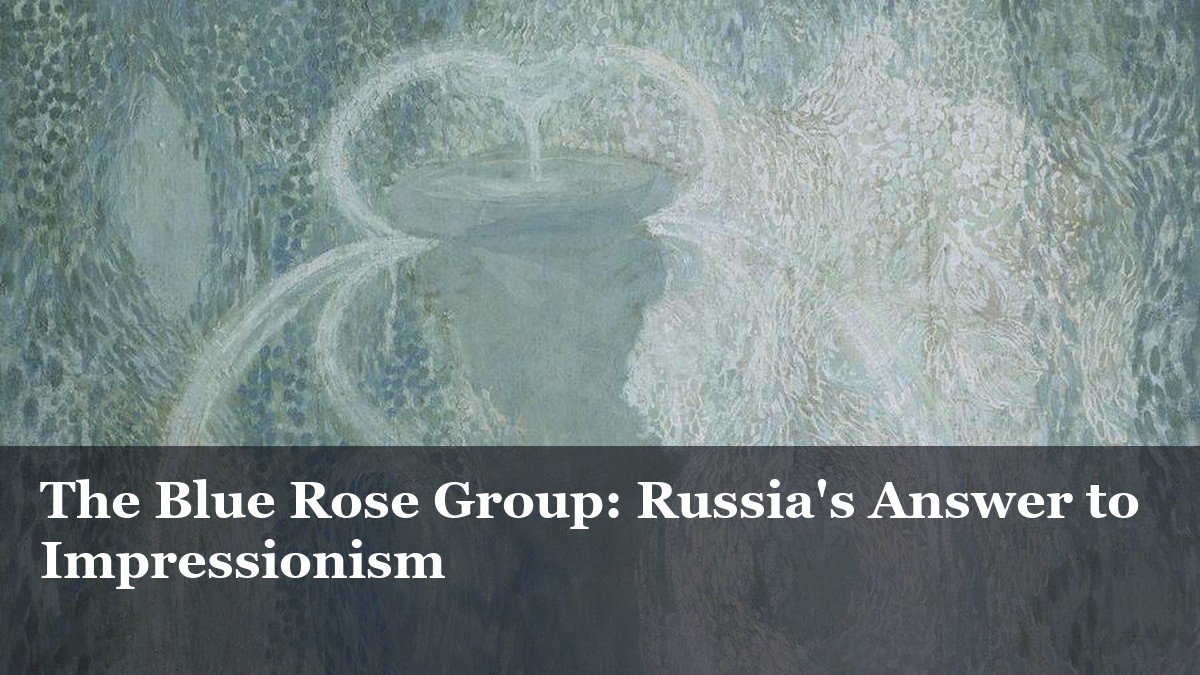
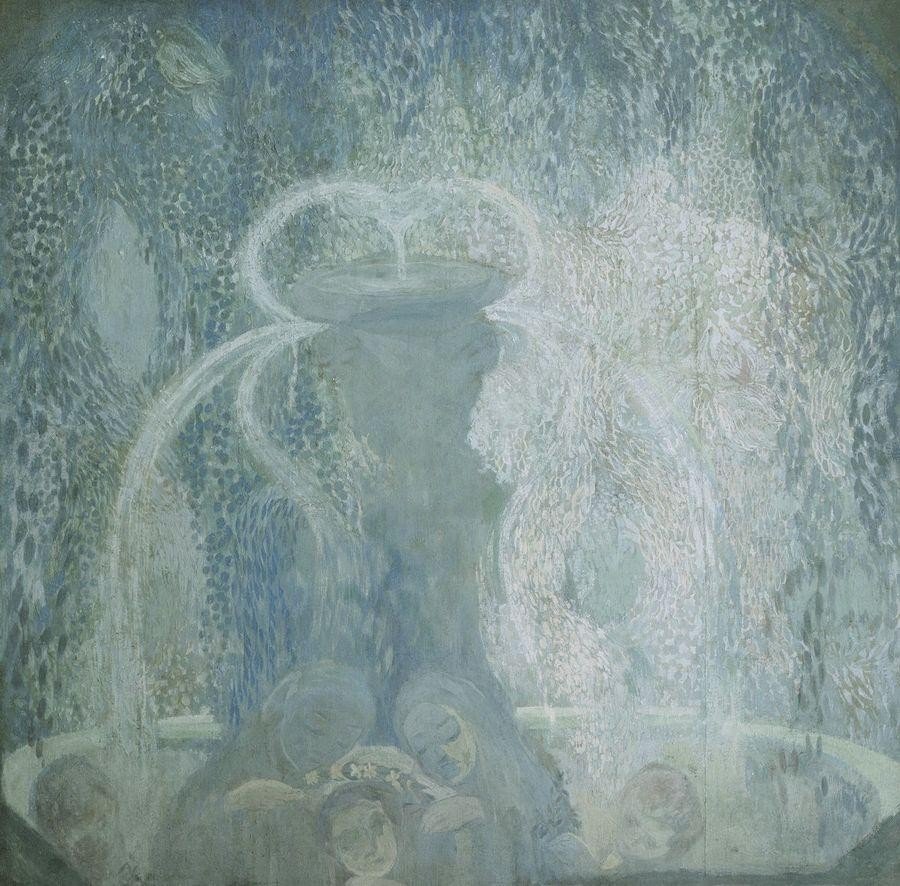
Pavel Kuznetsov organized the 1907 exhibition and gave Blue Rose its clearest visual signature with paintings like The Blue Fountain (1905), where a fountain, its water frozen into decorative arcs, sits at the center of a garden populated by pale, almost interchangeable figures. Kuznetsov returned to the fountain motif again and again in these years as a symbol of a hidden, self renewing life force, a theme also present in Alexander Blok’s poetry of the period. After 1907 his work moved steadily east, first to the Kalmyk steppe and later to Central Asia, trading the misty garden for open, sunlit landscapes without losing the decorative flatness he developed in the Blue Rose years.
Martiros Saryan and the Turn Toward the East
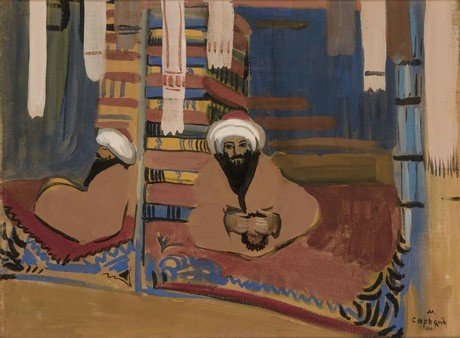
Martiros Saryan joined the group as a young graduate of the same Moscow school, contributing dreamy, fable like canvases in the Blue Rose years before his work changed direction entirely. Travels through Armenia, Persia, and Egypt after 1910 replaced the group’s cool blues with saturated orange, ochre, and turquoise, and figures drawn from myth gave way to caravans, markets, and specific portraits, as in Eastern Merchants (1910). Saryan eventually settled permanently in Armenia and became the founder of its modern national painting school, a trajectory that shows how far a single artist could travel from the misty gardens of 1907.
Did all Blue Rose artists stay in Moscow?
No. Saryan’s move to Armenia is the clearest example, but Sudeikin later worked in Paris and the United States, and Kuznetsov spent long stretches painting in Central Asia, so the group’s geography scattered almost as quickly as its style did.
Sapunov and Sudeikin: Theater, Masquerade, and Portraiture
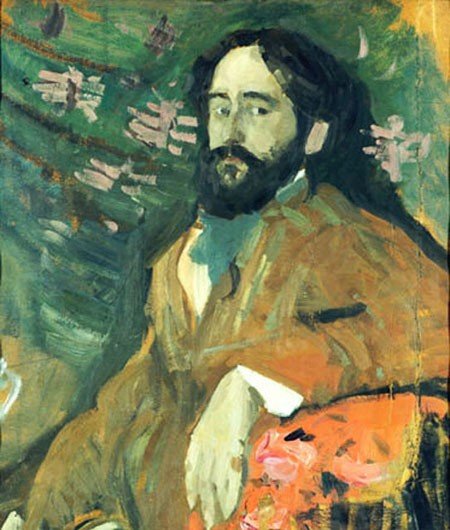
Nikolai Sapunov (1880, 1912) brought a theatrical, sometimes unsettling edge to the group, filling canvases with masked figures, still lifes of wilting flowers, and stage like interiors that read as sets waiting for actors. His 1908 portrait of fellow painter Nikolay Milioti carries that same stagecraft sensibility into a real sitter: artificial lighting, exaggerated gesture, a sense that the scene could be struck and rebuilt elsewhere. Serge Sudeikin worked in a related vein and kept designing for the theater long after Blue Rose dissolved, carrying its decorative color sense into emigre portraits such as his 1920 depiction of Vera Stravinsky, painted after he had left Russia. Sapunov drowned in 1912 at the age of thirty two, cutting short a career that had already moved from Blue Rose mysticism toward a harder, more grotesque strain of Symbolism.
Piotr Utkin and the Group’s Lesser Known Members
Piotr Utkin (1877, 1934) rounded out the group’s founding circle alongside Kuznetsov and Sapunov, and his 1904 painting The Dream carries the same drifting, half asleep figures and pale color harmonies that would define the 1907 exhibition three years later. Around a dozen further participants, including sculptors and decorative artists, exhibited alongside the better known painters, which is part of why Blue Rose reads less like a school with a single fixed style and more like a network of overlapping sensibilities gathered under one roof for a few weeks in 1907.
Myth vs. Fact: Not a Long-Running Society
Myth: Blue Rose operated for years as an ongoing exhibiting society, the way the Peredvizhniki did for decades. Fact: the name comes from one exhibition held in Moscow in March and April 1907. The circle had already scattered by 1908, and no second show ever used the Blue Rose name.
Notable Works: Reading the Canvases
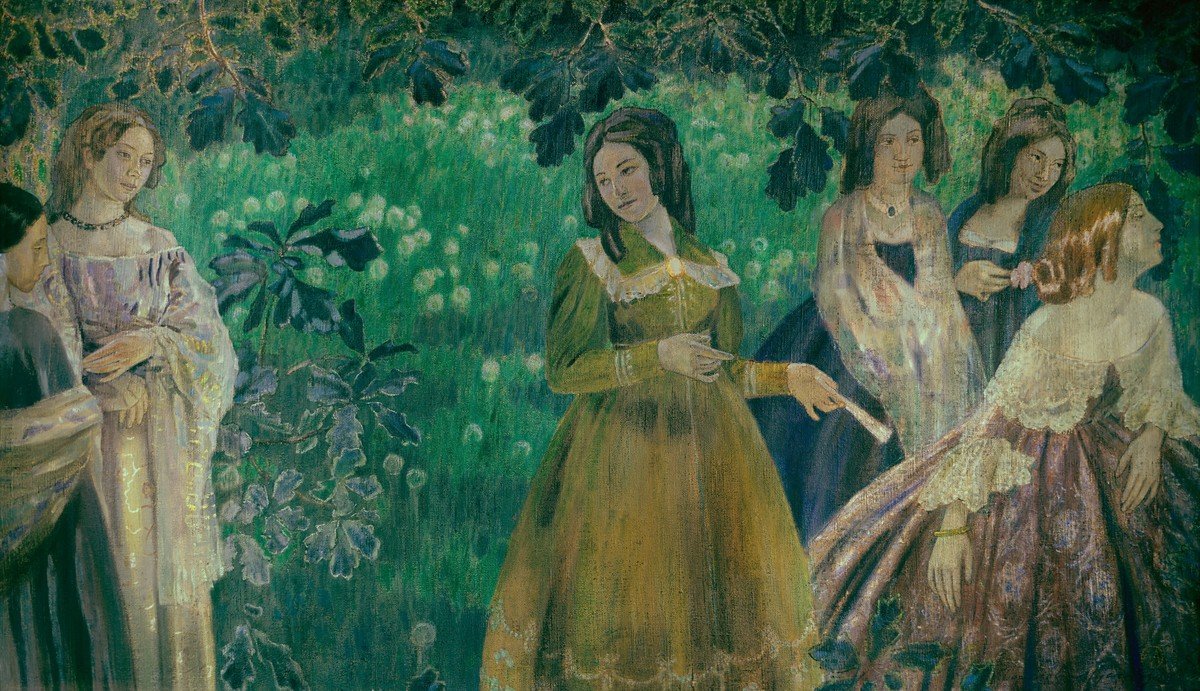
Beyond The Blue Fountain, Borisov-Musatov’s Emerald Necklace (1903, 1904) stands as one of the clearest statements of the mood the group aspired to: women in period dress arranged almost like a frieze along a riverbank, their poses echoing each other in a slow, decorative rhythm rather than any real conversation. These paintings reward reading for mood rather than story; titles are often vague on purpose (Phantoms, The Dream, Fountain), pointing to a feeling the painter wanted to evoke rather than an event to narrate.
How Blue Rose Differed from French Impressionism
Not in any technical sense. French Impressionists such as Monet and Renoir painted outdoors, tracked how light changed within minutes, and used broken, visible brushwork to record a specific optical moment. Blue Rose painters worked from memory and imagination toward a fixed, unchanging mood, often in muted studio light rather than sun, and their brushwork serves decorative pattern rather than optical accuracy.
Was Blue Rose really Russia’s version of Impressionism?
The comparison mostly comes from timing and geography: Blue Rose arrived in Russia roughly a generation after Impressionism had already reshaped European painting, and both movements broke with academic realism. But the underlying goals point in opposite directions, Impressionism toward observed fact, Blue Rose toward interior, symbolic truth, which makes the pairing more a matter of historical proximity than shared method.
Connections to World of Art and Symbolist Poetry
World of Art (Mir Iskusstva), the St Petersburg based group led a decade earlier by figures around Alexander Benois and Sergei Diaghilev, had already opened Russian art to Symbolist and decorative influences from Western Europe, and several Blue Rose artists, Sudeikin especially, later worked within Diaghilev’s theatrical and publishing circles. On the literary side, Blue Rose painters read and sometimes illustrated the Symbolist poets Alexander Blok, Andrei Bely, and Vyacheslav Ivanov, whose emphasis on hidden meaning behind ordinary appearances gave the painters a ready made vocabulary for gardens, fountains, and twilight as carriers of spiritual content.
Why the Group Dissolved by 1908
Blue Rose never held a second exhibition under its own name. Ryabushinsky’s journal Zolotoye Runo sponsored a further, larger Symbolist show in 1908 and 1909 that folded in French and other European Symbolists, diluting the original circle’s identity, and the magazine itself closed in 1910 as Ryabushinsky’s fortune declined. Individual members simply moved on: Kuznetsov toward Central Asia, Saryan toward Armenia, Sudeikin toward stage design abroad. Without a patron, a manifesto, or a shared style strong enough to hold them together, the group’s coherence lasted about as long as the exhibition that named it.
Legacy: From Steppe Landscapes to a National School
Kuznetsov carried the group’s decorative flatness into a long, celebrated career as a painter and teacher, applying the same simplified forms and unified color fields to Central Asian subjects in works such as In the Steppe (1911). Saryan’s later Armenian landscapes and portraits, still built on the flat color harmonies he learned in the Blue Rose years, became foundational to twentieth century Armenian art. Even artists who died young, Borisov-Musatov in 1905, Sapunov in 1912, left a body of work that later critics alternately dismissed as decadent and rediscovered as an essential bridge between nineteenth century realism and the avant garde explosion of the 1910s.
Modern Relevance: Where to See Blue Rose Today
Major holdings sit in Moscow and St Petersburg. The State Tretyakov Gallery holds significant paintings by Borisov-Musatov, Kuznetsov, and Sapunov, and the State Russian Museum in St Petersburg holds further key works. Outside Russia, Blue Rose remains less familiar than the slightly later avant garde of Malevich or Kandinsky, but museum retrospectives and touring Symbolism exhibitions over the past two decades have steadily built its international profile, and Saryan’s later fame in Armenia keeps at least one branch of the group visible well beyond Moscow.
Common Misconceptions
One persistent myth holds that “blue rose” refers to an actual flower the group painted or admired. It does not: a genuinely blue rose does not occur in nature, and the name works as a symbol borrowed from the same tradition that gave Novalis his unattainable blue flower and Maurice Maeterlinck his blue bird, standing for an ideal that painting can gesture toward but never fully capture. A second misconception treats Blue Rose as a tight, doctrinal school on the model of the Peredvizhniki decades earlier; in reality its roughly fifteen participants shared a mood and a moment more than any fixed technique or subject.
Related Movements
Blue Rose sits between two better known currents in Russian art: Peredvizhniki realism, which it reacted against, and the avant garde abstraction of Larionov, Goncharova, and Malevich, several of whom later exhibited in Ryabushinsky’s Golden Fleece shows before striking out on their own. It also shares ground with the Vienna Secession and the Nabis in its use of flattened, decorative color, and with German and Austrian Symbolism in its debt to Novalis style mysticism, though Russian critics of the time framed it specifically as a homegrown answer to Sophiology and Orthodox mystical thought rather than an import.
Essential Points
- Blue Rose names one exhibition (Moscow, March to April 1907), not a long-running society.
- The name is symbolic, borrowed from the tradition of the unattainable blue flower, not a specific painting or real flower.
- Patron Nikolai Ryabushinsky financed and publicized the group through his journal Zolotoye Runo.
- Victor Borisov-Musatov shaped the group’s style despite dying in 1905, before it formally existed.
- Pavel Kuznetsov’s The Blue Fountain (1905) remains the group’s most recognizable image.
- Members scattered afterward: Saryan toward Armenia, Kuznetsov toward Central Asia, Sudeikin toward stage design abroad.
- Unlike Impressionism’s outdoor light studies, Blue Rose paintings were built from memory toward a fixed, symbolic mood.
- Key works are held today mainly at the State Tretyakov Gallery and the State Russian Museum.
Frequently Asked Questions
- What is the Blue Rose group in Russian art?
- Blue Rose was a circle of Moscow Symbolist painters who exhibited together once, in 1907, favoring hazy blue and violet color harmonies over realistic detail. The name came from that single exhibition rather than a formal, ongoing society, and the group effectively dissolved within a year.
- When and where did the Blue Rose exhibition take place?
- The exhibition opened in Moscow in March 1907, funded by publisher Nikolai Ryabushinsky, who also promoted the artists through his journal Zolotoye Runo. It ran for several weeks and combined painting, sculpture, music, and poetry readings rather than a conventional gallery hang.
- What visual techniques define a Blue Rose painting?
- Thin, watery layers of cool blue, lilac, and grey green paint, simplified almost silhouette like figures, and flattened, decorative space instead of measured perspective. Fountains and gardens recur as settings, built from memory and imagination rather than direct observation.
- Was Victor Borisov-Musatov an official Blue Rose member?
- No. He died in 1905, roughly a year and a half before the 1907 exhibition, so he never formally joined. His misty, decorative canvases directly shaped the group’s style, and his work was shown alongside theirs as a guiding influence.
- Where can I see Blue Rose paintings today?
- The State Tretyakov Gallery in Moscow and the State Russian Museum in St Petersburg hold the largest collections, including works by Kuznetsov, Sapunov, and Borisov-Musatov. Martiros Saryan’s later paintings are held extensively in Armenia’s national collections.
This guide was written and reviewed by the rus-art.com editorial team, specializing in Russian art history. We cross-check dates, attributions, and museum holdings against museum and academic sources.