Quick Answer
The State Tretyakov Gallery in Moscow began in 1856 as the private collection of merchant Pavel Tretyakov, who bought contemporary Russian paintings with the explicit goal of founding a national art museum. By 1892 the collection had grown to some 2,000 objects, including more than 1,300 paintings, over 500 drawings, and several sculptures, all transferred to the Russian state. Today it holds one of the deepest collections of Russian art, from medieval icons to the Peredvizhniki realists who form its core.
What Is the Tretyakov Gallery?
The State Tretyakov Gallery is a leading museum of Russian fine art, built around a single idea: that Russia’s own painters, not imported old masters, deserved a national museum of their own. Located in Moscow, south of the Kremlin, it holds more than 1,300 paintings from its founding donation alone, plus drawings, sculpture, and icons added over more than a century of growth. What makes it unusual among major museums is its origin story. No monarch or state ministry assembled it. It grew, painting by painting, out of the private taste of one Moscow merchant who started buying contemporary Russian art in 1856 with a museum already in mind.
A Merchant’s Eye: Pavel Tretyakov’s Early Collecting
Pavel Mikhailovich Tretyakov (27 December 1832 to 16 December 1898) came from a Moscow merchant family and made his fortune in textiles, not art. Starting in 1856, he began buying paintings by living Russian artists, deliberately skipping the Western European old masters that filled most wealthy Russian collections of the period. His stated goal, recorded from early on, was to build a collection that could grow into a public museum of national art. That meant buying unfashionable, contemporary, often unglamorous work: genre scenes of ordinary life, portraits of writers and scientists rather than aristocrats, landscapes of the Russian countryside instead of the Italian coast. Tretyakov bought directly from artists and exhibitions, often before a painting had found critical approval, which gave him an unusually direct relationship with the painters whose careers he helped sustain.
From Private Rooms to a Public Trust
As the collection outgrew Tretyakov’s house on Lavrushinsky Lane, he kept expanding the building to hold it, and opened the rooms to visitors well before any formal donation. His brother, Sergei Tretyakov, collected alongside him and was himself a noted patron and philanthropist, though Sergei’s holdings leaned more toward Western European painting. One brother collected nationally, the other internationally. Their parallel habits say something about the range of taste among Moscow’s merchant elite in the late 19th century, a class that increasingly saw art patronage as a civic duty rather than a private luxury.
The Peredvizhniki and the Birth of a National Vision
Tretyakov’s collecting ran parallel to a rebellion inside Russian art itself. The Peredvizhniki, often called the Wanderers or Itinerants in English, formed as an artists’ cooperative in protest of the restrictions imposed by the Imperial Academy of Arts. By 1870 the group had organized formally as the Society for Travelling Art Exhibitions, touring realist paintings to audiences far outside St. Petersburg and Moscow’s academic circles.
Why did the Wanderers break from the Academy?
The Academy controlled both subject matter and access to exhibition, favoring historical and mythological scenes judged by a fixed hierarchy. Artists who wanted to paint contemporary Russian life, its poverty, its labor, its ordinary portraits, found the Academy’s rules a ceiling rather than a ladder. Breaking away let them choose their own subjects and reach the public directly through touring shows, and Tretyakov became their most consistent buyer.
Portraits of a Patron: How Artists Saw Tretyakov
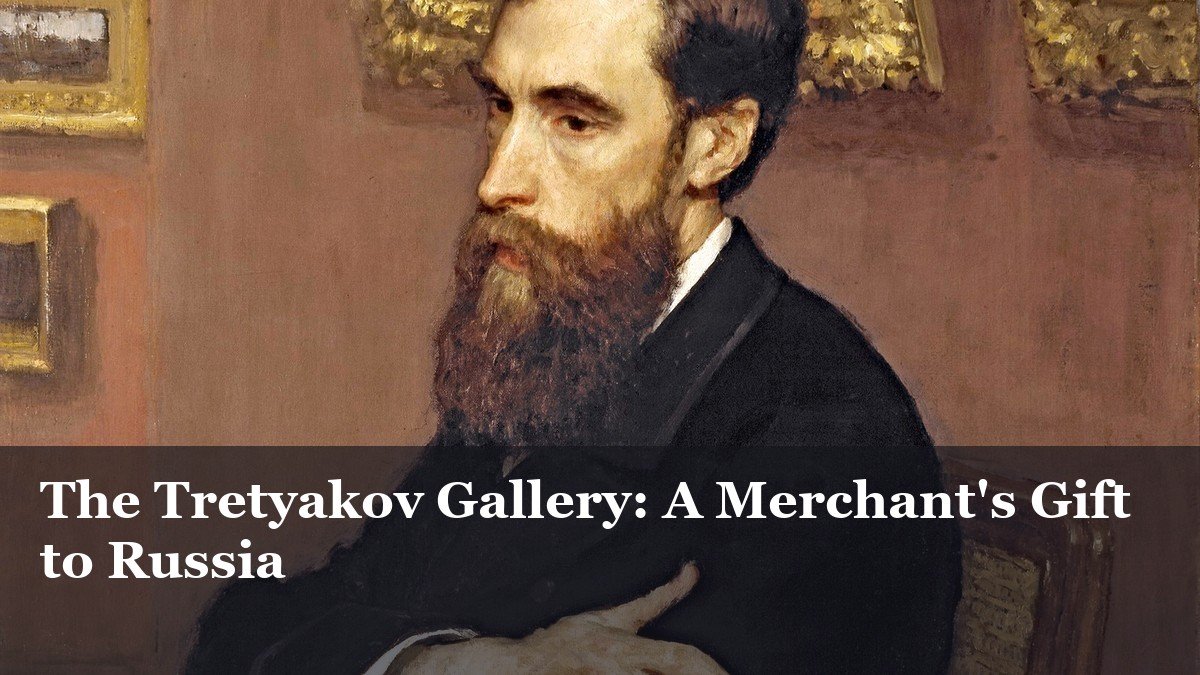
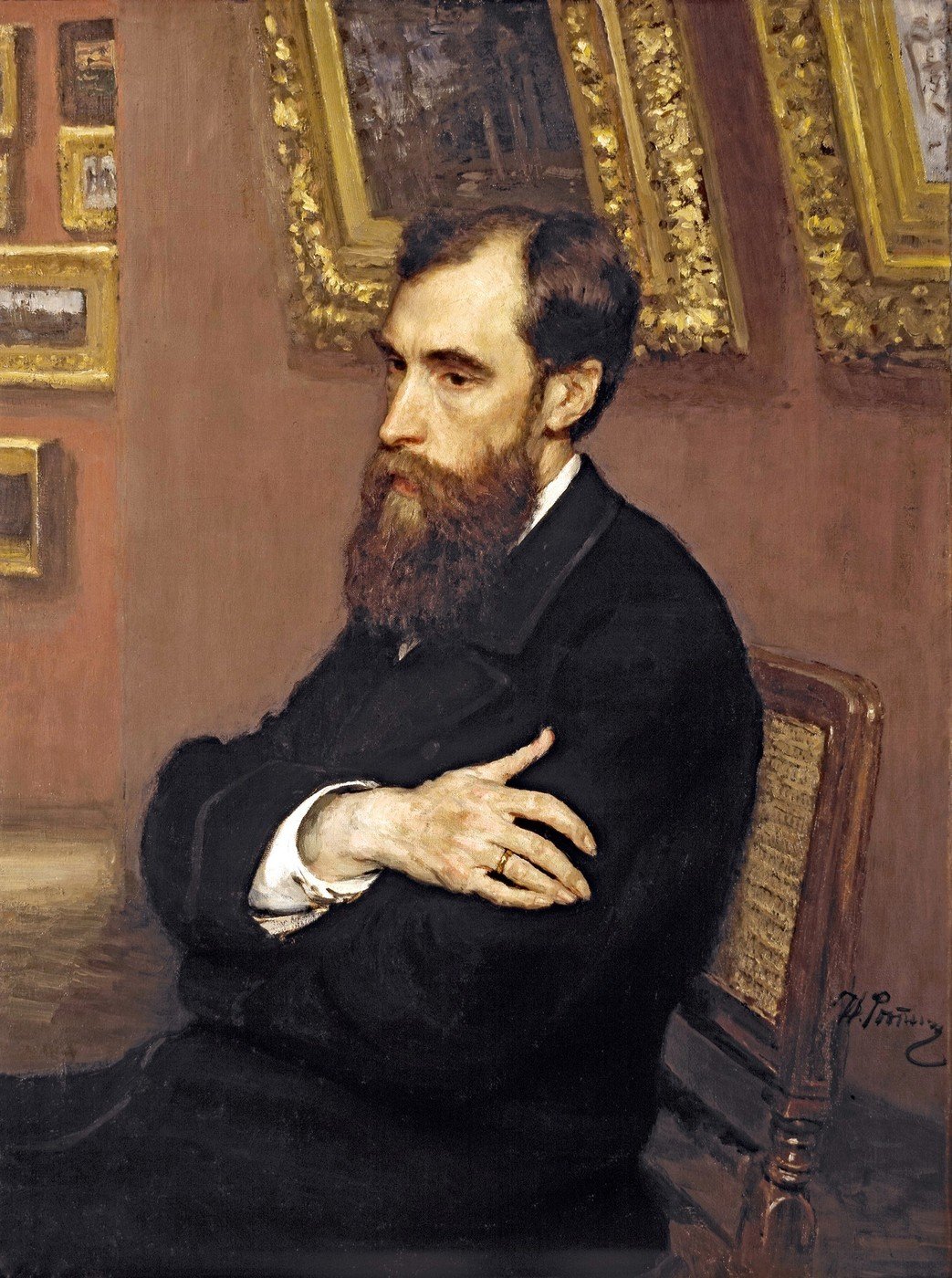
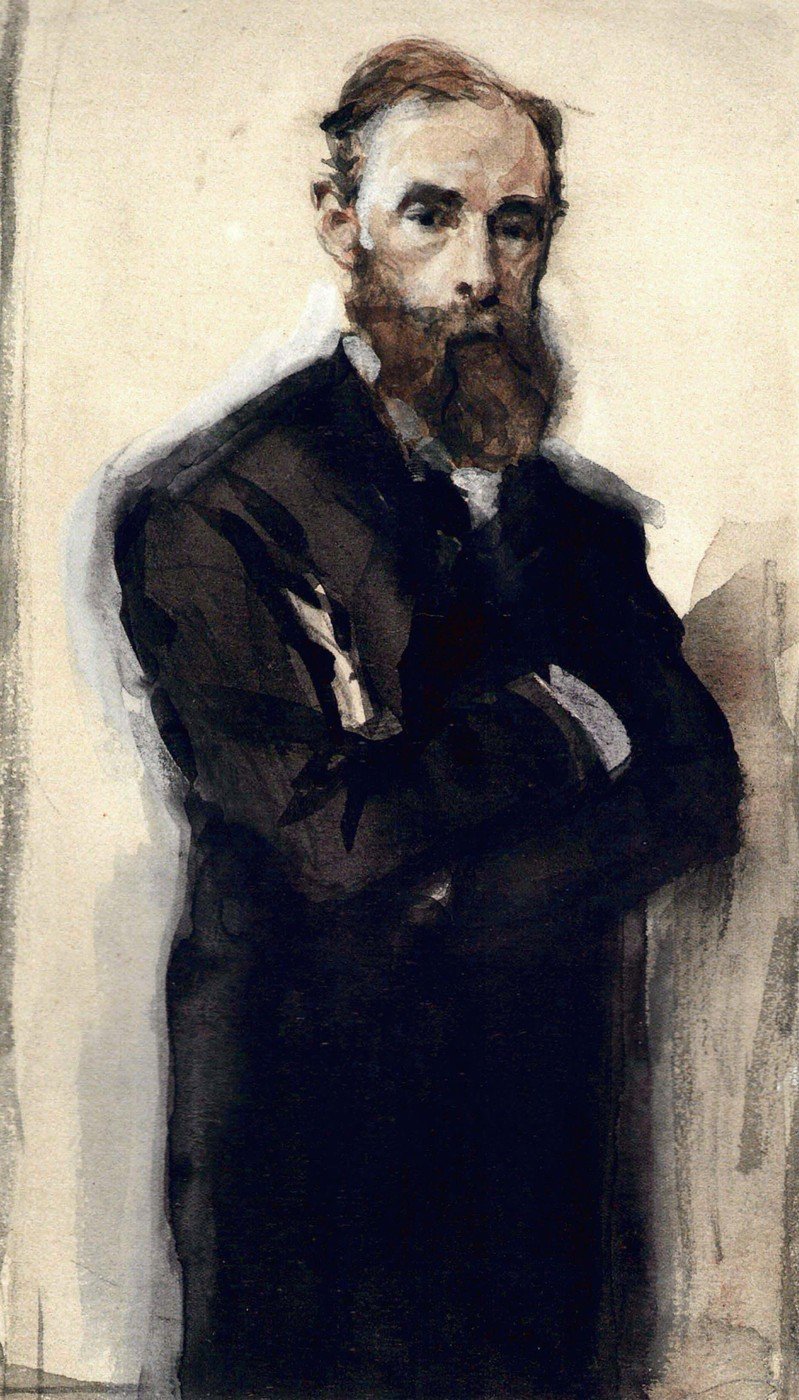
Tretyakov sat for portraits by two of the artists he had supported for decades. Ilya Repin painted him in 1883, plain-dressed and unadorned, a working patron rather than a public figure. Valentin Serov painted him again in 1899, a year after Tretyakov’s death, by which point the gallery’s future as a public institution was already settled. Set side by side, the two portraits track the shift from private collector to national benefactor. Repin’s version shows a man still in the midst of building his collection. Serov’s carries the retrospective weight of a legacy already secured.
Ivan Kramskoi and the Painter as Public Intellectual
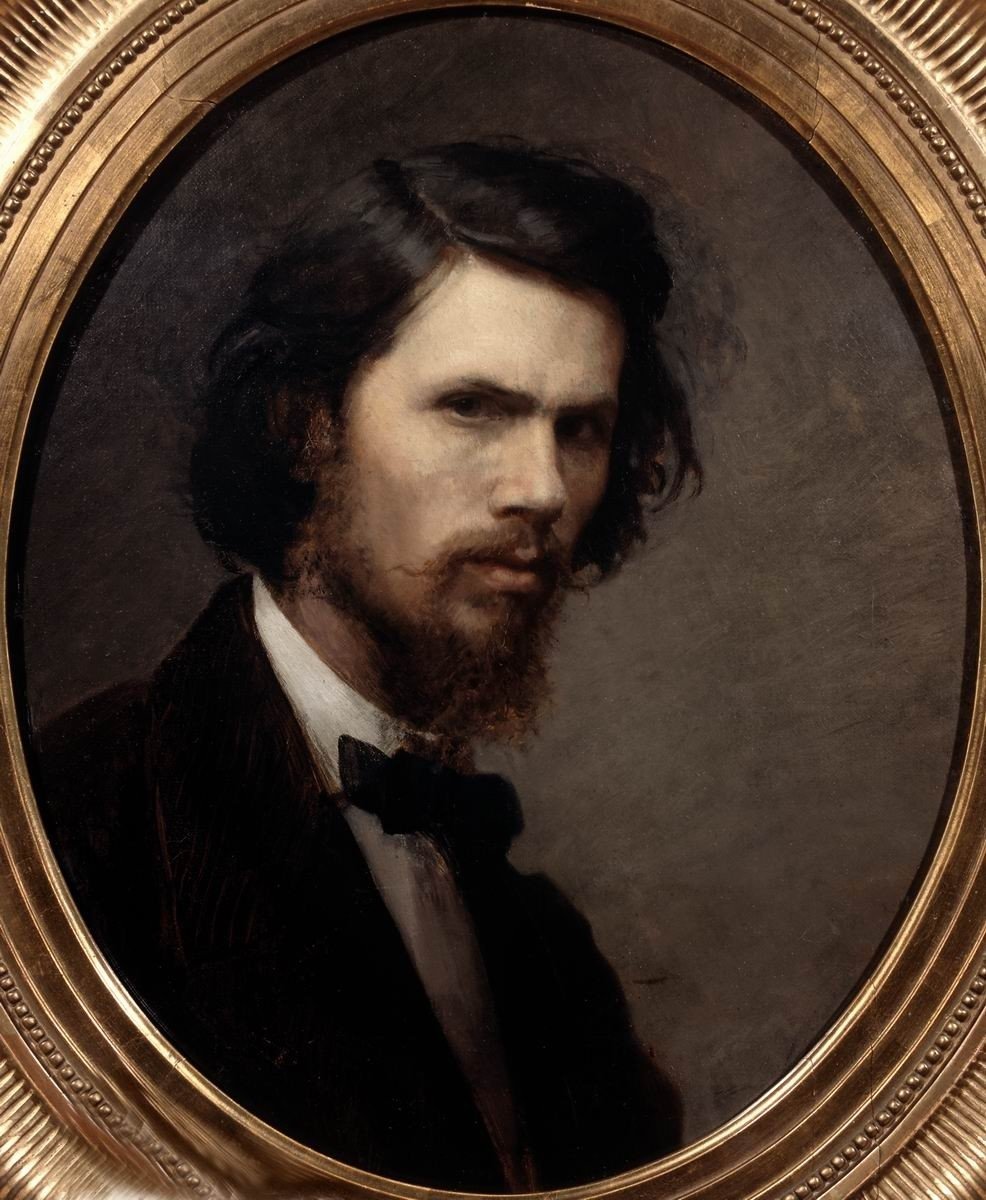
Ivan Kramskoi (1837-1887) was a Russian Realist painter and art critic, one of the most prominent artistic figures of Tsar Alexander II’s reign. He is remembered as a co-founding member and the public frontman of the Peredvizhniki, as comfortable writing criticism and organizing exhibitions as he was at the easel. His 1867 self-portrait, direct and unsentimental, reflects the same plain realism he championed in the group’s manifesto-like early exhibitions. Kramskoi gave the Peredvizhniki much of their public voice in the 1870s, arguing in print for an art rooted in Russian life rather than imported academic convention.
Ilya Repin: History, Portraiture, and the Weight of Russian Life
Ilya Repin (1844-1930) was born in Chuguev and began painting icons at sixteen. He failed his first attempt to enter the Imperial Academy of Arts in St. Petersburg, went anyway in 1863, audited courses, and won his first prizes in 1869 and 1871. After a tour along the Volga River in 1872, he presented drawings from the trip to the Academy, and Grand Duke Vladimir Alexandrovich commissioned the large-scale painting that would make his name, Barge Haulers on the Volga (1873).
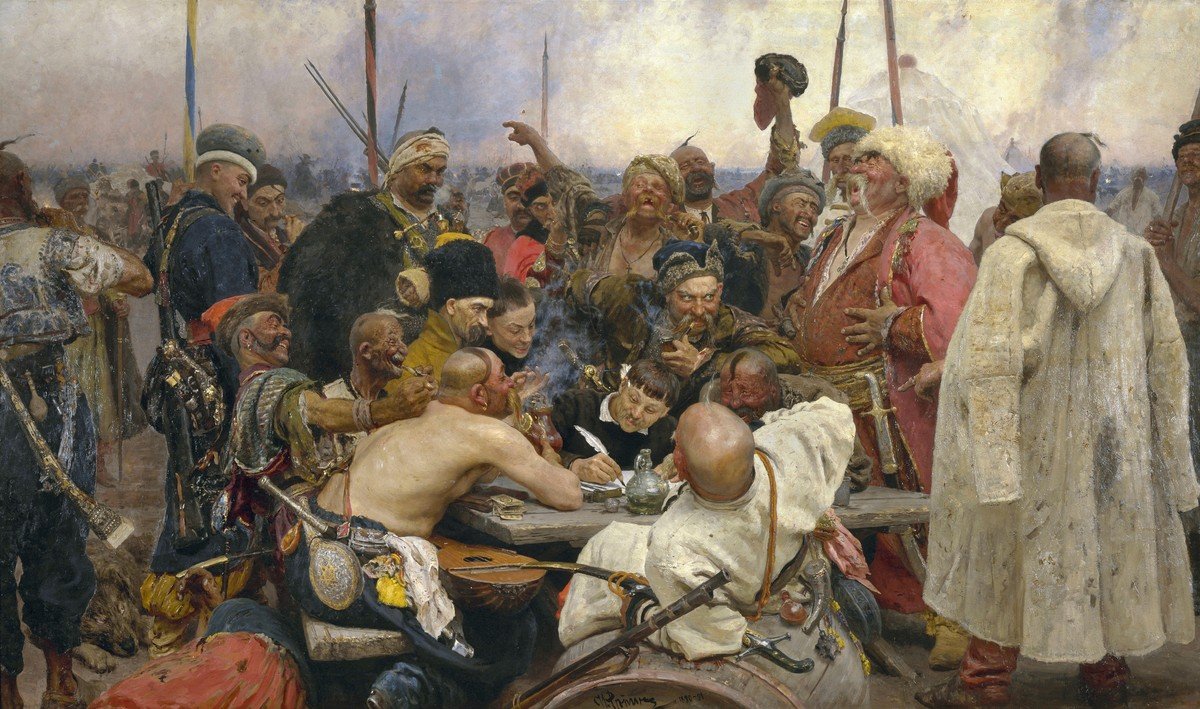
Repin’s major works span history painting and portraiture: Religious Procession in Kursk Province (1880-1883), Ivan the Terrible and His Son Ivan (1885), and Reply of the Zaporozhian Cossacks (1880-1891), alongside portraits of Mikhail Glinka, Modest Mussorgsky, Pavel Tretyakov, and, most enduringly, Leo Tolstoy, with whom he kept a long friendship. Reply of the Zaporozhian Cossacks shows Cossack warriors laughing as they draft an insolent reply to the Ottoman Sultan, a scene Repin researched for years, traveling to Ukraine to study period costume and weaponry before finishing it.
Vasily Surikov and the Drama of Russian History
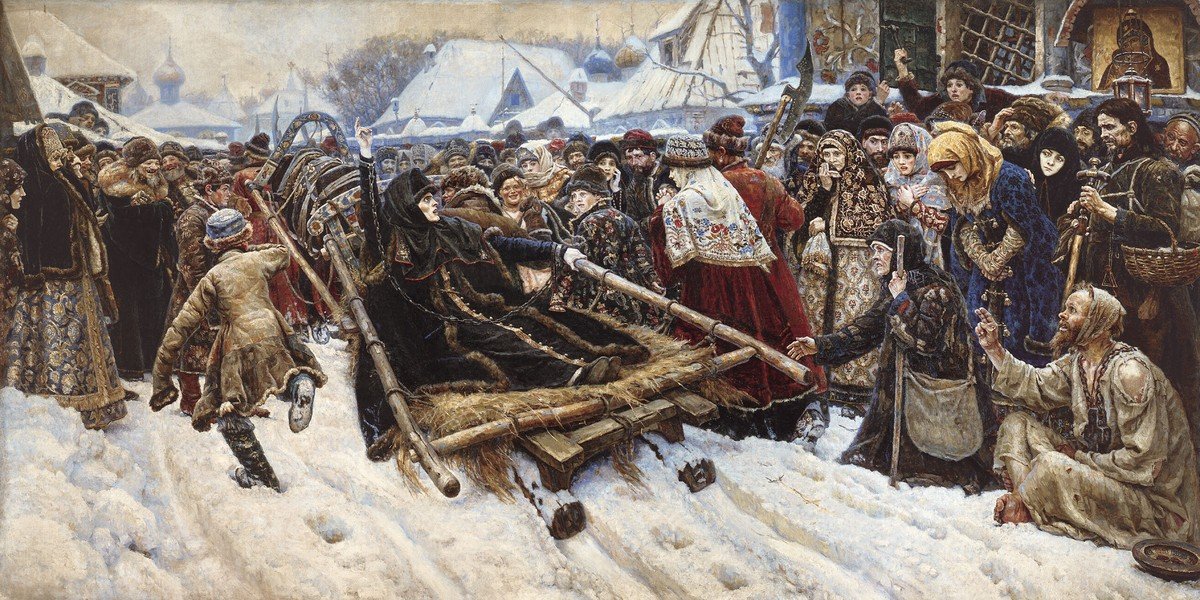
Vasily Surikov (1848-1916) worked in Moscow through the reigns of Alexander III and Nicholas II, and became known above all for large history paintings that treat crowds, not single heroes, as the main subject. Boyarynya Morozova (1887) depicts the noblewoman Feodosia Morozova, a 17th-century Old Believer, dragged through Moscow’s streets in chains, her raised hand still defiant. Surikov crowds the canvas with dozens of individually observed onlookers, turning a single act of religious persecution into a portrait of an entire society’s reaction: sympathetic, hostile, and indifferent by turns.
Isaac Levitan and the Mood Landscape
Isaac Levitan (1860-1900) was a Russian landscape painter credited with advancing what is often called the mood landscape, a way of painting the Russian countryside that carries emotional weight rather than simple topographic record.
What makes a landscape a ‘mood landscape’?
Earlier Russian landscape painting tended toward careful, almost documentary description of a scene. Levitan instead used light, color, and compositional emptiness to suggest a feeling, melancholy, stillness, or quiet abundance, attached to a specific place and season. Golden Autumn. Slobodka (1889) uses a low, saturated autumn palette and a wide, open composition to put the viewer inside a particular, fleeting moment of the year rather than a generic view of birches and a river.
Look Closer: Look closer at Repin’s portrait of Tretyakov
In Ilya Repin’s 1883 portrait, Tretyakov stands with his hands clasped loosely in front of him, in a plain dark coat, no medals, no ornate frame, against a nearly bare background.
Viktor Vasnetsov: Folklore, Fairy Tale, and the Gallery’s Own Face
Viktor Vasnetsov turned to Russian folklore and medieval history for subjects that most of his Peredvizhniki colleagues left alone, painting fairy-tale figures and legendary warriors at a scale usually reserved for history painting. Bogatyrs (1898) shows three legendary warriors on horseback at the edge of a forest, a subject drawn from oral epic rather than documented history, rendered with the same seriousness Surikov gave to real events. Vasnetsov’s feel for Russian folk and medieval ornament later shaped the gallery itself: he designed the building’s distinctive facade, completed after Tretyakov’s death, giving the museum a public face as recognizably Russian as the paintings inside it.
The 1892 Gift: When a Private Collection Became a National One
In 1892, Pavel Tretyakov formally presented his already-famous collection, by then around 2,000 works, more than 1,300 paintings, over 500 drawings, and several sculptures, to the Russian nation. He died six years later, on 16 December 1898, having spent more than four decades turning a personal buying habit into an institution built to outlast him. The gift fixed the collection’s identity for good: a museum built specifically around Russian art, at a moment when most comparable European and Russian collections still measured prestige by their old masters.
The Building Itself: A Fairy-Tale Facade on Lavrushinsky Lane
The building’s famous facade, designed by Viktor Vasnetsov in a style drawn from Russian fairy tales, was built in 1902-04, south of the Moscow Kremlin, after Tretyakov’s death. Over the 20th century the gallery expanded into several neighboring buildings, including the 17th-century Church of St. Nicholas in Tolmachi, absorbing historic architecture into the museum complex rather than demolishing it. The result is a museum whose exterior announces its subject before a visitor steps inside: this is a building about Russian art, built to look unmistakably Russian.
Notable Works in the Collection
Beyond the individually famous canvases already discussed, the gallery’s strength lies in depth. Ivan Shishkin’s Rye (1878) represents the Peredvizhniki landscape at its most plain-spoken, a field of grain under a wide sky, painted with the same attention to specific, observed detail that Tretyakov favored across the whole collection. Tretyakov bought such works directly from touring exhibitions, often as the first or only buyer, so many of the gallery’s signature paintings entered the collection within months of being shown publicly for the first time.
Historical Impact: Shaping What ‘Russian Art’ Means
Because Tretyakov bought almost exclusively contemporary Russian work, his collection effectively defined, for later historians and the Soviet institutions that inherited it, what counted as the national canon. The Peredvizhniki painters he favored became the default reference point for 19th-century Russian art, ahead of academic history painters working in more international styles. That emphasis still shapes how the period gets taught: survey courses on Russian art lean heavily on names Tretyakov collected while he was still alive to buy their work.
Legacy and Modern Relevance
The museum continues to draw large international audiences and remains central to any serious engagement with Russian painting. In 2020 attendance fell sharply from 2019 levels due to the COVID-19 pandemic. The collection now numbers well beyond the original 1892 gift, spanning medieval icons through 20th-century art across the main Lavrushinsky Lane building and its later additions, making it the first stop for anyone trying to see the full arc of Russian painting in one place.
Common Misconceptions About the Tretyakov Gallery
It is easy to assume the Peredvizhniki stayed permanent outsiders to the institutions they first rebelled against. In fact several, Repin among them, later taught at or received honors from the same Imperial Academy whose restrictions had pushed the group to organize independent touring exhibitions in the first place. Rebellion and institutional acceptance were not mutually exclusive over a long career.
It is also common to assume the gallery holds only 19th-century realist painting. The collection in fact spans far wider, including medieval icons and, in later additions to the complex, 20th-century Russian art, well beyond the Peredvizhniki core most visitors associate with the Tretyakov name.
Related Movements and Connections
Pavel Fedotov’s Encore, Again Encore! (1851) predates the Peredvizhniki by more than a decade, but its wry, closely observed scene of a bored officer and his dog already points toward the plain, unglamorous subject matter the Wanderers would later make their program. Fedotov is often read as an ancestor of Russian genre realism rather than a member of any formal group, working alone at a moment when the Academy’s grip on Russian painting was still largely unchallenged. The line runs from Fedotov’s quiet satire through the Peredvizhniki’s organized realism to the collection Tretyakov assembled, one continuous argument about what Russian painting should look at, an argument the gallery still makes simply by hanging these works in sequence.
Essential Points
- The gallery began in 1856 as Pavel Tretyakov’s private purchases of contemporary Russian painting, not a government project.
- In 1892 Tretyakov gave roughly 2,000 works, more than 1,300 paintings, over 500 drawings, and several sculptures, to the Russian nation.
- The Peredvizhniki formed in protest of Imperial Academy restrictions and organized as the Society for Travelling Art Exhibitions in 1870.
- Ilya Repin, Ivan Kramskoi, Vasily Surikov, and Isaac Levitan anchor the collection’s realist core.
- The famous fairy-tale facade was designed by painter Viktor Vasnetsov and added in 1902-04, years after Tretyakov’s death in 1898.
- The gallery later absorbed neighboring buildings, including the 17th-century Church of St. Nicholas in Tolmachi.
- In 2020 attendance fell sharply due to the pandemic; the museum remains a major destination for Russian art worldwide.
- Pavel Tretyakov’s brother Sergei was also a major collector and philanthropist, though his taste ran more toward Western European art.
Frequently Asked Questions
- What is the Tretyakov Gallery known for?
- It is a leading museum of Russian fine art, built in Moscow around the private collection of merchant Pavel Tretyakov. It specializes in Russian painters rather than foreign old masters, with particular depth in 19th-century realism and the Peredvizhniki movement.
- Why did Pavel Tretyakov start collecting Russian art?
- Starting in 1856, Tretyakov deliberately bought contemporary Russian paintings, not Western old masters, aiming from early on to build a collection that could grow into a public museum of national art. That collection, about 2,000 works in total, passed to the Russian state in 1892.
- What makes Isaac Levitan’s landscapes different from earlier Russian painting?
- Levitan is credited with advancing the mood landscape, using light, color, and open composition to convey feeling rather than simply documenting a view. Golden Autumn. Slobodka (1889) captures a specific, fleeting seasonal moment rather than a generic countryside scene.
- What role did Ivan Kramskoi play beyond painting?
- Kramskoi was a co-founding member and the public frontman of the Peredvizhniki, writing art criticism and arguing in print for Russian Realism alongside his own portraits and self-portraits, including his well-known 1867 self-portrait.
- Can you still visit the Tretyakov Gallery today?
- Yes. The main building on Lavrushinsky Lane in Moscow, with its Vasnetsov-designed facade, remains open to the public and expanded over the 20th century to include neighboring buildings. Attendance dropped sharply in 2020 due to the pandemic, though the gallery remains a major destination for Russian and international visitors.
The rus-art.com editorial team covers Russian art history, artists, movements, and museum collections.